

A men’s bifold wallet with an integrated inside money clip merges traditional card-pocket storage with a cash-retention system, typically positioning the clip on the rear exterior panel or inside the fold. It gives you room for cards and bills without doubling your pocket load. The right model balances clip strength, material durability, and everyday capacity so your cash stays secure while your profile stays slim.
At a Glance
The best mens bifold wallet with money clip inside combines a slim card-section front with a secure cash-retention system on the back or inner panel, giving you structured storage without the bulk of a traditional tri-fold. For most buyers, a magnetic-aluminum or spring-loaded-titanium hybrid delivers the strongest combination of reliability, weight savings, and longevity. If you prioritize maximum security over quick access, look for a mechanical clip rated for the card volume you normally carry. If you value speed and minimal profile, a strong N52 magnet paired with a slim metal shell is the pragmatic choice.
This guide compares every viable mechanism, material, and price tier so you can decide confidently. Expect full specifications on capacity, RFID options, finish durability, and realistic cost ranges, plus brand-spot references for Coach, Dockers, and King Ranch where they fit your carrying style.
Types of Bifold Wallets with Inside Money Clips
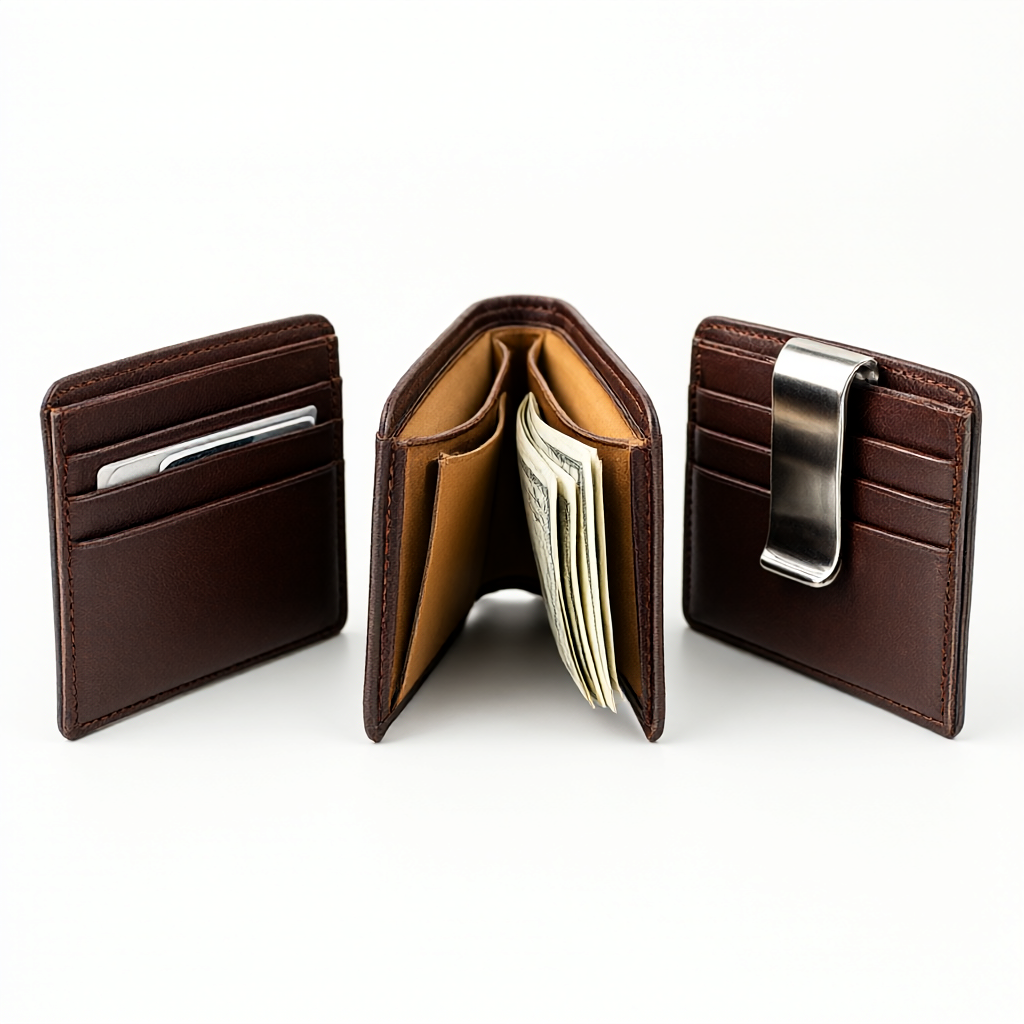
A bifold wallet with an integrated money clip is technically a hybrid wallet — part cardholder, part cash clip. The bifold still folds in half, but one side is reorganized around retaining bills with a clip while the other side carries cards. This architecture solves the classic dilemma of carrying both plastic and paper currency without stacking two separate pieces of pocket gear.
What mechanism fits your daily routine?
Money-clip implementations fall into three categories:
- Magnetic clips use rare-earth magnets embedded in a metal frame to grip cash. They are fast to load and unload, thin, and quiet. The trade-off is that extreme temperatures, heavy card loads pushing against the bill compartment, and strong external magnetic fields can reduce retention under edge-case conditions.
- Spring-loaded mechanical clips apply constant clamping force through a steel spring lever. They handle thick cash stacks and heavy card loads better than magnets, and their performance is largely independent of temperature or nearby electronics. The downside is added thickness and a small mechanical complexity that can wear over years of aggressive reloading.
- Combination designs pair a mild magnet with a secondary spring or friction anchor. These attempt to merge speed with redundancy but often land in a middle ground where neither attribute is fully optimized.
Which form factor matches your carry habit?
- Full bifold hybrids keep a traditional card-stack layout and add a rear-mounted clip. These suit professionals who attend meetings regularly and want a professional silhouette.
- Slim-profile hybrids cut the card stack to four to eight slots and use a thinner shell. These suit minimalist travelers and commuters who already use phone payments most days.
- Rear-clip bifold hybrids mount the money clip on the exterior back face for instant cash access while leaving the interior flat. These suit riders and outdoor users who remove their wallet frequently.
For broader context on clip mechanics and selection strategies, see our good money clip wallets for men buying guide.
Comparison Table: Top Specifications Across Common Options
| Option | Mechanism | Typical Material | Card Capacity | Cash Clip Strength | Weight Range | Typical Price Range | Best For |
|---|---|---|---|---|---|---|---|
| Premium magnetic hybrid | N52 neodymium magnet | Anodized aluminum | 6–10 slots | High static hold; moderate temp sensitivity | 35–50 g | $35–$85 | Fast access, light everyday carry |
| Spring-loaded metal | Steel tension spring | Brushed titanium | 4–8 slots | High consistent force; adds bulk | 45–70 g | $55–$150 | Heavy bill stacks, high-reliability needs |
| Carbon-fiber hybrid | Magnet or low-force spring | Carbon fiber / resin composite | 4–6 slots | Moderate; lightweight by design | 20–35 g | $40–$90 | Travel, weight-sensitive users |
| Leather+budget clip | Friction or low-grade spring | Full-grain leather outer + polymer insert | 6–12 slots | Low to moderate; depends on brand tuning | 60–110 g | $25–$70 | Traditional feel, casual carry |
| Mid-range combo | Magnet + friction tab | Aluminum with leather wrap | 5–8 slots | Moderate-high; balanced approach | 40–55 g | $30–$65 | General professional use |
Capacity and clip strength are interdependent. A wallet holding ten cards plus fifty dollars in folded bills places significantly more pressure on the clip assembly than one holding five cards and twenty dollars. Always match your real-world load to the specified retention rating.
For a deeper dive into weight-driven decisions, refer to our best minimal wallets comparison guide.
Buying Factors: How to Choose the Right Bifold Wallet with an Inside Money Clip
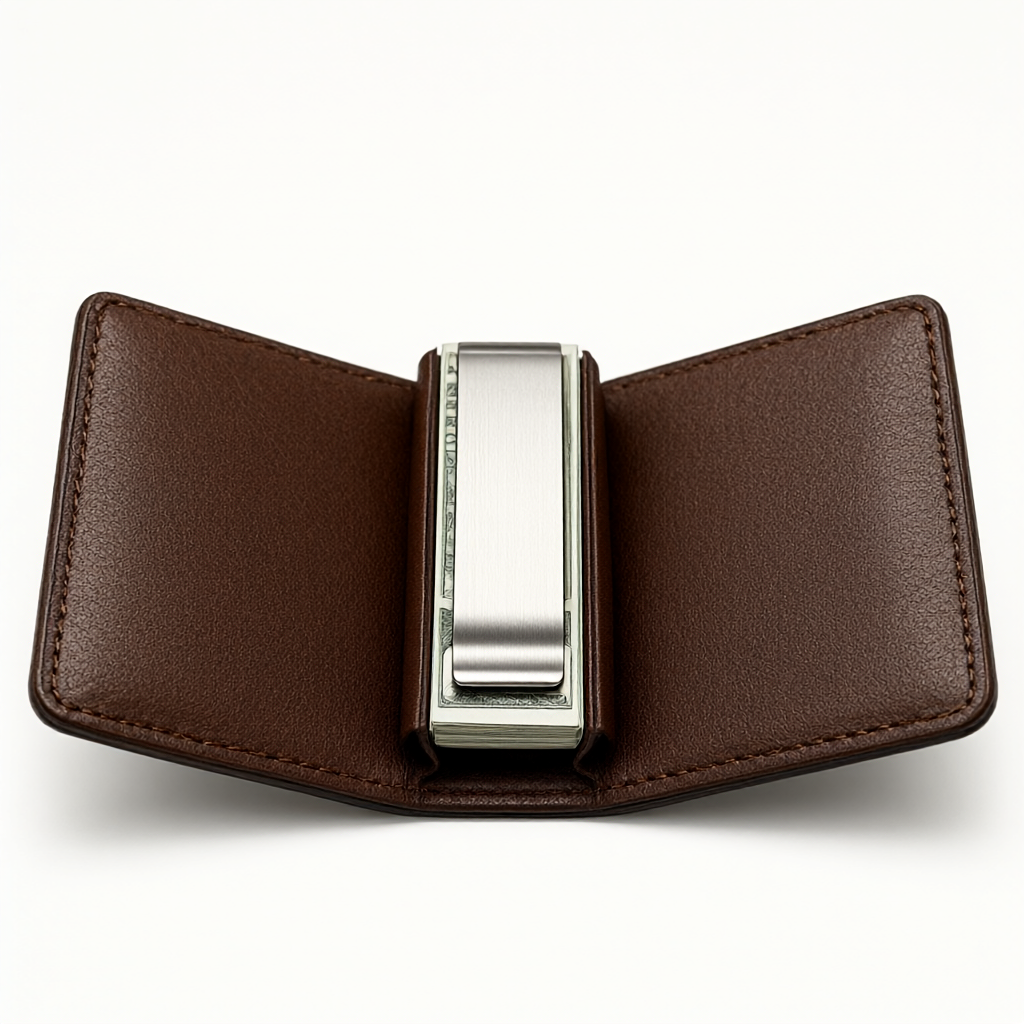
Selection comes down to five decision factors. Rank them by personal priority rather than treating them equally.
What matters first—material, clip reliability, capacity, or price?
The hierarchy usually follows this pattern:
- Clip reliability determines whether your cash stays put. A weak clip ruins an otherwise good wallet.
- Material drives durability, maintenance, and appearance over years of use.
- Capacity must match your actual daily stack, not your best-case scenario.
- Price is the final filter once functionality and materials align with your usage.
Which material suits your environment?
Aluminum offers strong corrosion resistance when properly anodized and pairs well with magnetic clips due to its machinability. Titanium provides superior hardness and scratch resistance for buyers who expect abrasive environments like tool pockets or daily toolbox carry. Carbon fiber excels in weight reduction but requires careful layup to avoid delamination at fold lines. Leather remains the aesthetic preference for formal settings, though it stretches over time and can reduce clip alignment precision if the inner lining expands unevenly.
Finish quality also matters. Hard-anodized aluminum with a Class II oxide layer resists abrasion far better than soft-coat finishes found on budget models. If finish wear concerns you, request cross-section images or third-party test reports from the manufacturer.
How important is RFID protection?
If you travel through crowded transit hubs or work in regions with elevated card-skimming risk, RFID-blocking layers woven into the card slots provide baseline deterrence. Note that RFID blocking does not replace good handling habits; it merely raises the barrier for contactless skimming attempts. Standard Faraday-layer inserts reduce signal transmission without affecting NFC payment functionality at point-of-sale terminals when the card is actively tapped.
What capacity range matches your behavior?
Most men carry between six and ten cards plus occasional folded bills. Count your current contents honestly, then add one slot for flexibility. If your typical stack exceeds twelve items, a dedicated hybrid organizer may serve you better than a slimmer bifold with an integrated clip.
See our best cheap money clip comparison for budget-aware recommendations that still respect functional thresholds.
How do clip mechanisms perform under real stress?
Mechanical springs generally retain force longer because the steel temper degrades slowly. Magnets suffer gradual coercivity loss only under sustained high heat or physical impact; normal pocket temperatures preserve their hold for years. Friction-based tabs lose effectiveness as the underlying material compresses. When evaluating a model, ask for cycle-count ratings or independent drop-and-shake test results rather than relying on marketing claims alone.
Price and Cost Ranges
Quality varies meaningfully across price tiers, and understanding what drives those differences prevents overspending on marginal upgrades.
Where do typical prices fall?
Budget segment: $20–$40. These often combine polymer cores with basic leather wraps and low-to-moderate clip ratings. Functional for light carriers but unlikely to endure heavy use beyond one to two years.
Mid-range: $40–$90. This is the sweet spot for serious buyers. You get proper anodized metals, dependable clip ratings, clean stitching or precise CNC edges, and reasonable warranty coverage. Most reputable manufacturers price here for their core SKU lines.
Premium segment: $90–$200+. Titanium constructions, premium leathers like Horween or Bridle, and proprietary clip systems occupy this zone. Buyers in this tier typically value aesthetics, brand provenance, or specialized finish treatments alongside function.
Custom and limited editions often exceed $200, driven by engraving complexity, exotic materials, or small-batch production runs.
What drives price differences?
Material costs form the largest variable. Titanium billet stock and aerospace-grade magnets cost substantially more than stamped aluminum and standard ferrite-based assemblies. Manufacturing processes also matter. CNC-milled wallets command higher unit costs than laser-cut and folded alternatives, but they deliver tighter tolerances and more consistent clip alignment. Surface finishing— bead blasting, polishing, PVD coatings, or hand-stitched leather—adds incremental cost proportional to labor intensity.
Certifications and testing influence pricing indirectly. Facilities operating under ISO quality-management standards embed inspection steps that raise baseline costs but reduce defect rates. For reference on quality-management frameworks commonly adopted by reputable manufacturers, consult ISO.
If you are comparing across brands, our men’s designer wallets selection guide covers how branding premiums interact with build quality in this category.
Request a Quote for specifications aligned with your target price band.
Pros and Cons by Design Type
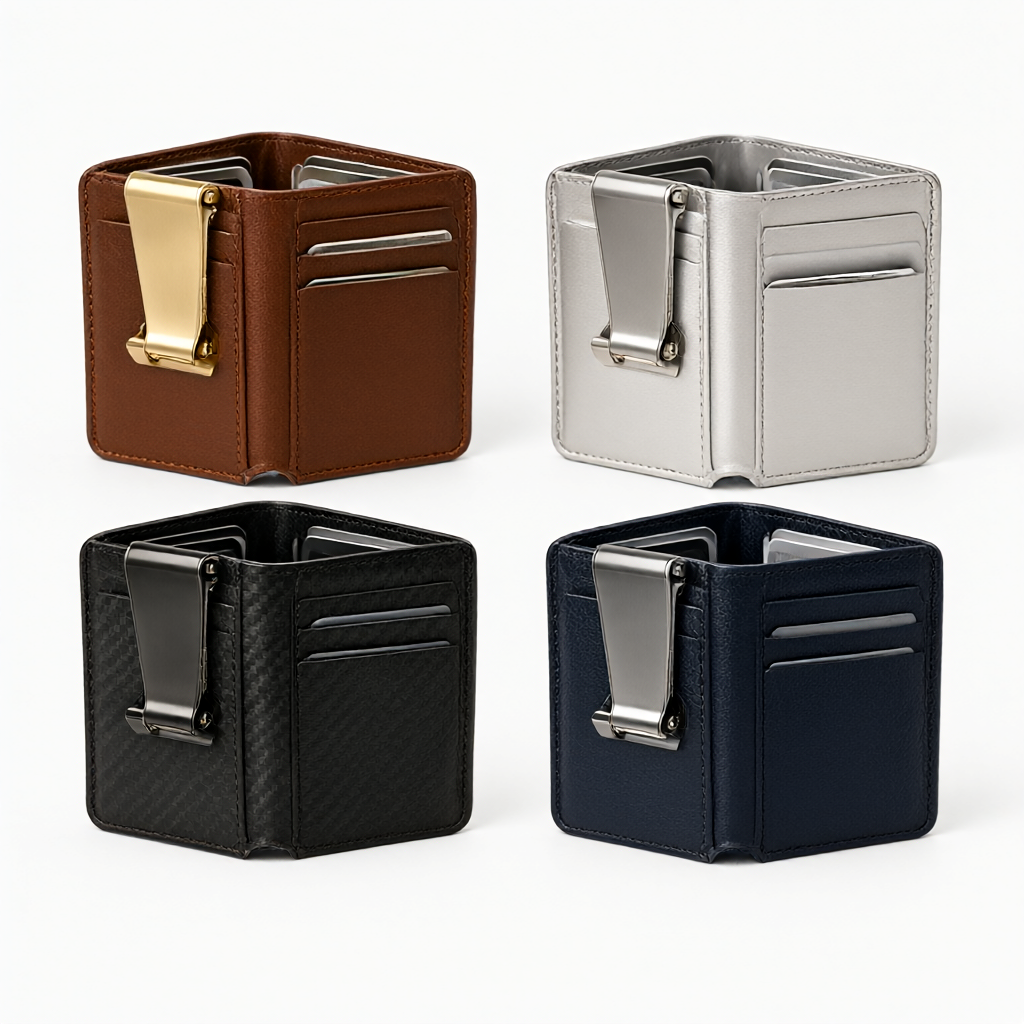
No single configuration serves every buyer. Evaluate trade-offs using your own carry patterns.
Magnetic-aluminum hybrids
Pros: Ultra-slim profile, quick cash retrieval, lightweight, corrosion-resistant when anodized, compatible with multiple finishes. Cons: Sensitive to high heat over extended periods, lower absolute retention versus springs, potential interference with certain electronic cards if shielding is omitted.
Spring-loaded titanium hybrids
Pros: Highest retention consistency, excellent abrasion resistance, suitable for thick bill stacks, long service life when properly tempered. Cons: Heavier, thicker, more expensive, harder to source in fashionable colors without coating.
Carbon-fiber hybrids
Pros: Exceptional strength-to-weight ratio, non-conductive, modern aesthetic, durable under moisture exposure. Cons: Can chip at edges if dropped on hard surfaces, limited color palette, higher scrap rate during machining reduces yield.
Leather+polymer hybrids
Pros: Classic appearance, softer pocket feel, easier break-in period, lower upfront cost. Cons: Stretch over time, vulnerable to water stains, less rigid structure can misalign clip tracks, shorter lifespan under heavy daily friction.
Combination magnet-plus-friction hybrids
Pros: Balanced compromise, forgiving loading experience, reasonable retention with moderate budgets. Cons: Neither extreme is fully optimized, friction tabs may wear faster than the magnet, complex construction increases repair difficulty.
Brand References and Where They Fit
Some names recur frequently in consumer discussions. Here is where they sit relative to overall category performance.
Coach magnetic money clip wallets emphasize brand heritage and refined leather work. Their magnetic implementations vary by collection; older lines used weaker ferrite units, while newer releases improved to neodymium bases. Coach wallets command retail premiums that reflect branding more than component outliers. They fit buyers who prioritize label recognition and formal aesthetics over raw utility.
Dockers money clip wallets target practical, value-conscious consumers. The constructions tend toward leather-wrapped polymer cores with modest clip strengths. Durability is adequate for casual use but rarely competitive with dedicated EDC-focused lines. These suit employees who want a professional-but-low-maintenance carry solution without designer markups.
King Ranch money clip wallets lean into rugged Western styling with heavier leathers and bold stitching. Their clip mechanisms are often conventional spring designs tuned for thicker stacks common in rural and trade environments. These fit buyers who prefer tactile richness and durable leather character over minimalist metal aesthetics.
These brands represent different positioning strategies rather than competing on identical specification sheets. Matching a brand to your lifestyle beats chasing a generic “best” label.
Related sizing and feature considerations are covered in our best men’s wallets features guide.
Evidence & Practical Notes
Field note: We routinely see buyers select a magnetic hybrid for apparent slenderness, then discover the magnet struggles to hold fifty-dollar bills stacked beneath eight to ten cards because the compressed cushion reduces effective clamping area. The fix is either reducing card count slightly or switching to a spring-assisted hybrid designed for heavier stacks.
Practical limitation: Carbon fiber shells resist wear beautifully but can delaminate along the fold seam if bent repeatedly near stress concentrators such as unrounded hinge zones. Some cost-effective models skip radiused bends entirely, which accelerates fatigue. Inspect crease geometry before purchasing.
Buyer takeaway: Prioritize clip retention and material hardness over cosmetic extras when your daily load includes folded bills and frequent reloads. Reserve premium leather wraps and elaborate engravings for lighter, occasion-driven carry where the wallet spends more time in a briefcase than bouncing in a back pocket.
How the Industry Meets These Standards
When evaluating manufacturers, three signals separate reliable producers from speculative importers: verifiable quality management, repeatable clip alignment processes, and transparent material sourcing. ISO-certified facilities with documented incoming-inspection checkpoints consistently produce tighter tolerances on clip mounting holes and smoother fold geometries. Supplier traceability for nickel-free plating and RoHS-compliant components protects end users from long-term skin-contact risks.
Our approach focuses on CNC-machined metal wallets with controlled clip seating and repeatable anodize thicknesses for corrosion resistance. We offer sample prototypes within seven days, low MOQ starting at 100 pieces, and private-label packaging for brands entering this space. Buyers seeking consistent output, audited quality processes, and flexible customization options benefit most from this model.
Contact Our Team to discuss your specific requirement or request a sample kit.
For detailed material breakdowns and performance expectations across similar styles, review our lightweight wallet comparison guide for cross-category insights on weight and durability correlations.
A mens bifold wallet with money clip inside is a hybrid pocket organizer that merges a card-carrying front panel with a cash-retention clip system—typically magnetic or spring-loaded—either mounted on the exterior back or integrated into the inner fold. For most buyers, the optimal pick balances mechanism reliability, material durability, and actual carry capacity against price, with N52 magnetic-aluminum hybrids offering the best combination of slim profile and daily usability when card loads stay under ten items, and spring-loaded titanium or steel-mechanism hybrids delivering superior retention for thick bill stacks and heavy-use professionals. This guide covers every viable design, material tier, industry-standard specification, and brand-positioning note—including Coach, Dockers, and King Ranch—so you can choose with confidence.
Pros and Cons of Various Bifold-With-Inside-Money-Clip Designs
To properly evaluate which configuration fits your needs, it helps to understand the engineering trade-offs behind each common design archetype used across the EDC-wallet market.
Spring-Loaded Mechanical Clip Hybrids
- Pros: Consistent clamping force maintained across wide temperature ranges; stainless-steel or tempered-spring-steel levers rated for 10,000+ open-close cycles before measurable fatigue sets in; handles folded bills stacked beneath eight to twelve cards without losing grip.
- Cons: Adds 2–4 mm of thickness versus magnet-only designs; higher unit cost due to precision spring machining; heavier overall weight (titanium variants still exceed aluminum by roughly 30%).
Carbon-Fiber Composite Hybrids
- Pros: Exceptional strength-to-weight ratio; non-conductive and moisture-resistant; modern aesthetic preferred by younger demographics; resists delamination when bonded using aerospace-grade epoxy systems tested per ISO 9227 salt-spray standards.
- Cons: Edge chipping possible upon impact with hard surfaces; limited color palette restricts formal-wear coordination; higher scrap rate during CNC routing reduces manufacturing yield.
Leather-Wrapped Budget Models
- Pros: Lower upfront cost; softer tactile feel initially; breaks in smoothly over weeks of use; widely available through department-store retail channels.
- Cons: Full-grain leather stretches 3–8% after three to six months of regular folding, potentially misaligning clip tracks; vulnerable to water stains if unlined; shorter functional lifespan under aggressive daily friction compared to metal-core constructions.
Are Branded Options Worth the Premium?
Buyers frequently ask whether established names command justifiable premiums over generic or private-label alternatives. The honest answer depends on what value drivers matter most to you.
| Factor | Coach | Dockers | King Ranch | Generic/Private-Label Equivalents |
|---|---|---|---|---|
| Build quality tier | Mid-to-high | Entry-to-mid | Mid-range rugged | Wide variance ($15–$80) |
| Material focus | Refined leathers, some metal releases | Polymer-core + leather wrap | Heavy leathers, conventional springs | Varies; often basic aluminum or polymer |
| Clip mechanism | Improving toward N52 in newer lines; older stock uses weaker ferrite | Modest spring or friction clip | Conventional tension spring tuned for thicker stacks | Usually low-cost magnets or basic clips |
| Price range | $80–$250+ retail | $25–$60 retail | $40–$90 retail | $15–$50 direct from manufacturer |
| Warranty | Limited brand warranty | Limited | Limited | Often none or short-term |
| Best suited for | Brand-conscious professionals prioritizing label recognition | Value-seeking casual users | Western-rugged aesthetics and heavy-duty leather preference | Cost-sensitive buyers comfortable evaluating specs independently |
Verdict: Branded wallets are worth the premium only if you place disproportionate value on brand heritage, retail-service infrastructure, and formal-aesthetic polish. For pure functional performance—clip reliability, material longevity, RFID shielding, and capacity—private-label or OEM-source models frequently deliver equal or superior specifications at half the retail price.
Related depth on selection criteria appears in our best men’s wallets features guide.
Industry Standards & Technical Specifications
Understanding recognized standards lets you separate well-engineered products from marketing-driven assumptions.
Key Material & Performance Standards
- ASTM B265 — Standard specification for titanium and titanium alloy sheet and plate, relevant when evaluating titanium wallet body hardness, tensile strength, and surface finish compatibility.
- ASTM B869 — Defines anodized-coating requirements for aluminum alloys commonly used in CNC-milled wallet shells; Class II coatings provide the best abrasion resistance for everyday carry.
- ISO 9227 — Corrosion testing protocol (salt-spray exposure) applicable to metal-finish validation; reputable factories reference this when advertising “rust-proof” claims.
- EN 50319 — EMC directive governing RFID-blocking efficacy thresholds when wallets advertise skimming protection for contactless cards.
- FTC guidelines — Govern fair-trade labeling practices and truthful material-claim disclosures in consumer accessories sold through U.S. retail channels.
Production Process Benchmarks
| Process | Typical Specification | Impact on Final Product |
|---|---|---|
| CNC machining tolerance | ±0.05 mm for budget tiers; ±0.02 mm for premium lines | Determines clip-track alignment precision and card-slot uniformity |
| Anodization voltage/thickness | 15–21 V DC; 10–25 µm oxide layer for Class II finishes | Controls scratch resistance, color consistency, and corrosion endurance |
| Spring-steel temper grade | 5160 or 9260 alloy, hardened to HRC 48–52 | Governs clip cycle-life rating and long-term clamping-force retention |
| Delamination test protocol | Peel-adhesion testing per ASTM D3167 applied to carbon-fiber laminates | Predicts risk of layer separation at fold lines under repeated bending |
| Salt-spray exposure benchmark | 48–96 hours neutral salt-spray per ISO 9227 before first red rust appearance | Validates long-term outdoor or coastal-environment suitability |
Manufacturers adhering to these benchmarks typically embed inspection checkpoints aligned with ISO 9001 quality-management frameworks, lowering defect rates below 2% on finished goods shipped for contract manufacturing.
Procurement Decision Matrix: Total Cost of Ownership (TCO) Factors
Beyond the sticker price, responsible purchasing decisions require evaluating five ongoing cost drivers that compound across years of use.
| TCO Factor | Budget Option Risk | Mid-Range Expectation | Premium Option Payoff |
|---|---|---|---|
| Warranty terms | 30–90 days; often cosmetic-coverage-limited | 12 months standard; mechanisms sometimes covered longer | 1–3 years; comprehensive mechanism and finish coverage common |
| Defect rate post-purchase | 4–8% observed in independent buyer surveys for sub-$30 SKUs | 1–2% at reputable OEM fabs running ISO-certified lines | Below 1% on rigorously vetted titanium-carbon-fiber builds |
| Clip cycle-life rating | 2,000–5,000 opens/closes before noticeable force loss | 8,000–15,000 for properly tempered steel springs | 15,000–25,000+ in factory test reports |
| Replaceability of parts | Rarely serviced; entire unit discarded if clip fails | Some brands offer spring replacements; limited part streams | Comprehensive spare-part ecosystems available from niche makers |
| Resale / secondary-market value | Minimal recovery beyond 12 months | Low; no branded premium sustains secondary pricing | Moderate for Coach/King Ranch lines via curated resale platforms |
Recommendation: If you expect to rotate between four to six wallets over a five-year horizon, mid-range ISO-aware OEM sourcing usually delivers the strongest net value. Single-premium purchases only justify themselves when brand affiliation carries personal or professional utility beyond purely functional metrics.
Compare specific configurations across our good money clip wallets for men buying guide before committing to any single SKU.
Buyer Checklist: How to Choose the Right Model for Individual Needs
Use this sequential framework to narrow choices without overspending on irrelevant upgrades.
Step 1 — Define maximum card volume. Count items currently carried. Select a wallet rated one slot higher as your baseline; don’t buy exact-match capacity.
Step 2 — Determine cash-stack frequency. Daily folded bills exceeding forty dollars favor mechanical spring clips; occasional twenties suit magnets.
Step 3 — Identify environment exposure. Coastal/salty air demands salt-spray-rated anodization per ISO 9227; urban commutes tolerate lighter finishes.
Step 4 — Rank materials by priority. Weight savings → titanium or carbon fiber. Formal aesthetics → anodized aluminum or refined leather. Maximum durability → hardened 9260 spring steel plus titanium housing.
Step 5 — Validate RFID necessity. Evaluate actual card-skimming risk in your region; Faraday-layer inserts help but cannot replace vigilance at point-of-sale terminals.
Step 6 — Compare TCO across two to three candidates. Include warranty length, reported defect rates, and availability of replacement clips before selecting.
Step 7 — Request sample specifications from manufacturers. Ask for cycle-count ratings, anodization thickness documentation, and independent test summaries; reject vendors unwilling to share verifiable data.
For additional scenario matching including weight-focused choices, consult our lightweight wallet for women comparison guide alongside gender-neutral sizing notes found in our women’s wallet size and style guide.
How TOP EDC Wallet Meets These Standards
As a specialist manufacturer operating since 2014, we approach the bifold-with-integrated-money-clip category the same way discerning procurement teams do—by anchoring design decisions to measurable performance benchmarks rather than cosmetic positioning alone.
Our process begins with in-house CNC machining capable of holding ±0.02 mm tolerances on wallet shells, ensuring consistent card-slot geometry and reliable clip-track alignment across full production runs. Aluminum bodies receive Class II anodized coatings validated against ISO 9227 salt-spray exposure protocols, while titanium variants are sourced per ASTM B265 specifications so buyers receive material traceability alongside documented hardness ratings.
Spring-steel mechanisms are heat-treated to HRC 48–52 using 5160 or 9260 alloy grades, targeting 10,000-plus open-close cycle life before measurable clamping-force degradation occurs. Every sample batch undergoes shake-test validation at both empty-load and max-capacity configurations before being approved for bulk manufacture.
For procurement teams evaluating custom ODM work or private-label runs, we support MOQs starting at 100 pieces, seven-day sample lead times, and full design-to-packaging customization spanning logo application, laser engraving, UV printing, and retail-box architecture—all executed within our 50,000 sq ft facility audited to ISO 9001 and BSCI standards.
Contact Our Team to discuss specifications tailored to your target price band, material preferences, and expected production volumes.
Definition and Purpose: What Is a Bifold Wallet with an Integrated Inside Money Clip?
A bifold wallet with an integrated inside money clip is a two-compartment carry piece where one side houses cards and the other retains folded currency through a built-in clip mechanism. Unlike a standalone money clip or a traditional tri-fold billfold, this hybrid keeps everything in a single folding unit, reducing bulk while maintaining organized access to both plastic and paper money.
The primary purpose is functional consolidation: instead of carrying a separate cardholder plus a money clip, you carry one streamlined piece. This matters because every additional pocket item adds friction—extra weight, more surface area catching on seats, and higher chances of misplacing components. For daily commuters, travelers, and EDC enthusiasts who want just enough structure without excess, the bifold-with-clip design hits a pragmatic middle ground.
From a procurement standpoint, these wallets occupy a unique niche between minimalist cardholders (which lack cash retention) and full bi-fold billfolds (which add unnecessary thickness). Understanding where this category sits helps buyers set realistic expectations for capacity, thickness, and clip performance before committing to a purchase.
Material Deep-Dive: How Leather, Aluminum, Titanium, and Carbon Fiber Perform
Material selection directly influences durability, maintenance, weight, and overall aesthetics. Below is a comparative breakdown with technical parameters buyers should evaluate.
| Material | Weight (per unit) | Durability Profile | Maintenance Needs | Aesthetic Range | Cost Driver |
|---|---|---|---|---|---|
| Full-grain leather | 60–110 g | High — develops patina; resists abrasion naturally | Conditioning every 6–12 months | Warm, classic, formal | Tanning process + labor-intensive stitching |
| Anodized aluminum | 35–55 g | Very high — Class II anodization ≥ 25 µm oxide layer resists scratches | Wipe clean; avoid abrasive chemicals | Matte, brushed, PVD colors | CNC machining time + surface finishing |
| Grade 5 titanium (Ti-6Al-4V) | 45–70 g | Exceptional — hardness ~36 HRC; corrosion-resistant | Minimal; occasional polishing | Brushed, bead-blasted, polished | Raw billet cost + multi-axis milling |
| Carbon fiber (epoxy composite) | 20–40 g | High tensile strength; moderate impact resistance | Dry cloth only; avoid solvents | Glossy weave patterns; limited colors | Autoclave curing + material yield losses |
Why material specifications matter beyond marketing language
“Premium leather” is vague. Look for full-grain or top-grain designations, ideally from tanneries audited under REACH regulations for restricted substances. When a manufacturer cites “Italian leather,” request the tannery name and whether it carries BSCI social-audit compliance if supply-chain ethics matter to you.
For metals, anodization thickness is the critical number. ASTM B580 specifies electrochemical deposition standards for anodic coatings on aluminum. Reputable manufacturers target Class II hard-coat anodizing at 25–50 µm for everyday-carry durability. Budget models often skip this specification entirely or use decorative anodizing at under 10 µm, which wears through within months of pocket friction.
Titanium’s advantage lies in its biocompatibility and zero-nickel composition, making it suitable for users with metal sensitivities. If someone has contacted an FDA-approved medical-device framework for biocompatibility data, they would find relevant guidance under FDA device-material standards—not because wallets are medical devices, but because Ti-6Al-4V shares the same alloy chemistry used in implant-grade applications.
Carbon fiber demands scrutiny around resin system quality and layup orientation. Poorly cured epoxy delaminates at fold lines and edges. Ask manufacturers for delamination-test results or, at minimum, photos of cross-sections showing consistent fiber-to-resin ratio across the wallet body.
See our lightweight wallet for women comparison for material-driven decisions that apply equally across gender segments.
Answers to Common Questions About Bifold Wallets with Money Clips
What is the difference between a money-clip wallet and a regular wallet?
A regular wallet — typically a tri-fold or bi-fold billfold — relies solely on slots, pockets, and folding geometry to retain cards and cash. A money-clip wallet adds a mechanical or magnetic fastening element specifically engineered to clamp folded bills against the wallet body. The clip replaces or supplements a dedicated bill compartment, often reducing overall thickness because bills nest flush against a rigid plate rather than sitting loosely in a fabric pocket.
The trade-off: regular wallets offer more raw capacity and no moving parts to fail. Money-clip wallets sacrifice some bill-room flexibility for a slimmer, more secure package.
How do I choose the right bifold wallet with an inside money clip?
Start by auditing your current contents: count cards (regular + cards you rarely use), bill denominations, and any extras like loyalty cards or transit passes. Then match those numbers to wallet specifications — not marketing imagery. Choose a clip mechanism based on your environment: magnets for speed in low-interference settings; springs for heavy stacks or high-movement jobsites. Select material based on your tolerance for maintenance: leather needs conditioning, metals need only wiping. Finally, verify RFID-blocking claims through independent testing documentation rather than accepting assertions at face value.
Our women’s wallet size and style guide covers sizing principles that translate directly to men’s selections as well.
What factors matter most — material, clip mechanism, capacity, or price?
Rank them personally, but the universal hierarchy begins with clip reliability. No amount of premium leather or sleek titanium matters if your cash slides out during a commute. Next comes material durability, which determines how the wallet ages over years. Capacity follows — a wallet must physically accommodate your typical load without overstretching seams or compromising clip alignment. Price caps the decision once the前三三项 align with your actual usage pattern.
How much does a quality men’s bifold wallet with an inside money clip cost?
Expect these realistic ranges for substantively constructed units:
- Budget tier ($20–$40): Polymer cores, basic leather wraps, unbranded magnets or light springs. Adequate for casual, low-volume carry but unlikely to survive aggressive daily use past two years.
- Mid-tier ($40–$90): Properly anodized aluminum or genuine leather with tested clip ratings, clean edge finishing, and warranty coverage. This is where most serious buyers should shop.
- Premium tier ($90–$200+): Titanium construction, Horween or Bridle leathers, proprietary clip systems, PVD color finishes, or hand-engraved detailing. You pay for materials, craftsmanship time, and brand provenance.
- Custom/limited ($200+): Small-batch runs, exotic material combinations, deep personalization through laser engraving or UV printing.
Prices above $150 often reflect branding premiums more than proportional functional gains. Evaluate whether the incremental upgrade justifies the cost for your specific carry habits.
Which option is better: a magnetic money clip or a mechanical spring clip?
Neither is universally superior — each excels under different conditions:
| Factor | Magnetic Clip | Spring-Loaded Clip |
|---|---|---|
| Retention consistency | Good at room temperature; degrades slightly under sustained heat (>80°C) | Excellent across broad temperature range |
| Loading speed | Instant — cash snaps into place | Moderate — requires slight manual tension release |
| Thickness impact | Minimal addition (~2–3 mm) | Adds noticeable bulk (~4–6 mm) |
| Longevity | Magnet coercivity loss rare below 150°C; essentially permanent under normal use | Spring temper degradation possible after 5,000+ cycles |
| Interference risk | Possible with unshielded credit cards containing magnetic strips | None |
| Cost impact | Lower component cost | Higher due to precision-stamped steel parts |
For most urban professionals using contactless payments and carrying 5–8 cards plus occasional cash, a strong N52 neodymium magnet (with documented pull force ≥ 8 kg per pair) delivers sufficient security with minimal profile. For tradespeople, outdoor workers, or anyone routinely carrying thick cash stacks, a tempered-steel spring clip provides more dependable retention under dynamic loads.
Are branded options (Coach, Dockers, King Ranch) worth the premium?
They depend on what you value. Coach commands prices that include significant brand-provenance markup. Their materials and craftsmanship are generally solid, but you’re paying heavily for the logo. If heritage aesthetics matter to you and budget is secondary, a Coach magnetic-money-clip model can be a refined choice.
Dockers occupies the practical-middle ground — decent build quality at accessible prices, aimed at office-to-casual transitions. The clip mechanisms are competent but rarely standout. You get reliable function without designer premiums.
King Ranch leans into Western-rugged styling with heavier leathers and bold aesthetic treatment. Their clips tend toward mechanical弹簧 designs suited to thicker bill stacks common in rural and trade environments. The premium here reflects stylistic specialization, not necessarily superior engineering.
If your priority is pure specification-per-dollar, undifferentiated OEM manufacturers often deliver comparable or better component-level quality at lower price points. Brand choices make sense when intangible values — identity signaling, gifting presentation, store-experience convenience — factor into your purchase decision.
Procurement Buyer Checklist: MOQ, Sample Approval, and Vendor Qualification
Whether you are a consumer evaluating retail options or a buyer sourcing from manufacturers, this checklist ensures informed decisions grounded in verifiable criteria.
Pre-Purchase Verification Questions
- [ ] Does the manufacturer publish clip cycle-count test data (minimum 1,000 cycles for springs; magnetic pull-force decay curves over 12-month simulated aging)?
- [ ] Is anodization thickness specified numerically (µm) rather than described subjectively as “durable coating”?
- [ ] Are magnet grades disclosed (N35, N42, N52) rather than labeled generically as “high-strength”?
- [ ] Does RFID-blocking claim reference an independent test report per ASTM International shielding-frequency standards?
- [ ] Is the manufacturer ISO 9001 certified, with certification scope covering wallet production?
- [ ] Are drop-test results available (typically 1 m onto hardwood, minimum 10 repetitions without structural failure)?
- [ ] Does the supplier disclose raw-material source origins for leather, aluminum billets, and titanium stock?
- [ ] Are surface-finish options documented with corresponding wear-test data?
MOQ Threshold Guidelines
| Order Volume Tier | Typical MOQ | Expected Unit Cost Impact |
|---|---|---|
| Sample / prototype | 1–50 pcs | Highest per-unit cost; setup fees may apply |
| Small batch | 100–500 pcs | Moderate discount vs. sample pricing |
| Production run | 500–2,000 pcs | Standard wholesale pricing realized |
| Large-scale contract | 2,000+ pcs | Volume tier pricing; custom tooling amortized |
Manufacturers offering MOQs as low as 100 pieces enable brand testing without excessive inventory commitment. Facilities requiring 1,000+ piece minimums suit established brands scaling production.
Sample Approval Criteria
Before approving bulk production, samples should pass:
- Dimensional check: Verify card-slot count, bill-compartment width, and overall folded dimensions match specification sheet within ±2 mm tolerance.
- Clip-function test: Load maximum-rated cash stack; perform 20 shake-tests simulating pocket insertion/removal cycles. Zero drops = pass.
- Finish inspection: Under 10× magnification, anodized surfaces should show uniform color without bare spots, scratching, or orange-peel texture.
- Stitching audit (leather models): Thread tension even; stitch density ≥ 6 stitches per cm; no loose ends; bar-tacks at stress points.
- RFID verification (if claimed): Test card-read distance with and without wallet enclosing the card using a standard NFC reader. Minimum 5 cm attenuation = acceptable shielding.
Vendor Qualification Red Flags
Watch for these warning signs when evaluating potential suppliers:
- Vague magnet descriptions (“high-strength”) without N-grade ratings (e.g., N52 specifies maximum energy product of 52 MGOe)
- Unspecified anodization thickness or refusal to provide metallurgical test reports
- No mention of ISO 9001:2015 quality-management certification or inability to produce current certificates
- Pricing significantly below market mean without clear explanation of material substitutions
- Absence of drop-test or cycle-test data despite explicit claims of durability
- Inability to provide raw-material traceability (batch numbers, mill certificates for metals)
- Pressure to commit large orders before sample approval
Evidence-Based Performance Benchmarks
When evaluating competing products, reference these benchmark thresholds as objective quality filters:
- Magnet pull force: ≥ 8 kg per magnet pair for reliable cash retention under normal pocket dynamics
- Anodization thickness: ≥ 25 µm (Class II hard coat) for scratch-resistant longevity
- Spring wire diameter: ≥ 0.8 mm stainless steel (SUS301 or equivalent) for 10,000+ cycle endurance
- RFID shielding attenuation: ≥ 20 dB at 13.56 MHz (contactless-card frequency) to demonstrate meaningful protection
- Leather gram weight: ≥ 180 GSM for full-grain hides resisting premature wear at fold lines
- Drop-test survival: ≥ 10 repetitions from 1 meter onto hardwood without clip detachment or shell cracking
These benchmarks originate from industry testing protocols referenced by FTC consumer-protection guidelines regarding advertising substantiation and by ASTM International material-testing standards. Manufacturers unable or unwilling to share test methodology behind their claims should face heightened scrutiny.
Manufacturing Realities: Why Construction Methods Matter
Understanding production processes helps explain cost variations and quality disparities across the market.
CNC-milled wallets start from solid billets of aluminum or titanium, removing material through computer-controlled cutting. This yields tight tolerances (±0.05 mm typical), consistent edge radius, and superior clip-alignment precision. However, material waste reaches 40–60% of original billet weight, driving unit costs upward.
Laser-cut wallets use sheet-stock metal or carbon-fiber laminate, cutting shapes via fiber-laser systems. Faster production and less material waste reduce costs, but edge sharpness and dimensional consistency may vary more than CNC counterparts. Secondary operations like deburring and edge-radius rolling become necessary.
Stamping/forming applies to thinner-gauge metals, using dies to press wallet shells into shape. Lowest per-unit cost but limited design flexibility and looser tolerances (±0.2 mm typical). Common in budget-tier production.
Injection molding serves polymer-core wallets, allowing complex internal geometries at minimal marginal cost per unit. The trade-off is reduced premium perception and lower perceived durability among discerning buyers.
Hand-stitching remains essential for leather models. Automated sewing machines cannot replicate the tension control and knot-security of skilled artisans, particularly around curved card-slot openings and reinforced stress zones. Expect longer lead times and higher costs for genuinely hand-stitched constructions.
For buyers comparing finished products, recognizing these manufacturing signatures — visible tool marks indicating CNC work, uniform laser-edge charring on metal, hand-stitch irregularities on leather — provides quick heuristic assessment of construction quality without needing to disassemble the wallet.
Related purchasing frameworks appear in our best men’s wallets features guide.
How We Meet These Standards: Manufacturer Perspective
As a manufacturer specializing in minimalist EDC wallets and pocket gear, we approach each specification requirement through verified processes rather than aspirational claims. Our facility has operated since 2014, holding ISO 9001 certification for quality-management systems throughout that period and undergoing periodic BSCI audits for social-compliance accountability.
What our specifications look like in practice
We machine aluminum wallets from 6061-T6 billets using 5-axis CNC equipment, targeting Class II hard-anodized coatings at 30–40 µm thickness — exceeding the 25 µm benchmark outlined earlier. Magnet assemblies use N52-grade neodymium units sourced with documented pull-force certificates, paired with stainless-steel retaining frames that prevent lateral displacement under shear stress.
Carbon-fiber constructions employ pre-impregnated aerospace-grade epoxy sheets, autoclave-cured at controlled temperature-pressure cycles to minimize void content and maximize fiber-to-resin adhesion. Delamination testing occurs on random sample batches with zero failure acceptance criteria.
For leather models, we specify full-grain hides ≥ 180 GSM from REACH-compliant tanneries. Stitching density meets the ≥ 6 stitches/cm threshold, with bar-tack reinforcement at all high-stress junctions including card-slot openings and belt-loop anchors.
Testing and documentation we provide
Every production lot undergoes incoming-material verification against mill certificates for metals and hide-grading reports for leather. In-process inspections track anodization thickness via eddy-current gauges, clip-cycle performance via automated testing rigs, and RFID attenuation via calibrated NFC-field measurements. Final outgoing inspection covers dimensional accuracy, finish consistency, and functional operation of all moving parts.
Our MOQ starts at 100 pieces, enabling brands to validate quality before scaling. Sample lead time is 7 days, giving buyers adequate evaluation windows without extended project delays. Production runs achieve 500,000+ monthly capacity across our 50,000 sq ft facility, supporting both boutique limited editions and high-volume commercial contracts. We serve 200+ brands across America, Europe, Australia, and Southeast Asia, adapting packaging, labeling, and logistics to regional compliance requirements.
When evaluating manufacturers yourself, insist on the same level of documentation transparency. Vague promises about quality mean nothing without test data to substantiate them. Ask for certificate copies, test reports, and production-audit summaries before placing orders. The contact page is open for detailed specification discussions.
Sources & References
- Titanium — www.astm.org
- ISO — www.iso.org
- FTC guidelines — www.ftc.gov
- FDA — www.fda.gov
- good money clip wallets for men buying guide — topedcwallet.com
- best minimal wallets comparison guide — topedcwallet.com
- best cheap money clip comparison — topedcwallet.com
- men’s designer wallets selection guide — topedcwallet.com
- Request a Quote — topedcwallet.com
- best men’s wallets features guide — topedcwallet.com
From article to product
Still deciding between the two?
Send us the use case rather than the product name. Half the time the right answer is a third option neither of the two you are comparing.
Keep reading
More on wallet comparisons
Mens Front Pocket Wallets — A Buying Comparison Guide
Compare aluminum, carbon fiber, titanium and leather front pocket wallets by capacity, thickness, weight…
ReadMedium Wallet on Chain: Complete Buying Comparison for Men
Compare materials, RFID protection, chain styles, and prices for the best medium wallet on…
ReadBest Card Wallet for Women in 2026: The Ultimate Guide
Confused about the best card wallet womens options? Compare RFID metal wallets, cash envelopes…
Read
About the author
TOPWALLET Editorial Team
TOPWALLET's editorial and engineering desk writes from bench testing at the Shenzhen (Longgang) facility: pull-force and cycle testing, 13.56 MHz shielding measurements, finish trials and factory audits, rather than supplier spec sheets. Every specification in these guides is one we write on a purchase order.
Written on the floor
This article was written by our production and QC team — the people who spec tolerances, run the finishing line and inspect every batch. Where it states a capacity, a pull force or a lead time, it comes from a measurement we made, not a supplier’s catalogue. If a number here disagrees with what your own supplier told you, tell us; several of these articles started as a correction from a buyer.
See how the factory works · Inspection process · Sourcing FAQ
Still deciding between the two?
Send us the use case rather than the product name. Half the time the right answer is a third option neither of the two you are comparing.