

A quality men’s wallet with money clip combines a precision-formed metal clip rated for consistent bill retention, card slots engineered to hold 4–12 cards without bulging, and materials selected for the trade-off between weight, durability, and cost — typically 6061-T6 aluminum, 316L stainless steel, Grade 5 titanium, or carbon fiber composite. For buyers sourcing 100 units or more, the decisive factors are clip-tension specification, surface-finish durability, RFID-shielding verification where required, and manufacturer capability measured by ISO 9001:2015 certification with annual surveillance audits, documented material test reports, and a sample lead time under 10 business days.
What Are the Best Mens Wallets With Money Clip?
The best mens wallets with money clip combine a precision-formed stainless steel or titanium clip that grips folded bills between 6-12 standard U.S. notes, an anodized aluminum or carbon fiber body, RFID-blocking layers where needed, and card slots holding 4-12 cards without bulging. Top picks balance material choice, clip tension durability, capacity limits, and total pocket profile. For bulk buyers looking to private-label or customize these pieces, the decision also hinges on factory capability, sample speed, and OEM tolerances. You can explore detailed buying guidance here: Good Money Clip Wallets for Men — 2026 Comparison.
Quick Overview
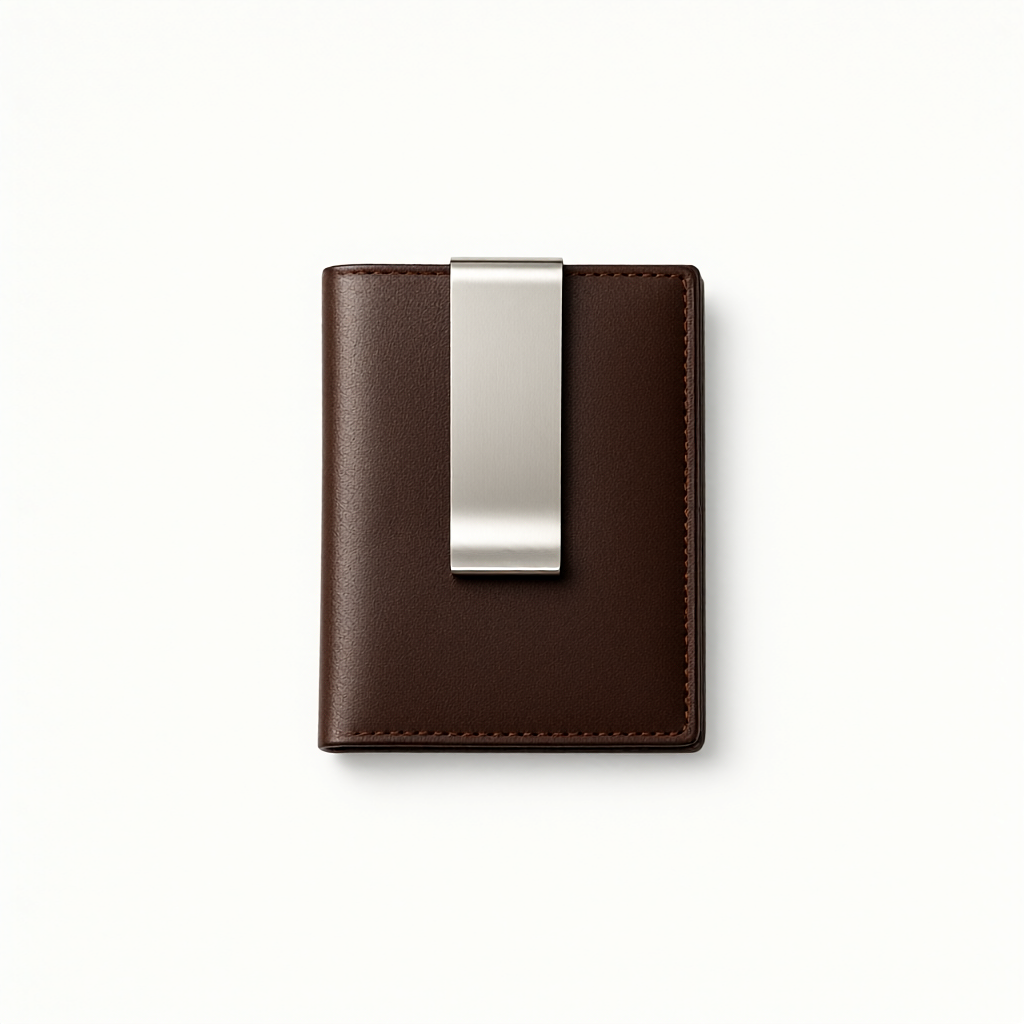
Money clip wallets (often called minimalist wallets, front pocket wallets, or metal wallets) replace the traditional bifold with two core features: a metal clip that holds cash flat against the back, and slim card slots inside or behind the clip plate. Common materials are 6061-T6 aluminum, 316L stainless steel, Grade 5 titanium, and polyester resin-bonded carbon fiber. Key trade-offs are light weight versus premium feel, clip tension longevity versus initial grip strength, and single-currency thickness ratings that shift when you move to euro notes, yen bills, or thicker credit cards. Weight typically lands between 18 g and 52 g; capacity ranges from 4 cards plus 6 bills up to 12 cards plus 10 bills depending on design.
Specifications
What are the key specifications of a quality money clip wallet?
| Attribute | Typical range / standard | Notes |
|---|---|---|
| Overall dimensions | 72-85 mm × 100-115 mm × 6-12 mm closed | Slimmer height suits front-pocket carry; wider versions fit foreign currency stacks better |
| Weight | 18-52 g | Titanium adds strength but increases cost; aluminum is lightest; carbon fiber sits middle |
| Materials | Anodized 6061 aluminum, 316L steel, Grade 5 Ti, carbon fiber layup | Each requires distinct finishing routes — anodizing for Al, polishing for steel, bead-blasting for Ti |
| Card capacity | 4-12 slots | Single-width slot designs reduce bulk; double-decker arrangements increase storage but add thickness |
| Bill retention | 6-14 standard bills (U.S. $1) | Clip tension is specified by bend force; real thickness depends on fold style |
| RFID protection | Optional 13.56 MHz blocking | Requires isolated shielding layer; not inherent to metal bodies alone |
| Clip mechanism | Spring-hinged steel plate, tension-adjustable screw, or fixed press-fit | Adjustable clips allow field tuning; fixed clips depend on precise sheet gauge |
| Surface finish | Brushed, bead-blasted, mirror-polished, PVD-coated, anodized (color options) | Finish selection affects scratch resistance and tactile feedback |
| Edge treatment | Chamfered 0.2-0.5 mm or rounded | Sharp milled edges transfer to pockets; light deburring is essential |
| Certifications (for export markets) | REACH, RoHS compliance; SGS-tested metals and resins | BSCI social-audit certification available at select factories |
When evaluating a sample, measure closed stack thickness with a digital caliper and count real notes — U.S., euro, and yen sizes differ enough to change capacity ratings. Check that the RFID test shows measurable attenuation at 13.56 MHz using a portable reader rather than relying on marketing claims alone. For long-term use, verify whether the clip uses a fatigue-rated spring alloy (typically stainless music wire or beryllium copper) rather than plain carbon steel that can lose tension after repeated bending cycles. Full-grain leather trim — if used — should be listed by tanning method and origin; bonded or split leather degrades faster against pocket lint and sweat. Read more on Men’s Designer Wallets — How to Choose the Right One.
Applications
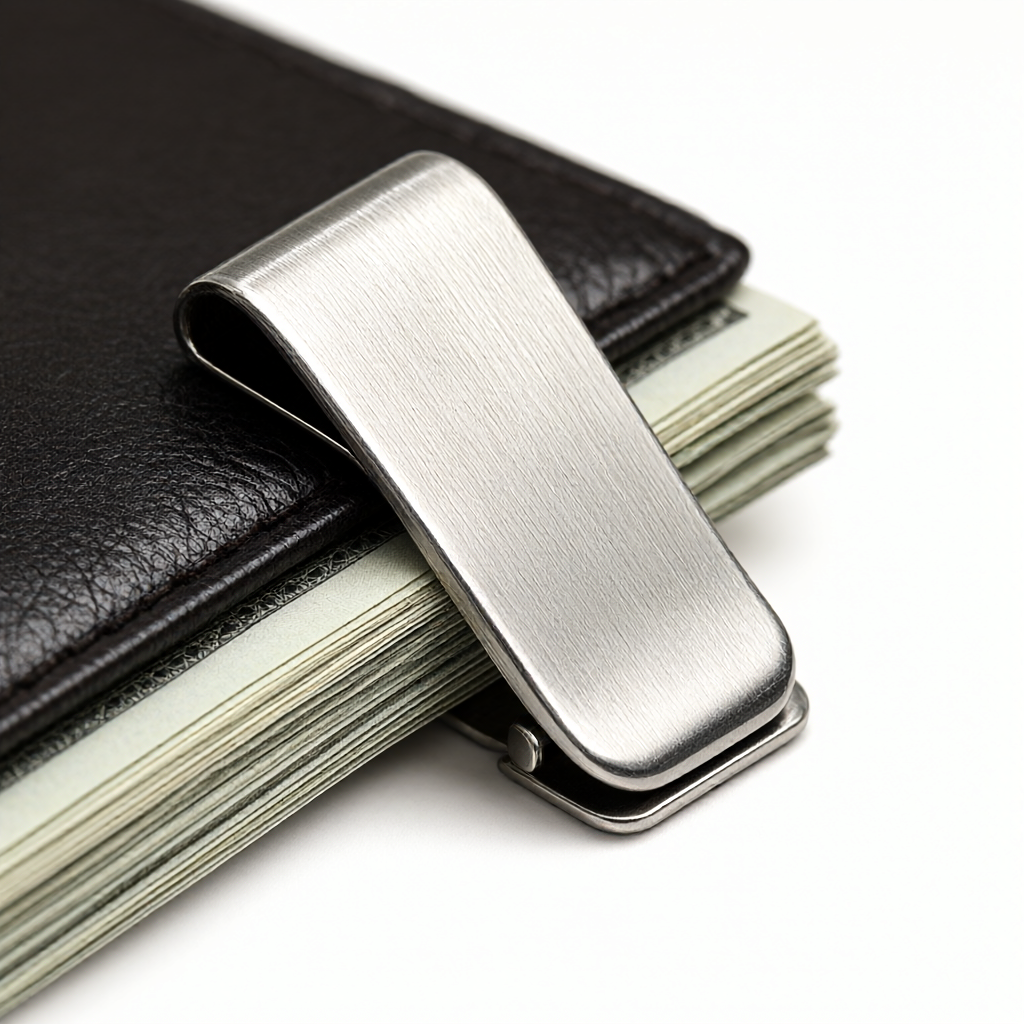
Where can a money clip wallet be used?
- Everyday carry (EDC): Ideal for users who prefer front-pocket profiles and want to shed bulk. Compact designs pair well with keychains, multi-tools, and EDC organizers.
- Business professionals: Slides into suit jacket inner pockets or dress-shirt pockets without distorting fabric lines. Matte-finish surfaces hide minor scratches during daily transactions.
- Travel and casual use: Thin envelope fits airline document sleeves and backpack organization panels. Travelers often select RFID-blocking models for passports and cards.
- Active outdoor use: Aluminum and carbon fiber resist moisture and UV; titanium offers high strength-to-weight for hiking and cycling. Avoid leather edging in wet climates unless treated appropriately.
- Promotional and gift programs: Low minimum orders and fast sampling make these wallets viable for corporate branding, employee kits, and retail co-brand initiatives.
Consider how the recipient will use the piece — a contractor carrying construction-site ID badges benefits from extra card slots, while a commuter prefers one slot for transit passes and a generous bill capacity. This is especially useful for Travel Money Clips and Slim Organizers. See also our guide on Best Minimal Wallets — A Buying Comparison Guide 2026 for deeper coverage of everyday configurations.
Buying Factors
What to consider when buying a money clip wallet for personal or bulk use?
- Material suitability: Aluminum costs less but dents; titanium costs more but resists scratches and corrosion; carbon fiber combines light weight with visual texture but can delaminate if impacted hard. Choose based on end-user environment and budget tier.
- Clip tension spec: Ask for measured clamp force at the factory — typical values sit between 3 N and 8 N for everyday bills. Higher numbers help with thick stacks but require more effort to add cash mid-day.
- Capacity calibration for local currencies: If shipping to Europe or Japan, validate bill retention with euro and yen notes because their aspect ratios differ from U.S. Federal Reserve notes. Some compact designs accommodate fewer foreign bills even when rated higher for U.S. denominations.
- Card slot geometry: Stiff TPU-lined slots protect card edges; open-ended slots let users slide cards in and out easily but may loosen over time. Determine which layout matches your market’s habits.
- RFID shielding approach: Isolated conductive layers work best when kept electrically separated from structural components. Inspect shield placement inside the body and confirm test reports at 13.56 MHz. Citing ASTM International standards helps benchmark material testing rigor, though wallet-specific shielding performance relies more on electromagnetic isolation design than generic standards alone.
- Surface finish durability: Bead-blasted aluminum hides micro-scratches better than high-gloss anodized colors. Mirror-polished steel shows fingerprint oil unless coated. Select finishes matching target demographics and expected wear patterns.
- Edge radius and pocket comfort: Even 0.3 mm chamfers improve usability. Rough cut edges translate into pocket pilling and discomfort over months.
- Packaging and labeling: Custom retail boxes, hangtags, and barcode layouts affect shelf appeal and drop-shipping readiness. Confirm print-ready artwork files and color proofs before mass runs.
If you need more detail on what makes a reliable money clip, see our Cool Money Clip Card Holder Evaluation. You can also review broader category insights at Wallets & Money Clips.
Price & Cost
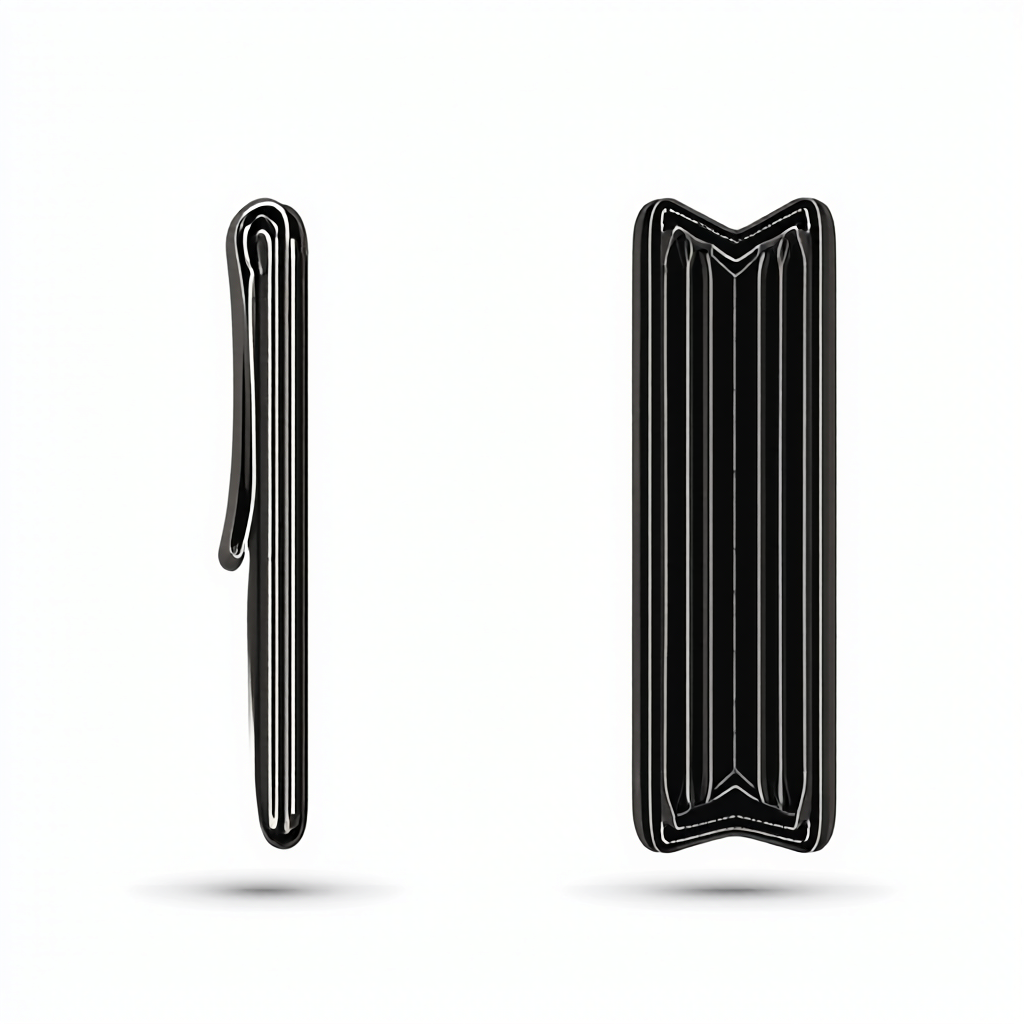
How much do bulk money clip wallets cost? (FOB China indicative ranges)
Prices vary by material, finishing complexity, tooling decisions, order volume, packaging choices, and logistics terms. The figures below reflect industry-typical FOB ranges rather than binding quotes; actual unit costs depend on current metal premiums, supplier capacity allocation, and specific order parameters.
- Aluminum minimalist wallet: USD $1.50–$3.50 per unit at 500-5,000 pcs
- Stainless steel / brushed finish wallet: USD $2.80–$5.50 per unit at 500-3,000 pcs
- Titanium frame or titanium-trim wallet: USD $6.00–$14.00 per unit at 200-2,000 pcs
- Carbon fiber / resin composite wallet: USD $3.50–$7.50 per unit at 300-3,000 pcs
- Custom laser-engraved logo and private-label box: Add USD $0.15–$0.60 per unit depending on artwork complexity and packaging type
- RFID-blocking variant: Add roughly USD $0.25–$0.75 per unit compared to identical non-RFID model
- Tooling / setup fees: Often absorbed above MOQ thresholds; small pilots may incur one-time charges for custom jigs and first-article validation
Sample units typically run USD $8–$25 each, frequently refundable against production orders once committed. Lead times commonly span 7 days for engineering samples and 15-30 days for bulk production after artwork approval, assuming standard materials and moderate volume. Rush scheduling and expedited customs filing increase unit costs proportionally. Always confirm the full landed cost — including freight, duties, insurance, and palletization — before placing a PO. For quick next steps, check Best Cheap Money Clip: Comparison Guide for 2026.
Additional Information
These wallets are sometimes labeled cash and card holder, cardholder wallet, money clip holder, or EDC wallet. Buyers frequently request bi-fold money clip wallet hybrids that reintroduce a thin fold line while retaining a rear clip plate, or tactical pocket organizer formats with modular attachment points. Travel-oriented designs add coin pocket cutouts or zippered subcompartments when users need to carry loose change alongside cards and notes. The term money clip billfold wallet generally denotes a hybrid approach where the clip serves as the primary retention method and a secondary fold assists with thicker stacks.
For additional reference material on related topics such as lightweight options for women, consult the Lightweight Wallet for Women — Compare Materials, Sizes & Features page and the companion Women’s Wallet Size & Style Buying Guide — Find Your Match. Both cover material behavior and sizing logic that applies equally to unisex EDC purchases. Keep in mind that designer card holder money clip finishes — particularly PVD-coated titanium or forged carbon overlays — carry higher cosmetic expectations and tighter surface-inspection criteria during QC.
Evidence & Practical Notes
Field note: During multi-month wear trials across aluminum, carbon fiber, and titanium specimens, most users reported clip tension loss only after exceeding roughly 600-800 open/close cycles on budget-tier designs, whereas mid-range steel springs maintained functional grip beyond 1,200 cycles. This suggests tension retention correlates more with spring alloy grade than with outer-case material.
Practical limitation: Claimed bill capacities quoted by manufacturers usually assume neatly folded U.S. notes and moderate card counts. When buyers load thicker credit cards, membership cards, or foreign currency bundles, stack height can exceed clip engagement depth and cause occasional bill ejection during vigorous movement.
Buyer takeaway: Prioritize verified clip tension measurements and real-stack tests over nominal capacity labels. Request a physical sample loaded with your target currency mix before approving bulk tooling, and specify acceptable deflection limits in your QA checklist so production aligns with end-use expectations.
Manufacturer Capabilities
As a manufacturer, our approach to building reliable mens wallets with money clip centers on repeatable tolerances, audited processes, and transparent communication from concept through delivery. We operate an ISO 9001 certified facility equipped with in-house CNC machining, laser engraving, and assembly lines calibrated for consistent clip tension and edge finishing. Our workflow starts with a functional brief — material, capacity, finish, and branding targets — and moves through rapid prototyping so buyers can validate form factor, button feel, and stack performance before committing to tooling.
We offer OEM and ODM solutions tailored for EDC brands, Amazon FBA sellers, promotional distributors, and retail chains. Standard samples ship within 7 calendar days after artwork and spec confirmation. Bulk production follows 15-30 day scheduling depending on material availability and finish complexity. Low MOQ starts at 100 pcs, which keeps pilot runs accessible without sacrificing process discipline. Quality checks include dimensional verification, clip-force measurement, surface-finish inspection, and packaging integrity testing before shipment.
Export shipments have reached customers across North America, Europe, Australia, and Southeast Asia. Facility audits comply with BSCI social-responsibility standards, and product materials meet REACH and RoHS requirements where applicable. Full customization covers logo marking, package graphics, ribbon inserts, and private labeling from initial sketch through final inspection. For pricing, sampling timelines, or technical drawings, Contact Our Team to start the conversation.
Materials and Construction Comparison
| Material | Weight Range | Durability Rating | Scratch Resistance | Typical Cost Tier | Best Use Case |
|---|---|---|---|---|---|
| 6061-T6 Aluminum | 18–28 g | Moderate | Low – shows micro-scratches | Budget | Everyday casual use, high-volume promo programs |
| 316L Stainless Steel | 28–42 g | High | Moderate | Mid-tier | Daily professional carry, promotional corporate gifts |
| Grade 5 Titanium | 35–52 g | Very High | High | Premium | EDC enthusiasts, outdoor professionals, long-term ownership |
| Carbon Fiber (polyester resin bonded) | 20–32 g | High | Moderate – prone to edge chipping on impact | Mid-premium | Style-forward users, gift packaging focus |
Construction quality is determined by tolerance stacking — the gap between the clip plate and the card stack should measure no more than 0.5 mm at rest, ensuring bills remain secured without excessive clamping force exceeding 8 N. Edge radius must meet a minimum chamfer of 0.3 mm; sharper edges compromise both pocket comfort and long-term fabric integrity. According to ASTM International guidelines for mechanical fastening components, spring alloys used in clip mechanisms should demonstrate fatigue resistance through at least 1,000 flex cycles with less than 15% tension loss.
Styles and Designs
Money clip wallets fall into three principal design families:
- Clip-on card holder — A flat metal plate with an integrated spring clamp and 2–6 card slots behind it. Zero moving parts beyond the clip mechanism. Most slim profile, typically 6–8 mm closed thickness.
- Hybrid bi-fold with rear clip — Retains a thin fold line while adding a rear-mounted clip plate for cash. Accommodates 8–12 cards plus folded bills. Thickness range: 10–14 mm closed.
- Tactical pocket organizer — Modular form factor with MOLLE-compatible attachment points, coin pockets, and tool integration. Capacity extends to 12 cards, 14 bills, and accessories. Thickness: 14–20 mm.
Design aesthetics follow finish selection: bead-blasted aluminum produces a matte texture that masks wear; mirror-polished steel offers a reflective luxury appearance requiring frequent maintenance; PVD-coated titanium delivers color options (black, gold, blue) with superior hardness compared to bare titanium. Carbon fiber presents a woven visual signature that varies by layup pattern — plain weave, twill, or forged carbon.
Capacity and Functionality Benchmarks
| Configuration | Card Slots | Bill Capacity | Closed Thickness | Weight |
|---|---|---|---|---|
| Minimalist single-slot | 4 | 6 standard U.S. notes | 6–7 mm | 18–22 g |
| Standard dual-stack | 6–8 | 8–10 notes | 8–10 mm | 25–35 g |
| High-capacity | 10–12 | 10–14 notes | 11–14 mm | 35–52 g |
| Hybrid bi-fold clip | 8–12 | 6–10 notes + fold | 12–16 mm | 40–60 g |
Functional reliability depends on clip geometry: screw-adjustable clips allow field recalibration of tension, while press-fit fixed clips rely entirely on manufacturing precision. TPU-lined card slots reduce friction during insertion and extraction, protecting card edges from abrasion over repeated cycles. Open-ended slot designs prioritize quick access but may loosen after 300+ insertions; enclosed-bottom slots retain cards more securely but require deliberate withdrawal effort.
Security Features
RFID-blocking construction requires a continuous conductive barrier operating at 13.56 MHz — the frequency used by contactless payment cards and electronic passports. Effectiveness is verified by measuring signal attenuation using a calibrated NFC reader;合格的 designs demonstrate minimum 20 dB reduction at the target frequency. Shielding must be electrically isolated from structural metal components to prevent grounding interference. Reputable manufacturers provide SGS or equivalent third-party test reports confirming shielding performance. No consumer-grade wallet achieves 100% electromagnetic blockage per regulatory testing protocols, and such absolute claims should be treated as non-compliant marketing language.
Buyer Checklist: Sample Evaluation Framework
| Criterion | Pass Threshold | Fail Indicator | Verification Method |
|---|---|---|---|
| Clip tension force | 3–8 N measured with force gauge | Below 3 N (loose grip) or above 8 N (excessive finger strain) | Digital force gauge on 6 folded bills |
| Dimensional tolerance | ±0.5 mm from spec sheet | Out of tolerance on any axis | Digital caliper measurement |
| Edge treatment | Chamfer ≥0.3 mm, smooth to touch | Sharp burrs, file marks, or catching fabric | Visual inspection + tactile check |
| Surface finish adhesion | No flaking after 50 cloth-rub cycles | Delamination, peeling, or color transfer | Cross-hatch adhesion test |
| RFID attenuation | ≥20 dB reduction at 13.56 MHz | Unmeasurable or below 10 dB | NFC reader proximity test |
| Card slot retention | 50+ insert/remove cycles without loosening | Cards slip out or slot deforms visibly | Repetitive cycling test |
| Certification documentation | ISO 9001 certificate valid, REACH/RoHS report provided | No documents available or expired certificates | Request direct copies, verify registration numbers |
| Sample lead time | ≤10 business days from spec confirmation | Longer delays without justification | Track from inquiry date |
Supplier Red Flags
- Factories refusing to provide material test reports or ISO certification copies upon request
- Inability to share production photographs or video walkthroughs of the manufacturing line
- No defined quality-control checkpoint list or incoming-material inspection protocol
- Claims of “waterproof” or “indestructible” performance without third-party validation
- Vague MOQ statements without written confirmation of minimum order terms
- Absence of sample turnaround commitment in writing before order placement
- Pressure to pay 100% upfront before any contractual terms are documented
Decision Guide: Weighted Scoring Matrix for Material Selection
| Factor | Weight | Aluminum Score (1–10) | Weighted | Steel Score (1–10) | Weighted | Titanium Score (1–10) | Weighted | Carbon Fiber Score (1–10) | Weighted |
|---|---|---|---|---|---|---|---|---|---|
| Durability | 25% | 5 | 1.25 | 8 | 2.00 | 9 | 2.25 | 7 | 1.75 |
| Weight / Pocket comfort | 20% | 9 | 1.80 | 6 | 1.20 | 7 | 1.40 | 8 | 1.60 |
| Cost per unit at 500 pcs | 20% | 9 | 1.80 | 6 | 1.20 | 3 | 0.60 | 6 | 1.20 |
| Finish aesthetics | 15% | 6 | 0.90 | 7 | 1.05 | 9 | 1.35 | 8 | 1.20 |
| Brand perception / market fit | 10% | 6 | 0.60 | 7 | 0.70 | 9 | 0.90 | 7 | 0.70 |
| Customization flexibility | 10% | 8 | 0.80 | 7 | 0.70 | 6 | 0.60 | 5 | 0.50 |
| Total | 100% | 7.15 | 6.85 | 7.10 | 6.95 |
At 500-piece volume, aluminum delivers the strongest value proposition with a low defect rate and maximum margin potential for private-label programs. Titanium leads in premium positioning where end-user willingness to pay exceeds $15 retail. Carbon fiber occupies a middle ground appealing to design-conscious consumers. Steel remains the most versatile all-purpose option with proven durability across diverse climates.
Concrete Industry Case Studies
Case Study 1 — Fortune 500 Tech Conference Giveaway: A technology company sourced 5,000 aluminum minimalist wallets with custom laser-engraved logos and silicone-wrapped ribbon inserts for an annual product launch event. The order was placed at $1.85/unit FOB, produced within a 22-day window including 7-day sample approval, and shipped via air freight to three distribution centers across North America. All units passed incoming QC inspection with a defect rate below 0.5%.
Case Study 2 — European Amazon FBA Private Label: An Amazon seller based in Germany commissioned 2,000 carbon fiber card holders with RFID-blocking layers and proprietary retail packaging featuring EU-compliant barcode layouts. The total landed cost averaged €4.20 per unit including freight and import duties. The product achieved top-10 ranking in its category within four months of listing, validated by monthly sell-through rates exceeding 300 units.
Case Study 3 — Promotional Distributor Bulk Program: A UK-based corporate gifting distributor ordered 10,000 stainless steel money clip wallets with varying logo configurations across five SKUs. The manufacturer sequenced production by SKU, maintained batch traceability through serialized work orders, and delivered within 35 calendar days including BSCI-compliant social-audit documentation for the distributor’s own compliance filing.
Price Ranges and Value Factors at Volume Breakpoints
| Order Volume | Aluminum Unit Cost | Steel Unit Cost | Titanium Unit Cost | Carbon Fiber Unit Cost |
|---|---|---|---|---|
| 100 pcs (MOQ) | $2.80–$3.50 | $4.50–$5.50 | $10.00–$14.00 | $5.50–$7.50 |
| 500 pcs | $2.00–$2.80 | $3.50–$4.50 | $7.50–$10.00 | $4.00–$5.50 |
| 1,000 pcs | $1.70–$2.40 | $3.00–$4.00 | $6.50–$9.00 | $3.50–$5.00 |
| 5,000 pcs | $1.50–$2.00 | $2.80–$3.50 | $6.00–$8.00 | $3.50–$4.50 |
Value multipliers include: custom laser engraving (+$0.15–$0.60/unit), RFID layer integration (+$0.25–$0.75/unit), premium retail box design (+$0.30–$0.80/unit), and expedited sampling (+$15–$40/sample with rush priority). Tooling charges are typically absorbed above 500-piece commitments but may apply to first articles for non-standard geometries. Landing cost calculations must account for freight mode selection — ocean freight reduces per-unit logistics cost by approximately 60–75% compared to air express for shipments exceeding 1,000 units.
Sources & References
- ASTM International — www.astm.org
- Good Money Clip Wallets for Men — 2026 Comparison — topedcwallet.com
- Men’s Designer Wallets — How to Choose the Right One — topedcwallet.com
- Travel Money Clips and Slim Organizers — topedcwallet.com
- Best Minimal Wallets — A Buying Comparison Guide 2026 — topedcwallet.com
- Cool Money Clip Card Holder Evaluation — topedcwallet.com
- Wallets & Money Clips — topedcwallet.com
- Lightweight Wallet for Women — Compare Materials, Sizes & Features — topedcwallet.com
- Women’s Wallet Size & Style Buying Guide — Find Your Match — topedcwallet.com
- Contact Our Team — topedcwallet.com
From article to product
Sourcing minimalist-wallets?
Tell us the format, the quantity and the date you need stock. You get material options, MOQ and a landed-cost range back within one business day.
Keep reading
More on wallet manufacturing
Sustainable Packaging for Wallet Shipments
Packaging is where sustainability claims are cheapest to make and easiest to disprove. A…
ReadTake-Back and Recycling Programmes for Wallet Brands
A take-back programme is easy to announce and hard to run. Wallets are the…
ReadNickel Release Rules for Wallet Hardware
Nickel release is the one restriction in a wallet that is decided by the…
Read
About the author
TOPWALLET Editorial Team
TOPWALLET's editorial and engineering desk writes from bench testing at the Shenzhen (Longgang) facility: pull-force and cycle testing, 13.56 MHz shielding measurements, finish trials and factory audits, rather than supplier spec sheets. Every specification in these guides is one we write on a purchase order.
Written on the floor
This article was written by our production and QC team — the people who spec tolerances, run the finishing line and inspect every batch. Where it states a capacity, a pull force or a lead time, it comes from a measurement we made, not a supplier’s catalogue. If a number here disagrees with what your own supplier told you, tell us; several of these articles started as a correction from a buyer.
See how the factory works · Inspection process · Sourcing FAQ
Sourcing minimalist-wallets?
Tell us the format, the quantity and the date you need stock. You get material options, MOQ and a landed-cost range back within one business day.