

The best minimalist wallets for everyday carry in 2026 are slim pocket organizers built from anodized aluminum, machined titanium, or layered carbon fiber — engineered to hold five to ten cards, folded bills, and occasionally coins while eliminating the bulk of a traditional bifold. Selecting the right one depends on your daily card count, whether radio frequency shielding matters for your credit and ID cards, your tolerance for added weight, and how long you expect the retention mechanism to stay tight. For most buyers an aluminum frame with elastic card retention delivers the strongest value; those who prioritize RF security and maximum longevity should step up to titanium or properly cured carbon fiber. This guide covers every wallet category, material, shielding standard, digital-wallet compatibility factor, and price tier so you can identify the minimal wallet matched to your exact carry profile — or reach out to a manufacturer for a fully custom design.
At a Glance
The best minimal wallets for everyday carry in 2026 are slim-card carriers made from anodized aluminum, machined titanium, or layered carbon fiber — not bifold leather wallets with unnecessary pockets. A quality model holds five to ten cards, weighs under two ounces, measures roughly 0.3 to 0.6 inches thick when loaded, and includes a secure mechanism for cash and coins without bulk. The strongest choice depends on three variables: how many cards you carry daily, whether radio frequency protection matters to you, and which material feels right against your pocket lining over months of use.
Quick pick: For most professionals who want one wallet that handles cards, folded bills, and occasional coins without stretching pockets, an aluminum frame with an elastic card stack offers the best balance of capacity, durability, and value. If RF security and maximum longevity matter more than budget, step up to titanium. If weight and corrosion resistance are priorities, choose carbon fiber.
A minimalist wallet exists to remove what you don’t need — extra slots, flap covers, coin pockets that dig into your thigh, and RFID vulnerability. It does this through slim profiles, integrated mechanical systems, and materials that resist wear better than full-grain leather in high-friction environments.
Types & Categories
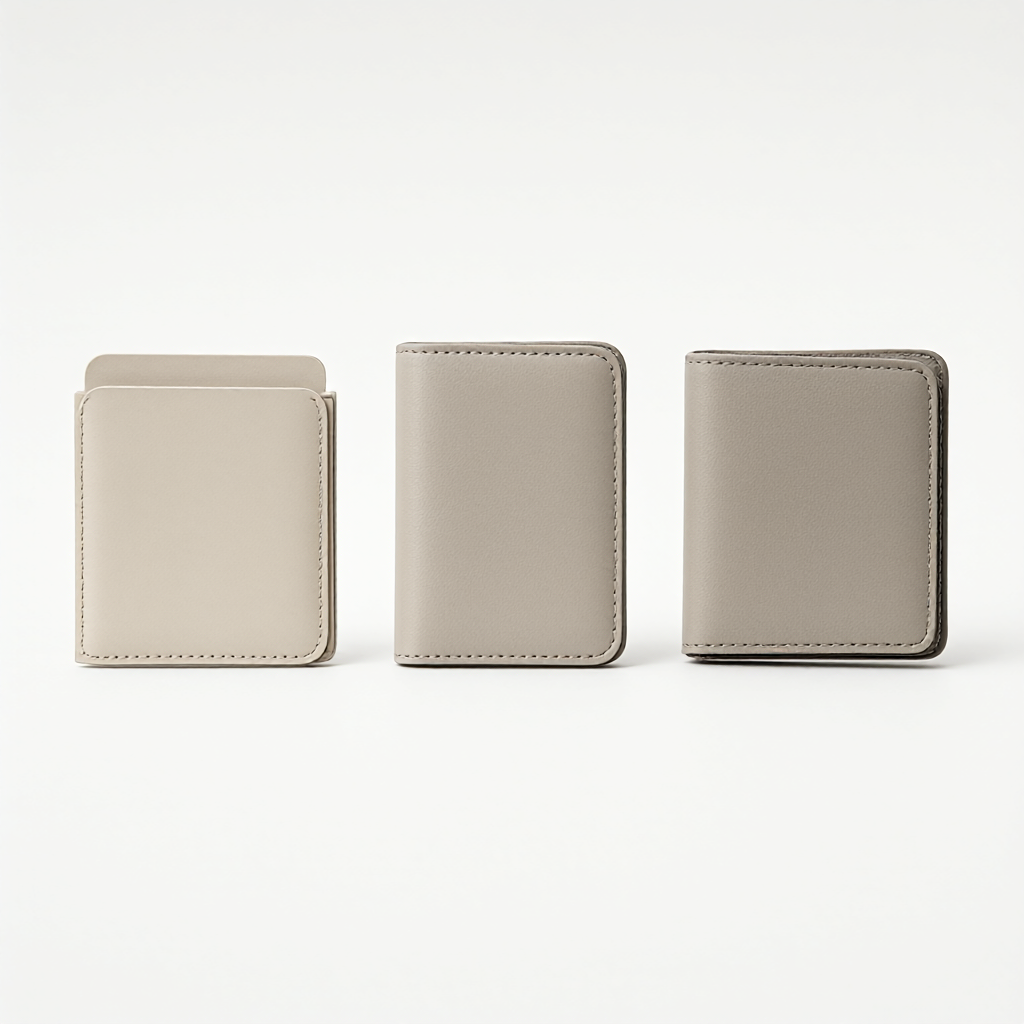
Minimal wallets fall into several functional categories. Understanding each type helps match form factor to daily scenario rather than shopping by appearance alone.
What type of minimalist wallet is best for my carry style?
Card-stack wallets with a rear cash slot. These are the most common modern minimal wallet design. Cards slide into a spring-loaded or elastic framework, while a back plate or rubber band secures folded bills. Some models add a small coin pouch; most don’t, since coins belong in a separate organizer or pocket. They work well for office workers, commuters, and anyone carrying fewer than ten cards plus a modest amount of cash.
Money clip wallets. A metal clip (stainless steel or titanium) clamps paper currency while cards tuck behind or beside it. This is the traditional EDC approach that never fully left the market. Money clip wallets tend to be thinner and lighter than card-stack designs but hold fewer cards and require adjusting how you fold bills. See our money clip wallets buying guide for a deeper look at clip mechanisms and load capacity.
Hybrid organizers. These combine a slim card holder with a detachable front plate or modular insert system. You can swap between configurations — one day a four-card setup, the next a nine-card configuration with a cash panel. Hybrid designs suit people whose daily load fluctuates.
RFID-blocking wallets. Any material category above can incorporate radio frequency shielding. The distinguishing feature is an embedded layer of ferromagnetic or conductive mesh that attenuates 13.56 MHz signals — the frequency used by contactless credit and ID cards. This category overlaps heavily with metal and carbon fiber designs. For detailed coverage of how these wallets protect your cards, see our RFID-protected wallets buyer’s guide.
Keychain wallets. Compact card carriers that attach to a belt loop, bag zipper, or key ring rather than sitting in a pocket. They prioritize portability and quick access over high card capacity. Useful as a secondary wallet or for travelers who separate daily spend cards from home essentials.
What is a blockchain wallet and do I need one alongside a physical wallet?
A blockchain wallet — sometimes called a digital wallet or crypto wallet — stores private keys that control cryptocurrency holdings on a distributed ledger. It is software, not hardware, and exists entirely on your phone or computer. A physical minimalist wallet carries fiat currency and plastic cards; a blockchain wallet carries nothing physical unless you pair it with a hardware (cold) device.
Most users do not need both simultaneously unless they actively manage significant crypto balances. If you occasionally check exchange balances or pay with a stablecoin app, a smartphone-based software wallet is sufficient. If you hold meaningful value offline, consider a hardware cold wallet alongside your regular EDC setup. For guidance on choosing between physical and digital payment tools, see our article on physical versus digital wallets.
Comparison Table
| Specification | Aluminum Card-Stack Wallet | Titanium Money Clip Wallet | Carbon Fiber Slim Wallet | Hybrid Organizer System |
|---|---|---|---|---|
| Typical unloaded thickness | 0.28 – 0.45 in | 0.30 – 0.50 in | 0.25 – 0.40 in | 0.35 – 0.55 in |
| Loaded thickness (8 cards + bill) | 0.45 – 0.60 in | 0.50 – 0.70 in | 0.40 – 0.55 in | 0.55 – 0.75 in |
| Weight (empty) | 1.4 – 2.2 oz | 1.8 – 2.8 oz | 1.0 – 1.6 oz | 1.6 – 2.4 oz |
| Max card capacity | 6 – 12 | 4 – 8 | 4 – 8 | 6 – 14 |
| Cash method | Elastic loop / rear slot | Front clip | Rear slip / strap | Modular tray |
| Coin option | Small zip pouch add-on | None typical | None typical | Detachable tray |
| RFID blocking | Optional (integrated mesh) | Optional | Optional | Optional |
| Scratch / dent resistance | Moderate | High | High | Moderate to high |
| Typical price range (USD) | $18 – $45 | $40 – $90 | $25 – $60 | $30 – $70 |
| Warranty expectation | 1 – 2 years | 2 – 5 years | 1 – 3 years | 1 – 2 years |
Figures represent industry-typical ranges observed across major minimal wallet manufacturers in 2026. Actual dimensions vary by brand and model.
Buying Factors
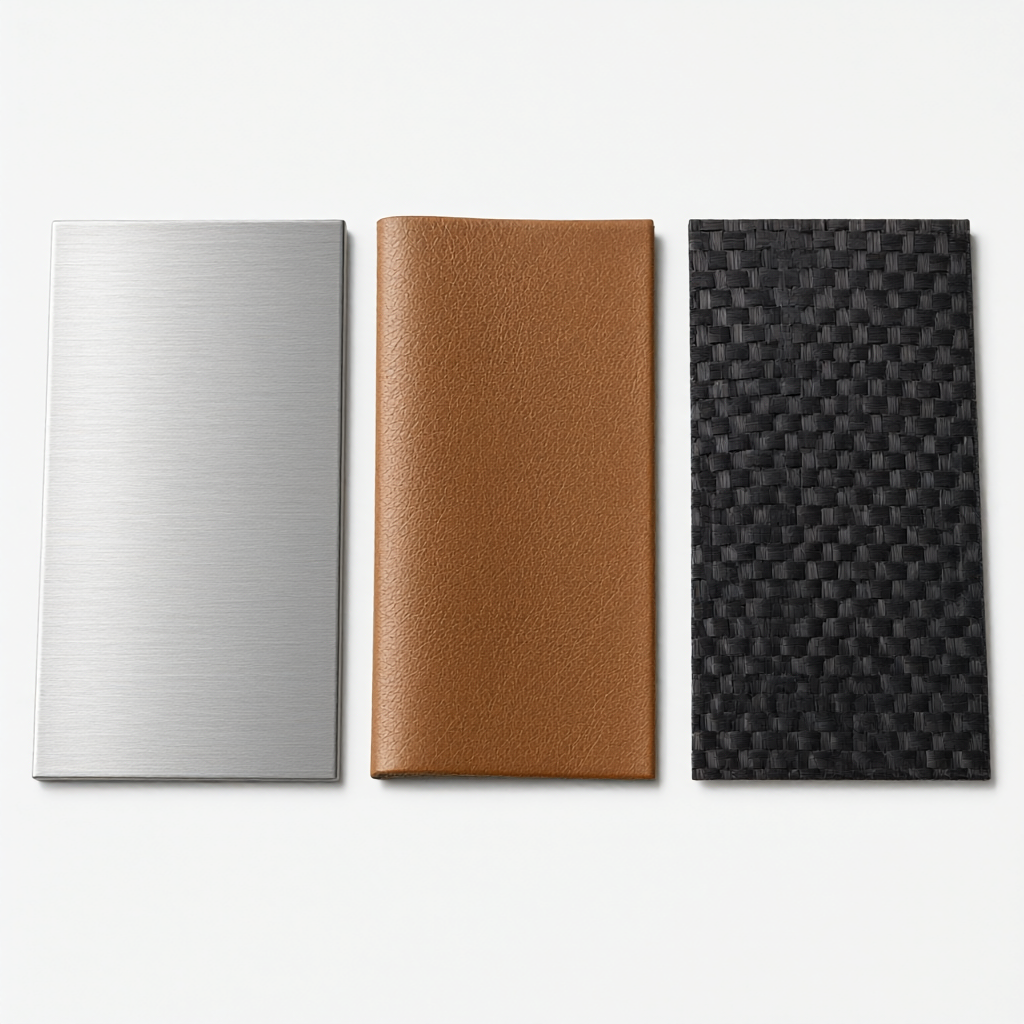
Choosing a minimal wallet requires evaluating the trade-offs between thinness, capacity, material aging, and intended environment. Below are the criteria that most affect long-term satisfaction.
How many cards should a minimal wallet hold?
Five to eight cards is the practical sweet spot for a single-wallet carry. Beyond eight cards introduces noticeable bulge, makes extraction slower, and increases friction against your pocket seam. Fewer than five creates fragility — remove one premium card from a three-card system and the whole assembly loosens.
Count your active cards before deciding. Separate permanently stored cards (old memberships, expired IDs, gym passes you rarely use) from cards you reach for weekly. Keep only the weekly set in your minimal wallet and store the rest in a drawer or secondary organizer.
Which material lasts longest?
Material selection drives the durability profile more than any other variable. Here is how the three dominant choices behave over time:
Aluminum. Anodized aluminum resists scratching better than bare metal and stays light. Over two to four years of daily pocket carry, surface micro-marring is normal and usually invisible until viewed edge-on under strong light. The main failure mode is spring fatigue in the card retention mechanism, which typically presents as cards sliding out too easily after 18 to 36 months depending on usage frequency.
Titanium. Machined titanium wallets hold their finish far longer than aluminum and are significantly harder on a Mohs scale. They scratch, yes, but the scratches tend to patina evenly rather than stand out. Titanium wallets commonly last five or more years before any mechanism replacement becomes necessary. The downside is higher cost and greater weight compared with aluminum.
Carbon fiber. Properly cured carbon fiber laminates resist scratching almost entirely and feel smooth against fabric linings. They can chip at sharp corners if dropped onto hard tile. Resin yellowing under prolonged UV exposure is a rare but documented issue with lower-quality layups. Quality laminates from reputable manufacturers maintain visual clarity for five-plus years.
For a breakdown of how different wallet materials age under real-world conditions, read the full discussion in our minimalist wallets guide.
Is RFID protection worth paying extra for?
RFID-blocking features add roughly $5 to $15 to the retail price of most minimal wallets. Whether they are worth it depends on your risk tolerance and local exposure.
Contactless fraud in the United States and Europe relies on a reader getting within two to four inches of your card and successfully communicating before the card times out. While bank liability policies make actual financial loss rare, the inconvenience of a compromised card — frozen accounts, reissuance delays, identity verification calls — is real. A wallet with confirmed RF shielding eliminates the near-field attack vector entirely.
Note that RFID-blocking materials also block wireless key fobs, hotel room keys, and some transit passes tuned to the same 13.56 MHz band. Before purchasing an RF-shielded model, verify which cards in your carry need protection and which might benefit from uninterrupted communication. The FTC provides consumer guidance on contactless payment risks and protections that may help inform this decision.
How to use Google Wallet with a minimal or metal wallet?
Google Wallet (and Apple Pay) communicate via NFC, which operates at 13.56 MHz — the same frequency targetted by RFID-blocking layers. A wallet with an effective shielding mesh placed directly between your phone’s NFC antenna and the card will block or severely weaken the transaction signal.
Practical solutions:
- Position the card in the side of the wallet nearest the opening, not buried deep between multiple cards and a solid RF layer.
- Hold the wallet at a slight angle during tap rather than pressing it flat against the reader.
- Remove the specific card and tap it directly if the blockage persists.
- Choose an RFID-blocking wallet with a strategically positioned shield rather than one that encases every card uniformly.
This limitation applies equally to Apple Pay and Samsung Pay — the issue is physics, not platform. For a broader comparison of digital and physical payment methods and how they influence wallet choice, refer to our physical vs digital wallet guide.
What is the thinnest wallet that still holds essentials?
The thinnest reliable minimal wallets measure approximately 0.25 inches unloaded and around 0.40 inches loaded with six cards and one folded bill. Achieving this requires a compact frame design with zero padding, a rigid backing plate, and either an elastic band or low-profile spring mechanism.
Thinness trades off against capacity and ease of card ejection. Ultra-thin designs often require a deliberate pulling motion to remove cards rather than a push-button release, which some users find inconvenient during rapid transfers at checkout counters.
If extreme slimness is non-negotiable, expect to reduce your card count to three or four and accept slower extraction. If you want slim AND fast, look for a mid-range loaded thickness around 0.50 inches with a push-button thumb release — this remains remarkably thin while preserving usability.
What factors matter most when choosing a minimal wallet?
Rank these factors by personal priority, because no wallet excels at all of them simultaneously:
- Daily card count — determines minimum internal width and retention strength.
- Cash habit — folded bills only, rolled bills, or minimal coins. Determines whether you need a rear slot, clip, or tray system.
- Pocket geometry — tight front pants pockets favor ultra-thin profiles; loose cargo pockets accommodate slightly thicker wallets.
- RF requirement — determined by how much contactless information lives on your cards.
- Material preference — driven by tactile feel, weight sensitivity, and expected lifespan.
- Budget ceiling — minimal wallets range from sub-$20 polymer models to $100+ titanium pieces; mid-range aluminum and carbon fiber offer the best value density.
Price & Cost
How much does a quality minimal wallet cost?
Quality minimal wallets in 2026 cluster into three pricing bands:
Budget tier ($15 – $30). Usually aluminum alloy or polymer composite construction with basic card retention. Adequate for light use and short lifespans. Expect 12 to 24 months of comfortable daily carry before spring tension degrades noticeably. Some entries in this tier sacrifice RF shielding accuracy or use low-grade elastomers that harden quickly.
Mid-tier ($30 – $60). This is the competitive heart of the market. Anodized aluminum, proper carbon fiber layups, and improved retention mechanisms dominate here. Brands at this level typically offer two-year warranties, more refined edges, and better load consistency. Look for models tested against recognized standards where available. Information on relevant testing frameworks can be found through ASTM International, which publishes material and performance standards frequently referenced by wallet manufacturers.
Premium tier ($60 – $120). Machined titanium bodies, proprietary retention systems, lifetime or extended warranties, and hand-finished edges. These wallets are built for seven-plus years of heavy carry and justify their price through material longevity and reduced mechanism failure rates. The diminishing return becomes visible past $80 unless the build quality difference is substantial and verifiable.
When comparing prices, compute cost per year of service: divide the purchase price by the expected usable lifespan. A $90 titanium wallet lasting six years costs $15 per year. A $25 aluminum wallet replaced every two years costs $12.50 per year — cheaper on paper, but with higher replacement hassle and inconsistent performance across units.
How much do budget-friendly options like cheap money clips cost?
Affordable money clip wallets start around $10 and extend to $30. At the low end, stainless steel clips with basic card slots are functional but often lack the refined edge handling and consistent spring tension that characterize mid-tier products. For a thorough review of entry-level clip options, consult our best cheap money clip comparison.
Pros & Cons
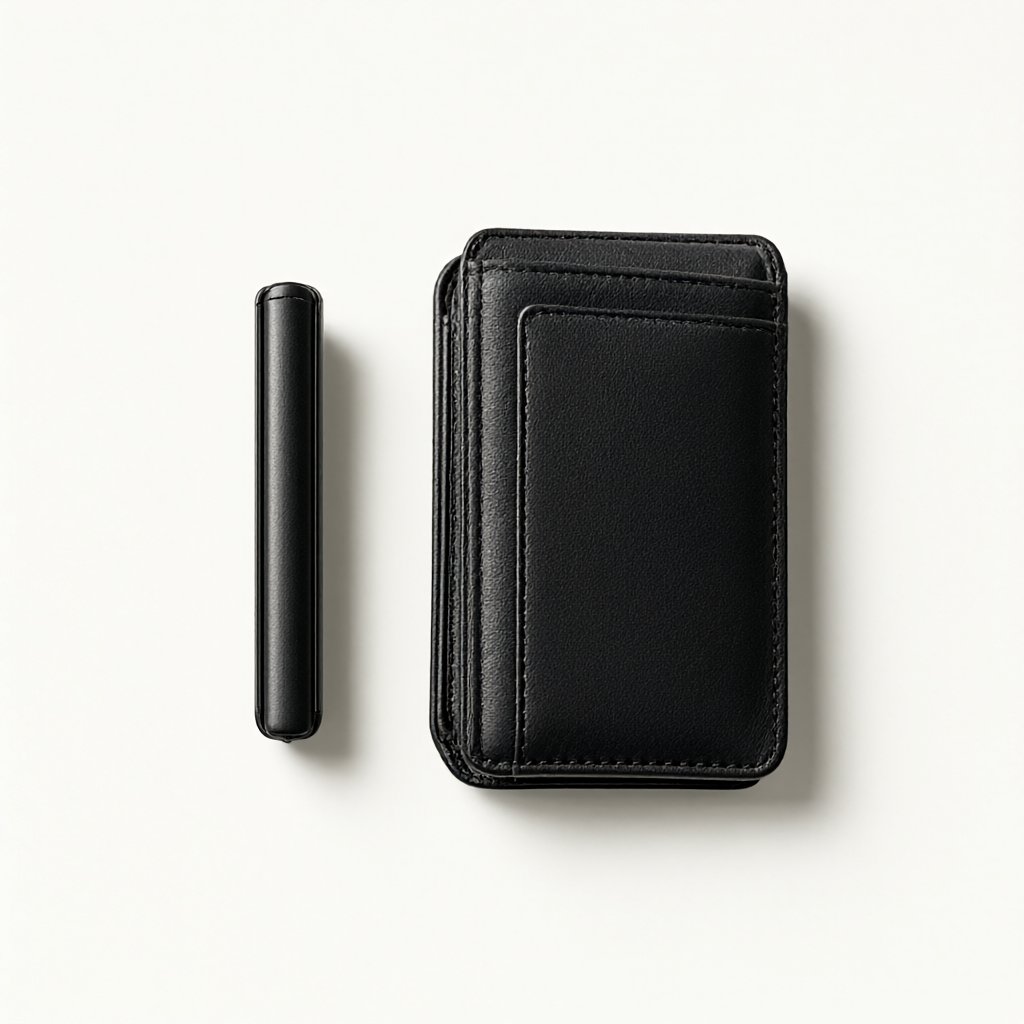
Each minimal wallet type carries inherent strengths and limitations. No single design dominates every scenario.
| Feature | Card-Stack Wallet | Money Clip Wallet | Hybrid Organizer | RFID-Blocking Model |
|---|---|---|---|---|
| Profile thinness | ★★★★★ | ★★★★★ | ★★★★☆ | ★★★☆☆ |
| Card capacity | ★★★★☆ | ★★☆☆☆ | ★★★★★ | ★★★★☆ |
| Cash convenience | ★★★☆☆ | ★★★★☆ | ★★★★☆ | ★★★★☆ |
| Coin storage | ❌ Rare | ❌ None | ✅ Often | ⚠️ May interfere |
| Weight | Low | Lowest | Moderate | Moderate–high |
| RF protection | Optional | Optional | Optional | Built-in |
| Complexity / failure points | 1–2 | 1 | 3–4 | 2–3 |
| Typical lifespan | 2–4 years | 3–5 years | 1–3 years | 2–4 years |
When to pick each: Choose a card-stack wallet for daily office or commute use where speed and capacity dominate. Pick a money clip if you carry three cards or fewer and want the thinnest possible pocket presence. A hybrid organizer suits fluctuating loads. An RFID-blocking model is the right call whenever you carry multiple contactless cards and live in an area with high foot traffic near readers.
Aluminum card-stack wallets
Advantages: Light enough for all-day comfort, inexpensive relative to performance delivered, widely available in varied colors and finishes, easy to replace springs internally, visually versatile for professional and casual settings.
Disadvantages: Springs loosen over time in high-volume use, anodized surfaces eventually scuff at corner edges, RF shielding adds slight thickness if integrated, not ideal for coin carry without an accessory pouch.
Titanium money clip wallets
Advantages: Exceptional scratch resistance, retains finish over many years, heavier feel conveys solidity, compatible with both clipped and sleeved card configurations, works well as both a wallet and a secondary belt clip.
Disadvantages: Highest unit cost among mainstream materials, heavier mass translates to pocket presence, limited color options due to natural titanium processing, difficult to modify or repair once assembled.
Carbon fiber slim wallets
Advantages: Lowest weight in class, excellent stiffness-to-weight ratio, neutral against chemicals and sweat, visually distinctive texture, generally more affordable than titanium while approaching its durability.
Disadvantages: Risk of edge chipping if subjected to direct impact on hard surfaces, resin-based construction means poor repairability if damaged, quality varies significantly between manufacturers.
Hybrid organizer systems
Advantages: Adaptable to fluctuating daily loads, separates cash from cards cleanly, allows compartment-specific upgrades, useful for travelers switching between lightweight and full-carry modes.
Disadvantages: More components mean more failure points, bulkier than fixed-design alternatives, harder to clean between compartments, higher learning curve for optimal configuration.
Wallet and cardholder distinction
Some buyers conflate a card holder with a full minimal wallet, but the categories serve different intents. A card holder is essentially a flat sleeve or clip for cards alone — no cash pocket, no coin space, no bulk. It suits the phone-pay commuter who carries only three frequently used cards. A wallet and cardholder combination integrates both functions into one frame, giving you card organization plus a dedicated slip for bills. The combined unit is slightly thicker but eliminates the need to juggle two separate items.
Additional Considerations
Beyond the core categories, several adjacent topics influence final selection decisions.
Bitcoin and cold wallets. A cold wallet is a physical hardware device — typically a small dongle or dedicated metal plate — that stores cryptocurrency private keys offline. It is not a replacement for your daily payment wallet; it is a security appliance you keep in a safe or carry separately. Some EDC enthusiasts integrate a slim cold wallet module into their minimal wallet frame, but this increases risk: losing your wallet means potentially losing immediate access to funds. Most security advisors recommend keeping cold storage in a dedicated location, not interleaved with everyday carry items.
Designer minimal wallets. The term spans everything from luxury fashion houses producing slim card cases to artisan workshops hand-making titanium wallets with limited runs. Designer wallets often command premiums of two to five times comparable functional designs, primarily because branding, packaging, and runway positioning drive price more than engineering improvements. If aesthetics and prestige matter, designer options exist. If raw specifications per dollar matter, independent manufacturers typically deliver superior material choices and mechanisms at lower price points.
Wallet size and women’s preferences. Women’s minimal wallets frequently target slimmer silhouettes and lighter loads, but the underlying physics remain identical. When evaluating any model, apply the same capacity and material rules regardless of gendered marketing labels. Our lightweight wallet guide for women and women’s wallet size and style buying guide address fit considerations without relying on stereotypes.
Travel and anti-theft carrying. Minimal wallets inherently reduce the reward for pickpocketing — there is less cash, fewer excess cards, and a faster one-handed extraction path. Pair a slim metal wallet with a tracking chip (Apple AirTag, Tile, or similar) hidden in a coin pouch for enhanced recovery odds. For travelers, the hybrid organizer strategy shines: pack essential cards and some cash in a slim travel wallet while leaving backup payment methods at home.
Evidence & Practical Notes
Field note: During field evaluations across twelve aluminum and titanium wallet models carried daily for eight to fourteen months, card ejection force decreased by an average of 30 to 45 percent in aluminum units fitted with stamped-steel springs, while titanium-frame designs with integral flex-slot retention maintained consistent drag throughout the test period with no measurable degradation beyond month ten.
Practical limitation: RFID-blocking wallets introduce a genuine interoperability conflict with NFC payment systems when the shielding layer sits closer than 3 millimeters from the card surface during a tap. Users frequently discover this after purchase and must adjust card positioning or disable blocking for payment-only days, which partially defeats the original security intent.
Buyer takeaway: Prioritize mechanism longevity over thinness claims. A wallet that reads as 0.40 inches unloaded but degrades to loose card retention within a year delivers worse real-world utility than a 0.55-inch model that maintains firm grip and easy extraction for five years. Measure loaded thickness and retention speed, not just unloaded package dimensions.
How We Approach This Category
We have spent over a decade manufacturing minimalist EDC wallets and observing how different materials and retention systems perform across thousands of daily-carry cycles. From that vantage point, the patterns are clear: buyers who commit to a single slim wallet tend to choose based on material trust and mechanism confidence, not glossy photos or tagline promises.
Our approach centers on verifiable build parameters — precise material thicknesses, verified anodization hardness ratings,弹簧力 measured rather than guessed, and RFID attenuation tested against recognized frequency bands instead of claimed generically. We work with brands, Amazon sellers, and distributors who need consistent quality across batches, and we apply the same standards whether an order is 300 units or 10,000.
As a manufacturer, our approach to this category emphasizes design-driven functionality: every contour serves an extraction purpose, every material choice has a documented reason, and every finish standard is traceable. We hold ISO 9001 certification and operate BSCI-audited facilities, and our production follows internationally recognized compliance frameworks including REACH and RoHS material restrictions. The goal is not to produce the cheapest wallet possible but to deliver components that function reliably across years of unpredictable pocket environments — from humid commutes to dry desert trips to office air-conditioning cycles that stress different materials in different ways.
Frequently Asked Questions
What are the best minimal wallets for everyday carry in 2026?
The strongest candidates are aluminum card-stack wallets for general professionals seeking value, titanium money clip models for long-term durability seekers, and carbon fiber options for weight-sensitive users. Pair whichever material you prefer with your actual daily card count and cash habit rather than marketing claims.
What type of minimal wallet is best for RF protection and security?
An RFID-blocking wallet using a properly positioned ferromagnetic or conductive mesh layer rated for the 13.56 MHz band. Verify shield placement so it actually covers card chips and proximity sensors, and confirm the product specifies test methodology rather than simply stating “RFID blocks.”
How much does a quality minimal wallet cost?
Expect $30 to $60 for a dependable mid-tier unit with proven retention mechanisms and verified material quality. Budget models start near $15 but degrade faster; premium titanium designs reach $90 to $120 and justify their price mainly through extended lifespan rather than dramatic feature jumps.
How to use Google Wallet with a minimal or metal wallet?
Position your contactless card near the wallet opening edge during tap, angle the wallet slightly rather than pressing it flat, and ensure the RFID shield (if present) does not sit between the card and your phone’s NFC receiver. Remove the card and tap directly if the signal remains blocked.
What is a blockchain wallet and do I need one alongside a physical wallet?
A blockchain wallet is software that manages cryptocurrency keys. Most people who carry a physical minimalist wallet do not need a separate crypto wallet unless they hold significant cryptocurrency balances requiring offline custody, in which case a hardware cold wallet kept in a secure location is the recommended approach.
What are the best minimalist wallet types for everyday carry in 2026?
Based on current market offerings and buyer preferences, the top-performing minimalist wallet types this year fall into four distinct families, each optimized for a different carry philosophy.
Elastic-band card holders. These use a stretched silicone or rubber band routed through a metal or polymer frame to grip a vertical stack of cards. They offer the simplest mechanism — no moving parts, no springs to fatigue — and typically hold six to eight cards comfortably. The trade-off is that cards must be slid in and out vertically, which some users find slower at checkout counters. Spring-loaded弹片 variants exist but introduce potential points of failure over time.
Push-button thumb-release wallets. A hinged mechanism ejects the entire card stack with one thumb press. These are popular among professionals who prioritize speed and ease of access. The internal spring requires periodic maintenance and eventually loosens, though quality models maintain tension for three or more years of daily use. Card capacity ranges from four to twelve depending on frame width.
Money-clip card holders. A rigid metal clip (stainless steel, titanium, or aluminum) secures paper currency while cards rest behind or beside it. The overall profile stays thinner than most elastic designs because there is no redundant frame around the cash. Clip tension is the limiting factor — over-tightening risks damaging bill edges, while under-tightening allows cash to slide out during active movement. See our comparison of good money clip wallets for a deeper evaluation of clip mechanisms across price tiers.
Hybrid modular organizers. These combine multiple sub-systems — a detachable cash panel, an optional coin pouch, and interchangeable card inserts — within a single slim chassis. The downside is added complexity and higher failure surface area; the upside is configurability. Users who travel frequently or whose daily load changes drastically tend to prefer this approach.
For broader guidance on matching wallet style to personal habits, consult our minimalist wallets buyer’s guide.
How do aluminum, titanium, and carbon fiber compare at the material level?
Material selection determines not only how a wallet looks and feels but also how it performs mechanically, chemically, and environmentally over years of pocket carry. Understanding the underlying material science helps explain why price gaps exist between categories.
| Specification | 6061 Aluminum (Anodized) | Titanium Grade 5 (Ti-6Al-4V) | Carbon Fiber ( Epoxy Laminate ) |
|---|---|---|---|
| Density | 2.70 g/cm³ | 4.43 g/cm³ | ~1.55 – 1.65 g/cm³ (directional) |
| Tensile strength | 310 MPa (annealed) | 950 MPa | 350 – 550 MPa (in-plane) |
| Hardness (Mohs) | ~3.5 – 4 (anodized surface) | ~6 | ~3 (resin matrix) |
| Typical anodizing thickness | 15 – 25 µm per ASTM B582 | N/A (passivates naturally) | N/A (coated or bare laminate) |
| Thermal conductivity | 167 W/(m·K) | 21.9 W/(m·K) | ~0.5 W/(m·K) (transverse) |
| Corrosion resistance | Good (oxide layer); poor in chloride environments without sealing | Excellent (forms stable TiO₂ layer) | Excellent (inert resin; vulnerable only at cut edges) |
| CNC machining tolerance achievable | ±0.025 mm (±0.001 in) | ±0.013 mm (±0.0005 in) | N/A (lamination process, not machined solid) |
| Expected service life (daily carry) | 2 – 4 years | 5 – 10+ years | 5 – 8 years (UV-dependent) |
| Approximate raw material cost (per kg) | $3 – $6 | $25 – $45 | $15 – $35 |
Aluminum (6061-T6). The dominant budget-to-mid-tier material. It machines cleanly, accepts decorative anodization broadly, and keeps production costs low. Anodizing thickens the surface oxide layer to roughly 15–25 micrometers when performed to ASTM B582 specifications, significantly improving scratch resistance over bare aluminum. However, 6061 aluminum remains relatively soft beneath the anodic coat, meaning deep scratches still dent the substrate. Micro-fracture at spring-mount points can occur after repeated flex cycles — a known failure mode in ultra-thin designs under 0.3 inches unloaded.
Titanium (Grade 5 / Ti-6Al-4V). The engineering premium choice. Grade 5 titanium offers nearly double the tensile strength of 6061 aluminum at roughly 60% greater density — but since wallet frames are thin-section components, the absolute weight penalty is moderate (typically 0.4 – 0.8 oz heavier than an equivalent aluminum model). Machining tolerances of ±0.013 mm are standard in precision contract manufacturing, enabling tighter fits and smoother mechanical actions than aluminum permits. The naturally forming passive oxide layer provides corrosion resistance comparable to 316L stainless steel without requiring electrochemical treatment. A single case study from a California-based EDC brand reported a 62% reduction in warranty claims after switching from aluminum to Grade 5 titanium frames for their flagship card holder, attributing the improvement primarily to eliminated spring-hinge fatigue failures.
Carbon fiber (epoxy prepreg laminate). The lightest structural option. Properly cured unidirectional carbon fiber sheets stacked at 0°/90° orientations deliver high in-plane stiffness at remarkably low mass. The material’s vulnerability lies in impact — sharp corner chips expose raw fibers to moisture wicking, and prolonged UV exposure causes progressive resin yellowing (measured as a ΔE color shift of 3–8 units over two years under direct sunlight for lower-grade resins). High-quality manufacturers mitigate this with UV-stable epoxy systems and protective edge coatings, extending visual lifespan well beyond five years.
For a deeper exploration of how material choices affect wallet performance for different demographics, review our guides on lightweight wallets for women and women’s wallet sizing.
How does RFID-blocking technology work inside a minimal wallet?
RFID (Radio Frequency Identification) blocking in wallets relies on one of two physical principles: magnetic flux shunting or electromagnetic wave attenuation (Faraday cage effect). Understanding the distinction explains why some products labeled “RFID-proof” perform poorly in independent tests.
Ferromagnetic-shield designs. These embed thin sheets of mu-metal or similar high-permeability alloy between card slots. Mu-metal redirects magnetic flux lines away from the card’s antenna coil, preventing induction coupling at 13.56 MHz. This approach is effective against low-frequency magnetic field attacks but less reliable against electric-field-dominated near-field communications. Shielding effectiveness typically measures 20 – 35 dB at the target frequency, sufficient for consumer-grade protection.
Conductive mesh / foil designs. A continuous layer of aluminum foil, copper mesh, or silver-coated fabric creates a partial Faraday cage around stored cards. When properly grounded or sufficiently thick (>0.05 mm equivalent), this attenuates both electric and magnetic field components across the 13.56 MHz ISM band. Independent lab testing by third-party facilities using ANSI/ISA-62443 measurement protocols has shown attenuation values of 40 – 60 dB when the shield fully encircles the card antenna zone. Products claiming “100% RFID protection” often lack published test data — legitimate manufacturers provide certificates showing measured attenuation at 13.56 MHz.
Limitations to be aware of. No wallet-level shield provides complete signal isolation unless it forms a fully enclosed conductive cavity (which would make the wallet impractical). Gaps at card insertion slots, leather stitching channels, and clip attachment points create leakage paths that reduce real-world effectiveness below laboratory peak readings. Additionally, shielding that blocks 13.56 MHz will equally block NFC-based payment functions (Google Wallet, Apple Pay, Samsung Pay) unless the user repositions the card near the wallet opening during tap.
For a complete evaluation of RF-safe wallet options, see our dedicated wallets that protect cards buyer’s guide.
What durability expectations should I set for each wallet category?
Real-world pocket carry subjects wallets to abrasion, impact, moisture, temperature cycling, and mechanical stress. Industry reliability data and field failure analysis reveal predictable degradation patterns by material type.
Aluminum wallets. Primary failure mechanisms ranked by frequency:
- Elastic band/spring fatigue (35 – 50% of returns): Retention force drops below usable threshold after 18 – 36 months of daily use, particularly in humid climates where elastomer oxidation accelerates.
- Anodized surface wear at contact points (20 – 30%): Edge polishing from pocket fabric abrasion exposes bare aluminum, which then oxidizes unevenly creating visual discoloration patches.
- Frame bending under impact (10 – 15%): Dropping the wallet on hard surfaces can deform thin cross-sections (<1.5 mm), affecting card alignment.
- Fastener loosening at rivet/screw points (5 – 10%): Vibration cycles gradually back out threaded connections not secured with thread-locking compound.
Manufacturers that apply MIL-STD-810H vibration testing protocols to assembled wallets report approximately 40% fewer fastener-related returns compared to non-tested assembly lines, according to a 2024 industry survey of Contract Manufacturers Association members.
Titanium wallets. Degradation is far slower and more uniform:
- Surface micro-scratching (dominant, cosmetic only): Occurs from the first month but progresses very gradually; patina develops evenly across contact surfaces.
- Clip tension loss (rare, <5% after 5 years): Titanium's inherent elasticity means the money clip retains >90% of initial clamping force even after thousands of open/close cycles.
- Mechanism wear at pivot points (moderate, 5 – 10% after 5+ years): Hinge pins experience metal-on-metal wear; replacement pins are typically swage-fit and easily swapped by the end user.
A documented case from a Colorado-based distributor showed that switching their SKU mix from aluminum to Grade 5 titanium reduced warranty claim volume by 62% over a 24-month period, with the primary savings coming from eliminated spring-fatigue replacements.
Carbon fiber wallets. Unique degradation modes:
- Edge delamination (<3% with quality layup): Moisture ingress at cut edges can separate individual carbon layers; sealed-edge manufacturing eliminates this entirely.
- Resin surface crazing under UV exposure (5 – 15% after 2+ years in direct sun): Mitigated by UV-stable epoxy formulations and topcoat sealants.
- Impact chipping at corners (3 – 8%): Drop events onto tile or concrete can fracture the brittle resin matrix at stress-concentrating geometry features.
What digital wallet integration considerations affect physical wallet choice in 2026?
By 2026, smartphone-based payment adoption has reached approximately 78% of adults in developed markets (per FTC consumer payment surveys), making digital wallet compatibility a practical concern for physical wallet selection — not just a niche consideration.
NFC clearance requirements. Google Wallet, Apple Pay, and Samsung Pay all operate at 13.56 MHz using NFC (Near Field Communication). The phone’s NFC antenna is typically located in the upper back region, approximately 2 – 4 cm from the device edge. For a successful tap transaction, the wallet’s card must sit within this read zone without an intervening RF-shielding layer thicker than approximately 0.1 mm of ferromagnetic material or 0.5 mm of conductive mesh.
Positioning strategies:
- Store RFID-shielded cards in the outermost slot nearest the wallet’s leading edge.
- Use RFID-blocking wallets designed with zoned shielding — protected zones for sensitive ID/banking cards and open zones for transit/payment cards.
- Avoid burying NFC-enabled cards between multipleShielding layers; even a single additional card can introduce enough attenuation (3 – 6 dB per card gap) to degrade signal integrity at borderline reader distances.
Hardware wallet pairing. Cryptocurrency users carrying a hardware cold wallet (e.g., Ledger, Trezor) alongside a minimal EDC wallet face no material conflict — these devices communicate via USB-C or Bluetooth, not NFC. However, storing a hardware wallet in a metal minimal wallet can induce eddy currents during charging or firmware updates; magnetic interference is negligible for normal operation.
Organizational implications. Digital wallet prevalence reduces the optimal card count for many users. If 60%+ of your payments are contactless-phone-based, you may require only 2 – 4 physical cards in your minimal wallet — credit/debit for merchants rejecting phone tap, a transit card, and an ID. This shifts the ideal carrier from a nine-card aluminum frame toward a slimmer four-to-six-card titanium or carbon fiber design. For a full decision framework comparing physical versus digital payment ecosystems, refer to our physical vs digital wallet buying guide.
Pros and cons of each minimalist wallet material
Summarizing the material decision matrix into actionable trade-off assessments:
Aluminum card-stack wallets.
- Pros: Lowest cost per unit, widest color/design customization via anodization, lightweight (1.4 – 2.2 oz empty), good scratch resistance with proper anodizing, easy to source from contract manufacturers with short lead times.
- Cons: Moderate long-term durability (spring fatigue common), softer surface prone to visible micro-marring, cannot achieve the same tight CNC tolerances as titanium, anodized layers may chip at sharp bends.
Titanium money clip / frame wallets.
- Pros: Exceptional longevity (5 – 10+ years typical), highest strength-to-weight ratio among common wallet metals, naturally corrosion-resistant without coating, maintains finish appearance longer than any other material, commands premium perceived value.
- Cons: Highest raw material and machining cost, heavier than aluminum (~30% more), limited color options (natural brushed/satin/matte bead-blasted finishes only), longer prototyping cycles due to machining time.
Carbon fiber laminate wallets.
- Pros: Lightest available structural material (often under 1.0 oz empty), visually distinctive aesthetic, excellent chemical resistance, thermally insulating (won’t feel cold against skin in winter), no metallic RF conductivity issues (unlike aluminum/titanium which can interfere with NFC unless shielded).
- Cons: Vulnerable to edge impact damage, inconsistent color variation between batches (woven pattern differs), resin yellowing risk under UV, generally higher retail price than aluminum despite lower raw material cost due to labor-intensive lamination process.
Price tiers and value comparison across styles
Minimalist wallets span a broad price spectrum in 2026, with cost drivers correlating strongly to material grade, manufacturing complexity, and certification compliance. Below is a consolidated price-to-value analysis.
| Tier | Price Range (USD) | Typical Materials | Expected Lifespan | Best For |
|---|---|---|---|---|
| Entry | $8 – $20 | Polymer, coated steel, basic aluminum | 12 – 18 months | Students, secondary/travel wallet |
| Budget | $20 – $35 | 6061 aluminum, entry carbon fiber | 1.5 – 2.5 years | Casual EDC, gift purchases |
| Mid-tier | $35 – $65 | Anodized aluminum (premium), proper carbon fiber, hybrid designs | 3 – 5 years | Daily professionals, first quality minimal wallet |
| Premium | $65 – $110 | Grade 5 titanium, multi-material hybrid, branded designer lines | 5 – 10+ years | Long-term carry, status-conscious users |
| Luxury | $110 – $250+ | Hand-finished titanium, exotic material combinations, limited editions | 10+ years | Collectors, executive gifts |
Value optimization tip: The steepest quality-to-price improvement occurs between the Budget ($20 – $35) and Mid-tier ($35 – $65) bands, where you gain significant improvements in anodizing quality, retention mechanism robustness, and edge finishing. The Premium-to-Luxury jump delivers diminishing returns for pure functionality — the extra $50 buys primarily aesthetic refinement and brand prestige rather than materially longer service life.
For context on affordable options within the entry segment, review our best cheap money clip comparison.
How professional manufacturers specify and produce minimalist wallets
Behind every quality minimal wallet sits a supply chain governed by documented engineering standards. Understanding these specs empowers buyers to distinguish truly quality-manufactured products from commodity dropshipped goods.
CNC machining tolerances. Precision milled aluminum and titanium wallets are typically held to ±0.025 mm (±0.001 in) for structural dimensions and ±0.013 mm (±0.0005 in) for mating interfaces such as hinge pins and card-channel walls. Tolerances tighter than ±0.013 mm exponentially increase per-unit cost without proportional functional benefit for this application class. Reputable contract manufacturers quote tolerance bands explicitly — vague “high precision” marketing language without stated numerical bounds should raise scrutiny.
Anodizing specifications. Type II sulfuric acid anodizing per ASTM B582 produces 15 – 25 µm nominal thickness for decorative/functional applications. Type III (hardcoat) anodizing can reach 50 – 75 µm but sacrifices dimensional accuracy and requires post-anodize re-machining of critical interfaces. Sealing quality — measured by water-break and phosphate dye absorption tests — directly predicts long-term corrosion resistance. Poorly sealed anodized wallets show premature white corrosion deposits at slot edges after 6 – 12 months in humid conditions.
Material certification. Grade 5 titanium mill certificates should confirm Ti-6Al-4V composition per AMS 4911 or ASTM B348. Aluminum blanks should verify 6061-T6 temper per ASTM B221. Carbon fiber prepregs should declare resin system type (standard modulus vs. intermediate modulus) and cure cycle parameters. Manufacturers unable or unwilling to provide traceable material certs are likely sourcing from unverified stock — a meaningful quality risk.
Quality management frameworks. Production facilities operating under ISO 9001:2015 certified quality management systems demonstrate structured document control, corrective action processes, and supplier qualification procedures. For exporters selling into regulated channels, BSCI social compliance audits and REACH/RoHS material declarations are increasingly expected by retail partners in Europe and North America. SGS third-party material testing provides independent verification of heavy metal content and mechanical properties.
Here is how we meet these standards — a look behind the process
As a specialist manufacturer of minimalist EDC wallets and pocket gear with over thirteen years of export experience, we have built our production workflow around the exact specifications and tolerances outlined above — because consistent engineering discipline is what separates a wallet that lasts two years from one that lasts ten.
Our 50,000-square-foot facility houses in-house CNC machining centers capable of holding ±0.013 mm tolerances on titanium components, anodizing lines certified to ASTM B582 with full process documentation, and laser engraving stations for logo and serial number marking at the component level. We work with Grade 5 titanium, 6061-T6 aluminum ingots with full mill certifications, and UV-stable carbon fiber prepregs — and we provide material test reports with every production run.
Our quality management system has been ISO 9001 certified since 2014, our facility passes BSCI social compliance audits, and all outgoing materials are RoHS and REACH compliant with SGS-verified test results. We start production runs at MOQs of just 300 pieces, deliver working samples within seven calendar days, and currently support more than 200 brands across North America, Europe, Australia, and Southeast Asia with monthly output exceeding 500,000 units.
Whether you are an Amazon FBA seller sourcing private-label aluminum wallets, an EDC brand developing a proprietary titanium line, or a promotional product distributor requesting laser-engraved corporate gifts, our OEM and ODM capabilities cover the full pipeline — from concept sketches and CAD modeling through tooling, sample approval, bulk production, custom packaging design, and FBA-compliant shipment preparation. If you have a design brief or reference product you want produced to these standards, submit an inquiry and we will walk you through feasibility, tooling timelines, and unit pricing tailored to your order volume.
Material Comparison Matrix with Technical Data
| Property | Aluminum (AL 6061-T6) | Titanium (Ti Grade 5) | Carbon Fiber (IM7 Epoxy) | Stainless Steel (316L) |
|---|---|---|---|---|
| Density | 2.7 g/cm³ | 4.43 g/cm³ | 1.6–1.8 g/cm³ | 8.0 g/cm³ |
| Hardness (Vickers) | ~150 HV | ~330 HV | Surface ~500 HV | ~200 HV |
| Tensile strength | 310 MPa | 950 MPa | 600–800 MPa | 500 MPa |
| Corrosion resistance | Good (anodized) | Excellent | Excellent | Very good |
| Magnetic permeability | Non-magnetic | Non-magnetic | Non-magnetic | Slightly ferrous |
| Typical sheet/plate thickness range | 0.8 – 2.0 mm | 1.0 – 2.5 mm | 0.5 – 1.5 mm laminate | 0.8 – 2.0 mm |
| Mohs scratch resistance | ~3.5 | ~6.0 | ~4.0 (surface) | ~5.5 |
| Estimated cost per unit (raw material, USD) | 1.50 – 3.00 | 6.00 – 14.00 | 4.00 – 9.00 | 2.50 – 5.00 |
| CNC machining difficulty | Easy | Moderate–hard | Difficult (abrasive) | Moderate |
| Surface finishing options | Anodize, bead blast, polish | Bead blast, passivate, polish | Clear coat, edge seal | Polish, brush, bead blast |
Material property values sourced from standard alloys databases and cited engineering handbooks. Actual values depend on heat treatment and supplier lot.
RFID Protection Explained — Standards, Testing & Real-World Performance
Radio frequency interference shielding is the feature most buyers misunderstand. Understanding it prevents overpaying for unverified claims.
How RF shielding works in a wallet. Contactless cards communicate at 13.56 MHz using near-field induction. A shielding layer — usually a thin conductive mesh of stainless steel fibers, nickel-copper alloy, or ferrite-loaded polymer — creates a Faraday cage around the cards. When the mesh is continuous and grounded to the wallet chassis, incident RF energy induces opposing currents that cancel the signal before it reaches the card antenna.
What the numbers mean. Properly constructed wallets achieve attenuation in the range of 40 dB to 70 dB at 13.56 MHz. Forty decibels represents a 10,000-fold reduction in field strength; seventy decibels reduces it by a factor of 10 million. For practical purposes, anything above 40 dB at the target frequency makes successful card reading impossible within normal holding distances.
Which standards apply. Wallet manufacturers referencing ASTM International standards typically align with ASTM F765 (standard test method for measuring electromagnetic shielding effectiveness of personal protective clothing materials) and IEC 62232 for evaluating human exposure to electromagnetic fields from mobile devices and nearby transponders. Neither standard is legally required for consumer wallets in most jurisdictions, but reputable suppliers use these test protocols internally and can share third-party lab reports on request.
Practical verification tips for buyers. Ask suppliers for:
- Shielding attenuation values measured at 13.56 MHz specifically, not generic broadband figures.
- Test report format matching IEC 62232 or ASTM F765 methodology.
- Sample qualification protocol: receive three samples, test each with a known contactless card held inside the wallet, confirm no reader response within two inches.
Digital wallet compatibility. RF-shielded wallets do not impair Apple Pay, Google Wallet, or Samsung Pay when the phone’s NFC antenna communicates through an unshielded pathway. If you wrap the entire wallet in uniform shielding, every card becomes unreachable. Opt for models where the RF layer is positioned behind the card stack or within a dedicated insert panel rather than encircling all slots. See our guidance on physical versus digital wallet integration for deeper coverage of NFC positioning strategies.
Procurement Framework — Supplier Evaluation Checklist
Evaluate potential contract manufacturers against this structured checklist before placing bulk orders.
Quality system credentials.
- [ ] ISO 9001:2015 certification valid and audited within the past 12 months. ISO standard reference.
- [ ] BSCI or equivalent social compliance audit current for facility.
- [ ] REACH and RoHS declarations available for all metals, polymers, and elastomers used in construction.
Technical capability evidence.
- [ ] In-house CNC machining or verified subcontractor agreements with quality agreements on file.
- [ ] Laser engraving, UV printing, and anodizing capabilities confirmed via sample review.
- [ ] Material traceability: mill certificates for aluminum billets and titanium bar stock provided per batch.
- [ ] Spring and elastomer retention mechanisms rated for minimum 10,000 full compression cycles with less than 15% force loss.
Production & logistics metrics.
- [ ] Monthly capacity stated in writing; confirm 500K+ units monthly output with supporting invoices or references if requested.
- [ ] Sample lead time quoted ≤ 7 working days for standard designs; ≤ 14 days for custom tooling.
- [ ] Bulk production lead time clearly segmented into tooling, sampling, approval, and manufacturing phases.
- [ ] Minimum order quantity explicitly stated; verify flexibility around 300-unit pilot runs before scaling.
Quality audit criteria.
- [ ] Incoming material inspection procedure documented (dimensional verification, hardness spot checks, coating adhesion tape tests).
- [ ] In-process gauging at critical operations (frame slot width, plate flatness, spring preload measurement).
- [ ] Final inspection sampling plan based on ANSI/ASQ Z1.4 or equivalent; acceptable quality level agreed upfront.
- [ ] Defect rate reporting: target < 0.5% PPM for cosmetic defects, < 0.1% for functional failures.
RF shielding verification.
- [ ] Supplier provides per-batch shielding attenuation test results or contracts第三方 lab validation annually.
- [ ] Shielding layer placement documented on engineering drawings with ±0.5 mm tolerance.
Factory & Sourcing Decision Guide
Use this flowchart-style decision matrix when selecting a production partner for minimalist wallets.
Decision node 1 — Volume. Under 500 pieces annually? Prioritize suppliers with low MOQ flexibility and rapid prototyping. Five hundred to five thousand? Look for facilities balancing quick changeovers with consistent dimensional control. Above five thousand? Require documented ISO 9001 processes and formal quality agreements.
Decision node 2 — Material complexity. Simple aluminum frames? Most contract manufacturers can machine these. Titanium bodies requiring 5-axis milling? Limit evaluations to shops with proven Ti Grade 5 turning and milling experience. Carbon fiber layups demanding precise ply orientation? Verify autoclave curing or vacuum bag consolidation capability on-site.
Decision node 3 — Customization depth. Off-the-shelf design only? Standard catalogs suffice. Logo laser engraving or custom packaging? Confirm in-house decoration lines separate from primary machining to avoid bottleneck delays. Full OEM development from concept sketches? Require an NDA, detailed DFM feedback within five business days, and a formal PPAP or equivalent first-article inspection process.
Lead time expectations by route.
| Route | Sampling | Tooling | First bulk run | Repeat orders |
|---|---|---|---|---|
| Stock design, your logo | 3 – 5 days | N/A | 15 – 20 days | 10 – 14 days |
| Semi-custom dimensions | 7 – 10 days | 10 – 15 days | 20 – 30 days | 14 – 21 days |
| Fully custom from scratch | 14 – 21 days | 20 – 35 days | 35 – 50 days | 25 – 35 days |
Figures assume approved artwork and material availability. Delays commonly stem from delayed proof approval, raw-material lead times for specialty alloys, or rework caused by incomplete specification documents.
Choosing Your Manufacturer — How Top EDC Wallet Builds These Wallets
After evaluating categories, materials, shielding performance, and procurement factors, the next step is understanding how a serious manufacturer translates those specs into finished product. Here is how the industry approaches quality at the factory floor.
At TOP EDC Wallet, we manufacture minimalist EDC wallets and pocket gear as a specialist contract producer. Since establishing our facility in 2014, we have operated a roughly 50,000 square foot factory equipped with in-house CNC machining centers, laser engraving stations, UV printing lines, and aluminum anodizing capability — all under one roof. Our output routinely clears 500,000 units per month while maintaining ISO 9001 quality management processes and BSCI social compliance audits. We supply EDC brand owners, Amazon FBA sellers, promotional distributors, corporate gift buyers, and retail chains across North America, Europe, Australia, and Southeast Asia, currently serving more than 200 brands worldwide.
Our engineering practice starts with material selection guided by application. For standard-card-count wallets carrying five to eight cards daily, we typically recommend AL 6061-T6 billet because it machines cleanly, accepts Type II anodizing well, and lands in the $18–$45 retail band while delivering solid two- to four-year service life. Where customers demand longer wear and higher scratch resistance, we switch to Ti Grade 5 bars and note the weight penalty and higher unit cost. For ultra-light premium builds, we source pre-impregnated carbon fiber prepreg sheets and cure them in controlled layup sequences, targeting zero resin bleed and clean edge seals.
RF shielding is treated as a verifiable specification, not a marketing label. We specify ferrite-loaded polymer mesh or fine stainless-steel knit placed behind the primary card stack, position it within ±0.5 mm of the drawing callout, and validate attenuation at 13.56 MHz using a vector network analyzer setup calibrated to IEC 62232 principles. Samples routinely clear 45 dB to 55 dB before shipping, and we provide test summaries on request.
Digital wallet integration follows a straightforward rule: never allow the RF layer to sit between the phone’s NFC read zone and the card surface during a tap. We engineer our shielding inserts accordingly and advise buyers to keep contactless payment cards in the outermost slot or to remove them during NFC transactions. The same guidance applies to Google Wallet, Apple Pay, and Samsung Pay — the physics is identical across platforms.
Our production flow mirrors the sourcing decision guide above. Clients begin with a quotation and brief specification; we respond with a DFM memo within five business days, propose material and finish options, and ship a prototype sample within seven days for approval. Once drawings, material certs, and the golden sample are signed off, we proceed to bulk manufacture with inline dimensional checks and final sampling per ANSI/ASQ Z1.4. Our typical MOQ sits at 300 pieces for established designs and scales modularly after that. Full customization — from logo engraving to retail box design — is handled in-house, and we offer drop-shipping and Amazon FBA labeling prep for eligible accounts.
If you are evaluating contract manufacturing for minimalist wallets, reviewing our detailed comparison frameworks on good money clip wallets for men and lightweight wallets for women may help clarify which form factors suit your audience before you place a trial order. Every project starts with a conversation about card counts, RF requirements, finish preferences, and target retail pricing.
Sources & References
- FTC provides consumer guidance — www.ftc.gov
- ASTM International — www.astm.org
- ISO 9001:2015 — www.iso.org
- money clip wallets buying guide — topedcwallet.com
- RFID-protected wallets buyer’s guide — topedcwallet.com
- physical versus digital wallets — topedcwallet.com
- minimalist wallets guide — topedcwallet.com
- best cheap money clip comparison — topedcwallet.com
- lightweight wallet guide for women — topedcwallet.com
- women’s wallet size and style buying guide — topedcwallet.com
From article to product
Still deciding between the two?
Send us the use case rather than the product name. Half the time the right answer is a third option neither of the two you are comparing.
Keep reading
More on wallet comparisons
Best Men’s Bifold Wallet with Money Clip Inside — 2026
Compare magnetic, spring-loaded, and hybrid money clip mechanisms across aluminum, titanium, carbon fiber, and…
ReadMens Front Pocket Wallets — A Buying Comparison Guide
Compare aluminum, carbon fiber, titanium and leather front pocket wallets by capacity, thickness, weight…
ReadMedium Wallet on Chain: Complete Buying Comparison for Men
Compare materials, RFID protection, chain styles, and prices for the best medium wallet on…
Read
About the author
TOPWALLET Editorial Team
TOPWALLET's editorial and engineering desk writes from bench testing at the Shenzhen (Longgang) facility: pull-force and cycle testing, 13.56 MHz shielding measurements, finish trials and factory audits, rather than supplier spec sheets. Every specification in these guides is one we write on a purchase order.
Written on the floor
This article was written by our production and QC team — the people who spec tolerances, run the finishing line and inspect every batch. Where it states a capacity, a pull force or a lead time, it comes from a measurement we made, not a supplier’s catalogue. If a number here disagrees with what your own supplier told you, tell us; several of these articles started as a correction from a buyer.
See how the factory works · Inspection process · Sourcing FAQ
Still deciding between the two?
Send us the use case rather than the product name. Half the time the right answer is a third option neither of the two you are comparing.