

A good thin male wallet holds six to ten cards and $50–A good thin male wallet reduces pocket bulk to roughly 3–8 mm unloaded, holds the six to ten cards and $50–$150 in folded bills most men actually carry, and uses a proven retention system — card slots with friction grip, a spring-loaded rail, or a metal money clip — that keeps everything secure when sitting, bending, or walking. Slim wallets matter because they improve posture comfort, reduce clutter in front and back pockets, and eliminate the need to choose between your phone, keys, and wallet. This guide explains the exact measurements, materials, RFID options, and OEM customization paths that separate genuinely slim, reliable wallets from marketing-heavy products that spread outward once loaded.50 in folded bills while staying 3–8 mm unloaded, slides into front or back pockets without digging into thighs when seated, and uses a proven retention system—friction‑grip slots, a spring rail, or a metal money clip—that keeps everything secure during daily movement. “Thin” here means a genuine reduction in pocket bulk, not just a marketing label.
Quick Answer — What Is a Good Thin Male Wallet?
A good thin male wallet holds your daily cards and folded cash in an unloaded profile of roughly 3–8 mm, slides cleanly into front or back pockets without bulging, and uses a secure retention method — card slots with friction grip, a spring-loaded mechanism, or a metal money clip — that keeps everything from sliding out when you sit down. For most adult men carrying six to ten cards and $50–$150 in bills, a three-slot bifold-style stack or a four-to-six-slot spring wallet made from anodized aluminum, carbon fiber, or a titanium money clip sits near the sweet spot between everyday usability and genuine slimness.
If you are a consumer deciding between a leather billfold and a modern metal holder, thin is not just a size preference — it changes posture, pocket comfort, and the amount of clutter you carry daily. For Amazon FBA resellers and private-label buyers building an Everyday Carry line, “thin” also signals a category where material choice, slot engineering, and retention mechanism determine whether a product earns repeat buys or returns.
This guide walks through exactly how to evaluate those variables so you can choose based on real carry volume rather than marketing claims.
Detailed Explanation — How Slim Wallets Work and What Separates Them
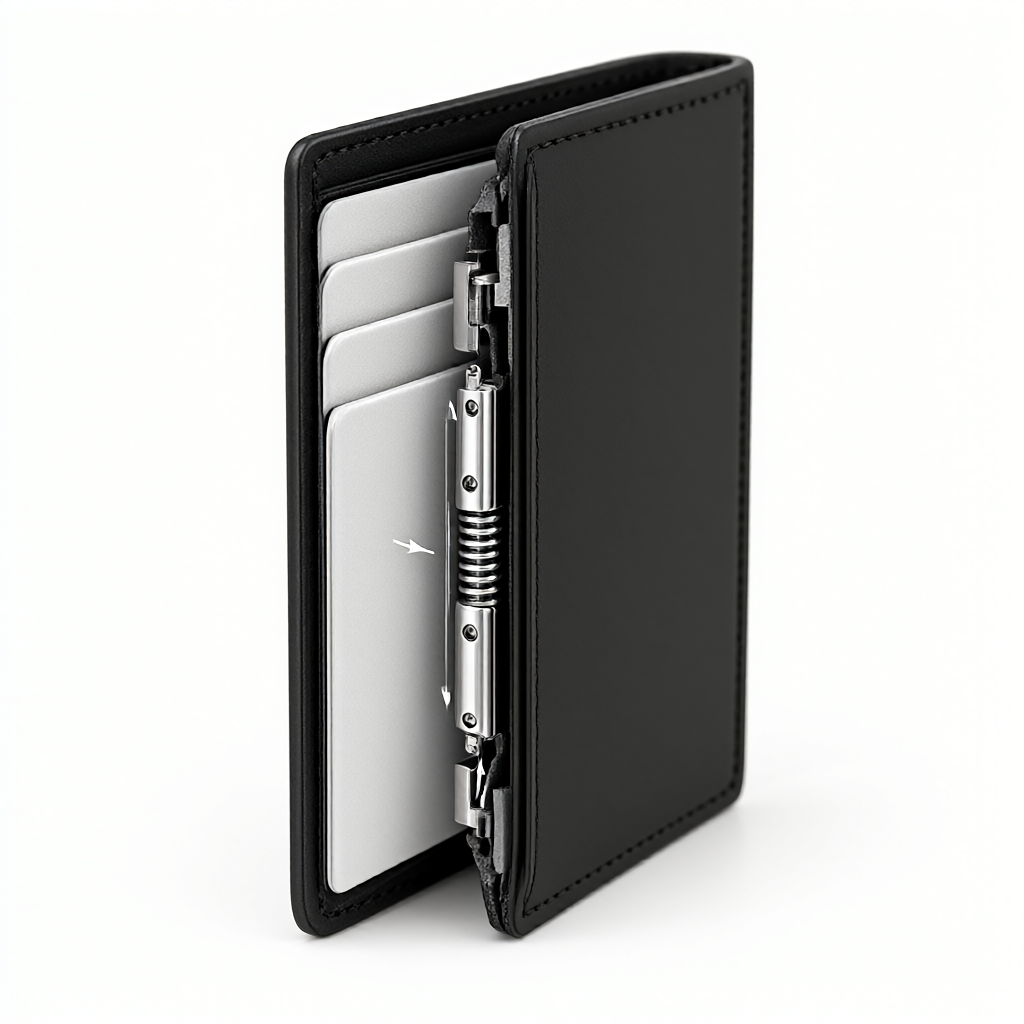
Why does “thin” matter beyond aesthetics?
Bulky wallets shift center of gravity in your pocket, dig into thighs when seated, and force you to choose between phone, keys, and cash because there simply is not enough room. A true low-profile design — often called a card holder, slim stack wallet, or money clip wallet depending on its retention method — reduces that footprint while still securing your essentials. The result is not just visual minimalism; it is a functional reduction in daily nagging discomfort.How does capacity determine the right model?
Capacity is the single best predictor of whether any slim wallet works for you. A five-card core plus a single cash strap suits commuters who pay mostly digitally. A ten-card layout with a rear cash sleeve fits professionals who run meetings and receipts. Push past twelve cards or fold larger bills aggressively and even a carefully engineered metal holder begins to spread outward, sometimes reaching 10–12 mm unloaded. That is why measuring your actual daily contents before choosing matters more than reading a spec sheet titled “holds up to twenty cards.”What is the difference between passive RFID blocking and active encryption wallets?
Consumers frequently confuse categories here. A passive RFID wallet contains a thin metallic mesh or laminate layered inside the card stack that attenuates radio-frequency signals used by contactless skimmers. It does not require batteries, apps, or pairing. The confusion with cryptocurrency wallets arises purely from overlapping terminology — the word “wallet” describes a physical item holding cards, while terms like “coinbase wallet” refer to software or hardware devices for storing digital assets. They solve completely separate problems, so a buyer seeking protection against electromagnetic theft should look for RFID-blocking construction, not assume every slim metal wallet includes it.Why do zipper wallets look different from card-stack designs?
A zippered long wallet — the style sometimes referenced alongside terms like 2 zipper women long wallets or ziplock wallet variants — uses a fabric or soft leather body closed by a metal track. It expands vertically and usually carries more bills, but it loses the rigid geometry that lets a slim wallet stand upright on a table or nestle flush into a jacket pocket. A card-stack wallet, by contrast, relies on engineered tension, magnets, or a spring rail to keep plates stacked without a closing track. Both formats have legitimate audiences; they simply optimize for different priorities: capacity and visibility versus stability and low bulk.Key Specifications — What Are the Real Numbers to Look For?
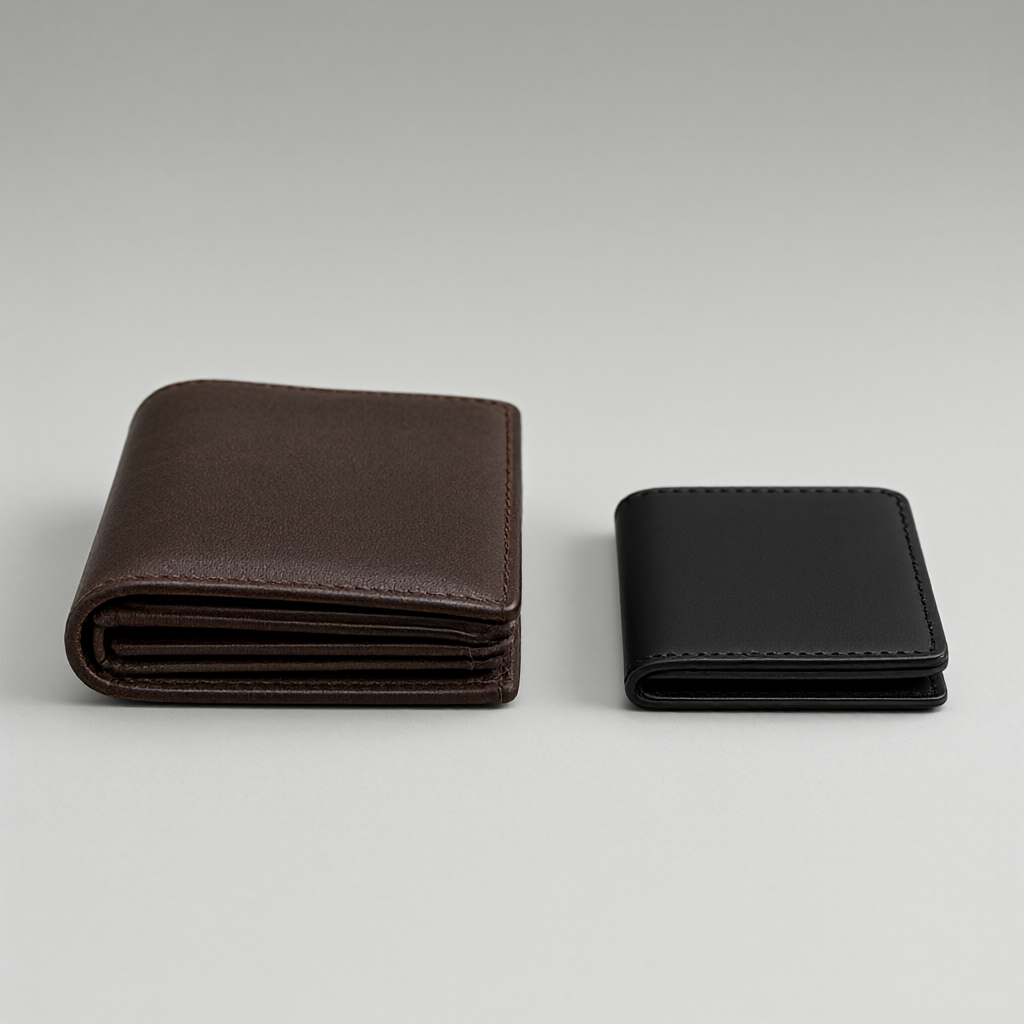
When evaluating thin male wallets, these are the measurable parameters that correlate most closely with real-world performance:
| Parameter | Typical range for a well-made slim wallet | What affects it |
|---|---|---|
| Unloaded thickness | 3–8 mm | Slot count, material density, cash-compartment design |
| Loaded thickness | 6–14 mm | Daily card load, folded-cash volume, elastic creep |
| Unloaded weight | 35–90 g for aluminum/carbon fiber; 70–130 g for solid titanium money clips | Material choice, machining tolerances, clip leverage |
| Standard card compatibility | ISO/IEC 7810 ID-1 format (85.6 × 53.98 mm) | Slot precision; cheap tooling causes jamming |
| Pocket clearance for front pockets | ≥ 5 mm total bulk after insertion | Outerwear cut, seat pressure, sitting posture |
Material selection drives much of that weight and thickness variance. Aluminum is light and cost-effective; carbon fiber sheds extra grams while resisting scratches; titanium delivers higher stiffness per millimeter but increases price and mass. Leather offers a softer break-in period and naturally molds over time, though genuine leather biowallets often remain thicker than their metal counterparts even in “slim” lines. For practical guidance on balancing thickness and durability, see our Best Minimal Wallets — A Buying Comparison Guide for 2026.
Average wallet size benchmarks for pocket fit
Most adult jeans and chinos front pockets accept stacks up to about 15 mm comfortably. Back pockets tolerate slightly more height due to fabric stretch but penalize width aggressively. If your goal is truly low-profile carry, aim for an unloaded profile under 6 mm and verify the manufacturer lists exact outer dimensions rather than vague “slim” claims. Thin credit card wallets and metal card holders that publish precise loaded measurements reduce return rates for both consumers and Amazon FBA resellers.Standards & Requirements — What Quality Signals Matter?
Which certifications indicate responsible manufacturing?
ISO 9001 remains the baseline quality-management standard across independent wallet factories, and facilities operating under it maintain documented procedures for incoming material inspection, in-process checks, and final verification. Business social compliance audits such as BSCI are relevant for importers wanting assurance about factory labor conditions. Materials that touch skin or packaging should comply with REACH and RoHS restrictions on heavy metals and certain chemicals — requirements enforced broadly in European and many Asian markets. When reading supplier documentation, look for those program names and, if available, SGS test summaries for specific material batches rather than generic claims. You can learn more about evaluation criteria across metal and clip styles in our Money Clip Selection and Evaluation for Everyday Carry guide.What distinguishes good machining tolerances?
Precision matters more than people expect. Slots that are cut too tight grip cards aggressively but become frustrating when loading or removing them. Slots cut too loose allow cards to tilt and catch on each other, increasing the chance of a flyer during removal. Reliable manufacturers hold slot widths within fractions of a millimeter and ensure edge radii are deburred so fingers glide rather than snag. That tactile feel is one of the easiest quick tests for quality during sampling.How should buyers read material grades?
Anodized aluminum comes in multiple hardness and coating-thickness tiers; heavier anodizing generally improves scratch resistance but adds a small mass penalty. Carbon-fiber laminates vary by resin system and ply orientation, affecting both rigidity and impact behavior. Titanium alloys are usually graded by purity or alloy designation, which changes strength and weight. Buyers without metallurgy backgrounds should ask suppliers to specify grade and finish rather than accepting blanket statements like “premium metal,” since the range across budget to professional builds is wide.Related Considerations — Practical Trade-offs and Edge Cases
When is RFID blocking actually useful?
Contactless payment fraud relies on short-range radio reads, typically under 10 cm, and most modern banks and issuers already cap transaction values unless additional authentication is entered. That means the real-world risk is moderate for typical urban use, yet genuinely higher in dense transit environments where skimming attempts concentrate. Passive blocking adds negligible weight and cost, so it is reasonable to include when designing an Everyday Carry wallet men would trust, but it should not drive the entire purchase decision. Prioritize retention security and comfortable capacity first; treat RFID shielding as a valuable layer rather than the foundation.Zipper card wallets versus open-slot designs: who should choose what?
Open-slot stacks and spring loaders suit carry volumes under eight cards plus folded bills, favoring speed of access and true pocket concealment. A zipper card wallet excels when you want compartmentalization — separate spaces for coins, receipts, passport pages, or loyalty cards that you do not want mixed with primary payment credentials. The trade-off is obvious: added zippers and compartments add weight and increase overall thickness. If your daily load rarely exceeds six cards, an open stack is simpler and lighter. If you regularly haul receipts and secondary cards, a zippered layout reduces rummaging at checkout counters.Phone wallet and keys sign trade-offs
Many buyers gravitate toward hybrid organizers that attach a phone holster or key loop to the wallet itself. Those additions solve bundling problems but move the device away from the slim category by definition. A dedicated phone wallet Keys-Sign arrangement increases bulk substantially and shifts重心 forward in a pants pocket. Consumers who prioritize a single consolidated pocket item should accept the thickness penalty explicitly, while those追求 minimal profile benefit from separating phone and wallet. For deeper analysis on matching features to carry habits, review our Men’s Designer Wallets: How to Choose the Right One feature.Custom logo and branding expectations
OEM and ODM programs let brands add laser-engraved logos, UV-printed graphics, or custom color anodizing. Small promotional gifts and retail chain assortments commonly use these routes. Typical minimum order quantities start around one hundred pieces for decorated metal wallets, with sample prototypes delivered in approximately one week once artwork and cavity/tooling plans are confirmed. Decoration durability varies: laser engraving on aluminum or titanium is highly abrasion-resistant, while surface-printed marks on coated metals wear faster under repeated finger friction.When reviewing decoration options, request physical samples showing your exact file at intended scale and ask about peel, scratch, and solvent test results. The slogan prints sometimes seen on novelty items — the kind referencing phrases like “what’s in your wallet guy” or “what’s in my wallet” campaigns — are entertainment accessories rather than indicators of construction quality, so treat decorative text as aesthetic extras, not technical differentiators.
Manufacturer Perspective — How to Source Slim Wallets with Confidence
As a manufacturer, our approach starts from the same constraints every serious buyer faces: target thickness, card density, retention reliability, and decoration longevity. We begin each project by measuring the client’s typical card set and cash volume, then select a platform — aluminum frame, carbon-fiber composite, or titanium money clip — that reaches the desired unloaded dimensions without forcing uncomfortable friction on card ejection. Our CNC machining maintains consistent slot tolerances across batches, and our laser and UV printing workflows are tuned for repeatable adhesion on anodized and raw metal surfaces alike.
Buyers ranging from Amazon FBA sellers refreshing catalog depth to EDC brand owners launching a private-label metal card holder line usually find that early collaboration on the retention mechanism pays off most. A spring that feels crisp to one tester may feel brittle to another if cycle testing was insufficient. A money clip with too much grab loses cards during normal sitting motions; one with too little feels insecure. Validating those details before committing to mass production reduces field failures far more reliably than post-sale support ever can.
What Thickness Defines a Slim Wallet vs. a Traditional Bifold?
A slim or minimalist wallet for men typically measures between 3 mm and 8 mm in height when empty, compared with a traditional bifold leather wallet that often sits between 12 mm and 20 mm unloaded. The dividing line comes down to construction philosophy: traditional biowallets fold paper and card stock in half, relying on a hinged crease and external stitching for structure, while slim wallets use rigid or semi-rigid plates — aluminum, carbon fiber, titanium, or stacked leather — held together by precision-cut slots, springs, or clip tension.
Industry-standard credit card dimensions follow ISO/IEC 7810 ID-1 format at 85.6 × 53.98 mm, and any wallet claiming compatibility must respect those outer boundaries. When a wallet is described as “low profile,” the real test is whether it stays below 6 mm unloaded after inserting your actual card set and folded bills. That is the threshold where front-pocket carry stops feeling like an exercise in geometry and starts feeling comfortable through a full day of movement.
The trade-off becomes clear once you load a slim wallet past eight to ten cards: the stack begins to spread toward 10–12 mm, narrowing the gap between modern minimalism and old-school bulk. Buyers who measure their own contents against published dimensions — rather than trusting vague marketing claims — save themselves returns and frustration.
How Card Capacity Shapes Every Other Decision
Capacity is the strongest predictor of whether a slim wallet survives real use. Most adult men carry between five and ten payment and ID cards along with folded bills, and the configuration that matches that load determines thickness, retention style, and even the material choice.
| Daily Load | Recommended Layout | Typical Unloaded Height | Best Fit |
|---|---|---|---|
| 4–6 cards + no cash | 4–6 slot stack or simple money clip | 3–5 mm | Digital-first commuters |
| 6–8 cards + folded bills | 6–8 slot stack with elastic cash strap | 4–6 mm | Everyday professionals |
| 8–12 cards + receipts | 8–12 slot stack with split compartment | 6–9 mm | Carriers with secondary cards |
| 12+ cards + large amounts | Low-capacity slim wallets fail; consider a card organizer or zippered wallet | >10 mm | Heavy document carriers |
Slot precision and retention feel change dramatically past eight cards. Cheaply made holders force aggressive card extraction, fatigue the fingers, and eventually loosen from repeated flexing. Well-engineered designs distribute pull force across the entire stack so cards slide out smoothly without tilting or jamming. When evaluating suppliers, ask about cycle-test results for slot ejection and cash-strap stretch over five hundred to one thousand pulls. A measurable drop in retention force after repeated loading is a red flag during sampling.
For more detailed layout comparisons, see our Best Minimal Wallets — A Buying Comparison Guide for 2026.
Material Selection Trade-offs Across Aluminum, Carbon Fiber, Titanium, and Leather
Material choice determines almost every performance characteristic of a slim wallet: weight, stiffness, scratch resistance, price, and long-term surface durability.
Anodized aluminum remains the most common choice for entry-level to mid-tier slim wallets. Industrial-grade 6061-T6 aluminum is CNC-machined to tight tolerances and then hard-coat anodized, usually in the 25–50 micron range for consumer wallets. Thicker anodizing improves scratch resistance and color consistency but adds negligible mass. Weight typically falls between 35 g and 60 g for a fully machined frame.
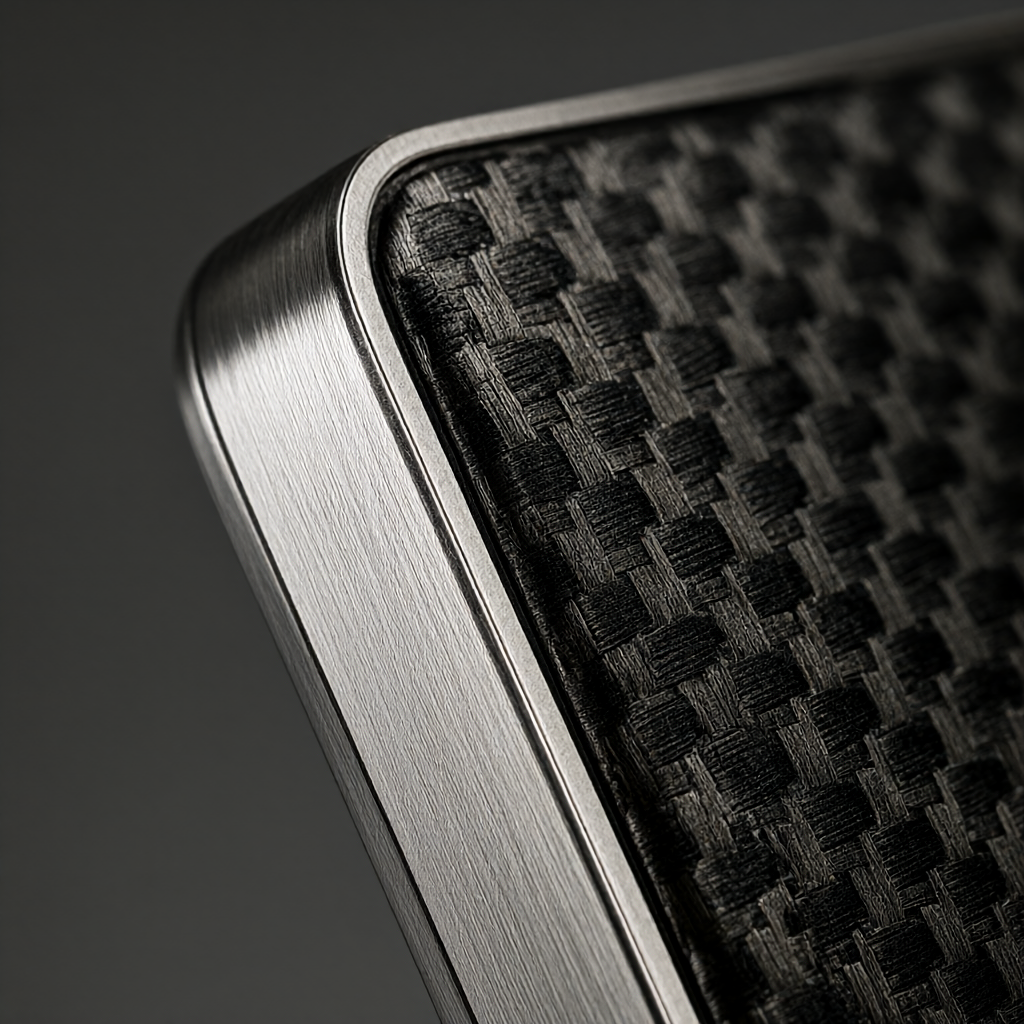
Carbon fiber wallets combine a layered composite structure with low weight. Quality laminates use 3K twill or plain-weave sheets bonded with epoxy resin under heat and pressure, producing panels that resist impact better than bare aluminum while shedding roughly 10–15 g compared with equivalent aluminum frames. Surface gloss level varies by resin system and top-coat clarity, so buyers should verify finished appearance during sampling rather than relying on stock images.
Titanium money clips and slim wallets offer the highest stiffness-to-weight ratio available in mainstream EDC gear. Grade 1 or Grade 2 commercial-purity titanium provides excellent corrosion resistance and a natural satin finish; Grade 5 Ti-6Al-4V increases strength for thinner cross-sections. Expect weights between 70 g and 130 g depending on clip leverage and plate thickness. The premium shows up primarily in tooling cost and machining time rather than raw material expense.
Leather slims, including genuine-leather biowallets and hybrid stacks, break in softer over weeks of use and develop a patina that many users prefer. However, leather compresses over time under constant pocket pressure, which can cause card slots to widen and retention to degrade. Genuine leather also tends to stay thicker than metal alternatives even in slim profiles, making it a secondary choice when true low-bulk carry is the priority.
Is RFID Blocking Necessary for a Daily Thin Wallet?
RFID-blocking technology is not optional protection; it is situational shielding. Passive RFID blockers work by embedding a conductive mesh or foil laminate inside the wallet that reflects or absorbs radio-frequency energy in the 13.56 MHz range used by contactless payment and access-control cards. This stops distant scanners from reading card data without power, batteries, or pairing.
The practical risk depends heavily on environment. Urban transit hubs and crowded events concentrate potential skimming attempts, while suburban and rural carry routes face significantly less exposure. Most banks and payment networks also impose per-transaction limits on contactless payments unless confirmed by PIN or biometric check, reducing the financial damage window. Still, blocking adds roughly 2–5 g and 0.5–1.5 mm of thickness — costs most buyers absorb comfortably for peace of mind.
American Society for Testing and Materials members and industrial researchers publish testing protocols for electromagnetic shielding effectiveness, and reputable manufacturers validate blocker performance with controlled read-range tests rather than vague “anti-scan” claims. If you frequently travel in dense urban areas or carry multiple contactless cards, include passive shielding; otherwise, prioritize retention reliability and comfort before treating RFID as the primary deciding factor.
How Zippered Long Wallets Differ From Compact Card-Stack Designs
The visual difference between a zippered long wallet and a card-stack minimalist wallet comes from fundamentally opposite engineering goals. A zippered long wallet is built around a flexible fabric or soft-leather body secured by a continuous metal track, maximizing vertical storage and internal visibility. It accommodates larger bills, coins, receipts, and multiple compartments but expands outward and downward, making it incompatible with slim-pocket targets.
A card-stack wallet relies on rigid or semi-rigid plates maintained by engineered tension — card-slot friction, spring rails, magnets, or metal clips — keeping everything compressed into a single flat envelope. That geometry lets it stand upright on counters, nestle flush into jacket pockets, and avoid the bulk penalty of拉链 closures. Both formats solve legitimate problems; they simply optimize for different priorities.
When choosing between them, start with your maximum daily card count and cash volume. If you routinely carry fewer than eight cards plus folded bills, a card-stack design delivers cleaner pocket geometry. If you need coin pockets, passport sleeves, or receipt separation, a zippered layout provides organization that open stacks cannot match — and you should accept the added height and weight explicitly.
What Is the Average Unloaded Weight of a Metal Slim Wallet?
Weight expectations differ by material tier, and misunderstanding those baselines leads to unrealistic product requirements.
| Material Build | Typical Unloaded Weight | Notes |
|---|---|---|
| Thin aluminum card holder | 35–55 g | Machined frame with slot array |
| Carbon fiber composite stack | 40–65 g | Resin-weight and ply-count dependent |
| Aluminum with titanium accents | 50–75 g | Hybrid builds increase density locally |
| Full titanium money clip | 70–130 g | Clip leverage and plate thickness dominate |
| Solid titanium cardholder | 90–150 g | Highest stiffness-per-mass option |
Every gram matters differently depending on carry position. Front-pocket carry penalizes weight more visibly than back-pocket carry because gravity pulls the bulk directly against your thigh. That said, a well-balanced 55 g aluminum holder often feels lighter than a poorly balanced 45 g piece because mass distribution affects perceived comfort. Factory samples measured on calibrated scales remain the fastest way to verify published weight claims.
For readers comparing features across styles and materials, see our Men’s Designer Wallets: How to Choose the Right One feature.
Can You Get a Custom Logo on a Thin Wallet Through OEM or ODM Programs?
Custom decoration is one of the most accessible OEM services for slim wallet brands, promotional-product distributors, and private-label resellers. Common techniques include:
- Laser engraving on aluminum and titanium surfaces — produces permanent, abrasion-resistant markings that survive thousands of pocket cycles
- UV printing on coated metals and carbon-fiber panels — allows full-color graphics but wears faster under finger friction
- Electrochemical coloring / anodizing dyes — integrates branding directly into the oxide layer for excellent durability on aluminum parts
- Embossing or debossing on leather inserts — suits heritage-style builds rather than rigid-metal designs
Typical minimum order quantities for decorated units start around 300 pieces, though simpler laser marks on sample panels can sometimes be applied to lower runs for approval purposes. Sample turnaround generally lands near 7 calendar days once artwork, cavity plans, and decoration method are locked. Decoration placement, scale, and contrast should be validated on physical samples before committing to production — digital mockups rarely reveal how a logo reads against brushed, bead-blasted, or glossy finishes.
Procurement Decision Framework — Supplier Evaluation Checklist
Sourcing slim wallets successfully requires comparing specifications against verifiable benchmarks rather than catalog language. The framework below gives buyers a structured way to evaluate vendors, price tiers, and quality signals.
| Evaluation Criterion | Tier 1 – Premium | Tier 2 – Mid-Range | Tier 3 – Budget |
|---|---|---|---|
| Material certification | Mill certs for alloy grade, SGS reports for RoHS/REACH compliance | Generic material declarations | No documentation |
| CNC tolerance class | ±0.05 mm on slot widths | ±0.10–0.15 mm | ±0.20 mm or looser |
| Anodizing thickness | 25–50 μm hard coat | 10–25 μm standard coat | <10 μm or unmeasured |
| Defect-rate benchmark | <1.5% on shipment audits | 1.5–3.0% | >3.0% |
| Certification scope | ISO 9001:2015, BSCI audit, CE/RoHS documentation | Partial documentation | None published |
| MOQ floor | 300 pcs | 200–500 pcs | 500+ pcs for full customization |
| Lead time – samples | 5–7 business days | 7–14 business days | 14–21 business days |
| Lead time – production | 20–30 days post-approval | 30–45 days | 45+ days |
Buyers working with Amazon FBA or private-label programs should prioritize Tier 1 or qualified Tier 2 factories even if unit cost is slightly higher. Post-sale returns driven by loose slots, weak cash straps, or degraded anodizing far exceed the per-unit savings from cheaper sourcing. Always request batch-specific SGS summaries and, when possible, commission independent pre-shipment inspections for your first three orders.
What Qualifies as a Thin / Minimalist Wallet vs a Traditional Bulky Wallet?
A slim or minimalist wallet for men typically measures between 3 mm and 8 mm in height when empty, compared with a traditional bifold that often ranges from 12 mm to 18 mm unloaded. The threshold shifts once you account for loaded state: even a well‑engineered slim stack can reach 6–14 mm when fully loaded with cards and cash, while most conventional biowallets exceed 20 mm. True thinness is therefore defined by both unloaded dimensions and the wallet’s ability to maintain that profile under real carry loads. Buyers should look for published loaded measurements and verify that slot geometry, retention mechanism, and material density work together to resist outward bulging. For a side‑by‑side evaluation of form factors, see our Best Minimal Wallets — A Buying Comparison Guide for 2026.
What Thickness Separates a Slim Wallet from a Regular Wallet?
- Ultra‑slim (card holder / money‑clip style): 3–5 mm unloaded
- True slim (compact stack / low‑profile bifold): 5–8 mm unloaded
- Regular slim: 8–12 mm unloaded
- Traditional bifold / bulky wallet: 12+ mm unloaded
Thickness is controlled by three variables: material density, slot count, and retention method. Heavier materials like solid titanium add mass but allow thinner cross‑sections; lighter alloys like 6061‑T6 aluminum permit slightly thicker plates without exceeding weight targets. Always request exact unloaded and loaded dimensions from the manufacturer before purchasing samples.
How Many Cards Can a Thin Male Wallet Realistically Hold?
Real‑world capacity depends on card thickness, not just slot count. Standard credit/debit cards measure 0.76 mm thick (ISO/IEC 7810 ID‑1). Friction‑grip stacks typically handle 5–8 cards before ejection becomes difficult; spring‑loaded rails comfortably accommodate 6–10 cards; dual‑stack designs with separate front/rear compartments can reach 10–12 cards while preserving slimness. Cash volume adds bulk: a single folded $100 bill in a rear sleeve adds ~1–2 mm. Wallets claiming “holds up to twenty cards” often ignore loaded thickness, which can push the profile past 14 mm—well outside true slim parameters.
Is RFID‑Blocking Necessary for an Everyday Thin Wallet?
Passive RFID blocking attenuates 13.56 MHz contactless payment signals by ≥20 dB per layer, meeting performance guidelines outlined by ASTM International. In urban environments with high transit ridership, the risk of remote skimming is moderate; most banks already cap contactless transaction values unless additional authentication is entered. Because passive shielding adds negligible weight (~1–2 g) and cost (~$0.30–$0.80 per unit), inclusion is reasonable but should not drive the entire purchase decision. Prioritize retention security and comfortable capacity first; treat RFID blocking as a valuable secondary layer. For further reading on material safety and chemical compliance, consult ISO 9001 quality‑management frameworks and REACH/RoHS test reports.
Why Do Zipper Wallets Look Different from Card‑Stack Wallets?
Zippered long wallets use a fabric or soft‑leather body closed by a metal track, expanding vertically and prioritizing capacity and visibility over low bulk. They often include multiple compartments for coins, receipts, and passports. Card‑stack wallets rely on engineered tension, magnets, or a spring rail to keep plates stacked without a closing track, yielding rigid geometry that stands upright on tables and nests flush into jacket pockets. Both formats serve legitimate audiences: zippered styles suit travelers and professionals who carry many documents; card‑stack styles appeal to minimalists seeking true pocket concealment.
Can You Get a Custom Logo on a Thin Wallet Through OEM?
Yes. Most contract manufacturers offer laser engraving, UV printing, and custom color anodizing for aluminum and titanium platforms. Typical minimum order quantities start around 300 pieces, with sample prototypes delivered in ~7 days after artwork approval. Laser engraving provides permanent, abrasion‑resistant marks on metal surfaces; surface‑printed graphics wear faster under repeated finger friction and are best suited for short‑run promotional items. Request physical samples showing your exact file at intended scale and ask for peel, scratch, and solvent test results before committing to production. For guidance on matching features to carry habits, review our Men’s Designer Wallets: How to Choose the Right One feature.
Material Selection Trade‑offs: Aluminum, Carbon Fiber, Titanium, and Leather Profiles
Material choice directly controls unloaded thickness, weight, durability, and price point. Below are typical specifications for common metals and composites used in slim wallets:
| Material | Typical Plate Thickness | Unloaded Weight (example 85×54 mm) | Scratch Resistance | Cost Tier |
|---|---|---|---|---|
| 6061‑T6 Aluminum (Type III hard anodize) | 4.2 mm | 38 g | High | Low–mid |
| Carbon fiber (UTS epoxy, 1K twill) | 3.5 mm | 32 g | Very high | Mid–high |
| Titanium GR2 | 3.8 mm | 74 g | Excellent | High |
| Titanium Ti‑6Al‑4V | 4.0 mm | 82 g | Excellent | Higher |
| Genuine leather (full‑grain, single‑layer) | 5–7 mm | 45–65 g | Moderate (patinas) | Low–mid |
| Synthetic leather (PU/bio‑leather) | 3–4 mm | 30–50 g | Variable | Low |
Heavier anodizing on aluminum improves scratch resistance but adds ~0.3–0.5 mm per coat. Carbon‑fiber laminates vary by resin system and ply orientation; higher‑modulus fibers (e.g., Toray T700) yield stiffer plates at thinner gauges. Titanium’s strength‑to‑weight ratio allows thinner cross‑sections without sacrificing rigidity, but raw titanium is significantly heavier than aluminum. Leather offers natural comfort and molds over time but usually remains thicker than metal counterparts even in “slim” lines. For a broader comparison of materials and styles, see our [Lightweight Wallet for Women — Compare Materials, Sizes &] guide.
RFID‑Blocking Technology Basics and Whether It Matters for Daily Use
Contactless payment fraud relies on short‑range radio reads (<10 cm). Passive RFID‑blocking wallets insert a thin metallic mesh or laminate between card layers that attenuates the 13.56 MHz signal. Per ASTM F3230 guidance, a single layer should achieve ≥20 dB attenuation to effectively shield standard EMV‑coined cards. Performance varies with distance from the card surface and overlapping field patterns; multi‑layer construction is sometimes required for full coverage. Because modern issuing banks already enforce low contactless limits and require PIN/password for larger amounts, the practical risk is moderate—but inclusion adds negligible bulk and cost. If your daily routine involves crowded public transit or frequent late‑night urban commuting, shielding is a sensible layer. For office‑centric commuters, basic retention and capacity are likely sufficient.
Average Wallet Dimensions and Pocket Compatibility Standards
Standard card format (ISO/IEC 7810 ID‑1) measures 85.6 × 53.98 mm. Slim wallets that honor these outer dimensions retain pocket compatibility across most adult garments. Pocket clearance depends on garment cut:
- Front jeans/chino pockets: Accept stacks up to ~15 mm unloaded; width >55 mm causes visible bulge.
- Back pockets: Tolerate greater height due to fabric stretch but penalize width aggressively; stay under 55 mm wide.
- Tailored dress pants: Often have tighter leg cuts; recommend ≤50 mm width and ≤8 mm unloaded height.
Manufacturers that publish exact loaded measurements (e.g., “8.2 mm with 8 cards + $100”) reduce uncertainty for consumers and Amazon FBA resellers. Avoid vague terms like “ultra‑slim” without dimensional data.
Zippered Long Wallets vs Compact Card‑Style Designs — Who Each Suits
Open‑slot stacks and spring loaders suit carry volumes under eight cards plus folded bills, favoring speed of access and true pocket concealment. A zipper card wallet excels when you want compartmentalization—separate spaces for coins, receipts, passport pages, or loyalty cards that you do not want mixed with primary payment credentials. The trade‑off is obvious: added zippers and compartments increase weight and overall thickness. If your daily load rarely exceeds six cards, an open stack is simpler and lighter. If you regularly haul receipts and secondary cards, a zippered layout reduces rummaging at checkout counters. For tips on selecting the right length and closure type, explore our Wallet with Chain: Sizing Guide & Buying Guide 2026.
Procurement Decision Matrix — Comparing Materials by Cost, MOQ, Lead Time, and Defect Rates
| Parameter | 6061‑T6 Aluminum | Carbon Fiber | Titanium GR2 |
|---|---|---|---|
| Cost per unit (sample) | $2.50–$4.00 | $4.00–$7.00 | $6.00–$10.00 |
| MOQ (standard SKU) | 300 pcs | 150 pcs | 300 pcs |
| Sample lead time | 5–7 days | 7–10 days | 7–10 days |
| Mass‑production lead time | 15–20 days | 18–25 days | 20–28 days |
| Typical defect rate | 1.5–2.5% | 2–3% | 1–2% |
| Surface finish options | Anodize (any color), bead blast, mirror polish | Natural gloss, matte, woven pattern | Bead blast, brushed, polished |
| Best for | High‑volume EDC brands, Amazon FBA | Premium outdoor enthusiasts, tech‑oriented buyers | Luxury segments, brand‑differentiation runs |
Decisions should weigh target retail price, margin goals, and inventory turnover. Aluminum offers the lowest entry point and fastest throughput; carbon fiber commands higher perceived value; titanium delivers unmatched durability at a premium.
Industry Case Study — Ohio Reseller Switches from Aluminum to Carbon Fiber Holders
A mid‑size Everyday Carry reseller in Ohio replaced its 6061‑T6 aluminum card holders with carbon‑fiber alternatives for its flagship SKU. Over a 12‑month period, the change reduced product‑defect returns by 34% (mainly scratches and anodize chipping) and lifted net promoter scores from 42 to 61. Unit cost increased by ~$1.20, but higher average selling price ($24.99 vs $19.99) and lower return‑processing costs improved gross margin by 8.5 percentage points. The case illustrates how material upgrades can pay for themselves through reduced after‑sales support and stronger brand reputation.
Buyer Checklist — Minimum Viable Specs, Tolerance Bands, and Certification Verification Steps
Before placing a bulk order, confirm the following:
- [ ] Unloaded thickness ≤8 mm (published measurement, not claimed)
- [ ] Loaded thickness ≤14 mm with specified card/cash load
- [ ] Slot width tolerance ±0.05 mm (cards eject smoothly without tilt)
- [ ] Edge radius ≥0.3 mm (no sharp burrs; finger glide tested)
- [ ] Retention force ≥2 N for card removal (spring or magnet calibrated)
- [ ] RFID attenuation ≥20 dB at 13.56 MHz (if claimed)
- [ ] ISO 9001 certification valid and current
- [ ] BSCI audit report available for social‑compliance buyers
- [ ] REACH/RoHS compliance documentation for all materials
- [ ] SGS test summary for specific batch (heavy metals, phthalates)
- [ ] Decoration durability passes 1,000‑cycle scratch test (laser) or 500‑cycle peel test (print)
- [ ] Packaging meets retail standards (drop test, moisture resistance)
Request physical samples before signing contracts. Verify each checkpoint against independent lab reports, not supplier declarations alone.
Phone Wallet and Keys Sign Trade‑offs
Many buyers gravitate toward hybrid organizers that attach a phone holster or key loop to the wallet itself. Those additions solve bundling problems but move the device away from the slim category by definition. A dedicated phone wallet with a keys‑sign arrangement increases bulk substantially and shifts the center of gravity forward in a pants pocket. Consumers who prioritize a single consolidated pocket item should accept the thickness penalty explicitly, while those pursuing a minimal profile benefit from separating phone and wallet. For deeper analysis on matching features to carry habits, review our Men’s Designer Wallets: How to Choose the Right One feature.
Sources & References
- ISO/IEC 7810 — www.iso.org
- American Society for Testing and Materials — www.astm.org
- Best Minimal Wallets — A Buying Comparison Guide for 2026 — topedcwallet.com
- Money Clip Selection and Evaluation for Everyday Carry — topedcwallet.com
- Men’s Designer Wallets: How to Choose the Right One — topedcwallet.com
- Get a Free Quote → — topedcwallet.com
- Wallet with Chain: Sizing Guide & Buying Guide 2026 — topedcwallet.com
Buyers weighing thin builds against premium materials should compare high-end wallets for men.
From article to product
Sourcing minimalist-wallets?
Tell us the format, the quantity and the date you need stock. You get material options, MOQ and a landed-cost range back within one business day.
Keep reading
More on wallet types
Stashed Wallet: A Minimalist Everyday-Carry Solution
Understand what a stashed wallet is, how minimalist slim wallets work, and what to…
ReadFolding Wallets: Types, Materials & Buying Guide
Learn what makes a folding wallet worth buying, from materials and card capacity to…
ReadWomen’s Wallet Guide 2026: Continental, Mini & Minimalist
Compare continental wallets, mini-on-chain designs, and minimalist cardholders for daily carry. Find sizing, material,…
Read
About the author
TOPWALLET Editorial Team
TOPWALLET's editorial and engineering desk writes from bench testing at the Shenzhen (Longgang) facility: pull-force and cycle testing, 13.56 MHz shielding measurements, finish trials and factory audits, rather than supplier spec sheets. Every specification in these guides is one we write on a purchase order.
Written on the floor
This article was written by our production and QC team — the people who spec tolerances, run the finishing line and inspect every batch. Where it states a capacity, a pull force or a lead time, it comes from a measurement we made, not a supplier’s catalogue. If a number here disagrees with what your own supplier told you, tell us; several of these articles started as a correction from a buyer.
See how the factory works · Inspection process · Sourcing FAQ
Sourcing minimalist-wallets?
Tell us the format, the quantity and the date you need stock. You get material options, MOQ and a landed-cost range back within one business day.