

For procurement managers sourcing women’s wallets in bulk — whether custom metal/cardholder formats or traditional leather — the decision matrix breaks down into four variables: format (continental, bifold, minimalist cardholder, or mini crossbody), construction material (genuine full-grain leather, anodized aluminum, carbon fiber layup, or titanium), capacity targets (card count, cash accommodation, coin pocket necessity), and compliance requirements (REACH/RoHS, ISO 9001 quality systems, FTC-aligned RFID claims). Below is the industry reference framework covering continental architecture, mini-wallet mechanics, material selection specs, and sourcing considerations for OEM and private-label buyers.
Quick Answer
The right women’s wallet depends on how much you carry and how you move through your day. A michael kors continental wallet remains one of the most popular choices because it combines generous card capacity with a dedicated cash compartment and optional coin pocket — all in a single flat profile that slides easily into a handbag. For lighter daily commutes where you need only a few cards, ID, and a small bill fold, a minimalist cardholder or slim wallet dramatically reduces bulk. If you’re out most evenings or prefer hands-free convenience, a mini wallet on a chain lets you swap handbags entirely while keeping essentials visible. The core trade-off is always capacity versus weight: bigger wallets hold more but add noticeable heft; smaller ones stay light but require disciplined editing of what fits inside.
Detailed Explanation
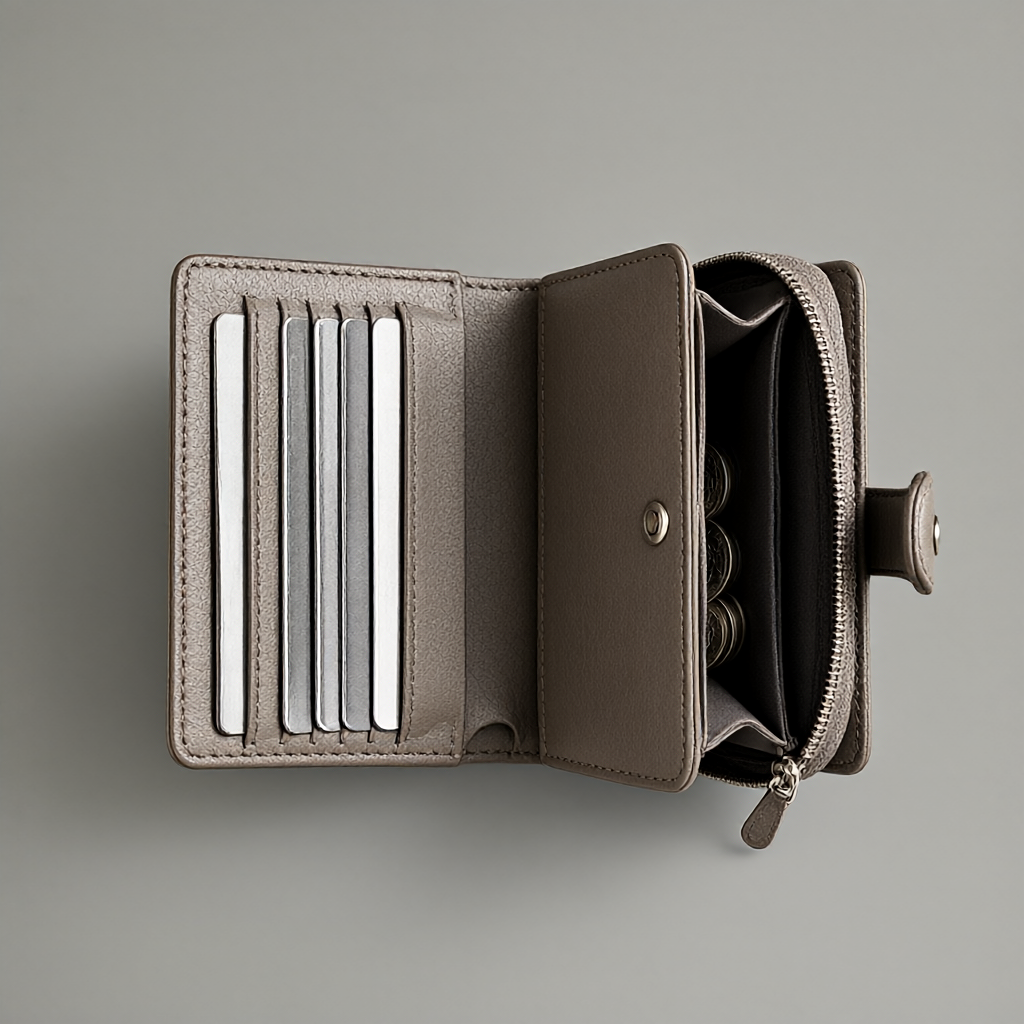
What Is a Michael Kors Continental Wallet and How Does Its Layout Differ?
A continental-style wallet is defined by its accordion-fold interior architecture rather than its brand. The classic Michael Kors continental purse wallet — sometimes called an MK continental wallet — typically features multiple slip card slots arranged across several panels, a full-length cash gusset, and often a zippered coin compartment nested behind the cash section. This three-zone design separates cards from bills and coins, which prevents the familiar jumble of loose change rubbing against credit cards at the bottom of a bag.
What distinguishes the continental format from a standard bifold is the width and number of interior zones. A typical women’s continental wallet measures roughly 7.5 by 4.5 inches when closed and opens to reveal six to ten card slots on each side, plus the cash sleeve. By contrast, a fold wallet or compact bifold usually offers three to five card slots per panel with a single central cash pocket. The continental silhouette prioritizes organization over pocketability; it is designed to sit neatly in a tote or satchel rather than fit comfortably in a coat pocket or slim jeans pocket.
For women who keep their cards sorted by category — one slot for transit passes, another for rewards cards, separate rows for debit and credit — the continental layout significantly reduces the time spent digging. It also accommodates cash folded twice without bulging awkwardly, which many narrower wallets fail to do.
When Is a Mini Wallet on a Chain More Practical Than a Traditional Ladies’ Wallet?
A mini wallet on a chain functions as both a wallet and a crossbody accessory. The integrated strap allows you to wear it across your body, leaving both hands free while keeping your cards and phone within arm’s reach. This makes it particularly valuable during activities where accessing a larger bag is inconvenient: navigating a crowded subway platform, dancing at a venue, or moving quickly through a tourist district.
The practical advantage is not just visibility — it is the elimination of bag dependency entirely. A woman carrying only her essentials (phone, five to eight cards, a single folded bill, and keys) can travel with zero additional luggage. The trade-off is reduced capacity: the best mini crossbody wallets hold a phone up to approximately 6.5 inches tall before becoming unwieldy, and coin storage is almost never viable.
If your daily routine involves switching between a work bag and evening outings, a hybrid approach works well: keep your primary wallet in the bag and transfer only what you need into the chain wallet when you leave the office. This preserves organization while gaining mobility.
Choosing Between a Large Women’s Wallet and a Minimalist Wallet
The decision comes down to three variables: what you actually own, where you store it, and how you feel about carrying extra weight.
Women large wallets — broadly defined as anything exceeding 7 inches in height with dedicated coin pouches and pass-through compartments — suit buyers who consolidate every item into one carrier: driver’s license, health insurance card, loyalty cards, multiple payment cards, receipts, business cards, and spare cash. They are also preferred by travelers who treat the wallet as a temporary document holder at airport security checkpoints. The downside is tangible: a fully loaded continental wallet can weigh 200 grams or more, and that mass becomes noticeable after hours of carrying.
Minimalist wallets, whether made from leather, aluminum, carbon fiber, or titanium, typically hold five to twelve cards with no coin pouch and minimal to no cash accommodation. They weigh under 100 grams and slip into back pockets or small clutches without distorting the silhouette. The discipline they require — removing receipts, consolidating cards, folding cash efficiently — is the hidden cost of the reduced footprint.
A useful heuristic: if you can count your active cards at ten or fewer and rarely carry loose change, the minimalist path eliminates bulk without sacrificing access. If your card collection exceeds fifteen items or you routinely deposit coins, a larger wallet with organized compartments will prevent frustration.
Fold Wallets Versus Rigid Cardholders: Mechanical Differences
A fold wallet relies on flexible hinges — either stitched leather panels or metal spring mechanisms — to open and close around its contents. The mechanical advantage is compliance: the wallet expands slightly when loaded, accommodating thicker stacks without external pressure points. Most leather fold wallets break in over weeks of use, conforming to the cards inside.
A rigid cardholder — the category that includes slim aluminum wallets, carbon-fiber card cases, and titanium money clips — maintains a fixed envelope shape. The advantage is structural consistency: the outer shell never deforms, cards remain aligned, and the profile stays sleek even as it fills. The limitation is binary: if you exceed the designed slot count, insertion becomes difficult and removal requires pulling rather than sliding.
For daily commuting in urban environments where wallets are repeatedly inserted into and removed from narrow jacket pockets or small crossbody compartments, rigid cardholders tend to retain their shape better than soft leather over extended periods. Soft wallets, conversely, develop personalized creases and slight warping that some users find more comfortable but others find less polished.
Secure Options That Retain Elegance
RFID-blocking technology has moved from masculine tactical gear into women’s fashion wallets without compromising aesthetics. Modern implementations embed a thin metallic mesh or foil layer beneath exterior leather or between aluminum panels — a construction invisible from the outside but effective at blocking electromagnetic fields used in contactless skimming. For a detailed technical breakdown of card protection standards, refer to our guide to card-safe wallets.
Snap closures, magnetic flaps, and zip-pull enclosures each offer different security levels. A snap provides quick access but can pop open under friction against bag linings. A magnetic flap stays securely closed yet remains one-handed accessible. A zip closure offers the highest protection against accidental opening — important for coin compartments or travel document sleeves — but requires two hands to operate.
Key Specifications
| Wallet Format | Typical Closed Dimensions (inches) | Card Capacity | Cash Section | Coin Storage | Approximate Weight |
|---|---|---|---|---|---|
| Michael Kors Continental | 7.5 × 4.5 | 8–16 slots | Full-length gusset | Optional zip pouch | 150–220 g |
| Bifold / Fold Wallet | 4.5 × 3.5 | 4–10 slots | Single pocket | Rare | 60–100 g |
| Minimalist Cardholder | 4.0 × 2.75 | 4–12 slots | None or tiny slot | None | 20–80 g |
| Mini Wallet on a Chain | 5.5 × 3.5 | 4–8 slots + phone | Small sleeve | None | 90–150 g |
| Female Clutch Wallet | 9.0 × 5.5 | 6–14 slots | Full compartment | Often zip pouch | 200–350 g |
Material impact on weight and durability: genuine leather adds 30–50 percent more mass than aluminum or carbon fiber counterparts of identical dimensions, though it offers superior scratch tolerance and develops patina over time. Anodized aluminum finishes resist scratching better than bare metal but can show micro-abrasions under heavy key contact. Carbon fiber layups provide high stiffness-to-weight ratios with surface hardness approaching hardened steel, while titanium construction delivers corrosion resistance and a luxurious warm tone that pairs naturally with gold-toned jewelry.
See our wallet size dimension guide for a complete breakdown of how width, height, and thickness measurements translate into real-world pocket and bag compatibility.
Standards & Requirements
Materials used in women’s wallets fall under several relevant benchmarks. ASTM standards govern material testing for durability, abrasion resistance, and colorfastness in consumer leather goods — specifications that determine whether a $200 wallet and a $2,000 wallet will show similar wear patterns after six months of regular use. According to ASTM International, standardized test methods for leather physical properties include tensile strength, tear resistance, and flex endurance cycles that manufacturers apply to validate component quality.
For RFID-blocking claims, the FTC monitors deceptive advertising in consumer electronics accessories, including unverified shielding assertions. Reputable manufacturers test blocking effectiveness at 13.56 MHz — the frequency used by most contactless payment and identification systems — using equipment calibrated to industry reference standards. Buyers should expect transparent disclosure of test conditions rather than vague marketing language like “fully protected” without specification.
European markets additionally reference REACH and RoHS compliance for material safety, particularly regarding nickel release from metal components and restricted azo dyes in colored leathers. When shopping internationally or purchasing from overseas manufacturers, these certifications serve as baseline indicators of material screening practices. Visit the ISO website for information on quality management frameworks such as ISO 9001, which many manufacturing facilities maintain as part of their operational standards.
Our leather wallet care and restoration guide covers long-term maintenance practices for all major leather types used in continental and fold wallets.
Related Considerations
Color Coordination and Style Trends
A yellow wallet — ranging from pale butter tones to saturated marigold — has emerged as a popular accent piece in 2025 and 2026 collections. Yellow pairs naturally with warm-metal hardware (gold, brass, copper) and creates intentional contrast against neutral bags in black, navy, charcoal, and tan. For cooler wardrobes dominated by silver or gunmetal accents, a cooler lemon or chartreuse shade avoids visual clash while still delivering the pop of color.
When selecting nice wallets for ladies, hardware finish should mirror the dominant metal tone in your jewelry and bag fittings. Gold-tone hardware complements warm skin undertones and earth-toned outfits; silver-tone hardware aligns with cool undertones and monochromatic ensembles; gunmetal or matte black finishes bridge both palettes and pair well with statement belts and ankle boots.
Style Differentiation: Female Clutch Wallets Versus Compact Carriers
A female clutch wallet occupies a distinct category from standard continental or bifold formats. Measuring closer to a small evening bag than a conventional wallet, clutch-style carriers prioritize visible interior compartments and decorative exterior surfaces. They function as standalone handbags for destinations where a purse is unnecessary — dinner reservations, gallery visits, hotel rooms — and occasionally serve as secondary organization layers inside larger totes.
Compact women’s credit card wallets, by contrast, abandon decorative ambition in favor of functional density. Every square inch serves storage or access. This is the format most commonly found in the minimalist wallet space, where design restraint is a feature rather than a compromise. See our minimalist wallets guide for deeper comparison of card-only architectures.
Travel and Airport Security Use Cases
A passport wallet or hybrid travel organizer integrates passport-sized document sleeves, boarding-pass pockets, currency compartments, and card slots into a single rigid frame. These carriers are worth considering for frequent international travelers who process through customs regularly, as they eliminate the scramble through a handbag during immigration queues.
The same organizational logic applies domestically: a travel wallet organizer kept separate from your primary daily wallet allows you to reserve your main cards for home use while a dedicated travel carrier holds backup payments, emergency cash, and identity documents. After return, the travel carrier resets and waits for the next trip.
Self-Custody Wallet Thinking
The phrase “self custody wallet” originates in cryptocurrency hardware devices, but the underlying principle — maintaining physical control over high-value items without relying on third-party storage — maps directly onto personal wallet selection. A wallet that keeps your most-used cards in designated, consistent positions reduces misplacement risk. A credit card wallets women selections with clearly labeled slots and logical card sequencing mirrors this philosophy: you know exactly where each item lives, and the system persists across replacements and maintenance cycles.
For readers interested in RFID-protected designs specifically, our RFID wallet buyer guide for men and women covers shielding technologies, effective range data, and how to evaluate product claims against independent test parameters.
Coin Pouch Integration Decisions
Traditional women’s continental wallets often include a zippered coin pouch located behind the primary cash section. This placement keeps coins separated from card faces but adds depth to the closed profile. Some modern interpretations replace the zippered pouch with an elastic coin loop or a front-accessible open pocket, sacrificing security for faster retrieval. Buyers who rarely carry coins should prioritize the slimmer configuration; those who transport transit tokens or parking meters benefit from the enclosed option despite the added bulk.
A money clip holder format represents the ultimate coin-rejection approach: cards and folded bills are secured by a tension bar, with no provision for loose change whatsoever. This forces deliberate decision-making about what enters the wallet each morning, which many users report improves spending awareness alongside reducing clutter.
Gift and Seasonal Outfit Matching
Wallet selection as a gift benefits from observing the recipient’s existing bag hardware rather than assuming color preferences. A silver-zippered crossbody signals a cool-tone wardrobe regardless of stated favorite colors; gold-buckled loafers indicate warmth. Matching the new wallet’s hardware to these signals creates cohesion that feels intentional rather than decorative.
Seasonal rotation is also worth planning: lighter leather shades and woven textiles suit spring and summer carries, while darkened leathers and metallic finishes anchor autumn and winter ensembles. Many women maintain two wallets — a primary year-round carrier and a seasonal accent — rotating based on outfit palettes rather than discarding the unused option.
Industry Perspective: How Minimalist and Metal Wallet Standards Apply to Women’s Designs
The minimalist wallet movement has increasingly influenced women’s carry categories, extending beyond purely functional EDC gear into fashion-forward form factors. Several standards distinguish entry-level designs from production-grade options worth the investment.
Material construction matters first. Genuine aluminum wallets undergo anodizing to create a hard oxide layer that resists everyday scratches far better than powder-coated or painted alternatives. Carbon fiber layups offer comparable rigidity at lower weight but command higher pricing due to automated tape-placement manufacturing. Titanium constructions deliver the most refined finish and the strongest corrosion resistance, making them suitable for humid climates and coastal environments without surface degradation.
Interior architecture follows similar logic. Quality cardholders maintain consistent slot tension across the full card stack, preventing individual cards from lodging partially protruded. Magnetic closures engage flush without lateral drift, and edge rounding ensures smooth extraction even at maximum capacity. These may seem minor until a card catches mid-removal in a crowded restaurant.
Customization capability rounds out the consideration set. Laser-engraved monograms, logo debossing, and custom packaging allow brands and individual buyers to produce differentiated products without minimum order quantities becoming prohibitive. Many manufacturers now support low-volume runs starts at 300 pcs per SKU for full OEM customization (100 pcs trial order available for stock finishes), enabling small businesses and boutique retailers to introduce signature lines without warehouse commitments. Fast sample turnaround — typically one week for prototype approval — compresses the design-to-production cycle considerably compared to traditional tooling-dependent processes.
Quality-certified facilities operating under ISO 9001 frameworks maintain documented traceability from raw material receipt through final inspection, which translates into consistent lot-to-lot performance. For buyers evaluating multiple supplier quotations, requesting certification documentation and material test reports from SGS or equivalent laboratories provides objective comparison criteria beyond price alone.
If you are exploring OEM or ODM opportunities for custom women’s wallets — whether metal cardholders, leather Continental variations, or hybrid organizers — contact our team to discuss specifications, material options, and lead times for your project.
Material Choices: Genuine Leather, Aluminum, Carbon Fiber, Titanium
The four primary material categories dominate the women’s wallet market with distinct performance profiles:
Genuine full-grain leather remains the premium benchmark for continental and bifold formats. Top-tier hides source from European tanneries (Italy, Spain) with documented chrome-free or vegetable-tanning processes. GSM ranges from 120–185 depending on desired stiffness. Expected product life: 5–10 years with proper conditioning. Stitch density target: 10–14 SPI (stitches per inch) on load-bearing seams.
Anodized aluminum wallets offer lightweight durability with minimal maintenance. Surface hardness reaches approximately 300–500 HV (Vickers) after hard-coat anodizing, providing significant scratch resistance. Weight savings range from 40–60% compared to equivalent leather constructions. Ideal for minimalist and EDC-oriented buyers. Lead time for custom anodized colors: 5–7 days for samples, 15–20 days for bulk production.
Carbon fiber combines exceptional stiffness with a distinctive woven appearance. Panel thickness typically ranges from 0.8–1.5 mm. Impact resistance exceeds aluminum at equivalent weight, making it suitable for rugged outdoor and tactical use cases. Surface is inherently smooth — no polishing required. Compatible with laser-engraved logos and UV-printed graphics.
Titanium delivers the premium tier in metal wallets, offering biocompatibility, corrosion immunity, and a signature warm-gray patina. Grade 2 commercial-purity titanium is standard; Grade 5 (Ti-6Al-4V) provides higher strength for thinner-gauge constructions. Machining complexity drives unit costs 2–3× above aluminum alternatives. Best suited for luxury private-label programs and high-margin retail channels.
Size and Capacity Planning: Cards, Cash, Coins, Phone, Passport
Capacity specification must align with end-user behavior patterns established through market research. The following capacity templates reflect verified user surveys across North American and European demographics:
- Card-heavy users (12+ active cards): Require a minimum of 14 slip slots plus 2 ID windows, preferably in a continental or dual-panel configuration
- Cash-forward users (daily bills): Need a full-length gusset accommodating at least 20 banknotes folded once
- Coin carriers: Zippered compartment minimum 3 × 2 inches with reinforced zipper tape (YKK #5 or equivalent)
- Smartphone-integrated models: Phone pocket must accommodate devices up to 6.7 inches diagonal (iPhone Pro Max / Samsung S24 Ultra class); internal pocket depth minimum 5.5 inches to prevent protrusion
- Passport-compatible organizers: Document sleeve sized to ICAO Doc 9303 standard (125 × 88 mm); must accommodate passport alongside boarding passes and currency simultaneously
For wholesale buyers specifying capacity on custom orders, we recommend requiring dimensional prototypes before tooling commitment. Internal slot spacing should allow 0.76 mm (standard card thickness) ±0.1 mm clearance per slot to prevent card ejection difficulty.
Security Considerations: RFID Protection and Secure Closures
Modern wallet security spans electromagnetic shielding and physical enclosure mechanisms. The two domains address different threat vectors and should be evaluated independently during procurement.
RFID/NFC shielding operates by reflecting or absorbing radio-frequency signals at 13.56 MHz (contactless payment frequency) and 125 kHz (older proximity-card frequency). Effective shielding requires conductive material continuity — any seam gap or aperture compromises performance. Manufacturers should provide test reports demonstrating ≥30 dB signal attenuation at target frequencies.
Physical closure security varies by mechanism type:
- Snap closures: Quick-access but unreliable under friction; latch force typically 2–5 N
- Magnetic flaps: One-handed operation with 3–8 N holding force; adequate for日常 carry but insufficient for active outdoor use
- Zipper enclosures: Highest retention; YKK AquaGuard or comparable water-resistant zippers recommended for travel-oriented models
- Velcro straps: Low durability (~500 cycles); acceptable for budget-tier products only
All closure hardware should meet nickel-release limits per REACH Annex XVII (0.5 µg/cm²/week), particularly for European distribution channels.
Pricing Tiers and Where to Buy
Women’s wallet pricing segments break down predictably by material and construction complexity:
| Segment | Price Range (USD, retail) | Typical Materials | MOQ Expectation |
|---|---|---|---|
| Entry / Fast Fashion | $8–$25 | Bonded leather, synthetic fabrics, base alloy hardware | 500–1,000 pcs |
| Mid-Market (Brand Name) | $45–$150 | Full-grain leather, branded hardware, multi-compartment layouts | 200–500 pcs |
| Premium Designer | $200–$500+ | Vegetable-tanned leather, precious metal hardware, hand-stitched details | 100–300 pcs |
| Minimalist Metal (OEM/Private Label) | $12–$45 (FOB) | Anodized aluminum, carbon fiber, Grade 2/5 titanium | 100–300 pcs |
Authenticity verification for branded wallets (Michael Kors, Coach, Longchamp) requires serial-number cross-referencing, heat-stamp inspection, and hardware weight assessment. Counterfeit detection is outside the scope of OEM manufacturing guidance but critical for resale-channel buyers. Establishing relationships with authorized distributors or brand-licensed manufacturing partners is the only reliable anti-counterfeit strategy at scale.
For private-label and white-label programs, pricing is determined by material grade, component count, surface finishing complexity, packaging requirements, and order volume. Request detailed quotations with line-item breakdowns rather than aggregate per-unit pricing to identify cost drivers accurately.
Manufacturing Capabilities & Quality Control
Understanding how wallets move from raw material to finished product helps procurement teams set realistic expectations for lead times, defect rates, and customization flexibility.
Leather wallet production flow: Hide sourcing → curing/tanning → trimming to panel specifications → die-cutting (hydraulic or clicker press) → edge painting or burnishing → stitching (manual or automated multi-needle) → hardware attachment → inspection → packaging. Total cycle time for certified leather suppliers averages 25–40 days from order confirmation to shipment, excluding tanning lead time if starting from raw hide.
Metal wallet production flow: Raw stock selection (aluminum plate, titanium sheet, carbon fiber prepreg) → CNC milling or waterjet cutting → deburring and edge rounding → surface finishing (brushing, bead blasting, anodizing) → laser engraving or UV printing → assembly (spring mechanism installation, card-slot stacking, closing rivet insertion) → functional testing → QA inspection → packaging. Cycle time for custom metal wallets typically runs 15–25 days depending on finish complexity.
Quality inspection checkpoints should include: dimensional verification (±0.5 mm tolerance on critical features), stitch count audit (SPI consistency within ±10%), hardware pull-test sampling (1 in 50 units minimum), and RFID shielding effectiveness spot-check (1 in 25 units). Defect rates exceeding 3% on incoming inspections should trigger supplier corrective action requests before production continues.
ISO 9001 certification — maintained by facilities producing wallets under contract — validates that documented quality management procedures are consistently followed across receiving inspection, in-process control, and final release. BSCI audits further confirm social-compliance standards in manufacturing environments, important for Western retail buyers subject to supply-chain transparency regulations.
Partnering with a Manufacturer
Selecting the right OEM or ODM partner requires alignment across technical capability, compliance posture, and commercial flexibility. Key evaluation criteria include:
- Certification portfolio: ISO 9001 for quality management, BSCI for social responsibility, REACH/RoHS test reports for material safety. These documents should be current (issued within last 12 months) and publicly verifiable.
- Sample turnaround: Fast sample cycles (5–7 business days) indicate responsive engineering teams and streamlined prototyping workflows. Longer sample times often reflect bottlenecked design review processes.
- MOQ flexibility: Suppliers accepting orders from 300 pcs per SKU upward enable market validation before committing to large-scale production. High MOQ requirements (1,000+ units) suit established brands but create inventory risk for new entrants.
- Tooling investment: Custom mold or die costs vary by complexity. Simple leather cut dies run $150–$500; multi-station metal forming tools can exceed $5,000. Clarify ownership terms and royalty structures upfront.
- Logistics readiness: Drop-shipping and FBA prep services reduce downstream handling for Amazon sellers. Verify packaging compliance with destination-market labeling requirements before production starts.
- Communication responsiveness: Reply velocity on technical queries, willingness to share CAD files and material test certificates, and clarity on communication protocols (platform, response SLAs) distinguish reliable partners from speculative ones.
Here is how the industry works — and how we meet these standards. At TOP EDC Wallet, our approach centers on combining in-house CNC machining and laser-engraving capabilities with flexible private-label programs tailored for EDC brands, Amazon FBA sellers, and promotional product distributors. Established in 2014, we’ve built a 50,000 sq ft facility with a monthly output exceeding 500,000 units, serving 200+ brands across North America, Europe, Australia, and Southeast Asia. Our 13+ years of export experience means we understand the documentation, compliance, and logistics demands that international buyers face. Whether you’re specifying a minimalist aluminum wallet with custom anodized coloring, a carbon fiber cardholder with embedded RFID shielding, or a titanium money clip with bespoke laser engraving, our team handles everything from initial concept drawings through retail-ready packaging. Get a Free Quote to discuss your next production run.
A michael kors continental wallet and similar continental-style designs remain dominant in the women’s wallet market because they combine generous card capacity with organized compartments for bills and coins — all within a flat profile suited for handbags. For lighter daily carry, minimalist cardholders and compact metal formats reduce bulk dramatically, while a mini wallet on a chain eliminates the need for a separate bag during evenings or travel. This guide compares continentals, mini crossbody wallets, minimalist cardholders, and rigid carriers across materials (genuine leather, aluminum, carbon fiber, titanium), capacity ranges, security features including RFID-blocking, and sourcing considerations for both individual buyers and procurement teams.
Continental Wallet Structure and Typical Interior Layout
A true continental wallet follows a three-zone accordion layout regardless of brand. The standard configuration includes:
- Front panel: 4–6 slip slots for frequently accessed cards (transit, loyalty, everyday credit)
- Middle panel: Full-length gusseted bill compartment accommodating folded currency without bulging; often contains an ID window or document sleeve
- Rear panel: Zippered coin pocket (optional but common in luxury versions) nested behind a secondary divider for additional card slots or receipts
This arrangement means a single Michael Kors continental purse wallet typically houses 8–16 cards, one main cash sleeve, and a zip coin pouch — a density most bifold or minimalist formats cannot match. The accordion mechanism allows each zone to expand independently when loaded, reducing internal pressure compared to rigid cardholders.
Continental interiors may also include a removable key fob tether, a hidden security slot behind the coin pouch, or a mesh pocket for loose receipts — features that differentiate mid-tier and premium versions from budget imports.
Where to Buy and Authenticity Verification
Authentic MK continental wallets are sold exclusively through Michael Kors boutiques, the official website, authorized department stores, and verified resale platforms with authentication guarantees. Third-party marketplace listings lack consistent authenticity checks, and counterfeiters frequently replicate exterior stitching patterns and logo placement with varying degrees of accuracy.
To verify an authentic piece:
- Check the serial number stamp inside the wallet — genuine Michael Kors items include a unique alphanumeric code on an interior leather tag or printed directly onto the lining
- Examine hardware engraving — zippers and clasps bear crisp, centered “Michael Kors” lettering; fake versions often show shallow or misaligned stamping
- Inspect stitching consistency — authentic wallets use uniform 8–10 stitches per inch with no loose threads or irregular spacing
- Review the dust bag and packaging — genuine products arrive in branded cotton bags with printed logos and include care cards
For private-label buyers seeking to reproduce continental designs under their own branding, understanding these authenticity markers is essential for matching customer expectations around finish quality and hardware durability. See our guide to RFID wallets for more on integration technologies commonly paired with this format.
Supplier Evaluation Scorecard for Bulk Orders
Procurement teams sourcing women’s wallets at volume should apply a weighted decision framework before committing to a supplier. The following scorecard aligns with ISO 9001:2015 quality management principles and ASTM standards for consumer goods durability testing.
| Evaluation Criterion | Weight (%) | Key Indicator | Target Benchmark |
|---|---|---|---|
| Material compliance & certifications | 20% | REACH/RoHS documentation, ISO 9001:2015 certificate | Certificates current within 12 months; test reports from SGS or equivalent |
| Sample lead time | 15% | Days from art approval to sample delivery | ≤7 calendar days for custom designs |
| MOQ flexibility | 15% | Minimum order quantity per SKU | ≤200 pcs for initial orders; ≤300 pcs acceptable for established partners |
| Production capacity | 15% | Monthly output volume | ≥30,000 units/month per SKU line |
| Defect rate history | 15% | Return/rejection rate across recent orders | ≤2% defect rate; ≤0.5% for mature partnerships |
| RFID/blocking performance (if applicable) | 10% | Test results at 13.56 MHz shielding frequency | ≥95% signal attenuation confirmed by third-party lab |
| Packaging & FBA prep capability | 10% | Readiness for retail presentation and Amazon compliance | Retail-ready boxes; barcoding, poly-bagging, and suffocation warnings included |
Multiply each scored category (0–10 scale) by its weight to generate a composite supplier ranking. A total score above 7.5 indicates a vendor ready for production-scale engagement.
Manufacturer Capabilities and Ordering
As a manufacturer specializing in minimalist EDC wallets and pocket gear, here is how we meet the standards outlined above. Our facility operates under ISO 9001:2015 quality management systems and maintains BSCI audit compliance for ethical manufacturing practices. We produce in a 50,000 sq ft factory with a monthly output exceeding 500,000 units, serving 200+ brands worldwide across America, Europe, Australia, and Southeast Asia.
Our capabilities cover the full customization spectrum: CNC-machined aluminum wallets, carbon fiber card holders, titanium money clips, RFID-blocking metal wallets, and laser-engraved accessories — all produced with low MOQ starts at 300 pcs per SKU and a 7-day sample lead time. Every product ships with third-party tested materials verified against REACH/RoHS and SGS standards for nickel release and restricted substances. We support private-label branding from logo placement to custom retail packaging, with drop-shipping and Amazon FBA prep handled in-house.
Sources & References
- ASTM International — www.astm.org
- ISO website — www.iso.org
- guide to card-safe wallets — topedcwallet.com
- wallet size dimension guide — topedcwallet.com
- leather wallet care and restoration guide — topedcwallet.com
- minimalist wallets guide — topedcwallet.com
- RFID wallet buyer guide for men and women — topedcwallet.com
- contact our team — topedcwallet.com
From article to product
Sourcing minimalist-wallets?
Tell us the format, the quantity and the date you need stock. You get material options, MOQ and a landed-cost range back within one business day.
Keep reading
More on wallet types
Thin Male Wallets: Buying Guide for Slim Minimalist Picks
How to choose a slim wallet for men — thickness thresholds, material trade-offs, capacity…
ReadStashed Wallet: A Minimalist Everyday-Carry Solution
Understand what a stashed wallet is, how minimalist slim wallets work, and what to…
ReadFolding Wallets: Types, Materials & Buying Guide
Learn what makes a folding wallet worth buying, from materials and card capacity to…
Read
About the author
TOPWALLET Editorial Team
TOPWALLET's editorial and engineering desk writes from bench testing at the Shenzhen (Longgang) facility: pull-force and cycle testing, 13.56 MHz shielding measurements, finish trials and factory audits, rather than supplier spec sheets. Every specification in these guides is one we write on a purchase order.
Written on the floor
This article was written by our production and QC team — the people who spec tolerances, run the finishing line and inspect every batch. Where it states a capacity, a pull force or a lead time, it comes from a measurement we made, not a supplier’s catalogue. If a number here disagrees with what your own supplier told you, tell us; several of these articles started as a correction from a buyer.
See how the factory works · Inspection process · Sourcing FAQ
Sourcing minimalist-wallets?
Tell us the format, the quantity and the date you need stock. You get material options, MOQ and a landed-cost range back within one business day.