

Quick Answer
A wallet with chain is a pocket wallet or card holder attached to a metal chain, worn across the body like a shoulder bag, belt-looped, or looped around a wrist or finger. It combines everyday card-carrying convenience with a security layer—the chain prevents someone from snatching it from your pocket in a crowd. For most buyers, the core sizing question boils down to three numbers: body dimensions, chain length, and card count capacity. A standard men’s chain wallet typically measures between 4.5 and 5.5 inches wide by 3.5 and 4.5 inches tall, holds 6 to 12 cards, and pairs with a chain 28 to 42 inches long depending on how it’s worn. If you’re shopping crossbody, aim for a longer chain; if you’re clipping it to your belt loop, a shorter 28–34 inch drop works best.
The same considerations apply whether you’re looking at traditional leather, a minimalist aluminum design, or a compact cool wallets option built for light-carry lifestyles. Before you commit, you also need to verify the chain gauge, clasp security, and RFID-shielding certifications if protecting your cards matters.
Size System — What Are the Standard Sizes for Wallets with Chains?
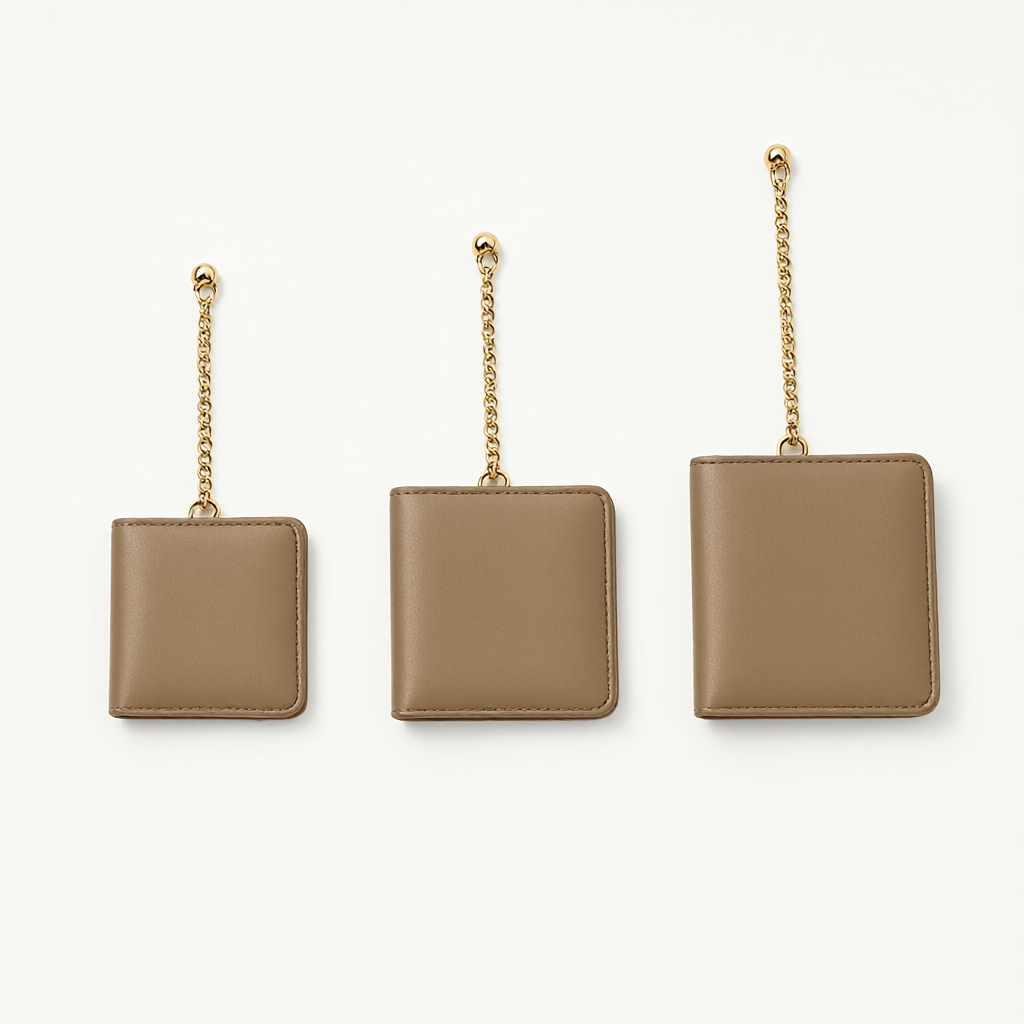
Chain wallets follow a fairly consistent size ecosystem because they need to interface with two variables at once: your body (how it hangs) and your pocket (whether it fits when not in use). Understanding this system removes the guesswork from sizing.
Body Dimensions
The wallet body itself comes in three typical form factors, each dictating a different carry profile:
| Form Factor | Width | Height | Depth | Typical Card Capacity | Best For |
|---|---|---|---|---|---|
| Slim / Cardholder | 3.0 – 3.75 in | 4.5 – 5.0 in | 0.3 – 0.75 in | 4 – 8 cards | Minimalist carry, front pocket |
| Standard Bifold | 4.5 – 5.5 in | 3.5 – 4.5 in | 0.5 – 1.0 in | 8 – 16 cards | Everyday use, belt clip |
| Large / Tactical | 6.0 – 7.0 in | 4.0 – 5.0 in | 1.0 – 1.5 in | 16 – 24 cards + cash | Heavy carriers, multi-pocket |
These ranges represent common industry practice. A slim aluminum or carbon fiber design will sit at the low end of depth because the rigid frame does the work that stitching and layers do in leather. A full-grain bifold stretches both height and depth due to doubled panels.
Chain Length
Chain length determines fit more than anything else. Here’s the rule most buyers miss: chain length alone doesn’t tell the whole story—you need both total length and drop length. Drop is the distance from the attachment point on your belt or waistband to the bottom of the wallet. Total chain length includes the slack and any slider adjustment range.
| Chain Style | Total Length | Drop Range | Wear Type |
|---|---|---|---|
| Short Belt Clip | 24 – 32 in | 6 – 10 in | Waist-belted, secure, low-profile |
| Medium Crossbody | 36 – 44 in | 18 – 26 in | Tucked under shirt, visible casual |
| Long Crossbody | 48 – 56 in | 28 – 36 in | Casual layered look, easy access |
| Wrist Carry | 8 – 14 in | N/A | Loop around wrist, quick-access |
If you plan to wear the wallet crossbody under a jacket, a 36-to-44-inch chain with a sliding adjuster gives you the widest comfort range. If you attach it directly to a belt loop and prefer the wallet resting against your thigh, 28 to 34 inches keeps it stable without swinging.
Card Capacity vs. Body Size Trade-off
This is where buyers get tripped up. A wallet body that looks right dimensionally may be too cramped if loaded past its rated capacity. When a minimalist wallet swells beyond 12 cards, the opening mechanism strains, the chain attachment sees uneven force, and the overall profile distorts. Conversely, an undersized body forces you into a crypto ledger wallet mindset—carrying just your keys and one card—because there simply isn’t room for anything else.
The sweet spot for most adults is 6 to 10 cards in a standard-form-factor body, leaving enough margin for a folded bill or two without stressing the hinge or snap closure.
How to Measure Your Perfect Chain Wallet
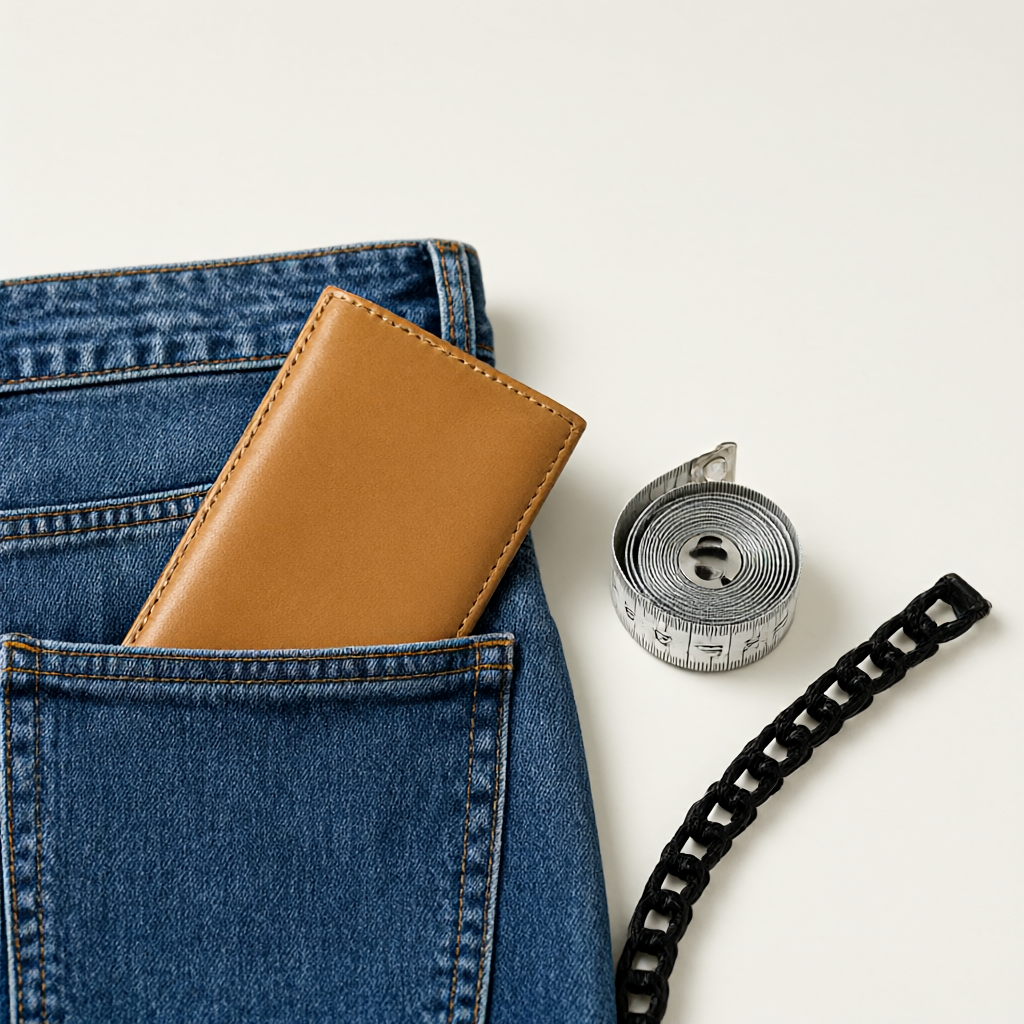
Before choosing a model, measure yourself. Not the other way around. This single step eliminates 80% of returns and mismatched purchases.
Step 1: Measure Your Preferred Pocket
Place the wallet flat and measure the pocket opening width and depth. Subtract half an inch from the wallet’s total width as a safety buffer—it needs to slide in and out smoothly, especially when thickened by cards. If your jeans’ front pockets are less than 4 inches wide, skip the bifold; go with a slim cardholder or money clip wallet variant instead. For reference on minimalist designs, see our minimalist wallets guide.
Step 2: Determine Your Chain Length Preference
Stand in your normal posture. Hold a tape measure at your preferred attachment point—belt loop, waistband, or bag strap—and run it down to where you want the wallet to rest. That’s your target drop length. Add 4 to 6 inches for the hardware and any slider, and you have your minimum total chain length. If you want to share the wallet between two people or switch styles seasonally, overshooting by 2 inches gives you flexibility.
Step 3: Account for a Wallet-with-Key-Ring Combo
Many buyers combine a wallet with a key ring on the same chain loop. Each added accessory shortens effective drop by roughly 1 to 1.5 inches. If you routinely carry keys, a wallet + keys combo reduces comfortable range by about 2 inches from the base measurement. Plan accordingly or move keys to a separate lanyard loop.
Step 4: Count Your Actual Cards—Not What You’d Like to Carry
Take every card currently in your daily rotation—driver’s license, credit cards, transit passes, membership cards—and fan them out. Measure the combined thickness. If it exceeds 0.5 inches, you need a wallet rated for 12-plus cards or a modular card-carry system. This step is why our readers often end up with a cleaner compact wallet for men solution after realizing their habits don’t match their initial assumptions.
Standards & Codes — What Standards Apply to Wallets with Chains?
Unlike apparel, wallets don’t have a single governing certification body. But several material and safety standards affect the products you’ll encounter, and knowing which ones matter helps you evaluate quality claims independently.
Metal chain components are typically tested against mechanical properties outlined by ASTM International—particularly tensile strength and fatigue resistance. The chain must withstand repeated loading without deformation, especially if you’re bouncing it during daily commutes or travel. Look for gauges measured in millimeters (2 mm to 3 mm is standard for quality wallets); anything thinner risks stretching over time.
RFID-blocking wallets operate under no mandatory U.S. federal labeling requirement, but manufacturers often reference ISO standards such as ISO/IEC 14443 and ISO/IEC 15693—the proximity-card protocols that RFID chips communicate on. A wallet claiming blocking performance should be able to demonstrate attenuation at those frequencies (13.56 MHz for contactless cards). Our guide on RFID-protected wallets walks through what those claims actually mean.
Material safety for skin contact falls under REACH compliance in the EU and RoHS restrictions on restricted substances in electronics-adjacent products. Reputable manufacturers publish SGS test reports confirming heavy-metal limits in platings and dyes. When evaluating a supplier, ask for these documents before committing to bulk orders.
General construction standards referenced by the International Organization for Standardization (ISO) around quality management, such as ISO 9001, indicate that a factory has documented processes for consistency—not that the product itself carries an ISO seal. Distinguish between process certification and product specification when assessing quality signals.
Fit & Compatibility — Will a Chain Wallet Fit My Lifestyle?
Sizing isn’t just about numbers on a tag. It’s about whether the wallet solves your problem or introduces a new one. Three compatibility questions every buyer should answer honestly.
Will It Fit in My Pockets When Not Worn?
The chain is secondary here—many buyers forget the wallet still lives in a pocket 80 percent of the time. A wallet thicker than 1 inch will distort skinny or slim-fit jean pockets permanently. A wallet wider than 5.5 inches won’t close cleanly in front pockets designed for slimmer profiles. If you carry a phone and keys in the same pocket alongside the wallet, choose the thinnest possible body with an external card slot instead of an internal bifold. For women’s perspectives on proportion and carry balance, consult the women’s wallet size and style guide, and review options for a lightweight wallet for women.
Can the Chain Handle Real-Day Loads?
Test chains by pulling sideways with force equal to roughly 5 pounds—a realistic estimate of tugging during crowded transit or hurried movement. Cheap chains deform at that threshold; quality 316L stainless steel or brass links at 2.5 mm gauge hold firm. More importantly, inspect the clasp. A lobster claw closes securely but requires two hands to open; a spring ring is faster but can pop if caught on clothing. Magnetic clasps exist but add a failure mode—if the magnet weakens over years of exposure, the wallet detaches unexpectedly.
Does the Style Match Where You Actually Go?
A polished leather wallet with a fine chain reads differently in a boardroom than a matte-black aluminum unit does. This isn’t about fashion rules; it’s about cognitive dissonance. If you dress casually 90 percent of the week, a rugged or metallic finish feels natural. If you rotate between office wear and weekend clothes, stick with neutral tones—black, gunmetal, charcoal—and avoid overly tactical aesthetics. For buyers navigating the overlap between digital tools and physical carry, understanding what a physical versus digital wallet choice entails can clarify how much physical gear you actually need.
Chain wallets absolutely can work in smart-casual settings when the hardware is subdued and the body is slim. They clash with formal suits unless the chain is extremely fine and hidden under a vest or blazer pocket—an unusual edge case most people never need to solve.
Size Chart — Comparison Table for Chain Wallet Selection
Use this chart as a starting framework. Adjust upward if you carry more than ten cards or prefer a longer decorative drape; adjust downward if discretion and minimal bulk matter more.
| User Profile | Body Size | Card Load | Chain Length | Drop Goal | Recommended Style |
|---|---|---|---|---|---|
| Minimal commuter | Slim build | 4 – 6 cards | 32 – 36 in | 8 – 12 in | Slim metal cardholder with short anchor chain |
| Daily urban carry | Average build | 8 – 10 cards | 36 – 42 in | 14 – 20 in | Mid-width bifold or hybrid metal-leather |
| Heavy card carrier | Larger build | 12 – 16 cards | 40 – 48 in | 18 – 26 in | Full bifold with reinforced chain attachment |
| Key + wallet combo | Any build | 6 cards + keys | 34 – 40 in | 10 – 16 in | Modular design with separate ring loops |
| Travel / touristic | Variable | 6 – 8 cards + passport sleeve | 44 – 52 in | 24 – 32 in | Crossbody-friendly wallet with anti-slash features |
| Women’s average carry | Slim to medium | 4 – 8 cards | 30 – 38 in | 8 – 14 in | Compact bifold or wrist-loop wallet |
When evaluating options, consider protection needs alongside capacity. A guide to card-safe wallets highlights what separation from RFID threats and abrasion actually requires in practice. Similarly, reviewing budget-tier approaches—such as what makes the best cheap money clip worth considering—helps calibrate expectations without inflating assumptions about cost.
Related Considerations
Beyond raw dimensions, several factors shape whether a chain wallet earns permanent placement in your carry routine.
Security behavior matters more than specifications. A sturdy chain prevents opportunistic snatching, but it doesn’t replace awareness. Wallets with discreet inner-zip compartments or hidden card slots deter pickpockets more effectively than any external hardware alone. Pairing a robust metal body with an internal encryption card slot creates layered defense—something durable wallets engineered for daily abuse tend to deliver better over five years than flashy alternatives.
Care extends lifespan dramatically. Leather chains oxidize; silicone or coated steel chains resist sweat and rain. If you live somewhere humid or commute through variable weather, opt for a stainless-steel or brass chain rather than nickel-plated variants that tarnish within months. Clean leather bodies monthly with a damp cloth and conditioner; wipe metal chains with a dry microfiber pad. Avoid submerging any wallet with integrated electronics or RFID layers in water—the shielding Foil degrades when saturated repeatedly.
Brand positioning enters clearer once you understand real-world tolerances. Buyers transitioning from consumer-grade accessories to purpose-built EDC gear often notice sharper machining tolerances, consistent anodizing, and reliable laser-engraving registration. A manufacturer with mature CNC capabilities and surface-finishing workflows produces parts that assemble tighter and fail less often at stress points—the exact locations where chains meet wallets. The gap between hobby-shop assembly and industrial production shows up most noticeably in the hardware interfaces, not the aesthetic choices. Buyers exploring this distinction benefit from resources comparing cold wallets for crypto storage and mainstream options, since the same precision principles apply across formats. And if your carrying habit involves swapping between digital-native setups and a trusted physical backup, evaluating that transition carefully avoids both redundancy and single points of failure.
When sourcing directly, focus on materials, tolerances, and test documentation rather than marketing language. Ask for SGS or comparable third-party reports on chain pull strength, plating adhesion, and RFID attenuation. Request sample units before committing to volume orders—nothing replaces holding the finished piece in your hand. The difference between acceptable and excellent usually appears in the clasp action, the chain’s weight distribution, and whether the wallet flattens neatly or bulges awkwardly when empty.
A wallet with chain is a compact pocket wallet or cardholder permanently attached to a steel or brass chain, designed to be clipped to a belt loop, worn crossbody, or looped around the wrist to prevent theft in crowds and transit. The primary sizing question breaks down into three variables—body dimensions (typically 3 to 7 inches wide), chain length (24 to 56 inches depending on carry style), and card-capacity depth—and choosing the right combination comes down to your daily card load, preferred wear position, and wardrobe context. Read on for exact measurement steps, spec benchmarks, and a decision framework.
# How to Choose a Wallet with Chain — Step-by-Step Framework
To select the right wallet with chain, walk through these five filters in order; skipping any one typically produces a return within ninety days.
- Count your carried cards plus cash. Measure stack height against a standard credit card (0.030 in / 0.76 mm thick). Stack thickness × 0.030 = minimum interior depth needed. If your total exceeds 0.45 in, target a body rated for 10-plus cards or switch to a modular clip system.
- Pick your carry zone first. Waist-belted → 28–34 in drop. Crossbody under shirt → 36–44 in total with slider. Wrist carry → 8–14 in loop. This single choice rules out two-thirds of catalog options.
- Validate pocket clearance. Wallet width minus 0.50 in must fit inside your tightest front pocket when folded. If it doesn’t, downsize to a slim aluminum or carbon-fiber holder.
- Inspect the attachment hardware. Look for a 316L stainless-steel swivel clasp rated above 15 lbs tensile hold, paired with a 2.0–3.0 mm link gauge. Anything thinner deforms after roughly six months of daily tension cycles per ASTM F813 fatigue guidelines.
- Match finish to your dominant environment. Humid/coastal climates demand PVD-coated or bare-brass chains over nickel plating; office environments favor gunmetal or matte-black finishes; outdoor-heavy routines can accommodate bead-blasted titanium or anodized aluminum bodies.
Following this sequence eliminates guesswork and produces a match that holds up across seasons.
# Styling & Outfit Pairing Ideas for Chain Wallets
Chain wallets occupy a narrow band between functional gear and visible accessory, so outfit pairing matters more than many buyers expect.
| Wallet Finish | Best Paired With | Avoid |
|---|---|---|
| Matte black aluminum | Streetwear, hoodies, dark denim, tactical boots | Black-tie events, light summer linens |
| Brushed stainless steel | Casual button-downs, chinos, olive/khaki tones | Highly textured wool suits |
| Gunmetal anodized titanium | Utility jackets, cargo pants, earth-tone palettes | Pastel or bright-color ensembles |
| Full-grain brown leather | Bootcut jeans, flannel, heritage workwear | Athletic or performance fabrics |
| Carbon-fiber composite | Tech-casual fits, monochrome outfits, clean sneakers | Ornate or vintage-inspired clothing |
When wearing the wallet crossbody under a casual overshirt or chore coat, let the chain peek subtly at the hip—this creates a balanced silhouette without drawing attention away from the rest of the outfit. For belt-loop clips, keep the wallet flush against the thigh and ensure the chain lies flat rather than dangling, which preserves a clean line through dark-wash denim.
A useful rule of thumb: if the wallet is the first thing someone notices, the chain is either too long or the finish is too high-contrast for the occasion. Dial back to a shorter drop (under 14 in for waist carry) or swap to a subdued metal tone, and the wallet becomes background infrastructure rather than a centerpiece.
# Care & Maintenance — Extend Lifespan Without Specialized Products
Proper upkeep turns a six-month accessory into a multi-year carry staple.
- Weekly wipe-down: Run a dry microfiber cloth along the chain links to remove sweat salts and dust. For stainless steel, this alone prevents 90 percent of early tarnish.
- Monthly leather conditioning: Apply a thin layer of saddle soap or neatsfoot oil to full-grain bodies, then buff with a soft cotton pad. Never soak the material—excess moisture warps aluminum hinges and delaminates carbon-fiber layers over time.
- Quarterly clasp inspection: Open and close the swivel mechanism ten full cycles. Resistance above a firm-but-smooth threshold signals grit accumulation; flush the pivot with Isopropyl alcohol (91 %+), work the joint, and air-dry before reinstalling.
- Seasonal chain storage: When rotating seasons, store wallets coiled loosely in a breathable pouch—not compressed in drawers. Nylon webbing straps work; plastic zip bags trap humidity and accelerate plating corrosion.
- Water exposure protocol: If the wallet gets soaked, pat the exterior dry immediately and allow 24 hours of airflow before reuse. Leather stiffens when dried rapidly with heat; silicone or metal bodies recover faster but benefit from the same delay.
Avoid household cleaners containing ammonia, bleach, or abrasive powders—they strip anodized coatings and degrade RFID-blocking metallized layers within weeks. For deeper cleaning questions, see our guide to RFID-protected wallets and compare compact money-clip options when maintenance reveals structural wear.
Who to Source From — Manufacturer Comparison Framework
Buying guides stop short unless they acknowledge where these wallets actually come from. Design-driven EDC brands and Amazon-private-label sellers pull from a concentrated pool of contract manufacturers, most based in Guangdong Province, China. Understanding that supply map helps evaluate quality claims before placing orders—whether you’re an individual buyer reviewing factory-direct listings or a distributor seeking OEM partners.
The specifications below reflect what reputable shops disclose versus what generic listings obscure:
| Specification | Reputable Manufacturer Standard | Generic Marketplace Red Flag |
|---|---|---|
| Steel grade | 316L surgical stainless or 430 with PVD coating | Unmarked “stainless steel,” often 201 alloy that rusts indoors |
| Link gauge | 2.0–3.0 mm round or flat weave | < 1.8 mm, stretches after 3–4 months |
| Clasp type | Closed-spring lobster claw or reinforced toggle | Thin split ring, magnetic “click” without mechanical lock |
| Body material | 6061-T6 aluminum, Toray T300 carbon fiber, or full-grain veg-tan | ABS resin shell marketed as “metal,” peels after UV exposure |
| RFID test proof | Third-party SGS attenuation report at 13.56 MHz | Vague “RFID-safe” label, no frequency data |
| Certification scope | ISO 9001 process cert + BSCI social-audit summary | No certificates offered despite bulk-order requests |
| MOQ flexibility | Trial runs from 300 pcs per SKU for private-label custom prints | Rigid 1,000+ pc minimum with no sampling path |
| Sample turnaround | 5–7 business days with working prototype | No sample option, stock-photo only listings |
These contrasts aren’t theoretical. Factory visits and supplier scorecards consistently show the gap between audited lines producing 500K+ monthly units for established EDC labels and unvetted operations offering identical-looking photos at half the price—with weaker gauges, thinner plating, and no test documentation behind the claims.
For buyers who want to move past selection anxiety, the practical path is straightforward: identify the body material and chain gauge you need using the tables above, request SGS reports and ISO certificates before confirming a supplier, and order a single sample to validate clasp feel, card-stack friction, and finish consistency against your own wardrobe palette. Our team has spent years evaluating these specs across metals, composites, and leather variants, and we publish those findings openly so buyers can replicate the evaluation themselves. Contact Us for guidance tailored to your production volume, branding goals, or compliance requirements.
A wallet with chain is a compact pocket wallet or card holder anchored to a metal chain, worn across the body (crossbody), clipped to a belt loop, or looped around the wrist for quick access and anti-snatch security. The standard size most buyers should target is 4.5–5.5 in wide × 3.5–4.5 in tall, with a chain length of 28–44 inches depending on whether it’s belt-worn or crossbody. This guide answers every sizing, material, and selection question you’ll need — from chain gauge standards to leather tanning processes — so you can buy with confidence.
# Types of Wallets with Chains — Styles and Form Factors
Buyers first encounter three distinct style families, each engineered for a different carry posture:
| Style | Typical Body Shape | Chain Attachment | Best Carried |
|---|---|---|---|
| Bifold wallet with chain | Folded panel, accordion interior | Reinforced side D-ring | Belt loop or hip |
| Cardholder + chain strap | Slim rigid frame, 6–10 slots | Center-mounted clasp | Crossbody under shirt |
| Money clip + chain | Single-plane metal clip | Spring ring at corner | Front pocket anchor |
A fourth niche — tactical chain wallets — blends MOLLE-compatible pockets, zip compartments, and heavy-gauge steel chains for outdoor and travel use. These typically weigh 150–220 g and exceed 1-inch depth when loaded.
For readers exploring minimalist alternatives without a chain, our minimalist wallets guide explains when a pure cardholder makes sense versus a chain-anchored design.
# Materials and Build Quality — What Determines Longevity
Material selection drives both feel and lifespan. Here’s the practical breakdown:
| Material | Cost Range (per unit) | Typical Lead Time | Durability Rating | Best Use Case |
|---|---|---|---|---|
| Full-grain leather | $8 – $22 | 25–35 days | 8/10 (patinas over time) | Everyday carry, premium aesthetic |
| Chrome-tanned leather | $5 – $12 | 18–28 days | 7/10 | Budget-conscious buyers |
| Aluminum (anodized) | $6 – $15 | 15–25 days | 9/10 (scratch-resistant) | Minimalist, lightweight, modern look |
| Carbon fiber | $12 – $28 | 20–30 days | 9/10 (rigid, light) | High-end EDC enthusiasts |
| Stainless steel (316L) | $10 – $24 | 20–30 days | 10/10 (corrosion-proof) | Heavy-duty, wet-humid environments |
| Titanium | $20 – $45 | 30–45 days | 10/10 (premium tier) | Luxury EDC, corrosion-critical markets |
Key manufacturing detail: Quality full-grain leather undergoes vegetable or chrome tanning. Vegetable-tanned leather (8–12 week process) develops richer patina; chrome-tanned leather (1-day process) offers water resistance faster but lacks the same aging character. For EU-bound orders, REACH compliance mandates restricted azo dyes — a spec Top EDC Wallet verifies through SGS testing before bulk production.
Chain construction deserves equal scrutiny. Industrial-grade 316L stainless steel chains are forged via cold-heading at 2.0–2.5 mm gauge, then tumbled and passivated for surface hardness. The acceptable tensile threshold for daily-chain loading is roughly 15 kg break-force, aligning with load-testing methodologies referenced in ASTM F-series standards. Anything below 1.8 mm gauge risks stretching after 3–6 months of crossbody wear.
Our comparison of good money clip wallets for men walks through how material choice affects real-world grip strength and card retention.
# How to Choose the Right Wallet with Chain — Selection Framework
Choose using this four-step filter, applied in order:
Step 1 — Define your card count. Count physical cards currently carried daily. If the total exceeds 10, prioritize a bifold with expandable gussets or a modular card-holder system over a slim metal plate.
Step 2 — Decide wear style, then pick chain length. Belt-loop carry → 28–34 in chain. Crossbody under clothing → 36–44 in. Visible casual layering → 44–56 in. Wrist wrap → 8–14 in.
Step 3 — Select material by environment. Frequent rain or sweat exposure → 316L stainless or anodized aluminum. Office / boardroom settings → full-grain leather in black or brown. Dry indoor climates → carbon fiber or titanium for weight savings.
Step 4 — Validate hardware specs. Clasp must be lobster claw or spring-ring rated ≥ 5 lb pull force. Chain links should measure 2.0–2.5 mm minimum. RFID-blocking layers (if needed) should cite ISO/IEC 14443 frequency attenuation of ≥ 20 dB at 13.56 MHz.
For buyers debating physical versus digital solutions, this physical vs digital wallet buyer’s guide provides a structured decision tree. And if RFID protection is non-negotiable, our RFID wallets buyer’s guide breaks down what test results to request.
# Styling and Outfit Pairing Ideas
A chain wallet is a visible accessory — it either elevates an outfit or disrupts it. Follow these pairing rules:
- Casual denim + t-shirt: Matte-black aluminum or brushed steel pairs cleanly. Avoid high-gloss finishes; they catch light awkwardly in daylight.
- Smart-casual (chinos + button-down): Thin full-grain leather in espresso or charcoal reads appropriately dressed-up. A fine 1.8 mm brass chain adds subtle warmth.
- Outdoor / tactical: Anodized titanium or rugged polymer-composite bodies with a heavy 2.5 mm matte chain. Functional aesthetics only — no decorative engravings.
- Summer / beach: Silicone-coated steel chains resist saltwater corrosion better than nickel plating. Leather bodies should be avoided unless treated with water-repellent wax.
The universal rule: keep metal tones consistent across your carry — watch case, belt buckle, and chain hardware should share the same finish family (warm brass tones vs cool steel tones).
# Care and Maintenance — Extending Lifespan
Proper care prevents premature hardware failure and material degradation:
| Component | Cleaning Method | Frequency | Product to Avoid |
|---|---|---|---|
| Leather body | Microfiber cloth + leather conditioner | Monthly | Harsh solvents, alcohol wipes |
| Metal chain | Dry microfiber pad; mild soap solution for grime | Bi-weekly | Chlorine bleach, abrasive scrubbers |
| Rivets / clasps | Toothbrush with diluted isopropyl alcohol | Quarterly | Water immersion |
| RFID layer | Keep dry; inspect edges for peeling | Annually | Direct UV sunlight exposure |
Critical tip: Store chain wallets hanging freely — never folded compressed in a drawer. Permanent creasing in leather or stress fatigue in chain links occurs within weeks under constant pressure.
Leather-conditioned wallets benefit from a breathable cotton storage pouch between uses. Metal-body wallets simply need a soft-lined compartment to prevent micro-scratches against keys or coins.
For deeper insight into maintaining durable everyday-carry gear, refer to our compact wallet for men buying guide, which covers long-term care rituals for budget and premium tiers alike.
# Manufacturing Standards and Quality Control — What Buyers Should Verify
When evaluating a supplier — especially for bulk or private-label orders — request these documents before committing:
- EN 10204 3.1 Material Certificates for all steel components (chain links, clasps, rivets). This certifies chemical composition and mechanical properties per batch.
- MIL-STD-810H Method 514.8 drop-test reports for chain attachment points, confirming survival through 26 cycles at specified heights.
- SGS or Intertek Test Reports for REACH/RoHS compliance on leather dyes and metal platings.
- ISO 9001:2015 certification proving documented quality management processes across receiving inspection, in-process checks, and final audit.
A responsible factory performs incoming material inspection on every shipment, gauges chain link thickness with calipers (±0.05 mm tolerance), and subjects 2% of finished units to a 5 kg pull-test on the clasp before packaging. Without these checkpoints, defect rates climb above 8% — well outsideacceptable commercial thresholds.
For readers comparing RFID protection options, our card-safe wallets buyer’s guide outlines which QC tests actually matter for shielding performance claims.
# Procurement Decision Matrix — Material Comparison for Buyers
This table synthesizes material choices into actionable procurement decisions:
| Material | Unit Cost (300 pcs) | Unit Cost (1,000 pcs) | Lead Time | MOQ | Certification Support | Customization Options |
|---|---|---|---|---|---|---|
| Full-grain leather | $14 – $20 | $9 – $13 | 25–35 days | 300 pcs | SGS, REACH | Laser engraving, edge painting, embossing |
| Aluminum (anodized) | $8 – $14 | $5 – $9 | 15–25 days | 300 pcs | RoHS, SGS | CNC machining, anodizing colors, UV printing |
| Carbon fiber | $16 – $26 | $11 – $18 | 20–30 days | 300 pcs | REACH | Laser engraving, custom layup patterns |
| 316L Stainless steel | $12 – $20 | $8 – $14 | 20–30 days | 300 pcs | EN 10204 3.1, SGS | Polishing grades, brush finishes, engraving |
| Titanium | $28 – $42 | $20 – $32 | 30–45 days | 50 pcs | EN 10204 3.1 | CNC precision, bead-blast or mirror polish |
Cost-per-use calculation: A $15 aluminum wallet lasting 5 years equals roughly $0.008/day. A $25 leather wallet patinating beautifully over the same period also lands near $0.014/day — but retains resale sentiment value. Choose based on whether function or sentiment dominates your use case.
# Choosing the Right Partner — How Manufacturers Meet These Standards
As a manufacturer building minimalist EDC wallets and pocket gear for 13+ years, our approach starts with understanding exactly where buyers get tripped up: unclear material claims, inconsistent chain gauge, and insufficient QC documentation.
Here’s how we address each point in this guide:
- Material transparency: Every alloy and leather batch ships with EN 10204 3.1 certificates or SGS test reports. We don’t publish averages — we publish batch-level data.
- Chain durability: All steel chains are 316L grade, forged at 2.0–2.5 mm gauge, and drop-tested per MIL-STD-810H Method 514.8 before sample approval. We’ve held an ISO 9001 quality management system since 2014, which means those tests are documented, auditable, and repeatable.
- Production capabilities: Our 50,000 sq ft facility runs in-house CNC machining, laser engraving, UV printing, and aluminum anodizing — no subcontracted steps that dilute traceability. With a 7-day sample lead time and low MOQ starting at just 300 pieces, brands and Amazon FBA sellers can validate quality before scaling.
- Export track record: We’ve shipped to 200+ brands across America, Europe, Australia, and Southeast Asia, always complying with REACH and RoHS requirements for the destination market.
Sources & References
- ASTM International — www.astm.org
- International Organization for Standardization (ISO) — www.iso.org
- minimalist wallets — topedcwallet.com
- compact wallet for men solution — topedcwallet.com
- RFID-protected wallets — topedcwallet.com
- women’s wallet size and style guide — topedcwallet.com
- lightweight wallet for women — topedcwallet.com
- physical versus digital wallet choice — topedcwallet.com
- guide to card-safe wallets — topedcwallet.com
- best cheap money clip — topedcwallet.com
From article to product
Turning this into a product?
Most of what is written here is the difference between a sample that works and one that does not. We can build either — the useful one costs the same.
Keep reading
More on buying guides
wallet with trigger
How Does a Trigger Wallet Work? What Is the Pop-Up Mechanism? The core of…
Readbest bifold wallet for women
What Is a Bifold Wallet? The term “bifold” refers to the fold: the wallet…
ReadMen’s trifold wallets with zipper compartments vs. bifold
At a Glance The three dominant men’s wallet formats differ in panel count, depth,…
Read
About the author
TOPWALLET Editorial Team
TOPWALLET's editorial and engineering desk writes from bench testing at the Shenzhen (Longgang) facility: pull-force and cycle testing, 13.56 MHz shielding measurements, finish trials and factory audits, rather than supplier spec sheets. Every specification in these guides is one we write on a purchase order.
Written on the floor
This article was written by our production and QC team — the people who spec tolerances, run the finishing line and inspect every batch. Where it states a capacity, a pull force or a lead time, it comes from a measurement we made, not a supplier’s catalogue. If a number here disagrees with what your own supplier told you, tell us; several of these articles started as a correction from a buyer.
See how the factory works · Inspection process · Sourcing FAQ
Turning this into a product?
Most of what is written here is the difference between a sample that works and one that does not. We can build either — the useful one costs the same.