

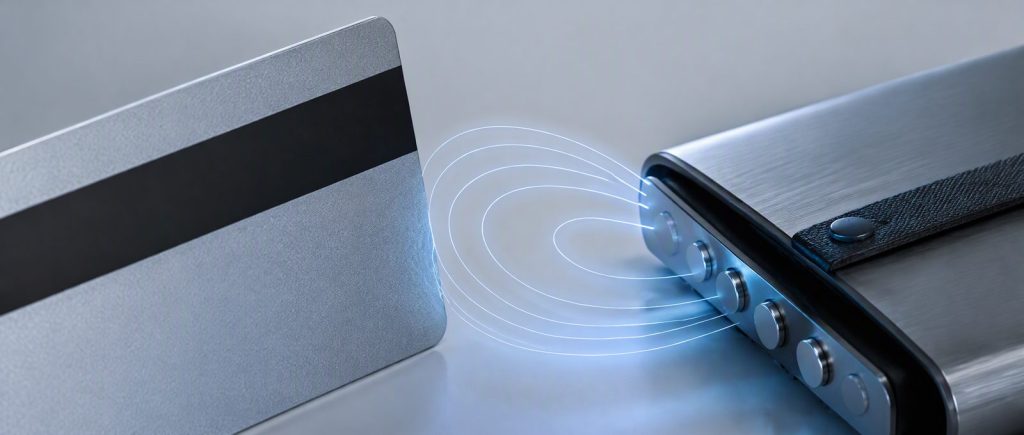
Here’s the short version: a stripe is erased when a magnetic field strong enough to overcome its coercivity reaches the particles. How strong that is depends on the stripe grade, and the grade splits cards into two groups. Bank credit and debit cards carry high-coercivity (HiCo) stripes that need a field around 2,750–4,000 oersteds to be altered; hotel keys, gift cards and some transit passes carry low-coercivity (LoCo) stripes that give up at roughly 300 oersteds. A wallet magnet sits in the tens-to-hundreds of oersteds range at touching distance, which is why it is a real threat to a hotel key and usually a non-event for a modern bank card. Distance is still the control that works for both, but the correct rule is not a fixed gauss number — it is keeping any stripe, and especially a LoCo stripe, out of contact with a magnet. The rest of this guide covers which sources are actually dangerous, which wallet types protect you, and how the wallet factory controls magnet placement so the closure never becomes the failure point.
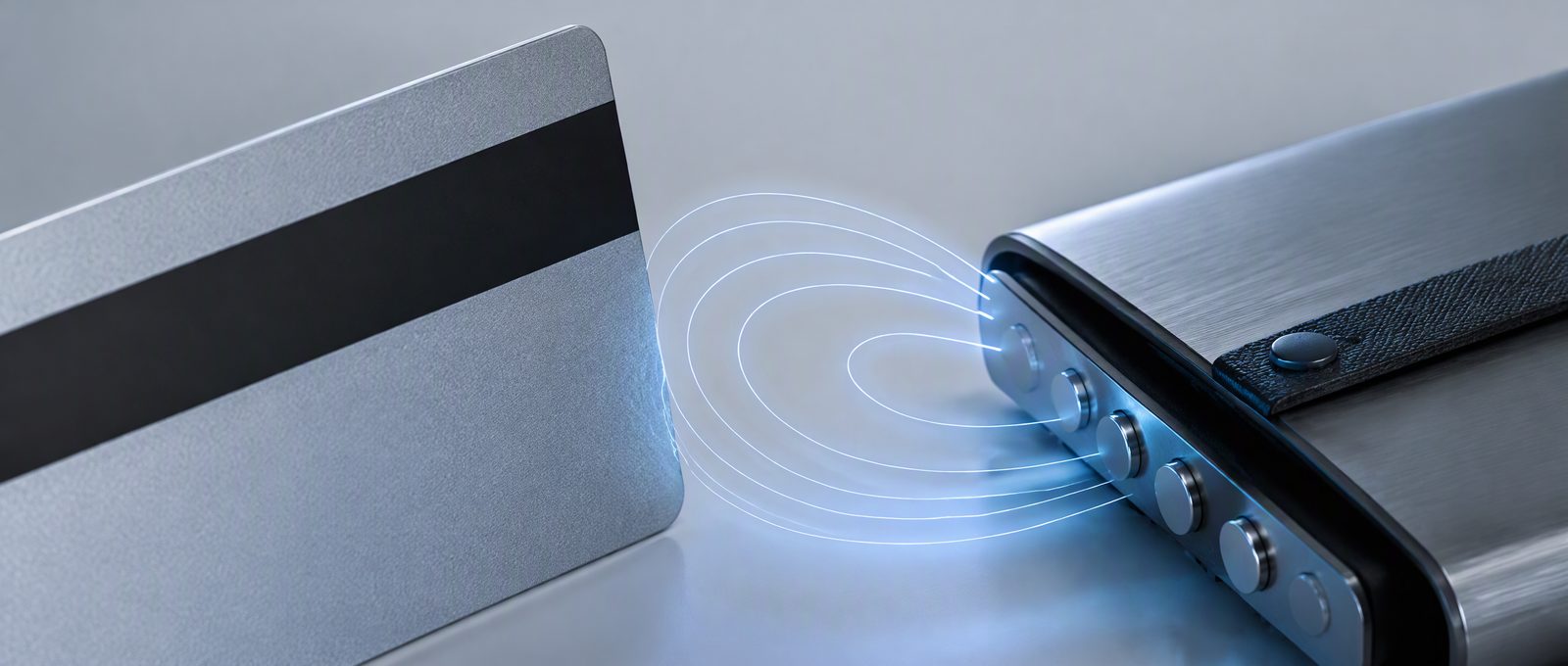
A demagnetized card is not a broken card. The stripe still looks fine — it just stops swiping, and the fix at the checkout counter is usually frustration, not repair. Damage is gradual: a stripe that gets wiped “a little” works sometimes, then fails at the worst moment. That’s why prevention beats detection, and why this guide treats magnetic distance — not shielding — as the first line of defense.
What Actually Demagnetizes a Card?
The magnetic stripe stores data as a pattern of microscopic magnetic particles. A strong external field re-aligns those particles into a uniform blob, and the pattern is gone. It takes surprisingly little force when the magnet touches the stripe directly.
The realistic risk sources, in order:
- Magnetic wallet closures — the flap magnet sits a few millimeters from your cards. This is the most common culprit because the distance is short and the field is always present.
- Strong-magnet wallets — minimalist wallets built around N52 magnets keep the magnet right against the card stack by design.
- Phone speakers and MagSafe — modern phone speakers are weak and usually safe, but MagSafe’s ring magnet on the back face is strong enough to matter if a stripe card is pressed against it.
- Industrial and medical equipment — MRI rooms, large motors, security gates, and warehouse equipment erase stripes almost instantly.
How Do a Stripe, a Chip, and an NFC Antenna Differ?
Card damage gets blamed on magnetism more often than it deserves, because three different technologies sit on the same piece of plastic:
| Technology | How it fails | Can magnetism kill it? |
|---|---|---|
| Magnetic stripe | Stripe particles re-aligned by magnetic field | Yes — the only real demagnetization risk |
| EMV chip | Physical cracking or repeated insertion wear | No — chips are not magnetic |
| RFID/NFC antenna | Physical breakage at the antenna coil | Almost never |
This matters because “my card stopped working” is usually a chip or antenna problem, not demagnetization. Our does rfid damage your cards guide covers the RFID side in detail; the short version is that contactless cards fail from bending and wear, not from magnetic fields. If your card fails at a chip reader but swipes fine, it was never demagnetized — that chip is physical damage.
How Strong Does a Magnetic Field Have to Be to Erase a Stripe?
Coercivity is the field strength required to flip the magnetisation of the stripe particles, and it is the number that decides whether your magnet matters. It is measured in oersteds (Oe); in air, 1 Oe is numerically about 1 gauss and about 0.1 millitesla, so the three units describe the same field.
| Stripe grade | Coercivity (commercial grade) | Stripe colour | Typical cards | What can alter it |
|---|---|---|---|---|
| LoCo | ~300 Oe | Brown | Hotel keys, gift cards, some transit passes | Small magnets at close range, weak stray fields |
| HiCo | ~2,750–4,000 Oe | Black | Bank credit and debit cards, ID cards | Industrial magnets, MRI-scale fields, demagnetisers |
Two caveats keep this honest. First, ISO/IEC 7811 defines performance requirements for magnetic stripe cards; 300 Oe and 2,750/4,000 Oe are the commercial stripe grades suppliers sell, not values the standard itself mandates. Second, coercivity is not security: a HiCo stripe resists accidental erasure, it does not encrypt anything.
The practical consequence is what most “magnet-proof wallet” copy gets wrong: a closure magnet that ruins a hotel key will leave your bank card’s stripe intact, because the field never approaches 2,750 Oe. That does not make contact safe — repeated contact plus a strong array is still the wrong habit — but it does mean the risk is grade-specific, not universal.
How Do Wallets Cause Demagnetization?
The wallet is the one object that sits next to your cards for 16 hours a day, so it does more damage than any phone or trip through airport security.
Magnetic closures. A flap-and-magnet closure puts a field in the tens-to-low-hundreds of oersteds range at the top card — same numeric range in gauss in air. Against a LoCo stripe that is enough to degrade data over repeated contact; against a HiCo bank card it stays far below the ~2,750 Oe needed to change the stripe. Suppliers rate closures for holding force, not for data safety, so a very strong closure is still a design smell even when your own bank card survives it.
Magnet-frame minimalist wallets. The slim-metal design uses magnet arrays to snap the shell shut, and an N52 array pressed against a card can exceed the field a LoCo stripe tolerates while still measuring well below a HiCo threshold. The safe version places the array on the far edge and keeps a card or cash buffer between magnet and stripe — not because every stripe will die, but because you cannot see which grade the card in your pocket was issued with.
What the factory does about it. In our own production line — ISO 9001:2015 certified, with 4-stage inspection and AQL 0.65 sampling — magnet placement is a spec decision, not an accident. We measure field strength at the card area during sampling, and we recommend customers put stripe cards in the slot farthest from the magnet array. With roughly 50,000 units a month shipped across 200+ partner brands, magnet-related card damage is a real complaint driver, which is why we mark magnet distance on the internal spec and test it on finished units before the 7-day sampling and 30-day production cycle closes.
Is NFC the Same Thing as a Magnet?
No, and treating them as one idea is where most card-safety advice collapses. RFID and NFC are radio: a reader drives an alternating field — 13.56 MHz for the HF cards in your wallet, 125 kHz for many access fobs — the card’s antenna coil harvests energy from that field, and the chip modulates its answer back. Nothing in that exchange is permanently magnetised, so an NFC read cannot erase a stripe, and a stripe cannot be “skimmed” by NFC.
| Magnetic field (a magnet) | Radio field (an RFID/NFC reader) | |
|---|---|---|
| What it is | Static field, no frequency | Alternating field at 13.56 MHz (HF) or 125 kHz (LF) |
| Threat to a stripe | Yes above the stripe’s coercivity | None — it cannot flip stripe particles |
| Threat to a contactless card | None — the chip and antenna are unaffected | Reads it — this is what skimming exploits |
| What blocks it | Distance; only a high-permeability shield such as mu-metal redirects it | A conductive layer forming a Faraday cage |
That table is the whole boundary: an RFID-blocking wallet stops the radio field and does nothing to a magnet, while a magnet threatens the stripe and does nothing to a contactless chip. If you want the shielding mechanics in detail, rfid blocking wallets explained covers the conductive layer; our does rfid damage your cards piece covers what actually kills a contactless card (bending and antenna fatigue, not fields).
One more myth worth closing: airport body scanners and X-ray baggage machines do not demagnetise stripes. X-rays are ionising radiation, not magnetic fields.
Which Wallet Types Actually Protect a Stripe?
Not all wallets are equal risk. Here’s the honest picture:
| Wallet type | Magnetic threat | Stripe safety | Best practice |
|---|---|---|---|
| No-magnet cardholder | None | Safe | Any slot |
| Magnetic-closure bifold | Closure near top card | Moderate | Keep stripe cards in middle slots |
| Strong-magnet minimalist | Magnet array near cards | Risky | 1–2 card buffer from magnet edge |
| RFID-shielded wallet | Same as base wallet | RF only — not magnetic | Shielding does not stop magnets |
The key correction most buyers miss: RFID shielding does not stop demagnetization. RFID blocking uses a conductive layer that creates a Faraday cage for radio waves. Magnetism is not radio waves — it passes straight through. So an RFID wallet protects your contactless card from skimmers but does nothing for the stripe when a magnet sits beside it. The rfid blocking wallets explained guide explains the shielding mechanics; for stripes, distance and slot choice do the work.
Which Five Rules Actually Protect Your Cards?
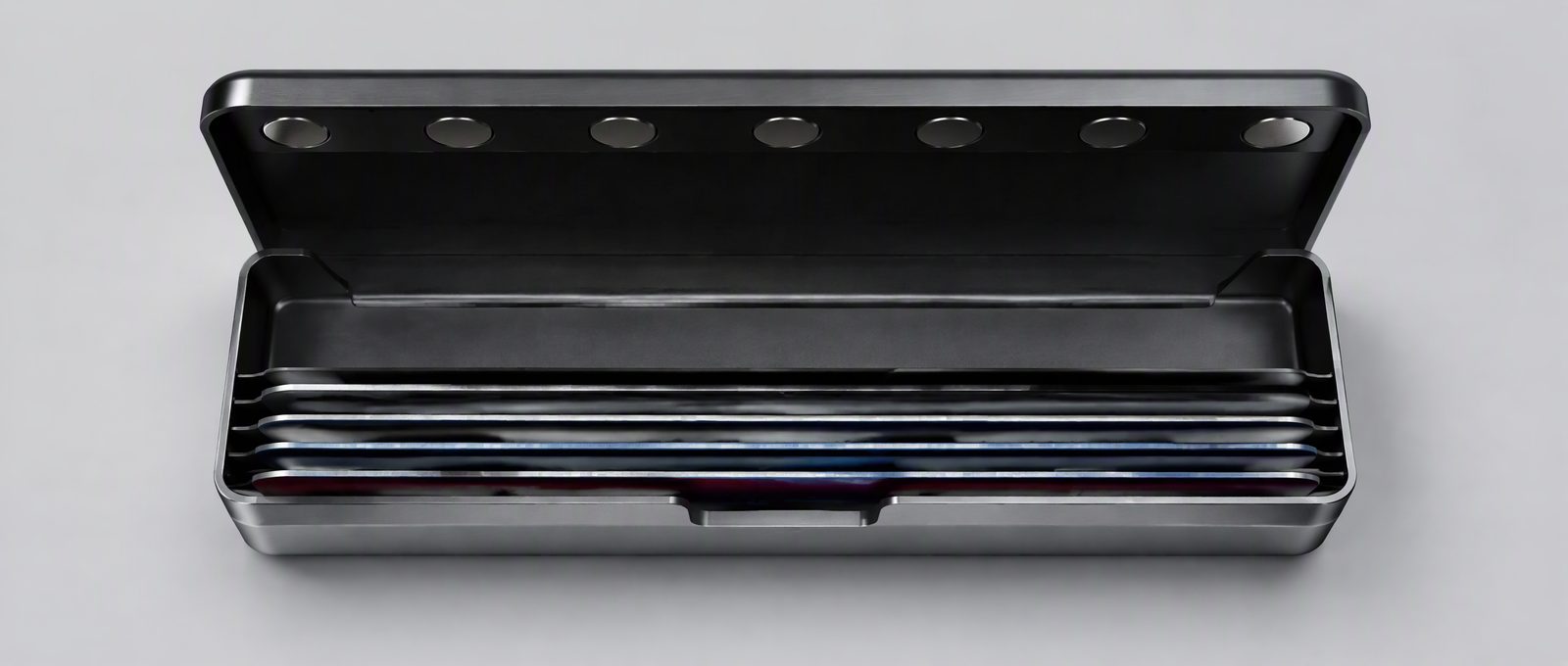
- Rule 1: Keep stripe cards away from any magnet, and never in contact. Distance is the control that works for every grade, because field strength falls fast with separation. Aim the magnet’s worst field at cash, not at cards.
- Rule 2: Don’t press cards against a phone back. A MagSafe ring concentrates field where a LoCo stripe would feel it, and a stripe card stuck to the phone back is the worst-case geometry. Same pocket, a few centimetres apart, is not a problem.
- Rule 3: Put cards in a separate slot from cash and keys. It’s not the metal that hurts the stripe — it’s the magnetic objects that ride with keys.
- Rule 4: Test with the grade you actually carry. Drop a spare LoCo card (an old gift card) in the slot nearest the magnet for a week, then try it; that is the sensitive test. A HiCo card in the same slot will usually keep working and tell you nothing. Our test rfid wallet at home method works for field safety checks too.
- Rule 5: Keep highest-value cards out of magnetic closures entirely. Travel cards, corporate cards, and any card you can’t replace same-day go in the no-magnet wallet.
What a Demagnetized Card Looks Like?
It’s useful to recognize the failure before you throw away a healthy card:
| Symptom | Likely cause | Next step |
|---|---|---|
| Swipe fails always, chip works | Demagnetized stripe | Replace or reissue the card |
| Swipe works after re-trying at different angles | Dirty or weak stripe | Wipe with a dry cloth, retry |
| Chip reader errors, swipe works | Damaged chip | Replace card |
| Contactless fails, everything else works | Broken antenna | Replace card |
Demagnetization shows up as consistent swipe failures on a stripe that looks untouched. If the card also fails intermittently at different readers, the stripe is weak — same cause, earlier stage.
How to Choose a Demagnetization-Safe Wallet?
If you’re buying or specifying a wallet with card protection in mind, make these checks:
- Ask whether the closure is magnetic, and if so, where the magnet sits relative to the card stack.
- Check the magnet rating — closures are typically 100–300 gauss; minimalist wallet arrays can hit 500–800 gauss at the nearest card.
- Prefer a design that guarantees a buffer slot — a dedicated cash slot or a card gap between magnet and stripe cards.
- If the brand is a manufacturer, ask how magnet placement is verified in QC. Field-strength measurement at the card area is the honest answer; “we use strong magnets” is not.
If you’re sourcing wallets for a brand or store, the how to choose rfid wallet manufacturer checklist covers factory verification — the same questions apply to magnet placement and to shielding quality.
Card Demagnetization: Which Questions Do Buyers Ask?
What actually causes a credit card to demagnetize?
A magnetic field that exceeds the stripe’s coercivity re-aligns its particles. LoCo stripes give up around 300 Oe, so a wallet magnet or a phone magnet in contact can do it; HiCo bank stripes need roughly 2,750–4,000 Oe, which means closures and phone magnets rarely qualify and industrial magnets, demagnetisers and MRI-scale fields do.
Does an RFID-blocking wallet stop demagnetization?
No. RFID shielding blocks radio waves via a conductive layer; magnetic fields pass straight through it. An RFID wallet protects against skimming, not against magnets — stripe protection comes from slot distance.
Do phone cases or MagSafe demagnetize cards?
Phone speakers are weak and effectively harmless. MagSafe ring magnets are concentrated enough to matter for a LoCo stripe held flat against the back face, and they do nothing to a HiCo bank stripe or to the chip. Same-pocket carry with a little separation is fine; pressing a stripe card onto the magnet is the habit to drop.
How long does a magnetic stripe last before demagnetizing?
A stripe in a normal wallet with no nearby magnets typically lasts years. With a closure or magnet array nearby, partial degradation can start within weeks. There’s no “lifespan” — it’s field strength times time.
Can my card be damaged by the wallet’s magnet without me noticing?
Yes. Damage is gradual; the card keeps working until the stripe crosses a reliability threshold. That’s why a buffer slot and a one-week test swipe beat visual inspection.
Is a metal wallet safe for cards?
The metal shell itself is harmless — aluminum, titanium, and steel frames don’t erase stripes. The risk is the magnet array some metal wallets use. Choose a metal wallet whose magnet sits on the far edge with a card buffer, like the patterns covered in metal wallet materials compared.
What should I do with a card that already fails to swipe?
If chip and contactless still work, the card is usable — stripe failure at a few readers is a mild inconvenience. If you need the stripe (older readers, travel), request a reissue; stripes cannot be remagnetized at home.
Are chip and contactless cards safe in magnet-heavy wallets?
Yes for the chip and the antenna — they are not magnetic. Only the stripe is at risk. If you rarely use the stripe, a strong-magnet wallet is a manageable trade-off; if you travel where swipe-only readers are common, avoid it.
Cards Demagnetizing: What Is the Bottom Line?
Magnetism only threatens the stripe, and only above that stripe’s coercivity: ~300 Oe for LoCo cards, ~2,750–4,000 Oe for the HiCo stripes on bank cards. Distance is the defence that works across grades, RFID shielding is not part of it, and NFC is a different physical phenomenon entirely. When you’re sourcing wallets, verify the magnet’s position at QC time — that’s where real protection gets manufactured, not marketed. If you’re building a card-protective wallet line, Ask Our Factory Team about our magnet-placement spec and field-strength testing, or Request a Quote for samples with the buffer design included. For a deeper look at electromagnetic interference basics, Get OEM Pricing on our materials testing documentation.
From article to product
Building an RFID range?
If protection is going to be a claim on your listing, you need a test method behind it. We test every batch with a live 13.56 MHz reader and supply the report.
Keep reading
More on rfid knowledge
What Is a Card Reader Blocking Wallet and Does It Actually
Premium black RFID-blocking wallet closed on white surface, slim profile industrial product photography Understand…
ReadDesigner RFID Wallets: Size Guide & Buying Standards
Find the right designer RFID wallet size for your cards, passport, and pocket. Compare…
ReadRFID Card Blockers: Do They Actually Work? (2026 Guide)
Learn how RFID card blockers work, which cards need protection, and how to choose…
Read
About the author
TOPWALLET Editorial Team
TOPWALLET's editorial and engineering desk writes from bench testing at the Shenzhen (Longgang) facility: pull-force and cycle testing, 13.56 MHz shielding measurements, finish trials and factory audits, rather than supplier spec sheets. Every specification in these guides is one we write on a purchase order.
Written on the floor
This article was written by our production and QC team — the people who spec tolerances, run the finishing line and inspect every batch. Where it states a capacity, a pull force or a lead time, it comes from a measurement we made, not a supplier’s catalogue. If a number here disagrees with what your own supplier told you, tell us; several of these articles started as a correction from a buyer.
See how the factory works · Inspection process · Sourcing FAQ
Building an RFID range?
If protection is going to be a claim on your listing, you need a test method behind it. We test every batch with a live 13.56 MHz reader and supply the report.