

What Is an ID Card Wallet?
An id card wallet is a compact pocket carrier engineered to hold identification cards—driver’s licenses, work badges, membership credentials—along with optional cash or coins. Unlike traditional billfolds, these are built around a single purpose: secure, slimcard storage. They are typically constructed from aluminum, carbon fiber, titanium, or high-grade polymer and often include RFID-blocking capability to prevent unauthorized scanning of contactless cards.
For B2B buyers, the term covers a spectrum of products—from basic metal card pockets sold as promotional items to precision-engineered badge wallets specified for corporate identity programs and factory credential systems. The defining characteristics are minimal bulk, durable construction, and the ability to hold standard-size cards without bending or degradation over repeated use.
How Do ID Card Wallets Work and Why Do They Matter?
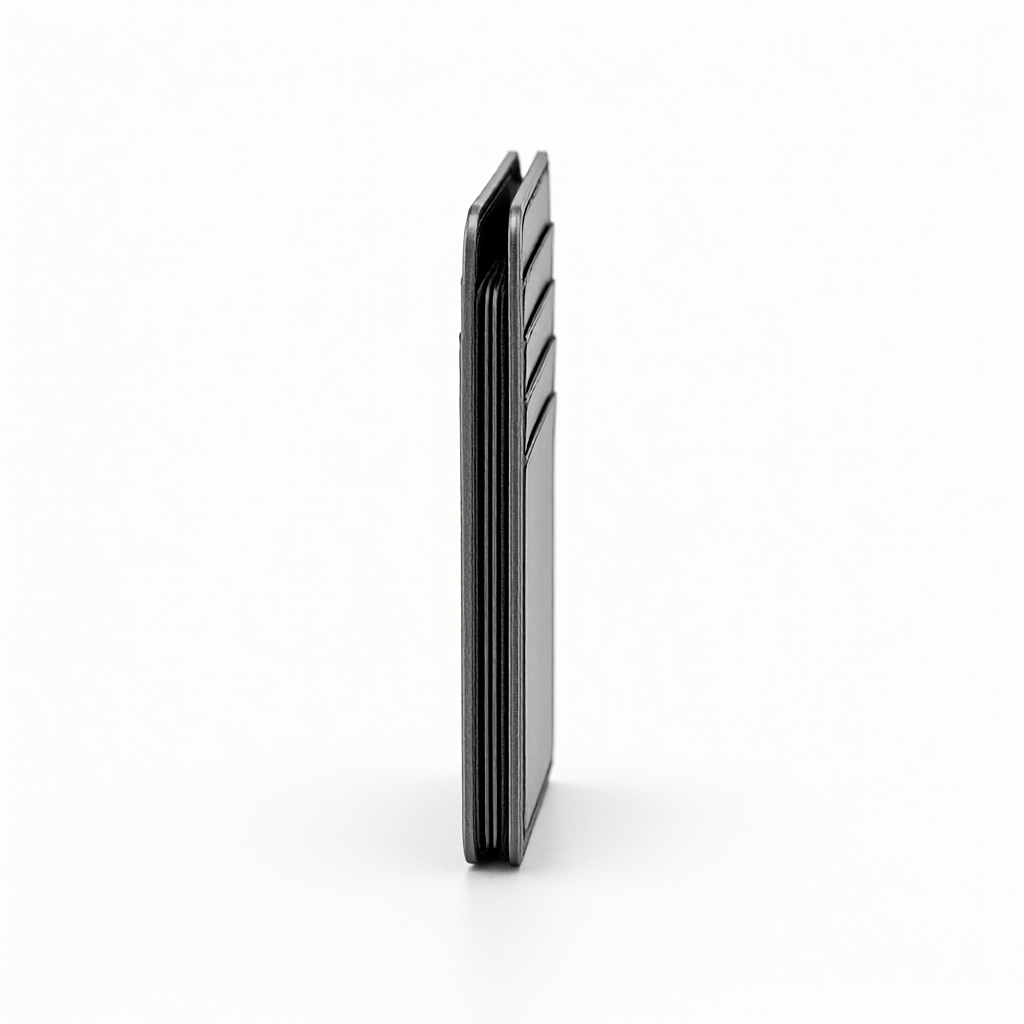
The Core Mechanism
An ID card wallet functions as a rigid or semi-rigid housing that retains cards in a fixed orientation. Most designs use a spring-loaded mechanism, a friction-fit slot, or a clamp-style retention system to keep cards from sliding out. The enclosure protects card edges and surfaces from abrasion, moisture, and warping—problems that degrade magnetic strips, chip contacts, and printed surfaces over time.
RFID Blocking and Contactless Security
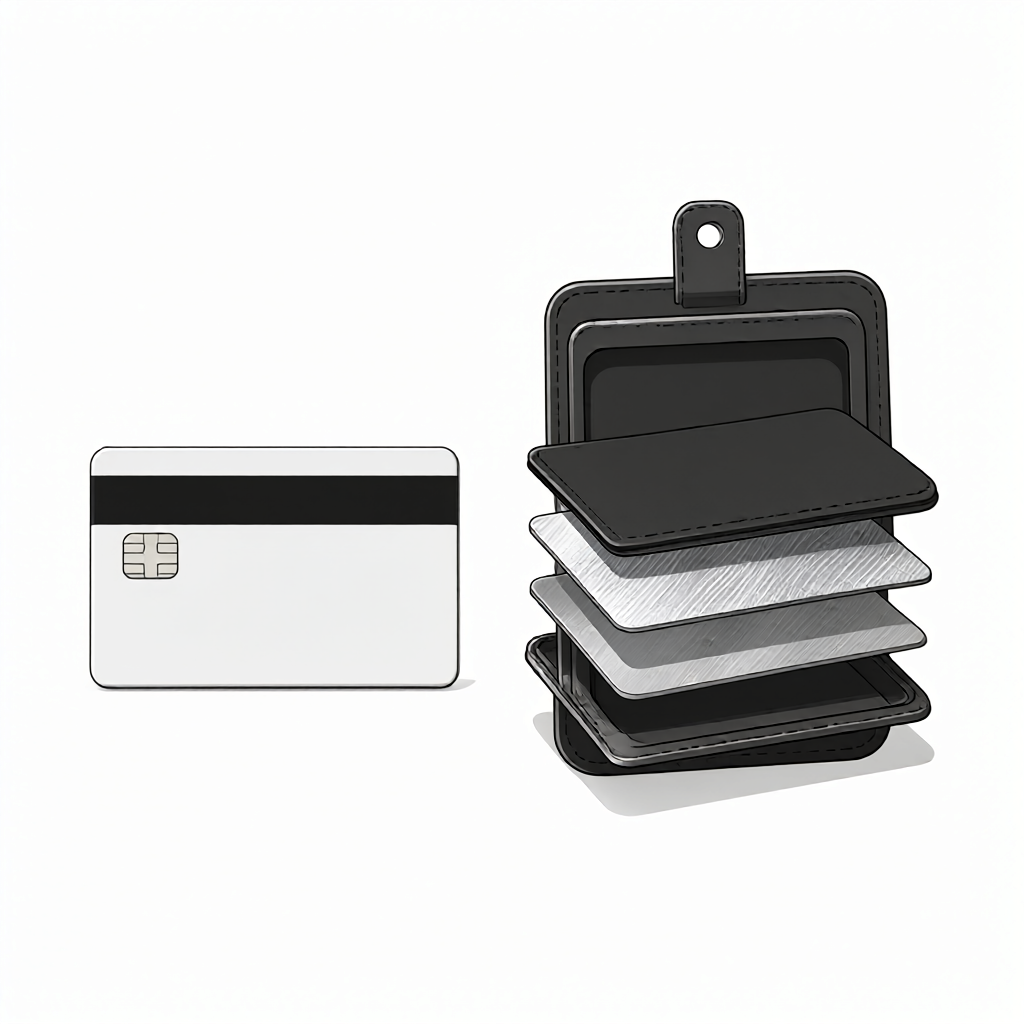
Modern contactless card wallets address a specific risk: skimming of RFID-enabled cards through wireless reading. An RFID-blocking wallet incorporates a conductive layer—typically a thin metal mesh or foil laminated between structural panels—that creates a Faraday cage around the cards. This layer attenuates radio-frequency signals at the 13.56 MHz frequency used by most proximity cards, preventing passive readers from accessing data without physical possession of the card.
Not all ID card holders require RFID blocking. Cards that rely solely on magnetic stripes or physical chip insertion are not vulnerable to remote scanning. However, for corporate identity program outfitting where employee badge cards commonly use contactless smart-chip technology, RFID protection becomes a specification requirement rather than an optional feature.
Why This Category Matters for B2B Procurement?
The ID card wallet segment has expanded beyond consumer EDC into structured B2B applications. Event badge distribution, factory worker credential cards, and promotional merchandise orders all drive recurring bulk demand. Buyers in these segments need products that meet specific durability, compliance, and branding requirements—making the sourcing process fundamentally different from retail procurement.
Understanding how these wallets are constructed, what materials perform under real-world conditions, and which standards apply is essential before specifying orders at scale.
What Are the Key Specs for ID Card Wallets?
Card Sizing and Capacity
Standard ID cards conform to the CR80 format (85.6 mm × 54.0 mm, thickness 0.76 mm), defined by ISO/IEC 7810. Any ID card wallet designed for universal compatibility must accommodate this dimension. Common capacity configurations include:
- Single-card holders: Designed for one card, often with a back pocket for folded cash. Typical of minimalist badge wallets used for daily carry.
- Multi-card holders (3–6 cards): The most common B2B configuration. Allows an employee badge plus a few additional cards. Spring-loaded eviction mechanisms enable one-handed card retrieval.
- High-capacity organizers (8–12+ cards): Used in tactical or professional contexts where multiple credentials are carried simultaneously.
Capacity directly influences thickness. A four-card aluminum holder typically measures 10–12 mm when loaded; a six-card version reaches 14–16 mm. Buyers should validate physical dimensions against their end user’s pocket or pouch constraints before finalizing specifications.
Material Options and Trade-offs
| Material | Weight (typical) | Durability | Cost Position | Best For |
|---|---|---|---|---|
| Aluminum (anodized) | 35–50 g | High | Mid-range | General B2B, promotional |
| Carbon fiber | 25–40 g | Very high | Premium | Premium branding, outdoor markets |
| Titanium | 40–60 g | Very high | Premium | High-end EDC, specialty programs |
| Polymer / TPU | 20–35 g | Moderate | Low-mid | Budget promotional, high-volume |
Aluminum remains the dominant material for bulk B2B orders due to its balance of durability, weight, and cost. CNC-machined aluminum wallets offer tight tolerances and consistent finish quality across large runs. Carbon fiber provides a lighter alternative with superior scratch resistance, making it attractive for brands positioning in the premium EDC segment. See our men’s minimalist wallets materials guide for deeper material comparison.
RFID Blocking Performance
Effective RFID attenuation requires a continuous conductive path around the card storage area. Gaps, seams, or cutouts for aesthetic purposes can compromise shielding performance. Reputable manufacturers test blocking effectiveness using standardized procedures. Buyers should request test documentation from suppliers rather than accepting performance claims at face value.
What Standards Apply to ID Card Wallets?
Material Compliance
ID card wallets that contact skin or are marketed for general consumer use must comply with material safety regulations in target markets. Key frameworks include:
- REACH (EU) and RoHS (EU): Restrict hazardous substances in electronics and consumer goods. Aluminum anodizing processes and polymer components must comply with chemical restriction lists.
- California Prop 65: Requires warning labels if certain heavy metals or chemicals are present above threshold levels.
- SGS testing: Third-party material verification is commonly requested by B2B buyers to confirm compliance before production.
ISO 9001 certification indicates that a manufacturer operates a documented quality management system, which is relevant when evaluating suppliers for consistent production standards.
Card Format Standards
The CR80 standard (ISO/IEC 7810) governs physical card dimensions globally. Any ID card wallet claiming universal compatibility should be verified against these dimensions. Non-standard card sizes—such as loyalty cards or custom-shaped credentials—require specialized holder designs.
RFID Testing References
While no single universal standard mandates RFID blocking performance for consumer wallet products, industry testing commonly references ASTM methodologies for material shielding effectiveness. Buyers should request specific attenuation values (measured in dB) from suppliers rather than relying on generic claims.
What Should You Consider When Sourcing ID Card Wallets?
Customization and Branding
B2B buyers typically specify one or more of the following customization elements:
- Logo application: Laser engraving on metal surfaces, UV printing on flat panels, or embossing on polymer. Laser engraving on aluminum produces permanent, fade-resistant marks suitable for corporate branding.
- Packaging: Retail boxes, blister packs, or bulk poly bags. Custom packaging design affects unit cost and shelf readiness for retail distribution.
- Material and finish selection: Anodized colors (black, silver, blue, red), brushed or polished textures, and material choices that align with brand positioning.
- Hardware variations: Spring tension, eviction mechanism type, and closure style affect user experience and should be evaluated against the end-user context.
See our EDC wallets manufacturing guide for details on the customization workflow from concept to production.
Minimum Order Quantities and Lead Times
MOQs vary significantly by customization level. Stock products with no branding may carry MOQs of 300–500 pieces. Custom engraved or privately labeled orders typically start at 500–1,000 pieces to justify tooling and setup costs. Sample lead times of 5–7 business days are standard for custom proofs before full production begins.
Quality Control Checkpoints
For bulk orders, establish QC checkpoints at:
- Pre-production sample approval — Physical sample confirming dimensions, finish, mechanism function, and branding placement.
- In-line inspection — Random sampling during production to catch deviations early.
- Pre-shipment inspection — Final random sampling against approved specifications before packaging and dispatch.
Total Landed Cost Factors
Unit price is only one component. Additional cost drivers include:
- Tooling and setup fees for custom engraving patterns or packaging
- Shipping method and volume (air vs. sea freight)
- Import duties and customs clearance in the destination market
- Packaging complexity and retail-ready requirements
For guidance on evaluating total sourcing costs beyond unit price, review our card holder sourcing guide.
Manufacturer Spotlight — How Top-E DC Wallet Meets These Standards
The specifications and standards discussed above represent the baseline expectations for professional-grade ID card wallets. Here is how a focused manufacturer approaches each requirement.
Material and construction: Our facility uses in-house CNC machining for aluminum and titanium holders, ensuring dimensional consistency across production runs. Carbon fiber composites are sourced from certified suppliers and undergo incoming material inspection. Finishing includes anodizing for aluminum and surface treatments appropriate to each material class.
RFID performance: Our RFID-blocking wallets incorporate continuous conductive shielding layers tested for signal attenuation. We provide test documentation upon request rather than relying on unverified claims.
Compliance and certifications: Our facility operates under ISO 9001 quality management standards and holds BSCI audit certification. Products comply with REACH and RoHS restrictions, and SGS testing is available for material verification.
Customization capability: We support full OEM and ODM workflows—from initial concept sketches and 3D modeling through sample production, branding application, and packaging design. Laser engraving and UV printing are performed in-house, allowing brand logos and custom artwork to be integrated directly into the production flow.
Production capacity and logistics: Our 50,000 sq ft facility handles 500,000+ units per month with starting MOQs from 300 pcs per SKU for standard configurations. Custom sample lead time is 7 days, and we offer drop-shipping and Amazon FBA prep services for distributor clients.
For corporate identity program outfitting, event badge distribution, or promotional merchandise orders, these capabilities align with the procurement criteria most B2B buyers evaluate: specification accuracy, compliance verification, customization flexibility, and scalable production.
Id Card Wallet: Where Can You Verify the Data and Sources?
- ISO 9001 — www.iso.org
- ASTM — www.astm.org
- men’s minimalist wallets materials guide — topedcwallet.com
- EDC wallets manufacturing guide — topedcwallet.com
- card holder sourcing guide — topedcwallet.com
- corporate identity program outfitting — topedcwallet.com
- Get a Free Quote → — topedcwallet.com
From article to product
Sourcing minimalist-wallets?
Tell us the format, the quantity and the date you need stock. You get material options, MOQ and a landed-cost range back within one business day.
Keep reading
More on wallet types
Thin Male Wallets: Buying Guide for Slim Minimalist Picks
How to choose a slim wallet for men — thickness thresholds, material trade-offs, capacity…
ReadStashed Wallet: A Minimalist Everyday-Carry Solution
Understand what a stashed wallet is, how minimalist slim wallets work, and what to…
ReadFolding Wallets: Types, Materials & Buying Guide
Learn what makes a folding wallet worth buying, from materials and card capacity to…
Read
About the author
TOPWALLET Editorial Team
TOPWALLET's editorial and engineering desk writes from bench testing at the Shenzhen (Longgang) facility: pull-force and cycle testing, 13.56 MHz shielding measurements, finish trials and factory audits, rather than supplier spec sheets. Every specification in these guides is one we write on a purchase order.
Written on the floor
This article was written by our production and QC team — the people who spec tolerances, run the finishing line and inspect every batch. Where it states a capacity, a pull force or a lead time, it comes from a measurement we made, not a supplier’s catalogue. If a number here disagrees with what your own supplier told you, tell us; several of these articles started as a correction from a buyer.
See how the factory works · Inspection process · Sourcing FAQ
Sourcing minimalist-wallets?
Tell us the format, the quantity and the date you need stock. You get material options, MOQ and a landed-cost range back within one business day.