

The best money clip for everyday carry is one that securely holds your typical cash load without scratching bills, feels comfortable in your pocket, and matches your style — usually a stainless steel or titanium model with rounded contact edges, 0.3 mm+ edge radius, spring tension rated 2.5–4 kg, and a slim profile under 14 mm when loaded. For B2B buyers, the ideal choice depends on positioning: budget Amazon sellers favor aluminum with basic card retention; mid-tier EDC brands select titanium or anodized aluminum with laser branding; and promotional channels prefer cost-effective stainless steel with optional RFID protection.
Best Money Clip: What Is the Quick Answer?
The best money clip balances secure bill retention, slim daily-carry profile, and durable construction across your intended carrying conditions. A stainless steel or aluminum money clip with moderate spring tension holds five to twelve bills comfortably without creasing, while titanium models offer the lightest weight and highest corrosion resistance for buyers who prioritize carry comfort over budget. For most everyday users, a metal alloy clip with rounded edges and a spring tension rated around 2.5 to 4.0 kg of holding force delivers reliable performance without damaging currency — which is why we recommend evaluating clips by measuring actual held-bill count and edge radius rather than relying solely on marketing descriptions.
For B2B buyers, the best choice depends on positioning: entry-level Amazon listings typically ship aluminum or carbon fiber inserts at competitive FOB prices; mid-tier EDC brands lean toward titanium and anodized aluminum with laser-engraved branding; and promotional/distribution channels often favor cost-effective stainless steel with basic RFID protection. Material and mechanism combinations ultimately determine whether a clip earns its place as a primary cash carrier or becomes a backup accessory.
Best Money Clip: How Does It Work in Detail?
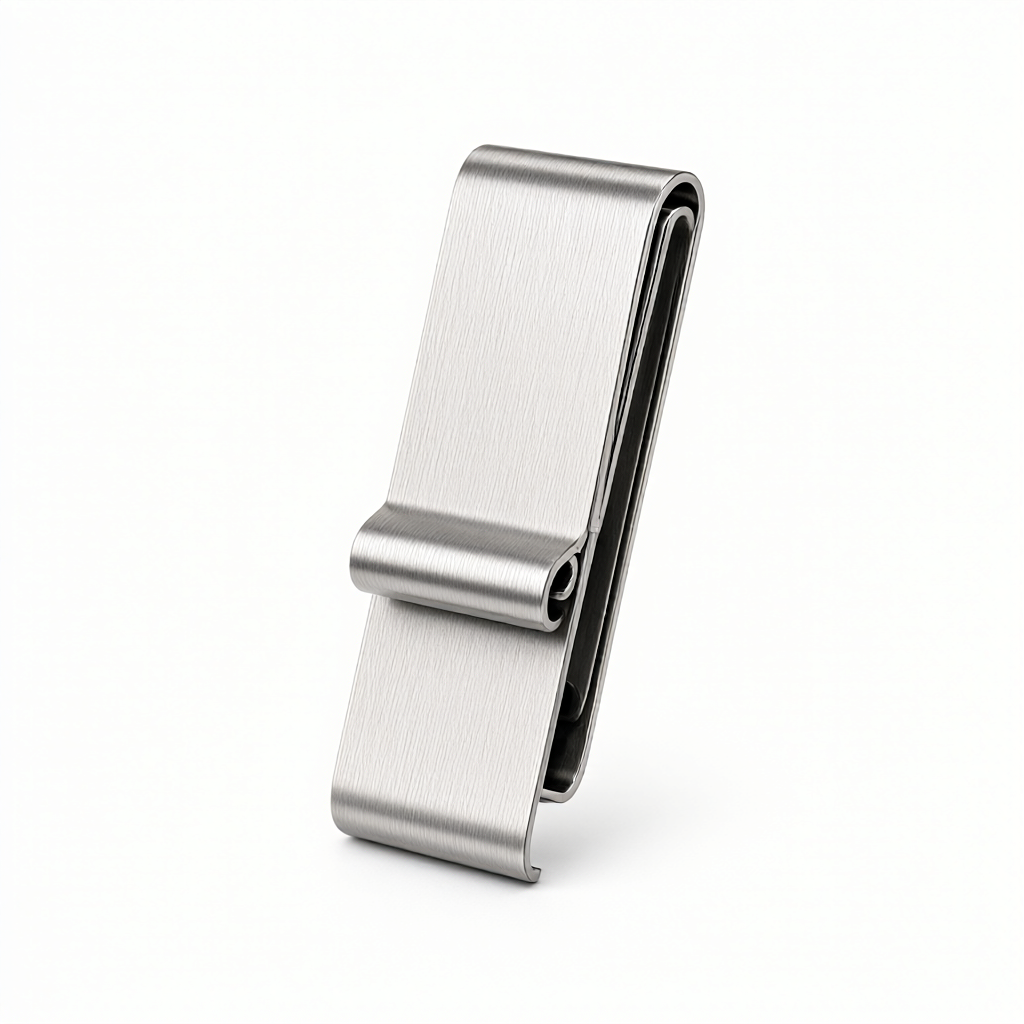
A money clip is a minimalist pocket organizer designed to hold folded paper currency through friction, clamping, or magnetic attraction. Unlike traditional bifold or trifold wallets that separate cards from bills across multiple compartments, a clip-style holder integrates cash retention and card storage into a single low-profile form factor. This architecture reduces carried volume dramatically — a well-engineered bill clip adds roughly one-third to one-half the bulk of a conventional leather wallet while still accommodating the same stack of notes plus several cards. The trade-off is reduced storage flexibility: you cannot stash receipts, coins, or IDs the way you would in a compartmentalized wallet, so the best money clip aligns with how many items you actually carry day to day.
Mechanically, money clips fall into three categories. Spring-loaded clips use a calibrated metal spring or elastomeric element to apply continuous compressive force against the bill stack. This is the most common mechanism in production because it provides predictable, adjustable tension and works reliably across a range of bill counts. Magnetic clips rely on neodymium magnets arranged in opposing arrays — one embedded in each plate — to attract and hold folded cash between them. These offer instant access and zero mechanical wear, but their holding force degrades slightly with repeated impact exposure and may not retain a thick stack during aggressive motion such as running or climbing. Hybrid clips combine a passive spring frame with supplemental magnetic plates, gaining the security of magnetism without sacrificing the fail-safe behavior of a mechanical clamp. Understanding these configurations is essential when selecting for specific use cases — a commuter who frequently pulls bills from a jacket pocket benefits from different tension characteristics than someone who carries only folded bills in a front pants pocket.
How does a money clip hold cash compared to a wallet?
A traditional wallet secures bills inside folded flaps with friction and elastic loops, distributing holding force across a wide surface area. A money clip concentrates that same force along a narrow horizontal band approximately 70 to 85 mm wide. This concentration means the clip must generate higher linear pressure per millimeter to prevent bills from sliding out, which is why spring preload calibration and edge geometry matter more on a clip than on a wallet bi-fold. On the positive side, the focused clamping action leaves fewer high-pressure points on individual bills — especially when the inner contact surfaces are finished with rounded or brushed edges rather than sharp mill-ground corners. That is the primary reason a well-made clip actually causes less long-term bill deformation than a poorly constructed wallet, where stiff card slots repeatedly press against the same fold line.
The effective carrying position also shifts. With a wallet, bills sit near the body centerline inside a thigh pocket, minimizing swing and lateral movement. With a slim bill clip, the load sits closer to the hip bone or upper thigh depending on placement, which increases dynamic forces during walking. This is why holding-force ratings — measured as the vertical pull force required to extract a folded bill stack from the clip — should exceed roughly 2.5 kg for reliable daily use. Anything below that threshold risks spontaneous ejection in an active carry scenario.
Which money clip is best for different materials?
Material selection determines the core performance envelope of every money clip. Stainless steel (typically 304 or 420 grade) remains the most widely used because it offers high tensile strength, good corrosion resistance, and a mature finishing ecosystem that includes mirror polishing, bead blasting, and PVD coating. Aluminum (6061-T6) sits just below steel in hardness but weighs approximately one-third as much, and anodizing expands its aesthetic palette across virtually any RAL or custom Pantone shade. Titanium (Grade 5 / Ti-6Al-4V) delivers the highest strength-to-weight ratio among accessible EDC metals — roughly 45% lighter than steel at comparable yield strength — and is naturally hypoallergenic and highly resistant to chlorides, which makes it attractive for sweat-exposed carry. Carbon fiber composite panels bonded to a metal substrate provide visual distinction and scratch masking while keeping assembly weight low; however, the resin-rich surface can chip under sharp impact and generally requires a metal backing plate for structural integrity.
Leather-wrapped variants exist primarily in the mid-range segment and serve a style function more than a performance one. Leather adds warmth against skin, absorbs minor impacts, and ages visibly over time — qualities some buyers prefer for tactile feedback. But genuine leather exposed to moisture swells and softens, which can loosen spring tension and reduce the overall rigidity of the outer shell. A leather accent — a thin wrap over a metal core — mitigates this by preserving structural integrity while adding a softer exterior layer.
Are metal money clips better than leather-wrapped ones?
Metal-core clips outperform fully leather constructions in nearly every durability metric relevant to daily carry. They resist deformation under sustained clamping force, maintain dimensional stability across temperature swings, and do not absorb oils or salts that degrade over months of skin contact. A leather-wrapped or leather-only clip has genuine appeal for style-oriented buyers and gifts, but it introduces measurable failure modes: edge fraying after six to eight months, spring-tension drift as the leather compresses, and moisture-related warping in humid climates. The practical recommendation is to specify leather as a cosmetic overlay rather than a structural component unless the buyer explicitly prioritizes aesthetics over longevity.
Do magnetic money clips actually stay secure?
Yes, when engineered correctly — but there are meaningful caveats. Modern EDC magnetic clips typically use two opposed N52 neodymium arrays that together produce between 4 and 8 kg of peak pull force across the clip face. In static tests (holding a vertical stack suspended from a bench), even modestly sized magnet clusters exceed typical user requirements. The real-world risk emerges during dynamic loads: rapid deceleration events such as dropping a clipped wallet onto concrete, sudden shoulder-check motions, or sitting down quickly on a textured seat can momentarily overcome the magnetic bond and allow partial ejection. Hybrid designs — a permanent magnet core supplemented by a passive elastic or spring retention band — close this gap by providing dual redundant holding. For B2B buyers specifying magnetic or hybrid units, request verified pull-force test data from the supplier rather than accepting unmeasured claims.
What are the key specs to look for in a quality money clip?
Beyond material classification, several quantitative and qualitative specifications separate professional-grade clips from discount commodity items. The critical ones buyers should verify are:
- Holding force: Minimum 2.5 kg for standard carry; 3.5 to 4.5 kg recommended for active outdoor or tactical environments. Ask suppliers for independent pull-test results, not in-house measurements.
- Bill capacity range: Quality clips handle between five and twelve standard-sized notes without deformation. Some slim formats specify four to seven bills for ultra-low bulk; others rate up to fifteen for extended-carry scenarios. Match capacity to target user behavior rather than maximizing the number.
- Edge radius on bill-contact surfaces: An edge radius of at least 0.3 mm prevents visible scoring on folded notes over repeated insertions and removals. Clips with sharp mill-edged faces will score bills within weeks even if capacity numbers look attractive on paper.
- Thickness when loaded: A well-designed clip at full bill capacity should measure between 8 mm and 14 mm total, with thinner profiles achievable only by reducing card-slot integration or tightening internal tolerances at the cost of ease of bill extraction.
- Weight: Stainless steel models typically run 35 to 55 g unloaded; titanium ranges from 18 to 30 g; aluminum falls between 22 and 38 g. Weight is a decisive preference factor for users transitioning from heavier leather wallets.
- Card slot specification: Integrated card holders add functionality but increase loaded thickness by 3 to 6 mm. Evaluate whether the target demographic values integrated storage enough to accept the added bulk, and confirm slot retention type (friction-fit rubber tabs versus open slotted cutouts) since friction-tabs preserve a slimmer external silhouette.
What standards apply to materials and finishing?
Materials used in EDC money clips must comply with standard chemical-restriction frameworks where applicable, particularly REACH and RoHS for European-bound shipments. Nickel release limits under REACH Annex XVII Item 27 are especially relevant for alloys used in direct skin contact, because nickel allergy is one of the most common contact dermatitis triggers. Titanium and properly anodized aluminum inherently satisfy nickel-restrictive requirements, while some lower-cost stainless steels may contain free-machining additives that warrant third-party verification. Surface treatments — anodizing thickness, PVD coating adhesion, and passivation quality on steel — should be auditable through SGS or equivalent test reports rather than left to supplier declaration alone.
Rounding back to the functional specification environment, RFID-blocking money clips with card holder capability address a separate category of buyer concern. Integrated blocking layers — typically ferrite-polymer laminates adhered to the interior plate surface — attenuate 13.56 MHz radio-frequency fields by 20 to 40 dB depending on laminate composition and coverage percentage. If a clip incorporates this feature, buyers should confirm through documented shielding-effectiveness measurements rather than verbal certification. See our What Is RFID Blocking? How It Protects Contactless Cards explanation for the underlying physics and testing methods.
Related to long-term financial protection strategies, some buyers also want guidance on securing physical assets beyond clipping mechanics. Understanding How Minimalist EDC Wallets Are Manufactured: A Procurement framework helps set realistic expectations for quality tiers and lead times when placing bulk orders.
How Do Money Clips Compare With Wallets and Cardholders?
The comparison among EDC money holders depends entirely on carry profile:
| Profile Type | Traditional Bi-Fold Wallet | Minimalist Cardholder | Money Clip / Bill Clip |
|---|---|---|---|
| Cash capacity | High (10–20 bills + receipt pockets) | Low to none | Medium (4–12 bills) |
| Card capacity | Moderate (4–12 cards) | High (up to 16 cards) | Low to moderate (2–6 cards) |
| Loaded thickness | 18–28 mm | 6–10 mm | 8–14 mm |
| Typical unloaded weight | 70–140 g | 25–45 g | 20–55 g |
| Pocket visibility | Prominent bump in rear pocket | Near-flat | Low-profile, flat stack |
| Bill condition preservation | Variable — depends on fold history | N/A | Good if edge radius ≥ 0.3 mm |
| Access speed | Slower (multiple flap opens) | Fast | Fastest (single upward slide) |
| Price tier (OEMFOB ref.) | $2.50–$9.00+ | $1.80–$6.50+ | $1.20–$7.00+ |
Money clips occupy the middle ground between the storage density of a wallet and the minimal footprint of a dedicated cardholder. For users whose daily cash load averages five to eight bills alongside two to four cards, a clip-based solution eliminates the dead space created by unused wallet compartments while retaining a familiar retrieval motion. For heavier cash users — contractors carrying tool payments, hospitality staff managing daily drawer tabs, travelers handling foreign denominations — a full wallet remains more practical despite the bulk penalty.
The decision matrix for choosing between a traditional wallet and a money clip often resolves to question: how many items do you actually remove from your pocket each day? If the routine consistently involves pulling only bills and perhaps one or two cards, a slim wallet or cardholder clip wastes capacity. If the routine requires simultaneous access to cash, six or more cards, IDs, and occasionally coins, a bifold or multi-compartment organizer stays the more useful tool.
Best Money Clip: Which Specifications Matter Most?
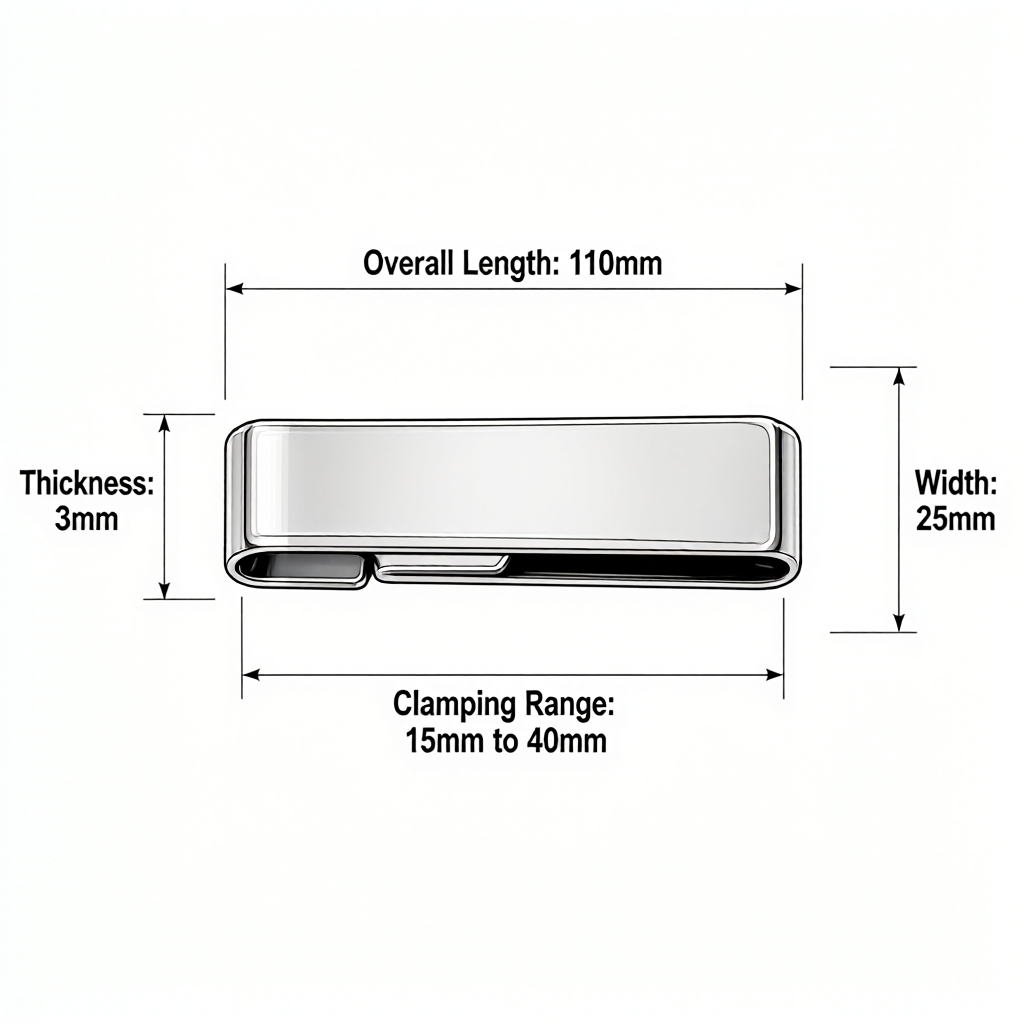
When B2B buyers evaluate OEM money clip options, several spec clusters recur across supplier catalogs and should be standardized internally before launching a sourcing round. Below are the representative ranges that reflect current market norms across mid-tier manufacturers.
- Overall length (closed): 70–90 mm — standard banknote width across USD, EUR, and JPY denominations fits comfortably within this envelope. Custom elongated formats exist for larger notes but reduce universality.
- Width (height when folded): 55–75 mm — constrains the vertical span of a stacked bill column; narrower units compromise capacity, wider units increase pocket bulge.
- Closed thickness: 6–10 mm — achievable only when omitting card slots or using very thin titanium frames.
- Loaded thickness: 8–14 mm — the practical operating window for most spring-loaded designs holding six to ten bills plus cards.
- Unloaded weight: 18–55 g depending on alloy and construction method.
- Holding force: 2.5–4.5 kg vertical pull resistance, measured at 75% of maximum rated bill capacity.
- Material grades: 304/420 stainless steel; 6061-T6 aluminum; Grade 5 titanium; PET-carbon-fiber laminates over aluminum or steel substrates.
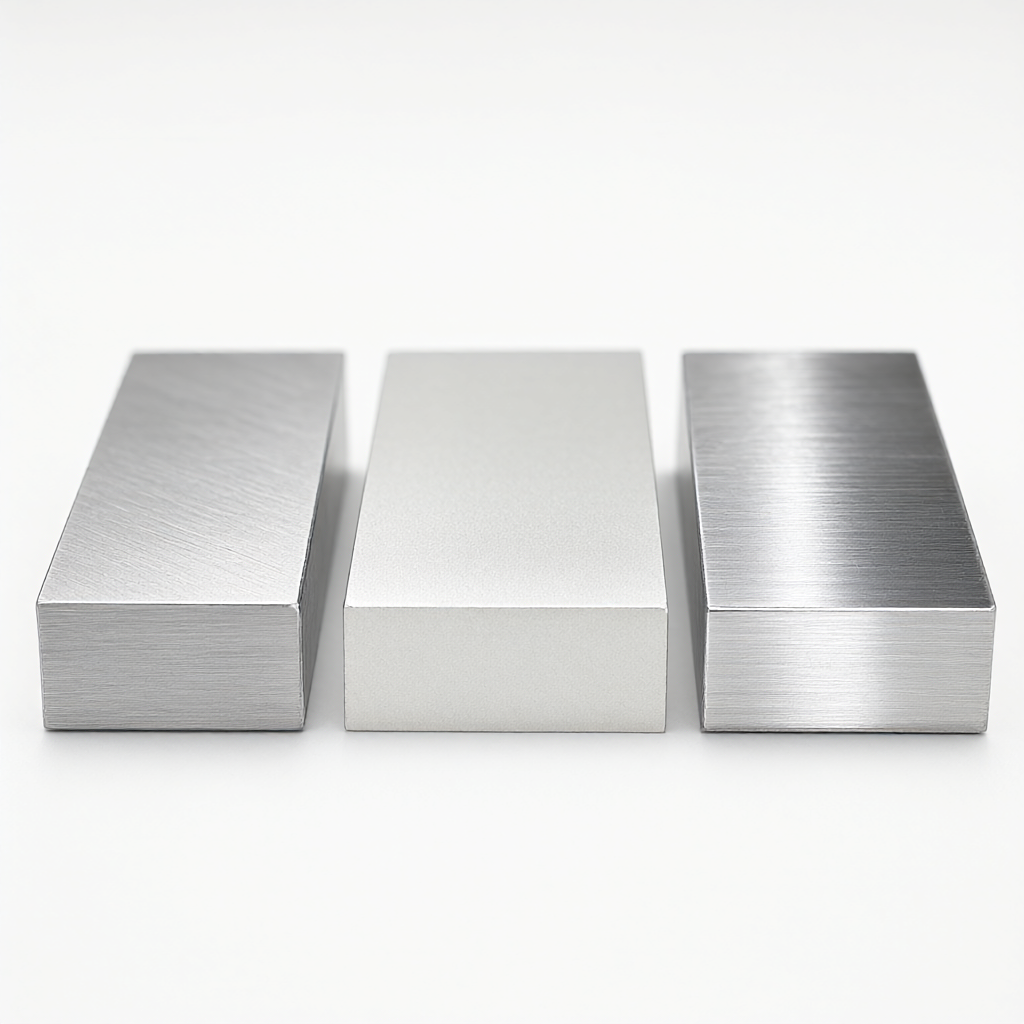
- Surface finishes: Brushed satin (Ra ≈ 0.4–0.8 μm), mirror polish (Ra < 0.1 μm), bead blast (Ra ≈ 1.0–1.5 μm), PVD black/DLC coating (hardness approaching 800 HV), powder coat (texture-dominant).
- Anodizing thickness: 10–25 μm for standard commercial Grade 5 parts; thicker coatings up to 50 μm are available for wear-intensive applications.
- Card slot count: 0 to 8 per side — more slots increase internal complexity and usually push loaded thickness upward.
- RFID blocking layer: Ferrite-polymer laminate, typically 0.15–0.30 mm thick, achieving 20–40 dB attenuation at 13.56 MHz. Coverage ratios range from 60% to full-face insertion.
- MOQ for custom designs: 300 pieces per SKU is common among flexible contract manufacturers; tooling-modified runs sometimes require 300–500.
- Sample lead time: 5–10 business days for modified-stock prototypes; 15–25 days for fully custom tooling development.
- Production lead time: 15–35 calendar days depending on order volume, finishing sequence, and certification documentation requirements.
These figures serve as reference boundaries rather than fixed rules — individual suppliers may diverge based on equipment availability and region-specific compliance demands. Before committing to a spec sheet, request measurement reports for the exact SKU under consideration, because advertised dimensions frequently reflect nominal values rather than statistically measured tolerances across sampled lots.
For additional context on broader wallet selection, consult our guide on How to Choose Men’s Wallets for B2B Sourcing to understand how money clips fit within a complete product-line sourcing strategy.
Best Money Clip: Which Standards and Certifications Apply?
Procurement of money clips follows the same quality-assurance and materials-compliance logic that governs other wearable EDC accessories. Because the device maintains prolonged skin contact and carries financial instruments, regulatory expectations cluster around material safety, electromagnetic compatibility where shielding is claimed, and general product conformity for destination markets.
- REACH (EC 1907/2006): Relevant for restricted substances in metals, plating baths, adhesives, and polymer laminates. Ni-release thresholds under Annex XVII Item 27 apply when ferrous alloys contact skin continuously; titanium and anodized aluminum bypass this exposure pathway entirely.
- RoHS (EU 2011/65/EU as amended): Governs heavy-metal content in soldered or plated interfaces, particularly for clips incorporating electronic RFID-shielding elements with conductive traces.
- ISO 9001: Not a product safety standard, but a process-certification indicator. Buyers should prefer suppliers maintaining an audited quality management system because it correlates with documented incoming inspection, first-article measurement records, and statistical process control on critical dimensions such as plate parallelism and spring preload.
- BSCI audit: Social-compliance evidence increasingly requested by European retail buyers and corporate gift procurement teams as part of vendor qualification.
- SGS / third-party material reports: Recommended for every new SKU to verify absence of prohibited phthalates in leather wraps, correct alloy designation in metal plates, and declared RF attenuation performance in RFID-equipped variants.
- CE marking relevance: Money clips themselves do not trigger mandatory CE conformity, but if the supplier labels products with RFID-blocking claims as “electromagnetically shielded,” the claim enters product-information territory where substantiation standards increase. Treat shielding claims as marketing statements unless accompanied by independent test documentation.
Quality-control checkpoints specific to clip construction include incoming raw-material certificate matching, spring-press torque verification at 10% sampling frequency, edge-radius inspection via Go/No-Go gauge, adhesive-bond shear testing on layered composites, and final functional pull-force抽检 (sample抽检) before packing. Any supplier that cannot describe at least one of these inspection stages should be treated as lacking formal process discipline.
Best Money Clip: What Else Should Buyers Consider?
Several operational topics influence the long-term purchasing decision beyond initial unit cost.
Durability and failure modes by material class. Over a twelve-month observation period in typical daily carry, stainless steel clips rarely exhibit functional degradation unless subjected to corrosive environments. Mainline failure happens at the spring anchor point, where cyclic loading fatigues the cantilever leg. Titanium displays negligible spring fatigue over the same horizon but costs substantially more upfront. Aluminum anodized clips show excellent cosmetic performance initially but risk decorative coating abrasion in high-friction pocket environments; once the anodized layer wears through, bare aluminum exposes itself to localized oxidation. Carbon-fiber overlays resist scratching well but can delaminate along the perimeter if impacted sharply — inspect bonding adhesive cure quality during incoming inspection.
Maintenance requirements. Metal clips demand minimal upkeep: occasional wiping with a dry microfiber cloth removes skin oils that, if accumulated, create visible smearing on polished surfaces. Leather-wrapped variants benefit from periodic conditioning every three to four months to prevent drying and cracking. Magnets lose negligible flux under normal ambient temperatures; keep clips away from strong external fields above roughly 50 mT to avoid partial demagnetization.
Bill-damage risk factors. The single strongest predictor of note-scoring is inner-edge sharpness combined with high clamping pressure. A clip rated at 4 kg holding force with a machined edge radius under 0.15 mm will leave visible indentation lines after hundreds of cycles. Increasing edge radius to 0.3 mm or greater reduces scoring incidence dramatically even at equal tension. Soft-material facings — silicone pads, rubberized inserts, or thin polymer liners — further mitigate abrasion but raise production cost and add thickness.
Using money clips with non-standard denominations. Foreign banknotes vary considerably in width and stiffness. Euro notes are slightly narrower than US dollars and can slide more easily from a snug clip unless the internal width is set conservatively. Asian yen and won notes are notably stiffer and thinner, which sometimes allows tighter stacking but reduces visual grip margin. Buyers serving international audiences should benchmark prototype clips against representative denominations from target regions rather than relying exclusively on domestic test stacks.
Drop and shake security narratives. Practical testing across jacket-pocket, front-pants, and bag-insert placements reveals distinct failure patterns. Front-pants carry subjects clips to the lowest dynamic load because hip motion produces gentler inertial forces; here even modest magnetic clips perform reliably. Jacket interior pockets impose moderate vibration levels from walking, testing mid-range magnetic and spring units adequately. Bag insertion introduces unpredictable folding angles and abrasive friction that accelerate edge wear — an underrated hazard for wholesale distribution because retail consumers often switch carry positions frequently during ownership.
Corporate gift and promotional contexts. Custom engraved metal clips remain popular in B2B-gift procurement because they project professionalism without the casual informality associated with apparel giveaways. Laser engraving depth of 0.05–0.10 mm preserves surface functionality while delivering brand legibility. Bulk pricing structures usually improve materially above 500-piece thresholds, and packaging customization — from simple poly bags to structured gift boxes — allows fine-tuning perceived value without proportionally increasing unit cost.
Where money clips replace wallets entirely. Active outdoor users, minimal-cash commuters, and professionals carrying digital-primary payment methods represent the segments where a full wallet transition makes sense. Conversely, users who regularly store pharmacy receipts, loyalty cards, transit passes, and varying currency denominations benefit more from a modular system — perhaps pairing a slim cardholder with a standalone bill clip in a backpack — than abandoning wallets altogether. Neither extreme represents a universal optimum; the decision hinges on daily item inventory.
Some buyers also explore companion strategies around asset recovery and loss prevention. Reviewing our How to Find a Lost Wallet: EDC Security Guide can inform broader pocket-security thinking beyond mere retention hardware.
For deeper background on protective-layer technologies, see our overview of RFID Protection: How It Works & Why It Matters for Everyday-Carry Wallets.
How Are Money Clips Sourced and Manufactured?
Selecting a contract manufacturer for a private-label money clip requires evaluating the same criteria applied to any bespoke EDC accessory: demonstrated capability, traceable quality systems, responsive prototyping, and transparent communication around lead-time variability. Fewer suppliers deliver the full combination, so alignment of buyer priorities with manufacturer strengths matters more than chasing headline pricing.
As a manufacturer, our approach to producing minimalist metal wallets and clip accessories focuses on balancing precision machining with scalable finishing workflows. Our facility is ISO 9001 certified, operates from a 50,000 sq ft in-house factory, and has been producing export-grade EDC products since 2014. We work with stainless steel, aluminum, titanium, and carbon-fiber assemblies, and we support OEM and ODM programs starts at 300 pcs per SKU for full OEM customization (100 pcs trial order available for stock finishes) per design. Samples typically ship within seven days, and custom packaging including retail boxes and poly Bags can be coordinated within the same run.
We recommend B2B buyers start sourcing conversations by sharing three things: target material, desired holding-force range, and estimated annual run size. From that baseline, qualified manufacturers can propose material alternatives, tolerance bands, and packaging options without inflating sample costs unnecessarily. For detailed manufacturing workflow references, read our piece on How Minimalist EDC Wallets Are Manufactured to compare process steps across common platform types before requesting quotes.
How Durable Is a Money Clip, and What Is It Worth Long Term?
Money clip longevity depends primarily on three factors: material selection, spring/clip-mechanism maintenance, and surface-finish integrity. Understanding how each factor degrades over time allows both retail buyers and procurement teams to set realistic lifecycle expectations and price against value rather than unit cost alone.
How Does Each Money Clip Material Degrade Over Time?
| Material | Typical Service Life (Daily Carry) | Key Degradation Mode | Maintenance Requirement |
|---|---|---|---|
| 304 Stainless Steel | 5–8+ years | Surface scratching; potential pitting in chlorinated environments | Wipe dry after exposure to salt/sweat; occasional polishing |
| 420 Stainless Steel | 3–6 years | Higher carbon content improves hardness but reduces corrosion resistance versus 304 | Same as 304; inspect passivation layer annually |
| Anodized Aluminum (6061-T6) | 3–5 years | Anodized layer wear at contact edges; minor denting under impact | Avoid abrasive cleaners; re-anodize only in specialized facilities |
| Titanium Grade 5 | 8–15+ years | Virtually no structural degradation; surface scratches possible | Minimal — wipe clean; no special treatment required |
| Carbon Fiber Composite | 5–7 years | Edge delamination if bonded poorly; resin UV yellowing over extended sun exposure | Store away from prolonged UV; inspect bond lines periodically |
A well-maintained titanium or stainless-steel money clip will outlast multiple budget aluminum replacements, which makes per-use-cost analysis important for bulk procurement decisions. For B2B buyers, requesting material Mill Certificates (also called MTRs — Material Test Reports) from suppliers ensures the claimed alloy grade matches what ships. A 304 certificate will specify chromium (18–20%) and nickel (8–10.5%) ranges per ASTM A240; titanium Grade 5 certificates reference AMS 4911 or Boeing BAC5724 specifications. Accepting shipments without verifiable mill certs introduces supply-chain risk — particularly when marketing claims of “medical-grade” or “grade 5 titanium” are central to product positioning.
How Do We Test Spring Retention and Holding Force?
The single most common failure mode in money clips is spring-tension loss. This occurs through:
- Metal fatigue — Repeated compression cycles exceed the elastic limit of the spring element. High-quality clips use music-wire steel (ASTM A228) or beryllium-copper springs rated for 10,000+ compression cycles before tension drops below 80% of initial preload.
- Plastic deformation — Over-tightening during assembly or misuse (forcing thick stacks beyond design limits) causes permanent set in the spring coil.
- Temperature cycling — Extreme heat (e.g., leaving a clip on a dashboard in summer) can anneal lower-grade springs, reducing restoring force.
Reputable manufacturers perform holding-force validation using standardized pull-test rigs. A typical test procedure involves:
- Loading the clip with a calibrated stack of six folded bills (standard US currency, approximately 90 g total).
- Applying a vertical tensile load at a rate of 50 mm/min until bill ejection occurs.
- Recording the peak force in kilograms-force (kgf).
- Repeating the cycle ten times and documenting tension retention percentage.
Buyers should request a test report summary showing average hold force and standard deviation across sample units. Industry targets for daily-carry clips sit at ≥3.0 kgf average with ≤15% variation between units. Anything below 2.5 kgf average or exceeding 20% unit-to-unit variation signals inconsistent spring calibration or substandard metallurgy.
How Long Does the Surface Finish Last?
Finish quality directly affects both aesthetics and perceived value. Common finishing processes and their durability rankings:
- Brushed/satin finish (mechanical abrasion): Hides micro-scratches well; moderate durability. Ideal for everyday carry where cosmetic perfection matters less than functional reliability.
- Mirror polish: Visually striking but shows scratches and fingerprints prominently. Requires careful packaging and handling.
- Anodizing (aluminum): Hardness of 300–500 HV depending on process parameters; color-fast but susceptible to galvanic corrosion if scratched deeply. Standard thickness for EDC applications is 15–25 microns per MIL-A-8625 Type II.
- PVD coating (physical vapor deposition): Hardness approaching 2,000 HV; excellent wear and corrosion resistance. Suitable for titanium and steel substrates. Must be verified for adhesion via cross-hatch tape testing per ASTM D3359.
- Laser engraving: Permanent marking that does not peel or fade. Depth typically 10–50 microns depending on power settings and substrate.
When evaluating suppliers for OEM orders, require finish specification sheets that document process type, hardness values (where measurable), and any relevant ASTM or ISO test results (e.g., salt-spray testing per ASTM B117 for corrosion resistance). Vague terms like “mature finishing ecosystem” provide zero quality assurance — specific process documentation does.
How Should End Users Clean a Money Clip?
Proper maintenance extends money clip service life measurably:
- Weekly: Wipe contact surfaces with a soft, lint-free cloth slightly dampened with isopropyl alcohol (≥70%) to remove oils and salts.
- Monthly: Inspect spring mechanism for debris accumulation; use compressed air or a soft brush to clear particles from moving interfaces.
- Quarterly: For metal clips, apply a thin coat of mineral oil or dedicated metal protectant to exposed surfaces — especially important for carry in humid or coastal climates.
- Annually: Check holding force by attempting to extract a loaded bill stack with gentle upward pressure. If extraction requires less effort than when new, the spring may be nearing end-of-life.
Leather-accented clips require additional care: condition the leather every three to four months with a pH-neutral conditioner, and never submerge in water. Moisture trapped between leather and metal core can cause corrosion or adhesive failure.
Related reading on protective features for EDC gear: explore What Is RFID Protection & How Does It Work? (Full Guide) to understand complementary security layers beyond physical cash retention.
Which Considerations Matter for Bulk OEM Money Clip Orders?
Procuring money clips at scale introduces variables that retail buyers never face: tooling costs, MOQ阶梯, certification verification, and supply-chain lead-time management. A structured evaluation framework prevents costly missteps, particularly for Amazon FBA sellers and private-label brands launching their first run.
What MOQ and Tooling Investment Apply to Money Clips?
MOQ structures vary significantly by manufacturing capability and customization depth:
| Customization Level | Typical MOQ Range | Tooling Cost Estimate | Lead Time (First Sample) |
|---|---|---|---|
| Stock SKU (no modifications) | 50–200 pcs | $0 | 3–5 days |
| Logo laser engraving only | 100–300 pcs | $150–$400 (engraving fixture) | 5–7 days |
| Custom design, existing mold | 200–500 pcs | $500–$1,500 (mold modification) | 10–14 days |
| Fully custom design, new tooling | 500–1,000 pcs | $2,000–$8,000 (new CNC programs/fixtures) | 21–35 days |
Low-MOQ suppliers (starts at 300 pcs per SKU) typically operate flexible CNC cells capable of quick changeover between parts. High-volume producers rely on dedicated molds and assembly-line fixtures, requiring larger commitments to amortize fixed costs. Buyers should match order volume to demand forecasts conservatively — overshooting MOQ for an unproven design risks dead inventory, while undersizing forfeits per-unit cost advantages.
Which Money Clip Pricing Tiers Should Buyers Expect?
OEMFOB price ranges for money clips reflect material, mechanism complexity, and finishing requirements. These benchmarks help buyers evaluate supplier quotes against market norms:
| Tier | Price Range (USD/unit FOB) | Typical Materials | Target Market Segment |
|---|---|---|---|
| Budget | $1.20–$2.50 | 420 stainless, basic anodized aluminum | Entry-level Amazon listings, promotional items |
| Mid-tier | $2.50–$4.50 | 304 stainless, 6061-T6 aluminum (multi-tone anodize), basic carbon fiber inserts | Established EDC brands, boutique retailers |
| Premium | $4.50–$7.00+ | Grade 5 titanium, PVD coatings, precision machined details, integrated RFID blocking | Flagship EDC products, corporate gifts, tactical channels |
Price alone is an insufficient quality indicator — a $1.80 clip may use inferior spring steel that loses tension within months, while a $4.20 unit could represent superior metallurgy and tighter tolerances. Request unit cost breakdowns from suppliers (material, machining, finishing, assembly, packaging) to identify where savings come from and whether they compromise performance.
Which Certifications Should You Verify Before Ordering?
For B2B procurement, certifications are non-negotiable in regulated or quality-conscious markets:
- ISO 9001:2015 (Quality Management System): Confirms the manufacturer operates documented QMS procedures covering design control, supplier management, production monitoring, and corrective actions. Verify the certificate is current and issued by an accredited body (e.g., via the IAF Multilateral Recognition Arrangement database).
- BSCI (Business Social Compliance Initiative): Audits social responsibility practices including working conditions, hours, and child-labor policies. Required by many European retail chains.
- REACH / RoHS compliance: Chemical-restriction compliance for EU-bound products. Request SGS or Intertek test reports confirming heavy-metal limits (lead, cadmium, hexavalent chromium) and phthalate restrictions.
- SGS-tested materials: Third-party material verification provides objective proof of claimed alloys. A mill cert from the foundry plus an SGS confirmation creates a defensible audit trail.
Do not accept self-declared compliance statements without supporting documentation. Ask suppliers specifically: “Can you provide current ISO 9001 certification, REACH test reports for our target SKUs, and SGS material certificates for all alloy components?”
See also our detailed guide on How to Choose Men’s Wallets for B2B Sourcing and Private Label Development for extended sourcing-framework advice applicable across wallet categories.
How Long Does Money Clip Production Take?
Realistic lead-time estimation prevents stockouts and lost sales windows:
| Phase | Duration | Dependencies |
|---|---|---|
| Design finalization & artwork approval | 3–7 days | Client feedback loops |
| Prototype/sample production | 5–10 days | Mold/tooling availability |
| Sample revision (if needed) | 5–7 days per iteration | Complexity of changes |
| Mass production | 15–30 days | Order volume, factory schedule |
| Quality inspection & packaging | 3–5 days | AQL sampling plan execution |
| Shipping (sea freight) | 25–35 days | Origin port, destination, customs |
| Shipping (air freight) | 5–7 days | Expedited option for urgent replenishment |
Total timeline from purchase order to warehouse receipt typically ranges 60–90 days for custom orders. Buffer an additional 10–15% for unforeseen delays (material shortages, inspection failures requiring rework, customs holds). Plan production calendars around seasonal demand peaks — ordering in Q2 for holiday-season inventory avoids expedited shipping premiums and factory scheduling bottlenecks.
Related reading on physical asset security in EDC routines: read How to Find a Lost Wallet: EDC Security Guide to contextualize where money clips fit within broader carry-strategy thinking.
Which Decisions Must Buyers Make Before Ordering Money Clips?
Before committing to a money clip procurement order, verify each item on this checklist. Skip no more than two items without documented justification.
What Should You Verify Before Sourcing Money Clips?
- [ ] Supplier holds current ISO 9001:2015 certificate — obtained and verified via accrediting body
- [ ] Sample units received and evaluated for build quality, finish consistency, and holding force
- [ ] Material test reports (mill certs) confirmed for all alloy components
- [ ] REACH/RoHS compliance documents available for target export markets
- [ ] BSCI audit report reviewed if supplying to European retail channels
- [ ] Hold-force test data provided — average ≥3.0 kgf, unit variance ≤15%
- [ ] Edge radius on bill-contact surfaces measured ≥0.3 mm
- [ ] Salt-spray corrosion test results (ASTM B117) reviewed — minimum 24-hour exposure for stainless, 48-hour for aluminum anodized
- [ ] Anodizing thickness verified (15–25 microns minimum for durability)
- [ ] PVD coating adhesion test (ASTM D3359) passed at 4B or higher rating
Which Product Specs Must Be Confirmed in Writing?
- [ ] Bill capacity matches target user profile (4–7 slim / 8–12 standard / 12–15 extended)
- [ ] Loaded thickness falls within acceptable range for intended pocket/carry style
- [ ] Card slot count and retention method documented (friction-tab vs. open-slot)
- [ ] RFID-blocking specification includes shielding-effectiveness test data (dB attenuation at 13.56 MHz)
- [ ] Weight specification confirmed — critical for competitive positioning in lightweight segments
- [ ] Color/finish options documented with RAL or Pantone references for consistency
Which Commercial Terms Should You Validate?
- [ ] Unit pricing compared against at least three alternative suppliers
- [ ] Tooling costs clearly separated from per-unit pricing — no hidden fixture charges
- [ ] Payment terms reviewed (standard: 30% deposit, 70% before shipment; negotiate for long-term partners)
- [ ] MOQ flexibility documented — what happens if initial order undercuts stated minimum
- [ ] Sample cost and refund policy clarified (many suppliers credit sample fees against production orders)
- [ ] Lead-time commitment written into contract with liquidated damages clause for chronic delays
- [ ] Packaging specification agreed — retail-ready boxes, barcode placement, insert materials
- [ ] Drop-shipping / Amazon FBA prep capability confirmed if required
What Does a Money Clip QA Protocol Include?
- [ ] AQL (Acceptable Quality Level) sampling plan defined — typically 1.0% for critical defects, 2.5% for major, 4.0% for minor
- [ ] Defect classification criteria shared with supplier before production begins
- [ ] Pre-shipment inspection scheduled with independent third-party inspector (SGS, BV, or equivalent)
- [ ] Contingency plan documented for failed inspections (rework scope, timeline, cost allocation)
- [ ] Warranty terms reviewed — typical expectation: 12-month coverage for spring failure and finish delamination
- [ ] After-sales communication channel established — designated account manager or support contact
Which Money Clip Brands Lead in 2026?
The money clip market spans commodity imports, boutique EDC makers, and specialist manufacturers. Below is a comparative overview of recognized options across price tiers, highlighting what differentiates each category and where our own production fits within the landscape.
Which Money Clips Fit the Budget Tier?
Entry-level clips dominate Amazon bestseller lists and promotional-product catalogs. Common characteristics include 420-series stainless construction, basic bead-blasted finishes, and rudimentary card slots. Brands in this tier often prioritize volume over tolerances — holding forces may meet specifications on average but show wide unit-to-unit variance. Notable models include generic offerings from established Chinese exporters and white-label products rebranded by US and European resellers. Quality is adequate for light daily use but rarely suited for demanding outdoor or tactical applications.
Which Money Clips Fit the Mid-Tier?
Mid-range brands differentiate through material upgrades (6061-T6 aluminum with multi-step anodizing,Grade 5 titanium), tighter dimensional tolerances, and design-originality. Popular models feature integrated card-management systems, textured grip patterns for wet-hand operation, and proprietary spring mechanisms tuned for consistent retention. These brands invest heavily in community engagement, unboxing experiences, and influencer partnerships. Manufacturing usually occurs in specialized OEM factories in Guangdong and Zhejiang provinces — the same industrial base that produces many premium-tier pieces. The value proposition centers on design pedigree and brand narrative rather than raw spec superiority.
Which Money Clips Fit the Premium Segment?
Ultra-premium clips target users who demand maximum performance regardless of cost. Titanium or bronze constructions, hand-finished surfaces, ceramic-coated options, and exotic materials (damascus steel accents, G-10 scales) populate this tier. Some models incorporate modular designs allowing interchangeable plates or expandable card capacity. Pricing reflects both material costs and low-volume artisanal production. For B2B buyers targeting this segment, specifications must be extremely tight —公差 often held to ±0.05 mm, surface roughness Ra <0.2 µm on contact faces, and holding-force variance capped at 8% maximum.
Where Does TOPWALLET Sit in This Market?
We manufacture across the mid-tier to premium transition zone, producing money clips that bridge functional reliability and design refinement at cost-competitive FOB prices. Our clients span Amazon FBA sellers seeking private-label differentiation, EDC brands developing signature collections, and corporate-gift programs requiring branded metal accessories. Rather than competing on novelty or ultra-premium materials alone, we focus on delivering consistent build quality, verifiable specifications, and responsive OEM/ODM collaboration — from initial concept sketches through final shipment. Buyers who prioritize spec transparency and supply-chain reliability over brand storytelling tend to find alignment with our approach.
Explore our full range of minimalist aluminum wallets, carbon fiber card holders, and titanium money clips at https://topedcwallet.com/.
How Do Money Clips Compare by Mechanism and Style?
Money clips differ not only by material but also by mechanical configuration, which determines how bills are retained, accessed, and secured over time. The three primary mechanisms — spring-loaded, magnetic, and hybrid — each serve different carry philosophies. Spring-loaded clips remain dominant because they offer quantifiable holding force that can be engineered within a tight window: enough to prevent ejection during normal movement, but not so much that bill removal requires excessive effort. Magnetic clips excel in convenience — a simple slide-off motion retrieves cash instantly — but introduce variability in real-world security depending on magnet degradation and impact exposure. Hybrid models attempt to reconcile both approaches by layering magnetic attraction atop passive spring tension, though this increases part count and assembly complexity.
Design styles further segment the market. Tactical clips feature aggressive knurling, matte black finishes, and sometimes integrated bottle-opening edges or striker surfaces. They skew heavier and thicker but appeal to outdoor and duty-carried users. Classic brushed-metal clips present a clean, utilitarian aesthetic — often bead-blasted or satin-finished stainless or aluminum — suitable for office and casual environments. Luxury or fashion-oriented clips may incorporate leather wraps, precious metal plating, or engraved patterns, targeting gift and lifestyle buyers rather than pure function seekers. Understanding which design language aligns with your target customer’s identity is as important as selecting the right mechanism or material grade.
What materials are used for money clips and how do they differ?
Material selection defines the performance envelope across strength, weight, corrosion resistance, and finish options. Below is a comparative overview of the most common choices.
| Material | Weight (typical, unloaded) | Corrosion Resistance | Tensile Strength | Anodize/PVD Compatibility | Relative Cost |
|---|---|---|---|---|---|
| 304 Stainless Steel | 35–55 g | High | ~515 MPa yield | Yes (PVD commonly applied) | Low–Mid |
| 420 Stainless Steel | 35–55 g | Moderate | ~690 MPa yield | Limited (higher carbon) | Low |
| 6061-T6 Aluminum | 22–38 g | Moderate (improved by anodizing) | ~276 MPa yield | Excellent (thick anodize possible) | Low–Mid |
| Grade 5 Titanium | 18–30 g | Very high | ~880 MPa yield | Limited natural color; PVD applied | Mid–High |
| Carbon Fiber Composite | 15–25 g (panel only) | N/A | Depends on substrate | N/A (panel aesthetic) | Mid–High |
Stainless steel offers the strongest combination of machinability, durability, and post-processing flexibility. PVD (physical vapor deposition) coatings on steel — typically producing TiN, CrN, or DLC layers — add surface hardness up to 2000+ HV and excellent wear resistance while providing color options from gold to black. Anodized aluminum delivers vibrant, fade-resistant colors through electrolytic oxidation, with thicknesses commonly ranging from 10 to 25 µm for consumer EDC applications. Titanium commands premium pricing but remains attractive for users prioritizing low weight and hypoallergenic properties — it contains no nickel and is inherently biocompatible.
How many bills can a quality money clip hold, and how thick will it be?
Bill capacity and loaded thickness are inversely related through internal design geometry. A well-engineered minimalist clip rated for five to eight standard US dollar bills typically measures between 8 mm and 11 mm in total height when fully loaded — thin enough to sit flat against the thigh without printing through clothing. Going beyond ten bills generally pushes thickness toward 12–14 mm, which begins to compromise the slim-carry advantage that distinguishes clips from wallets. Some manufacturers advertise capacities of fifteen or more bills, but these often rely on aggressive spring preload that accelerates bill wear and makes extraction increasingly difficult.
The card-slot dimension also affects overall thickness. A clip featuring two to four friction-fit card slots adds approximately 3 to 5 mm to the loaded profile. Buyers who prioritize ultra-slim bulk should consider a separate card holder or a clip with only a single narrow slot, accepting reduced card capacity in exchange for a leaner package. Conversely, all-in-one designs that accommodate six to eight cards alongside a moderate bill stack deliver maximum utility at the cost of a thicker pocket presence.
Which Quality Markers Separate a Good Money Clip From a Cheap One?
Evaluating money-clip quality requires attention to finishing details and mechanical tolerances that separate production-grade units from commodity imports. Surface treatment specifications, spring geometry, and edge radii are all measurable indicators that should appear on supplier datasheets rather than relying solely on product photography.
Spring tension should be specified as a compressive force range — typically 2.5 to 4.0 kg for general-purpose clips and up to 4.5 kg for tactical or heavy-carry variants. Springs fabricated from music wire (ASTM A228) or spring stainless steel (ASTM A313 Type 302) provide consistent force curves over thousands of open-close cycles. Buyers should request cycle-life data; reputable manufacturers test to 5,000+ cycles with less than 10% force degradation. Edge treatment on bill-contact surfaces must include a minimum 0.3 mm edge radius (per geometric-tolerance standards such as ASME Y14.5) to prevent sharp milling marks from scoring currency over repeated insertions. Bead-blasting, polishing, or tumbler-finishing processes achieve this — machines delivering a mirror polish without deburring will leave microscopically sharp corners even if the visual appearance looks refined.
Anodizing thickness on aluminum clips is another critical spec. Industry practice targets 15 to 25 µm for consumer EDC products, with sealing performed in hot deionized water per MIL-A-8625 type II requirements. Thinner anodic layers below 10 µm tend to chip or wear through during normal handling. PVD-coated components should pass cross-hatch adhesion testing (ASTM D3359, rating 4B or higher) and salt-spray resistance testing (ASTM B117, minimum 24 hours with no base-metal corrosion) to verify coating integrity.
Do RFID-blocking money clips actually work?
RFID blocking works by attenuating radio-frequency fields at the frequencies used by modern contactless payment and ID cards — primarily 13.56 MHz for EMV credit cards and NFC-enabled documents. Ferrite-polymer laminates or woven metallic mesh layers sandwiched between the clip’s outer plates create a Faraday-shield effect that reduces signal penetration. Independent laboratory measurements typically show attenuation between 20 and 40 dB depending on laminate coverage percentage, layer count, and the absence of aperture gaps larger than approximately 15 mm.
No-certification-claim money clips that advertise RFID protection without providing third-party test reports should be treated as unverified. Buyers should request an SGS or Intertek test report specifying shielding effectiveness at 13.56 MHz and 850–950 MHz (for newer cellular-band variants). See What Is RFID Blocking? How It Protects Contactless Cards for a deeper technical explanation of the physics and measurement methodology.
What Is the Decision Framework for Money Clip Sourcing?
When sourcing money clips at volume, B2B buyers should follow a structured evaluation process that moves from requirement definition through supplier qualification to pilot ordering. The framework below ensures that material claims, finish specifications, and compliance documentation are verified before committing to a production run.
Step 1 — Define carry-profile requirements. Document the intended bill capacity (four to twelve notes), target thickness under load (under 14 mm preferred), expected card retention (zero to eight cards), and weight ceiling for end-user comfort. This drives material selection: lightweight outdoor use favors titanium; budget retail favors anodized aluminum; durability-focused segments favor 304 stainless with PVD coating.
Step 2 — Specify finish and compliance requirements. Confirm REACH Annex XVII Item 27 nickel-release compliance for skin-contact metals, RoHS Directive 2011/65/EU conformity for restricted substances, and any destination-market specific requirements. Request SGS or equivalent test reports prior to sampling.
Step 3 — Evaluate spring and edge-quality documentation. Ask suppliers for cycle-life test data (minimum 5,000 cycles acceptable) and edge-radius verification. Samples should be physically tested — pull a folded bill stack through the clip repeatedly and inspect for scoring after twenty cycles.
Step 4 — Review OEM capability and tooling. Suppliers offering in-house CNC machining can produce tighter tolerances and faster iteration on custom geometries. Verify that your design files can be translated without requiring expensive new jigs unless the order quantity justifies the investment.
Step 5 — Validate MOQ and lead-time alignment. Entry-level custom runs often starts at 300 pcs per SKU for basic designs with standard tooling. Complex geometry or multi-material assemblies may require 300 to 500 pcs minimum. Sample lead time should be confirmed — seven-day samples indicate responsive engineering support.
Step 6 — Audit packaging and branding integration. Laser engraving depth of 0.05 to 0.15 mm is standard for metal surfaces; UV printing works on coated aluminum but has lower abrasion resistance. Confirm that retail-box design, hang-tag printing, and insert card artwork are handled in-house or through a vetted packaging partner.
What Goes on a Money Clip Sourcing Checklist?
Use the following checklist when evaluating potential money clip manufacturers:
- [ ] Material grade documented (e.g., 304 SS, 6061-T6 Al, Gr. 5 Ti) with mill certificate available
- [ ] REACH and RoHS test reports provided by independent lab (SGS, Intertek, or equivalent)
- [ ] Nickel-release compliance confirmed for alloys in direct skin contact
- [ ] Edge radius on bill-contact surfaces ≥ 0.3 mm, verified by sample inspection
- [ ] Spring cycle-life data ≥ 5,000 cycles with <10% force loss
- [ ] Holding-force specification stated in kg with test methodology disclosed
- [ ] Anodizing thickness ≥ 15 µm for aluminum (cross-section measurement or X-ray fluorometry)
- [ ] PVD adhesion rated 4B or higher per ASTM D3359
- [ ] Salt-spray resistance tested ≥ 24 hrs per ASTM B117 (for coated parts)
- [ ] RFID-blocking panels supported by shielding-effectiveness test at 13.56 MHz
- [ ] Sample turnaround time confirmed in writing (ideally ≤ 7 business days)
- [ ] MOQ clearly stated and aligned with order quantity expectations
- [ ] Custom packaging capability verified (box, bag, insert, hang-tag)
- [ ] Private-label laser engraving or UV printing evaluated on sample piece
- [ ] Drop-shipping or FBA prep service offered if required
- [ ] Certifications (ISO 9001, BSCI) on file and recent audit dates confirmed
Which Red Flags Should You Watch in a Money Clip Supplier?
Certain warning signs indicate insufficient quality control or misleading marketing that can result in costly B2B mistakes:
- No test reports available. If a supplier cannot produce REACH, RoHS, or material-certification documents on request, treat that as a disqualifying risk for export-bound orders.
- Unrealistic capacity claims. Promises of unlimited customization with zero MOQ and simultaneous fast delivery usually signal trading-company resellers rather than actual manufacturers with CNC capabilities.
- Missing edge-radius specification. Suppliers who never mention deburring or edge treatment on bill-contact surfaces likely skip this step to reduce machining time, resulting in scored bills and customer complaints.
- No spring-cycle data. Vague promises of “strong spring” without quantitative cycle-life metrics suggest the component hasn’t been stress-tested.
- Anodizing thickness unstated. Claims of “durable anodized finish” without micron-level specification often mask thin, easily worn coatings that degrade within months of consumer use.
- RFID claims without test data. Shielding-effectiveness numbers must come from a lab report; verbal guarantees are unactionable and unverifiable.
- Single-photo catalogs only. Reputable factories share production-floor imagery, QC stations, and sample workshops. Absence of facility transparency correlates with higher defect rates.
How Do We Approach Money Clip Manufacturing?
At TOP EDC Wallet, we engineer money clips for brands that demand consistency across material, finish, and mechanical performance. Our facility operates ISO 9001:2015 certified processes with BSCI-audited social compliance, and every production run is backed by SGS-tested material certificates. We machine clips in-house using CNC centers capable of ±0.05 mm dimensional tolerance, apply anodizing at 15–25 µm per MIL-A-8625 Type II protocols, and validate PVD adhesion to 4B or above before units leave the line.
Our OEM and ODM programs support 300-piece minimum orders with seven-day sample turnaround, and our in-house laser-engraving and UV-printing teams handle full branding from logo placement to custom retail packaging. With 13+ years of export experience serving 200+ brands across North America, Europe, Australia, and Southeast Asia, we specialize in translating concept sketches into production-ready EDC wallets, carbon fiber card holders, and titanium money clips.
Best Money Clip: Where Can You Verify the Data and Sources?
- What Is RFID Blocking? How It Protects Contactless Cards — topedcwallet.com
- How Minimalist EDC Wallets Are Manufactured: A Procurement — topedcwallet.com
- How to Choose Men’s Wallets for B2B Sourcing — topedcwallet.com
- How to Find a Lost Wallet: EDC Security Guide — topedcwallet.com
- RFID Protection: How It Works & Why It Matters for Everyday-Carry Wallets — topedcwallet.com
- How Minimalist EDC Wallets Are Manufactured — topedcwallet.com
- Get a Free Quote → — topedcwallet.com
- https://topedcwallet.com/ — topedcwallet.com
From article to product
Sourcing minimalist-wallets?
Tell us the format, the quantity and the date you need stock. You get material options, MOQ and a landed-cost range back within one business day.
Keep reading
More on wallet types
Thin Male Wallets: Buying Guide for Slim Minimalist Picks
How to choose a slim wallet for men — thickness thresholds, material trade-offs, capacity…
ReadStashed Wallet: A Minimalist Everyday-Carry Solution
Understand what a stashed wallet is, how minimalist slim wallets work, and what to…
ReadFolding Wallets: Types, Materials & Buying Guide
Learn what makes a folding wallet worth buying, from materials and card capacity to…
Read
About the author
TOPWALLET Editorial Team
TOPWALLET's editorial and engineering desk writes from bench testing at the Shenzhen (Longgang) facility: pull-force and cycle testing, 13.56 MHz shielding measurements, finish trials and factory audits, rather than supplier spec sheets. Every specification in these guides is one we write on a purchase order.
Written on the floor
This article was written by our production and QC team — the people who spec tolerances, run the finishing line and inspect every batch. Where it states a capacity, a pull force or a lead time, it comes from a measurement we made, not a supplier’s catalogue. If a number here disagrees with what your own supplier told you, tell us; several of these articles started as a correction from a buyer.
See how the factory works · Inspection process · Sourcing FAQ
Sourcing minimalist-wallets?
Tell us the format, the quantity and the date you need stock. You get material options, MOQ and a landed-cost range back within one business day.