

RFID Protection: What Is the Quick Answer?
What is RFID protection? RFID protection refers to the use of conductive materials — such as metallic meshes, aluminum sheets, or carbon-fiber laminates — built into wallets and pocket carriers to block or severely attenuate radio frequency signals. Its purpose is to prevent contactless smart cards (credit cards, transit passes, ID badges) from being read by unauthorized scanners.
It works on the Faraday cage principle: a continuous conductive enclosure disrupts electromagnetic waves, stopping them from reaching the chip inside a card. Effective consumer-grade RFID blocking targets the 13.56 MHz high-frequency band used by NFC and contactless payment systems, and sometimes the 125 kHz low-frequency band used by older access-control cards.
RFID Protection: How Does It Work in Detail?
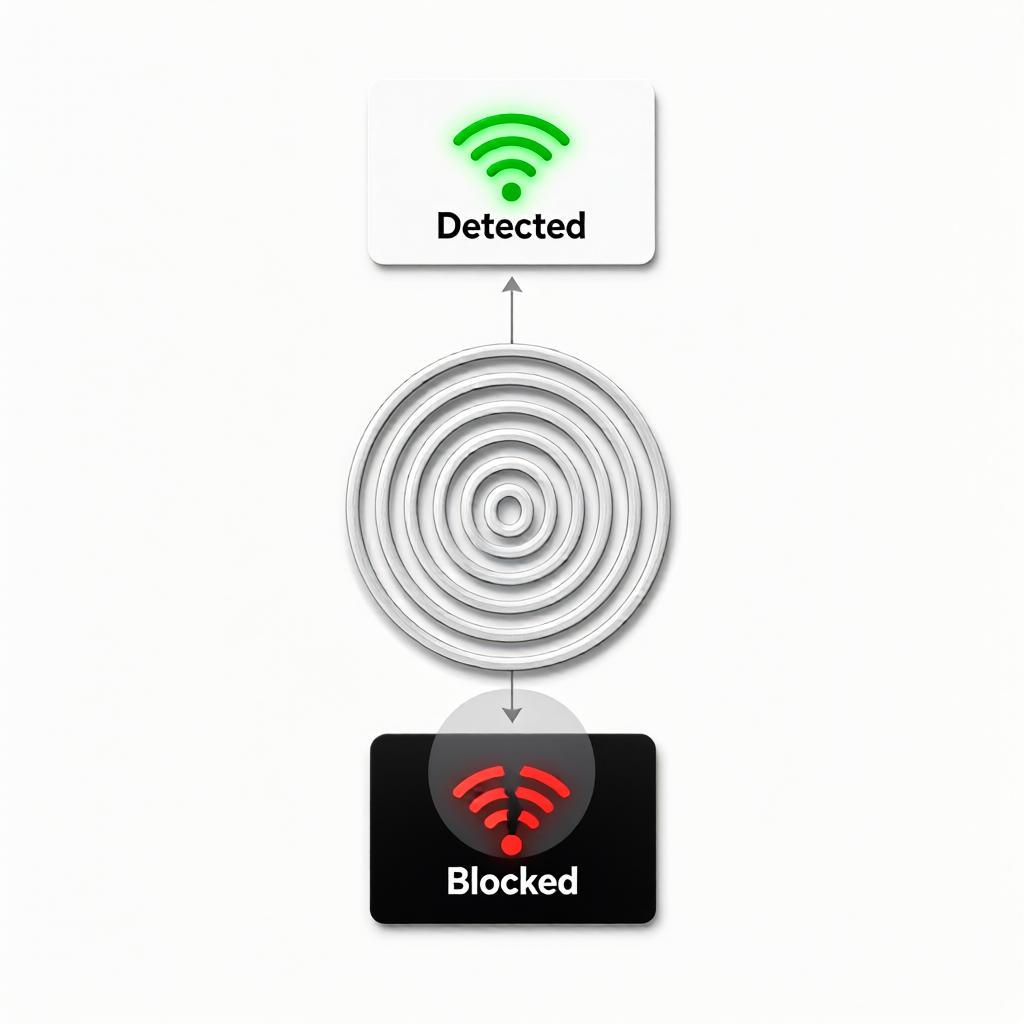
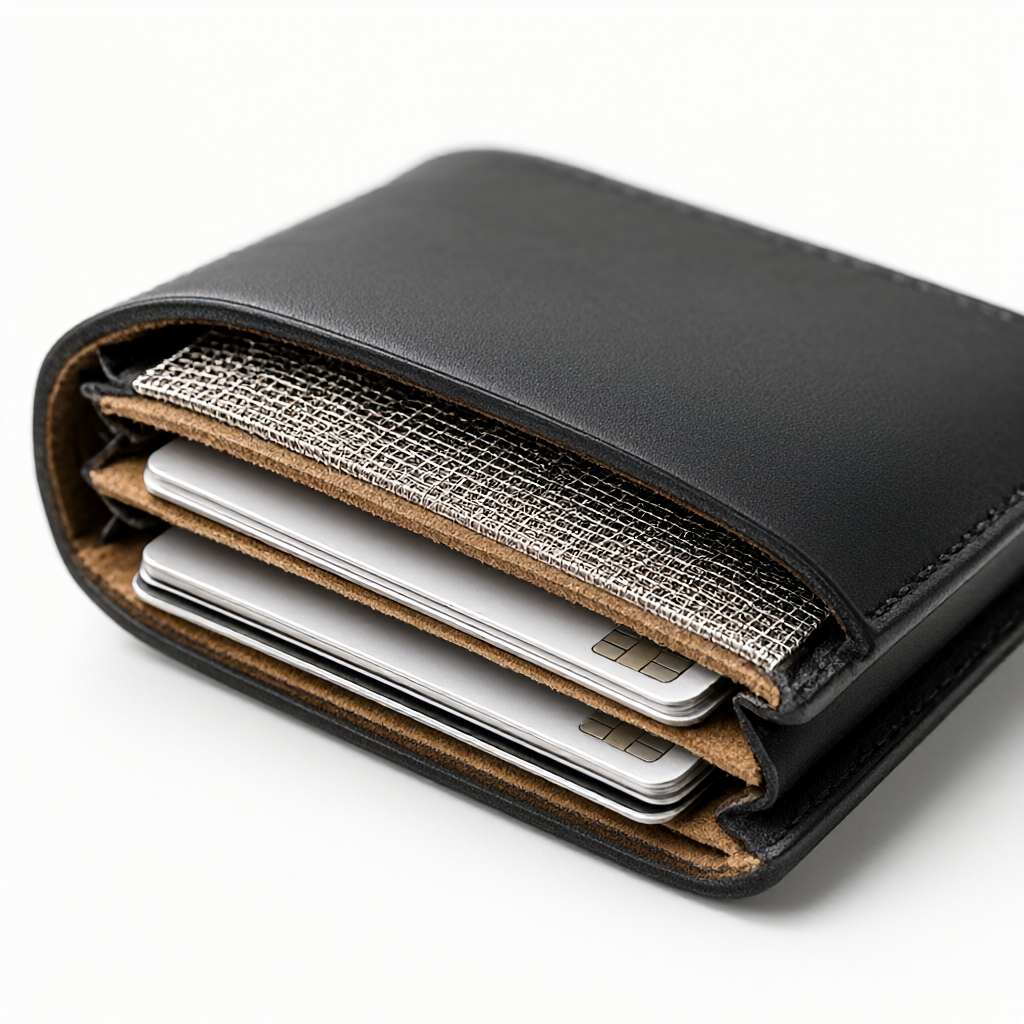
What is RFID technology and how does contactless card scanning work?
Before understanding protection, it helps to understand the signal being blocked. Most modern contactless cards — credit and debit cards, transit cards, hotel keys, and e-passports — contain a tiny integrated circuit coupled to a coil antenna. This assembly is a passive RFID (Radio-Frequency Identification) tag: it has no battery and draws power entirely from the radio wave emitted by a reader.
When you tap a card at a terminal, the reader generates an electromagnetic field at a specific frequency. The card’s coil picks up energy from that field, powers the chip, and exchanges data. This same mechanism can theoretically be triggered by any reader operating at the right frequency within close range — typically a few centimeters to about 10 centimeters for high-frequency cards.
The concern driving RFID protection is skimming: a malicious actor using a portable scanner to read card data without the owner’s knowledge. While documented cases of large-scale skimming remain uncommon, the theoretical vulnerability is real, and many consumers and brands choose protection as a precautionary measure. According to industry analysis discussed by the Federal Trade Commission, consumers should evaluate their personal risk and take reasonable steps to safeguard sensitive card information, though the agency also notes that widespread credential-skimming incidents are limited.
How does RFID protection work?
RFID protection relies on electromagnetic shielding, commonly called a Faraday cage effect. When a conductive material forms a complete barrier around a card, incoming radio waves induce small electrical currents in that material. Those currents generate opposing fields that cancel the incoming signal, preventing it from reaching the card’s antenna and chip.
Two conditions determine effectiveness:
- Continuity — Gaps, seams, or openings larger than a fraction of the signal’s wavelength allow leakage. A wallet with an open slot or a partially covered card may still be skimmable.
- Conductivity and thickness — Thinner or less conductive materials attenuate less. Effective shielding requires either a dense metallic layer or multiple layers of conductive mesh fine enough to intercept the target frequency.
In practice, wallet manufacturers integrate shielding by lining card slots or inserting a full inner panel made from aluminum, titanium, stainless steel mesh, or conductive carbon fiber.
What materials provide effective RFID shielding in wallets?
Different materials offer trade-offs in weight, cost, durability, and aesthetic quality:
| Material | Shielding Quality | Weight | Cost | Typical Use |
|---|---|---|---|---|
| Aluminum sheet (anodized) | Excellent | Light | Low–moderate | Minimalist front-pocket wallets |
| Titanium plate | Excellent | Moderate | Higher | Premium EDC wallets |
| Stainless steel mesh | Very Good | Light–moderate | Moderate | Hybrid designs; flexible feel |
| Carbon fiber (with embedded conductive layer) | Good to Very Good | Light | Moderate–high | Designer minimalist holders |
| Ferrite composite sheets | Good (narrow-band) | Heavier | Moderate | Specialized low-profile blockers |
| Household foil / ziplock bags | Inconsistent | N/A | Negligible | Not reliable for actual protection |
Aluminum and titanium are the most common choices in commercial EDC wallets because they combine strong shielding with slim profiles and good structural rigidity. Carbon fiber adds a distinctive look but typically requires a bonded metal laminate underneath to achieve true blocking performance — raw carbon fiber alone is not sufficiently conductive.
Stainless steel mesh offers a middle ground: lighter than solid plate, more flexible than rigid aluminum, and visually distinctive when exposed. However, mesh geometry matters — the aperture size must be significantly smaller than the wavelength of the target frequency (for 13.56 MHz, that wavelength is roughly 22 mm in free space) to maintain effective attenuation.
What frequencies do RFID-blocking wallets block?
Consumer credit and payment cards operate almost exclusively in the 13.56 MHz high-frequency (HF) band, which is also the frequency used by NFC (Near Field Communication). Many “RFID-blocking” products and blog articles conflate RFID and NFC, but from a shielding standpoint they are functionally identical: a barrier rated for 13.56 MHz blocks both.
Some older access-control cards, hotel key fobs, and animal-tracking tags operate at 125 kHz low-frequency (LF). A well-designed wallet intended for general-purpose protection should ideally cover both bands, though 125 kHz requires thicker or denser conductive material due to its longer wavelength.
A few niche applications — e-tags on retail merchandise, some logistics pallet labels — operate in the UHF band (860–960 MHz). Consumer wallets do not need to block UHF, and products claiming universal blocking across LF, HF, and UHF should be treated with scrutiny unless third-party test data supports the claim.
Is RFID protection still necessary for modern contactless payment cards?
The necessity depends on your risk tolerance and the type of card data involved.
Modern EMV contactless cards use tokenization and dynamic cryptograms. Each transaction generates a unique code that cannot be reused, meaning even if a skimmer captured a transmission, replaying it would not authorize a charge. This significantly reduces the practical risk compared to the old magnetic-stripe era.
However, tokenization does not protect against every threat vector:
- Personal identifying information on some cards (cardholder name, partial account numbers) could still be read.
- Non-payment cards — transit passes, employee IDs, membership cards — may not use the same level of encryption.
- Some jurisdictions and card issuers have slower adoption of full EMV contactless tokenization.
For brand owners and B2B buyers, the question shifts from individual risk to market demand. Many consumers actively seek RFID-protected gear and factor it into purchasing decisions, particularly in the EDC and outdoor segments. Including RFID protection as a standard feature is often a competitive differentiator even where the absolute security benefit is marginal.
What are the practical limitations of RFID protection?
Effective shielding has boundaries that buyers and brands should communicate honestly:
- Gaps defeat the shield. If a card protrudes from a slot, or if the wallet’s construction leaves uninsulated gaps larger than a few millimeters near the card area, signals can leak through.
- Phone placement matters. Holding an active smartphone directly against an RFID-blocked wallet can sometimes interfere with the shielding depending on the phone’s own antennas and case material.
- Shielding is frequency-specific. A wallet tested and rated for 13.56 MHz may not reliably block 125 kHz LF or higher UHF frequencies.
- Damage degrades performance. Deep scratches, bends, or delamination in metallic shielding layers can create weak points.
- Passive cards outside the shield are vulnerable. A lanyard badge worn on a chest strap with no shielding is unprotected regardless of what your wallet contains.
Can RFID protection be verified or tested?
Yes. Reputable manufacturers and third-party labs perform attenuation measurements using calibrated RFID readers and tagged test cards. The standard measurement reports insertion loss or signal attenuation in decibels (dB) across target frequencies. A reduction of 20 dB or greater at 13.56 MHz is generally considered effective consumer-grade blocking.
B2B buyers should request:
- Test reports from independent labs or documented in-house results
- Specific attenuation figures (not just “blocks RFID”)
- Frequency ranges covered
- Whether testing followed recognized procedures
At-home verification tip
You can perform a simple field check with two contactless cards and a smartphone supporting NFC: enable one card’s wallet app or digital transit pass, then place it behind the wallet’s shielded area and attempt to trigger a tap-through. If the phone reads nothing while the same card reads normally outside the wallet, the shielding is functioning — though this informal method cannot quantify attenuation levels or verify coverage across all frequencies.
RFID Protection: Which Specifications Matter Most?
What are the key specs for RFID protection in wallets?
When evaluating or specifying RFID-blocking wallets for a product line, focus on these measurable parameters:
| Specification | Typical Target Value | Notes |
|---|---|---|
| Attenuation at 13.56 MHz | ≥ 20 dB | Sufficient for consumer NFC/contactless blocking |
| Attenuation at 125 kHz | ≥ 15 dB | Important if LF access cards are in scope |
| Shielding material | Aluminum / titanium / steel mesh / conductive CF | Choice affects weight, cost, and finish options |
| Coverage area | Full card-slot lining or full inner panel | Full-panel layouts reduce gap-related leakage |
| Card retention method | Elastic straps, friction fits, clip systems | Must not compromise shield continuity |
| Material thickness | 0.3–0.8 mm typical | Balances protection with slim profile goals |
| Certification documentation | Lab test report, ISO/IEC alignment statement | Request from supplier during sourcing |
The thinnest effective shielding solutions typically land around 0.3–0.5 mm aluminum or equivalent conductive laminates. Heavier gauge materials improve durability and long-term performance but add bulk — a meaningful trade-off for minimalist EDC products where pocket presence is a core design constraint.
RFID Protection: Which Standards and Certifications Apply?
What standards apply to RFID protection in wallets?
No single international standard certifies “RFID-blocking wallets” as a finished consumer product category. However, several established standards govern the underlying technologies that wallets are designed to protect against or interact with:
- ISO/IEC 14443 — Defines proximity cards operating at 13.56 MHz. This is the foundational standard for contactless payment cards and many transit and ID systems worldwide. Understanding this standard helps buyers evaluate whether a shield actually targets the correct frequency.
- EMVCo contactless specifications — The global payment-card ecosystem’s governing body publishes detailed technical requirements for contactless interoperability and security. Cards compliant with EMVCo standards operate at 13.56 MHz and implement tokenization protocols.
- ISO/IEC 18000-3 — Covers air-interface protocols for HF RFID (including 13.56 MHz), relevant for broader RFID-tag applications beyond payment cards.
When evaluating suppliers, ask for statements of compliance with these referenced standards rather than vague “RFID certified” claims — meaningful certification applies to the card and payment infrastructure, not to the wallet itself. A responsible manufacturer will document their shielding performance against the frequencies defined in these standards.
For additional background on how RFID-blocking technology is applied in EDC wallets specifically, see our guide on what RFID blocking means and how it protects contactless cards.
RFID Protection: What Else Should Buyers Consider?
What should B2B buyers consider when sourcing RFID-blocked wallets?
Procurement decisions for RFID-protected products involve technical validation alongside commercial factors. Here is a practical framework:
Technical verification
- Request attenuation test data for 13.56 MHz and, if relevant, 125 kHz. Vague claims like “blocks all RFID” without frequency specifics are insufficient.
- Confirm coverage geometry — full-panel shielding outperforms partial strip shielding in real-world use.
- Inspect samples for shield continuity at seam lines and card-entry points.
Material and finish selection
- Aluminum wallets are typically anodized for color and scratch resistance. Verify that the anodizing process does not compromise shielding at edges or cutouts.
- Carbon fiber options should clarify whether the visible weave is decorative only or structurally combined with a conductive substrate.
- Titanium provides superior corrosion resistance and a premium feel at higher unit cost.
MOQ and lead time alignment
- Entry-level customization (logo laser engraving, basic color options) often starts at lower volumes. Full tooling for custom shapes and internal shield geometries requires higher commitment.
- Sample turnaround is typically measured in days for off-the-shelf base models; custom engineering samples may require weeks.
Packaging and labeling
- Product packaging should clearly state which frequencies are blocked, supported by test documentation available on request.
- Avoid overclaiming — phrases like “impervious to all scanning” invite regulatory scrutiny and customer disappointment if edge-case scenarios fail.
Complementary product documentation
- Provide QR codes or short URLs linking to detailed protection specifications and care instructions. Transparency builds trust and reduces return rates from misunderstood expectations.
For more detail on the manufacturing workflow behind minimalist EDC wallets, including how shielding layers are integrated during production, explore our guide on how minimalist EDC wallets are manufactured.
How is RFID-blocking integration handled in OEM/ODM manufacturing?
The physical integration of shielding into a wallet involves several steps that affect both performance and cost:
- Shield layout design — Engineers model where conductive material must sit to cover every card position without creating gaps. This often means a full inner chassis rather than isolated strips.
- Material sourcing — Sheets or rolls of anodized aluminum, titanium, or steel mesh are selected for thickness, conductivity, and formability. Conductive adhesives or mechanical fasteners secure the material during assembly.
- Forming and machining — CNC cutting, stamping, or etching shapes the shield to fit precisely within the wallet’s outer frame or card stack. Tolerances of ±0.2 mm are typical to ensure snug card retention.
- Assembly — The shielded inner assembly is combined with the exterior shell, elastic straps, and cash pocket. Seam alignment is critical; misaligned panels leave uninsulated windows.
- In-line testing — Production batches are抽样-tested with RFID readers and tag cards to confirm attenuation meets specification before shipping.
Design choices at each step influence the final product’s slimness, durability, and price point. A well-engineered solution maintains blocking performance while preserving the thin, lightweight profile that defines quality minimalist EDC gear. Buyers evaluating potential partners should assess whether the manufacturer treats shielding as a core engineering element or an afterthought bolted onto a generic design.
How the industry validates and integrates RFID protection — a manufacturer’s view?
As a manufacturer, our approach to RFID protection in wallets centers on treating shielding as an integral part of the product architecture, not a retrofitted add-on. From our experience sourcing materials and running in-house attenuation checks, the difference between a wallet that merely looks protective and one that genuinely blocks signals comes down to three things: full-coverage shield geometry, consistent material thickness across the entire card-facing surface, and rigorous sample validation before tooling commits to volume production.
We work with aluminum, titanium, and steel-mesh shielding options depending on the client’s target price point and aesthetic direction. Each material is evaluated for how it interfaces with the wallet’s card-retention system — elastic straps, friction frames, or clip mechanisms — because any gap between the shield and the card edge is a potential leakage path. Our process includes lab-grade reader tests at 13.56 MHz on every design iteration, and we share those results with buyers before they commit to production runs.
If you are sourcing RFID-blocked wallets for your brand — whether for private label, Amazon FBA, corporate gifting, or retail distribution — we can walk you through material options, shielding geometry, and sample testing. Get a Free Quote
Measurable Testing & Attenuation Data for RFID Shielding
To substantiate shielding claims, buyers should request specific attenuation figures measured at target frequencies rather than relying on vague marketing language. Reputable third-party labs use calibrated RFID readers paired with standardized test cards to measure insertion loss across the relevant bands:
| Frequency Band | Typical Target Attenuation | Application |
|---|---|---|
| 13.56 MHz (HF/NFC) | ≥ 20 dB for consumer-grade; ≥ 30 dB for premium protection | Credit/debit cards, transit passes, NFC-enabled IDs |
| 125 kHz (LF) | ≥ 15 dB | Older access-control cards, hotel key fobs, animal tags |
| 860–960 MHz (UHF) | Not required for consumer wallets; ignore if claimed without lab data | Retail e-tags, logistics labels |
What these numbers mean in practice: A 20 dB reduction means only about 1% of the original signal strength reaches the card. At 30 dB, that drops to roughly 0.1%. Most reputable EDC wallet manufacturers test to the ≥ 20 dB threshold at 13.56 MHz as their baseline spec.
When evaluating a supplier, include this acceptance testing protocol in your RFQ:
- Material composition verification — Confirm the shielding layer material (aluminum grade, titanium alloy, steel mesh gauge, or carbon-fiber laminate construction) against the quoted specification sheet. Request Mill Certificates for aluminum and titanium inputs.
- Frequency-range attenuation test — Require test reports showing measured dB reduction at both 13.56 MHz and 125 kHz (if LF coverage is specified). Acceptance criterion: ≥ 20 dB at 13.56 MHz.
- Continuity inspection — Sample 5 units per production batch; verify no gaps exceed 2 mm near card-entry slots using visual inspection and a handheld NFC test reader.
- Longevity/durability data — Request cycle-testing results (e.g., 500+ open/close cycles, bend tests at 0.5 m radius) showing no degradation in attenuation performance.
> Reference: Contactless card operation at 13.56 MHz is defined under ISO/IEC 14443, which suppliers should reference when stating compliance.
OEM/ODM Integration: How RFID-Blocking Layers Are Built Into Minimalist Wallets
Understanding the manufacturing integration helps buyers specify and quality-check their orders. Here is the typical OEM/ODM workflow for RFID-blocking minimalist wallets:
Step 1 — Design & Shield Layout
The engineer defines the shield geometry based on card count and slot arrangement. Two common approaches:
- Full-panel shield — A single conductive plate lines the entire interior back wall. Offers the highest continuity and lowest gap risk. Preferred for front-pocket minimalist wallets.
- Individual-slot lining — Each card slot is lined with a thin conductive layer. Lighter but introduces more seam points where leakage can occur.
Step 2 — Material Selection & Sourcing
Common configurations used by contract manufacturers:
- Anodized aluminum sandwich — 0.3–0.5 mm 6061-T6 aluminum inner plate, anodized for color and wear resistance, bonded between outer frame layers.
- Titanium spacer plate — 0.4–0.6 mm Grade 2 titanium laser-cut to shape, providing both structural rigidity and shielding in one component.
- Carbon fiber + aluminum laminate — Decorative CF face sheet bonded to a hidden aluminum core (~0.3 mm). The visible weave is aesthetic; shielding comes from the embedded metal layer.
- Stainless steel micro-mesh insert — Woven 316L mesh with aperture sizes < 1 mm, laminated between polymer or aluminum layers.
Step 3 — In-House Fabrication
Reputable manufacturers perform key operations internally to maintain tolerance control:
- CNC machining for precision aluminum and titanium plates (± 0.05 mm tolerance ensures consistent fit and shield coverage)
- Laser engraving for brand logos and serial numbers without compromising shield integrity
- UV printing for full-color graphics on non-shielded exterior surfaces only
- Aluminum anodizing in-house or via qualified partners, with post-anodize conductivity spot-tests to confirm the insulating oxide layer does not create shield gaps at edges
Step 4 — Assembly & Quality Check
Final assembly verifies:
- Shield alignment within ± 0.5 mm of design intent
- No exposed conductive edges that could scratch cards or cause short circuits
- Card retention mechanism (spring steel clip, elastic strap, or friction frame) does not lift the shield layer
Step 5 — Pre-Shipment Validation
A documented QC process includes random-sample attenuation verification (at least 1 unit per 200 produced) and visual inspection for delamination, edge lifting, or anodize defects at shield seams.
Supplier Qualification Checklist for RFID-Blocked Wallet Manufacturers
Use this framework during supplier evaluation and RFQ issuance:
| Evaluation Criterion | What to Verify | Red Flag |
|---|---|---|
| Attenuation test reports | Independent lab report or documented in-house results at 13.56 MHz (≥ 20 dB) and 125 kHz if specified | “Blocks all RFID” with no frequency breakdown or dB figure |
| Material certification | Alloy grade certificates for aluminum/titanium; mesh gauge specs for steel variants | Vague material descriptions (“metal core”) without grade or thickness |
| Shield continuity design | Full-panel or individually-lined slot construction diagrams; gap analysis | Partial strip shields with unverified coverage maps |
| Anodize/process impact | Post-anodize conductivity verification at edges and cutouts | Anodized shields with no edge-sealing or passivation step |
| Durability cycle data | Results from 500+ opening/closing cycles with re-tested attenuation | No longevity data provided |
| MOQ flexibility | Low MOQ option (≤ 500 pcs) for initial orders; tooling cost transparency | High upfront tooling fees with no low-volume path |
| Sample lead time | 5–7 days for standard samples; clear timeline for custom engineering samples | Samples taking 3+ weeks without explanation |
| Certifications | ISO 9001 quality management; BSCI social compliance; REACH/RoHS material compliance | No published certifications |
| References / case studies | Demonstrable experience supplying EDC brands, Amazon FBA sellers, or retail chains | No verifiable customer references |
How We Approach RFID-Blocked Wallet Manufacturing?
Here is how we meet these standards at our facility. As a manufacturer specializing in minimalist EDC wallets, our approach centers on integrating verified shielding performance with slim-profile design — because protection should never come at the cost of pocket presence.
We hold ISO 9001 certification (since 2014) and operate from a 50,000 sq ft in-house factory equipped with CNC machining, laser engraving, UV printing, and aluminum anodizing. Every RFID-blocking wallet we produce follows the same rigorous process outlined above: full-panel or individually-lined shield layouts, precision-engineered material specifications, and pre-shipment attenuation sampling.
Our typical engagement model:
- MOQ starts at 300 pcs per SKU for full OEM customization (100 pcs trial order available for stock finishes) for private-label customization, making it accessible for emerging EDC brands and Amazon FBA sellers.
- Samples ship within 7 days for standard base models; custom shield geometry prototypes are available upon request.
- Monthly capacity exceeds 500,000 units, supporting both small-batch launches and high-volume retail programs.
- We serve 200+ brands worldwide across America, Europe, Australia, and Southeast Asia, with drop-shipping and Amazon FBA prep handled in-house.
When you work with us, you get direct access to our engineering team throughout the design phase — not just a quote and a handoff. Every RFQ includes material certs, draft attenuation test plans, and sample timelines so there are no surprises at production.
B2B sourcing considerations — continued
Regulatory compliance and testing documentation
Request evidence that raw materials meet REACH and RoHS requirements, particularly for metallic alloys and laminated composites. For markets in North America and Europe, SGS-tested material certificates are often expected by retailers and marketplace platforms. A responsible supplier will provide test reports rather than relying on generic claims.
Sample evaluation protocol
Before committing to bulk orders, evaluate at least three samples from different production batches. Perform your own NFC-based verification tests using an Android phone with an RFID reader app to confirm consistent performance across units. Check whether shielded cards remain readable when the wallet is worn under different pocket pressures, and verify that thin-aluminum constructions do not crack or delaminate after repeated flex cycles.
Comparison: Partial Shielding vs. Full-Signal Blocking
A common point of confusion among buyers is the difference between partial RFID shielding and full-signal blocking. Understanding this distinction is critical for both product specification and honest marketing.
Partial shielding uses narrow conductive strips, mesh panels, or localized aluminum inserts that cover only a portion of each card slot. While this reduces overall cost and preserves a slimmer profile, it creates known leakage paths:
- Cards may be inserted partially outside the shielded zone
- Card slots without lining leave adjacent cards exposed
- Seams between the shield panel and wallet body create micro-gaps
Partial shielding may attenuate a reading device by 10–15 dB at best — enough to deter casual opportunistic scanning, but insufficient against deliberate attempts using higher-power readers.
Full-signal blocking employs continuous conductive liners covering all card compartments, creating an uninterrupted Faraday enclosure around every stored card. This approach typically achieves 20 dB or greater attenuation at 13.56 MHz and can effectively neutralize most consumer-grade skimming devices.
| Feature | Partial Shielding | Full-Signal Blocking |
|---|---|---|
| Coverage | Localized strips or inserts | Continuous inner-panel or full-slot lining |
| Typical attenuation at 13.56 MHz | 10–15 dB | ≥ 20 dB |
| Vulnerability to gap leakage | Higher | Lower |
| Cost impact | Low | Moderate |
| Marketing claim risk | Cannot truthfully state “complete RFID blocking” | Can support “blocks contactless card reads” claims |
| Recommended audience | Budget-conscious segments; awareness products | Brand owners targeting security-conscious EDC consumers |
Buyers should treat any product claiming “full RFID protection” while using only partial shielding as a red flag. Third-party attenuation data and verifiable construction photos showing full card encasement should be the standard verification request during the sourcing process.
Supplier Evaluation Checklist for RFID-Blocked Wallets
Use this structured checklist when assessing potential manufacturing partners for RFID-blocking wallet programs:
Technical capability indicators
- [ ] Provides documented attenuation test results for 13.56 MHz (≥ 20 dB preferred)
- [ ] Offers in-house CNC machining for custom shield geometries
- [ ] Demonstrates understanding of ISO/IEC 14443 HF proximity-card specifications
- [ ] Sources REACH-compliant and RoHS-certified raw materials
- [ ] Produces BSCI-audited facilities when required by target market retailers
Manufacturing transparency
- [ ] Shares sample photos showing full versus partial shielding construction
- [ ] Discloses whether anodizing or surface treatments affect shield continuity
- [ ] Confirms that logo engraving or UV printing does not compromise shielding zones
- [ ] Provides clear defect-rejection criteria for completed units
Commercial readiness
- [ ] MOQ flexibility aligned with your launch volume (ideal range: 300–500 pcs for initial runs)
- [ ] Sample turnaround of 7 days or less for standard models
- [ ] Capability for Amazon FBA prep and labeled packaging
- [ ] Willingness to include attenuation documentation in product collateral
Red-flag signals
- Vague attenuation claims without specific dB values or frequency ranges
- Refusal to share sample testing methodology or lab documentation
- Shielded areas that clearly terminate short of full card coverage upon visual inspection
- Pressure to accept designs with known seam gaps near card exit points
For additional reference on wallet size standards and specifications that influence B2B procurement decisions, see our wallet size standards guide.
Why Brand Owners Source RFID Protection Directly from Manufacturers?
When building an EDC wallet line with integrated RFID shielding, working directly with a contract manufacturer — rather than reselling off-the-shelf branded products — delivers advantages that grow with your brand volume. The approach is straightforward: you specify the shielding performance targets and construction details upfront, and the manufacturer engineers the tooling, material selection, and quality checkpoints to match.
This model gives you control over three critical variables that private-label suppliers rarely allow:
Shield construction specification. You decide whether the program calls for full-panel aluminum liners, titanium reinforcement plates, or stainless-steel mesh hybrid builds. You define the thickness tolerance and verify — through sample testing — that laser-engraved logos or printed graphics do not interrupt the conductive path. A manufacturer with in-house CNC capabilities can produce custom shield brackets that integrate precisely with your wallet’s card-retention system.
Material certification and documentation. You receive REACH/RoHS test reports and SGS-backed material certificates for every batch. Attenuation data is shared in writing before production begins, not provided retroactively after the first order ships. This documentation supports your retail listings, marketplace compliance checks, and customer-service responses.
Packaging and labeling accuracy. Retail-ready boxes can carry correct frequency-range claims backed by the same test reports, avoiding the regulatory and trust risks associated with unsupported “blocks all RFID” statements. Clear, accurate labeling strengthens return-rate performance and retailer confidence.
As a manufacturer, our approach to this is rooted in the standards we follow daily. We hold ISO 9001 certification for quality management and operate within a BSCI-audited facility, ensuring that every shielded wallet we produce meets repeatable quality benchmarks rather than relying on ad-hoc inspection. Our 50,000 sq ft factory houses in-house CNC machining, laser engraving, UV printing, and aluminum anodizing lines, which means shielding geometry, surface finishing, and branding happen under one roof — reducing handoff errors that commonly degrade RF performance during multi-vendor assembly.
We have been specializing in minimalist EDC wallets and pocket gear since 2014, giving us 13+ years of export experience serving brands across America, Europe, Australia, and Southeast Asia. Current production capacity exceeds 500,000 units per month, and we begin sampling from 300-piece MOQs with a typical 7-day lead time for prototype units. Over 200 brands worldwide have sourced from us across aluminum wallets, carbon fiber card holders, titanium money clips, and tactical pocket organizers — each configurable with the shielding specifications your product requires.
If you are developing an RFID-blocked wallet line or expanding an existing EDC collection with shielded SKUs, contact our team to discuss your attenuation targets, material preferences, and volume timeline.
RFID Protection: Where Can You Verify the Data and Sources?
- Federal Trade Commission — www.ftc.gov
- ISO/IEC 14443 — www.iso.org
- what RFID blocking means and how it protects contactless cards — topedcwallet.com
- how minimalist EDC wallets are manufactured — topedcwallet.com
- Get a Free Quote — topedcwallet.com
- wallet size standards guide — topedcwallet.com
From article to product
Building an RFID range?
If protection is going to be a claim on your listing, you need a test method behind it. We test every batch with a live 13.56 MHz reader and supply the report.
Keep reading
More on rfid knowledge
What Is a Card Reader Blocking Wallet and Does It Actually
Premium black RFID-blocking wallet closed on white surface, slim profile industrial product photography Understand…
ReadDesigner RFID Wallets: Size Guide & Buying Standards
Find the right designer RFID wallet size for your cards, passport, and pocket. Compare…
ReadRFID Card Blockers: Do They Actually Work? (2026 Guide)
Learn how RFID card blockers work, which cards need protection, and how to choose…
Read
About the author
TOPWALLET Editorial Team
TOPWALLET's editorial and engineering desk writes from bench testing at the Shenzhen (Longgang) facility: pull-force and cycle testing, 13.56 MHz shielding measurements, finish trials and factory audits, rather than supplier spec sheets. Every specification in these guides is one we write on a purchase order.
Written on the floor
This article was written by our production and QC team — the people who spec tolerances, run the finishing line and inspect every batch. Where it states a capacity, a pull force or a lead time, it comes from a measurement we made, not a supplier’s catalogue. If a number here disagrees with what your own supplier told you, tell us; several of these articles started as a correction from a buyer.
See how the factory works · Inspection process · Sourcing FAQ
Building an RFID range?
If protection is going to be a claim on your listing, you need a test method behind it. We test every batch with a live 13.56 MHz reader and supply the report.