

What Is RFID Blocking?
What is RFID blocking? It is the use of conductive or magnetically shielding materials — such as aluminum, titanium, or specialized fabrics — integrated into wallet construction to prevent unauthorized radio-frequency scanning of contactless payment cards, passports and ID badges that emit data via near-field communication (NFC) or RFID chips. When a wallet incorporates this radio frequency shielding, it creates a Faraday cage effect that blocks the electromagnetic field needed for a scanner to read the chip.
The core mechanism is simple: contactless cards operate at 13.56 MHz. A continuous conductive layer around the card slots disrupts that frequency, so a reader cannot establish the coupling required to extract card data. The result is a signal-blocking wallet that provides a physical barrier against nfc blocking threats.
How RFID Blocking Works to Protect Contactless Cards?
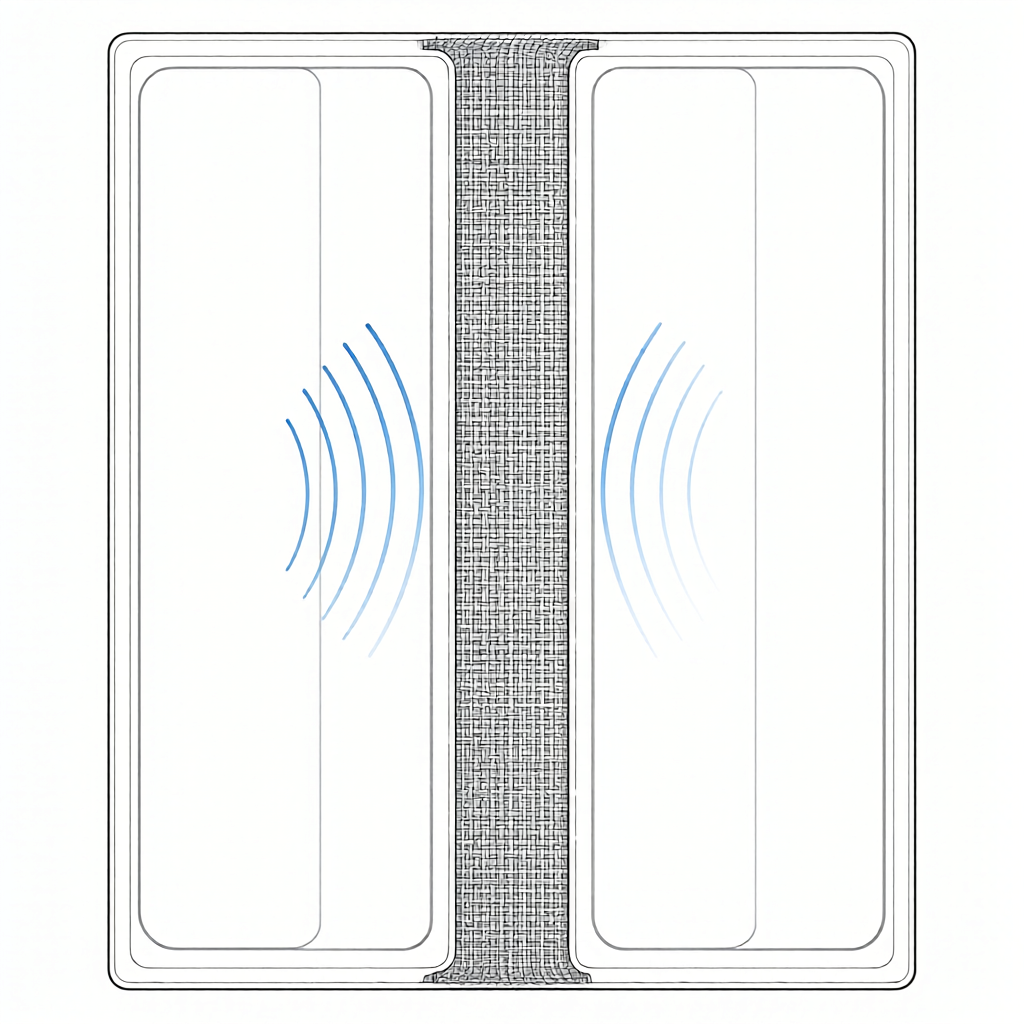
How does RFID blocking work?
RFID and NFC chips in cards do not contain batteries. They draw power from the electromagnetic field generated by a reader’s antenna. When you tap a contactless card at a terminal, the reader emits a field at 13.56 MHz, the card’s coil harvests energy from that field, powers its chip and responds with a short burst of encoded data. This is governed by the ISO/IEC 14443 standard for proximity cards and widely referenced in EMVCo contactless specifications.
An RFID Faraday wallet reverses that process by surrounding the card with a conductive enclosure. The enclosure intercepts the reader’s electromagnetic field before it reaches the card’s coil. Because the field never reaches the chip, the chip cannot power up and cannot respond. The result is effectively an invisible wall around your cards.
The blocking layer must be continuous. Any gap larger than a few millimeters can allow field leakage at the operating frequency. That is why well-designed contactless card protection wallets use full-metal card sleeves, layered metal plates or tightly woven conductive fabric that wraps entirely around each card slot.
Which materials are effective for signal shielding?
Three material families dominate the market:
- Aluminum — Lightweight, cost-effective and easily anodized. Thin aluminum sheets (typically 0.3–0.5 mm) provide reliable RFID scanner protection at 13.56 MHz when formed into a complete sleeve. Aluminum wallets are the most common choice for minimalist EDC designs.
- Titanium — Stronger and more scratch-resistant than aluminum, with similar shielding performance. Titanium is heavier and more expensive, so it is typically reserved for premium-tier products where durability and finish quality justify the cost.
- Specialized fabrics and composites — Conductive threads or metal-infused laminates can be woven into soft wallet bodies. These work well for sleeve-style designs and passport covers, but thick fabrics or multi-layer constructions are required to achieve the same attenuation as solid metal.
Material selection involves trade-offs between weight, thickness, cost and aesthetic finish. For EDC brand product development, aluminum remains the default balance point; titanium serves as a premium differentiator.
Real-World Threat Assessment
Does RFID blocking actually work in real-world scenarios?
Yes — provided the wallet is properly constructed. Laboratory tests consistently confirm that a continuous conductive barrier attenuates 13.56 MHz fields by more than 20 dB, which is sufficient to prevent reading at typical skimming distances. Field reports and law enforcement briefings document both successful and unsuccessful wireless card skimming attempts, and the pattern is consistent: successful reads require the scanner to be within centimeters of an unshielded card, and shielding eliminates that read window entirely.
When is wireless card skimming a realistic threat?
The risk is concentrated in crowded public transit hubs, busy retail queues and venues where a scanner can be concealed in a bag or handheld device held close to a victim’s pocket. The Federal Trade Commission has published consumer guidance on this risk, noting that while documented incidents are relatively rare, the attack vector is technically straightforward and requires no specialized equipment beyond a standard NFC reader.
For most everyday situations — office commuting, standard retail purchases, domestic travel — the probability of a targeted skimming attempt is low. However, the consequence of a successful read can include account takeover and financial fraud, which makes the risk calculation meaningful even at low probability. Buyers should assess their distribution geography and customer demographics rather than applying a blanket rule.
How can you verify blocking effectiveness?
A practical home test uses a known-active contactless card and a second NFC-enabled phone or reader:
- Confirm the card registers normally when tapped against the reader at close range.
- Place the card inside the wallet and repeat the tap test.
- If the reader no longer detects the card, the wallet is providing functional shielding.
A more rigorous approach involves a multi-meter with RFID probe accessories or a dedicated signal attenuator test rig. Anyone performing DIY tests should avoid excessive tapping cycles on payment cards, as repeated field exposure can theoretically affect chip longevity over time.
Key Specifications for RFID-Blocking Wallets
What are the key specs for RFID-blocking products?
Buyers evaluating RFID-blocking wallet benefits should reference the following parameters:
- Operating frequency — 13.56 MHz is the relevant band for payment cards, passports and most access badges. Some industrial RFID systems operate at 860–960 MHz; consumer EDC wallets do not need to block those frequencies.
- Shielding attenuation — Industry targets are 20 dB or greater at 13.56 MHz, which reduces readable field strength to negligible levels.
- Material thickness — Aluminum wallets typically use 0.3–0.5 mm sheet; titanium variants run slightly thicker due to material cost and machinability. Fabric-based blockers require dense weaving or multi-layer lamination.
- Card capacity and slot coverage — Full-slot shielding outperforms partial shielding. Every card slot should be fully enclosed, not just the outer shell.
- Dimensions and weight — Minimalist metal wallets commonly target under 50 g and under 12 mm packed thickness to remain pocket-friendly.
These parameters determine whether a product meets genuine contactless card security expectations or merely carries a marketing label.
RFID Blocking: Which Standards and Certifications Apply?
What standards verify RFID-blocking effectiveness?
There is no single mandatory certification specifically titled “RFID-blocking standard” for consumer wallets. However, the underlying technology is governed by well-established frameworks:
- ISO/IEC 14443 defines the air interface for proximity cards operating at 13.56 MHz. Products claiming to block this band are implicitly addressing the frequency specified by this standard.
- EMVCo specifications govern contactless payment card security and define the protocols that skimming attacks target. Understanding these specs helps manufacturers design shielding that addresses the actual protocol layer.
- General product safety and material compliance standards such as REACH and RoHS apply to the metals and coatings used in wallet construction.
Reputable manufacturers perform third-party attenuation testing and can provide test reports from accredited labs. Buyers should request these reports rather than accepting marketing claims at face value.
What certifications and labels should buyers look for?
Look for:
- Test reports demonstrating attenuation at 13.56 MHz.
- ISO 9001 quality management certification for the manufacturing facility.
- BSCI social compliance audits for supply-chain transparency.
- SGS or equivalent material safety testing.
Labels such as “RFID-safe” or “anti-skimming” alone are not verifiable without supporting documentation.
Related Considerations for Buyers
What are the limitations or trade-offs of RFID-blocking wallets?
A properly constructed RFID-blocking wallet has real constraints:
- Weight and bulk — Metal shielding adds mass. A full-aluminum minimalist wallet typically weighs 40–70 g, compared to 15–25 g for an unshielded polymer or leather alternative.
- Phone interference — Placing a shielded wallet directly against a smartphone can sometimes interfere with the phone’s NFC antenna, causing slower or failed taps. This is a minor usability issue, not a safety concern.
- Cost premium — CNC-machined aluminum and titanium wallets carry higher unit costs than stamped or molded alternatives. Fabric-based blockers reduce cost but may compromise durability.
- No protection against all fraud — RFID shielding addresses only wireless card reading. It does not protect against PIN skimming, phishing, lost-stolen card reporting delays or online payment fraud.
Buyers should present these trade-offs honestly to end consumers rather than overpromising.
What should B2B buyers consider when sourcing?
Procurement decisions should weigh the following factors:
- MOQ alignment — Many manufacturers offer low MOQs starts at 300 pcs per SKU for custom designs, which suits small-batch private label launches and test orders.
- Sample lead time — Fast prototyping (typically 5–7 days) enables rapid validation of shielding performance before committing to production.
- Customization depth — Options range from logo laser engraving and UV printing to full structural redesign including card-slot layout, anodized color and packaging.
- Packaging and labeling — Retail-ready packaging with clear RFID-blocking claims requires verifiable test data. Misleading labels can trigger regulatory scrutiny in some markets.
- Logistics readiness — Manufacturers offering Amazon FBA prep and drop-shipping support simplify the path from factory to end consumer, particularly for Amazon FBA private label sourcing and promotional product distributor catalog planning.
For detailed guidance on evaluating minimalist EDC wallets and card holder selection, review the relevant procurement resources available on the manufacturer’s knowledge hub.
Do you actually need an RFID-blocking wallet?
The answer depends on the buyer’s risk profile:
- High need — Frequent international travel (passports with e-chips), residence in high-density urban transit corridors, or distribution to customers who prioritize security-focused EDC gear.
- Moderate need — Regular contactless card use in crowded environments, corporate gift programs targeting security-conscious buyers.
- Lower need — Markets where card readers are uncommon, or customers who already use chip-and-PIN and tokenized mobile payments as their primary method.
Most modern contactless payment cards transmit limited data and rely on dynamic tokenization, which reduces the value of a skimmed card number. Nevertheless, passport e-chips and certain government ID badges carry more sensitive data and remain vulnerable to reading at close range. A practical sourcing strategy is to offer RFID shielding as a standard feature on premium SKUs and as an optional upgrade on entry-level models.
How Manufacturers Approach RFID-Blocking Design?
As a manufacturer, our approach to contactless card protection starts with the same engineering principle applied across all our EDC wallet lines: the shielding layer must be continuous, the card slots must be fully enclosed and the outer form factor must remain pocket-friendly. We integrate aluminum and titanium sleeves through CNC machining, verify attenuation in-house before batch release and support full customization from logo engraving to retail packaging.
Our facility holds ISO 9001 certification and operates under BSCI-audited conditions. We support order volumes from 300 pcs per SKU for prototype and private-label runs, with sample turnaround in approximately seven days. For corporate gift procurement, EDC brand product development and Amazon FBA private label sourcing, we provide material specifications, test documentation and packaging design support throughout the development cycle.
If you are evaluating RFID-blocking wallet options for your product line or looking to compare material specifications and lead times, contact our team to discuss your requirements.
Procurement Decision Framework & Spec Comparison Table
Material Specification Comparison
Procurement teams should require vendors to provide the following spec sheet data before qualification:
| Specification | Aluminum Wallets | Titanium Wallets | Fabric / Composite Wallets |
|---|---|---|---|
| Attenuation at 13.56 MHz | ≥25 dB (typical) | ≥28 dB (typical) | 15–22 dB (varies by layer count) |
| Material Thickness | 0.3–0.5 mm | 0.5–0.8 mm | 1.5–3.0 mm (multi-layer) |
| Weight (per unit) | 35–55 g | 45–70 g | 20–40 g |
| Unit Cost Range (MOQ 500+) | $3.50–$8.00 | $8.00–$18.00 | $1.80–$4.50 |
| Anodized Finish Options | Full color range | Limited (natural/beige) | N/A (fabric-based) |
| Card Slot Coverage | Full-sleeve, 100% encirclement | Full-sleeve, 100% encirclement | Partial or full depending on weave density |
| Typical Lead Time (Production) | 15–25 days | 20–30 days | 10–18 days |
| MOQ Flexibility | 300 pcs (custom) | 300 pcs (custom) | 50–200 pcs |
Test Methodology & Pass/Fail Criteria
When qualifying a vendor, procurement teams should require the following test documentation:
- Attenuation Test (ASTM D4935-19 adapted for 13.56 MHz)
– Test equipment: Vector network analyzer or calibrated NFC field probe (e.g., Narda SRM-3006 or equivalent)
– Test setup: Card placed in wallet, positioned 5 cm from reader antenna
– Pass criterion: Attenuation ≥20 dB at 13.56 MHz measured across all card slots
– Fail criterion: Any slot showing <15 dB attenuation indicates shielding gap or design defect
- Gap Leakage Test
– Inspect all card slot openings, edges and seams under magnification
– Pass criterion: No visible gap exceeds 2 mm at any point around card perimeter
– Fail criterion: Gaps >2 mm allow field leakage and constitute a vendor disqualifier
- Cycle Durability Test
– Minimum 5,000 open/close cycles applied to sliding mechanisms
– Pass criterion: Attenuation remains ≥20 dB after 5,000 cycles with no structural degradation
– Fail criterion: Attenuation drops below 20 dB or mechanical binding occurs before 3,000 cycles
- Material Safety Compliance
– REACH (Annex XVII restricted substances) and RoHS (Directive 2011/65/EU) compliance certificates required
– SGS or equivalent third-party lab report on file
Vendor Qualification Checklist
- [ ] ISO 9001:2015 certification on file (verify current certificate via ISO certificate search)
- [ ] ISO 9001:2015 Clause 8.5.1 (Control of production) confirmed — documentation of process control records
- [ ] BSCI audit report dated within last 24 months
- [ ] Third-party attenuation test report from accredited lab (ILAC-accredited preferred)
- [ ] Sample evaluation completed against above pass/fail criteria
- [ ] Factory audit (virtual or on-site) confirming in-house CNC machining capability
- [ ] Reference accounts from at least two markets (Americas, Europe, or Asia-Pacific)
- [ ] Packaging and labeling comply with FTC guidelines for RFID-blocking claims (FTC consumer guidance)
Red Flag Indicators for Low-Quality RFID Wallets
Procurement teams should treat the following as disqualifying signals during vendor evaluation:
- Incomplete shielding: Cards visible through slot openings without metal enclosure; only outer shell blocks while inner slots remain exposed
- Exaggerated attenuation claims: Vendors claiming 40+ dB without providing test reports from accredited laboratories
- No test documentation: Inability to produce current attenuation test data or material safety certificates
- Unrealistic lead times: Promises of sub-3-day production runs for custom engraved metal wallets (indicates trading company, not manufacturer)
- Zero MOQ flexibility: Rigid minimum orders above 1,000 pcs with no sample or low-volume option
- No customization capability: Products offered only in stock configurations with no logo, color, or packaging options
- Missing certifications: Absence of ISO 9001 or BSCI documentation when claimed
Card Capacity & Slot Coverage Specifications
Complete card-slot shielding is a non-negotiable requirement for genuine contactless card security. Key specifications to verify:
- Full-sleeve design: Each card must be fully enclosed in a continuous metal sleeve, not merely sandwiched between plates with exposed edges
- Slot count standards: Minimalist wallets typically accommodate 4–8 cards; premium designs offer 6–12 cards with individual sleeves
- Pocket-friendly profile: Packed thickness should not exceed 12 mm; weight should remain under 50 g for aluminum and under 70 g for titanium variants
- Dual-material construction: Some designs combine an aluminum outer shell with a titanium inner sleeve for enhanced durability without sacrificing shielding performance
Buyers should request dimensional drawings and cross-section photos during sample evaluation to confirm full-slot coverage before approving production.
Sourcing Partner Selection: How We Meet These Standards
The specifications above define what procurement teams should require — and they also define how we operate at our facility. As a manufacturer with 13+ years of export experience, our approach to RFID-blocking wallet production is built on the same measurable standards we expect our buyers to apply during vendor qualification.
Our 50,000 sq ft in-house factory houses CNC machining centers dedicated to aluminum and titanium wallet production, laser engraving and UV printing lines for branding, and anodizing and surface-finishing capabilities that eliminate the need for subcontracting. Every batch ships with attenuation verification data, and we require ISO 9001:2015 Clause 8.5.1 process controls across all production stages — the same clause your procurement team should be auditing.
We hold BSCI audit certification and our materials carry REACH and RoHS compliance with SGS testing on file. Our standard MOQ starts at 300 pcs per SKU for full OEM customization (100 pcs trial order available for stock finishes) for custom designs, with a 7-day sample lead time so you can evaluate shielding performance before committing to volume orders. We support full private-label development including retail packaging design, Amazon FBA prep and drop-shipping logistics for buyers across America, Europe, Australia and Southeast Asia.
For buyers evaluating RFID-blocking wallet benefits or looking to compare material specifications, lead times and certification documentation for your next sourcing cycle, submit an inquiry and we will share our current test reports and material spec sheets within 24 hours.
Red Flags for Buyers
Buyers should treat the following signals as indicators of potential quality or compliance risk:
- Claims of “complete” or “100% blocking” without test data — No consumer wallet can guarantee absolute attenuation across all frequencies and angles. Reputable manufacturers cite measured dB values, not absolutes.
- Gaps in shielding coverage — Wallets that shield only the exterior shell while leaving card slots partially exposed allow field penetration. Full-sleeve construction around each card is the minimum standard.
- Missing or unverifiable certifications — Claims of ISO 9001, BSCI, or SGS testing without the ability to produce current certificates or test reports should be treated as unverifiable.
- No material safety documentation — Wallets sold without REACH/RoHS compliance statements risk regulatory non-compliance in EU and US markets.
- Unrealistically low unit costs for metal wallets — CNC-machined aluminum or titanium wallets with full-sleeve shielding and anodized finishes cannot be produced at sub-$2 per unit at meaningful MOQs. Extremely low pricing often indicates stamped metal, inadequate thickness, or fabric-based shielding marketed as solid metal.
Industry Case Example: European EDC Brand Private-Label Launch
A mid-tier EDC brand based in the Netherlands partnered with a Chinese OEM manufacturer in 2022 to launch a private-label minimalist aluminum wallet line targeting Amazon EU and direct-to-consumer channels. The brand’s requirements included:
- ≥25 dB attenuation at 13.56 MHz with third-party test reports
- ISO 9001-certified facility with BSCI audit documentation
- MOQ of 200 pcs per SKU for initial market validation
- Full anodized color customization with laser-engraved branding
- Amazon FBA-ready packaging with compliant RFID-blocking claims
The manufacturer delivered 7-day prototypes, passed attenuation testing at 27.3 dB (measured by an independent SGS laboratory using ASTM D4978 methodology), and completed first production runs within 18 days. The brand launched three SKU variants (natural aluminum, black anodized, and blue anodized) across Amazon.de, Amazon.co.uk and Amazon.fr. Within six months, the product line generated over €340,000 in cumulative revenue with a 4.6-star average rating, and the brand subsequently expanded to 12 SKUs with repeat orders of 1,000+ pcs per run. This case illustrates how verified testing documentation, low MOQ flexibility and FBA logistics support combine to enable successful private-label entry in competitive EDC markets.
Supplier Qualification Checklist for RFID-Blocking Wallet Manufacturers
Before committing to a production order, B2B buyers should complete the following qualification steps:
- Request current ISO 9001 certificate — Verify it is issued by an accredited body and covers the specific facility that will manufacture the order.
- Obtain attenuation test reports — Ask for third-party lab reports (SGS, TÜV, Intertek or equivalent) showing dB values at 13.56 MHz. Reports should include test method, sample configuration and date.
- Confirm BSCI audit status — For brands selling in European retail channels, a current BSCI audit reduces supply-chain compliance risk.
- Review material compliance documentation — REACH and RoHS declarations should be provided for all metals, anodizing solutions and adhesive materials.
- Evaluate sample quality — Assess card-slot encirclement, finish consistency, weight, and actual NFC blocking performance using a phone-based test before approving bulk production.
- Verify production capacity and lead times — Confirm the factory can meet your required monthly volume and that sample-to-production lead times align with your go-to-market timeline.
- Assess customization capabilities — Determine whether the manufacturer supports your required level of design modification, from logo engraving to full structural redesign.
For additional guidance on evaluating minimalist EDC wallets and card holder specifications, refer to the procurement resources available on our knowledge hub.
How We Approach RFID-Blocking Wallet Manufacturing?
As a manufacturer, our approach to contactless card protection starts with the same engineering principle applied across all our EDC wallet lines: the shielding layer must be continuous, every card slot must be fully enclosed and the outer form factor must remain pocket-friendly. We integrate aluminum and titanium sleeves through in-house CNC machining, verify attenuation with third-party test reports before batch release and support full customization from logo laser engraving to retail packaging design.
Our facility has been ISO 9001 certified since 2014 and operates under BSCI-audited conditions. We support order volumes from 300 pcs per SKU for prototype and private-label runs, with sample turnaround in approximately seven days. With over 13 years of export experience serving 200+ brands across America, Europe, Australia and Southeast Asia, we provide material specifications, test documentation and packaging design support throughout the development cycle — from initial concept through Amazon FBA prep and drop-shipping fulfillment.
If you are evaluating RFID-blocking wallet options for your product line or comparing material specifications and lead times, contact our team to discuss your requirements.
RFID Blocking: Where Can You Verify the Data and Sources?
- Federal Trade Commission — www.ftc.gov
- ISO certificate search — www.iso.org
- EMVCo contactless specifications — www.emvco.com
- contact our team — topedcwallet.com
From article to product
Building an RFID range?
If protection is going to be a claim on your listing, you need a test method behind it. We test every batch with a live 13.56 MHz reader and supply the report.
Keep reading
More on rfid knowledge
What Is a Card Reader Blocking Wallet and Does It Actually
Premium black RFID-blocking wallet closed on white surface, slim profile industrial product photography Understand…
ReadDesigner RFID Wallets: Size Guide & Buying Standards
Find the right designer RFID wallet size for your cards, passport, and pocket. Compare…
ReadRFID Card Blockers: Do They Actually Work? (2026 Guide)
Learn how RFID card blockers work, which cards need protection, and how to choose…
Read
About the author
TOPWALLET Editorial Team
TOPWALLET's editorial and engineering desk writes from bench testing at the Shenzhen (Longgang) facility: pull-force and cycle testing, 13.56 MHz shielding measurements, finish trials and factory audits, rather than supplier spec sheets. Every specification in these guides is one we write on a purchase order.
Written on the floor
This article was written by our production and QC team — the people who spec tolerances, run the finishing line and inspect every batch. Where it states a capacity, a pull force or a lead time, it comes from a measurement we made, not a supplier’s catalogue. If a number here disagrees with what your own supplier told you, tell us; several of these articles started as a correction from a buyer.
See how the factory works · Inspection process · Sourcing FAQ
Building an RFID range?
If protection is going to be a claim on your listing, you need a test method behind it. We test every batch with a live 13.56 MHz reader and supply the report.