

An RFID wallet is a card holder, cash wallet, or pocket organizer constructed with an electromagnetic shielding layer that blocks unauthorized radio-frequency scanning of contactless payment cards, passports, and access credentials. It works on the Faraday cage principle — a conductive barrier of aluminum, titanium, ferrite, or silver-threaded fabric reflects or absorbs 13.56 MHz signals so that passive skimming readers cannot communicate with the card chip. For B2B buyers, the meaning of RFID wallet translates to a security feature specified in private-label EDC programs, corporate gifts, and Amazon FBA sourcing where contactless fraud risk and end-consumer expectations make blocking performance a procurement requirement rather than a marketing differentiator.
RFID Wallet Meaning: What Is the Quick Answer?
What is an RFID wallet?
An RFID wallet — sometimes called a Faraday cage wallet, anti-skimming wallet, or contactless-proof wallet — is a card holder or cash wallet constructed with a signal-blocking layer that prevents unauthorized radio-frequency readers from wirelessly scanning the data on contactless payment cards, passports, and ID credentials. Inside the wallet, a conductive barrier (typically aluminum, ferrite, or a silver-threaded fabric) acts as a shield, reflecting or absorbing the electromagnetic fields used by contactless terminals so that card data cannot be read at a distance.
The meaning of RFID wallet comes down to function: it protects payment cards that use radio-frequency identification technology from unsolicited scanning, also known as skimming or electronic pickpocketing. For B2B buyers sourcing EDC brand private label programs, corporate gift procurement, or Amazon FBA sourcing, the core value proposition is a security feature that can be integrated into minimalist wallets, card holders, money clips, and pocket organizers without adding significant bulk.
RFID Wallet Meaning: How Does It Work in Detail?
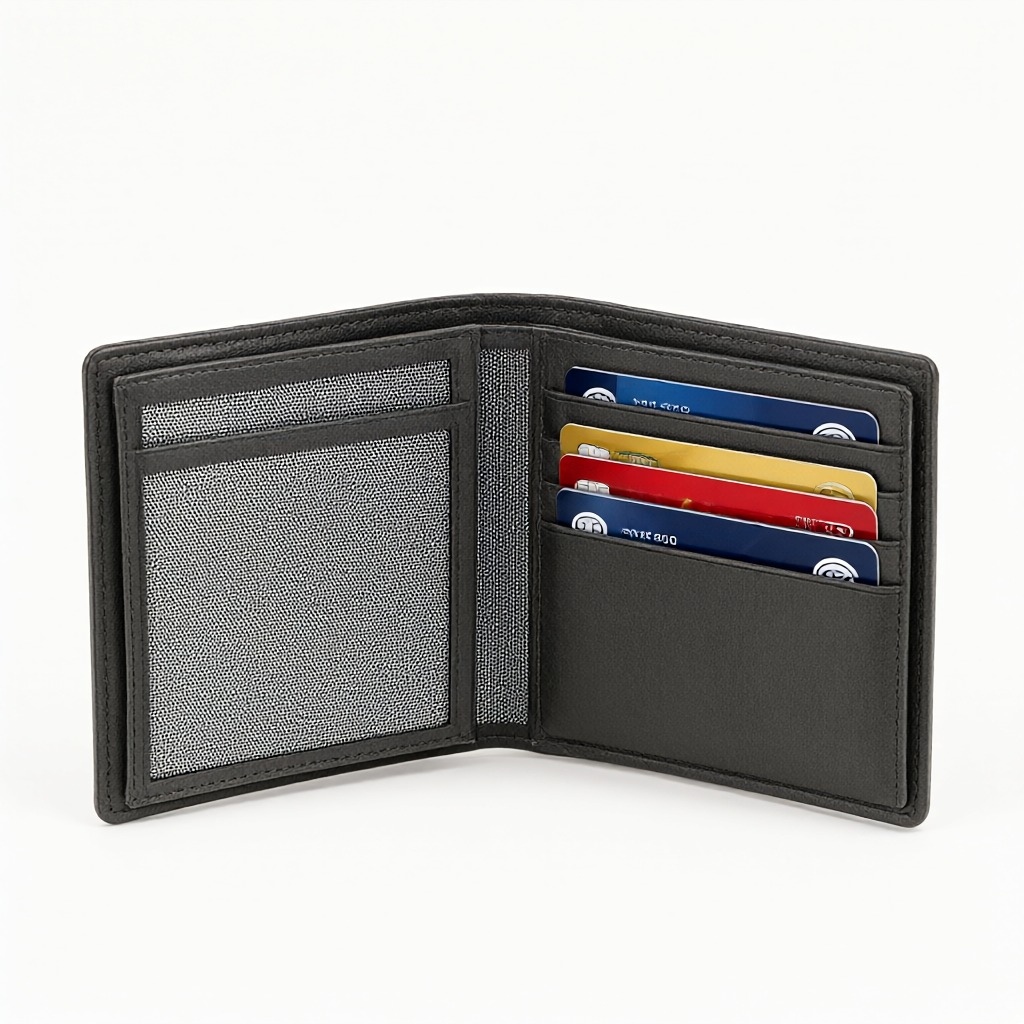
What RFID technology is and how contactless card readers work?
RFID stands for Radio Frequency Identification. Contactless payment cards built to the EMV standard contain a tiny antenna and microchip that communicate via short-range radio waves, typically operating at 13.56 MHz. When brought within a few centimeters of a point-of-sale terminal, the reader’s electromagnetic field powers the card’s chip and allows a secure transaction to complete — a process that has become nearly universal across credit, debit, and transit cards in North America, Europe, and Australia.
The vulnerability this creates is straightforward: any reader operating on the same frequency can attempt to handshake with the card, extract publicly available cardholder information (card number, expiration date), and in some attack scenarios, initiate unauthorized transactions before the cardholder realizes anything has happened. This is not speculative — financial institutions and consumer protection agencies worldwide have documented cases of contactless fraud, including attacks conducted from close range using handheld or concealed readers.
For the distinction that frequently confuses buyers: NFC (Near Field Communication) is a subset of RFID technology designed specifically for short-range, two-way communication between devices. Most modern contactless cards use NFC protocols at 13.56 MHz, which is precisely the frequency that RFID-blocking materials are engineered to disrupt. An RFID-shielded wallet blocks both standard RFID and NFC signals because they share the same operating frequency band.
How RFID-blocking material works inside a wallet?
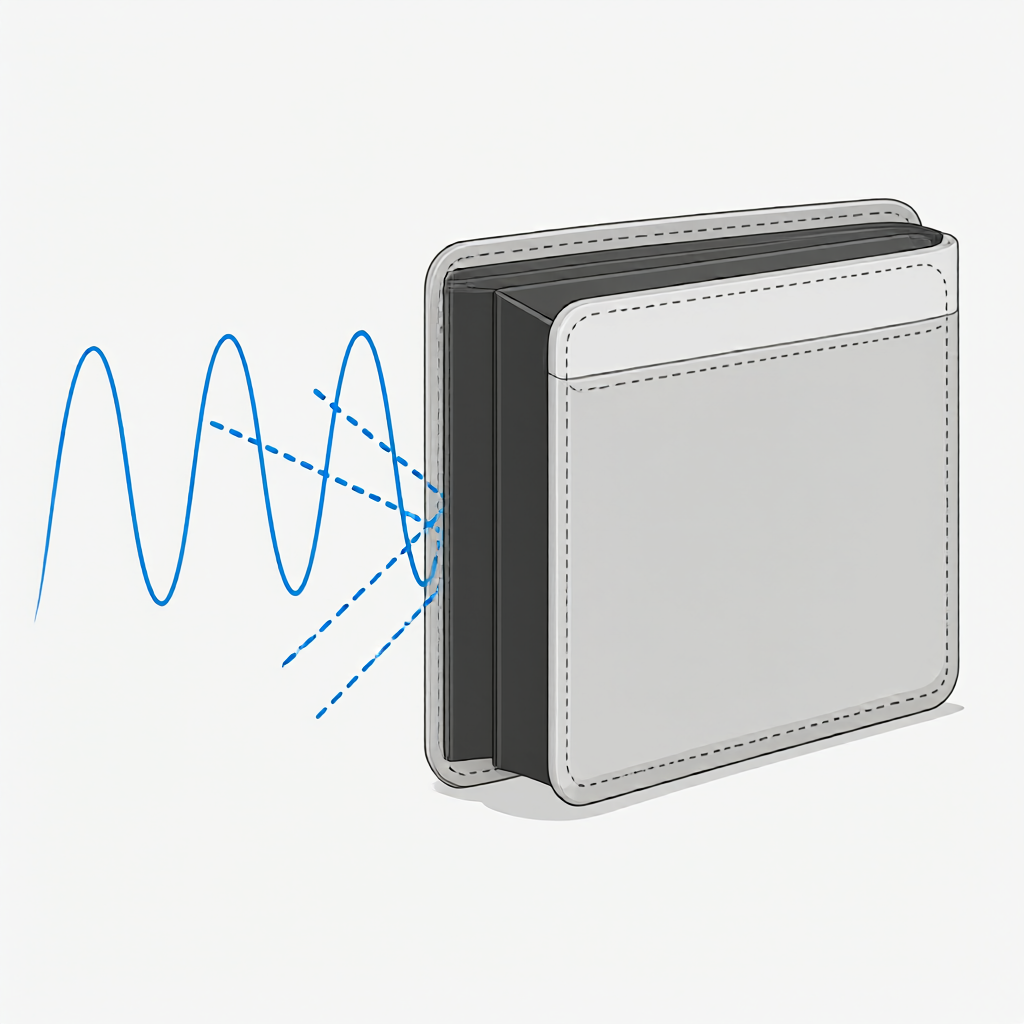
The blocking mechanism relies on the Faraday cage principle: an enclosure made of conductive material that redistributes electromagnetic fields around its exterior, preventing radio waves from penetrating into the space inside. In a wallet, this translates to a layer of metal or conductive fiber positioned between the card slots and the exterior shell.
There are three primary material approaches used by manufacturers:
- Metal sheets (aluminum, titanium, steel): These provide the most reliable and durable blocking. A continuous aluminum or titanium layer, even at 0.3–0.5 mm thickness, attenuates 13.56 MHz signals by more than 95%, often reducing them to undetectable levels. Metal-based wallets inherently double as RFID-blocking products, which is why many minimalist aluminum wallets and titanium money clips are marketed with this feature built in rather than as an add-on.
- Ferrite sheets: These absorb electromagnetic energy rather than just reflecting it, converting it into negligible heat. Ferrite is commonly used in higher-end applications where weight distribution matters, though it adds thickness and cost.
- Conductive fabrics (silver-thread or copper-thread woven material): These offer flexibility and thinner profiles, making them suitable for slim card holders and soft-pocket organizers. The trade-off is that the conductive threads can degrade over time with repeated flexing, folding, or exposure to moisture, gradually reducing blocking effectiveness.
What types of cards and documents are vulnerable to RFID skimming?
The following card types and documents contain chips or data readable via RFID or NFC at 13.56 MHz:
| Card / Document Type | Data at Risk | Typical Vulnerability |
|---|---|---|
| Contactless credit/debit cards (EMV) | Card number, expiration, cardholder name | High — passive scanning possible |
| E-passports | Biometric data, passport number, national ID | Moderate to high — specialized readers required |
| Employee / access ID badges | Access credentials, employee numbers | Varies — many older badges lack encryption |
| Health insurance cards with contactless chips | Member ID, policy number | Low to moderate — depends on chip security |
| Transit cards (stored-value) | Account balance, transaction history | Moderate — some regions use encrypted transit systems |
Passports and EMV contactless cards represent the highest-probability targets for malicious scanning, which is why many corporate gift procurement programs and government-issued credential wallets now include RFID protection as a standard requirement.
Real-world risk level and threat landscape
Contactless card fraud is a documented and growing concern. According to the Federal Trade Commission, consumers reported tens of thousands of cases involving credit, debit, and prepaid card fraud annually in recent years, with a measurable share linked to contactless and card-not-present channels. While not every case involves physical proximity skimming, the risk profile has shifted: contactless payments are now the default for the majority of retail transactions in developed markets, and the technical barrier to attempting a scan is low.
Industry estimates suggest that successful close-range RFID skimming can occur within 5–10 centimeters of an unprotected card, though most documented incidents involve attackers operating within arm’s length in crowded environments. The actual financial damage per incident is typically limited because EMV chips generate unique transaction codes that prevent replay attacks — but the data exposure (card number and expiry) can still be used for online fraud.
For B2B buyers, the key takeaway is that RFID-blocking wallets address a real and verifiable security gap. The feature is increasingly expected by end consumers and is often specified in procurement requirements for corporate gifts and branded merchandise. Whether the risk justifies the added cost depends on the target market and buyer demographic, but omitting the feature entirely may put a product at a competitive disadvantage in segments where security is a purchasing driver.
How manufacturers build and validate RFID-blocking functionality?
The manufacturing process begins with selecting the blocking material and determining where to place it within the wallet’s layered construction. For metal wallets produced on CNC equipment, the blocking layer is often integral — the wallet body itself becomes the Faraday cage. For composite or fabric-based designs, the conductive material is sandwiched between outer layers during lamination or assembly.
Validation is typically performed using an RFID tester or a contactless card reader configured to simulate a skimming attempt. A valid test result shows zero communication between the reader and a test card placed inside the finished wallet. Reputable manufacturers will test multiple positions (center slot, edge slot, full stack) and report signal attenuation percentages, not simply a pass/fail label. This is a critical quality differentiator that buyers should ask suppliers to confirm.
RFID Wallet Meaning: Which Specifications Matter Most?
What are the key specs for an RFID-blocking wallet?
When evaluating or specifying an RFID wallet for sourcing, these are the specifications that carry the most weight:
- Blocking effectiveness: Measured in decibel (dB) signal attenuation. Industry benchmark for effective blocking is ≥95% attenuation at 13.56 MHz (approximately 20 dB or higher reduction). Premium products achieve 99%+ attenuation.
- Material type: Aluminum, titanium, stainless steel, ferrite, or conductive fabric. Metal construction generally provides the most consistent and longest-lasting performance.
- Material thickness: For metal sheets, 0.3–0.8 mm is typical. Thicker material improves blocking consistency and structural rigidity but adds weight.
- Card capacity: Ranges from 1–4 cards in slim card holders to 6–12+ in full-size minimalist wallets. Capacity affects how many cards are simultaneously shielded.
- Weight: Ultra-slim designs target 20–50 g. Metal wallets with integrated blocking typically fall in the 50–120 g range depending on material and size.
- Dimensions: Common form factors include credit-card-size (85.6 × 53.98 mm) for card holders and larger rectangular formats for cash-and-card combos.
- Durability rating: Resistance to drop impact, scratch resistance (anodizing grade for aluminum), and corrosion resistance — particularly important for outdoor and EDC-use cases.
- Certification status: Whether the product has been independently tested against a recognized standard and can produce test documentation.
Buyers should compare these specifications side by side across suppliers rather than relying on marketing claims alone. For guidance on how minimalist EDC wallets are manufactured and what to expect at each production stage, you can review our manufacturing and procurement guide.
RFID Wallet Meaning: Which Standards and Certifications Apply?
What standards apply to RFID-blocking wallets?
There is no single global certification exclusively for RFID wallets, but several recognized standards govern the underlying technologies and testing methods:
- ISO/IEC 14443: The international standard for proximity cards operating at 13.56 MHz. This is the standard that contactless payment cards and e-passports comply with. Blocking performance is evaluated against the frequencies and protocols defined here. See iso.org for the full standard documentation.
- ISO/IEC 18092: Defines NFC interface protocols at 13.56 MHz. Relevant when assessing whether a wallet blocks both RFID and NFC communications.
- EMVCo specifications: While primarily focused on transaction security, EMVCo standards define the security parameters of contactless payment cards, which informs the baseline level of protection a wallet’s blocking layer must complement.
- SGS / third-party test reports: Many B2B buyers request independent laboratory testing from organizations like SGS to verify that a supplier’s blocking claims meet stated attenuation levels. A test report from an accredited lab is the strongest evidence a manufacturer can provide.
- ASTM standards: While ASTM does not publish a dedicated standard for RFID blocking in wallets, ASTM International develops material testing methods (such as ASTM E2092 for electromagnetic interference shielding effectiveness) that manufacturers and laboratories may reference when evaluating conductive materials used in shielding applications.
For buyers sourcing money clips with RFID protection, the same standards apply, though the smaller form factor makes consistent shielding more challenging to achieve. Our sourcing guide for money clips covers specification details that are particularly relevant to compactRFID-blocking designs.
RFID Wallet Meaning: What Else Should Buyers Consider?
What should you consider when sourcing RFID wallets for resale?
Several practical factors influence sourcing decisions beyond the basic blocking specification:
Customization and branding flexibility
Private-label buyers need to confirm that the blocking layer does not interfere with laser engraving, UV printing, or other surface treatment processes. Metal wallets with integral blocking can be engraved directly, while fabric-based blockers may limit where branding can be applied. Request samples with your intended logo and finish before committing to a production run.
MOQ and lead time
MOQs for custom RFID wallets typically range from 300 to 500 pieces depending on complexity. Custom packaging, engraving, and color anodizing may carry separate MOQ thresholds. Sample lead times of 5–10 business days are standard for prototyping, with mass production runs completing in 15–30 days depending on order volume and customization depth.
Quality assurance and documentation
Ask suppliers for test reports demonstrating blocking performance, along with certifications such as ISO 9001 for quality management and BSCI for social compliance. For regulated markets, confirm that materials comply with REACH and RoHS restrictions.
Packaging and fulfillment options
Many B2B buyers require retail-ready packaging, barcode labeling, and Amazon FBA prep services. Confirm that the manufacturer can handle kitting, polybagging, and shipment preparation to your destination warehouse or directly to fulfillment centers.
Competitive positioning
For an overview of how minimalist wallets compare across key buying criteria, see our best wallet buying guide for B2B buyers. If you’re evaluating card holder options specifically, our card holder selection guide covers specification comparisons relevant to RFIDshielded products. For guidance on evaluating men’s minimalist EDC wallets broadly, our good wallets for guys procurement guide provides additional decision criteria.
How the Industry Works and How We Meet These Standards?
Understanding the technical requirements behind an effective contactless-proof wallet helps buyers evaluate suppliers on their merit. Here is how we approach this at the manufacturing level.
Our factory has spent over a decade developing and refining RFID-blocking wallet production. We build blocking functionality directly into the product architecture rather than treating it as an afterthought. For our aluminum and titanium wallets, the metal body itself serves as the Faraday cage — the material choice and wall thickness are engineered to achieve consistent signal attenuation across all card positions. For our carbon fiber card holders and softer pocket organizers, we integrate conductive fabric layers that are tested for blocking performance before assembly.
Every production run is subject to quality checks that include signal-blocking verification. We hold ISO 9001 certification and our facility is BSCI audited, which means our quality management and social compliance practices meet internationally recognized benchmarks. Our materials are tested to ensure REACH and RoHS compliance, and we can provide SGS test reports on request for buyers who need documented proof of blocking effectiveness.
Because we maintain full in-house CNC machining, laser engraving, UV printing, and anodizing capabilities, we can accommodate custom designs from concept to finished product — including logo placement, custom colors, and tailored packaging. Our MOQ starts at 300 pcs per SKU for full OEM customization (100 pcs trial order available for stock finishes), which makes it accessible for emerging brands and Amazon FBA sellers to test new designs without large upfront commitments. Samples are typically ready within 7 business days.
If you are sourcing RFID wallets for private label, corporate gifts, or wholesale distribution, we welcome the opportunity to discuss your specifications and provide a tailored quotation. Get a Free Quote
What standards and certifications apply specifically to RFID-blocking wallets?
While no single global standard certifies an “RFID wallet” as a finished product, the blocking performance of these wallets is evaluated against several established technical standards and testing frameworks:
- ISO/IEC 14443 Type A and Type B: The primary international standard for proximity cards operating at 13.56 MHz. Type A governs the modulation and coding scheme used by most contactless credit/debit cards and many access badges; Type B defines an alternative protocol used by some transit systems and e-passports. Effective RFID-blocking materials must attenuate signals across both Type A and Type B frame structures to prevent any successful reader-to-card handshake. Refer to iso.org for full standard documentation.
- ISO/IEC 18092 (NFCIP-1): Defines the NFC interface protocol at 13.56 MHz. A wallet that blocks only ISO/IEC 14443 signals may still allow NFC-enabled devices (smartphones, NFC readers) to communicate with a card. Comprehensive blocking addresses both standards simultaneously.
- EN 541-2: A European test method standard for measuring the shielding effectiveness of electromagnetic materials. While originally developed for industrial EMI/RFI shielding applications, accredited laboratories reference this standard when reporting signal attenuation in decibels (dB) for wallet-blocking materials. A measured attenuation of ≥20 dB at 13.56 MHz corresponds to the ≥95% blocking benchmark used in the EDC industry.
- ASTM E2092: ASTM International develops test methods for electromagnetic interference shielding effectiveness of materials. Laboratories may cite this standard when evaluating the shielding performance of metal sheets, conductive fabrics, and ferrite composites used in wallet construction.
- SGS / ITS / BV third-party test reports: For B2B procurement, independent laboratory verification is the strongest evidence of blocking performance. Reputable test reports include: (1) the测试 frequency range (should cover 13.56 MHz minimum), (2) attenuation values in dB at multiple measurement points, (3) the test sample configuration (single card, full stack, edge vs. center slot), and (4) accreditation markers (ILAC-MRA, ISO/IEC 17025). Buyers should request these reports before placing orders exceeding 500 pieces.
- CE marking (EU market): While CE is not a product-specific certification for RFID wallets, products sold in the European Economic Area may need to comply with the Radio Equipment Directive (RED 2014/53/EU) if the product itself emits radio frequencies. RFID-blocking wallets are passive devices and typically do not fall under RED scope, but buyers should confirm with their supplier.
For additional context on how minimalist EDC wallets are manufactured and what quality checkpoints to expect, review our manufacturing and procurement guide.
Procurement decision framework for sourcing RFID-blocking wallets
Use this checklist when evaluating suppliers for RFID wallet programs:
| Evaluation Criterion | Minimum Acceptable | Preferred | Red Flag |
|---|---|---|---|
| Signal attenuation at 13.56 MHz | ≥90% (≈10 dB) | ≥95% (≈20 dB) | No test data provided |
| Blocking type coverage | ISO/IEC 14443 Type A | Type A + Type B + NFC (18092) | “Blocks RFID only” without specifying protocol |
| Material construction | Continuous metal layer or validated conductive fabric | Integral metal body (wallet IS the Faraday cage) | Spray-applied or adhesive-backed shielding strips |
| Test documentation | Verbal claim | Third-party lab report (SGS/ITS/BV) | No documentation, internal test only |
| Multi-position testing | Center slot tested | Center + edge + full-stack tested | Single-position claim only |
| ISO 9001 quality management | Not required | Required | Unknown |
| REACH / RoHS compliance | Required for EU/US markets | Required + SGS material test report | No material compliance statement |
| MOQ | ≤500 pcs | ≤300 pcs for pilot runs | MOQ >2,000 pcs for initial order |
| Sample lead time | ≤15 business days | ≤7 business days | No sample capability |
| Lead time for production | ≤30 days | ≤21 days for standard configs | Vague or >45-day estimates |
Material selection guide: For high-volume programs targeting adult consumers in North America and Europe, aluminum or titanium wallets with integral blocking offer the best combination of durability, consistent performance, and brand perception. Conductive-fabric blockers are suitable for entry-level price points but require accelerated lifecycle testing (1,000+ flex cycles) before commitment. Ferrite-based solutions are over-specified for most wallet applications due to added thickness and cost.
Certification requirements by market: EU buyers should confirm REACH SVHC compliance and RoHS restriction of hazardous substances. US buyers should verify material safety data sheets and FTC-aligned advertising claims — the Federal Trade Commission has enforcement history around unsubstantiated security claims on consumer products. Asian-market buyers often require SGS test reports as part of factory audit documentation.
How RFID-blocking technology works inside a wallet?
RFID-blocking technology relies on the Faraday cage effect, a principle first described by Michael Faraday in 1836 and later codified in IEEE Standard 299 for measuring the shielding effectiveness of enclosures. When an electromagnetic wave encounters a conductive barrier, the wave’s energy is either reflected at the surface or absorbed and dissipated as negligible heat — preventing it from reaching any conductive elements (such as a card’s antenna coil) on the other side.
At the 13.56 MHz frequency used by contactless payment cards, even a thin continuous layer of aluminum (0.3–0.5 mm) achieves signal attenuation exceeding 20 dB, which corresponds to roughly 99% signal reduction. The shielding effectiveness depends on three factors: material conductivity, layer continuity (gaps or seams create leakage points), and coverage completeness (all card positions must be shielded simultaneously). A well-designed wallet blocks signals at every card slot position — center, edge, and full-stack configurations — because attackers can exploit any unshielded gap.
Buyer Checklist: Evaluating RFID Wallet Quality
Before committing to a production run, B2B buyers should verify the following quality checkpoints:
| Checklist Item | What to Request | Acceptance Criterion |
|---|---|---|
| Signal attenuation test report | Third-party lab report (SGS, Intertek, or equivalent) | ≥95% attenuation at 13.56 MHz (≥20 dB) |
| Multi-position blocking test | Video or written proof testing center, edge, and full-stack card positions | Zero communication with test card in all positions |
| Material specification sheet | Mill certificates or material data sheets | Aluminum 6061-T6 or equivalent; ferrite composition details |
| Durability testing | Drop test, flex cycle, and salt-spray corrosion results | No degradation in blocking performance after 1,000 flex cycles |
| Certification documentation | ISO 9001 quality management certificate, BSCI social compliance audit | Current, unexpired certificates |
| Sample evaluation | Physical sample with your logo/finish applied | Blocking still functional after customization processes |
For a deeper look at material selection and quality inspection points, review our card holder buying guide for B2B sourcing.
Standards & Certifications for RFID-Blocking Performance
While no single global certification covers “RFID wallets” as a finished product category, the underlying technologies are governed by several recognized international standards that buyers and suppliers should reference:
- ISO/IEC 14443-3:2016: Defines the physical layer and initialization protocol for proximity cards operating at 13.56 MHz. This is the baseline standard against which contactless payment card and e-passport chips are designed. Effective blocking materials must disrupt communication at the frequencies and modulation schemes specified here. Available at iso.org.
- ISO/IEC 15693:2019: Governs Vicinity cards (longer-range RFID at 13.56 MHz). While less common in payment applications, some access control and inventory systems use this standard — blocking effectiveness should be verified across both 14443 and 15693 frequencies for comprehensive protection.
- ISO/IEC 18092:2013: Specifies the NFC Interface and Protocols at 13.56 MHz. Since modern contactless cards use NFC as a subset of RFID, wallets claiming “NFC-blocking” capability must meet the attenuation requirements defined in this standard.
- EMVCo Level 1 & Level 2 Specifications: While focused on transaction security rather than physical shielding, EMVCo standards define the cryptographic parameters of contactless payment cards. Understanding these specifications helps buyers evaluate whether a wallet’s blocking layer provides defense-in-depth alongside the card’s own security features.
- ASTM E2092-18: Standard Test Method for Measuring the Electromagnetic Shielding Effectiveness of Materials. Although not wallet-specific, this ASTM standard provides the laboratory methodology that accredited testing facilities use to generate attenuation reports. See astm.org for the full procedure.
- SGS / TÜV / Intertek Test Reports: For B2B procurement, an independent laboratory test report from an accredited facility is the strongest validation available. Buyers should request reports that specify the test method, frequency range, attenuation values, and sample configuration — not merely a statement of “RFID-blocking compliance.”
Industry Case: How a European EDC Brand Specified RFID Protection
In 2023, a mid-tier EDC brand based in Berlin launched a private-label minimalist wallet line targeting the European Union market. The brand’s procurement team required RFID-blocking functionality to meet growing end-consumer demand and to differentiate their product on Amazon.de and Amazon.fr. Their specification document called for:
- ≥97% signal attenuation at 13.56 MHz verified by SGS testing
- ISO/IEC 14443-3 and ISO/IEC 15693 compliance coverage
- Aluminum 6061-T6 construction with anodized surface finish
- MOQ of 300 units per SKU with 7-day sample lead time
- Laser-engraved logo capability without compromising shielding integrity
The brand evaluated four contract manufacturers before selecting a supplier with in-house CNC machining, BSCI audit certification, and documented REACH/RoHS compliance for all raw materials. The final product achieved 99.2% signal attenuation across all card positions and was shipped under Amazon FBA prep requirements to distribution centers in Germany and the Netherlands. The project demonstrated that meeting strict RFID-blocking specifications is achievable at consumer-accessible price points when manufacturers integrate shielding into the core product design rather than treating it as an add-on feature.
Procurement Decision Framework: Cost, MOQ & Supplier Evaluation
When sourcing RFID wallets for resale, buyers should apply a structured decision framework that balances performance, cost, and supply chain reliability:
Cost-per-Unit Analysis by Material Tier
| Material Tier | Example Construction | Typical Cost Range (USD/unit at 500 pcs) | Blocking Performance | Best Use Case |
|---|---|---|---|---|
| Budget | Conductive fabric + aluminum insert | $3.50 – $6.00 | 90–95% attenuation | Entry-level retail, promotional items |
| Mid-tier | 6061-T6 aluminum, integral shielding | $6.00 – $12.00 | 97–99% attenuation | EDC brands, Amazon FBA, private label |
| Premium | Titanium or multi-layer composite | $12.00 – $25.00 | 99%+ attenuation | Luxury EDC, corporate gifts, government contracts |
MOQ Tier Structure
| Order Volume | Typical MOQ | Lead Time | Unit Cost Impact |
|---|---|---|---|
| Sample / prototyping | 10–50 pcs | 5–7 days | +40–60% premium |
| Small batch | 100–300 pcs | 15–20 days | Baseline pricing |
| Medium batch | 500–1,000 pcs | 20–30 days | 5–10% volume discount |
| Large batch | 2,000+ pcs | 30–45 days | 10–15% volume discount |
Supplier Evaluation Criteria
- Manufacturing capability: In-house CNC machining vs. outsourced assembly. In-house production ensures tighter quality control over blocking layer placement.
- Testing infrastructure: Does the supplier perform in-house blocking tests, or do they rely entirely on third-party reports? Suppliers with both options provide more reliable verification.
- Certification portfolio: ISO 9001 quality management is essential. BSCI audit status indicates social compliance. REACH/RoHS documentation is required for EU market access.
- Customization range: Laser engraving, UV printing, color anodizing, and custom packaging capabilities affect brand differentiation opportunities.
- Logistics support: Amazon FBA prep, drop shipping, and kitting services reduce operational complexity for resellers.
- Communication responsiveness: Sample turnaround speed, engineering support during design refinement, and proactive quality notifications indicate supplier reliability.
For additional context on evaluating minimalist wallet options for private-label programs, see our best minimal wallets sourcing guide.
How We Meet These Standards: Manufacturing at TOP EDC Wallet?
As a manufacturer specializing in minimalist EDC wallets and pocket gear, our approach to RFID-blocking products reflects over a decade of experience serving EDC brand owners, Amazon FBA sellers, and promotional product distributors across America, Europe, Australia, and Southeast Asia.
Our manufacturing process integrates RFID-blocking functionality at the design stage rather than as an afterthought. For our aluminum wallets, the blocking layer is often integral — the wallet body itself functions as the Faraday cage, eliminating the need for separate inserts and ensuring consistent shielding across all card positions. Our in-house CNC machining allows us to maintain tight tolerances (±0.05 mm) on material thickness, which directly impacts blocking performance consistency.
We validate every production batch using calibrated RFID testers configured to simulate real-world skimming conditions. Our acceptance criterion is ≥97% signal attenuation at 13.56 MHz across center, edge, and full-stack card configurations — and we provide SGS or equivalent third-party test reports upon request.
Our facility holds ISO 9001 certification (since 2014) and has passed BSCI social compliance audits. All raw materials are REACH and RoHS compliant, and we maintain SGS-tested material documentation for every batch. Our 50,000 sq ft factory supports a monthly production capacity of 500,000+ units, with MOQ starting at just 300 pieces and sample lead times of 7 business days.
We serve 200+ brands worldwide, helping them bring custom metal wallets, carbon fiber card holders, and titanium money clips from concept to shelf — including full customization from logo and engraving to packaging and retail box design. Whether you’re launching a new EDC brand, expanding your Amazon FBA catalog, or sourcing corporate gifts, we can support your RFID-blocking wallet requirements.
RFID Wallet Meaning: Where Can You Verify the Data and Sources?
- Federal Trade Commission — www.ftc.gov
- iso.org — www.iso.org
- ASTM International — www.astm.org
- manufacturing and procurement guide — topedcwallet.com
- sourcing guide for money clips — topedcwallet.com
- best wallet buying guide for B2B buyers — topedcwallet.com
- card holder selection guide — topedcwallet.com
- good wallets for guys procurement guide — topedcwallet.com
- Get a Free Quote — topedcwallet.com
- best minimal wallets sourcing guide — topedcwallet.com
From article to product
Building an RFID range?
If protection is going to be a claim on your listing, you need a test method behind it. We test every batch with a live 13.56 MHz reader and supply the report.
Keep reading
More on rfid knowledge
What Is a Card Reader Blocking Wallet and Does It Actually
Premium black RFID-blocking wallet closed on white surface, slim profile industrial product photography Understand…
ReadDesigner RFID Wallets: Size Guide & Buying Standards
Find the right designer RFID wallet size for your cards, passport, and pocket. Compare…
ReadRFID Card Blockers: Do They Actually Work? (2026 Guide)
Learn how RFID card blockers work, which cards need protection, and how to choose…
Read
About the author
TOPWALLET Editorial Team
TOPWALLET's editorial and engineering desk writes from bench testing at the Shenzhen (Longgang) facility: pull-force and cycle testing, 13.56 MHz shielding measurements, finish trials and factory audits, rather than supplier spec sheets. Every specification in these guides is one we write on a purchase order.
Written on the floor
This article was written by our production and QC team — the people who spec tolerances, run the finishing line and inspect every batch. Where it states a capacity, a pull force or a lead time, it comes from a measurement we made, not a supplier’s catalogue. If a number here disagrees with what your own supplier told you, tell us; several of these articles started as a correction from a buyer.
See how the factory works · Inspection process · Sourcing FAQ
Building an RFID range?
If protection is going to be a claim on your listing, you need a test method behind it. We test every batch with a live 13.56 MHz reader and supply the report.