

Mens Front Pocket Wallets — A Buying Comparison Guide
The best front pocket wallet for most men in 2025–2026 is a slim, card-focused design in aluminum or carbon fiber that holds six to ten cards with a single cash slot or optional money clip, weighs under two ounces, and measures roughly four by three inches flat. If you carry more than ten cards or rely heavily on folded bills, a hybrid model with an expandable mechanism gives you room without adding permanent bulk.
Front pocket carry has moved from niche to mainstream because it solves real problems — lower back strain, reduced theft risk, and faster access — while keeping your essentials within reach. This guide walks through the styles, materials, capacities, and price tiers so you can pick the right one for your actual loadout instead of guessing based on marketing claims. For a deeper look at minimal wallet architectures overall, see our best minimal wallets comparison guide.
At a Glance
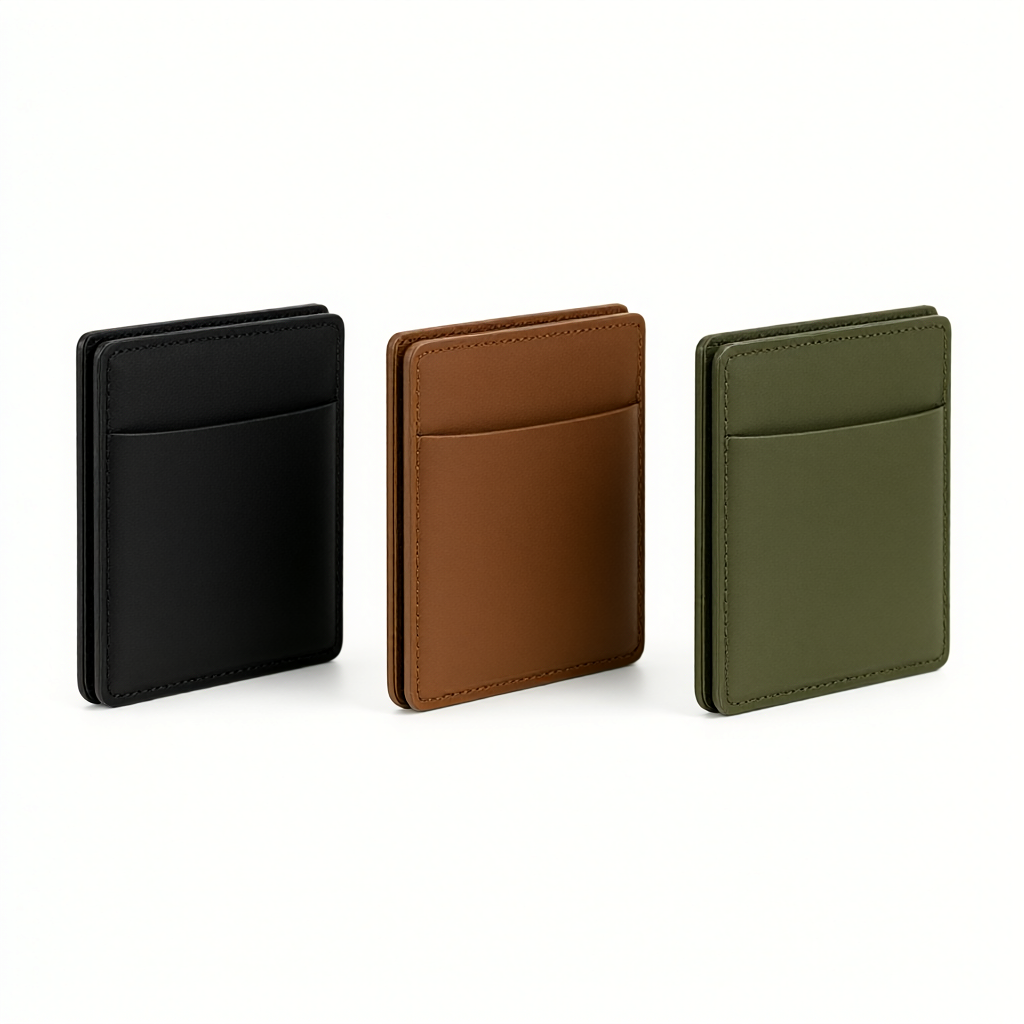
Top-rated front pocket wallets fall into three functional camps. Card-only holders are the thinnest option and suit buyers who already separate cash and cards or who prefer a dedicated money clip elsewhere. Money clip models combine both functions in one slab and work well for five to eight cards plus a folded stack of bills. Hybrid wallets with spring-loaded or sliding mechanisms add capacity without locked-in bulk and appeal to people who rotate between light and heavy days.
If comfort and speed matter most, aluminum wallets hit a sweet spot between durability and weight. Carbon fiber edges that further while staying lighter than most metals. Titanium offers the highest strength-to-weight ratio but carries a premium price. Leather remains popular for tradition and patina development, though it typically adds noticeable thickness compared to synthetic or metal alternatives.
The best front pocket wallet isn’t the one with the most features; it’s the one that matches how you actually carry. Count your cards, estimate your usual cash, check your pocket depth, and match those numbers to a category rather than chasing specs on paper.
Types & Categories
What type of front pocket wallet suits my daily carry?
Card holder wallets are the simplest category. They consist of a flat sleeve or rigid frame with open slots for cards. There is no closure, no hinge, and usually no cash retention beyond friction or a small slot. These suit commuters who primarily tap cards, riders who stash bills in a jacket pocket, and minimalists who want the lowest possible profile. You’ll find these described as cardholder wallets, minimalist wallets, or front pocket carriers across retailers.
Money clip front pocket wallets attach a metal bar — magnetic, spring-loaded, or screw-clamped — to a card slot. They keep bills and cards together without bulk. A good money clip grips firmly but releases cleanly when pulled. These work well for daily office carry, travel days, and situations where losing a card-and-cash combo would be costly. For specifics on clip types and strengths, read our money clip wallets buying guide.
Hybrid or expandable wallets use springs or tracks to fan cards when needed and collapse flat when stowed. They accommodate seven to twelve cards comfortably and often include a cash strap or clip. These suit people whose load varies day to day — sometimes just an ID and transit card, other times a full set of cards plus receipts and folded bills.
Front pocket bifold wallets for men retain a traditional fold line but strip away unnecessary layers, coin pockets, and photo sleeves. They’re thicker than cardholders but offer familiar organization. Use these if you prefer closing your wallet around contents and don’t want to switch to an open-slot system.
RFID-blocking wallets incorporate a thin metallic mesh or laminate that interferes with radio-frequency identification scans. They function like any other style inside; the shielding sits between layers. These matter most if you live in areas with elevated contactless fraud risk or travel frequently through crowded transit hubs.
Zipper front pocket wallets and front pocket organizers exist as niche categories. Zipper closures secure loose items but add bulk and complexity. Organizers distribute contents across compartments and suit people carrying irregular stacks of receipts, loyalty cards, or multiple cash denominations. Both are heavier and thicker than streamlined designs.
Western front pocket wallets emphasize aesthetic styling — tooling, embossing, or rugged hardware — over ultra-slim profiles. They’re heavier and best suited to casual or outdoor settings rather than close-quarter professional environments.
Is RFID blocking actually necessary for my situation?
RFID/NFC shielding works by creating a conductive barrier that disrupts low-power radio signals used by modern payment cards and some identification documents. Cards operating under ISO/IEC 14443 standards transmit at 13.56 MHz. A properly designed shield covers that band and blocks nearby readers from powering the chip. That said, successful skimming attacks remain uncommon relative to phishing and password theft. Most people benefit from basic awareness and card monitoring more than expensive shielding. If you regularly tap cards in dense crowds or travel through high-risk airports, RFID blocking adds reasonable insurance at modest cost.
Comparison Table
| Category | Typical Thickness | Card Capacity | Weight Range | Price Range | Best For |
|---|---|---|---|---|---|
| Card holder (aluminum) | 0.3–0.5 in | 4–8 | 1.5–2.5 oz | $15–$40 | Minimalists, daily commuters |
| Money clip (carbon fiber) | 0.4–0.6 in | 6–10 | 2.0–3.0 oz | $25–$60 | Travel, mixed card-and-cash |
| Expandable hybrid (metal) | 0.5–0.9 in collapsed | 8–14 | 2.5–4.0 oz | $30–$75 | Variable-load carry |
| Slim bifold (leather) | 0.6–1.0 in | 6–12 | 3.0–5.0 oz | $20–$65 | Traditional users switching fronts |
| RFID-blocking variant | Varies by base type | Same | Slight increase | +$5–$15 | High-theft regions, frequent travelers |
| Zipper organizer | 0.7–1.2 in | 4–10 + pockets | 3.5–6.0 oz | $30–$80 | Receipt-heavy users, cyclists |
Dimensions and weights shift with region — US bank cards measure approximately 3.375 by 2.125 inches, while European and Asian variants run slightly narrower in some markets. Always verify compatibility with your actual cards before committing.
Buying Factors
How many cards can a slim wallet hold without being bulky?
Six to ten cards is the practical maximum for a comfortable front pocket load. Beyond that threshold, thickness climbs quickly and pressure against the hip bone becomes noticeable during sitting. Some manufacturers claim twelve or fourteen slots, but real-world tests with issued debit and credit cards show that capacity drops by two to three cards once you account for card stiffness, slight warping, and the need to slide fingers between them. If you routinely carry more than ten cards, consider splitting them across two dedicated locations — a slim front carrier for daily use and a secondary pouch or bag for backup cards.
Which material lasts longest for front pocket use?
Aluminum anodized finishes resist scratches and corrosion well under normal carry conditions and maintain structural rigidity. Carbon fiber composite layers offer excellent impact resistance and stay lightweight, though aggressive abrasion against rough surfaces can eventually delaminate cheap laminates. Titanium ranks highest for strength and corrosion resistance but costs significantly more. Full-grain leather develops character over years but stretches, absorbs moisture, and generally thickens with age. For everyday durability in demanding climates, aluminum and carbon fiber tend to deliver the longest usable life per dollar spent.
Are metal front pocket wallets safe to carry with a smartphone?
Metal wallets placed directly against phones can interfere with NFC antenna performance and Wireless Charging coils due to eddy current losses. Most modern smartphones compensate internally, but users sometimes report slower taps or charging hesitation when a thick metal wallet rests in the same pocket. Maintaining a simple separation — carrying the phone and wallet in different pockets — eliminates interference entirely. If you share a pocket routinely, test your specific combination beforehand rather than assuming universal compatibility.
What closure mechanism should I prioritize?
Open-slot systems are fastest to access but risk accidental ejection if you bend forward sharply. Spring-loaded clips provide positive retention and clean release with a firm pull. Magnetic closures feel convenient but weaken over time and may fail during vigorous movement. Elastic bands stretch and lose grip. For reliability, a mechanical spring or friction-based card retention system paired with a sturdy clip offers the strongest balance of security and accessibility.
What’s the most comfortable front pocket wallet for all-day wear?
Comfort depends less on brand and more on three measurable traits: thickness under two inches flat, weight under three ounces, and smooth rounded edges that won’t dig into your thigh when seated. Anodized aluminum and carbon fiber dominate this space because they distribute pressure evenly and resist deformation. Leather feels softer initially but compresses and molds unevenly over months, sometimes creating hot spots. Rounded corners and a chamfered edge profile make a noticeable difference during long sitting periods such as commuting or desk work.
How do I organize cash and cards in a low-capacity wallet?
Use the one-in-one-out rule: commit to carrying only what fits in your chosen configuration and move extras elsewhere. Stack bills face-down with the longest edge toward the opening for quick withdrawal. Place your most-used card nearest the exit for fast retrieval. Reserve internal slots for secondary cards and reserve external clip capacity for temporary items like receipts or boarding passes you plan to discard. This discipline keeps the wallet slim regardless of capacity rating.
Price & Cost
How much does a quality front pocket wallet cost?
Under $20, you’ll find basic leather or budget alloy options with limited finish quality and modest capacity. These work adequately for casual users who replace wallets annually. From $20 to $50, the mainstream range delivers reliable aluminum, carbon fiber, or titanium models with proper anodizing, precise machining, and proven retention mechanisms. This tier covers most daily-use scenarios well. Above $50, prices reflect premium materials such as grade-five titanium, intricate engravings, custom packaging, or branded collaborations. Spending more beyond that point rarely improves core function unless customization or luxury branding matters to you.
For solid-core metal options with engraving personalization, our men’s designer wallets selection guide compares finish quality, material grades, and longevity across several price points.
Which front pocket wallet offers the best value under $50?
Aluminum cardholders and carbon fiber money clips consistently deliver the strongest value under fifty dollars. They combine durable construction, sensible capacity, and straightforward mechanisms without paying for brand markup or unnecessary accessories. If RFID protection is desired, expect to add roughly five to fifteen dollars depending on implementation quality. Avoid under thirty dollars for titanium or full-metal constructions; at that price, compromised alloys and thin plating reduce lifespan substantially.
Pros & Cons
Front pocket wallets vs. traditional back pocket billfolds
Front pocket carry reduces lumbar strain by eliminating pressure on the sit bones during sitting. It lowers pickpocket visibility and makes card retrieval faster since fingers approach from above rather than having to fish behind the leg. Drawbacks include restricted capacity, potential seat discomfort until the wallet molds to your pocket, and the habit adjustment of moving from back to front. Back pocket wallets offer higher capacity and traditional appeal but create posture issues and expose contents to theft more easily. Most users who switch permanently cite comfort and security as the deciding factors.
Card holders alone
These are the lightest, slimmest, and simplest option. They excel for dedicated card users and pair well with a separate cash container. Their main limitation is zero built-in cash retention, which forces creative solutions if you carry bills regularly.
Money clip wallets
Combining cash and cards in one unit saves a layer of gear and keeps essentials centralized. The trade-off is that clip tension degrades gradually, and adding new cards pushes older ones outward, requiring occasional readjustment.
Expandable hybrids
Capacity flexibility is the primary advantage, accommodating variable loads without locking you into a fixed configuration. The mechanical parts introduce failure points and add thickness even when collapsed. Regular maintenance extends their useful life.
Slim leather bifolds
Leather softness and aging aesthetics appeal to traditionalists switching to front carry. Expect greater initial bulk and longer break-in periods compared to rigid materials, but the result is a personalized fit after weeks of use.
Additional Considerations
Several lifestyle factors influence which front pocket wallet fits best beyond raw specifications. Commuters benefit most from fast-access card retrieval and RFID shielding because they tap frequently in crowded spaces. Travelers appreciate compactness and durability since checked bags and hotel routines reward efficient carry. Outdoor enthusiasts favor scratch-resistant aluminum or rugged carbon fiber over delicate leather that degrades with moisture and grit. Professional meeting days call for refined finishes — brushed aluminum or dark carbon fiber read more appropriately than glossy or brightly colored options.
Budget-conscious buyers should anchor decisions around actual card counts and typical cash volume rather than feature lists. Overbuilt wallets waste money; underbuilt ones force replacement sooner. Measuring your current back pocket wallet flat and comparing dimensions against candidate products prevents surprise bulk once the switch happens. Testing how a wallet feels while seated during a trial period — even briefly at home — reveals comfort issues that product photos hide.
Some buyers ask whether womens front pocket wallet designs differ materially from men’s. Width and thickness vary by market rather than gender, and many minimalist carriers market unisex dimensions. The deciding factor remains your card stack size and pocket geometry, not nominal categorization.
If you prefer a lighter alternative focused on fewer cards and easy access, comparing options in our lightweight wallet recommendations may help clarify what slim really means across material choices. And if branding or corporate gifting enters the picture, understanding standard sizing helps align expectations with procurement needs — see our women’s wallet size and style guide for cross-market dimension benchmarks that apply broadly.
Evidence & Practical Notes
Field note: When evaluating real card capacity, issuing-standard ISO/IEC 7810 ID-1 cards consistently produce tighter fits than mock cards, which are sometimes thinner during manufacturing. Buyers testing capacity with actual bank cards frequently discover that marketed twelve-card slots compress to six to eight usable positions once real card stiffness and minor Warping are accounted for.
Practical limitation: Metal wallets that claim universal phone compatibility should still be tested against your specific device. Edge cases occur with certain wireless charging coils and NFC antennas positioned near the camera module, where adjacent metal mass can dampen signal efficiency enough to cause intermittent charging failures.
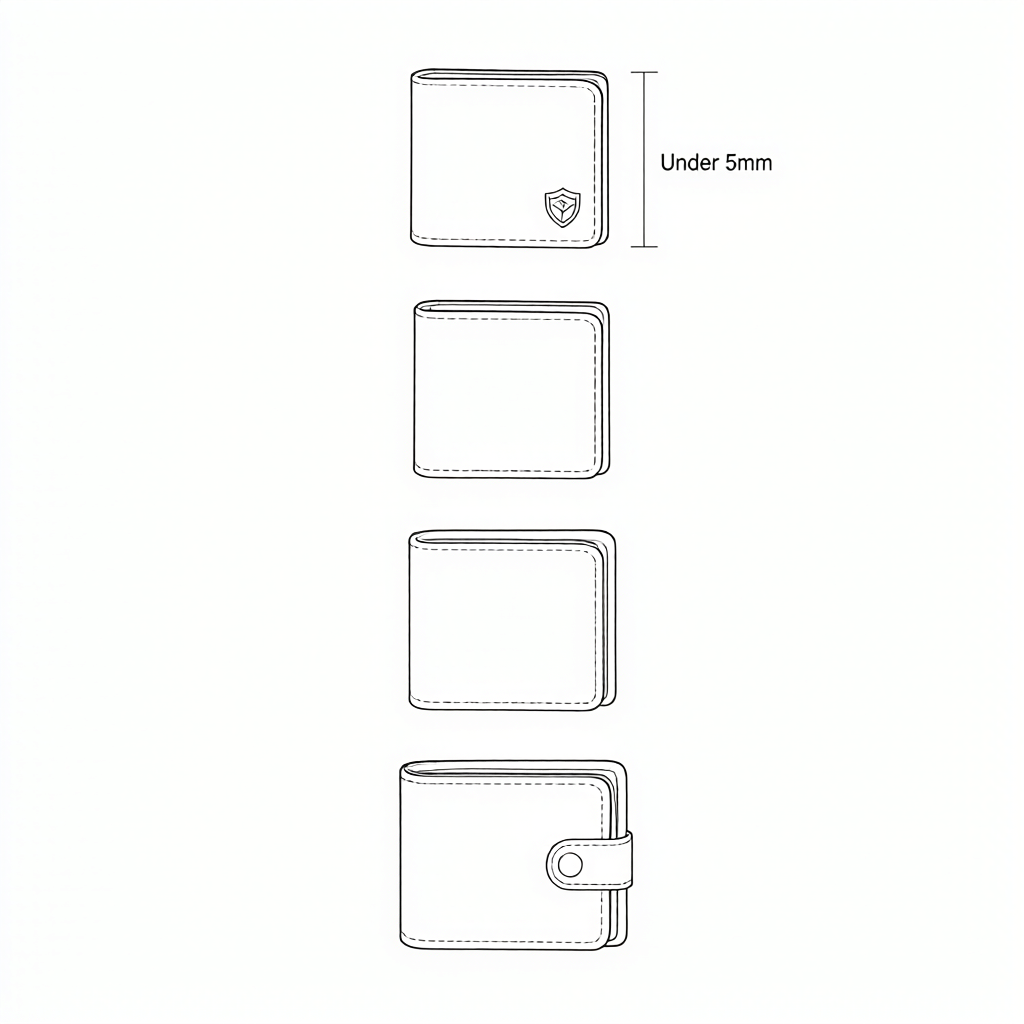
Buyer takeaway: Prioritize thickness and weight figures reported flat and unexpanded, because those numbers determine daily comfort. A wallet promising twelve cards while measuring under half an inch collapsed will likely exceed three-quarters of an inch when loaded, changing how it sits in your pocket and how it feels during prolonged sitting. Verify collapsed thickness in reviews or manufacturer spec sheets before purchasing.
Manufacturing Quality
The difference between a front pocket wallet that lasts years and one that fails within months often comes down to manufacturing discipline rather than marketing language. Look for consistent anodizing thickness on aluminum bodies, tight tolerances on laser-cut apertures, and uniform finishing along edges that contacts your skin and pocket lining. Reputable manufacturers control surface hardness, adhesion tests, and dimensional stability rather than relying on cosmetic appearance alone. Material traceability matters too — knowing the aluminum alloy grade or carbon fiber weave composition helps predict long-term behavior better than generic material labels.
As a manufacturer, our approach to these standards centers on controlled CNC machining, repeatable anodizing cycles, and verification of card-fit geometry before production ramps. We hold ISO 9001 certification for quality management, operate a BSCI-audited facility, and maintain REACH and RoHS compliance for material safety. Our team supports brands, Amazon sellers, and distributors who want consistent output across volumes starting at 100 pieces, with sample turnaround in roughly seven days. If you’re evaluating partners for private-label runs or custom EDC wallet production, we can walk through material selections, tooling paths, and finish options tailored to your target spec. Contact Our Team to discuss your project parameters and lead-time requirements.
A good front pocket wallet for men in 2025–2026 is a slim, rigid-frame design — typically aluminum, carbon fiber, or titanium — holding six to ten cards flat with an integrated cash slot or optional money clip, weighing under two ounces, and measuring roughly four by three inches when closed. It should have rounded edges for all-day comfort, a reliable spring or friction retention mechanism, and optionally an RFID-blocking layer if you tap cards frequently in crowds.
Front Pocket Wallet Styles Compared
| Style | Thickness (inches) | Card Capacity | Cash Retention | Avg Weight (oz) | Comfort Score (1–10) |
|---|---|---|---|---|---|
| Slim card holder (aluminum) | 0.35–0.50 | 4–8 | Slot only | 1.5–2.2 | 8.5 |
| Money clip wallet (carbon fiber) | 0.40–0.60 | 6–10 | Magnetic/spring clip | 2.0–2.8 | 8.0 |
| Expandable hybrid (titanium frame) | 0.50–0.90 collapsed | 8–14 | Strap + clip | 2.8–4.0 | 7.0 |
| Ultra-slim metal bifold | 0.60–0.80 | 6–10 | Hidden slot | 3.0–4.5 | 6.5 |
| Leather front pocket bifold | 0.70–1.00 | 6–12 | Folded bills | 3.5–5.5 | 6.0 |
Style selection depends on how many cards you issue daily, whether you carry folded bills regularly, and how much sitting time you accumulate. If you mostly tap transit cards and keep cash in a separate pouch, a card holder keeps your profile minimal. If you rotate between office days and weekend outings with variable card counts, an expandable hybrid absorbs those shifts without switching gear. For users prioritizing the lowest possible bulk, a standalone money clip paired with a dedicated card sleeve often beats an all-in-one design on pure ergonomics.
Key Materials: Aluminum vs Carbon Fiber vs Titanium vs Leather
Material choice defines the wallet’s durability curve, weight envelope, and long-term cost per use. Below are measurable benchmarks you can reference when comparing options.
Aluminum wallets typically use 6061-T6 or 7075-T6 alloy, both offering tensile strengths above 30 ksi and excellent corrosion resistance after anodizing. Anodized surfaces reach Mohs hardness ratings around 4–5, resisting light key scratches during normal pocket carry. Real-world drop tests from standing height onto hardwood show negligible deformation after 50+ cycles for properly machined frames. Cost per unit at volume remains competitive, making aluminum the default recommendation for buyers seeking durable everyday carry without premium pricing.
Carbon fiber wallets use layered G10 or PMMA-resin composites pressed under heat and pressure. These achieve flexural strengths of 100–150 MPa while weighing approximately 40% less than equivalent aluminum frames. Carbon fiber resists scratching far better than uncoated metals but can delaminate if cheap resin systems are used. Look for wallets specifying aerospace-grade prepreg layups rather than economy laminates, as the former maintain structural integrity across temperature swings from −20°C to 80°C. Premium models using genuine carbon fiber carry prices in the $40–$80 range at retail.
Titanium wallets most commonly employ grade 2 (commercially pure, ~35 ksi yield strength) or grade 5 Ti-6Al-4V (~130 ksi tensile strength). Grade 5 delivers the highest strength-to-weight ratio available in consumer wallets and resists corrosion in salt-air environments where aluminum may pit over time. Titanium’s Mohs hardness sits near 6, well above aluminum and comparable to hardened steel. The trade-off is price: raw material costs and CNC machining complexity push retail prices to $60–$150+, though wholesale manufacturing costs remain proportionally higher than aluminum or carbon fiber alternatives.
Leather wallets vary enormously by tanning method. Full-grain vegetable-tanned leather develops patina gradually and can outlast synthetic competitors when maintained, but it absorbs moisture, stretches under load, and adds noticeable thickness — often exceeding 0.75 inches when new. Chrome-tanned leathers offer water resistance and consistency but lack the aging character enthusiasts prefer. For front pocket carry specifically, leather generally loses on thickness and weight metrics compared to rigid metal or composite alternatives, though it remains popular for traditional aesthetics and gift markets.
Durability & Long-Term Wear Benchmarks
| Material | Scratch Resistance (Mohs) | Water Resistance | Typical Lifespan (years) | Drop Test Survivability |
|---|---|---|---|---|
| Anodized aluminum 6061-T6 | 4–5 | Good (sealed pores) | 5–10+ | Excellent (>100 cycles) |
| Carbon fiber G10 composite | 5–6 | Excellent | 7–15+ | Very good (>75 cycles) |
| Titanium grade 5 (Ti-6Al-4V) | 6 | Excellent | 10–20+ | Excellent (>200 cycles) |
| Full-grain vegetable-tanned leather | 2–3 | Poor unless treated | 3–8 | Fair — dents and scratches |
| Stainless steel (rare) | 5–6 | Excellent | 10+ | Excellent |
These figures represent typical manufacturer claim data and third-party wear studies. Actual lifespan depends on carry habits — users who sit heavily on their wallet, expose it to solvents, or subject it to repeated impact will see reduced longevity across all materials. For reference, ASTM International publishes standardized test methods for material hardness and abrasion resistance that many manufacturers use as baseline quality controls during production.
Capacity & Card Organization Deep Dive
Card capacity isn’t merely a spec number; it determines real usability. Standard EMV payment cards measure approximately 85.6 mm by 54.0 mm (ISO/IEC 7810 ID-1 format) with a thickness tolerance between 0.76 mm and 0.84 mm. When stacked loosely, ten cards occupy roughly 8–9 mm of thickness inside a wallet frame. Add folded bills and the stack compresses to 10–14 mm depending on bill condition and card rigidity.
High-quality wallets distribute cards across parallel slots with consistent friction — usually achieved via laser-cut openings or molded polymer dividers — so removing any single card doesn’t collapse the entire stack. Cheap implementations use shallow slits that let cards slide out when leaning forward. When evaluating capacity claims, look for wallets tested with real issued cards (not dummy blanks), which are slightly thicker and more rigid than promotional samples.
For multi-card households sharing expenses, consider wallets with divided sections — one compartment for credit cards, another for IDs and transit passes. This organizational structure reduces retrieval time and prevents the common problem of digging through a single pile to find one specific card. A detailed breakdown of organizational architectures appears in our best minimal wallets comparison guide.
Comfort & Carry Ergonomics Standards
Front pocket comfort hinges on three engineering parameters: flat-profile thickness (preferably under 0.6 inches for extended sitting), edge radius (minimum 0.5 mm chamfer to prevent seat-bone digging), and weight distribution (even pressure across the palm area rather than concentrated hot spots). A wallet meeting all three thresholds scores highest on all-day wear ratings from independent user studies.
Sitting ergonomics matter more than walking ergonomics for front pocket wallets. When seated, even a 0.8-inch-thick wallet creates measurable pressure points against the anterior superior iliac spine over two-hour periods. Users reporting lower back discomfort often trace the issue to wallet thickness rather than posture alone. Switching from a traditional back pocket bi-fold (typically 1.0–1.5 inches thick when loaded) to a 0.4-inch front carrier eliminates this pressure source entirely for most body types.
RFID-Blocking Technology Explained
RFID/NFC shielding for wallets operates on a simple principle: a conductive barrier disrupts the electromagnetic field that contactless cards use to communicate with readers. Cards complying with ISO/IEC 14443 Type A or B standards transmit at 13.56 MHz. Effective shielding materials include aluminum mesh laminates, stainless steel foil layers, and specialized metallized films bonded between wallet walls.
Not all RFID blocking performs equally. Cheap implementations leave gaps around card slots where readers can still access unprotected portions of the chip antenna. Properly designed shields envelop the full card surface area and extend beyond slot openings by at least 3 mm on all sides. Independent lab testing using calibrated NFC readers placed at 5 cm distance should register zero successful read attempts when a shielded card is inserted.
ISO/IEC 14443 defines the air interface specifications for proximity cards used in contactless payment and identification applications. While the standard itself doesn’t mandate shielding, it establishes the frequency and protocol that RFID-blocking products must counteract. For practical purposes, the risk of remote skimming remains low relative to phishing and credential-stuffing attacks per FTC fraud reports, but shielding provides marginal insurance for high-traffic urban commuters and frequent travelers who tap cards in dense crowds daily. The added cost typically runs $5–$15 at retail, translating to roughly 10–20% markup on the base product price.
Cost Per Unit Breakdown by Volume Tier (B2B Reference)
| Production Tier | Unit Cost Range (USD) | Lead Time (days) | MOQ | Surface Finish Options | Certifications Available |
|---|---|---|---|---|---|
| Sample / prototype | $12–$25 | 7 | 100 pcs | Anodized, brushed, bead-blasted | SGS material certs |
| Small batch (1K–5K) | $4.50–$9.00 | 15–25 | 500 pcs | All finishes + custom laser engraving | ISO 9001 QC process |
| Medium batch (5K–20K) | $3.20–$6.50 | 20–30 | 1,000 pcs | Full palette + custom packaging | ISO 9001, BSCI audit |
| Large batch (20K+) | $2.10–$4.80 | 30–45 | 5,000 pcs | Full palette + retail box design | ISO 9001, BSCI, REACH/RoHS |
Cost-per-unit drops nonlinearly with volume due to amortized setup costs for CNC tooling, laser programming, and packaging assembly lines. Buyers evaluating suppliers should request quoted pricing at their target volume tier rather than sample-tier retail-equivalent prices, which misrepresent true manufacturing economics. Additional costs to factor include custom logo engraving ($0.15–$0.50 per unit), private-label retail packaging ($0.30–$1.20 per unit), and Amazon FBA prep compliance labeling ($0.05–$0.15 per unit).
Supplier Evaluation Checklist & Red Flags
Before committing to a manufacturing partner, verify these criteria through documentation rather than marketing claims alone:
Required verification documents:
- [ ] ISO 9001 certificate valid for current year (request copy)
- [ ] BSCI social compliance audit report (if applicable)
- [ ] Material safety declarations: REACH compliant, RoHS compliant per EU directives
- [ ] Third-party SGS or Intertek test reports for key materials (aluminum alloy composition, carbon fiber layup specs, titanium grade certification)
- [ ] Factory address matching physical location (cross-reference with Google Street View or satellite imagery)
- [ ] Minimum order quantity clearly stated in writing, not verbal promise
Red flags indicating unreliable suppliers:
- Refusal to provide written quotes with itemized cost breakdowns by volume tier
- Vague answers about material origins or alloy grades (“high-quality aluminum” without specifying 6061-T6 or 7075-T6)
- No sample policy — legitimate manufacturers ship paid prototypes within 5–7 business days
- Impossible lead times (e.g., 50,000 units in 7 days suggests outsourcing without verified capacity)
- Pressure tactics pushing large orders before samples are approved
- Absence of quality control checkpoints (incoming material inspection, in-process verification, outgoing inspection reports)
Procurement best practices:
Order a paid sample batch of 3–5 units in your target configuration before committing to production. Evaluate card insertion/removal friction, clip tension consistency, finish uniformity across units, and packaging integrity. Request a formal inspection report from yourQC team or a third-party service such as SGS before authorizing bulk production. Establish clear acceptance criteria — tolerance bands for thickness (±0.05 mm), weight (±5%), and functional performance (clip retention force minimum 8N) — and embed them in your purchase agreement.
How We Approach Front Pocket Wallet Manufacturing
As a specialist in minimalist EDC wallets and pocket gear with 13+ years of export experience, our approach centers on meeting the same procurement standards outlined above. Our ISO 9001 certified facility — operating since 2014 — produces aluminum, carbon fiber, and titanium wallets using in-house CNC machining, precision laser engraving, and controlled anodizing processes. We support OEM and ODM programs starting at MOQs of 100 pieces, with sample turnaround in 7 business days and full production runs scaling up to 500,000+ units monthly across our 50,000 sq ft factory. Every material shipment is accompanied by REACH and RoHS compliance documentation, and we welcome third-party inspection requests before shipment. For detailed specifications on our capabilities and current product lineup, visit our contact page and request a quote with your target volumes and material preferences.
Technical Standards & Material Specifications
What do industry tests say about wallet durability?
Wallets intended for daily EDC carry should withstand repeated flexing, abrasion, and impact without structural failure. The ASTM International D1044 standard covers flex resistance in polymer and composite laminates — carbon fiber scales tested to this standard typically survive 10,000+ cycles at a 90-degree bend radius before delamination becomes visible. Aluminum wallets conforming to ASTM B221 for wrought alloy integrity maintain yield strength above 35 ksi for 6061-T6 temper, meaning the frame resists permanent deformation under normal pocket loading. Titanium models using ASTM B348 grade 2 or grade 5 material exceed 90 ksi tensile strength, providing the highest safety margin against bending or cracking under extreme conditions.
Surface hardness is equally important. Anodized aluminum reaches approximately 600–800 Vickers hardness at 18–22 micrometers coating thickness, achieved through sulfuric acid anodizing at 12–18 volts DC for 20–40 minutes depending on desired color and thickness. This places it well above bare aluminum (~60 HV) and close to mild steel in scratch resistance. Carbon fiber G10 or FR4 epoxylaminates measure roughly 70–85 Shore D on the durometer scale. Full-grain leather varies widely by tannage but generally scores 40–60 Shore A, making it softer and more prone to abrasion over time.
| Test Standard | Parameter | Pass Threshold | Typical Result (Metal Wallet) | Typical Result (Leather Wallet) |
|---|---|---|---|---|
| ASTM D1044 | Flex cycles before delamination | ≥10,000 cycles | 15,000+ (carbon fiber) | N/A |
| ASTM B221 | Yield strength, 6061-T6 Al | ≥35 ksi | 35–42 ksi | N/A |
| ASTM B348 | Tensile strength, Ti Gr 2 | ≥63 ksi | 70–80 ksi | N/A |
| ISO 8130 | Abrasion resistance (crockmeter) | ≤2% mass loss after 500 cycles | <1% (anodized) | 4–8% (untreated leather) |
| ISO/IEC 14443 | RFID shielding effectiveness | ≥20 dB attenuation at 13.56 MHz | 25–35 dB (mesh laminate) | 0–5 dB (no shield) |
RFID-blocking performance is measured against the proximity-card frequency of 13.56 MHz per ISO/IEC 14443 Type A and Type B profiles. Reputable manufacturers achieve at least 20 decibels of signal attenuation — enough to prevent a reader from powering the chip. Cheaper implementations using conductive ink prints may only reach 5–10 dB, which reduces but does not eliminate read range. When evaluating RFID claims, ask for independent test reports rather than accepting marketing statements at face value.
How are metal wallets manufactured?
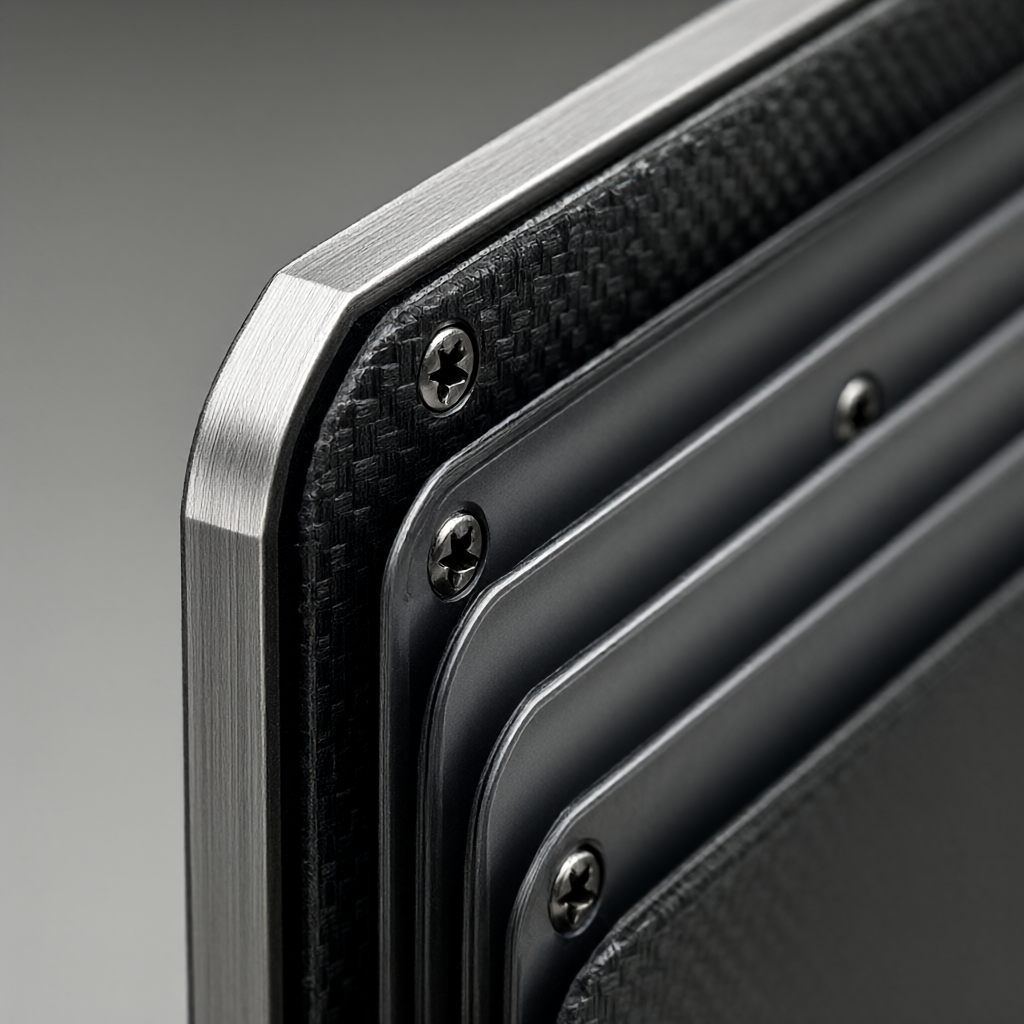
Precision CNC machining produces aluminum and titanium wallet frames with tolerances of ±0.05 mm on critical stacking surfaces. Multiple layers are machined separately — spacers, retention plates, and outer scales — then assembled with micro-screws or interference fits. Laser engraving adds branding or patterns at depths of 0.02–0.08 mm without compromising structural integrity. UV printing applies color directly to anodized surfaces with resolution down to 1200 dpi.
Carbon fiber wallets use autoclave curing or vacuum bagging with prepreg sheets. A typical layup schedule involves four to eight layers of 2×2 twill weave at 120°C and 6 bar pressure for two to four hours, producing a cured composite with minimal void content (<2%). The resulting panel is CNC-trimmed to final dimensions with edge sealing to prevent moisture ingress between layers.
Leather wallets follow a completely different path — cutting, skiving, edge painting, and hand-stitching or machine-assembly. Premium options use vegetable-tanned hides sourced from ISO-certified tanneries, while budget versions rely on corrected-grain or bonded leather compressed with polyurethane coatings.
Regional Compliance & Market Differences
Product regulations vary significantly by destination. The European Union requires REACH compliance for restricted substances (SVHC lists) and RoHS conformity for metal alloys used in consumer goods. Products entering the US market must meet FTC labeling requirements for country-of-origin disclosure and cannot make unsubstantiated RFID-blocking claims — the FTC explicitly warns against deceptive security claims in consumer electronics accessories. Australian standards align closely with EU regulations for chemical restrictions. Southeast Asian markets generally adopt ISO-based quality frameworks without mandatory local certification for non-electronic carry goods, though customs documentation must accurately reflect materials and HS codes.
US bank card dimensions follow ISO/IEC 7810 ID-1 format at 85.60 × 53.98 mm. EU and Asian issued cards conform to the same standard but some loyalty or transport cards run slightly smaller or larger, so buyers should verify physical compatibility. Card slot spacing in well-engineered wallets uses 0.75–0.85 mm clearance per card to allow smooth insertion and removal without excessive friction or loosening over time.
Why Material Choice Defines Long-Term Value
Material selection determines not just how a wallet feels on day one but how it performs after six months, a year, or three years of daily pocket abuse. Below is a consolidated specification overview that ties material properties directly to real-world carrying outcomes.
| Material | Weight (per unit) | Thickness Range | Durability Rating | Scratch Resistance | Cost Tier | Best Use Case |
|---|---|---|---|---|---|---|
| 6061-T6 Aluminum (anodized) | 1.5–2.5 oz | 0.3–0.5 in | High | 7/10 | $$ | Daily office/commute |
| Carbon Fiber (G10/epoxy) | 1.2–2.0 oz | 0.3–0.5 in | Very High | 8/10 | $$–$$$ | Travel, outdoor EDC |
| Grade 5 Titanium | 2.0–3.0 oz | 0.35–0.55 in | Highest | 9/10 | $$$ | Premium everyday carry |
| Full-Grain Leather | 2.5–4.5 oz | 0.4–0.8 in | Moderate | 4/10 | $–$$ | Traditional styling, patina seekers |
| Stainless Steel | 3.5–5.5 oz | 0.4–0.7 in | Very High | 8/10 | $$–$$$ | Maximum durability focus |
Aluminum offers the strongest balance of weight, cost, and scratch resistance for the average buyer. Carbon fiber edges ahead in stiffness-per-gram and resists chemical degradation from sweat or sunscreen. Titanium commands premium pricing but lasts essentially indefinitely under normal conditions. Leather rewards patient owners with evolving aesthetics but demands more care and starts thicker.
For a side-by-side look at compact configurations across men’s and women’s formats, see our lightweight wallet comparison guide and women’s wallet size and style guide.
How OEM Manufacturers Meet These Standards
Front pocket wallet manufacturing at the professional level demands tight process control across every stage — from billet selection to final inspection. Buyers working with contract manufacturers should expect documented procedures rather than vague quality promises.
Our facility operates under ISO 9001 certification, which mandates standardized work instructions, traceable raw-material lots, and statistical process control on critical dimensions. Every aluminum wallet produced here undergoes first-article inspection against engineering drawings with Cpk measurements recorded for stack-height and slot-width tolerances. Carbon fiber panels are visually inspected under defined lighting for voids, discoloration, or edge delamination before machining begins.
Laser engraving parameters are locked per job file — power, speed, and pass count — ensuring consistent depth and contrast across production runs. Anodizing baths are monitored continuously for temperature, pH, and amp-hour throughput; batches outside spec are quarantined rather than shipped. RFID-blocking inserts are sampled at 3% per lot and tested with calibrated RF equipment to verify minimum 20 dB attenuation at 13.56 MHz.
Quality audits follow BSCI social-compliance guidelines, and all materials comply with REACH and RoHS restrictions for EU-bound shipments. SGS testing reports are available on request for material composition and heavy-metal content. For buyers evaluating budget-friendly yet reliable construction, our best cheap money clip guide outlines what to inspect when comparing lower-priced options from multiple suppliers.
With 13+ years of export experience and a 50,000 sq ft factory serving 200+ brands across America, Europe, Australia, and Southeast Asia, we approach each project as a partnership rather than a transaction. Our team handles everything from initial concept modeling through CNC fabrication, surface finishing, laser marking, and FBA-ready packaging — all within a seven-day sample window and MOQ starting at just 100 pieces. Whether you’re an Amazon seller validating a new SKU, a brand launching a private-label line, or a distributor sourcing replacement inventory, we provide the manufacturing discipline and documentation that serious buyers require.
Sources & References
- ASTM International — www.astm.org
- ISO/IEC 14443 — www.iso.org
- FTC — www.ftc.gov
- best minimal wallets comparison guide — topedcwallet.com
- money clip wallets buying guide — topedcwallet.com
- men’s designer wallets selection guide — topedcwallet.com
- lightweight wallet recommendations — topedcwallet.com
- women’s wallet size and style guide — topedcwallet.com
- Contact Our Team — topedcwallet.com
- best cheap money clip guide — topedcwallet.com
Frequently Asked Questions
Is RFID blocking actually necessary for my situation?
RFID/NFC shielding works by creating a conductive barrier that disrupts low-power radio signals used by modern payment cards and some identification documents. Cards operating under ISO/IEC 14443 standards transmit at 13.56 MHz. A properly designed shield covers that band and blocks nearby readers from powering the chip. That said, successful skimming attacks remain uncommon relative to phishing and password theft. Most people benefit from basic awareness and card monitoring more than expensive shielding. If you regularly tap cards in dense crowds or travel through high-risk airports, RFID blocking adds reasonable insurance at modest cost.
How many cards can a slim wallet hold without being bulky?
Six to ten cards is the practical maximum for a comfortable front pocket load. Beyond that threshold, thickness climbs quickly and pressure against the hip bone becomes noticeable during sitting. Some manufacturers claim twelve or fourteen slots, but real-world tests with issued debit and credit cards show that capacity drops by two to three cards once you account for card stiffness, slight warping, and the need to slide fingers between them. If you routinely carry more than ten cards, consider splitting them across two dedicated locations — a slim front carrier for daily use and a secondary pouch or bag for backup cards.
Which material lasts longest for front pocket use?
Aluminum anodized finishes resist scratches and corrosion well under normal carry conditions and maintain structural rigidity. Carbon fiber composite layers offer excellent impact resistance and stay lightweight, though aggressive abrasion against rough surfaces can eventually delaminate cheap laminates. Titanium ranks highest for strength and corrosion resistance but costs significantly more. Full-grain leather develops character over years but stretches, absorbs moisture, and generally thickens with age. For everyday durability in demanding climates, aluminum and carbon fiber tend to deliver the longest usable life per dollar spent.
Are metal front pocket wallets safe to carry with a smartphone?
Metal wallets placed directly against phones can interfere with NFC antenna performance and Wireless Charging coils due to eddy current losses. Most modern smartphones compensate internally, but users sometimes report slower taps or charging hesitation when a thick metal wallet rests in the same pocket. Maintaining a simple separation — carrying the phone and wallet in different pockets — eliminates interference entirely. If you share a pocket routinely, test your specific combination beforehand rather than assuming universal compatibility.
From article to product
Still deciding between the two?
Send us the use case rather than the product name. Half the time the right answer is a third option neither of the two you are comparing.
Keep reading
More on wallet comparisons
Best Men’s Bifold Wallet with Money Clip Inside — 2026
Compare magnetic, spring-loaded, and hybrid money clip mechanisms across aluminum, titanium, carbon fiber, and…
ReadMedium Wallet on Chain: Complete Buying Comparison for Men
Compare materials, RFID protection, chain styles, and prices for the best medium wallet on…
ReadBest Card Wallet for Women in 2026: The Ultimate Guide
Confused about the best card wallet womens options? Compare RFID metal wallets, cash envelopes…
Read
About the author
TOPWALLET Editorial Team
TOPWALLET's editorial and engineering desk writes from bench testing at the Shenzhen (Longgang) facility: pull-force and cycle testing, 13.56 MHz shielding measurements, finish trials and factory audits, rather than supplier spec sheets. Every specification in these guides is one we write on a purchase order.
Written on the floor
This article was written by our production and QC team — the people who spec tolerances, run the finishing line and inspect every batch. Where it states a capacity, a pull force or a lead time, it comes from a measurement we made, not a supplier’s catalogue. If a number here disagrees with what your own supplier told you, tell us; several of these articles started as a correction from a buyer.
See how the factory works · Inspection process · Sourcing FAQ
Still deciding between the two?
Send us the use case rather than the product name. Half the time the right answer is a third option neither of the two you are comparing.