

A money clip wallet is a minimalist carry item that combines a metal or polymer clip for securing folded banknotes with integrated card slots — replacing the bulky traditional bi-fold with a thin, front-pocket-friendly profile. For B2B buyers, the key decision factors are clip mechanism reliability, material specifications, MOQ and customization options, and compliance with destination-market standards such as ISO 9001, REACH, and BSCI.
What Is a Money Clip Wallet?
A money clip wallet is a minimalist pocket item that combines a card-carrying section with an integrated metal or polymer clip for securing folded banknotes. It replaces the traditional bi-fold wallet — which typically holds cards, cash, and coins in separate compartments — with a single thin profile designed for front-pocket carry.
The core concept is simple: a spring-loaded, magnetic, or elastic clip holds cash against a card slot or plate. The result is a wallet that eliminates bulk while keeping the essentials accessible. For B2B buyers evaluating the category, understanding the clip mechanism and material choices is critical before committing to OEM or ODM specifications.
How Does a Money Clip Wallet Mechanism Work?
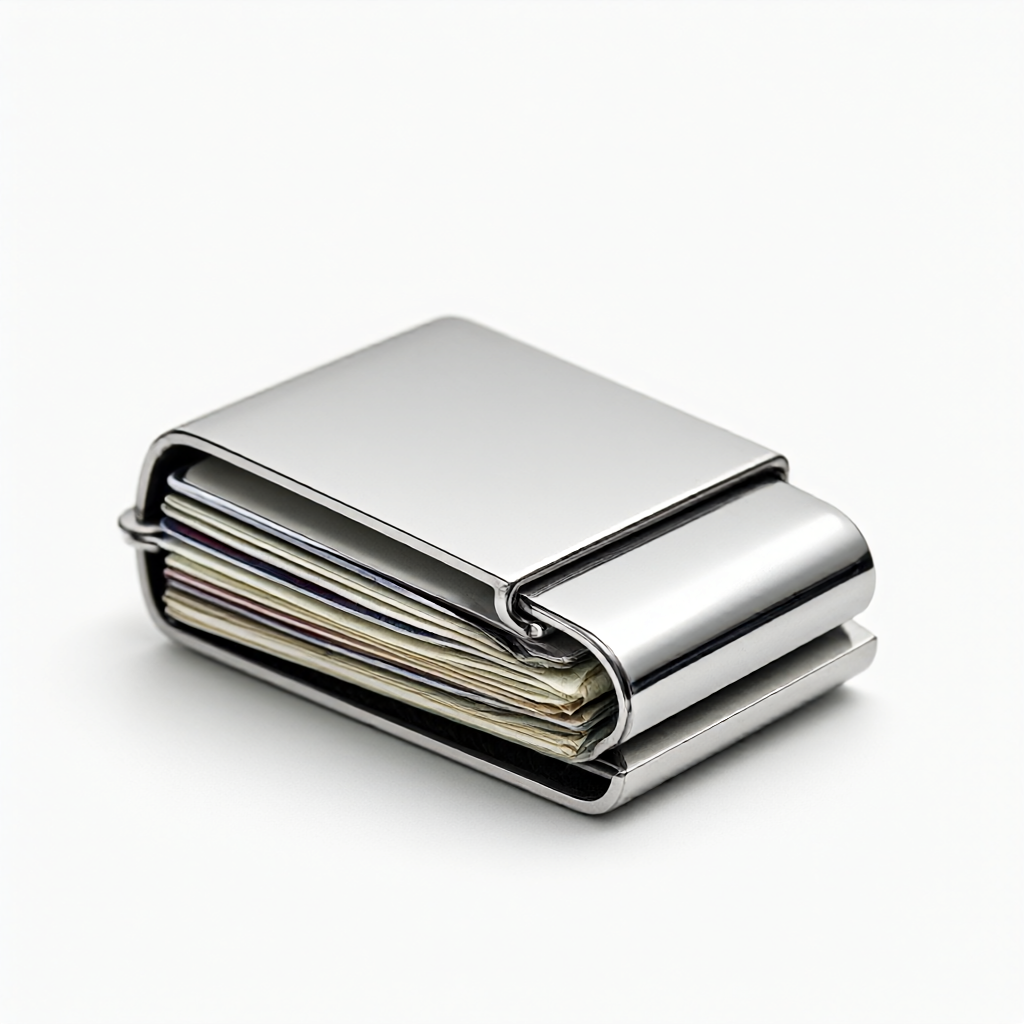
The clip is the defining component of this product type. Different mechanisms deliver different holding characteristics, wear profiles, and price points. Buyers should understand the trade-offs before specifying.
How Does a Spring-Loaded Bypass Clip Work?
A stainless steel spring strip is mounted inside the wallet body. When you insert bills, the spring flexes outward; when released, it returns to its resting position, pressing the cash against the card plate. This is the most common mechanism in metal EDC wallets.
The key variable is spring tension. Too loose, and bills fall out during use. Too tight, and the user struggles to remove or insert cash. Quality suppliers test clip retention across temperature ranges and cycle counts. A well-engineered bypass clip maintains consistent tension over thousands of open-close cycles without metal fatigue.
When Do Elastic Band Clips Make Sense?
Some slim wallets — particularly those with aluminum or carbon fiber outer plates — use a stretched elastic band (often TPU-coated steel wire) instead of a metal spring. The band wraps around the cash and is anchored at both ends. This design offers softer grip pressure and a different tactile experience.
Elastic clips are lighter and cheaper to tool but degrade over time. Heat, UV exposure, and repeated stretching reduce elasticity, leading to sagging or permanent deformation. For long-lived products, buyers should evaluate whether the elastic band is replaceable or if the entire clip assembly must be sourced as a replacement part.
Do Magnetic Clips Hold Cash Securely?
Rare-earth magnets are embedded in the wallet structure to hold cash in place. These produce the cleanest external appearance since no visible spring or band is needed.
The trade-off is capacity. Magnets provide adequate hold for a modest stack of bills but lose effectiveness with thicker cash loads. They also risk demagnetization near strong electromagnetic fields and can interfere with RFID-shielding layers if not properly isolated. Magnet-based clips are best suited for lightweight, fashion-forward designs rather than high-capacity daily carry models.
What Is a Hybrid Money Clip Design?
Some manufacturers combine mechanisms — for example, a magnetic closure paired with an internal elastic band. This approach can improve retention while maintaining a clean exterior. However, hybrid systems add complexity, increase component count, and raise the likelihood of failure points. From a sourcing perspective, each additional mechanism raises per-unit cost and complicates quality control.
Which Materials Are Used for Money Clip Wallets?
Material selection determines the wallet’s weight, durability, finish options, and price tier. The four most common materials in B2B production are:
Aluminum (6061 or 6063 alloy)
The default for budget-to-mid-tier metal wallets. It is lightweight, corrosion-resistant when anodized, and accepts laser engraving, sandblasting, and UV printing for custom branding. Typical thickness ranges from 1.5 mm to 3.0 mm depending on the clip assembly design. Anodized finishes provide color consistency and surface hardness. See our minimalist wallet materials and sourcing guide for detailed alloy and finish comparisons.
Titanium (Grade 2 or Grade 5)
A premium option for brands targeting the high-end EDC segment. Titanium is stronger and lighter than aluminum at equivalent thickness, resists corrosion without coating, and accepts laser engraving with a distinctive contrast finish. It is significantly more expensive to machine due to tool wear and longer cycle times. Titanium wallets typically command a 2× to 3× price premium over aluminum equivalents.
Carbon Fiber
A composite material woven from carbon filaments and cured in resin. Carbon fiber card holders are extremely light, scratch-resistant, and visually distinctive. The material is difficult to machine — most carbon fiber wallets are cut from pre-preg sheets rather than CNC-milled. This limits design flexibility for complex clip geometries but allows for very thin profiles. Carbon fiber also accepts laser marking for logos.
Leather
Genuine leather, synthetic leather, and vegan leather variants appear in hybrid designs where the clip plate is metal and the cash-wrap component is leather. Leather provides warmth and flexibility but stretches over time, reducing clip tension. Full-grain leather ages well; bonded or corrected leather may delaminate. For B2B buyers, leather origin and treatment method (vegetable-tanned vs. chrome-tanned) should be specified to meet destination-market chemical restrictions.
Which Money Clip Wallet Specs Do Buyers Evaluate?
When comparing suppliers and requesting quotes, the following specifications are the primary decision factors:
How Thick Should a Money Clip Wallet Be?
Quality money clip wallets range from approximately 6 mm to 18 mm thick when loaded. Ultra-slim designs target 6 mm to 10 mm but sacrifice bill capacity. Mid-range designs sit at 10 mm to 14 mm. Over 14 mm begins to conflict with the “minimalist” positioning. Buyers should specify maximum loaded thickness based on their target pocket profile.
How Much Should a Money Clip Wallet Weigh?
Aluminum wallets typically weigh 30 g to 60 g unloaded. Titanium adds 20% to 40% in weight at equivalent thickness. Carbon fiber variants are among the lightest, often under 30 g. Weight impacts shipping costs for bulk orders and is a key differentiator in product listings.
How Many Cards Fit in a Money Clip Wallet?
Most money clip wallets hold 4 to 12 cards. Budget designs with thin aluminum plates may only accommodate 4 to 6 cards before the clip tension is compromised. Higher-capacity designs use reinforced plates and stronger springs. Buyers should define card capacity as a spec requirement — not all suppliers optimize for the same number.
How Many Bills Fit in a Money Clip Wallet?
A standard money clip wallet holds 6 to 20 folded bills depending on mechanism and clip tension. Real-world testing with actual denominations (e.g., $20 US notes or €50 Euro notes) is the most reliable capacity measurement. Claimed capacity that exceeds 20 bills usually requires a looser clip, which reduces retention security.
How Much Retention Force Should the Clip Deliver?
Measured in newtons or grams-force, clip retention force indicates how much downward pressure the clip applies to the cash. Typical values range from 5 N to 15 N. Lower values risk bills falling out; higher values make insertion and removal difficult. This is a specification buyers should request from suppliers during the quotation process.
Which Standards Apply to Money Clip Wallets?
Money clip wallets for international markets must comply with material safety and chemical regulations. The following standards and frameworks are most relevant:
RFID-Blocking Performance
RFID-shielded wallets use metallic layers (typically aluminum or copper mesh) embedded between outer plates. Performance is measured against the 13.56 MHz frequency band used by contactless card chips. While there is no single mandatory standard for consumer RFID wallets, testing against ISO/IEC 14443 (the standard for proximity card communication) provides a credible benchmark. Suppliers should provide test reports from independent laboratories confirming signal attenuation of 20 dB or greater at 13.56 MHz.
REACH Compliance (EU Regulation EC 1907/2006)
All materials in contact with the user — metals, coatings, adhesives, leather treatments, elastic bands — must comply with REACH restricted substance lists. This is particularly relevant for leather components treated with chromates or azo dyes. B2B buyers should require REACH compliance declarations from suppliers, especially for products destined for the European market.
RoHS Compliance (EU Directive 2011/65/EU)
RoHS restricts lead, cadmium, mercury, and certain flame retardants in electronic equipment. While wallets are not electronics, RoHS compliance is often requested by buyers as a baseline material safety indicator, particularly for metal alloys and plating processes.
BSCI Social Compliance
The Business Social Compliance Initiative audit covers labor practices, working hours, and facility conditions. Many European distributors and retail chains require BSCI-certified suppliers as a condition of engagement.
SGS Testing
Third-party material testing by SGS or equivalent laboratories verifies heavy metal content, nickel release (particularly relevant for metal wallets in contact with skin), and chemical composition. Buyers should request current SGS test reports for raw materials before approving samples.
What Matters Most When Sourcing Money Clip Wallets?
The awareness stage of B2B procurement focuses on understanding the category and establishing evaluation criteria. The following considerations apply specifically to money clip wallets:
How Reliable Is the Clip Mechanism Over Time?
A wallet that fails after three months of daily use creates warranty claims, returns, and brand damage. The clip mechanism is the highest-failure-risk component. During sample evaluation, test the clip repeatedly — insert and remove cash 50 to 100 times. Check for tension loss, spring deformation, or detachment of the clip assembly from the wallet body. For elastic band designs, verify that the band anchors are secured with adhesive, riveting, or weld points — not simply threaded through a hole.
How Durable Are the Card Slots?
Cards are inserted and removed daily. Thin aluminum slots can deform or widen over time, causing cards to slide out unexpectedly. Ask suppliers about slot reinforcement methods — some use double-layer card plates or insert molded polymer sleeves inside the metal frame. Card slot design is a differentiator that many buyers overlook during initial evaluation.
How Long Does the Finish Coating Last?
Anodized aluminum finishes can scratch or wear through at high-contact points. Laser-engraved logos expose bare metal beneath the anodized layer, which may tarnish differently over time. UV-printed graphics can chip at edges. For promotional and corporate gift programs, finish durability is often a deciding factor in supplier selection. Request finish longevity data from your supplier — some manufacturers conduct salt spray and abrasion tests on finished parts.
Which Customization Options Are Available?
Money clip wallets are highly customizable for private label and promotional programs. Standard options include:
- Logo application: laser engraving, UV printing, or embossing
- Material selection: aluminum, titanium, carbon fiber, or leather
- Color anodization: any PANTONE-matched color is feasible with aluminum
- Packaging: custom retail boxes, blister packs, or plain poly bags
- Clip mechanism: spring, elastic, or magnetic (specify at design stage)
Lead times for custom orders depend on the complexity of tooling and finishing requirements. Simple logo engraving on stock blanks may add 2 to 3 days; full custom design from concept to production typically requires 15 to 30 days including sample approval.
What MOQ and Pricing Structure Apply?
Minimum order quantities for custom money clip wallets typically starts at 300 pcs per SKU per design. Lower MOQs are available for stock items with simple branding. Pricing varies significantly by material and mechanism:
- Aluminum spring-clip wallets: mid-range pricing
- Carbon fiber models: premium pricing due to material and cutting costs
- Titanium variants: highest pricing tier
- Magnetic clip designs: variable, depending on magnet grade and isolation requirements
For corporate gift programs and promotional product distributors, volume pricing tiers are standard. Buyers should request FOB quotations that specify tooling costs separately from per-unit pricing, as一次性 tooling fees are common for custom clip assemblies.
How Long Does Sample Lead Time Take?
Fast sample turnaround is critical for time-sensitive product launches and trade show commitments. Industry-standard sample lead time for money clip wallets is 5 to 10 business days from approved artwork. Some manufacturers offer expedited 7-day sample service for urgent projects. Always confirm sample cost — many suppliers charge a sample fee that is refundable against the first production order.
For an overview of EDC wallet manufacturing processes and sourcing fundamentals, see our EDC wallets and minimalist wallet manufacturing guide for B2B buyers. If your requirements lean more toward card-carrying capacity than cash retention, also review our card holder sourcing guide to understand where the money clip wallet fits in the broader EDC portfolio.
How Does a Money Clip Wallet Compare With Bi-Fold Wallets?
From a procurement and product strategy perspective, the money clip wallet competes with the traditional bi-fold on specific use cases rather than universally replacing it. Understanding where each format wins helps buyers position their product lines correctly.
Where Do Money Clip Wallets Win?
Profile and carry position. Money clip wallets are 50% to 70% thinner than bi-fold wallets when loaded. This makes them suitable for front-pocket carry, which is increasingly preferred for comfort and security. Bi-folds push into the back pocket, creating discomfort and potential damage to seated devices or the wallet itself.
Simplicity of carry. A money clip wallet carries only what the user chooses to carry. There is no coin pocket, no hidden billfold compartment, no checkbook sleeve. This simplicity is a feature for minimalist users and a cost advantage for manufacturers — fewer components mean lower BOM cost and fewer failure points.
Branding real estate. The flat metal or carbon fiber plates of a money clip wallet provide large, smooth surfaces ideal for laser engraving and UV printing. Bi-fold wallets have curved surfaces, stitching lines, and multiple panels that complicate branding application.
Shipping and packaging efficiency. Slim wallets pack denser in cartons, reducing per-unit freight cost. For importers shipping from Asia, this freight difference compounds across container loads.
Where Do Bi-Fold Wallets Still Win?
Capacity. Bi-folds hold more cards, more cash, and often coins. Users who carry membership cards, loyalty cards, and multiple payment methods alongside rolled or folded bills will find money clip wallets insufficient.
Protection. The enclosed structure of a bi-fold protects cards from bending and cash from snagging. Money clip wallets expose cards on one side, making them more susceptible to accidental removal or debris accumulation in the card slots.
Price point. Basic bi-fold wallets can be manufactured at lower cost using injection-molded materials or simple leather construction. Money clip wallets with precision-machined metal components sit at a higher price tier, which may limit market reach in price-sensitive segments.
How Should Each Buyer Segment Decide?
EDC brand owners should evaluate money clip wallets as part of a product line that includes both slim and capacity-focused SKUs. The money clip model serves the minimalist, urban, front-pocket demographic; the bi-fold serves users who prioritize capacity over profile.
Promotional product distributors should consider money clip wallets for corporate gifts where brand visibility matters — the large engraving area and perceived premium quality make them attractive for executive gifts and conference giveaways.
Amazon FBA sellers should note that money clip wallets have strong search volume and rating potential but face significant competition. Differentiation comes from material choice (titanium vs. aluminum), clip mechanism reliability, and packaging quality.
Send Your Project Requirements for a Custom Quote
How Do We Approach Money Clip Wallet Manufacturing?
As a manufacturer, our approach to this category follows the same evaluation framework buyers should apply: mechanism reliability, material quality, and finish longevity are non-negotiable specifications. We source 6061 and 6063 aluminum alloys with verified chemical compositions, validate clip retention force during prototype testing, and run salt spray and abrasion tests on anodized finishes before approving production runs. For titanium and carbon fiber models, we control tolerances more tightly because material cost leaves less margin for rework.
Our facility is ISO 9001 certified and BSCI audited, with REACH and RoHS compliance built into every material specification. We offer low MOQ starts at 300 pcs per SKU with a 7-day sample lead time, which allows buyers to evaluate clip mechanisms and finishes before committing to bulk orders. See our men’s minimalist wallets materials, specs and sourcing guide for a deeper look at how material selection affects product performance across the EDC wallet category.
What Procurement Benefits Do Money Clip Wallets Offer?
From a sourcing and product-positioning standpoint, money clip wallets offer distinct advantages over traditional bi-fold wallets:
Lower Bill of Materials (BOM) cost. A money clip wallet typically contains 3 to 8 components versus 10 to 20 in a bi-fold (multiple card slots, coin pocket, billfold panels, stitching). Fewer components translate to lower assembly time, fewer quality inspection points, and reduced per-unit cost.
Simpler tooling and faster time-to-market. With fewer moving parts, customizing a money clip wallet requires less complex tooling. Laser-engraved or UV-printed branding can be applied to stock blanks without additional molding, enabling faster sample approval and shorter launch timelines.
Higher perceived value in EDC and outdoor segments. The minimalist aesthetic and premium materials (anodized aluminum, titanium, carbon fiber) align with the growing everyday-carry market. These materials support higher retail price points than standard leather bi-folds, improving margin potential for private-label buyers.
Better shipping economics. At 6 mm to 14 mm thick and 30 g to 60 g weight, money clip wallets pack significantly denser than bi-folds. For container-load shipments from Asia, this density difference can reduce freight cost per unit by 15% to 30% compared to bulkier wallet formats.
Front-pocket carry compliance. Many corporate and promotional programs now specify front-pocket carry as a comfort and security requirement. Money clip wallets inherently meet this standard, while bi-folds do not.
What Are the Slim-Profile Advantages?
The core value proposition of the money clip wallet is its slim profile. Understanding the dimensions and trade-offs is essential for B2B buyers specifying products for retail or promotional channels.
Loaded thickness range. Quality money clip wallets loaded with 8 to 10 bills and 4 to 6 cards typically measure 8 mm to 14 mm thick. Ultra-slim designs target 6 mm to 8 mm but sacrifice bill capacity to 4 to 6 bills. Mid-range designs at 10 mm to 12 mm represent the best balance for most consumer use cases.
Weight-to-capacity ratio. Aluminum money clip wallets deliver approximately 4 g to 6 g of holding capacity per gram of wallet weight. Titanium variants achieve similar ratios at higher absolute weights. This metric matters for e-commerce product listings where weight is a stated specification and for shipping cost calculations on bulk orders.
Minimalism as a market differentiator. The minimalist EDC movement has driven sustained demand for slim, purpose-built carry items. Buyers targeting outdoor enthusiasts, professionals, and gift purchasers should position money clip wallets as “what you need, nothing you don’t” — a framing that resonates with the target demographic and supports premium pricing.
How Should You Evaluate a Money Clip Wallet Supplier?
When evaluating potential suppliers, B2B buyers should apply a weighted decision framework across the following criteria:
| Evaluation Criteria | Weight | What to Verify |
|---|---|---|
| Clip mechanism cycle-test data | 20% | Supplier-provided test reports showing retention force after 5,000+ open-close cycles; absence of spring fatigue or tension loss |
| Material certification | 15% | SGS test reports for alloy composition, nickel release compliance, REACH SVHC declaration, and RoHS confirmation |
| Quality management certification | 15% | Valid ISO 9001:2015 certificate; BSCI audit report for facilities supplying European or North American retail chains |
| Sample lead time | 10% | Standard 5 to 10 business days; expedited 7-day option available for urgent projects |
| MOQ flexibility | 10% | Starting MOQ starts at 300 pcs per SKU for full OEM customization (100 pcs trial order available for stock finishes) per design; tiered pricing structure visible in quotation |
| Customization capability | 10% | In-house CNC machining, laser engraving, anodizing, and packaging design; ability to execute ODM from concept |
| Lead time for production | 10% | 15 to 30 days for custom orders from sample approval; transparent timeline with milestone updates |
| FOB pricing transparency | 10% | Tooling costs separated from per-unit price; volume discount tiers documented |
How to use this framework: Score each supplier on a 1-to-5 scale per criterion, multiply by the weight, and sum for a total score out of 100. Suppliers scoring below 65 should be further evaluated or excluded. This framework ensures objective comparison beyond price alone.
Which Red Flags Should B2B Buyers Watch For?
Certain warning signs indicate supplier risk and should trigger deeper due diligence or disqualification:
- No cycle-test or retention-force data. If a supplier cannot provide quantitative clip performance data (e.g., Newton force measurements or cycle-count test results), treat this as a major quality-risk indicator. Reputable manufacturers track clip retention across temperature ranges and published cycle counts.
- No material certification available on request. Suppliers who cannot produce SGS reports, REACH declarations, or alloy composition certificates within 48 hours of request may lack proper raw-material traceability. This is especially critical for markets with strict chemical regulations (EU, California Prop 65).
- Vague or absent ISO/BSCI certification. Claiming “quality certified” without providing a verifiable certificate number and issuing body is a red flag. Request the certificate directly from the certifying body (e.g., ISO 9001:2015 registry) to confirm validity.
- Unrealistically low MOQ with no minimum for simple branding. While low MOQ (300 pcs) is achievable with stock blanks and laser engraving, suppliers offering 50 pcs or fewer for fully custom designs with new tooling are likely outsourcing — which reduces quality control and communication clarity.
- No sample fee policy disclosed upfront. A supplier who does not state sample cost and refund conditions before sample approval is being sent may add unexpected charges later. Industry standard is a sample fee of $50 to $200 refundable against the first production order of 500+ pieces.
- No specification for anodized layer thickness. Quality anodizing for aluminum wallets requires a layer thickness of 10 to 25 micrometers for durability. Suppliers who cannot specify this range may be using thin, cosmetic-grade anodizing that scratches easily.
- Unwillingness to share factory location or facility photos. For overseas sourcing, basic facility transparency is expected. Refusal to share this information should prompt a video call or third-party factory audit before proceeding.
Which Money Clip Wallets Do We Recommend?
Based on material tier, clip mechanism, and target market segment, the following product archetypes represent the strongest sourcing options:
Entry-level aluminum spring-clip wallet
- Material: 6061 aluminum, anodized
- Clip: Stainless steel bypass spring
- Card capacity: 4 to 8 cards
- Bill capacity: 6 to 12 bills
- Loaded thickness: 8 mm to 10 mm
- Target retail price: $15 to $25
- Best for: Promotional programs, corporate gifts, high-volume distribution
- Sourcing note: Lowest BOM cost; highest margin potential at volume; anodized color options limited to PANTONE-matched range
Mid-tier aluminum or carbon fiber wallet
- Material: 6063 aluminum (anodized) or pre-preg carbon fiber plate
- Clip: Spring-loaded bypass or elastic band
- Card capacity: 6 to 10 cards
- Bill capacity: 8 to 16 bills
- Loaded thickness: 10 mm to 12 mm
- Target retail price: $25 to $45
- Best for: EDC brand owners, Amazon FBA sellers, retail chains
- Sourcing note: Carbon fiber variants command premium positioning; aluminum anodized offers widest color customization
Premium titanium wallet
- Material: Grade 2 or Grade 5 titanium
- Clip: Spring-loaded bypass (titanium or stainless steel)
- Card capacity: 4 to 8 cards
- Bill capacity: 6 to 12 bills
- Loaded thickness: 8 mm to 12 mm
- Target retail price: $50 to $100+
- Best for: High-end EDC brands, outdoor gear retailers, luxury corporate gifts
- Sourcing note: 2× to 3× material cost versus aluminum; laser-engraved logos show distinctive contrast on titanium; longer machining cycle time affects lead time
Hybrid leather-and-metal wallet
- Material: Full-grain leather cash wrap with aluminum or titanium clip plate
- Clip: Leather-wrap tension or integrated spring
- Card capacity: 4 to 8 cards
- Bill capacity: 6 to 15 bills
- Loaded thickness: 10 mm to 14 mm
- Target retail price: $30 to $60
- Best for: Brands targeting traditional leather-goods consumers who want modern slim profiles
- Sourcing note: Leather origin and tanning method must comply with REACH; chrome-tanned leather requires additional nickel-release testing
Which Sourcing Case Studies Show the Model Working?
Case Study 1: North American EDC Brand — Aluminum Wallet Private Label
A US-based EDC brand commissioned 2,000 units of a custom 6061 aluminum money clip wallet with laser-engraved logo and PANTONE-matched anodized finish. The supplier provided ISO 9001:2015-certified production, SGS-tested anodized layer thickness (18 µm), and clip cycle-test data (5,000 cycles with <5% tension loss). Sample lead time was 7 days; production lead time was 21 days from sample approval. FOB pricing was $8.50 per unit at 2,000 pcs, with a one-time tooling fee of $300 for the custom clip bracket. The brand achieved a retail price of $28, yielding approximately 60% gross margin after shipping and duties.
Case Study 2: European Promotional Products Distributor — Carbon Fiber Wallet Program
A UK-based promotional products distributor sourced 5,000 carbon fiber money clip wallets with UV-printed client logos and custom retail packaging. The supplier provided BSCI audit certification, REACH SVHC compliance declaration, and SGS nickel-release test results below 0.5 µg/cm²/week. MOQ was met at 300 pcs per design across five custom color variations. Total lead time from artwork approval to shipment was 28 days. FOB pricing was $12.00 per unit, with packaging tooling at $500. The distributor retailed the wallets at £35, achieving strong uptake in corporate gifting segments during Q4.
Money Clip Wallet: How Do We Meet These Standards?
As a manufacturer specializing in minimalist EDC wallets since 2014, our approach to money clip wallet production is grounded in measurable quality controls and transparent specifications. We operate from a 50,000 sq ft in-house facility equipped with CNC machining, laser engraving, and aluminum anodizing — all under one roof, which means every specification from clip retention force to anodized layer thickness is verified before shipment.
Our ISO 9001:2015 quality management system (certified since 2014) ensures consistent process control across all production stages. Every batch of raw aluminum, titanium, or carbon fiber material is accompanied by SGS test reports covering alloy composition, nickel release, and heavy metal content. For EU-bound products, we provide REACH SVHC compliance declarations and RoHS confirmation as standard. Our BSCI-audited facility meets the social compliance requirements of major European distributors and retail chains.
For clip mechanism validation, we conduct cycle tests exceeding 5,000 open-close operations and measure retention force within the 5 N to 15 N target range. We share this data with buyers during the quotation phase — not as marketing claims, but as verifiable test records.
Our OEM and ODM capabilities allow us to execute custom money clip wallet programs from concept to shipment. With an MOQ starting at 300 pcs and a 7-day sample lead time, we accommodate both small-batch private-label launches and large-volume distributor orders. Full customization — from logo application and anodized color selection to custom retail packaging and Amazon FBA prep — is handled in-house.
We currently serve 200+ brands worldwide across North America, Europe, Australia, and Southeast Asia. For detailed specifications on our money clip wallet product lines, materials, and sourcing process, visit https://topedcwallet.com/.
Money Clip Wallet: Where Can You Verify the Data and Sources?
- ISO/IEC 14443 — www.iso.org
- minimalist wallet materials and sourcing guide — topedcwallet.com
- EDC wallets and minimalist wallet manufacturing guide for B2B buyers — topedcwallet.com
- card holder sourcing guide — topedcwallet.com
- Request a Bulk FOB Quotation — topedcwallet.com
- https://topedcwallet.com/ — topedcwallet.com
From article to product
Sourcing minimalist-wallets?
Tell us the format, the quantity and the date you need stock. You get material options, MOQ and a landed-cost range back within one business day.
Keep reading
More on wallet types
Thin Male Wallets: Buying Guide for Slim Minimalist Picks
How to choose a slim wallet for men — thickness thresholds, material trade-offs, capacity…
ReadStashed Wallet: A Minimalist Everyday-Carry Solution
Understand what a stashed wallet is, how minimalist slim wallets work, and what to…
ReadFolding Wallets: Types, Materials & Buying Guide
Learn what makes a folding wallet worth buying, from materials and card capacity to…
Read
About the author
TOPWALLET Editorial Team
TOPWALLET's editorial and engineering desk writes from bench testing at the Shenzhen (Longgang) facility: pull-force and cycle testing, 13.56 MHz shielding measurements, finish trials and factory audits, rather than supplier spec sheets. Every specification in these guides is one we write on a purchase order.
Written on the floor
This article was written by our production and QC team — the people who spec tolerances, run the finishing line and inspect every batch. Where it states a capacity, a pull force or a lead time, it comes from a measurement we made, not a supplier’s catalogue. If a number here disagrees with what your own supplier told you, tell us; several of these articles started as a correction from a buyer.
See how the factory works · Inspection process · Sourcing FAQ
Sourcing minimalist-wallets?
Tell us the format, the quantity and the date you need stock. You get material options, MOQ and a landed-cost range back within one business day.