

Quick answer: a custom leather card holder is only manufacturable and defensible when the brief defines function, material article, thickness checkpoints, branding method, RFID claim scope and approval evidence. A leather name is a starting point, not a specification — full-grain tells you the grain is intact, not the tannery, finish, thickness or how the pockets behave when loaded.
Custom leather card holders turn a compact accessory into a branded product, but production starts well before colour selection and logo placement. For brands and product developers, this OEM/ODM guide connects the brief, material selection, slim construction, branding, RFID claims and quality control into one controllable process — so samples prove the promise instead of only looking good on a table.
What Must a Leather Card Holder OEM/ODM Brief Contain?
Write the brief around what the product has to do before deciding how it should look. A front-pocket sleeve and a business-card presenter share a category name but need different layouts: one prioritises thin access, the other prioritises a clean presentation face and reliable extraction. Development normally starts from a pattern and a prototype that settles slot spacing and fit before any material is committed. For the range of formats this brief may cover, see what a card holder is and the types available.
OEM and ODM are not interchangeable labels. In an OEM project, state which drawings, tolerances and specifications your team supplies. In an ODM project, state which existing supplier design is being adapted and exactly what changes are included — and put the answer in writing, because both parties rarely interpret these labels identically.
How Do You Write a Leather Card Holder Brief That Returns Comparable Quotes?
- Function: intended cards, capacity, access direction, cash requirements and whether the holder must close.
- Materials: exterior article, lining, reinforcement, thread and any shielding component.
- Appearance: colour references, edge treatment, logo artwork, size and placement.
- Commercial scope: quantity by colour, destination market, packaging, tooling ownership and who owns sampling.
A quotation is only comparable when every supplier quotes the same requirement set. If one factory prices a full leather interior and another prices a paper-board core with a leather face, the lower number is not a saving — it is a different product. The same logic applies across formats: leather wallet manufacturing for men sets out the process and specification side of that equation.
Why Are Leather Names Not Specifications for Card Holders?
Choose material by balancing appearance, hand feel, structural behaviour and landed cost — not by the label on the swatch. Full-grain means the grain surface is intact; corrected-grain has been mechanically corrected and finished. Neither term describes the tannery, the finish, the thickness range or the temper of the hide. The Leather Working Group’s list of leather definitions is a useful reference for keeping that language precise with suppliers.
Ask for four things with every swatch: the tannery article reference, the finish, the thickness range and a physical sample. Then test the sample the way the product will be used — bend it, load it, fold it.
| Material | What the name actually tells you | What to specify before sampling |
|---|---|---|
| Full-grain cowhide | Grain surface left intact | Tannery article, finish, thickness range, acceptable natural variation |
| Corrected-grain leather | Surface corrected and finished | Correction method, coating, colour fastness, uniformity limits |
| Nappa | Soft, supple hand feel from various hides | Hide source, thickness, pocket support under load |
| Shell cordovan | A specific hide section with a long tanning and finishing cycle | Price, availability, lead time, separate sampling before launch planning |
| Faux / synthetic | Not leather; a coated substrate | Coating and backing composition, flex, abrasion, peeling checks |
Which Natural Leather Options Suit Leather Card Holders?
Full-grain cowhide is worth evaluating when the collection’s story is visible natural character. Set acceptable variation with physical examples rather than requiring every panel to look identical — the grain is supposed to differ. Nappa describes a soft hand feel across several hides and skins; for a structured card case, request a full sample and judge pocket support, not just softness. Shell cordovan is a specialist option with a distinctive story: Horween describes a multi-month tanning and finishing process, so price and availability need separate confirmation before a launch date is set.
Which Faux and Exotic Alternatives Work for Leather Card Holders?
For custom faux leather business card holders, request the coating and backing composition, then agree on flexing, abrasion and peeling checks. Keep the product description honest: the FTC Leather Guides cover disclosure where a material looks like leather but is not. Do not call a synthetic “eco-friendly” without evidence specific to that material.
For python, galuchat or other exotic materials, request species identification and sourcing documentation before any sampling. Destination requirements vary; US commercial wildlife shipments can involve licensing, declarations, designated ports and clearance, as set out in the Fish and Wildlife Service trade FAQ. A finished accessory does not sidestep those requirements.
How Do You Build Slimness and Shielding Into One Leather Card Holder Stack?
Card holder refinement is a construction decision, not a thin exterior. Skiving — localised thinning of leather — reduces bulk around folds and pocket mouths; the layered pockets then have to be aligned, bonded, stitched and finished as one assembly. Ask the factory to document thickness checkpoints for the exterior, the pocket mouths, the fold zones and the finished loaded stack.
Arithmetic explains why this matters. In a six-layer assembly where every layer runs slightly over its target, the errors add rather than cancel. Correcting only the final outline does not remove the accumulated bulk — the pockets still bind and the holder still bulges.
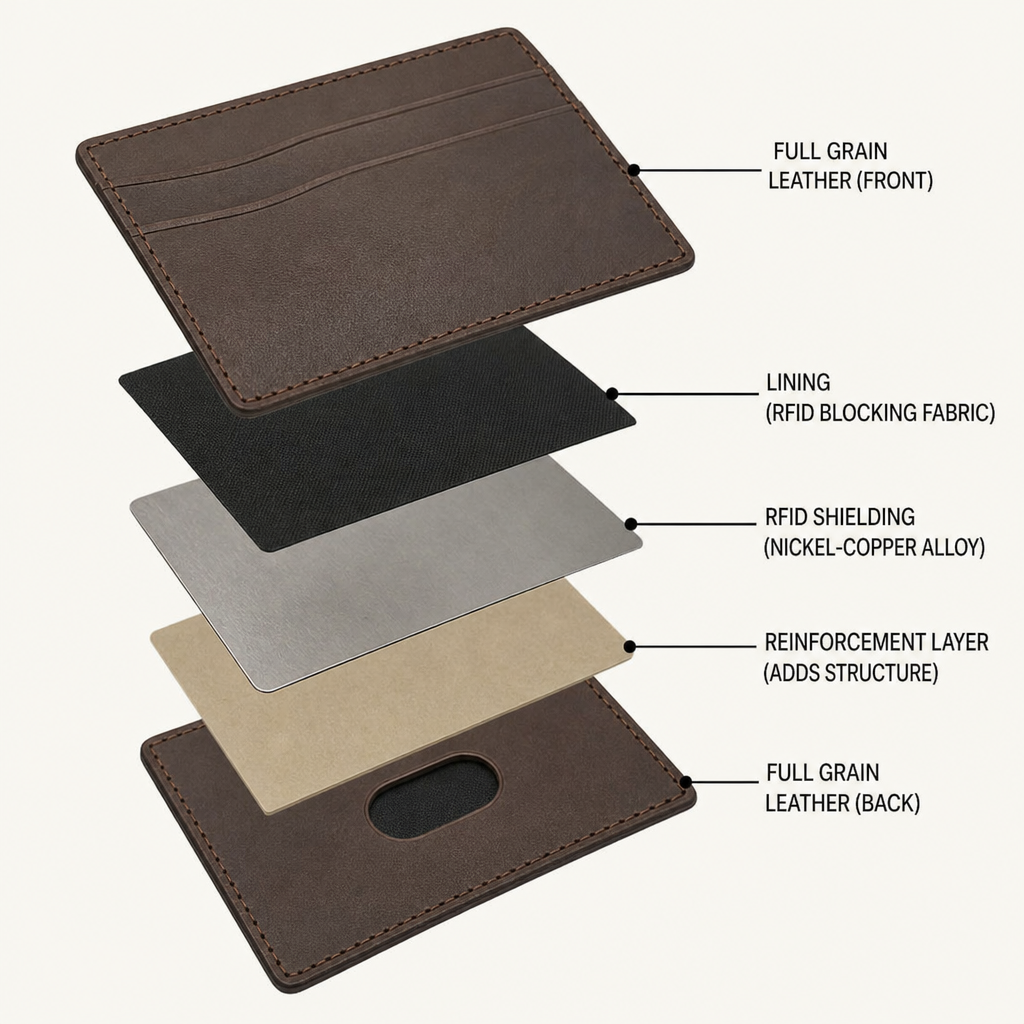
If the product carries an RFID claim, the shielding layer belongs in the stack from the first prototype, not added at the end. Recheck loaded thickness, folding behaviour and edge finishing once it is included.
Which Functional Sampling Decides Leather Card Holder Dimensions?
- Load real cards. Check each pocket and the fully loaded holder, never only an empty sample.
- Check access and retention. Agree a repeatable insertion, extraction and movement check.
- Repeat after use cycles. Compare initial fit with fit after agreed conditioning.
- Inspect stress points. Pocket corners, stitch terminations and mouth reinforcement.
Specify stitch position, spacing and appearance against an approved reference, and let the factory propose achievable tolerances demonstrated on production samples. Copying a generic millimetre limit into the order without agreeing measurement points and process capability creates disputes rather than quality. The full process view is in leather wallet manufacturing process and procurement.
How Should Leather Card Holder Branding Be Approved on Real Material?
A recessed logo, a foil layer and a folded edge each change the finished result differently, and none of them can be approved reliably from a digital mock-up. For debossing, specify a recessed impression and whether it is blind (no foil or ink). For hot foil stamping, approve contrast, coverage and adhesion. For laser marking, request trials on the chosen finish, because colour and appearance vary by material. Keep fine artwork and placement subject to physical approval — these are the same decisions covered in monogrammed card holders for B2B buyers.
Edge treatment deserves equal attention. Burnishing compacts a compatible exposed edge; painting adds a coating system; folding conceals the cut edge but needs additional construction allowance. None of the three is automatically the premium answer — evaluate bulk, corner appearance and movement on your design.
For a combined branding-and-RFID design, approve one complete sample that proves all three at once: the logo stays legible, the shielding backing does not show through, and the loaded pockets still perform as specified.
How Should RFID Blocking Be Tested in a Leather Card Holder?
RFID is not one frequency. GS1 distinguishes HF technology at 13.56 MHz from UHF systems operating in a different band, as described in the GS1 General Specifications. State which cards and which frequency your claim covers instead of ordering an unspecified “RFID-proof” liner.
Ask the supplier to identify the shielding material and to propose a finished-product test that names the reader, card, orientation, pocket position and pass/fail condition. Test the assembled holder after agreed flexing and handling — a fresh liner swatch proves very little. Do not publish a blocking percentage unless the evidence supports that exact number and that exact test scope. The test protocol and compliance evidence are covered in detail in RFID blocking wallets: OEM testing and compliance, and the material behaviour in how RFID blocking works.
How Do You Extend a Leather Card Holder Range Without Duplicating It?
Build coordinated accessories around shared visual choices, then validate each format on its own terms. A card holder prioritises compact access; a wallet adds cash storage and folding requirements. Related leather wallet designs can share colours, thread and branding while keeping different internal layouts — the host program is described in wholesale men’s wallets: OEM and private label.
For a distinctive card case, make the differentiation purposeful: a different access direction, a thumb opening, or a business-card presentation format. Ask testers to handle prototypes before selecting a more complicated mechanism.
A leather cell phone card ring holder needs its own development brief — attachment surface, loaded capacity, ring movement and device compatibility checks. Do not approve a phone-mounted accessory simply because its pocket resembles an already approved standalone holder. Business-card variants with a presentation face carry their own standards, covered in selecting business card holders for B2B use, and leather RFID formats in leather card holders with RFID blocking. If the item also holds contactless cards, the buyer precautions in why B2B buyers need RFID card holders apply.
How Do You Approve Leather Card Holder Standards and Packaging Together?
Keep a signed reference sample backed by written specifications and defect photographs — including internal construction, not only the attractive front face. Sampling guidance in the trade consistently points to the same checks before bulk approval: real-card fit, stitching, edges, branding, lining, hardware and packaging.
What Belongs on a Leather Card Holder Release Checklist?
Every line needs a named owner and an evidence file: material lot, edge-finish photos, stitch density, RFID attenuation report, and signed golden sample. Nothing releases on verbal confirmation.
- Material: article, colour range, thickness checkpoints, permitted substitutions.
- Function: capacity, access, retention, loaded closure criteria.
- Workmanship: unacceptable stitch defects, glue marks, edge damage, logo variation.
- Testing: methods, sample quantities, acceptance limits, corrective actions.
- Packing: box fit, protective materials, labels, insert copy, carton identification.
Ask whether minimum quantities apply per design, per colour, per material or per packaging version, and request separate confirmation of sampling, material procurement, production, inspection and shipping stages. For a holiday gifting launch, work backwards from the required arrival date and leave room for revisions rather than treating sample approval as a guaranteed schedule. These gates are detailed in the wallet quality control checklist, and market documentation in the wallet compliance checklist.
Approve packaging alongside the product. Artwork, labels, inserts and tooling are production inputs too; leaving them unresolved delays an order that is otherwise finished.
How Does a Sample Prove the Leather Card Holder Promise?
The strongest custom leather card holders connect material character with reliable daily use. Start from a focused brief, test the complete construction, and turn every approval into a measurable production requirement.
A distinctive logo attracts attention, but final approval should weigh card access, secure retention, clean edges and consistent assembly just as heavily. That is the difference between a sample that photographs well and a product that ships without surprises.
Leather Card Holder FAQ: Grades, Capacity, and Edge Wear — Which Questions Do Buyers Ask Most?
Is full-grain leather worth the premium on a card holder?
Only when the brand story is material-led. Full-grain keeps the original surface and ages visibly, which suits premium positioning but shows marks sooner and yields less-uniform panels; top-grain buys consistency and a lower unit cost when volume and repeatability matter more than character.
How many cards can a leather card holder hold before it stretches out?
Six to eight cards is the practical ceiling. Beyond that the stack pushes the panel outward, stitch lines take the load, and the opening loses tension within weeks. If the brief demands ten or more, specify a slot-and-gusset construction instead of stretching the same pattern.
Which edge finish survives daily pocket friction best?
Burnished and waxed edges outlast painted ones in a pocket. Edge paint looks sharper but cracks at the fold where the holder flexes; a skived, glued, then burnished edge absorbs repeated friction and can be re-waxed, which is why premium card holders still use it.
Can a supplier call a card holder vegetable-tanned without proof?
No, that claim needs substantiation. Under the FTC Leather Guides, tanning claims must be truthful and backed by the supplier declaration naming the tannery and the process; without a certificate or tannery statement, the safe wording is simply "full-grain leather" with no tanning claim.
From article to product
Sourcing minimalist-wallets?
Tell us the format, the quantity and the date you need stock. You get material options, MOQ and a landed-cost range back within one business day.
Keep reading
More on wallet manufacturing
Sustainable Packaging for Wallet Shipments
Packaging is where sustainability claims are cheapest to make and easiest to disprove. A…
ReadTake-Back and Recycling Programmes for Wallet Brands
A take-back programme is easy to announce and hard to run. Wallets are the…
ReadNickel Release Rules for Wallet Hardware
Nickel release is the one restriction in a wallet that is decided by the…
Read
About the author
TOPWALLET Editorial Team
TOPWALLET's editorial and engineering desk writes from bench testing at the Shenzhen (Longgang) facility: pull-force and cycle testing, 13.56 MHz shielding measurements, finish trials and factory audits, rather than supplier spec sheets. Every specification in these guides is one we write on a purchase order.
Written on the floor
This article was written by our production and QC team — the people who spec tolerances, run the finishing line and inspect every batch. Where it states a capacity, a pull force or a lead time, it comes from a measurement we made, not a supplier’s catalogue. If a number here disagrees with what your own supplier told you, tell us; several of these articles started as a correction from a buyer.
See how the factory works · Inspection process · Sourcing FAQ
Sourcing minimalist-wallets?
Tell us the format, the quantity and the date you need stock. You get material options, MOQ and a landed-cost range back within one business day.