

A leather wallet is made by cutting graded hides into precise panels, skiving overlapping areas to slim seams, assembling pockets through saddle-stitch or rivet construction, applying edge paint or burnishing, installing hardware and RFID liners, and passing units through multi-point quality inspection before packaging. Understanding each step — from leather grade selection and tanning chemistry to customization tooling and compliance testing — helps B2B buyers specify products accurately, negotiate better unit costs, and avoid defects during mass production.
How Is a Leather Wallet Made?
A leather wallet is cut, skived, stitched, edged, and finished, then assembled with hardware and lining.
A leather wallet is made by cutting tanned animal hide into precise shapes, assembling the layers through stitching or riveting, attaching hardware such as snaps or RFID liners, and finishing the edges with paint or burnishing. The exact sequence depends on whether the wallet is a bifold, cardholder, money clip, or trifold, but every production run follows the same core stages: selecting the right leather grade, preparing patterns and dies, cutting blanks, forming and assembling pockets and slots, finishing surfaces and edges, and conducting quality checks before packaging. Buyers who understand each step can negotiate more effectively with manufacturers and avoid surprises when placing custom orders.
Quick Answer — What Actually Happens in Production?
Production runs six stages: cutting, skiving, stitching, edge work, hardware fitting, and inspection.
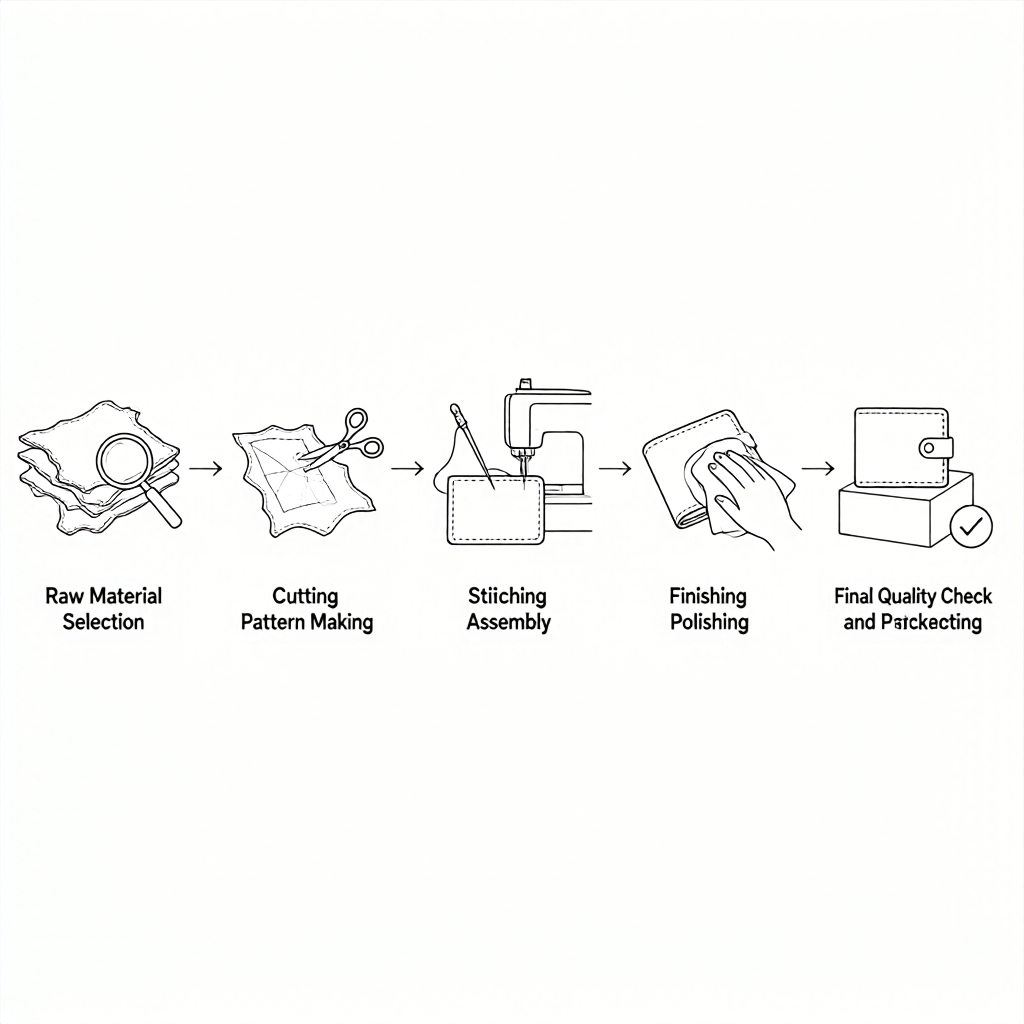
What is the basic sequence for how to make a leather wallet?
In short, it comes down to seven stages:
- Material intake and grading — Incoming hides are inspected for grain integrity, thickness consistency, and defects.
- Pattern drafting and die cutting — Technical drawings are converted into metal dies or CNC-cut tooling; blanks are stamped from the chosen leather.
- Skiving — Layered areas are thinned so that seams lie flat and the finished wallet remains slim.
- Stitching and riveting — Pocket linings, card slots, and Gussets are sewn or fastened depending on the design intent.
- Edge finishing — Cut edges receive paint, sealant, or mechanical burnishing to prevent fraying and create a clean perimeter.
- Hardware installation — Snaps, zippers, money clips, RFID liners, or gusset reinforcements are pressed or glued into place.
- Inspection and packaging — Each unit is examined against tolerance standards, cleaned, and prepared for shipment.
This flow applies whether you are sourcing handcrafted leather wallets for a boutique label or moving volume through a private label supply chain. The differences appear in equipment choices, cycle times, and the degree of automation used at each station.
How Does the Leather Wallet Process Unfold Step by Step?
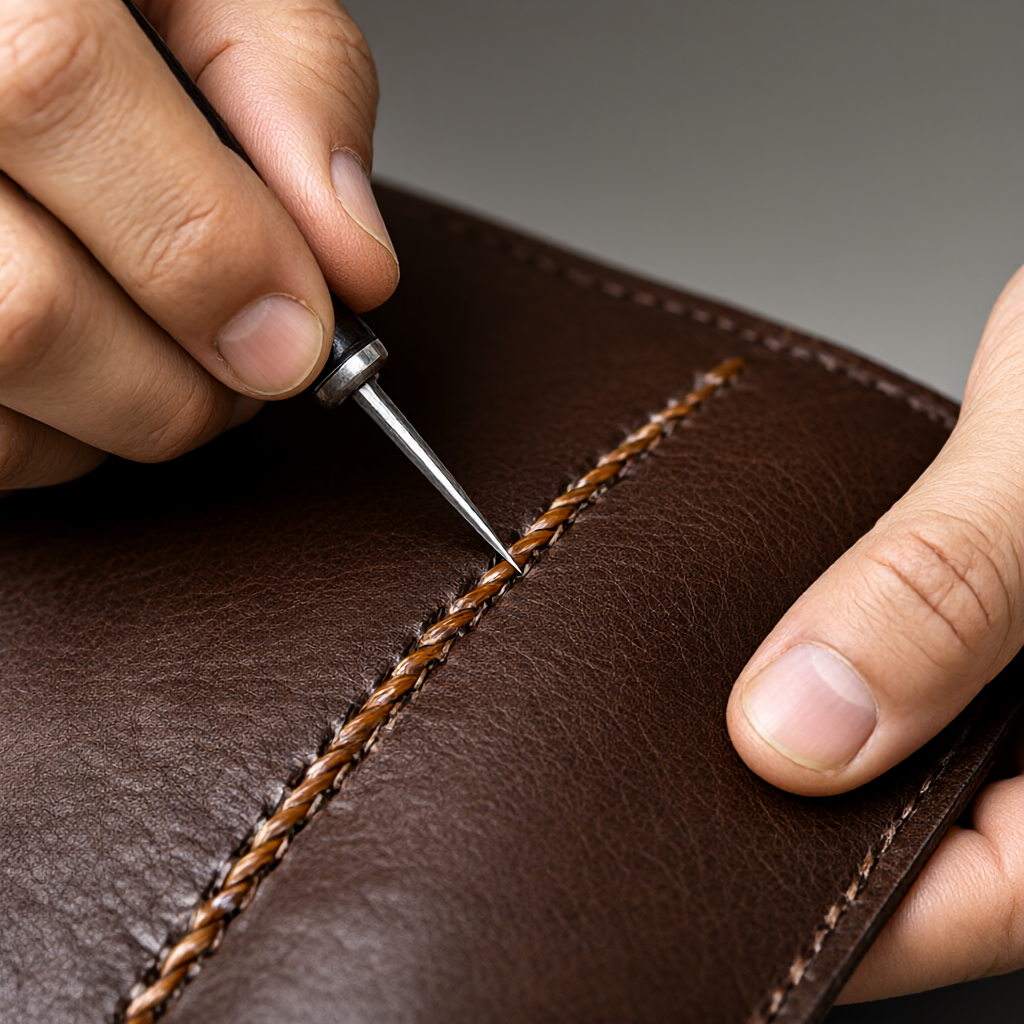
What types of leather are used in wallet manufacturing?
The choice of leather grade drives both cost and durability. Full-grain leather retains the natural grain surface and offers the highest tensile strength; it develops a patina over time and is preferred for premium bifold and pocket organizer designs. Top-grain leather is sanded to remove imperfections, producing a more uniform appearance at lower cost while still offering solid longevity. Bonded leather, made from shredded leather fibers compressed with adhesives, sits at the entry level for price-sensitive programs but lacks the same scratch resistance or lifespan.
Tanning method matters equally. Vegetable-tanned leather is stiff enough to hold crease lines and works well for traditional bifold styles, while chrome-tanned leather is softer and more water-resistant, which suits everyday carry wallets exposed to moisture. Both approaches have trade-offs, and reputable suppliers will disclose which method was used because it affects downstream染整 and compliance status.
How are patterns drafted and blanks cut?
Wallet geometry begins as a technical specification sheet that defines outer dimensions, slot counts, fold lines, and clearance tolerances. From that data, manufacturers create either manual paper patterns or digital CAD files. When orders exceed several hundred units, those patterns are translated into hardened steel dies for high-speed stamping, or into CNC routing programs for prototyping and smaller batches.
Die cutting produces consistent blanks much faster than laser or knife routing, but it requires upfront investment in tooling. Many factories use hybrid workflows: steel dies for body panels, combined with precision blade routers for intricate gusset pockets or multi-compartment layouts. The result is predictable cycle time and repeatable part geometry across the production run.
What happens during assembly and stitching?
Assembly is where component parts become a functional wallet. Card slots, cash pockets, ID windows, and coin compartments are layered according to the bill of materials, then joined through one of two primary methods:
- Stitched construction uses nylon or polyester thread in saddle-stitch or lock-stitch configurations. Saddle stitching creates interlocking knots on both sides of the leather, yielding superior seam durability for items subjected to frequent flexing. Lock stitching mimics sewing machine behavior on the surface while maintaining reasonable pull-out resistance.
- Riveted construction employs copper or brass pins set through pre-drilled holes and peened on the reverse side. Rivets provide exceptional shear strength and are common in tactical or heavy-use designs where reinforced stress points matter.
Many modern wallets blend both techniques, using rivets at pocket corners and stitching along main seams to balance aesthetics with structural integrity.
How are edges finished?
Edge treatment determines both feel and longevity. There are three principal approaches:
- Edge paint involves applying multiple thin coats of dye or polyurethane-based finish, followed by sanding between layers and sealing at the end. This method produces the smoothest visual result and is standard on most mid-tier and premium wallets.
- Burnished edges rely on friction and natural leather oils. Skived edges are dampened, then heated and polished with a wooden or glass slicker until they form a hard, glossy border. This technique works best on full-grain and veg-tanned leathers that release natural fats under heat.
- Raw or rolled edges leave the cut perimeter untreated, often found on minimalist cardholders and money clip wallets where thinness is prioritized over a finished look.
Buyers should specify edge treatment during sourcing discussions because it influences both unit cost and perceived product quality. Edge paint adds labor steps; burnishing requires suitable leather chemistry; raw edges save time but expose the core to delamination risk if the leather is poorly skived.
How is hardware integrated into leather wallets?
Modern wallets frequently incorporate functional add-ons beyond the basic stitching and folding architecture. Common integrations include:
- Magnetic snap closures secured with metal cups set into pre-molded leather wells
- Zippers inserted into gusseted cash compartments using coil or wire-zip tapes laminated to fabric backing
- Money clip attachments pressed onto the exterior panel, often backed by a rubberized liner to prevent slippage
- RFID-blocking liners placed between inner leather layers; these typically consist of metallized fabric or thin ferromagnetic sheets that attenuate 13.56 MHz passive NFC fields without interfering with conventional contactless card functionality
For additional background on shielding technology, see What Is RFID Blocking? How It Protects Contactless Cards. Hardware placement also raises concerns about sharp metal edges abraded against card surfaces, so responsible designers round clip edges and line interior contact zones with soft felt or silicone patches.
Key Specifications — What Determines Suitability for Your Order?
Hide grade, thickness, card capacity, closed size, and lining determine whether a spec fits your order.
When evaluating manufacturing proposals, focus on the parameters that affect performance, lead time, and landed cost:
| Parameter | Typical Range | Impact |
|---|---|---|
| Leather thickness | 0.8 – 1.4 mm | Dictates stiffness, pocket depth, and fold memory |
| Stitch density | 6 – 10 stitches per inch | Higher density improves seam strength but increases labor cost |
| Tolerance on overall dimensions | ±1.5 – 3.0 mm | Varies by construction method and buyer specifications |
| Minimum order quantity | 300 – 500 pcs (company dependent) | Determines whether steel die tooling is amortized cost-effectively |
| Sample turnaround | 5 – 15 working days | Shorter cycles usually require existing blank stock or simpler geometries |
| Production lead time | 15 – 35 working days after sample approval | Influenced by leather lead time, stitch complexity, and order size |
These ranges represent typical industry practice. Actual values depend on factory equipment, leather availability, and the complexity of the design file you submit. Requesting quoted specifications based on your own tech pack prevents mismatched expectations later.
Standards & Requirements — Which Rules Apply to Exported Leather Goods?
Leather accessories entering major markets are subject to chemical, safety, and labeling regulations. The most relevant frameworks include:
- REACH compliance (EU) restricts certain azo dyes, pentachlorophenol, hexavalent chromium levels above defined thresholds, and a growing list of restricted substances in processed hides. Suppliers should be able to present test reports for heavy metals and banned azo colorants.
- RoHS alignment (EU) primarily targets electrical and electronic products, but some buyers extend its spirit to wallets containing electronic components such as embedded trackers or active anti-loss modules.
- ASTM standards for material testing provide reference methods for assessing tensile strength, tear resistance, and colorfastness of leather substrates. According to ASTM International, standardized test protocols help manufacturers benchmark performance and verify that incoming hide lots meet contractual requirements.
- ISO quality management systems such as ISO 9001 certification indicate that a facility operates documented procedures for incoming inspection, in-process control, and finished-goods release. The presence of an auditor-verified system does not guarantee perfect output, but it reduces variability compared with informal operations.
Beyond regulatory compliance, many brand owners impose private standards: maximum allowable dimensional variation, specific thread colors, approved hardware finishes, and mandatory stress tests for snap retention or zipper pulling force. These are negotiated during vendor qualification rather than derived from public law.
Related Considerations — What Should You Evaluate Beyond the Process?
Lead time, MOQ, tooling cost, and export documentation decide whether a process suits your program.
Which Customization Options Are Available?
Embossing, laser marking, dyeing, and hardware swaps are the four levers most factories offer.
Most contract producers support meaningful differentiation beyond changing leather color. Common customization avenues include:
- Embossing and debossing — Raised or recessed logos applied with heated metal dies; effective on firm-grain full-grain and top-grain leathers, less reliable on heavily corrected or bonded substrates.
- Laser engraving — Provides fine-line artwork reproduction without physical tooling; particularly suited for serial numbering, QR codes, or intricate graphic overlays on darker leather shades.
- Dyeing and patina effects — Surface pigments can be adjusted to match brand colors within a limited saturation band; deep dyes penetrate further, while surface stains offer quicker iteration.
- Hardware variants — Brass, stainless steel, titanium, and coated alloys each impart different wear characteristics and aesthetic tones; some buyers choose matte black finishes for tactical positioning or polished mirrors for dress-oriented lines.
- Packaging and branding — Retail boxes, dust bags, hang tags, and instruction inserts are routinely sourced by wholesale buyers targeting retail channels. Packaging specifications often account for drop-test performance and shelf visibility rather than mere visual identity.
Each customization route carries its own setup fee and unit-cost impact. Embossing dies require capital expenditure, whereas laser engraving incurs negligible tooling cost but longer mark time per unit. Buyers with mixed SKU strategies benefit from understanding these economics early.
What Lead Times and MOQs Apply?
Stock leather runs start near 200 pieces with 25–35 day lead times; custom dies push MOQ to 500.
Lead time consists of sample development, raw-material procurement, tooling manufacture, production run, and logistics staging. For a straightforward bifold wallet using stock leather, sample approval typically arrives within one week, with mass production completing in roughly two to three weeks thereafter. More complex configurations — multi-compartment designs requiring custom rivet placements or specialty RFID liners — extend timelines accordingly.
Minimum order quantities reflect the point at which fixed costs become economical. Very small runs may be handled through manual bench work at higher per-unit expense, while volumes exceeding a few thousand pieces justify dedicated fixture setup and batch processing. Some manufacturers accommodate low-start orders by maintaining a library of standard blanks that can be branded quickly without new die fabrication.
Which Compliance Tests Apply to Exported Leather?
REACH and RoHS chemical limits plus chrome content rules apply at the destination border.
Finished goods destined for regulated jurisdictions normally undergo pre-shipment sampling. Common assays include:
- Hexavalent chromium screening to confirm chrome t余量 stays within permissible limits
- AZO dye testing for cleavable aromatic amines that could be released during wear
- Nickel and lead release assessments for metallic components touching skin
- pH and colorfastness checks to evaluate whether the leather will stain clothing under normal conditions
Manufacturers holding recognized audit credentials such as BSCI or those operating under ISO-certified quality systems generally maintain traceable documentation for these examinations. Third-party laboratory reports dated within the current calendar year provide the strongest evidence during buyer evaluations.
What Drives Bulk Order Pricing?
Hide grade, labor minutes, tooling, and packaging set the quote; freight is quoted separately.
Several variables explain why quotation ranges differ substantially even among comparable products:
- Leather grade and origin — Full-grain American or European hides command higher base prices than split leathers or imported corrected grains.
- Construction complexity — Additional pockets, reinforced gussets, or mixed-material panels increase processing steps.
- Hardware specification — Stainless steel or anodized aluminum components cost more than plated zinc alloy equivalents.
- Order volume — Larger runs spread setup expenses across more units; small bespoke programs absorb tooling and calibration overhead proportionally.
- Labeling and packaging requirements — Custom retail-ready boxing elevates unit cost relative to bulk-packed shipments intended for redistribution.
Pricing structures vary: some suppliers quote FOB per dozen with separate line items for tooling and shipping; others bundle duties, freight, and insurance into destination quotations. Clarifying the Incoterm basis during initial inquiry avoids misinterpretation when comparing offers.
How Does a Certified Manufacturer Make a Leather Wallet?
A certified plant documents hide origin, tracks each batch, and tests chemical limits before shipping.
Procurement decisions for leather wallets improve when buyers understand not just what makes a quality product, but how systematic manufacturing reduces variability across large orders. Our approach to this topic emphasizes material traceability, controlled process parameters, and documented quality checkpoints throughout production.
As a manufacturer focused on pocket gear and minimalist wallets, we align our workflow with internationally recognized standards such as ISO 9001 quality management practices and BSCI facility audits, while ensuring that incoming leathers meet REACH-relevant substance restrictions before they enter the cutting line. We maintain in-house capabilities for pattern development, die punching, skiving, stitching, edge painting, hardware setting, and final inspection, which allows us to manage lead times without subcontractor dependencies. Stock blanks enable shorter sample cycles, whereas fully custom architectures benefit from structured tech-pack review prior to committing to tooling.
If you are evaluating suppliers for private-label leather wallets, corporate gifting programs, or retail-chain sourcing, compare their responses against the specifications and compliance checkpoints outlined above. A responsive partner will ask about your target price band, expected annual volume, and market-regulatory constraints before proposing a solution.
How Do You Make a Leather Wallet for Bulk Orders?
Bulk orders freeze a spec sheet, approve a physical sample, then repeat that exact build per batch.
Manufacturing a leather wallet involves selecting the appropriate hide grade, converting digital designs into physical tooling, cutting blanks by die or CNC, stitching or riveting pocket assemblies, finishing edges through paint or friction polish, integrating functional hardware, and conducting pre-shipment inspection against tolerance and chemical limits. Buyers who approach the process with clear specifications — including leather thickness targets, stitch density ranges, and acceptable defect rates — consistently achieve higher yield percentages and fewer post-production disputes. The framework below explains the full procurement pathway, from raw-material selection to bulk-cost estimation, with decision checkpoints at every stage.
Which Leather Grades and Tanning Methods Should You Choose?
Full-grain with chrome tan suits most premium orders; bonded leather belongs only in low-cost lines.
How Do You Choose the Right Leather Grade?
Full-grain for premium programs, split for mid-tier, bonded only for low-cost promotional work.
Wallet durability begins with the hide selected for blank stock. Full-grain leather retains the complete natural grain layer and typically delivers tensile strength in the range of 15–25 MPa depending on species origin; it is the preferred substrate for premium bifold and pocket organizer programs because it develops a rich patina while resisting puncture under repeated flex cycles. Top-grain leather has been lightly sanded to remove surface scars, yielding a more uniform appearance at lower material cost while still providing serviceable longevity for mid-tier product lines. Bonded leather, composed of shredded fiber remnants compressed with polyurethane binders, meets entry-level price points but offers reduced abrasion resistance and shorter operational life, making it suitable only for disposable or promotional SKUs.
Leather thickness specifications for wallet applications generally fall between 0.8 mm and 1.4 mm. Panels thicker than 1.4 mm tend to create bulky fold lines and excess volume in slotted configurations, while material thinner than 0.8 mm may lack sufficient tear resistance at pocket corners subjected to repeated card extraction forces. Standard caliper tolerance across a production lot should not exceed ±0.15 mm to maintain consistent slot depth and fold behavior.
How Does Tanning Affect Performance?
Chrome tan resists moisture and molds fast; vegetable tan patinas but needs more care.
Vegetable tanning uses natural tannins extracted from tree bark and other botanical sources over periods ranging from several weeks to months. The resulting leather is firmer, holds embossed markings crisply, and absorbs edge paint uniformly, making it ideal for traditional bifold constructions and heritage-style branding. Chrome tanning produces softer, more pliable hides with inherent water resistance, which benefits everyday carry designs exposed to humid environments or incidental moisture contact. Both tanning routes must comply with REACH regulatory limits on substances such as pentachlorophenol and certain azo dye residues; manufacturers supplying EU-bound merchandise should provide Certificates of Conformity confirming heavy metal migration levels remain below restricted thresholds.
Sustainability considerations increasingly influence sourcing decisions. Leather Working Group (LWG) certified tanneries operate under audited environmental protocols covering wastewater treatment, energy consumption, and chemical management. Buyers targeting eco-conscious retail channels often require LWG Gold or Silver rated hides as a precondition for vendor qualification, though program premiums typically add 8–15% to per-unit material costs compared with non-certified equivalents.
Which Sustainability Documents Should You Require?
LWG certification plus hide traceability records cover most buyer and retailer audits.
Modern procurement frameworks expect suppliers to present chain-of-custody records linking finished wallets back to tannage origin and slaughter region. This documentation supports brand storytelling around responsible sourcing and satisfies due-diligence obligations under emerging regulations concerning supply-chain transparency. Requesting tannery audit summaries and material safety data sheets during the RFQ phase reduces the risk of last-minute compliance surprises before container loading.
Which Inspections and Pass Criteria Apply to Leather Wallets?
Inspect incoming hide, in-process stitching, and pre-shipment flex and chemical results at AQL 0.65.
How Is Incoming Leather Inspected?
Check thickness, color match, and defect density against an approved swatch before cutting.
Quality assurance begins at raw-material intake. Reputable manufacturers sample incoming hide lots using statistical plans based on ISO 9001:2015 clause 8.4 guidelines for controlling externally provided processes. Inspectors verify thickness uniformity with digital micrometers, assess grain consistency visually and through tactile evaluation, and flag panels containing scar tissue, insect bites, or chemical staining that would compromise appearance or structural integrity. Lots failing to meet acceptance criteria are quarantined and returned to the supplier rather than entering the cutting station, preventing defect propagation downstream.
Which In-Process Checks Apply?
Cut accuracy, stitch density, and edge alignment are checked at three stations during assembly.
During fabrication, operators perform periodic verification measurements against the approved tech pack. Common in-process checks include stitch pitch verification using gauge templates, rivet peen height confirmation, slot width measurement with calipers, and visual examination of edge finish continuity. First-article inspection reports document baseline measurements before full production commences; subsequent sample pulls taken every two hours capture drift trends caused by needle wear, thread tension variation, or adhesive curing shifts.
Which Pre-Shipment Tests Apply?
Test flex cycles, seam strength, and chemical limits before cartons ship.
Before containers are sealed, finished wallets undergo battery-testing protocols designed to simulate real-world usage conditions:
| Test Category | Typical Parameters | Acceptance Threshold |
|---|---|---|
| Tensile strength (leather pull-test) | 15–25 MPa per ASTM D412 reference methods | Minimum 15 MPa for full-grain; 10 MPa for top-grain |
| Tear resistance | Elmendorf tear method per ASTM D679 | ≥ 12 N for premium grades; ≥ 8 N for commercial grades |
| Stitch pull-out force | Dynamic cyclic flex test, 500 cycles | No thread breakage; seam separation < 2 mm |
| Edge paint adhesion | Cross-hatch tape pull test per ASTM D3359 | Minimum rating 4B (minor flaking allowed) |
| Snap retention force | Pull-test on magnetic snap closures | Force ≥ 15 N to detach without deformation |
| RFID attenuation | Shielding efficacy at 13.56 MHz | ≥ 20 dB signal reduction confirmed by lab report |
| Hexavalent chromium | EN 13393 colorimetric spot test | Below 3 mg/kg detectable limit |
| Azo dye screening | EN ISO 14365-1 testing protocol | Zero detected cleavable aromatic amines above 30 mg/kg |
| Nickel release | Long-term skin-contact simulation per EU Directive 94/27/EC | Below 0.5 µg/cm²/week released nickel ion transfer |
| pH level of leather extract | Aqueous extraction per ISO 17070 | Range 3.2–5.2 for chrome-tanned; 4.5–7.0 for veg-tanned |
According to ASTM International, standardized test methods provide repeatable benchmarks for evaluating material performance across competing suppliers, while reference to ISO quality management systems clarifies that documented QC procedures reduce variance but do not replace physical verification at each生产阶段.
How Are Defects Classified?
Critical, major, and minor defects map to AQL 0, 2.5, and 4.0 acceptance levels.
Manufacturers classify imperfections into critical, major, and minor categories. Critical defects — such as hole punctures through load-bearing stitch lines, broken rivets, or failed RFID shielding — trigger immediate rejection of the entire batch segment. Major defects affect functionality or consumer perception, including misaligned pocket slots, visible glue stains, uneven edge paint coverage exceeding 10% of perimeter length, or dimensional deviation beyond ±2.5 mm. Minor cosmetic variations like slight shade difference within the same lot may be accepted if they fall within the agreed Visual Acceptance Limit samples signed off during sampling.
Industry-standard Acceptable Quality Level (AQL) thresholds for leather wallet shipments commonly use AQL 0.65 for major defects and AQL 1.0 for critical defects, inspected according to ISO 2859-1 sampling plans. Third-party inspection agencies replicate these procedures to deliver unbiased pre-shipment verification reports accepted by major retailers and Amazon FBA fulfillment centers. For additional context on internal wallet architecture and protective layering, see the guide on How Minimalist EDC Wallets Are Manufactured: A Procurement.
Which Customization Options Can a Manufacturer Offer?
Embossing, laser marking, dyeing, and hardware swaps are the four practical customization levers.
How Do Embossing and Debossing Differ?
Embossing raises the mark, debossing cuts it in; debossing holds up better on thick leather.
Embossing creates raised logo or text impressions through heated steel dies pressed into leather at pressures ranging from 8 to 15 tons depending on die depth and hide density. Debossing produces recessed marks by stamping the same die from the opposite direction. Both techniques require precision-engineered aluminum or steel matrices machined to the buyer’s artwork vectors; typical die fabrication costs range from $150 to $400 depending on complexity and number of impression stations. Embossing performs best on firm-grain full-grain and vegetable-tanned leathers where fiber resilience holds the raised profile after die release. Corrected-grain and bonded substrates compress too readily, producing shallow impressions that lack definition and may crack along stamped borders under repeated flex exposure.
What Can Laser Marking Do on Leather?
Laser burns a permanent mark on leather and hardware without requiring a die.
Fiber laser systems mark leather surfaces by vaporizing a thin layer of material along programmed vector paths, producing permanent etched graphics without mechanical contact pressure. Laser engraving excels at reproducing intricate patterns, serial numbers, QR codes, and fine-line illustrations that would be impractical to achieve through traditional die stamping. Mark depth typically ranges from 0.05 mm to 0.20 mm, controlled through laser power settings and pass count. On dark-colored leathers, engraved areas appear as lighter contrast tones; on light leathers, the process darkens marked zones through carbonization. Setup costs are negligible compared with embossing dies, making laser customization economical for short runs and version-controlled SKU variants. However, laser-marked edges may require resealing with edge paint to prevent fraying along cut-perimeter engravings.
How Do Dye and Patina Effects Work?
Surface dye sits on top and fades; drum dye penetrates and holds deeper color.
Leather coloring falls into two categories: penetrating dyes that absorb into hide fibers versus surface pigments that sit atop the grain layer. Dye baths adjust base hue across a limited saturation band determined by the starting leather condition; deep dye penetration yields richer tone development but requires longer processing time and thorough rinsing to prevent bleeding during subsequent finishing steps. Pigment coatings provide opaque color coverage capable of shifting leather appearance more dramatically, but thick pigment layers can reduce breathability and create cracking risks along high-flex zones such as fold creases and corner stress points.
For brand-matched color programs, manufacturers rely on Pantone Solid Coated references converted into wet-mix formulations matched under standardized D65 viewing-box lighting conditions. Color consistency across production lots depends heavily on batch-to-batch leather absorbency variation, so pre-approval strike-off samples representing actual run conditions are essential before bulk commitment.
Which Hardware Options Can Be Integrated?
Snap closures, magnetic clasps, and RFID plates each change assembly and tooling needs.
Functional components extend wallet capability beyond basic storage. Magnetic snap enclosures use neodymium magnets seated in brass or stainless-steel cups epoxied into leather-reinforced wells. Zipper gussets employ coil-zip tapes laminated to woven fabric backing, sewn into compartment openings with reinforced bar-tack stitching at stress concentrations. Money clip attachments feature spring-loaded metal clamps secured through layered leather sandwiches, sometimes backed by silicone anti-slip pads. Embedded RFID-blocking liners consist of metallized nylon fabric or ferromagnetic alloy sheets attenuating passive NFC fields around 13.56 MHz without disrupting conventional card chip operations. For background on shielding technology and placement strategies, review RFID Wallet Meaning: Definition, Technology & Buyer’s Guide.
Each customization route carries distinct setup economics. Embossing demands one-time tooling investment amortized across order volume; laser engraving eliminates tooling cost but extends cycle time per unit marked. Buyers managing mixed-SKU portfolios should evaluate these trade-offs during the procurement planning stage rather than after contract signing. Related guidance on Wallet Size Standards & Specs for B2B Buyers can inform dimension decisions when pairing hardware additions with panel geometry constraints.
Which Material Costs Apply?
Hide area, lining, thread, and hardware make up most of the material cost.
Hide procurement represents the largest single variable in wallet unit economics. Full-grain steerhide commands higher per-square-foot prices than split leather or bonded alternatives, but delivers correspondingly superior durability margins that justify premium positioning at retail. Tanning method influences cost further: chrome-tanned hides generally price 10–20% below vegetable-tanned equivalents due to shorter processing cycles and higher throughput at tannery scale. Regional leather availability also affects landed cost — hides sourced from South American cattle operations often arrive at competitive freight rates to Asian manufacturing hubs, whereas European-origin hides command transport premiums but carry recognized provenance value in Western retail markets.
Secondary material expenses include thread (nylon 6,6 or polyester core-spun varieties), adhesive compounds for rivet backing and liner bonding, edge paint volumes calculated by perimeter length, and hardware pieces priced individually per unit configuration. Packaging components — retail boxes, tissue wraps, hang tags, and desiccant pouches — add incremental cost typically ranging from $0.15 to $0.60 per finished unit depending on box construction complexity and print finish selections.
How Is Labor Cost Allocated?
Stitch minutes and edge finishing dominate labor; overhead spreads across each batch.
Stitching represents the most labor-intensive operation in wallet assembly, especially for hand-stitched saddle-stitch constructions requiring skilled artisans operating at bench stations. Automated sewing cells reduce cycle time for lock-stitch configurations but introduce higher initial capital expenditure that factories recoup through volume commitment agreements. Edge finishing labor varies proportionally with treatment selected: edge painting requires multiple coat-application and drying cycles completing over 4–8 hours of active work per batch, while burnished edges demand operator skill calibration but no curing wait time. Riveting operations are generally faster mechanically but require pre-drilling accuracy to maintain alignment tolerances.
Overhead allocations cover facility energy consumption, quality-inspection staffing, equipment depreciation, and administrative functions supporting order tracking and logistics coordination. Factories serving export markets with ISO-certified quality systems carry slightly elevated overhead structures reflecting documentation rigor and audit preparation activities, yet these investments correlate with lower defect escape rates and smoother retailer onboarding processes.
Why Do Prices Step at Volume Breaks?
Cutting, tooling, and setup costs spread across larger runs, so unit price drops in steps.
Pricing models for leather wallet production typically follow tiered quantity brackets reflecting amortized fixed costs:
| Order Volume Bracket | Approximate Unit Discount | Tooling Amortization Impact |
|---|---|---|
| 300 – 499 pcs | Baseline pricing | Die/tooling costs added separately or rolled into first-unit price |
| 500 – 999 pcs | 8–12% reduction vs. baseline | Fixed costs spread across larger quantity base |
| 1,000 – 2,499 pcs | 12–18% reduction vs. baseline | Economies of scale become visible in labor routing efficiency |
| 2,500 – 4,999 pcs | 18–25% reduction vs. baseline | Dedicated fixture setup justified; slower changeover times between SKUs |
| 5,000+ pcs | 25%+ reduction vs. baseline | Factory capacity reservation possible; priority scheduling on production line |
Minimum order quantities exist primarily to ensure tooling investment recovery and production-line setup efficiency. Runs below MOQ thresholds often incur supplementary setup fees compensating for partial machine utilization during shorter batches. Some manufacturers maintain standard blank inventories enabling branded runs at reduced MOQ floors by eliminating die-fabrication lead time, though design flexibility remains constrained to pre-existing pocket architectures.
Which Hidden Costs Should Buyers Expect?
Tooling, plating, testing, packaging, and freight add cost beyond the quoted unit price.
Several expense categories frequently omitted from preliminary quotes surface during production execution. Sample-development charges cover pattern drafting, prototype material procurement, and artisan assembly time before bulk commitment; these typically range from $50 to $200 per design iteration depending on complexity. Rush-order surcharges apply when production timelines compress below standard lead windows, reflecting overtime labor premiums and expedited material procurement costs averaging 15–30% above normal rate cards. Shipping insurance, customs brokerage documentation, and destination-port handling fees represent separate line items outside factory FOB pricing and should be factored into total landed-cost calculations before purchase-order approval.
Which Checklist and Red Flags Apply?
Verify certifications, sample match, capacity, and payment terms; refuse suppliers who skip samples.
Structured evaluation prevents costly sourcing mistakes. Before awarding contracts, verify the following:
Required documentation:
- Tech pack with dimension callouts, material specification sheets, and Bill of Materials
- Signed Visual Acceptance Limit sample representing baseline quality expectations
- ISO 9001 certification documents and recent BSCI audit summary if applicable
- REACH compliance declaration and third-party lab test reports dated within current calendar year
- Product-specific test results covering tensile strength, stitch pull-out, edge paint adhesion, and chemical restrictions
Red-flag warning signs:
- Suppliers refusing to share test documentation or claiming proprietary confidentiality as justification
- Quoted prices significantly below market average suggesting compromised material grades or skipped inspection stages
- Absence of first-article inspection procedures indicating inadequate in-process quality controls
- Pressure to accept unverified color strike-offs without physical sample comparison under standardized lighting
- Vague responses regarding AQL inspection thresholds or rejection-handling protocols
- Inability to explain defect classification categories or rework policies for non-conforming units
Reviewing these criteria systematically during vendor qualification helps identify reliable partners capable of delivering consistent quality at predictable unit costs. For buyers seeking deeper understanding of alternative pocket gear formats, the resource on What Is a Card Holder? Definition, Types & Materials Guide provides comparative material and construction insights applicable to wallet sourcing decisions.
How Do We Meet Leather Wallet Manufacturing Standards?
We document hide origin, test seams and flex per batch, and keep spec sheets for every SKU.
As a specialist manufacturer of minimalist EDC wallets and pocket gear with 13+ years of export experience, our approach aligns directly with the procurement framework outlined above. Established in 2014, our 50,000 sq ft facility operates ISO 9001 certification and BSCI-audited quality systems, maintaining documented procedures spanning incoming hide inspection, in-process checkpoint verification, and pre-shipment functional testing aligned with the test parameters described previously. We produce a monthly capacity of 500,000+ units across a product portfolio that includes minimalst aluminum wallets, carbon fiber card holders, titanium money clips, tactical pocket organizers, RFID-blocking metal wallets, and custom laser-engraved wallet accessories — all supporting OEM, ODM, private-label, and custom-design engagement models.
Our procurement workflow mirrors the standards detailed throughout this guide. Raw-material intake incorporates SGS-tested hide lots verified for thickness consistency and defect-free grading before cutting commences. During production, operators execute first-article inspections and hourly sample pulls documenting dimensional tolerance adherence and stitch-quality markers against approved reference panels. Pre-shipment QA applies AQL sampling plans calibrated to industry-standard thresholds for major and critical defect classification, generating inspection reports compatible with retailer and marketplace compliance requirements.
Customization execution spans the methods outlined — embossing and debossing via heated steel dies, laser engraving for fine-detail artwork reproduction, surface dye and pigment application matching Pantone references, and hardware integration encompassing magnetic snaps, zipper gussets, money clips, and RFID-blocking liners conforming to 13.56 MHz attenuation specifications. We support low-MOQ starting orders from 300 pcs per SKU for prototyping and small-batch launches, scaling efficiently to multi-thousand-piece runs benefiting from dedicated fixture setups and batch-processing optimization. Sample turnaround averages 7 working days for standard geometries, while bulk production lead times typically range 15–35 working days depending on leather availability, stitch complexity, and order magnitude.
With export experience reaching 30+ countries across America, Europe, Australia, and Southeast Asia, and relationships with 200+ brands worldwide, we combine mid-tier quality positioning with cost-competitive pricing suited for outdoor enthusiasts, EDC brand owners, Amazon FBA sellers, promotional product distributors, corporate gift buyers, and retail chain purchasers seeking design-driven pocket gear. Our in-house CNC machining, laser engraving and UV printing capabilities, aluminum anodizing and surface-finishing infrastructure, custom packaging and retail-box design services, and drop-shipping and Amazon-FBA prep operations enable end-to-end procurement coordination from concept through shelf delivery.
How Do You Start a Leather Wallet Order?
Start with a spec sheet and one prototype, then approve tooling before committing volume.
A leather wallet is made by grading and preparing animal hides, drafting patterns and cutting blanks, skiving overlapping layers to slim seams, assembling pockets through saddle-stitch or rivet construction, applying edge paint or burnishing, integrating hardware such as magnetic snaps and RFID-blocking liners, and passing each unit through multi-point quality inspection before packaging. Understanding each step — from leather chemistry and tanning sustainability to tooling amortization, stitch density standards, and REACH compliance thresholds — helps B2B buyers specify products accurately, benchmark supplier claims, and avoid defects during mass production.
How Do You Verify Leather Traceability?
Ask for tannery name, LWG status, and hide origin per shipment.
Ethical and environmental factors increasingly influence procurement decisions. Buyers should request information on:
- Chrome tanning residue limits — compliant leather must keep hexavalent chromium below regulatory thresholds defined by REACH Annex XVII entries 46 and 47.
- Vegetable-tanning certifications — options such as Leather Working Group (LWG) auditing provide assurance that water usage, chemical management, and energy efficiency meet defined benchmarks.
- Supply-chain traceability — reputable tanneries maintain records linking finished hides back to certified ranches or cooperatives, reducing exposure to deforestation-linked sourcing risks.
Including these requirements in your tech pack early prevents last-minute substitutions and protects brand reputation, particularly when selling into European and North American retail channels that emphasize transparency.
How Long Does Leather Wallet Production Take?
Allow 45–60 days: sampling, bulk run, and freight each take a share.
Understanding the full production calendar helps buyers plan inventory and avoid stock-outs. A representative timeline looks like this:
| Phase | Typical Duration | Notes |
|---|---|---|
| Tech-pack review and quotation | 1–3 working days | Depends on design complexity and file completeness |
| Sample development | 5–10 working days | Includes digital mock-ups, physical prototype, and revision rounds |
| Tooling fabrication (steel dies, embossing stamps) | 7–14 working days | Required only for high-volume orders exceeding standard blank capacities |
| Raw-material procurement | 3–7 working days | Stock leather ships quickly; specialty dyes or imported hides may extend lead time |
| Bulk production run | 15–30 working days | Scales with order volume and stitch complexity |
| Pre-shipment inspection and logistics staging | 3–5 working days | Includes AQL sampling, cleaning, poly-bagging, and carton labeling |
Total elapsed time for an initial order typically falls between four and eight weeks, depending on whether custom tooling is needed and how far the shipping port is from the factory. Expedited schedules are possible when working from existing blank inventories or when prioritizing simpler geometries over multi-compartment layouts.
How Does MOQ Affect Unit Cost?
Below MOQ, setup costs dominate; above it, material and labor set the price.
Minimum order quantities reflect the point at which fixed costs become economical. Very small runs may be handled through manual bench work at higher per-unit expense, while volumes exceeding a few thousand pieces justify dedicated fixture setup and batch processing. Common MOQ structures include:
- Standard blank wallets: 100 – 300 pieces per SKU, suitable for private-label programs that test market response before scaling.
- Custom tooling orders: 500 – 1,000 pieces, allowing steel-die amortization to produce a competitive per-unit cost.
- Hybrid approaches: Some factories combine off-the-shelf blanks with on-site branding operations, keeping effective MOQs low while still delivering personalized logos, laser marks, or embroidery.
When evaluating proposals, ask manufacturers whether their quoted MOQ includes tooling fees, packing materials, and artwork setup charges. Transparent breakdowns prevent budget surprises once sampling advances to bulk production.
Which Tests Run Before Shipment?
Flex, seam strength, colorfastness, and chemical screening run on every lot.
Reputable manufacturers apply statistical process control at multiple checkpoints, supported by independent laboratory verification when required by the destination market. Common tests include:
- Tensile and tear strength — measured according to ASTM D412 for rubber-like substrates and corresponding leather-equivalent protocols, confirming the material can withstand repeated flexing without seam failure.
- Colorfastness to rubbing and perspiration — evaluated using AATCC test methods to ensure pigments do not transfer onto clothing or card surfaces during normal use.
- Flex-cycle endurance — automated machines fold and unfold wallet panels through thousands of cycles, simulating years of pocket compression and checking for delamination or stitch breakage.
- Snap retention force — magnetic closures and metal snap inserts are tested to confirm they remain engaged under defined pulling forces.
- RFID attenuation performance — when shielding features are specified, meters verify that 13.56 MHz passive NFC fields are reduced below functional thresholds without blocking legitimate contactless payments. See also What Is RFID Blocking? How It Protects Contactless Cards.
- Chemical compliance screening — pre-shipment samples are routinely submitted for REACH and RoHS conformance reports, confirming restricted substances remain within permissible concentrations.
Many factories operate under ISO 9001 quality-management systems, meaning these inspections follow documented procedures rather than ad hoc judgment. Buyers can request test summaries and AQL sampling plans before releasing payment.
Which Edge Finishing Method Lasts?
Burnished edges age well; painted edges crack first at the corners.
Edge treatment determines both tactile feel and long-term durability. Three principal approaches are available:
- Painted edges involve applying multiple thin coats of dye or polyurethane-based finish, followed by sanding between layers and sealing at the end. This method produces the smoothest visual result and is standard on most mid-tier and premium wallets. Painted edges are more labor-intensive but offer consistent color matching across large batches.
- Burnished edges rely on friction and natural leather oils. Skived edges are dampened, then heated and polished with a wooden or glass slicker until they form a hard, glossy border. This technique works best on full-grain and veg-tanned leathers that release natural fats under heat, and it avoids the added material thickness of paint systems.
- Raw or rolled edges leave the cut perimeter untreated, often found on minimalist cardholders and money clip wallets where thinness is prioritized over a finished look. While fast and economical, raw edges expose the core to delamination risk if the leather is poorly skived or if the substrate lacks sufficient fiber cohesion.
Choosing an edge method affects unit cost, perceived quality, and compatibility with specific leather grades. Specify your preference during the quoting phase to ensure the manufacturer selects the appropriate workflow.
How Is an RFID Liner Integrated Into a Leather Wallet?
The liner sits between leather layers under the card pocket, then gets flex-tested at the fold.
RFID shielding can be incorporated into almost any leather wallet design without substantially increasing thickness. The most common implementations are:
- Metallized fabric inserts laminated between inner leather layers, providing broad-spectrum attenuation across UHF and HF frequencies.
- Ferromagnetic sheet liners that absorb and redirect electromagnetic fields, effective specifically against the 13.56 MHz passive NFC band used by modern payment cards and passports.
- Layered composite panels combining conductive threads with insulating背衬 fabrics, balancing flexibility with sustained signal reduction over repeated folding cycles.
Installation typically occurs during the assembly stage, positioned between the exterior leather shell and interior card-slot stack. The liner must be precisely sized to avoid creating bulk at fold lines or interfering with snap-magnet alignment.
For guidance on how shielding technology works and what frequency ranges matter, see RFID Wallet Meaning: Definition, Technology & Buyer’s Guide. When specifying RFID protection, request confirmation that the shielded zone covers all card-sized compartments and that the design remains compatible with wireless charging coils in smartphones.
Here is how the industry works in practice, and how we approach each stage at our facility. As a manufacturer with over a decade of experience producing minimalist EDC wallets and pocket gear, our process starts the moment a tech pack arrives. We evaluate leather grade, tanning method, and target MOQ together with our engineering team, then map out which combination of steel die cutting, CNC routing, or hand bench work will deliver the strongest margin at your volume. During sample development, we move quickly — typically delivering an approved physical prototype within seven days — because every week you wait is a week you cannot list or promote. From there, bulk production runs through staged QC checkpoints aligned with ISO 9001 procedures: incoming hide inspection against AATCC colorfastness and thickness tolerances, in-process tension and flex testing, and final AQL sampling before cartons are sealed. If your program calls for RFID shielding, laser engraving, custom hardware, or private-label packaging, we handle all of it in-house rather than outsourcing to sub-contractors, which keeps lead times predictable and communication direct. You can see our current capabilities and recent project examples at https://topedcwallet.com/, and if you want to discuss specs, volumes, or timing for your next order, reach out through our Contact Page.
Make Leather Wallet: Where Can You Verify the Data and Sources?
- ASTM International — www.astm.org
- ISO quality management systems — www.iso.org
- What Is RFID Blocking? How It Protects Contactless Cards — topedcwallet.com
- Get a Free Quote → — topedcwallet.com
- How Minimalist EDC Wallets Are Manufactured: A Procurement — topedcwallet.com
- RFID Wallet Meaning: Definition, Technology & Buyer’s Guide — topedcwallet.com
- Wallet Size Standards & Specs for B2B Buyers — topedcwallet.com
- What Is a Card Holder? Definition, Types & Materials Guide — topedcwallet.com
- https://topedcwallet.com/ — topedcwallet.com
Leather Wallet Making FAQ: Hide Yield, Laser, Color, Tanning — Which Questions Do Buyers Ask Most?
How many leather wallets can one hide produce?
A standard 1.4–1.6 square meter hide yields roughly 12–18 slim wallets after cutting loss, depending on layout efficiency.
Does laser engraving weaken leather over time?
Slightly, at the marked area only. Deep burns on thin leather can crack at the edge, so specify shallow marking on skived panels.
What causes color mismatch between leather wallet batches?
Hide-to-hide variation and dye bath drift. Approve a color swatch and require the same tannery lot per order to limit it.
Can a leather wallet be made without chemical tanning?
Vegetable tanning avoids chrome, but it costs more, needs more care, and typically limits colors to natural tones.
From article to product
Sourcing minimalist-wallets?
Tell us the format, the quantity and the date you need stock. You get material options, MOQ and a landed-cost range back within one business day.
Keep reading
More on wallet manufacturing
Sustainable Packaging for Wallet Shipments
Packaging is where sustainability claims are cheapest to make and easiest to disprove. A…
ReadTake-Back and Recycling Programmes for Wallet Brands
A take-back programme is easy to announce and hard to run. Wallets are the…
ReadNickel Release Rules for Wallet Hardware
Nickel release is the one restriction in a wallet that is decided by the…
Read
About the author
TOPWALLET Editorial Team
TOPWALLET's editorial and engineering desk writes from bench testing at the Shenzhen (Longgang) facility: pull-force and cycle testing, 13.56 MHz shielding measurements, finish trials and factory audits, rather than supplier spec sheets. Every specification in these guides is one we write on a purchase order.
Written on the floor
This article was written by our production and QC team — the people who spec tolerances, run the finishing line and inspect every batch. Where it states a capacity, a pull force or a lead time, it comes from a measurement we made, not a supplier’s catalogue. If a number here disagrees with what your own supplier told you, tell us; several of these articles started as a correction from a buyer.
See how the factory works · Inspection process · Sourcing FAQ
Sourcing minimalist-wallets?
Tell us the format, the quantity and the date you need stock. You get material options, MOQ and a landed-cost range back within one business day.