

A card holder is a slim, pocket-carry accessory engineered to securely hold credit cards, identification cards, business cards, and folded cash in a compact form factor far smaller than a conventional bifold wallet. It typically consists of a rigid or semi-rigid frame made from anodized aluminum (6061-T6), Grade 2/5 titanium, carbon fiber composite, stainless steel, or leather, employing one of several retention mechanisms — spring-loaded plate, sliding tray, elastomer band clamp, or magnetic closure — to keep cards aligned and accessible with a single-hand draw. Key B2B evaluation parameters include card capacity (typically 4–12 cards), overall thickness (under 15 mm for front-pocket comfort), weight (30–80 g), surface finish durability per ASTM and MIL standards, RFID-blocking integration, and customization depth for private-label branding.
What is a card holder?
A card holder is a slim, pocket-carry accessory designed to hold credit cards, IDs, business cards, or cash without the bulk of a traditional wallet. It typically consists of a frame or sleeve made from metal (aluminum, titanium, stainless steel), carbon fiber, leather, or polymer, using mechanisms such as spring-loaded plates, sliding trays, rubber bands, or adhesive strips. Key attributes include card capacity (typically 4–12 cards), material composition, RFID-blocking capability, thickness/profile, finish options, and customization potential for B2B branding.
Unlike a conventional bifold wallet that folds open to reveal multiple compartments, a card holder is purpose-built for front-pocket carry and rapid access. It functions as a wallet alternative, a slim wallet, or a pocket card organizer — depending on the mechanism and form factor chosen.
How does a card holder work compared to a regular wallet?
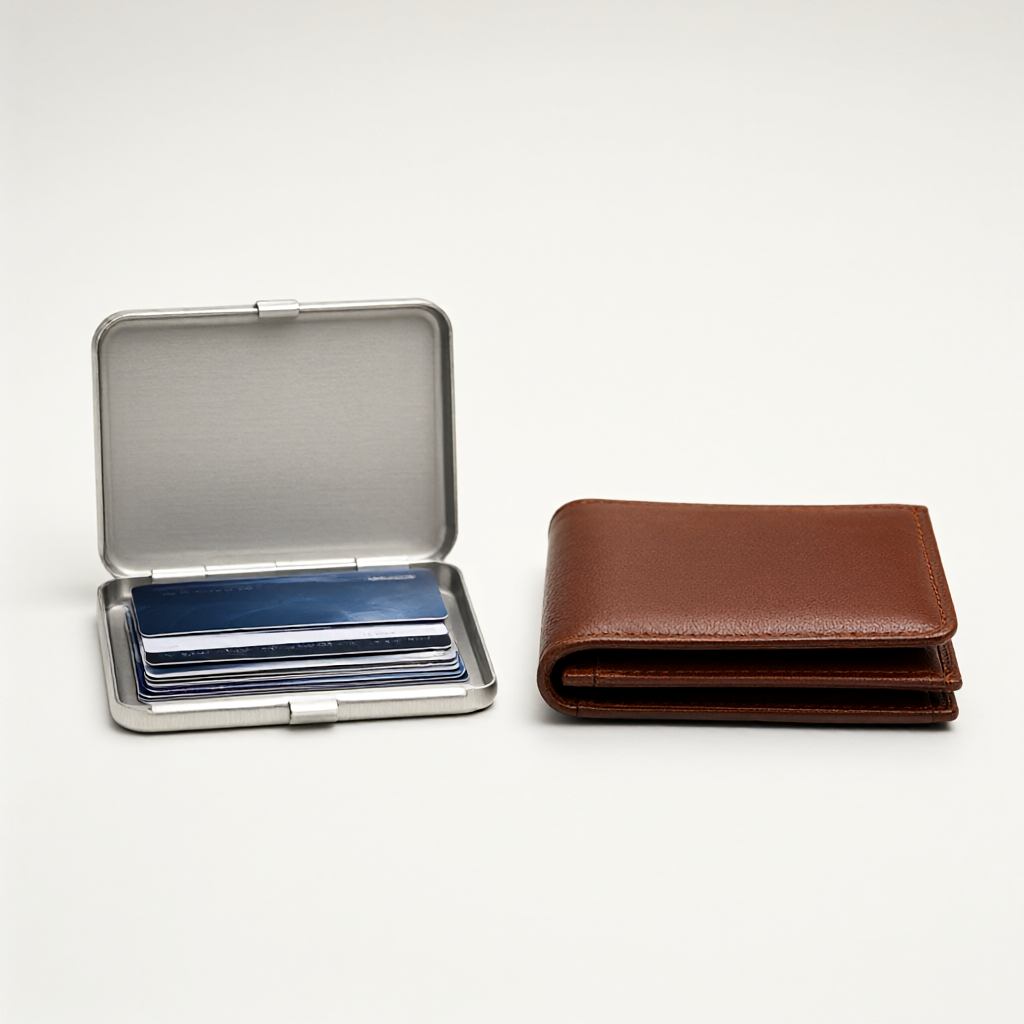
A regular wallet relies on folding leather or fabric panels with stitched pockets to organize bills and cards. A card holder replaces that system with a single-plane mechanical design. The most common approach uses a spring-loaded plate that applies consistent pressure against the back of your cards, keeping them aligned and accessible even when you pull out one card at a time. Other mechanisms include sliding trays that extend cards in sequence, elastomer bands that wrap and grip, and magnetic closures that snap together.
The functional difference matters for EDC (everyday carry) users and B2B buyers alike. Front-pocket carry reduces hip and lower-back strain associated with bulky back-pocket wallets — a concern frequently discussed in How to Find a Lost Wallet: EDC Security Guide. For brand owners and Amazon FBA sellers, this ergonomic advantage is a clear value proposition when positioning minimalist wallets and card cases to end consumers.
What are the main types of card holder mechanisms?
Four primary mechanisms dominate the market, each suited to different use cases:
- Spring-loaded plate: A tensioned metal or polymer plate holds cards against a fixed backplate. Pulling one card slightly compresses the spring, allowing the next card to slide forward automatically. This is the most common system found in aluminum and titanium money clip card holder combos and front pocket wallets.
- Sliding tray: Cards sit in nested trays that extend sequentially when you press a button or tab. This design offers precise card presentation but adds mechanical complexity and a slightly thicker profile.
- Elastomer band clamp: A stretchable silicone or rubber band wraps around the stack of cards, held in place by side plates. These are lightweight and simple but may loosen over time, especially with frequent card swaps.
- Magnetic closure: Two plates — one embedded with magnets and one metallic — snap together to secure the card stack. Magnetic systems are popular in high-end titanium designs and work well as a money clip card holder combo since they also function as a bill clip.
For detailed guidance on mechanism selection for private label programs, see our Best Card Holder Buying Guide for B2B Sourcing.
What materials are card holders commonly made from?
Material choice determines durability, weight, tactile feel, cost, and finish options. Here is how the most common options compare:
Aluminum (6061-T6): The most widely used material for minimalist card holders. 6061-T6 aluminum offers a strong strength-to-weight ratio, excellent machinability for CNC production, and responds well to anodizing. It typically weighs between 30–50 grams for a 6-card format. Surface finishes range from matte black and gunmetal to colored anodized options. Aluminum is mid-range in price and offers reliable performance for daily carry.
Titanium (GR2 / GR5): A premium option that is significantly lighter than steel and roughly 40% lighter than aluminum at equivalent strength. Grade 2 titanium is the standard for EDC applications, offering excellent corrosion resistance and a natural brushed or bead-blasted appearance. Titanium commands a higher unit cost but appeals to buyers targeting the upper tier of the minimalist wallet market.
Carbon fiber: Constructed from woven carbon fiber sheets laminated with resin, usually on an aluminum or titanium core. Carbon fiber delivers a distinctive textured appearance and very low weight, but the material is more fragile under impact than solid metal. It is primarily used for aesthetic differentiation rather than structural advantage.
Stainless steel: Rarely used as the primary housing material because of its weight, but often appears as internal springs, clips, and fasteners. Some budget-oriented card cases use thin steel plates for the outer shell, though these tend to dent more easily than aluminum.
Leather: Traditional leather card holders remain relevant, particularly for corporate promotional gifts where a classic aesthetic is preferred. Leather offers warmth and patina over time but lacks the waterproofing and uniformity of synthetic alternatives. It also limits automation in manufacturing compared to metal and carbon fiber options.
For a deeper comparison of metal card holder vs leather card holder trade-offs in a sourcing context, see our Sourcing Money Clips for B2B: Specs & Standards guide.
What are the key specifications to check when buying card holders in bulk?
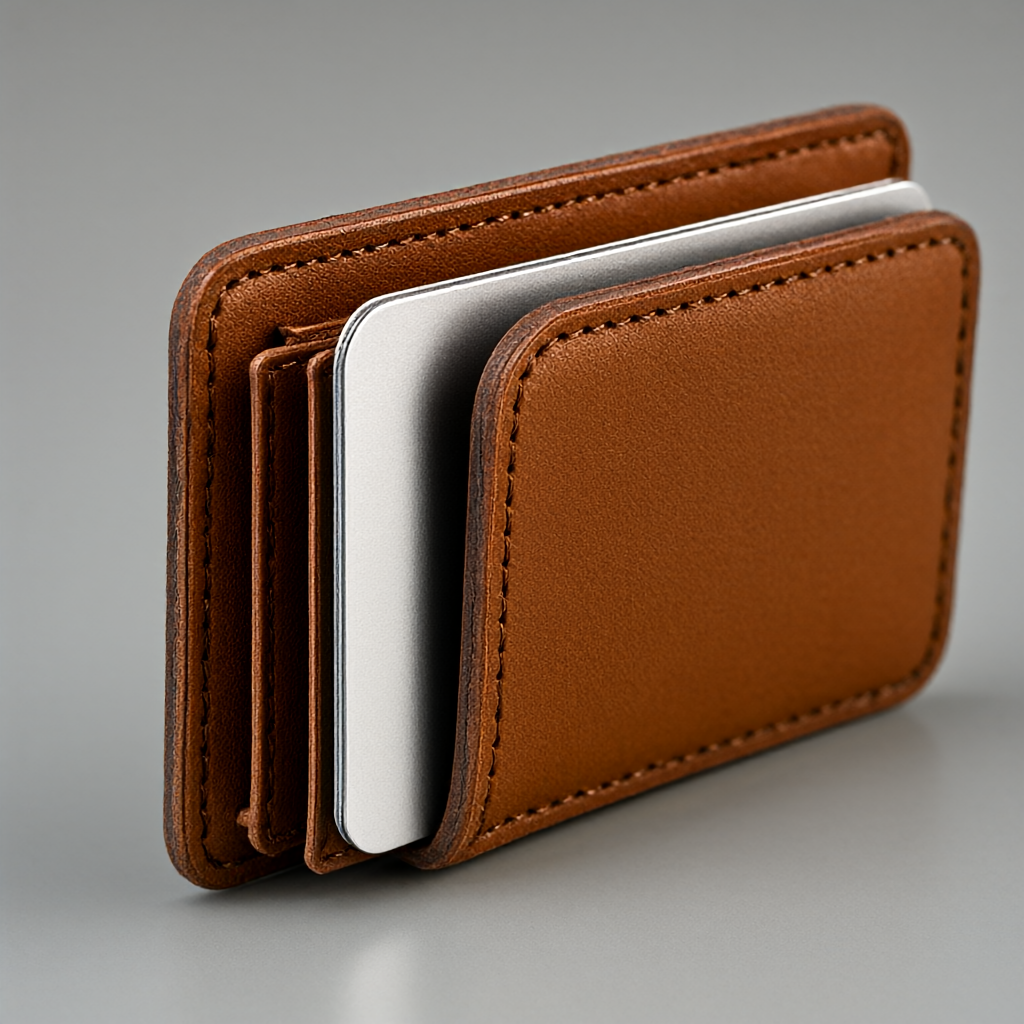
When evaluating card holders for private label or OEM production, three specification categories determine fit for your target market:
| Specification | Typical Range | Why It Matters |
|---|---|---|
| Card capacity | 4–12 cards | Determines end-user appeal; 6–8 cards is the industry sweet spot for everyday use |
| Thickness | Under 15 mm | Front-pocket comfort threshold; anything thicker risks discomfort and visibility |
| Weight | 30–80 g | Impacts perceived quality and portability; lighter is generally preferred |
| Material gauge | 1.5–3.0 mm | Thinner gauges reduce weight but may flex under load; thicker gauges add rigidity |
| RFID-blocking layer | Included / Optional | Adds ~0.5 mm thickness and $0.15–$0.40 per unit depending on material |
| Surface finish | Anodized, bead-blasted, polished, coated | Drives perceived quality; affects scratch resistance and color consistency |
Card capacity deserves particular attention. Manufacturers sometimes list maximum capacity — meaning the number of cards that physically fit — rather than comfortable operating capacity. A holder rated for 12 cards may require significant force to extract individual cards once fully loaded, which degrades the end-user experience. A realistic operating range for most spring-plate designs is 6–10 cards before extraction becomes difficult. Always verify capacity claims with physical samples before committing to a production order.
Does RFID-blocking actually work on card holders?
RFID-blocking card holder technology uses a conductive layer — typically fine copper or nickel mesh, or a ferromagnetic alloy sheet — integrated into the wallet’s construction to create a Faraday cage around the cards inside. When activated, this layer blocks radio frequency signals at 13.56 MHz, the frequency used by contactless payment cards, passports, and access credentials.
The effectiveness depends on complete signal enclosure. A card holder that blocks RFID on three sides but leaves the top open will still allow partial signal penetration. High-quality blocking designs wrap the conductive layer around the entire card compartment, including the sides and back. For a comprehensive technical breakdown, refer to What Is RFID Blocking? How It Protects Contactless Cards and our RFID Wallet Meaning: Definition, Technology & Buyer’s Guide.
From a procurement standpoint, note that RFID-blocking layers add approximately 0.3–0.8 mm to the overall thickness and $0.15–$0.50 to the per-unit cost depending on the shielding material and coverage area. In markets where contactless payment adoption is high — particularly North America and Western Europe — this feature has become a meaningful differentiator for brand owners positioning products against non-blocking competitors.
What manufacturing processes are involved in making a card holder?
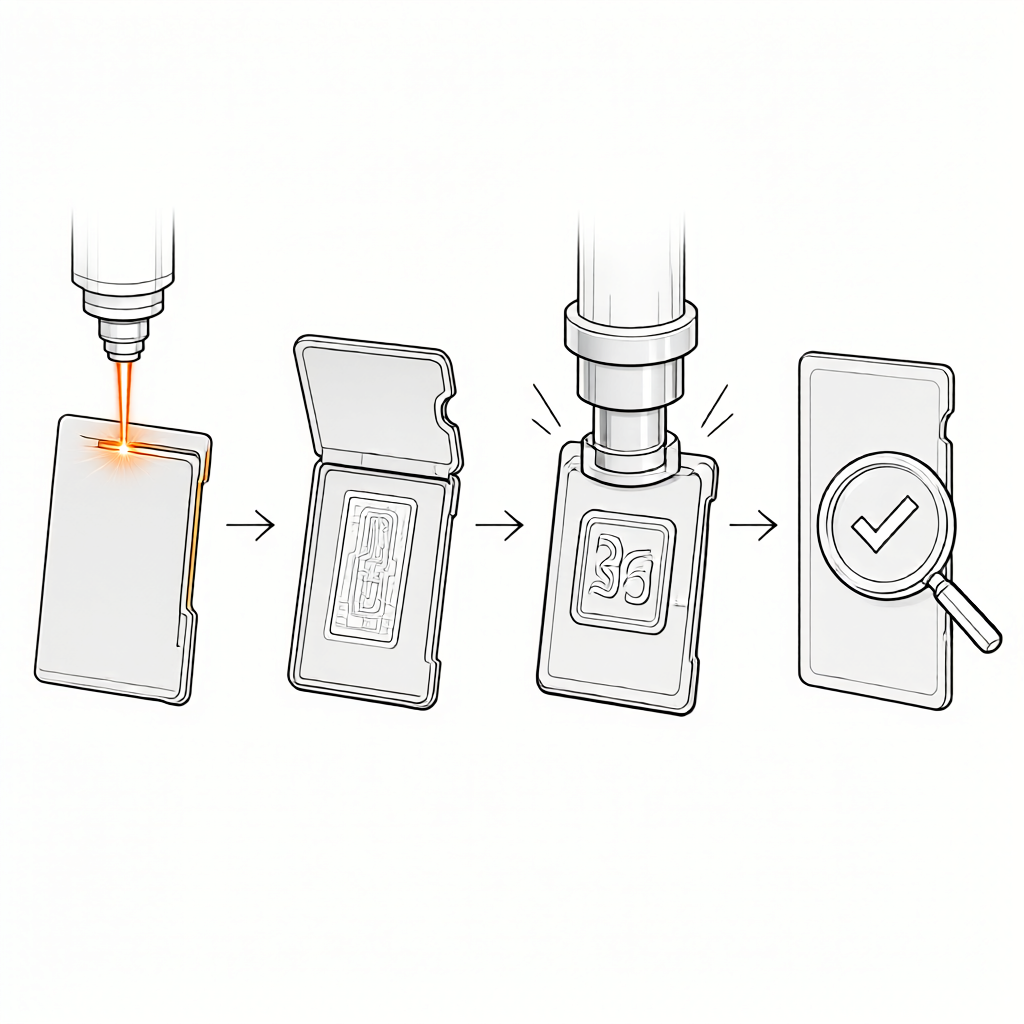
Understanding the production workflow helps buyers evaluate supplier capabilities and negotiate informed quotes. The typical manufacturing sequence for a metal or carbon fiber card holder includes:
- CNC machining: Raw aluminum billets or titanium plates are cut to rough dimensions on multi-axis CNC centers. Tolerances for precision-machined parts typically fall within ±0.05 mm, ensuring smooth card ejection and consistent spring engagement across production batches.
- Surface preparation: Machined parts undergo sandblasting, polishing, or brushing to achieve the desired base texture before finishing.
- Anodizing (aluminum only): Electrochemical oxidation creates a durable oxide layer that enhances corrosion resistance and accepts dye for color. Common finishes include matte black, silver, gold, and custom brand colors. Anodized parts meet ASTM B136 standards for coating thickness and adhesion.
- Laser engraving: Logos, serial numbers, or decorative patterns are etched onto the surface using fiber or CO2 lasers. Engraving depth is typically 0.02–0.05 mm and remains visible regardless of subsequent handling.
- UV printing: Full-color graphics or photography can be applied directly to flat surfaces. UV-cured inks bond to metal and composite substrates without heat, preserving dimensional tolerances.
- Assembly and QC: Springs, elastomer bands, or magnetic elements are installed, and each unit undergoes visual inspection and functional testing of card ejection.
For insight into the full production pipeline from raw material to finished product, see How Minimalist EDC Wallets Are Manufactured: A Procurement Guide.
What standards apply to card holders?
While no product-specific regulatory framework governs consumer card holders, several internationally recognized standards shape quality expectations and compliance requirements:
- ISO 9001: Quality management system certification that verifies a manufacturer follows documented processes for design control, incoming material inspection, in-process quality checks, and final product release. For B2B buyers, ISO 9001 certification signals that a factory operates with consistent traceability and defect prevention — not merely that individual units pass inspection.
- BSCI (Business Social Compliance Initiative): A social responsibility audit framework covering working conditions, wages, hours, and safety. Retail chains and larger distributors increasingly require BSCI compliance from their supply base.
- REACH / RoHS: European chemical regulations restricting certain substances in electronic and consumer goods. While card holders contain minimal electronics, any integrated RFID-blocking layer or magnetic component falls under RoHS scope, requiring confirmation that lead, cadmium, mercury, and other restricted substances are below permitted thresholds.
- SGS-tested materials: Independent third-party material verification provides assurance that advertised alloys (e.g., 6061-T6 aluminum, GR2 titanium) match the actual composition delivered. SGS reports are standard documentation for contract manufacturing orders.
These certifications do not certify the product itself but validate that the manufacturing ecosystem meets baseline expectations for quality, ethics, and chemical safety. Buyers should request current certification documents and verify expiry dates before signing a purchase agreement.
What should you consider before ordering custom card holders?
Several practical factors separate a smooth sourcing experience from costly rework:
MOQ and pricing tiers: Minimum order quantities vary by mechanism complexity and material. Simple spring-plate aluminum models typically starts at 300 pcs per SKU for full OEM customization (100 pcs trial order available for stock finishes) for custom branding, while titanium or multi-component assemblies may require 300–500 units to amortize setup costs. Expect unit prices to drop 15–30% between 100 and 1,000 piece runs, with further reductions at 5,000+ pieces.
Sample lead time: Reputable manufacturers produce evaluation samples within 5–10 business days. Custom samples with logo engraving or specific anodized colors may take 7–14 days. Never approve a production order without receiving and testing a physical sample — photos and CAD renderings do not reveal tolerances, spring tension, or finish consistency.
Customization depth: True customization extends beyond logo placement. Consider whether you need custom packaging design, color-matched anodization to your brand palette, or modifications to the internal mechanism for a proprietary card arrangement. Each additional variable increases NRE (non-recurring engineering) costs and may extend lead time by 3–7 days.
Target buyer contexts: Your end-market shapes every specification decision. Amazon FBA private label sourcing demands tight tolerance control and consistent packaging to avoid negative reviews from size mismatches. Corporate promotional gifts with custom logo prioritize faster turnaround and broader color availability over extreme precision. EDC gear retail brand production requires the highest attention to material grade and finish consistency, since end consumers in this segment are discerning about weight, texture, and long-term durability. Minimalist wallet distributor procurement often involves mixed SKUs across multiple formats, making standardized component platforms more valuable than fully bespoke designs.
See our Best Minimal Wallets for B2B Sourcing and Private Label guide for further procurement strategy.
Here is how the industry works — and how we meet these standards. At TOP EDC Wallet, we have operated a 50,000 sq ft in-house facility since 2014, focusing exclusively on minimalist wallets, carbon fiber card holders, titanium money clips, and related EDC pocket gear. Our approach to each specification above is grounded in practical manufacturing experience: we machine our own parts rather than subcontracting critical steps, maintain ISO 9001 quality systems, and source materials verified through SGS testing. Whether you are evaluating a small custom run for a promotional program or scaling a private label line for retail distribution, our team is set up to move from concept to shipped product with clear timelines and transparent communication.
Card Holder Types: What Should You Know First?
A card holder is a slim, pocket-carry accessory engineered to hold credit cards, IDs, cash, and keys without the bulk of a traditional bifold wallet. It uses mechanical systems — spring plates, sliding trays, magnetic closures, or elastomer bands — housed in metals like aluminum or titanium, composites such as carbon fiber, or traditional leather. For B2B buyers, understanding card holder types, manufacturing processes, material specs, RFID-blocking technology, and procurement criteria (MOQ, lead times, certification requirements) is essential to selecting or private-labeling a product that performs reliably at scale.
Industry standards and material specifications for B2B buyers
Beyond general material descriptions, experienced procurement teams evaluate card holders against specific industry standards that define acceptable tolerances, surface performance, and chemical compliance:
- ASTM B136 / ASTM B580: Standards governing anodized coating thickness and adhesion for aluminum components. A minimum anodize thickness of 0.0003 in (7.5 µm) is typical for consumer-grade EDC products; thicker coatings (up to 0.001 in / 25 µm) are specified for high-wear tactical applications.
- MIL-DTL-8625 (Type III hardcoat): Military specification for thick anodized coatings on aluminum alloys. While not commonly required for consumer EDC, some premium buyers reference Type III hardcoat standards (minimum 0.001 in / 25 µm thickness, hardness ≥ 500 HV) when specifying extreme-durability finishes.
- ISO 9001:2015: Quality management system standard. Buyers should request current certification documents and confirm that the scope explicitly covers design and manufacturing of metal/polymer pocket accessories, not just generic industrial operations.
- ISO 14001:2015: Environmental management system standard increasingly requested by European distributors as part of sustainability compliance requirements for importers.
- REACH Regulation (EC) No 1907/2006 — SVHC List: The EU’s candidate list of Substances of Very High Concern currently includes over 240 restricted substances. Any RFID-blocking foil, adhesive, or anodizing dye used in card holder production must comply with REACH authorization requirements. B2B buyers should require a REACH conformity declaration from suppliers.
- RoHS Directive 2011/65/EU (and amendment (EU) 2015/863): Restricts lead, cadmium, mercury, hexavalent chromium, PBB, PBDE, and four phthalates (DEHP, DBP, BBP, DIBP) in electronic-adjacent consumer goods. RFID-integrated card holders fall under RoHS scope and require documented compliance testing.
- SGS / Intertek material verification reports: Third-party analytical reports confirming alloy composition (e.g., 6061-T6 aluminum must contain 0.8–1.2% magnesium, 0.4–0.8% silicon per AMS 4198). Buyers should request recent SGS reports matching each production lot.
These standards are referenced throughout the How Minimalist EDC Wallets Are Manufactured: A Procurement Guide and inform quality clauses in B2B contract manufacturing agreements.
Procurement decision framework: comparing suppliers
A structured supplier evaluation matrix reduces risk when sourcing custom card holders at volume. The following framework compares key decision criteria used by experienced EDC brand owners and Amazon FBA operators:
| Evaluation Criterion | Tier 1 Supplier Benchmark | Tier 2 Supplier Benchmark | Red Flag |
|---|---|---|---|
| ISO 9001 certification | Current, audited annually, scope includes product design | Certification present but scope limited to production only | No QMS certification offered |
| BSCI audit | Passed within last 12 months, no critical non-conformities | Audit completed but with minor findings pending resolution | No social compliance documentation |
| REACH/RoHS compliance | Full test reports available per batch; SVHC screening documented | General compliance statement without batch-level reports | Unable to provide material declarations |
| MOQ flexibility | starts at 300 pcs per SKU for standard designs; 300+ for complex assemblies | Minimum 300–500 pcs across all product types | No MOQ disclosed or requires 1,000+ pcs |
| Sample lead time | 5–7 business days for plain samples; 7–14 days for custom branded | 10–21 business days | Samples quoted at 30+ days |
| Defect rate (acceptance) | ≤ 1.5% AQL on incoming inspection | 1.5–3% AQL | No AQL commitment stated |
| On-time delivery record | ≥ 95% on-time shipment rate over past 12 months | 85–95% on-time rate | No delivery performance data |
| Unit cost at 500 pcs (aluminum, 6-card) | $4.50 – $7.50 | $3.00 – $5.00 | Below $2.50 (indicates substandard materials or process) |
| NRE / setup fee | Waived or $150–$300 for standard tooling | $300–$600 | Unlimited or undisclosed setup fees |
This framework helps B2B buyers move beyond price-only comparisons and evaluate total cost of ownership, including rework risk, compliance exposure, and supply-chain reliability. For additional guidance on selecting the right card holder type for your market, consult the Best Card Holder Buying Guide for B2B Sourcing.
How we approach custom card holder manufacturing?
The card holder market has evolved significantly since minimalist EDC gear entered mainstream awareness around 2014. Today’s buyers expect tighter tolerances, faster turnaround, and more sophisticated customization than earlier generations of slim wallets offered. Here is how the industry works, and how we meet those standards on the production floor.
Our facility operates a 50,000 sq ft in-house manufacturing space equipped with multi-axis CNC machining centers, fiber laser engravers, UV printing stations, and anodizing lines — all under one roof. This vertical integration means we control dimensional tolerances from raw billet to finished unit without relying on external subcontractors, which directly impacts consistency across production batches. Our ISO 9001 certification (in place since 2014) and BSCI-audited facility reflect the same documented processes and quality checkpoints described in the procurement framework above. We run at a monthly capacity exceeding 500,000 units, with MOQs starts at 300 pcs per SKU for standard aluminum and carbon fiber designs and sample lead times of 7 business days.
We serve 200+ brands worldwide across America, Europe, Australia, and Southeast Asia — ranging from Amazon FBA private label sellers building signature EDC lines to corporate gift programs requiring branded metal wallets with custom laser engraving and retail packaging. Every order follows the same QC protocol: incoming material verification against SGS-certified alloy reports, in-process dimension checks at each CNC operation, anodize thickness validation per ASTM B136, and final functional testing of card ejection force before packaging. If you are evaluating suppliers against the decision matrix above, Request Quote to discuss your project specifications and receive a detailed proposal within 24 hours.
Card Holder Types: Where Can You Verify the Data and Sources?
- How to Find a Lost Wallet: EDC Security Guide — topedcwallet.com
- Best Card Holder Buying Guide for B2B Sourcing — topedcwallet.com
- Sourcing Money Clips for B2B: Specs & Standards — topedcwallet.com
- What Is RFID Blocking? How It Protects Contactless Cards — topedcwallet.com
- RFID Wallet Meaning: Definition, Technology & Buyer’s Guide — topedcwallet.com
- How Minimalist EDC Wallets Are Manufactured: A Procurement Guide — topedcwallet.com
- Best Minimal Wallets for B2B Sourcing and Private Label — topedcwallet.com
- Get a Free Quote → — topedcwallet.com
From article to product
Sourcing minimalist-wallets?
Tell us the format, the quantity and the date you need stock. You get material options, MOQ and a landed-cost range back within one business day.
Keep reading
More on wallet types
Thin Male Wallets: Buying Guide for Slim Minimalist Picks
How to choose a slim wallet for men — thickness thresholds, material trade-offs, capacity…
ReadStashed Wallet: A Minimalist Everyday-Carry Solution
Understand what a stashed wallet is, how minimalist slim wallets work, and what to…
ReadFolding Wallets: Types, Materials & Buying Guide
Learn what makes a folding wallet worth buying, from materials and card capacity to…
Read
About the author
TOPWALLET Editorial Team
TOPWALLET's editorial and engineering desk writes from bench testing at the Shenzhen (Longgang) facility: pull-force and cycle testing, 13.56 MHz shielding measurements, finish trials and factory audits, rather than supplier spec sheets. Every specification in these guides is one we write on a purchase order.
Written on the floor
This article was written by our production and QC team — the people who spec tolerances, run the finishing line and inspect every batch. Where it states a capacity, a pull force or a lead time, it comes from a measurement we made, not a supplier’s catalogue. If a number here disagrees with what your own supplier told you, tell us; several of these articles started as a correction from a buyer.
See how the factory works · Inspection process · Sourcing FAQ
Sourcing minimalist-wallets?
Tell us the format, the quantity and the date you need stock. You get material options, MOQ and a landed-cost range back within one business day.