

What is a leather card holder?
A leather card holder is a slim, minimalist wallet designed to carry credit cards, IDs, and occasionally folded cash. Unlike traditional bifold wallets, it prioritizes low profile and portability — typically slipping into front or back pockets without creating bulk. The construction centers on genuine or synthetic leather as the primary exterior material, with internal card slots, a cash pocket, or an integrated money clip holding the cards in place.
For B2B buyers, the leather card holder occupies a specific niche between full-size wallets and hard-shell metal or carbon fiber cases. It appeals to buyers who want the tactile and aesthetic qualities of leather while accepting the reduced capacity that comes with a slim form factor. Understanding where this product fits helps you evaluate whether it aligns with your brand’s positioning, your customers’ carry habits, and your margin targets.
A leather card case — sometimes called a wallet insert or minimalist leather wallet — typically holds between 4 and 12 cards depending on leather thickness and internal architecture. This capacity range is narrower than what you’ll see with metal wallets, which can often accommodate more cards through spring-loaded or elastic retention systems. The trade-off is that leather card holders generally feel more premium to the touch and develop a patina over time, which matters significantly for brands targeting corporate gifting or private-label retail.
The product category has expanded in recent years to include RFID-blocking variants, laser-engraved branding options, and sustainable leather grades. These additions have made the leather card holder one of the most versatile SKUs in the minimalist wallet segment for B2B buyers looking to diversify their product line.
How is a leather card holder constructed?
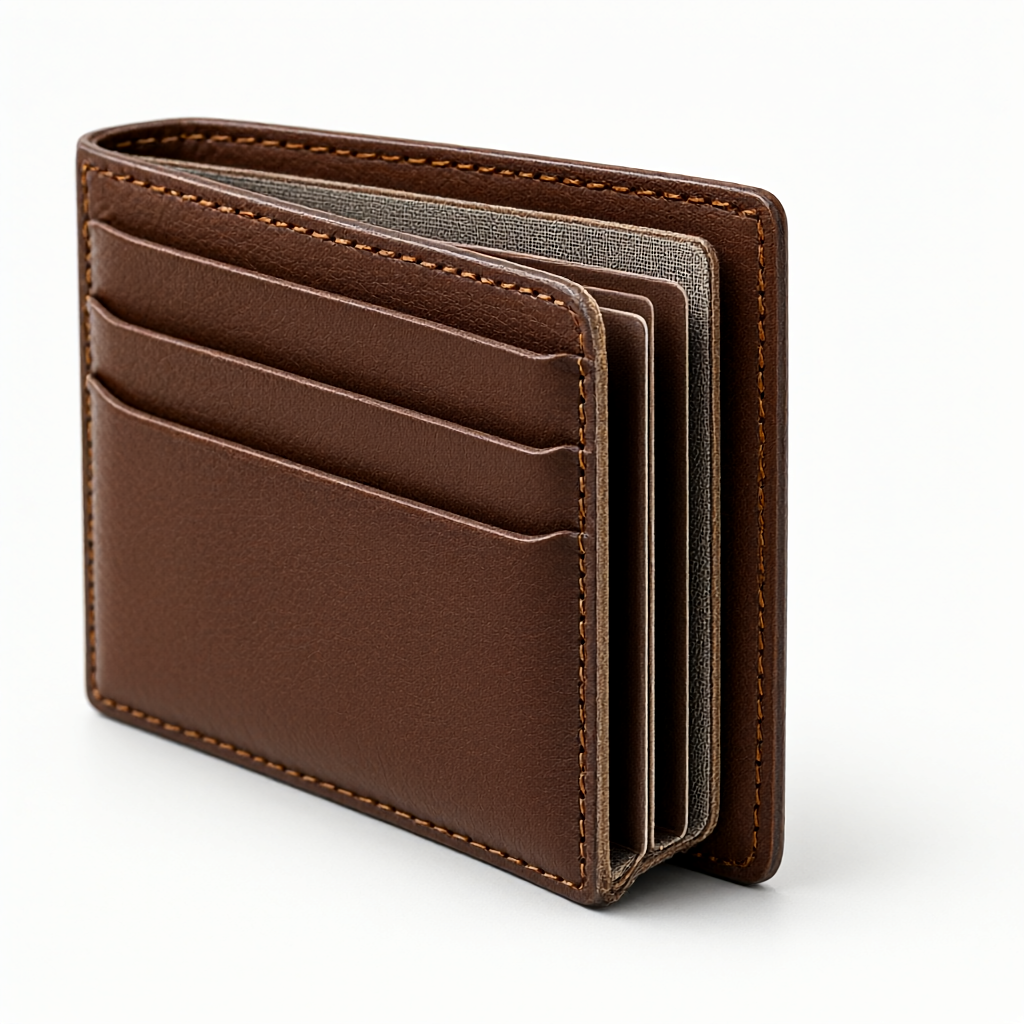
The construction of a leather card holder involves several decisions that directly affect durability, appearance, and cost. Understanding these components helps you evaluate quotes from manufacturers and avoid common sourcing pitfalls.
Leather materials and grades
Not all leather is equal, and the terminology used on product spec sheets can be misleading. The four main categories you’ll encounter are:
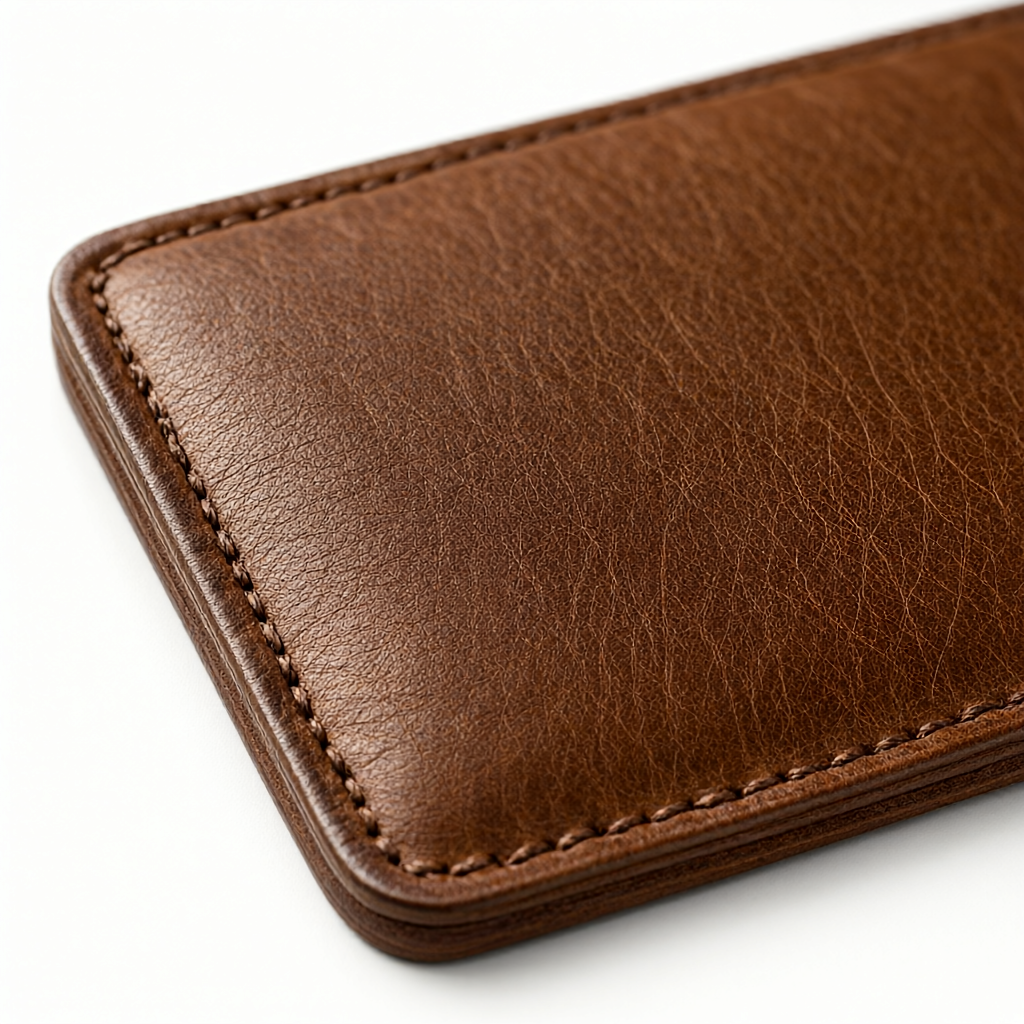
Full-grain leather comes from the top layer of the hide and retains the natural grain pattern. It is the most durable option and develops the richest patina over time. Full-grain leather card holders command higher unit costs but typically justify them through longevity and perceived quality.
Top-grain leather has been sanded or buffed to remove imperfections, then often finished with a coating. It offers a more uniform appearance than full-grain and is softer to the touch. This is the most common choice for mid-tier EDC wallets and corporate gifts where visual consistency matters more than natural character.
Genuine leather is a grading term that refers to real leather but does not indicate quality. In sourcing contexts, “genuine leather” often means split leather or corrected-grain leather that has been heavily processed. It is cost-effective for promotional product programs but may not hold up as well under daily carry conditions.
Bonded leather is made from leather fibers bonded together with adhesive and coated with polyurethane. It is the lowest-cost option and rarely recommended for B2B brands positioned in the mid-tier or above.
The choice between these grades should be driven by your target price point and brand positioning. For private-label retail brands, top-grain leather typically provides the best balance of cost and perceived quality. Promotional product distributors may find genuine leather adequate for one-time gift programs where long-term durability is secondary.
RFID-blocking integration
RFID-blocking technology has become a standard feature expectation for leather card holders sold in North America and Europe. The technology works by embedding a layer of conductive material — typically aluminum, nickel, or copper — between leather layers or within the card slot structure. This creates a Faraday cage that blocks radio-frequency signals from contactless payment cards.
When evaluating RFID-blocking claims, you should look for verifiable certification rather than marketing language. Reputable manufacturers test their RFID-blocking layers against actual card scanners to confirm signal attenuation meets published specifications. Without independent verification, RFID-blocking claims are difficult to assess. According to EMVCo contactless payment security specifications, card manufacturers implement certain encryption and authentication protocols to protect contactless transactions, but these do not eliminate the theoretical risk of skimming at close range — which is why RFID-blocking layers remain a relevant feature for consumer protection.
Internal architecture
The internal layout determines how many cards a holder can accommodate and how securely they are retained. Common architectures include:
- Slot-based design: Individual leather or fabric slots for each card. Simple and reliable, but capacity is fixed at time of tooling.
- Elastic band retention: A stretched elastic band across the front holds cards in place. Allows slightly more flexible loading but may loosen over time.
- Money clip integration: A metal clip (stainless steel or titanium) on the exterior holds cash and provides an additional card slot behind it. This design combines the functions of a leather wallet insert and a leather money clip with card slots into one product.
- Hybrid layouts: Combinations of slots, cash pockets, and coin pockets in varying configurations.
For B2B buyers, slot-based designs are generally more reliable for long-term use because they lack moving parts that can fail. Money clip integrations add complexity and cost but appeal to buyers looking for a more feature-rich product at the same slim profile.
Stitching and hardware
Stitching quality is one of the most visible indicators of construction standards. Double-stitched seams with waxed nylon or polyester thread are significantly more durable than single-stitch construction. Thread color should match or intentionally contrast with the leather — inconsistent thread color selection is a common defect in lower-tier production runs.
Hardware such as metal clips, snap closures, or rivets should be made from corrosion-resistant materials like stainless steel or anodized aluminum. Cheap zinc alloy hardware can tarnish or break, especially in humid environments. For branded products, hardware finishing should coordinate with the overall design language rather than being an afterthought.
What are the key specifications for leather card holders?
Specification evaluation is where B2B buyers separate viable suppliers from problematic ones. The following parameters should be documented and verified before placing a bulk order.
| Specification | Typical Range | Notes |
|---|---|---|
| Overall dimensions (W x H x D) | 75–90 mm × 110–120 mm × 5–12 mm | Width and height vary by market preference; depth determined by card count and leather thickness |
| Card capacity | 4–12 cards | EMV chip thickness adds approximately 0.3 mm per card |
| Leather thickness | 0.8–1.5 mm | Thicker leather increases durability but reduces slim-profile appeal |
| Weight | 30–80 grams | Depends on leather grade, RFID layer, and hardware |
| RFID blocking frequency range | 13.56 MHz | Standard for contactless payment cards |
| MOQ | 300–500 pieces | Varies by customization level and leather source |
| Sample lead time | 5–14 days | Depends on whether existing templates can be modified or new tooling is required |
| Production lead time | 15–30 days | After sample approval and material procurement |
| Custom packaging | Available | Retail boxes, polybags, or custom-branded sleeves |
Card capacity is the specification that most often causes buyer-supplier mismatch. EMV chips are thicker than older magnetic stripe cards, so a leather card holder rated for 8 cards with older card stock may only accommodate 6 modern cards. Buyers should specify the exact card types and quantities they intend to test with during the sample phase.
Leather thickness is another critical specification. Thinner leather (0.8–1.0 mm) produces a slimmer profile but is less durable under heavy daily use. Thicker leather (1.2–1.5 mm) increases longevity but pushes the overall thickness beyond the slim category. The optimal thickness depends on whether the product is positioned as a daily carry item or an occasional-use accessory.
For a detailed breakdown of wallet materials and their procurement implications, see our Men’s Minimalist Wallets — Materials, Specs & Sourcing guide.
What standards apply to leather card holders?
Several standards and compliance requirements affect leather card holder sourcing, particularly for products sold in regulated markets.
Leather sourcing standards
The Leather Working Group (LWG) certification is the primary standard for environmentally responsible leather tanning. LWG-certified tanneries are audited for water usage, chemical management, and energy efficiency. Products made from LWG-certified leather can be marketed with verifiable sustainability claims, which is increasingly important for corporate gifting programs with ESG commitments. While LWG certification is not legally required, many large corporate buyers now request it as part of their procurement criteria.
For buyers who need guidance on evaluating leather grades and sourcing specifications, the Leather Wallet Guide: Types, Grades & Procurement Specs provides a detailed framework for comparing full-grain, top-grain, genuine, and bonded leather options against cost and quality benchmarks.
RFID-blocking verification
There is no universal legal standard requiring RFID-blocking performance in consumer wallets, but third-party testing laboratories can verify signal attenuation. Buyers should request test reports from SGS, Intertek, or equivalent laboratories when sourcing RFID-blocking leather card holders. These reports should document the frequency range tested and the decibel reduction achieved. Products marketed as RFID-blocking without independent test documentation should be treated with caution.
Chemical compliance
Leather processing involves chemicals that may be regulated depending on the destination market:
- REACH (European Union): Restricts certain azo dyes, chromium VI, and other substances in leather products sold in the EU.
- RoHS (European Union): Primarily applies to electronics, but relevant if RFID-blocking layers contain certain metals.
- Proposition 65 (California): Requires warnings for products containing certain chemicals, including some leather tanning agents.
SGS-tested materials provide evidence of compliance with these regulations and should be part of your supplier documentation package.
Quality management
ISO 9001 certification indicates that a manufacturer has a documented quality management system covering material inspection, in-process quality control, and final product testing. BSCI audit certification demonstrates compliance with social responsibility standards, which matters for corporate buyers with ethical sourcing policies. When evaluating manufacturers, request copies of these certifications rather than accepting them as unverified claims.
What should you consider when sourcing leather card holders?
Sourcing leather card holders involves trade-offs across cost, quality, customization, and timeline. The following factors should be evaluated systematically before committing to a supplier.
Material cost and availability
Leather prices fluctuate based on hide quality, tanning method, and global supply conditions. Full-grain and top-grain leathers from established tanneries in Italy, Spain, and China are the most commonly sourced options. Vegetable-tanned leather — preferred for its natural aging characteristics and lower environmental impact — typically costs 15–30% more than chrome-tanned alternatives. Lead times for specialty leather grades can also be longer, so material selection should be finalized early in the sourcing process.
Customization depth
Customization options for bulk leather card holders include:
- Laser engraving: Suitable for logos, text, and decorative patterns. Depth and detail depend on leather type — top-grain and full-grain accept laser engraving better than heavily corrected genuine leather.
- Embossing: Creates a raised or debossed logo without removing material. Works well on thicker leathers and produces a more subtle branding effect than engraving.
- Edge painting: Colored edge finish applied to leather cut edges. Available in matching or contrasting colors.
- Packaging customization: Retail boxes, tissue paper, and hang tags can be fully branded. This is often the highest-impact customization for retail brands.
- Hardware customization: Metal clips and rivets can be finished in multiple colors (black, silver, gold, gunmetal).
When evaluating customization options, consider that each additional variable — different leather colors, hardware finishes, packaging designs — increases complexity and may extend lead times. A straightforward single-color, single-material order with minimal branding will move through production faster than a highly customized SKU with multiple variants.
Quality control checkpoints
Effective quality control for leather card holders should include inspections at three stages:
- Material inspection: Verify leather grade, color consistency, and RFID-blocking layer integrity before production begins.
- In-process inspection: Check stitching quality, alignment of card slots, and hardware attachment during assembly.
- Pre-shipment inspection: Randomly sample finished products to verify dimensions, appearance, and function against the approved sample.
Buyers should specify acceptable defect rates and inspection criteria in their purchase orders. A typical industry standard is no more than 2–3% defective units in a shipment, but this should be negotiated explicitly rather than assumed.
Comparison with alternative minimalist wallets
Leather card holders compete with metal wallets and carbon fiber card holders in the minimalist segment. Each material has distinct advantages:
Leather vs. metal wallets: Leather offers a warmer tactile experience and natural aging that many buyers prefer for everyday carry. Metal wallets excel in durability, water resistance, and thinness. For corporate gifting, leather is generally perceived as more premium and professional. For outdoor and tactical EDC use, metal may be the better choice. A comprehensive comparison of EDC wallet materials and sourcing approaches can help you advise your customers appropriately — see our EDC Wallets: What They Are and How to Source Them guide for additional context.
Leather vs. carbon fiber: Carbon fiber card holders are extremely thin and lightweight with high rigidity. They do not develop patina and maintain a consistent appearance over time. Leather offers aesthetic warmth and brandability through engraving and embossing that carbon fiber cannot replicate. Carbon fiber is also more expensive at equivalent quality levels.
For a broader understanding of minimalist wallet categories and their sourcing considerations, refer to our What Is a Minimalist Wallet? B2B Buyer’s Guide 2026 and What Is a Card Holder? B2B Sourcing Guide for Buyers.
Use cases and market applications
Leather card holders serve several distinct B2B applications, each with different requirements:
Corporate gifting programs prioritize appearance, brandability, and perceived value. Top-grain leather with laser-engraved company logos is a common specification. Quantities typically range from 300 to 5,000 units per order. Sustainability credentials such as LWG-certified leather are increasingly requested.
Promotional product distributor catalogs focus on competitive pricing and fast turnaround. Genuine or top-grain leather at moderate price points serves this channel best. Customization is usually limited to logo application rather than structural changes.
Private label retail branding requires the most rigorous specification control. Brand owners need consistent leather quality, precise dimensions, and packaging that meets retail display standards. Minimum orders are typically higher, but per-unit costs decrease with volume.
EDC gear line expansion buyers look for products that complement existing metal and carbon fiber offerings. Leather card holders fill the gap for customers who prefer traditional materials or want a gift option alongside tactical gear.
For women-specific product lines, the Wallets for Women: B2B Sourcing Guide provides additional considerations around size preferences, color trends, and style variations that may influence your leather card holder specifications.
How does TOP EDC Wallet approach leather card holder manufacturing?
Understanding how a manufacturer approaches production helps you evaluate whether their processes align with your quality and sourcing requirements. Here is how the industry works — and how we meet these standards.
Our approach to leather card holder manufacturing starts with material selection. We work with top-grain and full-grain leather sourced from LWG-audited tanneries, with vegetable-tanned options available for sustainability-focused programs. Each hide lot is inspected for grain consistency, color uniformity, and thickness tolerance before cutting begins.
RFID-blocking layers are independently tested for signal attenuation at 13.56 MHz, and test reports are provided with each order. We do not rely on unverified supplier claims — every RFID-blocking claim is backed by laboratory documentation.
Our in-house CNC machining and laser engraving capabilities allow us to produce precise card slot cuts and custom branding without outsourcing to third-party shops. This vertical integration reduces lead times and gives us direct control over dimensional accuracy. Stitching is performed using double-needle machines with waxed thread, and seam strength is verified during in-process quality checks.
For buyers evaluating our capabilities against their requirements, we offer the following specifications:
- MOQ: starts at 300 pcs per SKU for full OEM customization (100 pcs trial order available for stock finishes) for standard designs; custom tooling may require higher minimums depending on complexity.
- Sample lead time: 7 days for modified existing templates; 10–14 days for fully custom designs requiring new patterns.
- Production lead time: 15–30 days depending on order volume, leather availability, and customization depth.
- Certifications: ISO 9001 quality management and BSCI social compliance audits.
- Customization scope: Laser engraving, embossing, edge painting, hardware finishing, and full retail packaging design.
- Compliance: REACH and RoHS compliant materials; SGS-tested leather and RFID-blocking components.
We serve EDC brand owners, Amazon FBA sellers, promotional product distributors, and corporate gift buyers across North America, Europe, Australia, and Southeast Asia. Our 50,000 sq ft factory supports a monthly production capacity exceeding 500,000 units, with drop shipping and Amazon FBA prep available for qualifying orders.
The leather card holder remains one of the most requested products in our portfolio because it bridges the gap between traditional wallet aesthetics and modern minimalist carry needs. Whether you are launching a private-label line, expanding an EDC brand, or sourcing corporate gifts, the specifications and customization options available today make this a practical addition to most product catalogs.
Leather Card Holder: Where Can You Verify the Data and Sources?
- EMVCo — www.emvco.com
- Men’s Minimalist Wallets — Materials, Specs & Sourcing — topedcwallet.com
- Leather Wallet Guide: Types, Grades & Procurement Specs — topedcwallet.com
- EDC Wallets: What They Are and How to Source Them — topedcwallet.com
- What Is a Minimalist Wallet? B2B Buyer’s Guide 2026 — topedcwallet.com
- What Is a Card Holder? B2B Sourcing Guide for Buyers — topedcwallet.com
- Wallets for Women: B2B Sourcing Guide — topedcwallet.com
- Get a Free Quote → — topedcwallet.com
From article to product
Choosing a material for a range?
Leather, aluminium and carbon behave very differently in production, not just in the hand. Send us the spec and we will tell you what it costs to make at your volume.
Keep reading
More on wallet materials
Vegetable Tanned Leather for Wallet Programmes
“Vegetable tanned” is a marketing phrase with a technical meaning, and the two do…
ReadRecycled Aluminium in Wallet Shells: Verifiable Claims
“Recycled aluminium” is a claim about provenance, and the wallet shell in your hand…
ReadFashion Zipper Men’s Wallets Leather Short Design Guide
Learn how to choose a short zipper leather wallet for men — full grain…
Read
About the author
TOPWALLET Editorial Team
TOPWALLET's editorial and engineering desk writes from bench testing at the Shenzhen (Longgang) facility: pull-force and cycle testing, 13.56 MHz shielding measurements, finish trials and factory audits, rather than supplier spec sheets. Every specification in these guides is one we write on a purchase order.
Written on the floor
This article was written by our production and QC team — the people who spec tolerances, run the finishing line and inspect every batch. Where it states a capacity, a pull force or a lead time, it comes from a measurement we made, not a supplier’s catalogue. If a number here disagrees with what your own supplier told you, tell us; several of these articles started as a correction from a buyer.
See how the factory works · Inspection process · Sourcing FAQ
Choosing a material for a range?
Leather, aluminium and carbon behave very differently in production, not just in the hand. Send us the spec and we will tell you what it costs to make at your volume.