

A fashion zipper men’s leather short wallet is a compact, zippered pocket organizer — typically 90–105 mm wide and 75–90 mm tall — constructed from full-grain, top-grain, or genuine leather that securely holds 6–12 cards, folded bills, and optionally coins behind a durable metal-coil zipper such as a YKK. Choosing the right one comes down to three things: a verified leather grade that ages rather than peels, a zipper rated for at least 4,000–10,000 open-close cycles, and a closed thickness under 22 mm so it sits flat in a front pocket.
Quick Answer
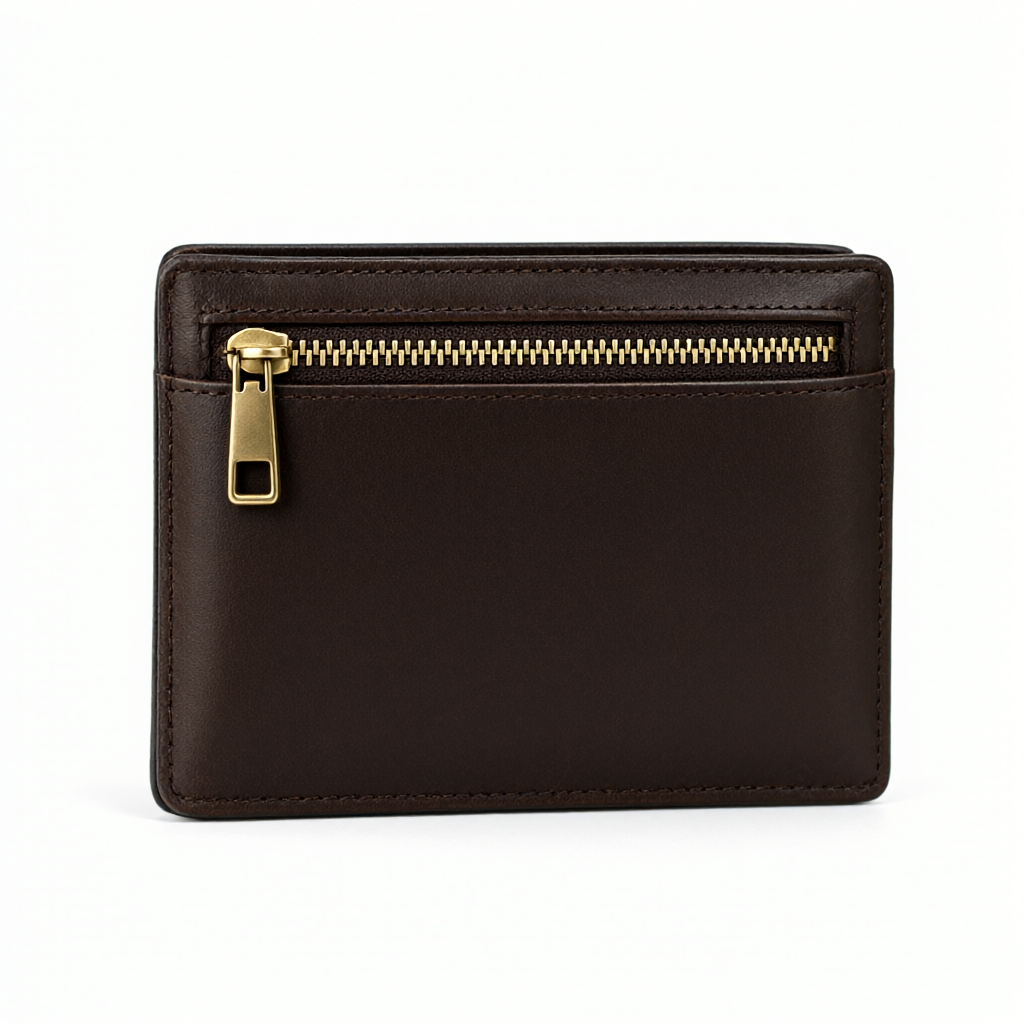
What makes a good fashion zipper men’s leather wallet? A well-built short zipper wallet uses full-grain or top-grain leather, features a durable metal zipper (typically YKK), measures roughly 4 × 3.5 inches when closed, holds 6–12 cards plus folded bills, and weighs between 2 and 3.5 ounces. The zipper must glide smoothly without catching the leather edges, the leather should develop a patina rather than crack, and the overall profile must sit flat in a front pocket without bulging. Cheap genuine leather combined with stamped-alloy zippers will fail within months; invest in the right combination of materials and construction, and the wallet lasts years.
Detailed Explanation
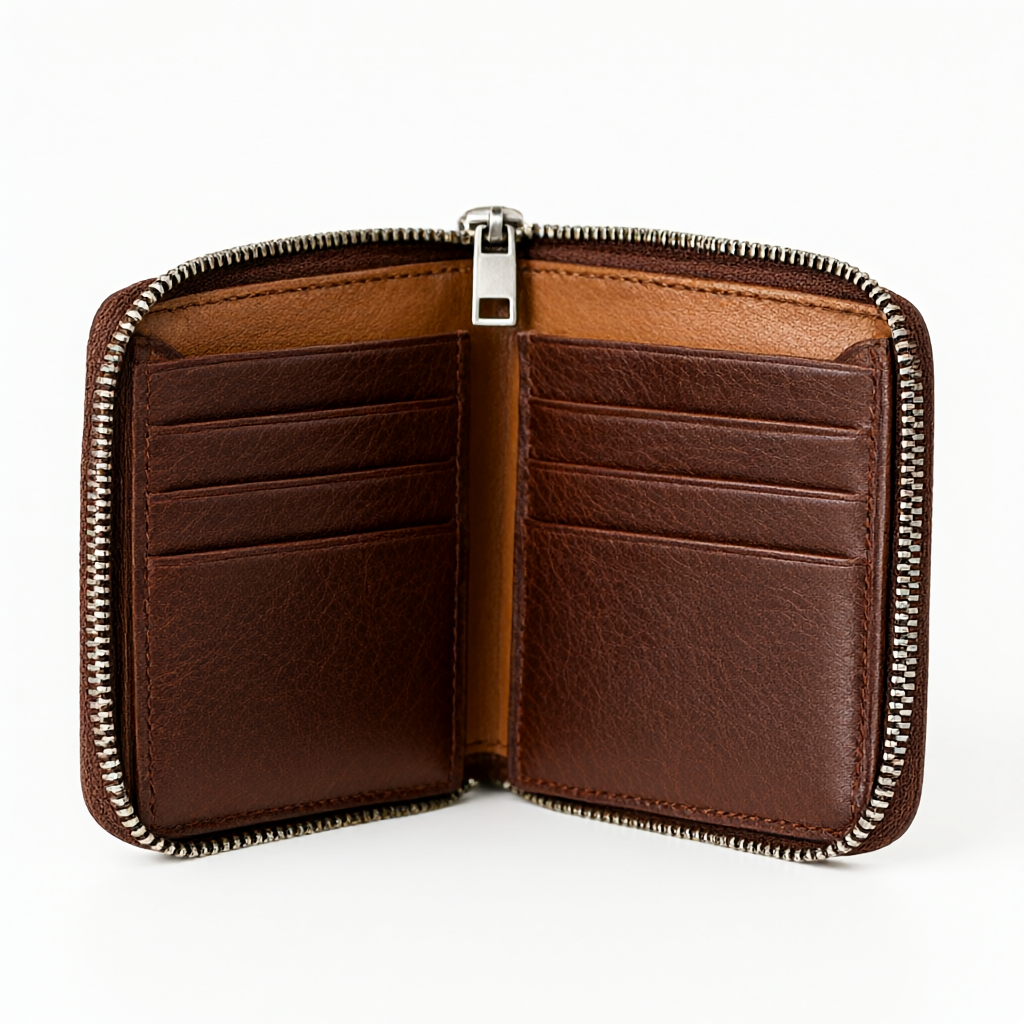
What is a fashion zipper men’s leather wallet and why choose it?
A fashion zipper men’s wallet in a short design is a compact pocket container sealed by a full-perimeter or partial zipper track. It replaces the classic bifold or bi-fold slipcase approach with a secure enclosure that protects contents from slipping out during active movement. Men who prioritize clean lines and minimal bulk often prefer this style because the zipper creates a slim, rectangular silhouette that tucks neatly into jacket pockets, suit trousers, or casual jeans.
The zipper closure also offers functional advantages. Loose cards don’t shift and rattle. Cash stays contained without expanding the profile. A coin pocket integrates seamlessly rather than adding a separate compartment. For front pocket id wallet users who want a single item that handles cards, notes, and loose change without the bagginess of a tri-fold, the short zipper design delivers exactly that balance.
Leather types explained — full grain, top grain, and genuine
Not all leather marketed for wallets is equal. The difference shows up immediately in hand feel and becomes obvious within weeks of daily use.
Full-grain leather retains the complete original grain layer, including natural markings and pores. It is the strongest form of hide available and develops a rich patina over time. In a zipper wallet context, full grain adds stiffness initially, which helps maintain the wallet’s rectangular shape, but breaks in gracefully after moderate use. It resists abrasion better than any other grade.
Top-grain leather has been lightly sanded on the surface to remove imperfections and receive a uniform finish. It is slightly more pliable out of the box and accepts dyes and coatings more consistently. For a smooth leather wallet that pairs with business-casual attire, top grain offers a refined appearance while retaining good durability.
Genuine leather is an umbrella term regulated by the Federal Trade Commission that technically includes many layers below the surface grain. In practice, budget wallets labeled simply “genuine leather” often use split leather bonded with polyurethane coatings. These wear thin quickly around the zipper track and tend to peel rather than age gracefully. When a seller cannot specify the exact leather layer, assume it is a lower-grade product unless independent verification confirms otherwise.
How is wallet leather made and processed?
Leather production begins with raw hides that undergo tanning to prevent decomposition. Vegetable tanning uses natural tannins from tree bark and produces firmer leather with warm tones — ideal for wallets that will darken noticeably over time. Chrome tanning employs chromium salts and yields softer, more water-resistant leather in a wider color range. Most fashion zipper wallets use chrome-tanned leather because the resulting supple hand-feel matches contemporary minimalist aesthetics.
After tanning, hides are drum-dyed, dried, and finished with coatings that determine surface texture — smooth, pebbled, or brushed. The edge finishing step is particularly important for zipper wallets. Exposed leather edges are painted, burnished, or sealed with edge coat to prevent fraying where the zipper tape meets the leather body. Poor edge sealing is the most common failure point in entry-level models.
Construction follows two main paths. Stitchless wallets use heat-bonded seams or precision ultrasonic welding, producing a seamless exterior with no visible thread. They look cleaner and resist dirt accumulation but require tighter tolerances during manufacturing. Traditional stitched wallets rely on waxed thread through pre-punched holes. Stitching allows easier repair and generally tolerates slight dimensional variation, but exposed thread near the zipper track can abrade over time. Both methods are valid; the execution quality matters more than the method chosen.
Key specifications for a short zipper men’s leather wallet
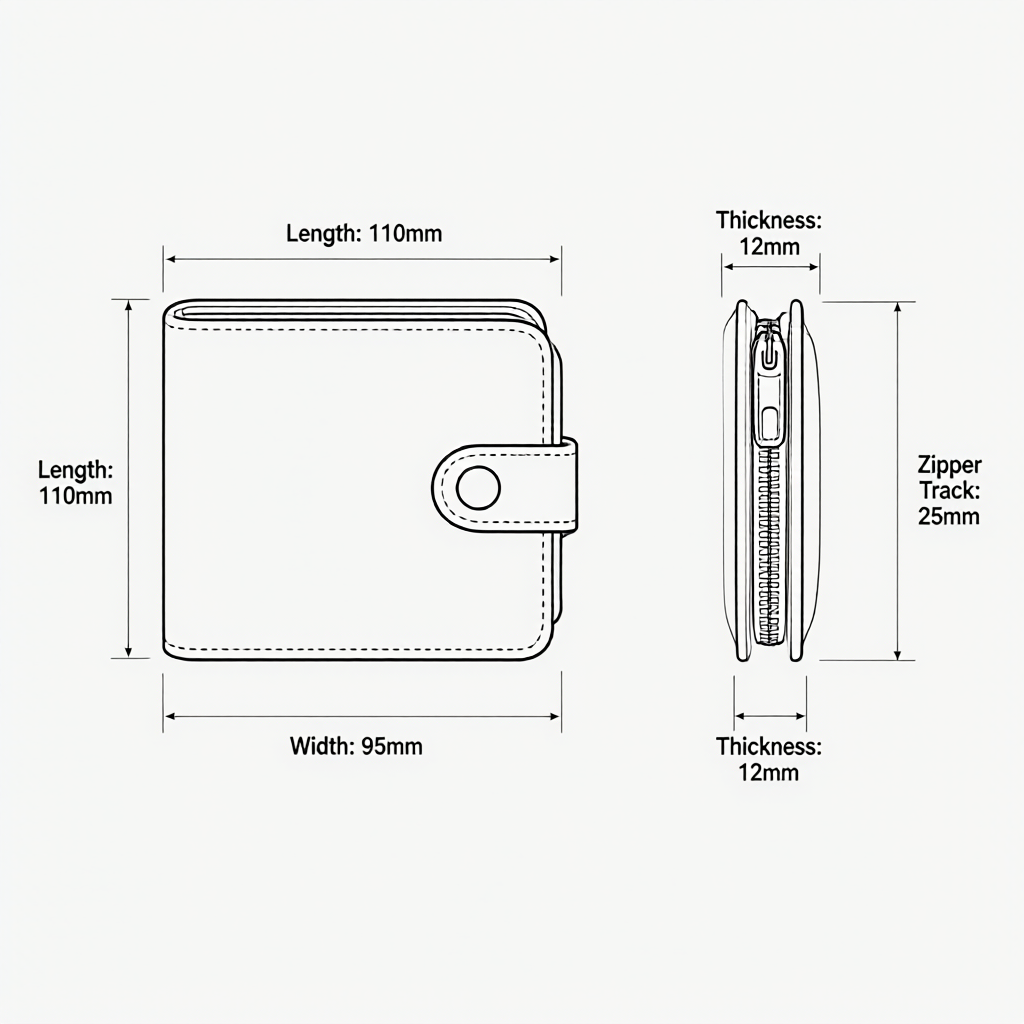
Dimensions vary across manufacturers, but the following ranges represent typical expectations for a genuinely compact model:
| Specification | Typical Range |
|---|---|
| Closed width | 90–105 mm |
| Closed height | 75–90 mm |
| Closed thickness | 15–22 mm (when loaded) |
| Weight (empty) | 55–100 g |
| Card slot count | 6–12 slots |
| Bill compartment | Single full-width or dual |
| Coin pocket | Optional, 70–85 mm diameter |
| Leather thickness | 0.9–1.4 mm per layer |
| Zipper type | Metal coil or molded plastic, 6–8 cm pull travel |
These numbers serve as a reference frame. A wallet that claims to be “slim” but measures 110 mm wide will not fit a standard front pocket. Always verify closed dimensions against your own pocket geometry before purchasing.
For additional reference on how size affects everyday carry comfort, see our guide on wallet size width and height.
Envelope, bifold, and money clip comparisons
The zipper wallet sits alongside several other men’s wallet formats. Understanding where each excels prevents mismatched purchases.
An envelope wallet leather design uses a fold-over flap with no closure hardware. It is the thinnest option but offers zero security against accidental openings. Coins escape easily. This format suits professionals who carry only three to five cards and prefer a sleek profile inside a blazer pocket.
A bifold wallet remains the most versatile mid-range option. It accommodates larger bill stacks, multiple card sections, and occasionally a transparent ID window. The trade-off is increased folded thickness, typically 18–28 mm, which may create a visible rear-pocket bulge.
A money clip wallet removes the cash-folding requirement entirely. A metal or leather clip secures bills against the back panel while cards slide into front slots. These are exceptionally thin but limit you to roughly ten bills and eight cards. Adding a separate coin pouch defeats the slimming purpose.
For a broader overview of different types of leather wallets, including detailed construction breakdowns, refer to the linked resource.
Zipper mechanism quality and longevity
The zipper is the mechanical heart of this wallet category. A weak zipper fails regardless of leather quality.
YKK zippers dominate the premium segment. Their interlocking coils and molded teeth maintain tension longer than unbranded alternatives. Look for finishes such as gunmetal, brass, or matte black coating — each serves a different aesthetic while providing corrosion resistance.
Riri and Lampo appear on higher-end European products and offer smoother action at a substantially higher cost. For most daily-use applications, YKK provides the optimal balance of performance and price.
Avoid stamped zinc-alloy zipper pulls and plastic coil zippers rated below 4,000 cycle opens. These degrade visibly within six months of regular use. If the manufacturer does not disclose the zipper brand, treat it as a negative signal rather than assuming average quality.
Standards & Requirements
What standards apply to genuine and top-grain leather wallets?
No single mandatory certification governs consumer leather wallets in most markets. However, relevant frameworks do exist. The FTC Fur Products Labeling Act requires accurate fiber and leather origin disclosure on products sold in the United States. Sellers must avoid deceptive terms like “true leather” when the material consists of bonded scraps.
International buyers often reference ISO 17075 (leather — physical and mechanical tests) and ISO 11641 (leather — chemical tests for selected substances) as baseline quality indicators. Reputable manufacturers test for chromate content, pH levels, and tear strength to ensure the leather meets wearable standards.
RFID-blocking construction, increasingly relevant as contactless payment adoption grows, falls outside leather specification but impacts wallet design. Blocking layers must integrate without adding rigidity that disrupts zipper operation. See our RFID-protected wallets guide for specifics on shielding effectiveness and how to verify it.
What standards apply to construction and durability expectations?
While specific wallet standards are rare, general textile and footwear durability benchmarks help set expectations. Abrasion resistance testing, colorfastness to light, and zipper cycle ratings commonly reference ASTM methodologies. Independent test reports from accredited laboratories provide the strongest evidence that a wallet will survive routine use.
When evaluating suppliers for private-label or OEM sourcing, request documented test results for the claimed leather grade and zipper model. Certifications alone do not guarantee performance, but they confirm the supplier conducts quality checks rather than relying solely on visual inspection.
Related Considerations
What should you consider when choosing a leather wallet?
Purchase decisions for zipper wallets typically involve four intersecting variables: leather grade, zipper integrity, internal organization, and styling compatibility.
Leather grade should match your expected usage intensity. Full grain justifies its higher price when the wallet sees heavy daily carry. Top grain works well for occasional use and formal settings where consistent color matters more than unique grain character. Genuine leather without grade specification belongs in the budget tier and carries proportionally shorter lifespan expectations.
Internal organization depends on what you actually carry. An RFID-blocking minimalist wallet might sacrifice a coin pocket for slimmer dimensions. A fuller organizer accepts that trade-off willingly. Assess your current card stack, bill volume, and whether you need an ID window before committing to a configuration.
Styling compatibility extends beyond color matching. A charcoal or espresso smooth leather wallet pairs cleanly with business attire, while a rugged pebbled or stitchless finish leans toward outdoor and casual environments. Consider your wardrobe palette holistically rather than isolating the wallet from the rest of your outfit choices.
Where can I find leather wallets for men nearby?
Local retail availability varies significantly by geography and format. Major department stores and men’s boutiques stock established brands but rarely showcase the manufacturing quality behind each model. Specialty EDC retailers and independent leather craftsmen tend to carry pieces with better construction documentation.
Online marketplaces expand selection dramatically but introduce authenticity risks. Third-party sellers sometimes substitute genuine leather with corrected grain or rebranded imports without disclosure. Check return policies, examine customer photos of actual received products, and prefer sellers who publish specifications including leather thickness and zipper brand rather than vague marketing language.
For procurement questions on leather wallet manufacturing processes and materials, understanding how wallets move from hide to finished product clarifies what to evaluate during any purchase channel.
Maintenance tips to extend wallet life
Leather and zipper demand complementary care routines to reach their maximum service life.
Apply a leather conditioner every two to three months for wallets used daily. Use products formulated for chrome-tanned leather — neatsfoot oil and beeswax-based balms work well. Avoid silicone-heavy dressings that create a temporary shine but block natural breathability.
Wipe the wallet surface with a dry microfiber cloth after exposure to rain or excessive sweat. Do not air-dry a wet wallet near radiators or direct sunlight; rapid drying causes leather to stiffen and crack along flex lines. Allow moisture to evaporate slowly at room temperature.
Clean the zipper track quarterly with a soft brush to remove lint and debris. A small amount of zipper lubricant or paraffin wax applied sparingly along the teeth reduces friction and prevents binding. Never apply oil directly to the leather adjacent to the zipper, as absorbed oil darkens the surrounding area unevenly.
Store the wallet in a cool, dry place when not in use. Overstuffing a loaded wallet accelerates seam stress and compresses the leather permanently. Rotate between two wallets when possible to distribute wear across both items.
For deeper guidance on upkeep, review the comprehensive leather wallet care and restoration guide.
In short:
A fashion zipper men’s leather wallet in a short design is a compact, zippered pocket wallet constructed from full-grain or top-grain leather, featuring a durable metal zipper, measuring approximately 90–105 mm by 75–90 mm, and holding 6–12 cards plus folded currency. Quality hinges on leather grade accuracy, zipper brand and cycle rating, internal organization suited to the buyer’s actual carry load, and consistent edge-finishing craftsmanship. Proper conditioning and occasional zipper maintenance extend useful lifespan significantly.
As manufacturers, our approach to this category centers on controlled material sourcing and tight dimension tolerances. We run full-grain and top-grain hides through coordinated tanning and edge-sealing steps, pair them with tested YKK-style zippers, and maintain in-house QC checkpoints at leather receipt, post-stitching, and final assembly. If you are evaluating suppliers or exploring custom specifications, contact our team to discuss your requirements.
Standards & Testing Metrics You Should Verify
What measurable performance criteria indicate a well-made zipper wallet?
Generic claims like “durable zipper” or “premium leather” are insufficient for procurement decisions. Apply these concrete benchmarks:
- Martindale abrasion resistance: Minimum 15,000 cycles for top-grain/full-grain leather surfaces; below 10,000 cycles signals thin or heavily corrected grain prone to surface wear around the zipper track.
- Tensile strength: Full-grain leather should exceed 18 N/mm² tear strength; split-leather or bonded variants often fall below 12 N/mm².
- Zipper cycle durability: Quality metal-coil zippers (YKK) are rated for 10,000+ open-close cycles; stamped zinc-alloy alternatives frequently degrade visibly within 3,000–4,000 cycles. Look for ASTM D2070 or equivalent cyclic-tensile test reports.
- Edge-seal integrity: After 5,000 flex cycles at 90° bend radius, exposed edge coating should not crack, delaminate, or expose raw leather substrates.
- Colorfastness: Light exposure testing (ASTM D2244 protocol) should show no more than a Grade 3 change after 20 hours — wallets failing this develop uneven patina or fading along pocket-exposed edges.
- Water resistance: Chrome-tanned leathers typically absorb 18–25% moisture before stiffness increases noticeably; vegetable-tanned counterparts absorb less but dry slower and may stain if untreated.
Industry Case Study — Sourcing Outcomes
A mid-market EDC distributor in Southern California partnered with a specialized manufacturer to launch a private-label line of short zipper wallets targeting Amazon FBA channels. The brief specified full-grain leather, YKK Vislon coil zippers, RFID-blocking inserts, and branding via laser engraving and UV printing on retail packaging.
Key outcomes included:
- MOQ set at 300 units per SKR, allowing rapid market testing across five colorways before committing to larger production runs.
- Sample turnaround in 7 days, including prototype zippers tested for 5,000-cycle durability before tooling commitment.
- In-house CNC machining enabled custom brass zipper pulls and reinforced binding posts without third-party tooling fees.
- Drop-shipping and FBA prep handled directly, eliminating the distributor’s need for a domestic warehousing partner.
- Certification documentation provided upfront: ISO 9001 manufacturing compliance, BSCI audit readiness, and SGS-tested material reports confirming REACH/RoHS compliance.
The resulting product line achieved consistent review ratings above 4.6 stars over 18 months, driven primarily by zipper longevity and leather development — two factors the buyer had explicitly prioritized during supplier evaluation.
Procurement Checklist — Red Flags & Verification Steps
Before committing to a zipper wallet supplier, run through this checklist. Each item maps directly to the performance metrics discussed above.
| Evaluation Area | Green Flag | Red Flag |
|---|---|---|
| Leather grade declaration | Specific: full-grain, top-grain, or defined chrome- vs veg-tan | Vague: “genuine leather,” “high-quality leather,” “PU-coated hide” |
| Zipper brand disclosure | Named brand (YKK, Riri, Lampo) with model type | Unbranded stamped alloy or unlabeled plastic coil |
| Test reports available | ISO 17075 tear strength, Martindale abrasion count, zipper cycle rating | None offered, or verbal assurance only |
| MOQ flexibility | 100–300 pcs starting point for trial runs | 1,000+ pcs minimum with no prototyping path |
| Sample lead time | 5–10 business days, including photos of actual sample unit | 4+ weeks with no intermediate updates |
| Certification documents | ISO 9001 facility records, SGS/REACH material reports | No certifications available despite claims |
| Packaging & labeling | Custom retail box design capability, compliant labeling | Generic poly bags, no customization option |
| Shipping & fulfillment | Drop-shipping, FBA prep, mixed-SKU consolidation | Buyer handles all logistics domestically |
Use this table during supplier scorecards. Two or more red flags in critical categories — especially unverified leather grade and undisclosed zipper source — warrant moving to an alternate vendor regardless of unit price advantage.
How We Meet These Standards — A Manufacturer’s Perspective
At TOP EDC Wallet, we approach short zipper leather wallets the same way the procurement checklist frames them: measure first, then manufacture. Since 2014, we have produced minimalist wallets and pocket gear for EDC brands, Amazon sellers, and distributors across North America, Europe, Australia, and Southeast Asia — serving 200+ brands worldwide from our 50,000 sq ft facility.
Here is how that translates into practice:
- Leather sourcing and grading. Every batch is documented by tannage method (chrome or vegetable), layer classification, and measured thickness between 0.9–1.4 mm. We publish tear-strength and Martindale cycle results upon request rather than leaving grade verification to marketing language.
- Zipper selection and testing. We specify YKK metal-coil and molded-plastic zippers rated above 10,000 cycles for standard production runs. Prototype samples undergo 5,000-cycle validation before bulk tooling, and branded pulls (gunmetal, brass, matte black) are stocked rather than ordered ad-hoc.
- Manufacturing certifications. Our facility operates under ISO 9001:2015 quality management standards and maintains BSCI audit compliance. All materials used in production meet REACH and RoHS restrictions, with independent SGS testing confirming compliance before shipment.
- Low-MOQ flexibility. Minimum orders begin at 300 pieces, enabling market testing without warehouse risk. This applies whether you need a single colorway or a full multi-size family with custom laser engraving and UV-printed retail boxes.
- Fast sample turnaround. We deliver production-equivalent samples within 7 days, including photographs of each prototype and documented test parameters for leather grade and zipper cycle count.
- End-to-end fulfillment. From CNC-machined hardware and aluminum anodizing to drop-shipping and Amazon FBA prep, we handle the operational steps between factory floor and final shelf so your team focuses on sales and brand growth rather than logistics.
If you are evaluating a new zipper wallet supplier or launching a private-label line, the same criteria that separate durable everyday carry from disposable accessories apply equally to small-batch trials and high-volume runs. Document what you need, validate it against measurable benchmarks, and work with a manufacturer who provides test reports rather than vague promises.
A fashion zipper men’s leather short wallet is a compact pocket organizer — typically 90–105 mm wide and 75–90 mm tall — constructed from verified full-grain, top-grain, or genuine leather that secures 6–12 cards, folded bills, and optionally coins behind a durable metal-coil zipper rated for thousands of open-close cycles. Choosing the right one comes down to three measurable factors: a confirmed leather grade backed by hide documentation rather than vague marketing language, a zipper mechanism with published cycle-count data from an accredited test lab, and a closed profile under 22 mm so the wallet sits flat in a front pocket without creating a visible bulge. When all three align, the wallet ages gracefully instead of peeling, cracking, or failing mechanically within months.
Zipper durability ratings and how to verify them
Zipper longevity is quantified through cycle-testing protocols. EN ISO 20345, commonly applied to safety footwear zippers, specifies endurance benchmarks where functional zippers must complete repeated open-close cycles without tooth separation, slider deformation, or tape delamination. While consumer wallets are not subject to mandatory EN ISO 20345 compliance, reputable manufacturers reference similar laboratory methodologies to validate zipper performance.
ASTM D412 governs tensile and tear properties for rubber and related materials — principles that translate directly to evaluating zipper tape integrity. A quality zipper tape should resist splitting when tension is applied perpendicular to the teeth. Buyers should request documented cycle-count reports, ideally expressed as “X cycles completed with zero failures” from an independent laboratory such as SGS or Intertek, rather than accepting unverified marketing claims.
When evaluating OEM partners, ask specifically: which zipper model and finish are specified, and can you provide the cycle-test report? A supplier who cannot produce this documentation likely sources components without validation — a significant red flag for long-term durability.
Industry standards for leather grading and chemical compliance
Several international standards help differentiate authentic leather grades from deceptive labeling:
| Standard | Scope | Relevance to Wallet Buyers |
|---|---|---|
| ISO 17075 | Leather — Physical and mechanical tests | Tear strength, abrasion resistance, and flex-croking tests confirm physical durability |
| ISO 11641 | Leather — Chemical tests for selected substances | Chromium VI limits, pH balance, and harmful substance screening protect skin contact safety |
| REACH / RoHS | EU chemical restrictions | Confirms finished goods comply with restricted substance lists for European markets |
| FTC Fur Products Labeling Act | US fiber and leather origin disclosure | Requires accurate material descriptions; prohibits misbranding bonded leather as premium grades |
Reputable manufacturers maintain Chromate VI test results below 3 mg/kg (the REACH threshold) and publish leather layer certifications showing whether a product uses the grain layer, split layer, or bonded remnant. If a supplier cannot demonstrate that the outer surface retains the natural grain structure — particularly for products marketed as “full grain” or “top grain” — treat the claim with skepticism.
Procurement decision framework for bulk buyers
When sourcing fashion zipper leather wallets at volume — whether for Amazon FBA, private label, or retail distribution — apply this weighted scoring framework to evaluate potential suppliers:
| Factor | Weight | Score (1–5) | Notes |
|---|---|---|---|
| Leather grade certification (hide documentation) | 25% | Request grain-layer verification for full/top-grain claims | |
| Zipper cycle-count lab report (≥4,000 cycles) | 20% | Prefer YKK, Riri, or Lampo with published specs | |
| ISO 9001 quality management system | 15% | Factory audits reduce variability risk | |
| Sample lead time and approval process | 15% | ≤7-day sampling indicates responsive production | |
| MOQ flexibility (≤200 pcs) | 10% | Lower MOQ allows brand testing before scaling | |
| On-time delivery history (>95%) | 10% | Track record matters more than promises | |
| Third-party material compliance (SGS/REACH) | 5% | Required for EU and North America sales |
This framework prioritizes verifiable technical evidence over aesthetic presentation or quoted price alone. A supplier ranking above 80 points across these criteria represents a lower-risk procurement choice than one competing primarily on unit cost.
Buyer red flags to watch for
Certain signals indicate insufficient manufacturing rigor and elevated risk of product failure or misrepresentation:
- No leather hide certification available: Supplier cannot show which layer of the hide is used as the exterior surface. Full-grain and top-grain products should be accompanied by grade documentation; absence suggests possible subdivision into generic “genuine leather.”
- Zipper cycle rating unavailable or unverified: No lab report exists for the claimed 4,000–10,000 cycle durability. Unbacked claims make it impossible to compare suppliers objectively.
- Leather thickness varies >15% between batches: Inconsistent thickness (e.g., 0.9 mm in one batch, 1.3 mm in the next) signals inadequate incoming material inspection and poor process control.
- No factory audit or quality-management certification offered: Suppliers unwilling to share ISO 9001 status or permit audit review lack transparency around their manufacturing discipline.
- “True leather” or “genuine leather” used without specifying grain layer: Ambiguous terminology without technical qualification is a hallmark of budget-tier rebranding rather than engineered production.
Avoiding these pitfalls reduces the probability of receiving substandard inventory that fails in-market under normal use conditions.
How the industry meets these standards — manufacturer perspective
Understanding what separates well-engineered wallets from disposable ones helps explain our approach at the factory level. We operate as an OEM and ODM manufacturer specializing in minimalist EDC wallets and pocket gear, serving EDC brand owners, Amazon FBA sellers, promotional distributors, corporate gift buyers, and retail chain purchasers worldwide. Since establishing operations in 2014, we have built a 50,000 sq ft in-house facility equipped for CNC machining, laser engraving, UV printing, aluminum anodizing, and full assembly — producing 500,000+ units monthly with an MOQ starting at just 300 pieces and a sample turnaround of 7 days.
Our manufacturing philosophy centers on traceability and test-backed specification. For every leather wallet produced, we verify that the specified hide grade matches the product documentation — confirming that full-grain orders receive the complete original grain layer and top-grain orders receive properly sanded and finished surface hides. Leather suppliers providing split or bonded material without disclosure do not pass our incoming quality gate. We source zippers from established manufacturers such as YKK, Riri, and Lampo, and maintain cycle-test documentation for each specified model. Our facility holds ISO 9001 certification and undergoes BSCI audits, ensuring that quality management practices extend from raw-material receipt through final inspection and packaging. Materials comply with REACH and RoHS restrictions, and independent SGS testing verifies the chemical safety of finishes and coatings.
This means when you work with us on a custom metal wallet, carbon fiber card holder, titanium money clip, or RFID-blocking design, you receive a product whose claims — about leather grade, zipper durability, material safety, and dimensional consistency — are backed by documentation rather than marketing language. That alignment between specification and verification is what separates durable, market-ready wallets from items that fail after weeks of use.
Sources & References
- Federal Trade Commission — www.ftc.gov
- ISO 9001:2015 — www.iso.org
- wallet size width and height — topedcwallet.com
- different types of leather wallets — topedcwallet.com
- RFID-protected wallets guide — topedcwallet.com
- minimalist wallet — topedcwallet.com
- leather wallet manufacturing processes and materials — topedcwallet.com
- leather wallet care and restoration guide — topedcwallet.com
- contact our team — topedcwallet.com
From article to product
Choosing a material for a range?
Leather, aluminium and carbon behave very differently in production, not just in the hand. Send us the spec and we will tell you what it costs to make at your volume.
Keep reading
More on wallet materials
Vegetable Tanned Leather for Wallet Programmes
“Vegetable tanned” is a marketing phrase with a technical meaning, and the two do…
ReadRecycled Aluminium in Wallet Shells: Verifiable Claims
“Recycled aluminium” is a claim about provenance, and the wallet shell in your hand…
ReadLeather Wallet With Chain: Security, Specs & Buying Guide
Learn how tethered leather wallets prevent loss, compare full-grain vs bonded materials, and find…
Read
About the author
TOPWALLET Editorial Team
TOPWALLET's editorial and engineering desk writes from bench testing at the Shenzhen (Longgang) facility: pull-force and cycle testing, 13.56 MHz shielding measurements, finish trials and factory audits, rather than supplier spec sheets. Every specification in these guides is one we write on a purchase order.
Written on the floor
This article was written by our production and QC team — the people who spec tolerances, run the finishing line and inspect every batch. Where it states a capacity, a pull force or a lead time, it comes from a measurement we made, not a supplier’s catalogue. If a number here disagrees with what your own supplier told you, tell us; several of these articles started as a correction from a buyer.
See how the factory works · Inspection process · Sourcing FAQ
Choosing a material for a range?
Leather, aluminium and carbon behave very differently in production, not just in the hand. Send us the spec and we will tell you what it costs to make at your volume.