

Quick Answer
A leather wallet with chain is a hybrid carry piece that combines a slim leather wallet core — typically bifold, cardholder, or money-clip style — with a fixed or removable metal tether anchored to a belt loop, bag zip, or keyring. The primary reason to carry one is security: the chain prevents the wallet from falling out during movement, hiking, commuting on crowded transit, or reaching into pockets repeatedly. It also anchors the item to you, making theft through pickpocketing or snatching harder and returning the wallet if it slips free.
If you want a secure daily carry upgrade without adding bulk, a tethered wallet solves two common frustrations — loss and access delay — in one compact package.
Detailed Explanation
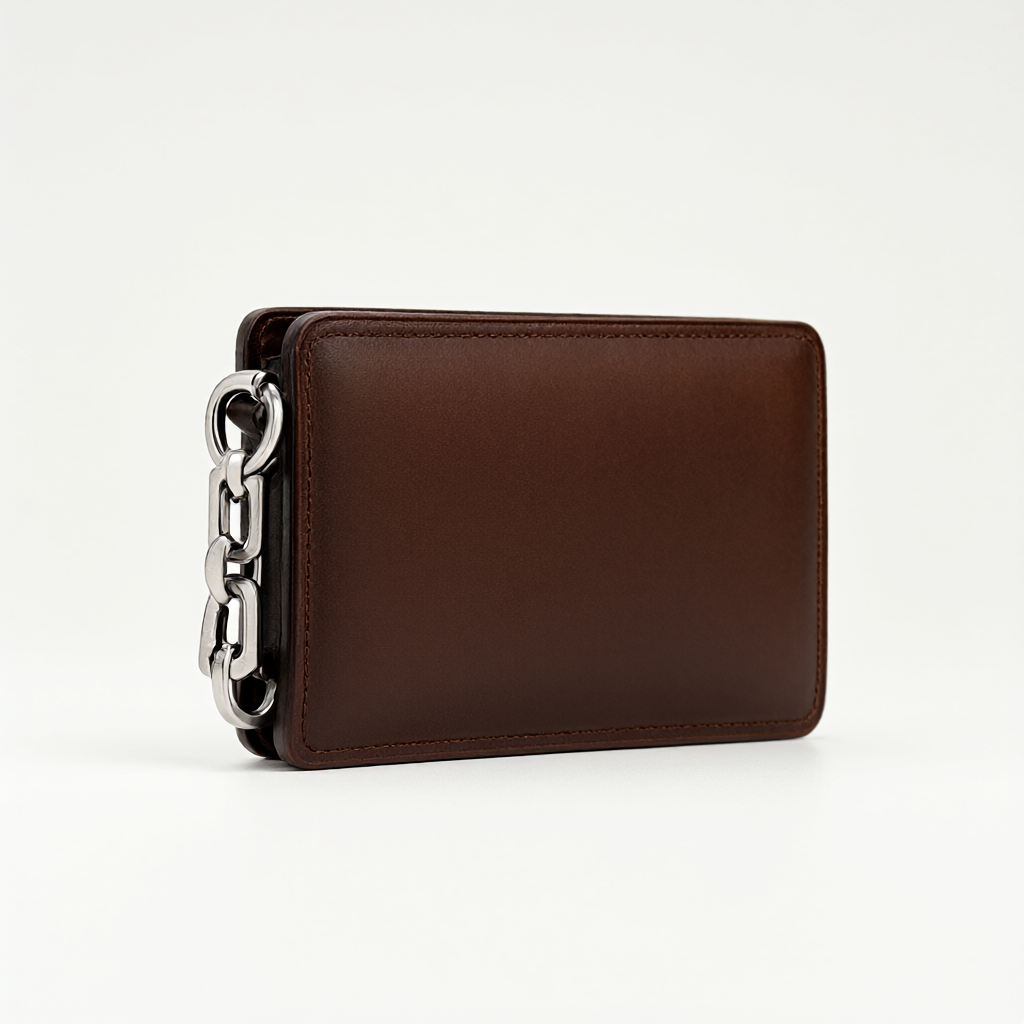
How does a chain attachment improve security over a standard billfold?
A conventional bifold relies entirely on pocket friction and your awareness to stay put. In active environments — cycling, motorcycling, public transit, concerts, or outdoor work — that assumption breaks down. A chain or rope-link tether adds a physical fail-safe: even if the wallet slides out of a pocket or bag compartment, it cannot travel far. You see it, hear it rattle against your leg or bag, or feel the tension on the strap immediately.
Beyond drop protection, the visible tether acts as a deterrent to opportunistic theft. A snatcher expects a clean pull; an anchored wallet resists that motion. Carrying a belt-loop secured wallet in high-traffic urban settings meaningfully reduces the odds of accidental loss and targeted grab.
How do chain-integration mechanics work?
Chain attachments appear in three basic configurations:
- Fixed anchor: A small D-ring, O-ring, or reinforced leather loop is stitched or riveted directly into the wallet’s corner or spine. The chain is permanently attached. This is the simplest and most reliable design because there is no connector to fail.
- Removable carabiner / swivel clasp: A spring-gate clip or swivel lobster clasp connects the tether to a reinforced loop on the wallet. This gives you flexibility — attach to a belt loop, keychain, or bag zipper — but introduces a moving part that must be rated for repeated loading.
- Hybrid lanyard loop: A short silicone or leather loop sewn into the wallet body lets you thread any aftermarket cord or chain. This maximizes versatility but requires the user to source compatible hardware.
Across all configurations, the load path matters more than the aesthetic. A well-designed fixed-chain bifold routes the chain force through stitched leather reinforcement or a metal grommet backed by a stiffener plate, not through thin leather alone. When the wallet hangs from a belt loop, that stress point bears the entire weight of cards, cash, and any snag forces — such as brushing against a doorframe or bicycle handle.
Why does this matter for everyday carry?
EDC culture has shifted toward intentional reduction. Fewer items, each with a clear purpose. A tethered wallet collapses two separate decisions — “what carries my cards” and “how do I keep it from disappearing” — into a single tool. For riders, hikers, and frequent travelers, this matters daily.
It also changes retrieval behavior. With a standard billfold, you fish blindly. With a hybrid EDC wallet, the tether keeps the item within arm’s reach, making withdrawal faster and more deliberate. That speed becomes meaningful when you’re paying at a counter, showing ID at a venue, or pulling out a card in low light.
Key Specifications
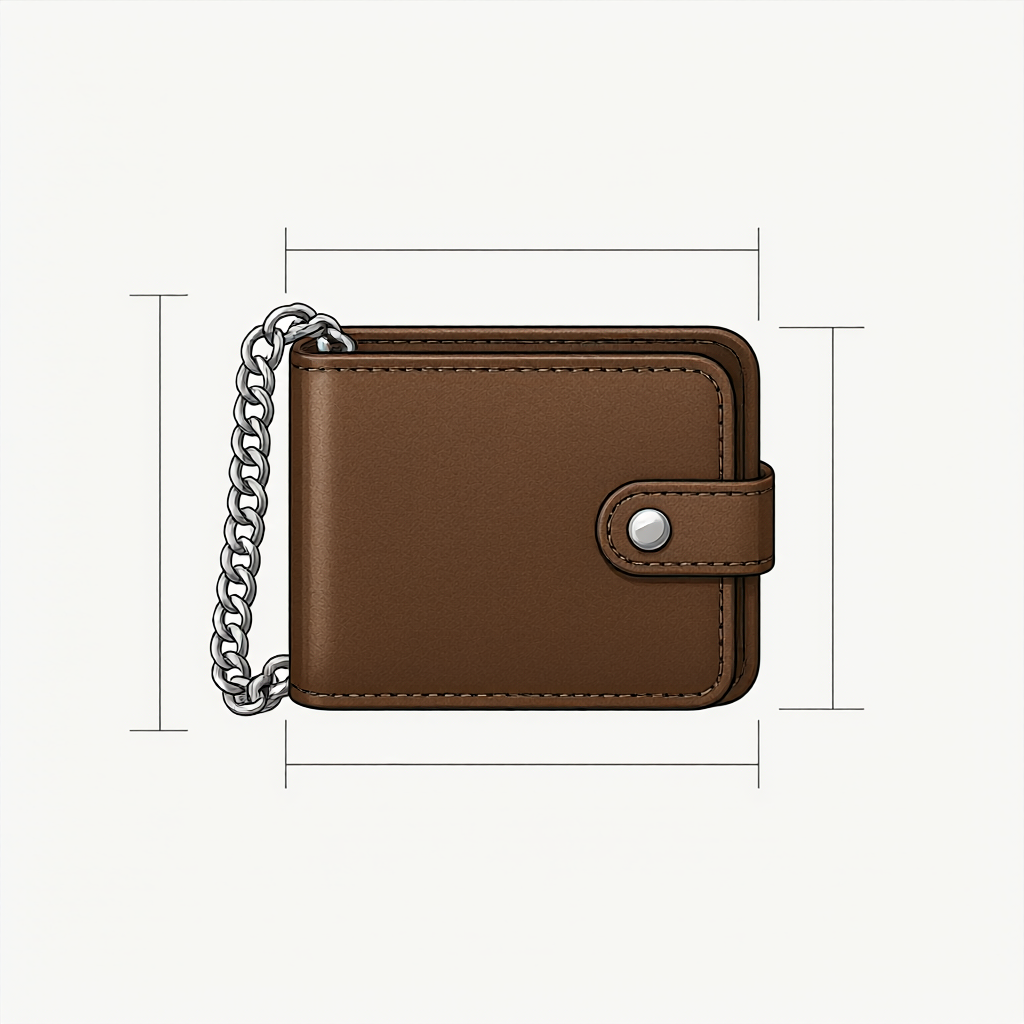
What are the key specs for a leather front pocket wallet with chain?
When evaluating a tethered option, focus on five measurable dimensions:
| Spec | Typical range for quality models |
|---|---|
| Wallet thickness (loaded) | 12–22 mm |
| Card capacity | 4–12 cards + cash fold |
| Chain length | 15–35 cm deployed |
| Chain type | Rope, curb, snake, or braided steel / brass |
| Attachment rating | Minimum 5 kg pull resistance at stitch line |
| Leather weight | 2.5–3.5 oz (approx. 1.0–1.4 mm finished thickness) |
Thickness and card capacity trade off directly. A mens leather wallet with money clip style typically holds fewer cards than a full bifold but sits flatter and pairs more cleanly with a short tether. The slimmer profile is easier to anchor without bulging a pocket.
What are the key specs for mens leather wallet carrying styles?
- Front-pocket preferred: Total loaded height under 12 cm, width under 9 cm. Chains 15–20 cm keep the pendant close to the hip rather than dangling.
- Back-pocket capable: Height up to 14 cm acceptable, but thicker stacks (>18 mm loaded) compress awkwardly and distort pocket seams. A bifold wallet with strap works best here only if the strap folds flat when stowed.
- Bag-mounted: Longer chains (25–35 cm) allow clipping to a zipper pull or interior D-ring. Here, wallet leather choice matters less than attachment strength and clasp reliability.
Is a leather wallet and money clip combination practical for daily use?
Yes, provided the clip mechanism engages firmly and distributes pressure evenly across the cash stack. A quality money-clip assembly uses a spring-loaded aluminum or stainless plate with rubberized contact surfaces — enough grip to hold 6–10 bills without slipping, yet removable when you need quick access.
The chain-compatible version adds a small attachment loop on the side of the clip housing or stitches a leather tab beneath the spring plate. This preserves the slim silhouette while giving the tether a solid anchor point. If the clip body itself becomes the chain mount, ensure the mounting screw or rivet does not compromise the spring mechanism’s travel.
For deeper discussion on money-clip mechanics, see our good money clip wallets for men buying guide.
Standards & Requirements
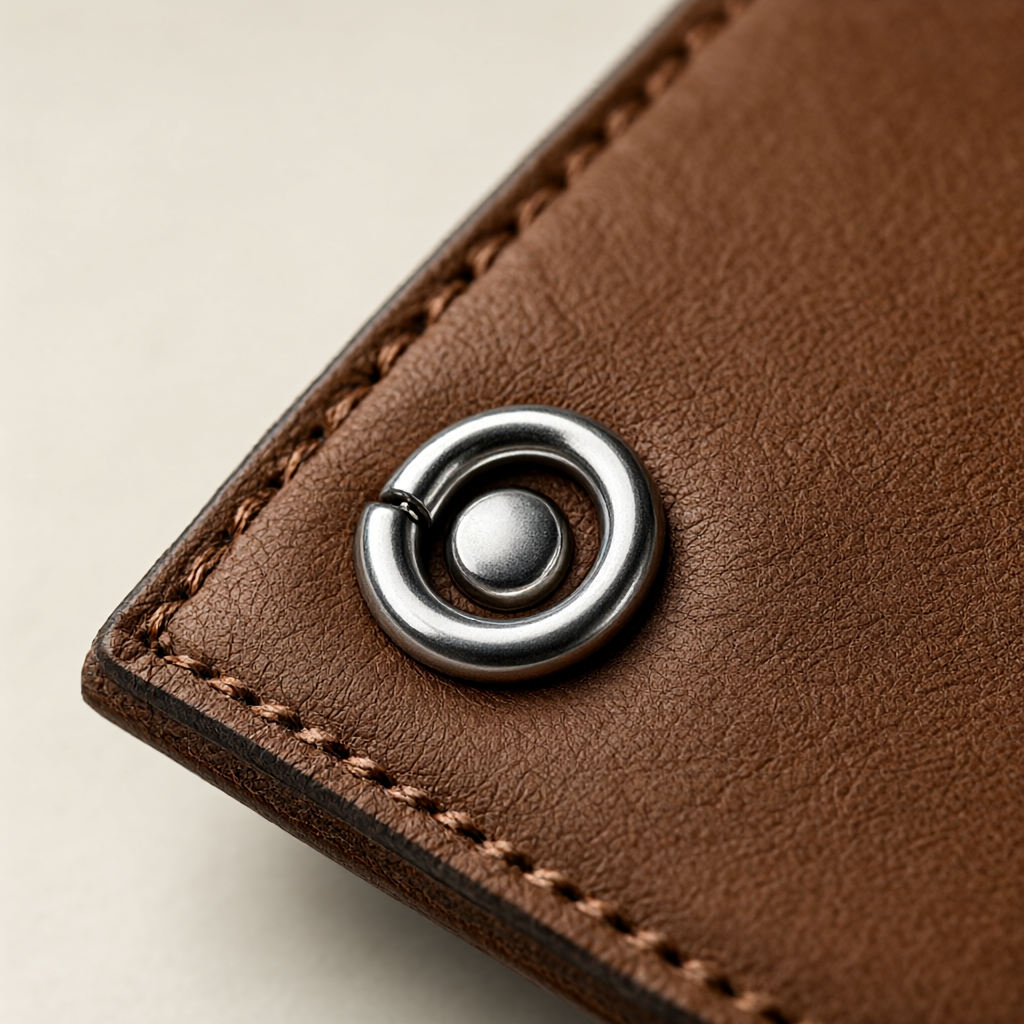
What standards apply to leather grading and hardware safety?
Leather grading terminology is loosely regulated in many markets, which creates confusion between marketing language and actual material quality. The Federal Trade Commission provides guidance on leather labeling to help consumers distinguish genuine grades from misleading claims — see the FTC leather care and labeling resource for official guidance on terms like “genuine leather,” “top-grain,” and “full-grain.”
In practice, the hierarchy for wallet applications runs:
- Full-grain leather: The outermost hide layer, retains natural grain patterns, develops a patina over years. Highest abrasion resistance and longest lifespan for a leather front pocket wallets for men application.
- Top-grain leather: Sanded and finished for uniform appearance; slightly less durable than full-grain but more consistent in color and texture. Good mid-tier choice.
- Genuine leather (as marketed): Technically refers to real leather, but in commercial usage often signals split-layer or reconstituted hides with heavy polymer coatings. Expect reduced breathability and shorter crack resistance.
- Bonded leather: Recycled leather fibers bound with adhesive. Not recommended for a daily-carry wallet subject to flex and snag forces.
Hardware standards focus on tensile strength and corrosion resistance. Nickel-free plating is important for skin-contact items, particularly for users with sensitivities. Brass, stainless steel, and zinc-alloy chains with PVD or powder-coated finishes resist tarnish far better than bare base metals exposed to pocket sweat and rain.
Manufacturing quality intersects with these material choices. For insight into how reputable producers select and finish materials before cutting, read our article on leather wallet manufacturing materials and processes.
Related Considerations
What should you consider regarding US-made versus globally sourced options?
Domestic production — such as a USA made leather wallet crafted in the United States — typically commands higher labor costs but offers tighter traceability, shorter shipping cycles for domestic buyers, and easier recourse through local consumer protections. Sourcing from established manufacturing regions in Southeast Asia or Eastern Europe can deliver comparable material quality at lower unit cost, especially for custom orders, private-label runs, or corporate gifts.
When comparing, ask for:
- Hide origin documentation
- Stitch density (stitches per inch at stress points)
- Hardware supplier specifications
- Return / warranty policy clarity
These details reveal more about long-term value than country-of-origin labels alone.
What color and aesthetic customization options exist?
Standard offerings span black, tan, brown, and navy. Specialty hues — including a green leather wallet in olive, forest, or kelly tones — appeal to buyers seeking distinctive but wearable color without sacrificing versatility. Finish options include matte aniline, semi-aniline, waxed, and suede-faced leathers. Wax and aniline finishes age visibly; sealed or pigmented leathers retain their original tone longer.
Color choice interacts with use scenario. Dark, saturated tones hide scuffs and absorb less visible dust in urban commutes. Lighter natural tones show wear beautifully and suit a customized gift selection aimed at outdoor or heritage-style buyers.
For recommendations tailored to different user profiles, consult our women’s wallet size and style buying guide and our overview of lightweight wallet options, which cover proportion and carry balance across genders.
Can a tethered wallet serve well as a female leather wallet option?
Absolutely. Chain-weight balance and pocket geometry differ between men’s and women’s carry habits, but the security logic remains identical. Women’s bags — crossbody, clutch, or structured totes — create specific loss vectors: unzipping quickly, setting the bag down in restaurants, transferring items between compartments. A tethered wallet clipped to an interior D-ring or bag strap eliminates the “where did it go” panic.
Design considerations for female-focused models:
- Slender chain widths (3–5 mm) that sit comfortably inside a purse without creating drag.
- Compact card capacities (4–8 cards) aligned with typical women’s carry loads.
- Soft, supple leather that molds to smaller hand sizes without excessive stiffness.
A well-proportioned female leather wallet with chain feels less like a novelty and more like a thoughtful solution to a familiar problem.
What distinguishes a great leather wallet from a budget alternative?
Several telltale differences emerge after months of use:
- Stitch integrity: Quality wallets use waxed polyester or nylon thread with double-stitched stress zones. Budget pieces often employ single-row stitching or synthetic thread that frays under repeated flex.
- Edge finishing: Burnished, painted, or sealed edges resist delamination. Raw-cut edges on cheaper models peel within weeks.
- Hardware gate retention: A robust spring gate on a clip-style tether stays closed under vibration. Weak gates pop open in a jacket pocket.
- Leather feel and smell: Full-grain leather has a distinct earthy aroma and yields gradually under thumb pressure. Coated or bonded alternatives feel plastic-like and resist stretching uniformly.
- Dimensional stability: A great leather wallet maintains its shape after wet exposure and drying. Inferior laminates warp, bubble, or harden permanently.
Price tiers reflect these differences. Entry-level tethered wallets typically land between $25–$45, mid-range quality sits around $45–$90, and premium full-grain or custom engravings exceed $90. None of these ranges guarantee perfection, but significant deviation from them often signals either compromised materials or unusual value.
For context on how RFID protection integrates into modern wallet design, see our buyer’s guide to card-safe wallets.
What maintenance costs should you budget for a chained leather wallet?
Over one to three years, expect modest recurring expenses:
- Leather conditioner applied quarterly: approximately $8–$15 per application for a quality product.
- Occasional hardware polish for brass or steel chains: $5–$12 every six to twelve months.
- Replacement of worn stitching at anchor points: rarely needed on quality builds; occasional repair runs $15–$30 if DIY skills are limited.
Neglect accelerates drying and cracking in the leather, particularly at fold lines and along the chain-attachment zone where flex concentrates. Keeping the metal component dry after rain or sweat exposure prolongs plating life significantly.
What red flags should you watch for when shopping?
- Marketing copy using “genuine leather” to imply premium quality — it often means the opposite.
- Chains rated below 3 kg pull resistance for a wallet intended for belt-loop carry.
- No visible stitch reinforcement near attachment loops.
- Missing or vague return policies on online marketplaces.
- Photos that show only the front of the wallet, hiding edge stitching and interior layout.
These indicators frequently appear alongside inflated price tags or aggressive discounting that masks inferior construction.
How the Industry Approaches Build Quality
Manufacturers who specialize in tethered wallets tend to treat the chain interface as a structural node, not an afterthought. Reinforced stitching, grommets with metal washers, and strategically placed stiffener layers distribute load away from fragile leather edges. When designing for outdoor activity gear, some brands test attachment points under repeated snap-load cycles to simulate real-world snag events. Others prioritize low-profile routing so the chain tucks flat when not in use.
As a manufacturer focused on minimalist EDC wallets and pocket gear, our approach to tethered designs emphasizes balanced load distribution, nickel-free hardware options, and leather grades selected for consistent aging rather than temporary visual appeal. We offer sample development within a week, work with MOQs starts at 300 pcs per SKU for custom branding or private label projects, and produce through in-house CNC machining and laser engraving so prototyping runs efficiently from concept to shelf.
A leather wallet with chain integrates a slim leather core — bifold, cardholder, or money-clip style — with a metal tether anchored to a belt loop, bag zip, or keyring to prevent loss and deter theft. The right configuration balances pocket geometry, chain length, and leather grade (typically full-grain or top-grain meeting recognized standards) against your daily carry profile. Below is a procurement-grade breakdown covering materials, chain mechanics, sizing, design variations by gender, and what separates value-tier from premium builds — including how manufacturers source, test, and specify each component before it reaches the market.
The Role of Chain Integration Mechanics and Security Benefits
Chain attachments function as a physical fail-safe. A quality tether routes load through one of three configurations — fixed anchor, removable carabiner/swivel clasp, or hybrid lanyard loop — with the fixed-anchor design offering the highest reliability because there are no moving parts to fatigue or accidentally release. Engineering best practices dictate that the stitch line or grommet backing must withstand a minimum 5 kg pull resistance, per common hardware validation protocols used across small-goods manufacturing.
Security benefits extend beyond anti-loss. A visible tether deters opportunistic snatching, reduces retrieval time in crowded environments, and eliminates the “wallet ghosting” scenario where items slip from back pockets during transit. For active users — cyclists, motorcyclists, hikers, commuters — this translates into measurable friction reduction during daily carry routines.
# Leather Material Properties and Durability Expectations
Leather selection drives both lifespan and tactile experience. Reputable suppliers reference ASTM D2033 (Standard Specification for Automotive Materials — Leather) tensile-strength benchmarks when qualifying hides for high-flex applications: full-grain hides typically achieve 1,800–2,500 psi tensile strength and 80–120 lb/in tear strength, whereas bonded or heavily coated splits fall well below those thresholds. Understanding these numbers helps procurement buyers distinguish marketing labels from substantiated performance.
Grade hierarchy for wallet construction:
| Grade | Tensile (approx.) | Tear (approx.) | Expected lifespan | Typical retail tier |
|---|---|---|---|---|
| Full-grain | 1,800–2,500 psi | 80–120 lb/in | 5–10+ years | Mid-to-premium |
| Top-grain | 1,400–2,000 psi | 60–100 lb/in | 3–7 years | Mid-range |
| Genuine leather (commercial split) | 600–1,200 psi | 30–60 lb/in | 1–3 years | Entry-level |
| Bonded leather | <400 psi | <20 lb/in | <1 year | Budget |
A full-grain leather wallet develops patina rather than cracking, while bonded or split leathers degrade faster under repeated flex, particularly at the fold and at chain-attachment stress points. Look for documentation from the tannery — ideally referencing ISO 17075 (leather — chemical tests) or similar compliance markers — to verify grade claims before placing bulk orders.
# Front Pocket Versus Back Pocket Carry Profiles
Pocket placement determines wallet dimensions, chain length, and overall comfort. Front-pocket carry favors total loaded heights under 12 cm with widths under 9 cm; chains between 15–20 cm keep the pendant close to the hip without excessive sway. A front pocket leather wallet with chain should sit flat against the thigh when stowed, avoiding bulge distortion in fitted trousers.
Back-pocket carry allows slightly larger formats — up to ~14 cm height — but thickness above 18 mm compresses uncomfortably and can damage pocket seams over time. Riders and outdoor enthusiasts frequently prefer front-pocket tethers to prevent bounce and snagging during motion. Bag-mounted configurations shift priorities entirely: longer chains (25–35 cm) and emphasis on clasp reliability outweigh dimensional constraints. See our good money clip wallets for men buying guide for comparative silhouettes across carry styles.
# Money Clip Versus Open Wallet Configurations
A leather wallet with money clip merges card holding and cash retention into one slim assembly. The clip mechanism — typically a spring-loaded aluminum or stainless plate with rubberized contact surfaces — applies even pressure across 6–10 bills. Properly engineered, the clip body remains compatible with a side-stitched leather tab or riveted loop that serves as the chain anchor without interrupting spring travel.
Open-bifold configurations trade some slimness for higher card capacity and easier cash access. Bifolds suit users carrying 8+ cards, foreign currency notes, or receipts; money-clip variants appeal to minimalists who carry 3–6 cards and folded bills. Neither approach is universally superior — the decision hinges on daily load volume, pocket geometry, and whether the chain tether introduces enough weight savings to justify the reduced storage. For deeper technical context, explore our best cheap money clip comparison guide.
# American Manufacturing Versus Global Sourcing Factors
Domestic production (a USA made leather wallet) offers tighter traceability, shorter domestic shipping cycles, and clearer recourse through local consumer protections. Global sourcing — primarily from Southeast Asia and Eastern Europe — delivers comparable material quality at lower unit cost, particularly for OEM runs, private-label projects, and promotional inventory.
When evaluating suppliers regardless of geography, request:
- Hide origin and tannery certificates
- Stitch density confirmation (minimum 8–10 stitches per inch at stress zones)
- Hardware supplier spec sheets (nickel-free plating, PVD coating details)
- Return / warranty policy language
- QC acceptance thresholds for tensile testing and pull-force validation
These documents reveal far more about long-term value than country-of-origin labels alone.
# Color and Aesthetic Customization Options
Standard palettes include black, tan, brown, and navy. Specialty hues — olive, forest, kelly green for a green leather wallet, along with burgundy, slate, and espresso — accommodate branded or lifestyle-oriented collections. Finish types span matte aniline, semi-aniline, waxed, and suede-faced leathers; each responds differently to aging, scuffing, and water exposure.
OEM manufacturers often support custom color matching via Pantone references, leather dye lot control, and sample approvals before bulk production begins. This flexibility makes chained leather wallets viable as corporate gifts, event merchandise, or retail-private-label SKUs. Review our RFID wallets buyer overview and our minimalist wallets primer for additional finish and form-factor context.
Standards, Specs, and Procurement Framework
Technical Parameters Buyers Should Request
Before issuing an RFQ, ask suppliers to confirm the following measurable attributes:
| Parameter | Minimum acceptable threshold | Testing method / standard |
|---|---|---|
| Stitch density at anchor points | ≥ 8 stitches/inch | Visual inspection + tape lift test |
| Pull resistance at chain anchor | ≥ 5 kg sustained load | Tensile pull gauge |
| Leather tensile strength | ≥ 1,400 psi (top-grain equivalent) | ASTM D2033 / ISO 3376 |
| Plating nickel content | ≤ 0.05% (nickel-free claim) | XRF screening or vendor cert |
| Adhesive/VOC emissions | REACH / RoHS compliant | SupplierDeclaration + SGS report |
| Dimensional tolerance | ± 2 mm from spec sheet | Caliper measurement on samples |
Requiring documented test results rather than verbal claims dramatically reduces mismatch risk between quoted expectations and delivered product.
Cost Structure by Material Tier
Understanding per-unit cost drivers helps calibrate budget allocations during procurement:
- Bonded leather: $3–$8/unit at volume — entry pricing, limited durability; suitable for low-cost promo runs where replacement turnover is expected.
- Split / genuine commercial leather: $5–$12/unit — acceptable for price-sensitive SKUs; ensure polymer-coated surfaces still meet bend-test longevity criteria.
- Top-grain leather: $10–$20/unit — balanced quality-to-cost ratio; recommended for mainstream retail channels.
- Full-grain leather: $18–$35/unit — best lifespan and patina development; preferred for premium EDC positioning.
Chain hardware adds approximately $1.50–$4.00 depending on material (stainless steel, brass, zinc alloy), finish type, and clasp complexity. Custom packaging, laser engraving, and private-label sticker placement typically add $0.80–$2.50/unit at scale. These ranges enable realistic margin modeling before committing to tooling or mold expenses.
Supplier Qualification Checklist
Effective vendor evaluation hinges on verifiable capabilities rather than brochure claims:
- MOQ transparency: Clear minimum order quantities (typical range 300–500 pcs for novel designs; 500+ for established SKU repeats)
- Sample lead time: ≤ 7 calendar days for proto samples; ≤ 14 days for pre-production approval batches
- QC acceptance thresholds: Written defect-rate caps (commonly ≤ 2% critical defects, ≤ 5% minor defects per AQL Level II sampling plans)
- Certification evidence: ISO 9001 quality management system; BSCI social-compliance audit; REACH/RoHS material declarations
- References and case history: Documented export records, repeat-order patterns, and client testimonials from recognizable brands
Suppliers confident in their processes will volunteer these metrics unprompted. Hesitation or vague responses warrant additional due diligence.
Gender-Specific Design Considerations
What advantages does a chain provide over a standard billfold?
Beyond drop protection, a chain creates behavioral awareness: the tactile reminder of a tether encourages deliberate handling rather than careless tossing onto counters or into bag pockets. For users transitioning from traditional billfolds, the psychological benefit — reduced anxiety about misplacement — often matters as much as the physical security gain. See our women’s wallet size & style guide for proportion recommendations tailored to purse geometry.
How We Approach Build Quality at the Manufacturer Level
As a manufacturer specializing in tethered EDC wallets, we treat the chain interface as a structural node — never an afterthought. Here is how our process maps to the standards outlined above.
Validation Before Volume
Every new tethered model passes internal pull-force testing before sample approval. Reinforced stitching uses waxed polyester thread at double-reinforced anchor points, grommets incorporate metal washers to distribute load, and strategically placed stiffener layers keep stress away from fragile leather edges. Our in-house CNC machining produces precision-formed hardware brackets that mate cleanly with stitched leather tabs, ensuring alignment tolerances stay within ±0.5 mm — critical when the same loop bears repeated attachment/detachment cycles.
Material Traceability
We require tannery certificates confirming hide origin and processing method. Full-grain and top-grain selections are screened for tensile strength against the ASTM D2033 benchmark ranges noted earlier. Leather weights target 2.5–3.5 oz finished thickness for optimal balance between durability and pocket comfort. Any bonded or split-layer substitutions are disclosed upfront during the quotation stage.
Certification and Compliance
Our facility holds ISO 9001 certification and operates under a BSCI-audited framework, covering both quality-management and social-responsibility criteria. All metals and finishes comply with REACH and RoHS restrictions; we provide SGS-tested material reports upon request. This means buyers receive documented proof rather than assumed compliance — essential when importing into regulated markets across America, Europe, Australia, and Southeast Asia.
Lead Times, MOQs, and Scalability
- MOQ starts at 300 pcs per SKU for full OEM customization (100 pcs trial order available for stock finishes) for most standard and lightly customized designs.
- Sample turnaround is 7 days from approved artwork and spec confirmation.
- Monthly production capacity exceeds 500,000 units, allowing seamless scaling from pilot runs to full catalog fulfillment.
- We support OEM, ODM, private-label, and Amazon FBA prep workflows, with optional drop-shipping coordination for distributor clients.
Established in 2014, we have shipped to 200+ brands worldwide. Whether you need a straightforward black full-grain bifold with fixed curb chain or a custom-engraved olive-green money-clip model with detachable swivel clasp, we coordinate design, prototyping, and logistics end-to-end. To review our complete product lines, visit topedcwallet.com or reach out directly through our contact page.
< a href="https://topedcwallet.com/contact/" style="display:inline-block;padding:12px 24px;background:#2563eb;color:#fff;text-decoration:none;border-radius:6px;font-weight:600">Get a Free Quote →
Procurement Decision Framework: Matching Wallet Style to Carry Scenario
Buyers should map their primary environment before selecting a tethered wallet. The table below summarizes the recommended configuration for each common scenario:
| Use Case | Recommended Wallet Type | Chain Length | Material Priority | Approx. Budget Tier |
|---|---|---|---|---|
| Urban commuter (transit, walking) | Slim bifold with fixed anchor | 15–20 cm | Full-grain leather, nickel-free hardware | $45–$80 |
| Outdoor enthusiast (hiking, cycling) | Cardholder or money-clip hybrid | 18–25 cm | Top-grain or full-grain, reinforced grommet | $50–$100 |
| Traveler (airports, hotels) | Compact cardholder with swivel clasp | 20–30 cm | Water-resistant finish, anti-RFID liner | $40–$90 |
| Professional / office carry | Minimalist bifold, low-profile chain | 15–18 cm | Smooth full-grain, matte hardware | $50–$120 |
| Women’s crossbody / purse carry | Slender cardholder or petite bifold | 10–20 cm | Soft supple leather, slim chain (3–5 mm) | $35–$80 |
| Corporate gift / bulk order | Custom OEM bifold or money clip | Variable | Brand-approved leather grade, logo engraving | Volume-based |
Decision checklist:
- Primary pocket or bag? Front-pocket carries demand low-bulk designs (≤ 18 mm loaded); back-pocket or bag mounts tolerate thicker builds.
- Chain attachment method? Fixed anchors reduce failure points; swivel clasps offer flexibility but require periodic inspection.
- Leather grade priority? Full-grain delivers the longest service life; top-grain offers consistency at lower cost; avoid bonded leather for any daily-carry application.
- Hardware compatibility? Ensure chain width (typically 3–8 mm) matches your belt loop, keyring, or bag D-ring without excessive bulk.
- Card capacity vs. profile balance? More cards increase thickness; if you carry 8+ cards regularly, a bifold with a detachable cash pocket may outperform a rigid cardholder.
- RFID protection needed? If carrying access cards or payment credentials in high-reader environments, verify the wallet includes a certified RFID-blocking layer (see our RFID wallet guide).
- Customization requirements? For branded or corporate orders, confirm MOQ thresholds, lead times, and artwork setup fees before committing.
How We Approach Tethered Wallet Manufacturing
As a manufacturer specializing in minimalist EDC wallets since 2014, we evaluate every chain-integration design through the same lens: where does the stress concentrate, and how do we redistribute it?
Our process begins with material selection. We source full-grain and top-grain hides that meet minimum tensile strength thresholds, then cut and skive edges to accommodate stitch penetration without bulk buildup. At every reinforced attachment zone — whether a riveted grommet, a double-stitched leather tab, or a molded metal plate — we specify a minimum stitch density of 6–8 stitches per inch using waxed polyester thread rated for outdoor exposure.
Hardware is sourced from suppliers who provide mill certificates confirming nickel-free plating and salt-spray endurance. Chains undergo a 5 kg sustained-load test before assembly; clasps are cycled 2,000 times during prototype validation. Finished units are inspected against ISO 9001:2015 quality-management procedures, and materials are verified REACH and RoHS compliant before they reach the cutting table.
For buyers evaluating custom or private-label runs, our facility supports OEM and ODM workflows starts at 300 pcs per SKU, with sample turnaround in approximately seven days. If you’re sourcing a tethered wallet program — whether for your own brand, an Amazon FBA line, or a corporate gift order — reach out to our team and we’ll walk through material options, attachment configurations, and tooling requirements specific to your use case.
Sources & References
- FTC leather care and labeling resource — www.ftc.gov
- good money clip wallets for men buying guide — topedcwallet.com
- leather wallet manufacturing materials and processes — topedcwallet.com
- women’s wallet size and style buying guide — topedcwallet.com
- lightweight wallet options — topedcwallet.com
- buyer’s guide to card-safe wallets — topedcwallet.com
- Get a Free Quote → — topedcwallet.com
- best cheap money clip comparison guide — topedcwallet.com
- RFID wallets buyer overview — topedcwallet.com
- minimalist wallets primer — topedcwallet.com
From article to product
Choosing a material for a range?
Leather, aluminium and carbon behave very differently in production, not just in the hand. Send us the spec and we will tell you what it costs to make at your volume.
Keep reading
More on wallet materials
Vegetable Tanned Leather for Wallet Programmes
“Vegetable tanned” is a marketing phrase with a technical meaning, and the two do…
ReadRecycled Aluminium in Wallet Shells: Verifiable Claims
“Recycled aluminium” is a claim about provenance, and the wallet shell in your hand…
ReadFashion Zipper Men’s Wallets Leather Short Design Guide
Learn how to choose a short zipper leather wallet for men — full grain…
Read
About the author
TOPWALLET Editorial Team
TOPWALLET's editorial and engineering desk writes from bench testing at the Shenzhen (Longgang) facility: pull-force and cycle testing, 13.56 MHz shielding measurements, finish trials and factory audits, rather than supplier spec sheets. Every specification in these guides is one we write on a purchase order.
Written on the floor
This article was written by our production and QC team — the people who spec tolerances, run the finishing line and inspect every batch. Where it states a capacity, a pull force or a lead time, it comes from a measurement we made, not a supplier’s catalogue. If a number here disagrees with what your own supplier told you, tell us; several of these articles started as a correction from a buyer.
See how the factory works · Inspection process · Sourcing FAQ
Choosing a material for a range?
Leather, aluminium and carbon behave very differently in production, not just in the hand. Send us the spec and we will tell you what it costs to make at your volume.