

What Is a Leather RFID Wallet?
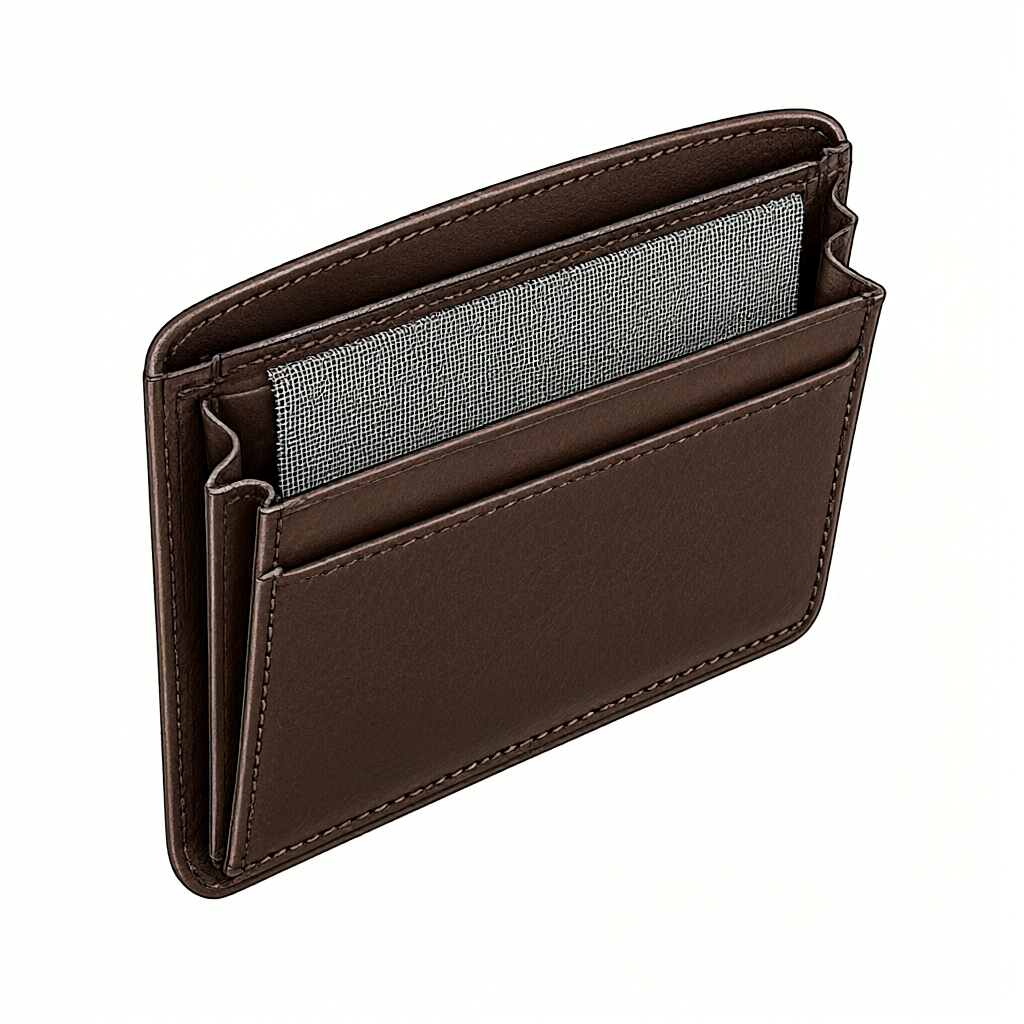
A leather RFID wallet is a pocket carrier built from leather exterior materials with an integrated RFID-blocking layer — typically a metal mesh, foil laminate, or composite sheet — positioned between the leather outer shell and the inner card compartments. The blocking layer creates a Faraday cage effect around contactless cards, passports, and ID chips, preventing radio-frequency interrogation from unauthorized readers.
The term covers many configurations: minimalist card holders, bifold designs, and hybrid organizers. From a sourcing perspective, the core question isn’t whether a wallet claims RFID protection — it’s whether the blocking layer is continuous, properly positioned, and tested against real frequencies. A leather exterior with a poorly placed or incomplete barrier offers little meaningful protection.
How Does RFID Blocking Work Inside a Leather Wallet?
How does the blocking layer function?
RFID-blocking technology relies on electromagnetic interference. When a contactless card emits or receives a radio signal at 13.56 MHz (the standard NFC frequency), a conductive material — aluminum mesh, stainless steel weave, or ferrite-infused composite — disrupts that signal path. The result is that an external reader cannot communicate with the card chip. This is the same principle behind the RFID-lined sleeves you may already use for travel documents.
The blocking layer must form a complete electrical loop around each card slot. Gaps, seams, or cutouts for aesthetics can create signal leaks. In practice, the most effective designs use a wraparound liner or a full interior panel that covers both card slots and the cash compartment, with no exposed card-edge pathways.
Does leather interfere with RFID blocking?
Leather itself is non-conductive and RF-transparent, which is precisely why it’s used as the exterior material. The trade-off is that leather adds thickness, so the blocking layer must be positioned close to the cards rather than at the outer surface. This means manufacturers must engineer the lamination stack carefully — the RFID material goes first, then the leather is bonded over it. The thickness of the leather doesn’t reduce blocking performance, but it does affect how slim the final product remains.
Are RFID wallets still necessary in 2025?
Contactless payment adoption continues to grow globally, and while the actual risk of skilled skimming is lower than marketing often suggests, the baseline protection is inexpensive and adds no meaningful bulk. For B2B buyers, the value proposition shifts: it’s not about fear-based selling but about a feature that buyers increasingly expect as standard. A wallet without any RFID layer may compete on price alone, but one with verified blocking opens up positioning in the mid-range segment where consumers want both aesthetics and security.
Key Specifications — What to Evaluate When Sourcing Leather RFID Wallets
When evaluating a leather RFID wallet for your product line, these are the specifications that determine fit, function, and sourceability:
Card capacity and layout. Typical minimalist leather RFID wallets hold 4–8 cards plus cash. Bifold designs may reach 10–12 cards but sacrifice slimness. Card capacity directly influences internal layering — more card slots mean more opportunities for blocking-layer gaps if the design isn’t carefully engineered.
Leather thickness and grade. Full-grain leather typically runs 1.0–1.4 mm for wallet applications. Top-grain is slightly thinner at 0.8–1.2 mm. Genuine leather, which is the lowest commercial grade, varies widely and often requires heavier treatment to achieve consistent durability. For an RFID wallet, you want leather thick enough to protect the blocking layer from abrasion but thin enough to maintain a slim profile. See our leather wallet guide for detailed grading information.
Blocking material composition. Three common options exist:
- Aluminum foil laminate: most cost-effective, lightweight, but can degrade at fold points over time.
- Stainless steel mesh: durable and wash-resistant, slightly heavier, good for high-volume orders.
- Ferrite composite sheets: best performance per thickness, but more expensive and harder to source in custom colors.
Overall weight. A quality leather RFID wallet typically weighs between 60 g and 110 g depending on card capacity and blocking material. Weights above 120 g usually indicate excessive layering or low-quality dense leather.
Internal dimensions. Standard credit card size is 85.6 × 53.98 mm. Any leather wallet designed for international use must accommodate this dimension with at least 1–2 mm of clearance per slot. Oversized cards (some transit passes, military IDs) may require slightly larger internal tolerances.
What are the key specs for a minimalist leather RFID wallet?
A well-sourced minimalist version typically features: 4–6 card slots, 1.0 mm full-grain or top-grain leather, aluminum or steel mesh blocking liner, overall weight under 80 g, and dimensions no thicker than 18 mm when loaded. These numbers represent the sweet spot where protection, slimness, and leather quality converge.
Standards & Requirements — Certifications That Matter for RFID Wallet Procurement
What standards apply to RFID-blocking wallets?
There is no single mandatory certification for consumer RFID-blocking wallets in most markets. However, two standards provide the technical benchmarks that responsible manufacturers reference:
ISO/IEC 14443 defines the interface standards for proximity cards operating at 13.56 MHz — the frequency used by most contactless payment cards and e-passports. A blocking layer that attenuates signals at this frequency is effectively protecting against the most common NFC-based card reading. More on ISO standards for contactless technology.
FCC Part 15 governs intentional radiators in the United States. While this regulation primarily applies to devices that emit RF energy, it’s relevant for wallets claiming to block signals because the blocking material must not create unintended interference with nearby electronics. Manufacturers testing to FCC guidelines for their blocking materials can demonstrate compliance with this framework. FCC Part 15 regulatory information.
CE marking may apply if the wallet is sold in the European Economic Area, though it is more commonly associated with electronic devices than passive accessories. Some buyers request CE documentation as part of their import compliance process.
What certifications should B2B buyers verify?
Beyond RFID-specific standards, request the following from potential suppliers:
- Material safety compliance: REACH and RoHS declarations confirm the blocking material and leather treatments contain no restricted substances.
- Quality management: ISO 9001 certification indicates the supplier follows documented quality processes, which is critical when you’re specifying custom blocking performance.
- Social compliance: BSCI audits matter if you’re selling through retailers with corporate social responsibility requirements.
Can RFID wallets interfere with contactless payments?
A properly designed leather RFID wallet blocks unwanted scanning but should not prevent the cardholder from using their own card. The blocking layer only becomes active when an external reader attempts to communicate — when you tap your card at a terminal, the reader’s field is strong enough to temporarily override the wallet’s attenuation. If a wallet completely blocks your own card from working, it’s either too thick or poorly designed. This is a useful quick-test: ask suppliers for video demonstration of a blocked card being read by a standard NFC terminal.
Related Considerations — B2B Buying Factors and Common Pitfalls
What should B2B buyers consider when sourcing leather RFID wallets?
The procurement landscape for leather RFID wallets involves several interdependent decisions:
MOQ and customization. MOQ varies significantly depending on whether you’re ordering stock designs or specifying custom tooling. Existing molds and standard blocking layers keep MOQs lower — typically 100–300 pieces for custom branding or color choices. Fully custom designs, including unique blocking geometries or specialty leather sourcing, raise the MOQ and increase tooling investment.
Lead times. Sample development for a new leather RFID wallet typically takes 7–14 days depending on material sourcing and blocking-layer prototyping. Production lead time ranges from 15–30 days for established designs to 30–45 days for fully custom builds. Rush sampling is often available at a premium.
Quality control checkpoints. Key QC moments include incoming leather inspection (color consistency, thickness tolerance, grain pattern), blocking-layer adhesion testing (peel strength after simulated flex cycles), and final functional testing (verified signal attenuation at 13.56 MHz using an NFC tester). Any supplier that cannot demonstrate testing at the final inspection stage is taking a risk on your behalf.
Packaging and labeling. Custom retail packaging adds cost and lead time but is essential for private-label and Amazon FBA sellers. Factor in barcoding requirements, country-of-origin labeling, and any packaging material certifications your target market requires.
What are common misconceptions about RFID wallet protection claims?
Several claims circulate in this category that buyers should evaluate critically:
“The wallet is 100% waterproof.” Leather is not waterproof unless specifically treated, and even treated leather degrades with prolonged moisture exposure. A blocking layer may survive water, but the leather exterior will show wear, discoloration, or stiffness changes.
“The blocking works at any distance.” Real-world RFID blocking effectiveness drops off significantly beyond 3–5 cm for most wallet-sized barriers. Claims of “infinite range” or “blocks all wireless signals” are not technically accurate for a thin passive layer in a wallet.
“Genuine leather is a premium grade.” In the leather industry, “genuine leather” is actually the lowest commercial grade — it refers to split leather layers bonded with adhesive and coated. Full-grain and top-grain are higher grades. See our guide on EDC wallet manufacturing for more on material grades and their sourcing implications.
“RFID wallets are obsolete because skimming is rare.” While actual high-profile skimming incidents are infrequent, the cost of adding verified blocking is minimal relative to the product price. Buyers increasingly expect it as standard, and omitting it narrows your market positioning.
How do leather RFID wallets compare to aluminum or titanium alternatives from a sourcing perspective?
Leather RFID wallets occupy a different segment than their metal counterparts:
| Specification | Leather RFID Wallet | Aluminum/Titanium RFID Wallet |
|---|---|---|
| Exterior material | Full-grain, top-grain, or genuine leather | CNC-machined aluminum or titanium |
| Blocking integration | Interior liner layer (separate component) | Often integrated into the metal body itself |
| Weight (loaded) | 60–110 g | 40–80 g |
| Aesthetic range | Wide — natural grain variations, multiple colors via dye and aniline | Limited to metallic finishes and PVD coatings |
| Customization flexibility | High — embossing, engraving, custom dye, stitching patterns | Moderate — laser engraving and etching available |
| Tooling cost | Lower (molds for leather cutting and stitching) | Higher (CNC programs, finishing jigs) |
| Typical MOQ | 100–300 pcs for custom branding | 200–500 pcs for custom engravings |
| Per-unit cost range | $3–$12 depending on leather grade and blocking material | $5–$20+ depending on metal and finishing |
| Durability profile | Patina develops over time; blocking layer protected internally | Scratch-resistant finishes; blocking is inherent to the material |
| Best buyer use case | Brands targeting traditional aesthetics with security features | Brands targeting tactical, outdoor, or ultra-minimalist segments |
Leather RFID wallets are generally easier to customize for branding — embossed logos, custom stitch colors, and varied leather treatments offer more differentiation at lower tooling cost. Aluminum and titanium wallets rely more on form factor and finish for brand identity. For buyers entering the RFID-protected wallet space, leather offers a lower barrier to entry with broader aesthetic appeal. For established brands seeking a premium, distinctive feel, metal wallets may better serve that positioning.
How the Industry Approaches This?
The leather RFID wallet category has matured considerably, and the difference between a competent manufacturer and a poor one often comes down to three things: how they integrate the blocking layer, how rigorously they test it, and how transparently they communicate specifications.
As a manufacturer, our approach to leather RFID wallets starts with the blocking layer selection. We source certified RFID-shielded liners that are independently tested for attenuation at 13.56 MHz and 125 kHz, the two primary frequencies used by proximity cards and older RFID tags. The liner is laminated between the leather exterior and the interior card pockets, ensuring a continuous conductive barrier around every slot. We avoid aluminum foil laminates for premium lines because they degrade at fold points; instead, we use stainless steel mesh or ferrite composite sheets for better longevity.
For leather sourcing, we prioritize full-grain and top-grain options because they age predictably and maintain structural integrity. We work with tanneries that provide REACH-compliant hide treatments, which matters when your buyers operate in regulated markets. The entire wallet is assembled in our facility, where each production batch undergoes a functional blocking test using an NFC reader and a simulated card. Wallets that fail to attenuate the signal below the required threshold are rejected before packaging.
We also recognize that B2B buyers have different needs depending on their channel. Amazon FBA sellers typically want clean, consistent stock designs with minimal lead time and reliable unit economics. Promotional product distributors prioritize customization speed and competitive per-unit pricing at higher volumes. Corporate gift programs look for premium leather options with subtle branding — debossed logos, foil stamping, or custom card insertions. Each of these channels benefits from a manufacturer that can flex between stock and custom production without compromising quality.
If you’re evaluating suppliers for leather RFID wallets, ask specific questions about their blocking material composition, their testing methodology, and their leather grading standards. The right partner will provide clear answers and documentation — not just marketing claims.
Leather RFID Wallet: Where Can You Verify the Data and Sources?
- More on ISO standards for contactless technology — www.iso.org
- FCC Part 15 regulatory information — www.ftc.gov
- leather wallet guide — topedcwallet.com
- EDC wallet manufacturing — topedcwallet.com
- Get a Free Quote → — topedcwallet.com
From article to product
Building an RFID range?
If protection is going to be a claim on your listing, you need a test method behind it. We test every batch with a live 13.56 MHz reader and supply the report.
Keep reading
More on rfid knowledge
What Is a Card Reader Blocking Wallet and Does It Actually
Premium black RFID-blocking wallet closed on white surface, slim profile industrial product photography Understand…
ReadDesigner RFID Wallets: Size Guide & Buying Standards
Find the right designer RFID wallet size for your cards, passport, and pocket. Compare…
ReadRFID Card Blockers: Do They Actually Work? (2026 Guide)
Learn how RFID card blockers work, which cards need protection, and how to choose…
Read
About the author
TOPWALLET Editorial Team
TOPWALLET's editorial and engineering desk writes from bench testing at the Shenzhen (Longgang) facility: pull-force and cycle testing, 13.56 MHz shielding measurements, finish trials and factory audits, rather than supplier spec sheets. Every specification in these guides is one we write on a purchase order.
Written on the floor
This article was written by our production and QC team — the people who spec tolerances, run the finishing line and inspect every batch. Where it states a capacity, a pull force or a lead time, it comes from a measurement we made, not a supplier’s catalogue. If a number here disagrees with what your own supplier told you, tell us; several of these articles started as a correction from a buyer.
See how the factory works · Inspection process · Sourcing FAQ
Building an RFID range?
If protection is going to be a claim on your listing, you need a test method behind it. We test every batch with a live 13.56 MHz reader and supply the report.