

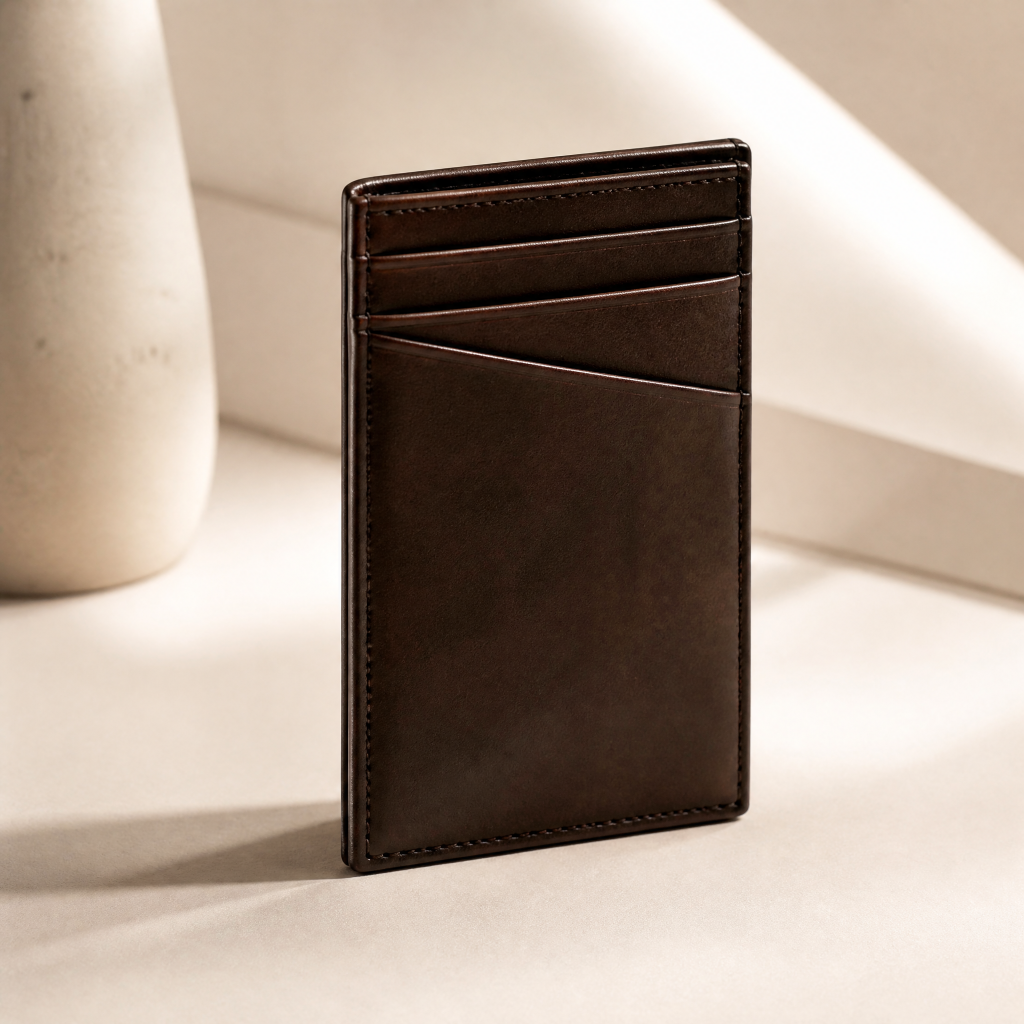
Sourcing wholesale leather wallets through OEM or private label production lets retailers and brands build a wallet collection around their own specifications, branding, and customer needs. The key buying decisions are the design, material specification, minimum order quantity, approved sample, and total delivered cost—not simply the lowest factory quote. This guide explains how to compare wholesale wallets for men, evaluate suppliers, and prepare a first order without relying on vague quality promises.
What is the difference between OEM and private label wallets?
OEM wallet production generally means a manufacturer builds a product to your design and specifications. Private label commonly means applying your branding to an existing supplier design, although suppliers use these terms differently. Confirm exactly which patterns, materials, dimensions, and construction details you can change before comparing offers. Manufacturers may offer both routes, alongside design development support. (larkville.co)
pChoose the route according to what you need to prove:
•
Private label: Consider an existing design when your immediate goal is testing demand, packaging, or brand positioning. Request a physical sample before committing to branded stock.
•
OEM: Consider original development when a distinctive pocket layout, size, closure, or construction is central to the offer. Prepare drawings and measurable requirements rather than a mood board alone.
•
A staged approach: Start with an existing construction, then discuss deeper changes after you understand customer feedback and reorder demand.
pFor either route, document ownership of artwork, tooling, and patterns. Ask whether the same design can be sold to other buyers; your logo alone should not be treated as evidence of exclusivity.
Build the collection around a clear use case
Before requesting bulk men’s wallets, define the everyday problem your collection should solve. A front-pocket customer and a frequent traveler should not receive the same product brief. Specify what the wallet must hold, how it should close when loaded, and where the customer will carry it.
Use this table to organize sample requests, not as a universal pricing hierarchy:
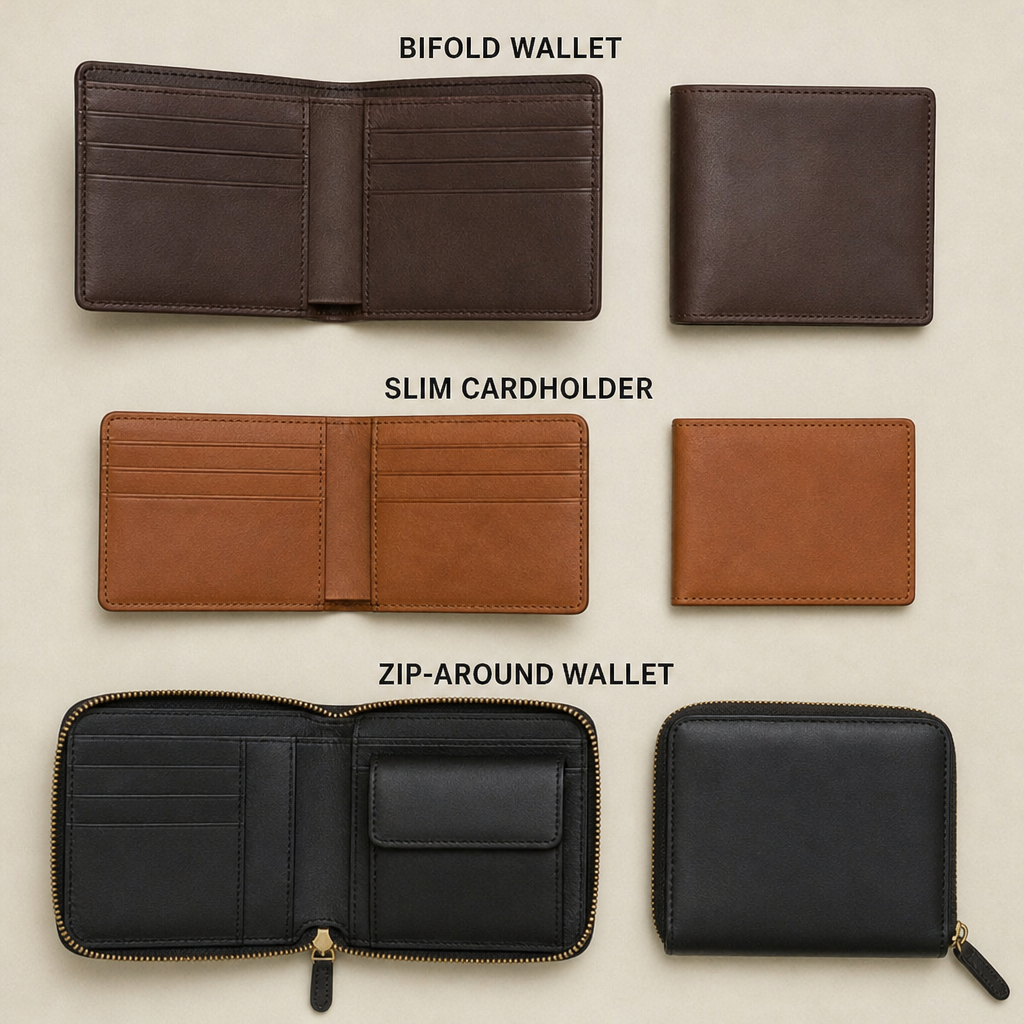
| Wallet format | Intended use to evaluate | Sample checks | Customization questions |
|---|---|---|---|
| Bifold | Everyday cards and cash | Fold alignment, bill fit, loaded thickness | Can pocket count or lining change? |
| Trifold | Multiple cards and identification | Closure when full, access to inner pockets | Can panels be adjusted without excess bulk? |
| Slim cardholder | Minimal everyday carry | Card retention and removal | Is a center pocket or pull tab available? |
| Money clip wallet | Cards with accessible cash | Clip security and comfort | Which clip finishes and attachments are offered? |
| Travel or zip-around wallet | Organized travel documents | Document fit, zipper movement, compartment access | Can dimensions and closures be customized? |
Ask suppliers to quote your chosen formats against the same material and packaging brief. Otherwise, a lower-priced sample may represent a different specification rather than better value.
Specify the material beyond the sales label
Full grain, tanning method, surface finish, and thickness describe different aspects of leather. Full-grain leather retains its entire grain without corrective mechanical removal; corrected-grain leather has undergone partial grain removal and finishing. Those definitions help describe material, but your purchase specification should also identify the actual leather article and approved appearance. (leatherworkinggroup.com)
If a supplier offers top-grain, genuine leather, vegetable-tanned leather, suede, or nubuck, ask for a named material reference and a physical swatch. Do not accept a broad label as the complete specification. Record the approved color, feel, thickness, backing, lining, and acceptable variation so later production can be compared with something concrete.
Request confirmation of the following:
- Exterior and interior materials: Identify each separately, including pocket backing and hidden reinforcement.
- Finish expectations: Agree on texture, sheen, visible markings, and acceptable color variation.
- Performance evidence: Ask what testing is available for rubbing, flexing, abrasion, and color transfer, then agree on relevant requirements.
- Substitution rules: Require written approval before changing the leather, coating, lining, or adhesive.
For U.S. marketing, describe composition accurately. The FTC’s Leather Guides address misleading leather claims and disclosure of non-leather materials that look like leather. If you choose a vegan alternative, identify its actual composition rather than presenting it as animal leather. (ftc.gov)
Make customization serve the product
Logo application, custom lining, hardware, RFID lining, and private label packaging are options offered by wallet manufacturers, but availability depends on the supplier and selected construction. Ask for a production-representative example of each requested feature instead of assuming every catalog option can be combined. (merrisbags.com)
For branding, request samples of debossing, embossing, foil stamping, or engraving on your chosen material. Judge readability at the intended logo size, not from an enlarged digital mockup. Record placement, orientation, dimensions, and the approved visual result.
Treat RFID blocking as a performance requirement rather than decorative wording. Ask the supplier to identify the claimed protection, provide relevant test evidence, and explain whether the report covers your finished construction. Avoid publishing a broad protection claim merely because a lining is described as RFID-blocking.
Packaging needs a specification too: box dimensions, insert, tissue, care card, barcode placement, and shipping protection. Where your sales channel requires GS1 identifiers, account for product variations when planning barcodes; GS1 states that each variation needs its own GTIN. (support.gs1.org)
How much should you order, and what will it really cost?
Your opening quantity should balance the supplier’s minimums with what you can realistically sell, while your budget should include every cost needed to receive saleable inventory. There is no dependable universal MOQ or unit price for wholesale wallets. As one supplier-specific example, Adnan Lederwaren advertises a minimum of 300 pcs per SKU per model and color—not necessarily 100 pieces spread across an entire collection. (adnanlederwaren.nl)
Ask whether minimums apply by design, color, leather article, logo treatment, or packaging version. Request separate quotes for your opening order and a realistic reorder quantity. Also ask whether repeat orders can use the approved materials and tooling without new development charges.
Compare proposals using a shared cost worksheet:
- Wallet unit price against the same specification.
- Sampling, artwork setup, molds, and logo tooling.
- Packaging, labels, inserts, and carton requirements.
- Inspection and agreed testing.
- Freight, insurance, applicable import charges, and delivery fees.
- Responsibility for defects, shortages, replacements, and rework.
Confirm which items are included and which remain estimates. Use the resulting delivered-cost estimate for planning, then allow separately for your selling expenses and returns.
Attractive men’s wallet deals should survive this comparison. Affordable men’s wallets are a useful positioning goal; cheap men’s wallets are a poor purchasing brief unless material, construction, and acceptance requirements remain explicit.
Evaluate the supplier, not just the showroom sample
Send shortlisted suppliers the same specification and ask them to explain how they would make it. Request evidence of comparable work, identify the production location, and establish which operations are performed by subcontractors. A clear explanation of limitations is more useful than an immediate promise to meet every request.
For local and offshore candidates, compare the same practical factors: communication, sample access, inspection arrangements, delivered cost, shipping responsibility, and reorder support. Do not assume geography alone determines quality or responsiveness. Ask who owns the project when the salesperson is unavailable and how production changes are approved.
Use certifications and audit reports as evidence with a defined scope. Verify the issuing organization, facility name, validity, and relevance to your order. For leather sourcing, LWG provides supplier certification information and assesses traceability, but you should still establish which leather source supplies your selected material. (leatherworkinggroup.com)
Ask for documentation connecting sourcing claims to the proposed material, rather than accepting a logo in a presentation. Keep environmental statements narrow enough to match the evidence. LWG distinguishes supply chain mapping, chain of custody, and traceability; one document should not be assumed to establish all three. (leatherworkinggroup.com)
Finally, have an appropriate testing or compliance specialist identify requirements for your destination market and construction. Agree on the necessary documents before production instead of collecting unrelated certificates afterward.
Turn sampling into an approval process
A sample should answer whether the proposed wallet works—not merely whether it photographs well. Create an approval sheet before the sample arrives, then evaluate it using the cards, currency, and documents your intended customer will carry. Keep dated photographs and written comments so revisions remain traceable.
Use this practical sample checklist:
- Load it realistically. Fill the stated card slots and cash compartment. Check access, retention, folding, and closure without forcing the product.
- Inspect construction. Look closely at pocket alignment, seams, loose threads, exposed adhesive, edge finishing, and hardware attachment. Ask the manufacturer to explain any weak-looking area.
- Check touchpoints. Repeatedly handle the fold, zipper, clip, and card openings. Record observations, while recognizing that informal handling does not replace agreed laboratory testing.
- Compare branding and packaging. Confirm logo placement, spelling, color, inserts, barcode details, and fit inside the box.
- Approve a reference. Identify the accepted sample and specification revision. Require approval of any later material or construction change.
When a sample fails, describe the failure precisely. “The loaded wallet does not close under its own weight” gives the developer more direction than “make it better.” Ask for a revised sample when a change affects fit, construction, material, or the promised customer experience.
Plan production around checkpoints, not a headline lead time
Ask for a schedule that separates material procurement, sample revisions, approval, production, inspection, packing, and transport. Confirm the event that starts each period: deposit receipt, artwork approval, material availability, or final sample approval. Leave room to resolve problems before promising customers a launch date.
Agree on checks at material receipt, early production, and before shipment. Define which defects require correction and who authorizes release. If you use an independent inspector, provide the approved specification, reference sample details, quantity breakdown, packaging requirements, and agreed inspection instructions.
Put the commercial agreement in writing, including payment milestones, delivery responsibilities, permitted substitutions, shortage handling, and defect remedies. Ask what happens if an inspection fails and whether reinspection or replacement freight is covered. Avoid relying on an informal assurance that issues will be fixed with the next order.
For reorders, retain the approved sample, artwork, material references, and inspection records. Review customer returns and complaints before repeating the specification. Use actual feedback to decide whether the next order needs a design change or simply tighter production control.
Choose a focused first order
For an initial collection, consider one clear customer promise: compact everyday carry, organized cash storage, or a gift-ready presentation. Benchmark competing products through observable details such as layout, finish, packaging, stated materials, and service—not retail price alone. Use those observations to sharpen your brief without copying another brand’s design.
The strongest sourcing decision is the one you can explain and verify. Start with a focused specification, compare equivalent quotes, approve a representative sample, and document production expectations. That approach gives your wholesale men’s wallet collection a clearer identity while keeping purchasing decisions grounded in evidence.
From article to product
Turning this into a product?
Most of what is written here is the difference between a sample that works and one that does not. We can build either — the useful one costs the same.
Keep reading
More on buying guides
wallet with trigger
How Does a Trigger Wallet Work? What Is the Pop-Up Mechanism? The core of…
Readbest bifold wallet for women
What Is a Bifold Wallet? The term “bifold” refers to the fold: the wallet…
ReadMen’s trifold wallets with zipper compartments vs. bifold
At a Glance The three dominant men’s wallet formats differ in panel count, depth,…
Read
About the author
TOPWALLET Editorial Team
TOPWALLET's editorial and engineering desk writes from bench testing at the Shenzhen (Longgang) facility: pull-force and cycle testing, 13.56 MHz shielding measurements, finish trials and factory audits, rather than supplier spec sheets. Every specification in these guides is one we write on a purchase order.
Written on the floor
This article was written by our production and QC team — the people who spec tolerances, run the finishing line and inspect every batch. Where it states a capacity, a pull force or a lead time, it comes from a measurement we made, not a supplier’s catalogue. If a number here disagrees with what your own supplier told you, tell us; several of these articles started as a correction from a buyer.
See how the factory works · Inspection process · Sourcing FAQ
Turning this into a product?
Most of what is written here is the difference between a sample that works and one that does not. We can build either — the useful one costs the same.