
Wallet Manufacturing · 9 min read
RFID Blocking Wallets: OEM Manufacturing, Testing & Compliance Guide

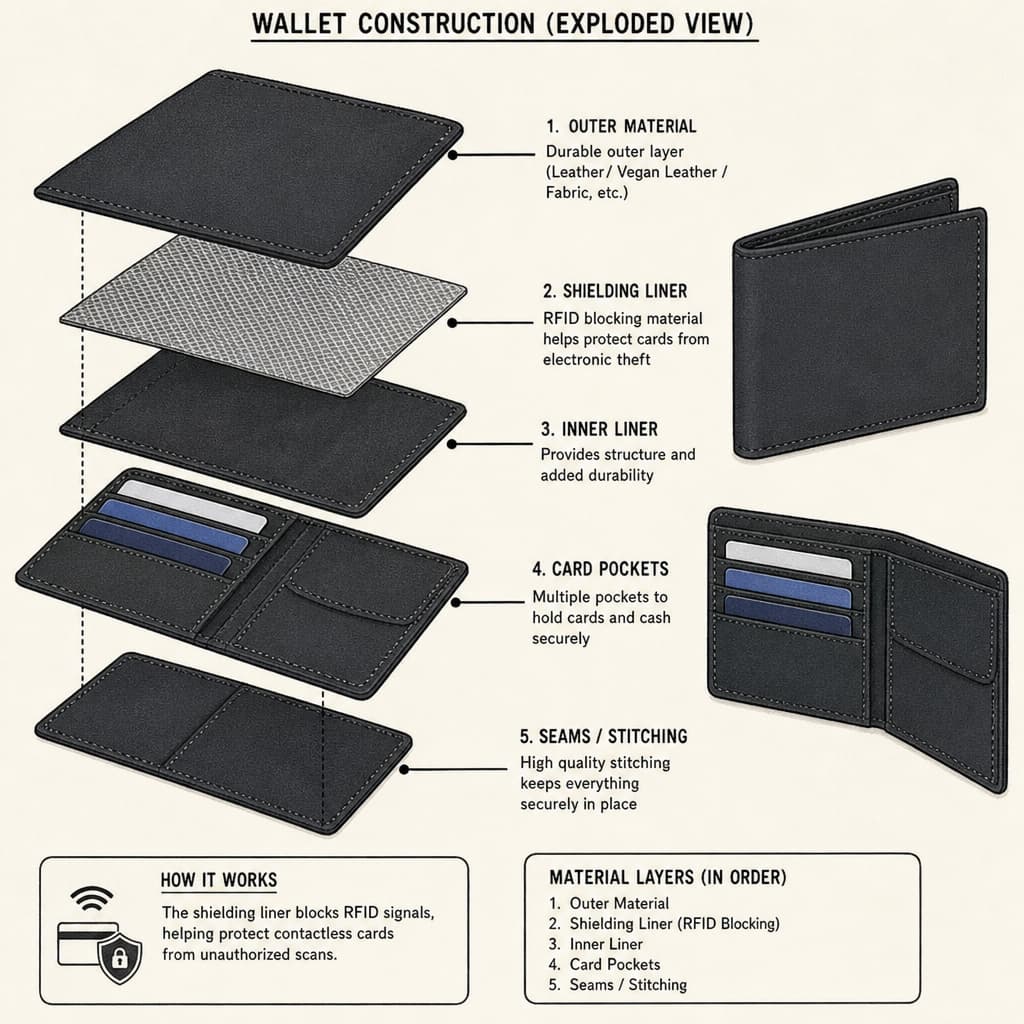
Quick answer: an RFID-blocking wallet only earns its claim when the finished product is tested as a product — defined frequency band, defined protected pockets, defined closure state, documented reader protocol and retained evidence. Material samples and supplier reports are screening tools, not proof. This guide turns that into an OEM specification, a test protocol and a compliance file.
RFID blocking wallets use conductive shielding to limit communication between contactless cards and compatible readers. For original equipment manufacturers (OEMs), reliable protection starts with a defined frequency range, suitable materials, and repeatable testing of the finished product — not an “RFID lining” label. This guide shows how to convert those requirements into a sourcing, manufacturing and claims-validation process your factory and your customer can both audit.
How Does RFID Blocking Work in a Wallet?
RFID blocking technology interferes with the electromagnetic coupling that lets a reader power and communicate with a contactless card. Conductive material near an NFC antenna generates opposing fields and disrupts that exchange. In a wallet, the intended outcome is narrower than the marketing: a protected card cannot establish communication under the conditions described in the product claim. For the underlying mechanics in consumer terms, see what an RFID wallet is and how blocking works, and for the material-level detail read RFID blocking technology and implementation for wallets.
Why Is the Narrower Claim Better for RFID Blocking Wallets?
For an OEM brief, replace “blocks RFID” with a testable requirement: name the card technologies, the protected compartments, the closure position and the intended card loading. That gives designers and laboratories one shared target instead of an ambiguous promise that sales and engineering interpret differently.
Which Frequency Decides What RFID Blocking Wallets Can Claim?
High-frequency RFID and NFC operate at 13.56 MHz, low-frequency access credentials typically sit around 125–134 kHz, and UHF systems use other bands with different coupling. Texas Instruments sets out these bands and their coupling methods in Navigating your way through the RFID jungle. Success against one system does not establish protection against every RFID application, and a single NFC demonstration cannot validate protection across unrelated bands.
Write the frequency down before you write the claim. If a wallet is specified for 13.56 MHz card and passport readers only, say so, and refuse any marketing line that implies coverage of 125 kHz access cards or UHF logistics tags. The procurement-side consequences of that wording are covered in RFID protection: how it works and why it matters.
Which Shielding Materials Should RFID Blocking Wallets OEM Buyers Compare?
The best material is the construction that meets your finished-wallet test requirements at acceptable weight and cost. Conductive foils, metal housings and metallised textiles are all candidates, but a material name alone cannot establish performance — compare thickness, coverage, construction and frequency-specific evidence. Use the table below to organise sampling, not as a performance ranking.
| Construction | Manufacturing fit | Verify before approval |
|---|---|---|
| Aluminium foil, laminate or housing | Lightweight, cost-focused designs | Finished weight, fold behaviour, edge coverage, assembled performance |
| Copper foil or copper-bearing textile | Structured or flexible products | Actual thickness, handling requirements, cost per finished wallet |
| Nickel-copper metallised fabric | Sewn linings and flexible constructions | Coating specification, seam layout, processing limits, durability |
| Stainless-steel-thread textile | Conductive fabric alternatives | Weave, bulk, performance at the claimed frequency |
Do not automatically classify copper as “maximum protection” or aluminium as “moderate”. Request comparable samples and reports, then judge the complete assembly — cutting, lamination, sewing, inspection and scrap — rather than the shielding material in isolation. If the same program also sells metal-bodied wallets, the material trade-offs in aluminium versus stainless steel wallets apply alongside these liner choices.
Mu-metal solves a different problem: low-frequency magnetic shielding through high permeability. Its specialist processing makes it a material to investigate for a defined need, not an automatic upgrade for an everyday wallet. Equally, do not infer shielding performance from a “graphite” label — require evidence for every claimed function.
How Do You Convert an RFID Claim Into an OEM Specification?
Before requesting custom RFID wallets, prepare a written specification that connects design choices to acceptance tests, and ask every RFID wallet supplier in an OEM program to quote the same requirements so price differences become meaningful. A lower quotation is impossible to judge if one factory includes full compartment shielding and another proposes a small insert.
What Must the RFQ for RFID Blocking Wallets Establish?
- Protection scope: named card technologies, frequencies and exactly which pockets are protected.
- Material controls: shielding composition, thickness or fabric weight, approved supplier, substitution rules.
- Construction details: shield coverage, overlap, fold placement, closure, permitted tolerances.
- User configuration: maximum card loading and whether the wallet must be closed to protect.
- Acceptance evidence: approved samples, finished-product tests, durability checks, retained production records.
For an RFID purse, specify one protected card compartment instead of implying every pocket is shielded. For a wallet with an exterior quick-access pocket, decide deliberately whether that pocket stays readable, and make the distinction explicit in both testing and instructions. If the product also carries a tracker, add a separate functional test with the wallet loaded and closed: shielding and tracking are different claims and need different evidence.
Supplier selection sits upstream of all of this — the twelve-point vetting process in choosing an RFID wallet manufacturer is worth completing before samples are cut.
How Do OEMs Test Finished RFID Blocking Wallets?
Test completed wallets with a documented reader-and-card protocol, an unshielded baseline and repeatable conditions. Material testing screens candidates; only product-level testing shows the assembled wallet prevents reads in the configuration the customer receives. The steps below are the minimum a laboratory or factory QA team should be able to reproduce from your file.
What Belongs in a Wallet Development Test Protocol?
Hold three checkpoints: bare card in shield, card in assembled wallet, and wallet after 50 flex cycles. Each checkpoint needs a fixed reader distance, so results stay comparable between builds and labs.
- Confirm the baseline: each selected card reads reliably outside the wallet with the chosen reader.
- Record the setup: reader hardware, settings, card type, orientation, distance, wallet configuration.
- Test every protected pocket: both faces, edges, folds and closure areas — never one favourable position.
- Vary realistic loading: a single card and the intended maximum, recorded separately.
- Challenge the construction: repeat after agreed flexing, abrasion, closure cycling and environmental conditioning.
- Verify production consistency: sample across the pilot run and later lots, including material changes.
Define pass/fail before testing. A defensible example: no successful communication during the agreed sequence, with the baseline still readable. Ask the laboratory to justify reader choice, exposure conditions and sample quantity. A phone demonstration only counts when that phone reliably reads that card outside the wallet first — otherwise the test proves nothing, and consumers can reproduce the same failing demo at home using the steps in testing an RFID wallet at home.
Production-lot inspection is a separate discipline from shielding validation. The AQL sampling and inspection sequence in the RFID wallet quality control checklist is where repeatability is actually enforced.
How Should RFID Blocking Wallets Match Evidence to the Claim?
Keep test methods, laboratory reports and product certifications distinct. ASTM D4935 measures shielding effectiveness of planar materials under specified far-field conditions across 30 MHz to 1.5 GHz — see the ASTM D4935 scope. That range does not directly cover 13.56 MHz near-field wallet performance, so such a material report must never be presented as conclusive proof of the wallet claim.
Ask the laboratory to explain its method’s relevance, limitations and coverage of the assembled product. If a supplier offers a certificate, check the issuing organisation, tested model, sample description, frequency range and actual results. Avoid converting a narrow report into an unrestricted “RFID certified” statement.
For US marketing, the FTC requires a reasonable basis for objective advertising claims before publication, as set out in its policy statement on advertising substantiation. Lines such as “RFID secure wallets”, “blocks all frequencies” or “prevents identity theft” invite a broader reading than the evidence supports, so qualify them and retain the documents behind them. Material, labelling and electronics requirements for each destination market are a separate workstream — start from the REACH, CPSIA, Prop 65 and RoHS checklist and confirm scope with a qualified compliance partner.
What Everyday Benefits and Care Apply to RFID Blocking Wallets?
Frame RFID protection as control over when a compatible credential can communicate, not as complete financial security. EMV contactless transactions already use cryptographic protections, including a one-time transaction cryptogram — described by EMVCo. A shielding wallet adds a physical communication barrier; it does not replace payment-system safeguards, which is also why the real-world risk picture in whether RFID skimming is still a real threat matters more than fear-based copy.
Legitimate use cases exist: a commuter wanting deliberate card presentation, a traveller choosing one protected document compartment. Avoid implying that airports, transit stations or malls automatically create contactless theft risk. Sell a verified feature, not an unsupported narrative.
Write care instructions around the approved construction — permitted cleaning, drying, heat exposure and handling — rather than promising universal washability. Conductive textile care varies by coating and weave, and the wallet’s adhesives and outer materials matter as much as the liner. Build the routine from the material-by-material guidance in how to clean a wallet.
Why Is Repeatability the Release Criterion for RFID Blocking Wallets?
Approve a production wallet only when design, test results, instructions and claims agree. Keep a reference sample, record every material substitution, and require retesting whenever a change could affect protection. Cost is part of that equation: shielding and assembly choices move unit price, and how material choice changes factory cost shows where that money actually lands.
That turns an RFID feature from a sourcing checkbox into a controlled product requirement — and gives customers a clearer understanding of what they are buying, which is the only durable basis for an “RFID blocking wallet” claim.
RFID Blocking Wallets OEM FAQ: Certification, Card Safety, and Lead Times — Which Questions Do Buyers Ask Most?
Do RFID blocking wallets need FCC or CE radio approval?
No. A passive metal or foil shield is not a radio transmitter, so it does not require FCC or CE radio certification. What buyers should hold instead is material evidence: REACH and RoHS declarations for the shield and liner, plus an attenuation test report supporting the blocking claim you print on the pack.
Can a metal wallet demagnetize cards or damage a magstripe?
No magnet, no damage — the risk comes from magnets, not metal. An aluminum or titanium body is non-magnetic, and card chips are passive, so nothing is erased by proximity; the only real wear risk is abrasion at slot edges, which edge radius and deburring control.
What MOQ and lead time should an OEM RFID wallet order expect?
Plan on a 100-piece pilot MOQ and roughly 15–25 production days after sample sign-off. Tooling and anodizing setup add time on the first run only, so ask for the tooling line and the sample window separately instead of accepting one bundled lead time.
From article to product
Sourcing minimalist-wallets?
Tell us the format, the quantity and the date you need stock. You get material options, MOQ and a landed-cost range back within one business day.
Keep reading
More on wallet manufacturing
Sustainable Packaging for Wallet Shipments
Packaging is where sustainability claims are cheapest to make and easiest to disprove. A…
ReadTake-Back and Recycling Programmes for Wallet Brands
A take-back programme is easy to announce and hard to run. Wallets are the…
ReadNickel Release Rules for Wallet Hardware
Nickel release is the one restriction in a wallet that is decided by the…
Read
About the author
TOPWALLET Editorial Team
TOPWALLET's editorial and engineering desk writes from bench testing at the Shenzhen (Longgang) facility: pull-force and cycle testing, 13.56 MHz shielding measurements, finish trials and factory audits, rather than supplier spec sheets. Every specification in these guides is one we write on a purchase order.
Written on the floor
This article was written by our production and QC team — the people who spec tolerances, run the finishing line and inspect every batch. Where it states a capacity, a pull force or a lead time, it comes from a measurement we made, not a supplier’s catalogue. If a number here disagrees with what your own supplier told you, tell us; several of these articles started as a correction from a buyer.
See how the factory works · Inspection process · Sourcing FAQ
Sourcing minimalist-wallets?
Tell us the format, the quantity and the date you need stock. You get material options, MOQ and a landed-cost range back within one business day.