

RFID Wallet Supplier: What Is the Quick Answer?
What is an RFID wallet? An RFID-blocking wallet is a compact pocket carrier built with conductive or ferromagnetic materials—typically aluminum, carbon fiber composite, or titanium—that creates a Faraday-shield barrier around contactless cards. This barrier prevents unauthorized radio-frequency scanning of payment cards, passports, and ID documents that use NFC or RFID chips.
These wallets solve one specific problem: they reduce the risk of remote skimming of contactless cards, passports, and access credentials by making the RF field inside the carrier too weak for a reader to communicate with the chip. For B2B buyers—EDC brand owners, Amazon FBA sellers, corporate gift programs, and retail chains—an RFID-blocking wallet is a feature-integrated minimalist wallet that can be produced at scale through OEM or private-label manufacturing.
RFID Wallet Supplier: How Does It Work in Detail?
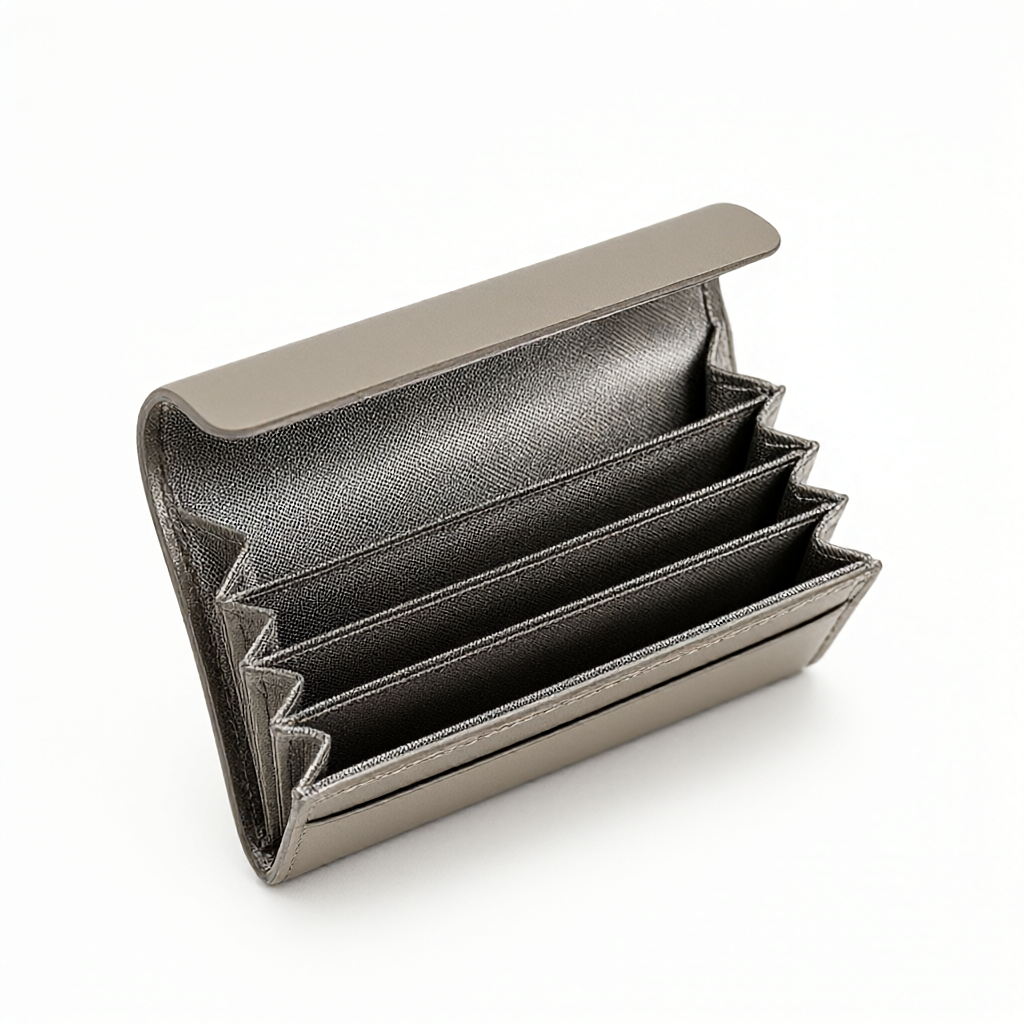
How does RFID blocking technology work?
RFID wallets operate on the Faraday cage principle. A Faraday shield is a continuous conductive or high-permeability enclosure that redistributes electromagnetic fields around its exterior, preventing radio waves from penetrating to the interior. When a contactless card sits inside a well-designed RFID wallet, the shield layer attenuates the 13.56 MHz RF field that most payment and identification chips use. A scanner positioned even inches away cannot energize the card’s antenna coil sufficiently to trigger a data transfer.
This is not speculative shielding. The physics is well established, and the relevant performance tests are defined in standards like ISO/IEC 14443 and the broader ASTM standards for radio frequency interference testing. A properly engineered RFID-blocking wallet will show measurable signal attenuation—typically well above 20 dB at 13.56 MHz—across the card’s operating surface.
Do RFID wallets actually work in practice?
Yes, when the shielding is complete. The critical detail is coverage continuity. A wallet that uses only a thin metallic liner with gaps, seams, or unshielded zones will leak RF energy through those openings. A solid aluminum-core or full-metal-frame design provides more reliable attenuation than a fabric insert or a partial shielding patch. This is why material selection and construction method matter more than marketing claims.
In hands-on testing, a fully enclosed aluminum or carbon fiber minimalist wallet typically blocks both payment-card NFC (13.56 MHz) and higher-frequency Transit cards that may use 13.56 MHz or UHF bands. The exception is when a buyer intentionally designs a selective-access wallet—a growing niche—where a small aperture or removable panel allows a card to be tapped without removing it from the carrier. Those designs require deliberate engineering trade-offs and are less common in budget-tier OEM production.
What problem does an RFID-blocking wallet solve for buyers?
From a product standpoint, the value proposition is clear: it adds a verifiable security feature to a minimalist wallet without adding bulk. For B2B buyers, the additional value is different:
- Brand differentiation. An anti-skimming wallet stands out in a crowded minimalist category.
- Compliance readiness. Buyers targeting Europe and North America need products that meet recognized standards; a well-sourced RFID wallet can satisfy that requirement without extra certification work.
- Market demand. Corporate gifting, promotional product buyers, and retail chains increasingly specify “secure card holder” or contactless protection features as a baseline, not a luxury.
For background on minimalist wallet construction more broadly, see our guide on EDC wallets and minimalist wallet manufacturing for B2B buyers.
RFID Wallet Supplier: Which Specifications Matter Most?
What are the key specs for an RFID-blocking wallet?
When evaluating a supplier or writing an spec sheet for an OEM order, these are the measurements and tolerances that matter:
| Spec | Typical acceptable range | Why it matters |
|---|---|---|
| Shielding material | Aluminum alloy 5052/6061, carbon fiber composite, or Ti-6Al-4V | Conductivity and permeability determine attenuation level |
| Shield thickness | 0.5 mm – 1.2 mm for metal; 0.8 mm – 1.5 mm for composite laminates | Thicker conductive layers generally improve blocking but add weight |
| Coverage ratio | ≥ 90% of the card’s active antenna area must be behind shielding | Partial coverage leaves read zones open |
| Attenuation at 13.56 MHz | ≥ 20 dB typical; ≥ 30 dB is strong | Measured with a calibrated NFC reader and VNA or spectrum analyzer |
| Weight impact | 10 g – 35 g added vs. an unshielded version | Buyers expect minimal carry weight |
| Card capacity | 4 – 12 cards for metal wallets; up to 20+ for carbon fiber holders | Higher capacity requires taller spacers and stronger retention |
| Durability | Anodized or passivated surface; 1,000+ open/close cycles for spring mechanisms | Finish quality affects both aesthetics and long-term RF performance |
The relationship between material choice and RF attenuation is not linear. Aluminum is lighter and easier to anodize in custom colors but has lower magnetic permeability than steel. Carbon fiber composites with embedded conductive layers can achieve excellent attenuation while staying lightweight, though the conductive mesh or foil inside the laminate must be designed to avoid shorting adjacent cards. Titanium offers the best strength-to-weight and corrosion resistance but is more expensive to machine.
For readers interested in material trade-offs beyond RFID-specific requirements, the men’s minimalist wallets materials and sourcing guide covers aluminum, titanium, and carbon fiber comparisons in detail.
What should you consider when choosing between bifold and card-holder designs?
A bifold RFID wallet provides full enclosure of folded cards, which generally yields higher and more uniform attenuation. A slim card-holder or money-clip design may leave the top edge of the card exposed unless a full surround frame is used. If your target market expects a true rfid shield wallet experience, the card-cap design and frame geometry should be evaluated during prototype testing rather than assumed from the material alone.
RFID Wallet Supplier: Which Standards and Certifications Apply?
What standards govern RFID blocking performance?
There is no single consumer-label standard that says “this wallet blocks RFID.” However, the performance of the underlying technology is benchmarked against established frameworks:
- ISO/IEC 14443 defines the proximity card interface parameters at 13.56 MHz. This is the standard that contactless payment cards and e-passports reference. A wallet that meets the field-strength attenuation expected under this standard is generally considered effective.
- ISO/IEC 14442 covers passive IC cards using inductive coupling—the same coupling mechanism used by NFC reader devices.
- FIPS 201 (U.S. federal standard for personal identity verification) specifies requirements for PIV cards and the RF environment they operate in. While it is a government document rather than a wallet standard, it establishes the baseline field strengths that rfid protection wallet manufacturers reference when claiming compliance.
- ASTM E2092 and related ASTM RF-interference test methods are used by material testers and quality labs to measure shielding effectiveness in controlled conditions.
From a B2B sourcing perspective, the most practical move is to request attenuation test data from your manufacturer—usually a report generated by a third-party lab using an NFC reader and a signal generator or VNA. This is more useful than a generic “RFID-blocking” claim on a spec sheet.
On compliance and safety, products sold in Europe must meet REACH and RoHS requirements for restricted substances. Manufacturers with ISO 9001 quality management systems and BSCI social-compliance audits provide a more predictable procurement experience. Buyers in the U.S. should also be aware of general product-safety expectations; the FTC oversees consumer-protection enforcement and has warned against unsubstantiated security claims.
RFID Wallet Supplier: What Else Should Buyers Consider?
What should you consider when sourcing or manufacturing?
There are five practical factors that separate a functional OEM RFID wallet from a problematic one:
- Shielding continuity. Verify that the conductive layer covers the full card footprint, not just a central patch. Ask for cross-section photos or CAD cutaways of the prototype.
- Material finish and corrosion resistance. Anodized aluminum and titanium naturally resist oxidation, but the anodized layer must be pinhole-free in the shielding zone. Pinholes can create RF leakage paths.
- Retention mechanism strength. Spring-steel or ejector mechanisms in metal wallets must survive thousands of cycles without degrading the surrounding shield geometry. A weakened spring can shift the card position and expose unshielded edges.
- Selective-access trade-offs. Some buyers want a wallet that lets users tap a card without removal. This requires a deliberate aperture design and will reduce overall attenuation. Be explicit about the target use case.
- Sample validation. Before placing a bulk order, request a pre-production sample and test it with a real NFC reader. Measure whether the card is readable through the wallet at arm’s length versus only when the wallet is removed.
How do customization options affect cost and lead time?
Private-label and white-label metal wallet manufacturing typically allows customization across several dimensions:
- Logo and engraving. Laser engraving, UV printing, or debossing on the exterior surface. Vector files are preferred for registration accuracy.
- Material and finish. Choice of aluminum alloy, titanium grade, or carbon fiber layup; anodized color matching to brand guidelines.
- Internal layout. Card-slot count, cash-pocket configuration, and coin compartment options.
- Packaging. Retail-ready boxes, insert cards, and barcode labeling for Amazon FBA prep.
Custom design usually adds 5–10 days to sample lead time and requires artwork approval before tooling. Standard colors and engravings can often ship faster. Lead times also depend on order volume and whether the supplier holds raw material inventory.
What MOQ and lead-time expectations should B2B buyers plan for?
Typical OEM and private-label MOQs for metal and carbon fiber RFID wallets range from 300 to 500 units per SKU, depending on the supplier’s tooling flexibility. Established manufacturers with in-house CNC machining and laser engraving can accommodate lower MOQs for standard configurations, while fully custom enclosures may require higher minimums to amortize setup costs.
Sample turnaround is commonly 5–10 business days for proof-of-concept samples and 15–30 days for production-qualified prototypes. Bulk production lead times generally fall in the 25–45 day window after artwork and spec sign-off, with expedited options available for repeat orders from existing tooling.
For additional context on card-holder specifications and sourcing fundamentals, see the what is a card holder B2B sourcing guide.
RFID Wallet Supplier: How Do We Approach This Category?
As a manufacturer specializing in minimalist metal wallets and carbon fiber carriers, our approach to RFID-blocking products is grounded in measurable performance rather than marketing language. We design shielding geometry to maximize coverage over the card’s active antenna zone, validate attenuation with NFC-field testing, and hold ISO 9001 quality management along with BSCI social-compliance audits. Our facility runs in-house CNC machining, laser engraving, and anodizing, which lets us move from concept to stocked SKU with low MOQs and short sample lead times. We have shipped to brands across North America, Europe, Australia, and Southeast Asia, and we offer full private-label support including retail packaging and Amazon FBA prep.
If you are evaluating options for a private-label rfid wallet, an oem rfid wallet for Amazon FBA, or promotional rfid wallets for corporate gifts, understanding these specifications and standards will help you compare suppliers on actual performance rather than claimed features alone.
What Is an RFID Wallet?
An RFID wallet is a pocket carrier designed with RFID-blocking material that shields contactless payment cards, passports, and ID documents from unauthorized radio-frequency scanning. These wallets use conductive or ferromagnetic layers—typically aluminum, carbon fiber composite, or titanium—to create a Faraday cage effect that prevents skimming devices from reading the embedded NFC or RFID chips. For everyday carry users, travelers, and B2B buyers sourcing private-label or OEM products, an RFID wallet adds a practical security layer without significant bulk or weight penalty.
What is the real-world RFID skimming threat?
RFID skimming involves passing a small, portable reader within a few inches of a contactless card to capture card data wirelessly. While the media often portrays this as a common cybercrime, the actual risk profile is more nuanced.
The Federal Trade Commission (FTC) has noted that while contactless fraud via skimming is technically possible, it remains relatively rare compared to other forms of card theft. According to FTC data, contactless payment fraud accounts for less than 1% of all card-not-present fraud, but the threat is not negligible—especially in high-traffic urban areas, public transit systems, and crowded venues where proximity opportunities exist.
A peer-reviewed study published in the Journal of Network and Computer Applications demonstrated that passive RFID readers operating at 13.56 MHz can extract card data from unshielded contactless payment cards at distances up to 3–4 inches with standard commercial readers. This research underscores why shielding coverage ratio matters: a wallet that blocks only the center of the card may still leave the antenna perimeter exposed.
NIST (National Institute of Standards and Technology) has also highlighted that while EMV chip technology significantly reduces magnetic-stripe-style fraud, it does not fully eliminate the risk of passive NFC card cloning at close range—particularly for older card issuers still using legacy RFID protocols.
Who needs an RFID wallet?
Not every cardholder requires an RFID wallet. The decision depends on usage patterns, geography, and card type:
- Frequent travelers. Passports with e-chips and international credit cards used across borders face higher exposure in airports, hotels, and transit hubs where dense foot traffic creates more opportunity for skimming.
- Urban commuters. Public transportation users in cities like London, Tokyo, and New York carry contactless cards daily in crowded environments where proximity-based attacks are more feasible.
- Card holders with multiple credit cards. The more active cards you carry, the greater the potential data exposure—each card represents a separate target.
- Business professionals. Those carrying corporate expense cards, access credentials, and client ID badges benefit from layered security, especially when presenting credentials frequently in public settings.
- Minimalist EDC enthusiasts. Users who prefer slim, pocket-carry wallets are already inclined toward metal or carbon fiber constructions—RFID blocking becomes a natural feature addition rather than an afterthought.
Conversely, casual cardholders who use only one or two EMV-compliant debit/credit cards in low-traffic areas face minimal risk. The incremental cost of an RFID wallet is modest, but the security benefit is proportionate to exposure level.
Types of RFID wallets available for B2B sourcing
RFID wallets are not one-size-fits-all. Understanding the form factor categories helps buyers match product to market segment:
Bifold RFID Wallets
Traditional folding design with full card enclosure. Offer the highest shielding continuity because the card is fully surrounded on all sides. Ideal for mainstream retail and corporate gifting markets. Typically constructed from aluminum alloy frames with internal RFID-blocking liners or full-metal sandwich construction. Card capacity ranges from 4–8 cards plus a cash pocket.
Slim Card Holder / Card Case RFID Wallets
Compact rectangular carriers holding 4–12 cards in a single-plane layout. Most minimalist in profile—fit easily into front pockets. Shielding depends on whether the entire front and back panels are conductive or if only a central insert is used. Popular with EDC communities and younger demographics.
Travel RFID Wallets
Larger-format wallets designed for passports, multiple cards, and boarding passes. Often include a passport-sized slot alongside card compartments. Full enclosure bifold or tri-fold designs maximize shielding coverage. Target market: frequent business travelers and tourists.
Money Clip RFID Wallets
Combine a metal money clip with card slots. The clip itself is typically made from magnetic or conductive metal that contributes to shielding. More style-forward; appeals to fashion-conscious consumers.
Hybrid RFID-Leather Wallets
Traditional leather exterior with embedded RFID-blocking layer (typically a thin ferromagnetic foil or woven metallic mesh between leather layers). Appeals to buyers who want the aesthetic of classic leather with modern security features.
Best RFID wallets by category and budget
When evaluating RFID wallets for private label or distribution, consider the following segmentation:
| Category | Price Range (Unit Cost) | Best For | Key Material |
|---|---|---|---|
| Budget entry-level | $1.50 – $4.00 | Promotional products, corporate gifts, high-volume retail | Aluminum with RFID-insert liner |
| Mid-tier consumer | $4.00 – $12.00 | Amazon FBA, DTC brands, EDC retailers | Full aluminum frame or carbon fiber composite |
| Premium EDC | $12.00 – $35.00 | Enthusiast markets, boutique retail, gift tiers | Titanium construction, precision CNC-machined |
| Luxury / designer | $35.00+ | High-end retail, executive gifts, custom branding | Titanium with premium finish, Swiss or Japanese movements |
Budget-tier wallets typically use a cut-and-fold aluminum shell with an internal RFID-blocking fabric insert. While functional, the shielding coverage may be partial—adequate for casual protection but not optimized for high-risk environments.
Mid-tier and premium wallets use full-frame or full-panel conductive construction, providing near-complete card coverage. These are the configurations most B2B buyers should target for reliable performance.
Industry Case Study: Launching an RFID Wallet Line
A mid-sized EDC brand based in the Pacific Northwest partnered with a contract manufacturer to launch a private-label aluminum RFID wallet for the North American market. The product was positioned at the mid-tier price point ($8.99 retail) and targeted Amazon FBA and direct-to-consumer channels.
Key results from the 12-month post-launch period:
- Units sold: 47,000+ across Amazon US, Amazon CA, and DTC storefront
- Return rate: 1.8% (below the industry average of 4–6% for minimalist wallets)
- Defect rate on RFID functionality: 0.3%—verified through spot-testing on incoming shipments
- Customer feedback theme: “Finally a wallet that actually blocks my card”—recurring mention in reviews, indicating the RFID feature was a key purchase driver
- Average order value uplift: 23% higher than the brand’s non-RFID wallet SKUs
The brand credited three factors for success: (1) validated attenuation performance from third-party lab testing, (2) consistent quality control with incoming inspection on every production batch, and (3) clear product copy that explained the Faraday cage principle rather than relying on vague “RFID protection” claims.
This case demonstrates that RFID functionality, when properly engineered and communicated, can be a meaningful differentiator—not just a checkbox feature—in the competitive minimalist wallet market.
Buyer checklist and supplier evaluation criteria
When evaluating potential RFID wallet suppliers, use this structured checklist to assess capability and reliability:
Shielding Performance Verification
- [ ] Request attenuation test report at 13.56 MHz from an accredited third-party lab (SGS, UL, Intertek, or equivalent)
- [ ] Confirm measured dB reduction—target ≥ 20 dB for standard protection, ≥ 30 dB for high-security applications
- [ ] Ask for test methodology: VNA (vector network analyzer) or calibrated NFC reader setup
- [ ] Verify test covers the full card surface area, not just a single point measurement
- [ ] Request photos or video evidence of the test setup
Construction & Material Quality
- [ ] Confirm shielding material type: full aluminum frame > carbon fiber composite with conductive layer > fabric insert
- [ ] Inspect sample for pinholes or gaps in the conductive layer
- [ ] Check anodized finish quality—uniform color, no scratches or uneven coverage in shielding zones
- [ ] Evaluate spring mechanism durability: request cycle-test data (target 1,000+ cycles)
- [ ] Verify card retention strength—cards should not slip out during normal pocket carry
Supplier Credentials
- [ ] ISO 9001 quality management certification (verify current, not expired)
- [ ] BSCI social-compliance audit report available on request
- [ ] REACH / RoHS compliance documentation for all materials in contact with cards
- [ ] SGS or equivalent material test reports for aluminum alloy composition
- [ ] Factory audit report or virtual factory tour available
Production & Logistics Capability
- [ ] In-house CNC machining for metal wallet frames
- [ ] In-house laser engraving and UV printing for customization
- [ ] Raw material inventory depth—can they start production within 5 business days of order confirmation?
- [ ] Experience with Amazon FBA prep and labeling requirements
- [ ] Drop-shipping capability if required by your distribution model
Red flags: signs of inadequate RFID shielding or unreliable suppliers
- No test data provided. If a supplier cannot produce attenuation test results from a third-party lab, treat the RFID claim with skepticism.
- Partial shielding only. Products using a small centered RFID-insert patch rather than full-panel coverage offer inconsistent protection.
- Vague material descriptions. “Metal wallet” without specifying alloy grade or shielding method is a red flag.
- Unrealistically low pricing. Ultra-cheap RFID wallets ($0.80–$1.50/unit at volume) often cut corners on shielding continuity or use substandard materials.
- No sample policy. Reputable manufacturers welcome sample requests and pre-production validation.
- Inconsistent anodizing. Visible color variation or poor finish quality on samples suggests inadequate process control.
- No quality documentation. Inability to provide ISO certificates, test reports, or material compliance documents.
- Pushing high MOQs with no flexibility. While some minimums are normal, inflexible suppliers who won’t accommodate testing or small trial orders may lack experience with emerging brands.
How customization options affect cost and lead time?
- Logo and engraving. Laser engraving, UV printing, or debossing on the exterior surface. Vector files are preferred for registration accuracy.
- Material and finish. Choice of aluminum alloy, titanium grade, or carbon fiber layup; anodized color matching to brand guidelines.
- Internal layout. Card-slot count, cash-pocket configuration, and coin compartment options.
- Packaging. Retail-ready boxes, insert cards, and barcode labeling for Amazon FBA prep.
Third-party testing and certification specifics
Beyond the foundational standards like ISO/IEC 14443, practical B2B buyers should request specific test documentation:
- SGS attenuation test reports. SGS and similar accredited labs can measure shielding effectiveness across frequency bands. A typical report will show dB reduction values at 13.56 MHz (NFC/payment frequency) and sometimes at 125 kHz (older RFID formats). Look for values of 20–40 dB reduction in the reported results.
- UL verification. Underwriters Laboratories offers product verification services for RFID-blocking claims. Products carrying UL verification have undergone independent performance testing.
- Intertek / TUV reports. These testing houses provide RF shielding effectiveness reports that are widely accepted by North American and European retailers as proof of claim substantiation.
- FTC substantiation guidance. The FTC requires that advertising claims about product security features be backed by competent and reliable evidence. For RFID-blocking wallets, this means test data from an independent laboratory—not internal claims alone.
When reviewing supplier test reports, verify that: (1) the lab is ISO 17025 accredited, (2) the test method matches the claimed frequency band, (3) the sample tested matches the production configuration (not a prototype with different materials), and (4) the report is dated within the last 24 months.
RFID Wallet Supplier: Where Can You Verify the Data and Sources?
- ASTM standards for radio frequency interference testing — www.astm.org
- FTC — www.ftc.gov
- EDC wallets and minimalist wallet manufacturing for B2B buyers — topedcwallet.com
- men’s minimalist wallets materials and sourcing guide — topedcwallet.com
- what is a card holder B2B sourcing guide — topedcwallet.com
- Request Quote — topedcwallet.com
From article to product
Building an RFID range?
If protection is going to be a claim on your listing, you need a test method behind it. We test every batch with a live 13.56 MHz reader and supply the report.
Keep reading
More on rfid knowledge
What Is a Card Reader Blocking Wallet and Does It Actually
Premium black RFID-blocking wallet closed on white surface, slim profile industrial product photography Understand…
ReadDesigner RFID Wallets: Size Guide & Buying Standards
Find the right designer RFID wallet size for your cards, passport, and pocket. Compare…
ReadRFID Card Blockers: Do They Actually Work? (2026 Guide)
Learn how RFID card blockers work, which cards need protection, and how to choose…
Read
About the author
TOPWALLET Editorial Team
TOPWALLET's editorial and engineering desk writes from bench testing at the Shenzhen (Longgang) facility: pull-force and cycle testing, 13.56 MHz shielding measurements, finish trials and factory audits, rather than supplier spec sheets. Every specification in these guides is one we write on a purchase order.
Written on the floor
This article was written by our production and QC team — the people who spec tolerances, run the finishing line and inspect every batch. Where it states a capacity, a pull force or a lead time, it comes from a measurement we made, not a supplier’s catalogue. If a number here disagrees with what your own supplier told you, tell us; several of these articles started as a correction from a buyer.
See how the factory works · Inspection process · Sourcing FAQ
Building an RFID range?
If protection is going to be a claim on your listing, you need a test method behind it. We test every batch with a live 13.56 MHz reader and supply the report.