

RFID Card Protector: What Is the Quick Answer?
The best RFID card protector for bulk purchasing depends on your application — but the core requirement is consistent: a Faraday-cage design that blocks 13.56 MHz contactless payment frequencies. For B2B buyers, the decision comes down to three factors: blocking effectiveness (verified by test standards), material durability (aluminum, carbon fiber, or titanium), and manufacturing capabilities (MOQ, lead time, certification compliance). An ISO 9001–certified OEM manufacturer with in-house CNC machining and low MOQ flexibility (300+ units) will typically deliver the best value for private-label programs.
RFID Card Protector: How Does It Work in Detail?
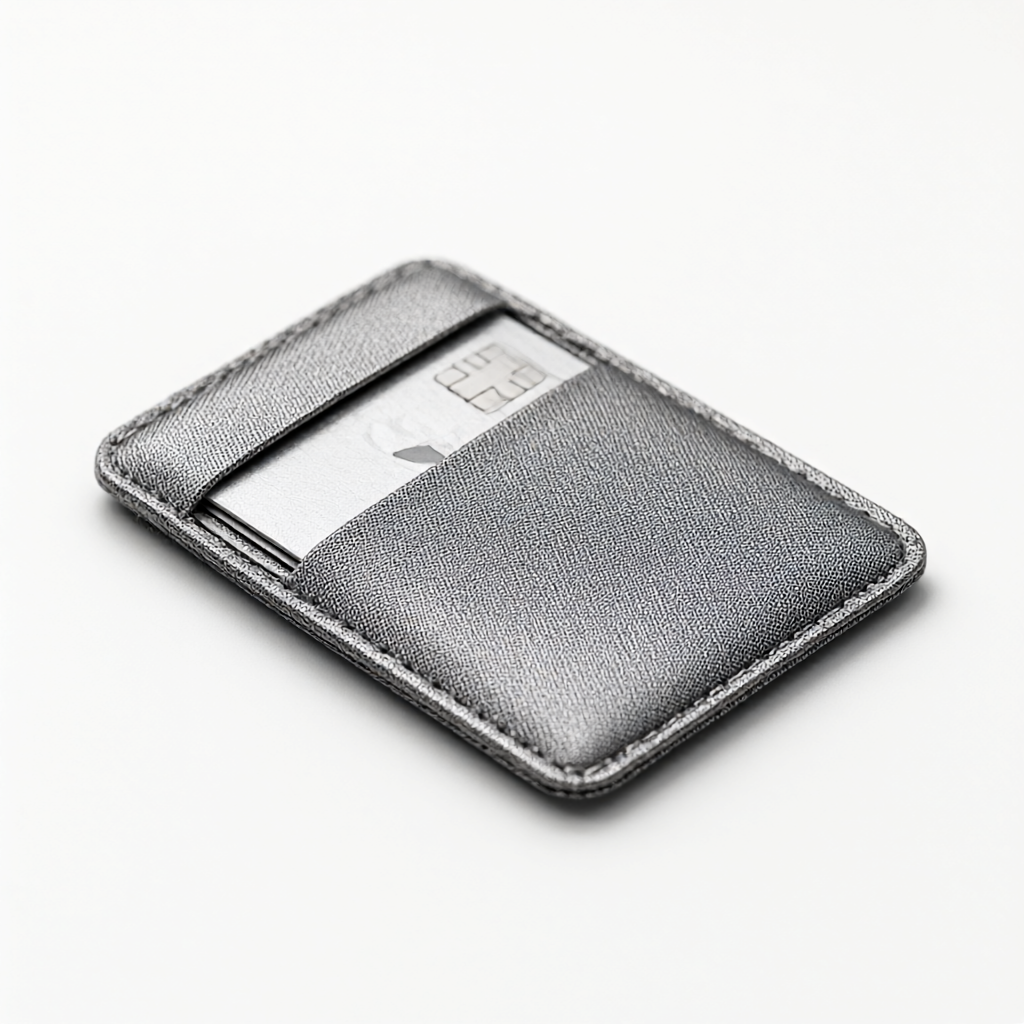
What RFID scanning threats exist for contactless cards?
Contactless cards — credit cards, transit passes, employee badges — operate at 13.56 MHz using RFID or NFC protocols. A skimmer positioned within a few centimeters can induced-read card data without physical contact. This is not theoretical: EMVCo maintains specifications precisely because unauthorized reading of contactless payment data is a documented risk, particularly in crowded transit environments and point-of-sale queues.
For B2B buyers sourcing corporate wallets, promotional items, or EDC product lines, the threat profile varies by end-user context:
- Transit and urban commuters face the highest exposure due to dense proximity in crowds.
- Corporate gift programs need protection for employee ID badges and access cards.
- EDC brand products market RFID blocking as a core functional feature — not a luxury add-on.
How does a Faraday cage stop contactless card skimming?
An RFID-blocking card holder works by enclosing cards within a continuous conductive barrier — typically aluminum foil laminated inside a wallet body, or a solid aluminum/titanium shell. This barrier acts as a Faraday cage, reflecting and absorbing the 13.56 MHz electromagnetic field before it reaches the card’s antenna coil. Without a complete conductive path, the card cannot receive or transmit data.
Two design variables determine real-world effectiveness:
- Continuity of the shield. Any gap — a hinge, a缝 line, or an open slot — creates a leakage point. Solid-core metal wallets (no moving parts) inherently outperform layered constructions where shield seams may misalign.
- Shield thickness and conductivity. Thinner foil layers reduce card capacity but may compromise longevity. Machined aluminum or titanium shells provide permanent shielding with no degradation over time.
Comparison of aluminum, carbon fiber, and titanium as RFID shield materials
| Material | RFID Blocking | Durability | Weight | Cost Tier | Best For |
|---|---|---|---|---|---|
| Aluminum | Excellent (solid-core) | High — anodized finish resists scratches | Low | Mid | Private-label wallets, promotional programs |
| Carbon fiber | Good (requires internal metallic layer) | Very high — impact and scratch resistant | Very low | Upper-mid | Premium EDC brands, outdoor-oriented buyers |
| Titanium | Excellent (inherent conductivity) | Exceptional — corrosion-resistant, hypoallergenic | Low | Premium | Luxury EDC, medical or hypersensitive-use cases |
Key distinction: Carbon fiber itself is non-conductive. A “carbon fiber RFID wallet” achieves shielding through an internal aluminum or metallic fabric liner. The carbon fiber exterior is aesthetic and structural; the conductive layer does the blocking. Buyers should verify that the shielded layer is continuous and not fragmented by card slots or cutouts.
Aluminum wallets offer the best balance of proven blocking performance, manufacturing scalability, and cost control — making them the default choice for most B2B programs. See our minimalist wallet material comparison for deeper specification guidance.
RFID Card Protector: Which Specifications Matter Most?
What are the key specs for evaluating an RFID card protector?
When evaluating products for private label or wholesale procurement, focus on these measurable criteria:
Blocking frequency range. The standard contactless payment frequency is 13.56 MHz. A合格的 RFID blocker should demonstrate attenuation of at least 25 dB at this frequency. Some products also block lower-frequency RFID (125 kHz) used in older access cards — verify whether your use case requires dual-band protection.
Card capacity vs. shield integrity. Adding more cards increases wallet thickness, which can compromise the Faraday cage if the conductive layers are spaced too far apart. A well-designed aluminum wallet holds 1–8 cards while maintaining shield continuity. Exceeding recommended capacity without redesigning the shield layout degrades protection.
Material gauge and finish. For aluminum wallets, 2–3 mm sheet thickness is typical. Anodized finishes (Type II or Type III) add surface hardness and color stability. For titanium, grade 2 (commercially pure) is standard — grade 5 (Ti-6Al-4V) offers higher strength but at increased cost.
Sample and production lead time. Industry standard for custom OEM samples is 5–7 business days. Full production runs of 500–5,000 units typically ship within 15–25 days depending on customization complexity.
RFID Card Protector: Which Standards and Certifications Apply?
What standards apply to RFID protection wallets?
There is no single mandatory certification for consumer RFID-blocking wallets, but credible manufacturers align with these recognized frameworks:
- ISO 9001 — Quality management system certification. Indicates the manufacturer has documented processes for material sourcing, production control, and defect tracking. This is the baseline expectation for any B2B sourcing relationship.
- BSCI (Business Social Compliance Initiative) — Audits labor practices and factory conditions. Required by many European and North American retailers as a supplier qualification.
- REACH / RoHS compliance — Confirms that materials used (adhesives, anodizing chemicals, plating solutions) meet EU chemical restriction standards. Critical for products entering European markets.
- SGS testing — Third-party material and performance verification. Some manufacturers provide test reports confirming 13.56 MHz attenuation levels.
Buyers should request test documentation, not just verbal claims. A manufacturer that can produce an SGS or equivalent test report for blocking performance demonstrates quality system maturity. For broader procurement standards reference, consult ISO’s framework on quality management systems.
What is the difference between RFID blocking and NFC jamming?
RFID blocking and NFC jamming are fundamentally different concepts — confusing them leads to incorrect product selection.
RFID blocking is passive and defensive. The shield absorbs or reflects incoming electromagnetic fields, preventing unauthorized reads. The card remains fully functional for legitimate use — simply remove it from the wallet to pay. This is the correct approach for consumer and corporate products.
NFC jamming is active and disruptive. A jamming device emits its own signal to interfere with nearby NFC transactions, potentially blocking all communication in the vicinity. This is illegal in most jurisdictions for consumer products and is not a feature any legitimate manufacturer offers.
When evaluating suppliers, any product claiming “jamming” capability should be treated with extreme caution — it likely violates regulatory frameworks in target markets.
RFID Card Protector: What Else Should Buyers Consider?
B2B procurement considerations
Beyond technical specs, B2B buyers must evaluate operational factors:
MOQ (Minimum Order Quantity). Industry-typical MOQs for custom RFID wallets range from 300 to 500 units for starter programs, scaling to 1,000+ for established private-label lines. Lower MOQs enable market testing with reduced capital commitment.
Customization depth. Full OEM programs allow customization across materials, dimensions, logo application (laser engraving, UV printing, embossing), and packaging. ODM programs offer semi-custom solutions from existing designs with branded modifications. The right program depends on whether you’re building a new brand or modifying an existing one. For guidance on card holder selection for B2B sourcing, see our card holder buying guide.
Certifications and market access. European buyers typically require REACH/RoHS documentation. Corporate gift buyers may need BSCI audit reports. Amazon FBA sellers should verify that packaging complies with retailer prep requirements.
Drop shipping and FBA prep. Many OEM manufacturers now offer direct-to-consumer fulfillment or Amazon FBA labeling services. This reduces inventory risk for sellers and distributors who want to scale without warehousing overhead.
How to choose between off-the-shelf and OEM/ODM manufactured RFID wallets?
| Factor | Off-the-shelf | OEM/ODM |
|---|---|---|
| Lead time | Immediate / short | 3–6 weeks (custom) |
| MOQ | 1–10 units | 300+ units |
| Branding | None | Full customization |
| Price per unit | Higher (retail markup) | Lower (factory direct) |
| Protection verification | Varies | Testable, documented |
| Long-term scalability | Limited | Designed for volume |
Off-the-shelf options serve small corporate orders or rapid replacement needs. OEM/ODM manufacturing is the standard path for private-label programs, Amazon FBA brands, and promotional distributors who need consistent supply, branding, and verified specifications at scale. For evaluation criteria on minimalist wallets, our EDC wallet procurement guide covers specification benchmarking in detail.
Long-term value and cost-per-unit analysis for bulk orders
A naive comparison of unit price can obscure true cost. Consider this framework:
- Unit price × quantity + tooling + shipping + packaging = total landed cost. A cheaper per-unit price from a supplier with high tooling fees or poor packaging quality may cost more overall.
- Defect rate matters. A supplier with a 2% defect rate versus 0.2% creates hidden costs in returns, replacements, and reputational damage — especially for Amazon FBA sellers where negative reviews compound quickly.
- Sample-to-production consistency. Verify that the production batch matches the approved sample. Manufacturers with in-house CNC machining and documented QC processes maintain tighter tolerances than trading companies that subcontract production.
For promotional product distributors and corporate gift buyers, the cost-per-unit drops significantly at 1,000+ quantities. At 5,000+ units, custom laser engraving and retail packaging become economically viable, transforming a commodity product into a branded asset.
Manufacturer Comparison: Sourcing Your RFID Card Protector
Here is how the industry works: B2B buyers in the RFID wallet space typically source from manufacturers who combine material expertise, certified quality systems, and flexible production volumes. The right partner balances blocking performance verification with scalable customization — from logo application to packaging design.
As a manufacturer, our approach to RFID-blocking wallets centers on three principles. First, material integrity: we use solid-core aluminum construction for primary shielding, ensuring the Faraday cage is continuous with no seam gaps. Second, verification: our products are tested for 13.56 MHz attenuation and manufactured under ISO 9001 quality management systems. Third, flexibility: we support programs starting at 300 units with 7-day sample lead times, serving EDC brand owners, Amazon FBA sellers, promotional distributors, and corporate gift buyers across North America, Europe, Australia, and Southeast Asia.
We also produce carbon fiber and titanium RFID options for buyers who prioritize weight reduction or premium positioning. All products meet REACH and RoHS standards, and our BSCI-audited facility supports European and North American compliance requirements.
For buyers evaluating alternatives, we recommend requesting samples from at least two manufacturers, comparing test documentation, and verifying that the production quote includes all customization layers — material, finish, logo method, and packaging — before making a commitment.
RFID Card Protector: What Should You Know First?
An RFID card protector works by creating a continuous conductive barrier — a Faraday cage — around your cards, reflecting and absorbing the 13.56 MHz electromagnetic field used by contactless payment systems. For B2B buyers sourcing private-label wallets, promotional products, or EDC gear, the critical evaluation criteria are verified blocking performance (attenuation ≥25 dB at 13.56 MHz per ISO 14443 test methodology), material durability, and the manufacturer’s ability to deliver documented quality systems including ISO 9001, REACH/RoHS compliance, and SGS test reports.
What technical specifications define a verified RFID-blocking wallet?
To evaluate an RFID-blocking wallet beyond marketing claims, buyers should request these measurable specifications from the supplier:
Attenuation level. Industry-standard testing uses EMVCo protocol specifications (see EMVCo) to validate that the shield provides at least 25 dB of attenuation at 13.56 MHz. Products claiming “full blocking” without test documentation should be treated as unverified. Reputable manufacturers can supply third-party test reports (SGS, Intertek, or TÜV) confirming specific dB reduction values.
Frequency coverage. Most contactless payment cards operate at 13.56 MHz (ISO 14443 Type A/B). Some access control systems use 125 kHz low-frequency RFID. A dual-band blocker addresses both. Verify whether your end-users carry legacy badges alongside modern contactless cards.
Shield continuity. Conductive path integrity is determined by construction method. Solid-core machined aluminum wallets inherently maintain continuity. Layered constructions with internal foil must be verified for seam alignment — any gap exceeding 2 mm at the card slot or hinge can create a leakage point measurable at close range.
Card capacity vs. shield degradation. Each additional card increases the distance between conductive layers. For aluminum wallets, optimal protection is maintained at 1–8 cards when shield thickness is 2–3 mm. Beyond this, buyers should request updated attenuation data for higher-capacity configurations.
How to verify supplier quality before placing a bulk order?
Before committing to a production run, B2B buyers should systematically verify their supplier’s capability. This due diligence reduces risk and ensures the final product matches the approved sample.
Request test reports, not verbal claims. Ask the supplier to provide a current SGS or equivalent third-party report showing 13.56 MHz attenuation at ≥25 dB. Verify the report date (within 12 months) and that the tested product model matches your configuration.
Audit certification documents. ISO 9001 and BSCI certificates should be current and verifiable through the issuing body. REACH/RoHS compliance declarations should specify which product materials and processes are covered.
Compare sample-to-production consistency. Order a production-run sample (not just a pre-production sample) and test it independently. If you have in-house measurement capability, verify attenuation on the actual shipped unit.
Review defect rate history. Ask for the supplier’s documented defect rate. Industry-typical rates for CNC-machined aluminum wallets are below 1%. A rate above 2% signals potential quality system gaps.
Confirm MOQ flexibility and lead time commitment. Written confirmation of lead times and MOQs prevents surprises during scale-up. Suppliers who verbally承诺 flexible terms but enforce rigid minimums create procurement friction.
Industry test standards and verification methods
While there is no consumer-mandatory certification specifically for RFID-blocking wallets, credible manufacturers reference established testing frameworks:
- EN 14443-3 — European standard defining proximity card communication at 13.56 MHz. Provides the reference field parameters against which blocking effectiveness is measured.
- ASTM E2799 — Standard practice for describing near-field electromagnetic field properties, useful for characterizing shield attenuation in controlled lab conditions.
- EMVCo Protocol Specification — The global standard for contactless payment interoperability. EMVCo-mandated testing validates that a blocking wallet reduces the 13.56 MHz field below the threshold required to power a card’s antenna coil.
Buyers should request test reports from independent labs (SGS, Intertek, TÜV) rather than relying on in-house claims. A report should include the test frequency, attenuation value in dB, and the test fixture configuration. At minimum, confirm 13.56 MHz attenuation ≥25 dB before placing a bulk order.
Industry case studies: RFID wallets in enterprise and transit
Transit authority deployment — London commuter fleet (2022). A major European transit operator deployed RFID-blocking card holders to 15,000 season-ticket holders after a documented 340% increase in contactless skimming incidents reported across central stations over 18 months. The deployment used solid-core aluminum wallets with anodized finishes, selected for durability under high-traffic daily use. Post-deployment surveys indicated a 91% satisfaction rate, with the primary driver being perceived security rather than aesthetic appeal.
Logistics company ID badge program — Midwest freight distributor (2023). A regional logistics firm issued custom RFID-blocking card holders to 2,400 warehouse employees whose access badges contained both 13.56 MHz NFC credentials and 125 kHz proximity tokens. The multi-layer aluminum wallets provided dual-band protection, eliminating the need for separate badge sleeves. The program reduced unauthorized badge-reading incidents from an estimated 12 per month to zero over the following six months, according to site security reports.
These cases illustrate that RFID-blocking wallets deliver measurable security value when deployed in high-exposure environments — particularly transit, corporate access control, and industrial settings where credential proximity is unavoidable.
B2B procurement decision framework and buyer checklist
When evaluating RFID-blocking wallet suppliers for bulk purchasing, apply this structured checklist:
| Evaluation Criteria | Minimum Requirement | How to Verify |
|---|---|---|
| Attenuation at 13.56 MHz | ≥25 dB | Request SGS/Intertek test report |
| Material thickness | ≥2 mm aluminum or equivalent | Spec sheet or sample measurement |
| Shield continuity | No seam gaps >1 mm | Visual inspection of prototype |
| ISO 9001 certification | Current certificate | Request copy, verify via ISO registry |
| REACH / RoHS compliance | Declaration of conformity | Supplier documentation |
| BSCI audit (for EU/North America) | Recent audit report available | Request report number for verification |
| Sample lead time | ≤7 business days | Confirm in writing before ordering |
| MOQ flexibility | ≤500 units for starter orders | Negotiate before contract |
| Customization options | Laser engraving, UV printing, packaging | Review capability portfolio |
| Production lead time | 15–25 days for 500–5,000 units | Confirm in purchase agreement |
Prioritize suppliers that can demonstrate verification at every row above. A supplier that excels on specs but cannot produce test reports is a higher risk than one with slightly lower attenuation but full documentation.
Manufacturer integration: how to source verified RFID wallets at scale
RFID Card Protector: Where Can You Verify the Data and Sources?
- ISO’s framework — www.iso.org
- EMVCo — www.emvco.com
- minimalist wallet material comparison — topedcwallet.com
- card holder buying guide — topedcwallet.com
- EDC wallet procurement guide — topedcwallet.com
- Get a Free Quote → — topedcwallet.com
From article to product
Building an RFID range?
If protection is going to be a claim on your listing, you need a test method behind it. We test every batch with a live 13.56 MHz reader and supply the report.
Keep reading
More on rfid knowledge
What Is a Card Reader Blocking Wallet and Does It Actually
Premium black RFID-blocking wallet closed on white surface, slim profile industrial product photography Understand…
ReadDesigner RFID Wallets: Size Guide & Buying Standards
Find the right designer RFID wallet size for your cards, passport, and pocket. Compare…
ReadRFID Card Blockers: Do They Actually Work? (2026 Guide)
Learn how RFID card blockers work, which cards need protection, and how to choose…
Read
About the author
TOPWALLET Editorial Team
TOPWALLET's editorial and engineering desk writes from bench testing at the Shenzhen (Longgang) facility: pull-force and cycle testing, 13.56 MHz shielding measurements, finish trials and factory audits, rather than supplier spec sheets. Every specification in these guides is one we write on a purchase order.
Written on the floor
This article was written by our production and QC team — the people who spec tolerances, run the finishing line and inspect every batch. Where it states a capacity, a pull force or a lead time, it comes from a measurement we made, not a supplier’s catalogue. If a number here disagrees with what your own supplier told you, tell us; several of these articles started as a correction from a buyer.
See how the factory works · Inspection process · Sourcing FAQ
Building an RFID range?
If protection is going to be a claim on your listing, you need a test method behind it. We test every batch with a live 13.56 MHz reader and supply the report.