

Quick Answer — What Are the Best RFID Wallets for Men?
The best RFID wallets for men share three qualities: they block the primary contactless payment frequency (13.56 MHz), retain cards and cash securely, and suit the buyer’s daily carry style. For most users, this means choosing between a slim aluminum or titanium wallet with full-metal RFID shielding, a carbon fiber card holder with embedded conductive layers, or a fabric-based RFID-blocking wallet liner for those who prefer a softer profile.
A truly effective RFID-blocking wallet — sometimes called a contactless-blocking wallet or RFID shield wallet — uses a continuous conductive barrier around the card slots. This barrier reflects or absorbs radio-frequency signals so that unauthorized scanners cannot read the data stored on the contactless chip inside your credit card, passport, or ID badge. The best options combine this shielding with a practical form factor: card capacity that matches real-world use, a secure cash retention method, and materials that hold up to daily carry.
For B2B buyers evaluating options across material types, the decision usually comes down to trade-offs between protection breadth, weight, thickness, and retail appeal. Metal wallets offer the widest frequency coverage but add bulk and can trigger metal detectors. Fabric-lined wallets are thinner and lighter but may only block specific frequencies unless verified by testing. The right choice depends on your target market’s priorities — commuters and travelers typically favor metal minimalist wallets for maximum shielding, while style-conscious buyers may prefer carbon fiber or fabric-lined options.
Detailed Explanation — How Do RFID-Blocking Wallets Work?
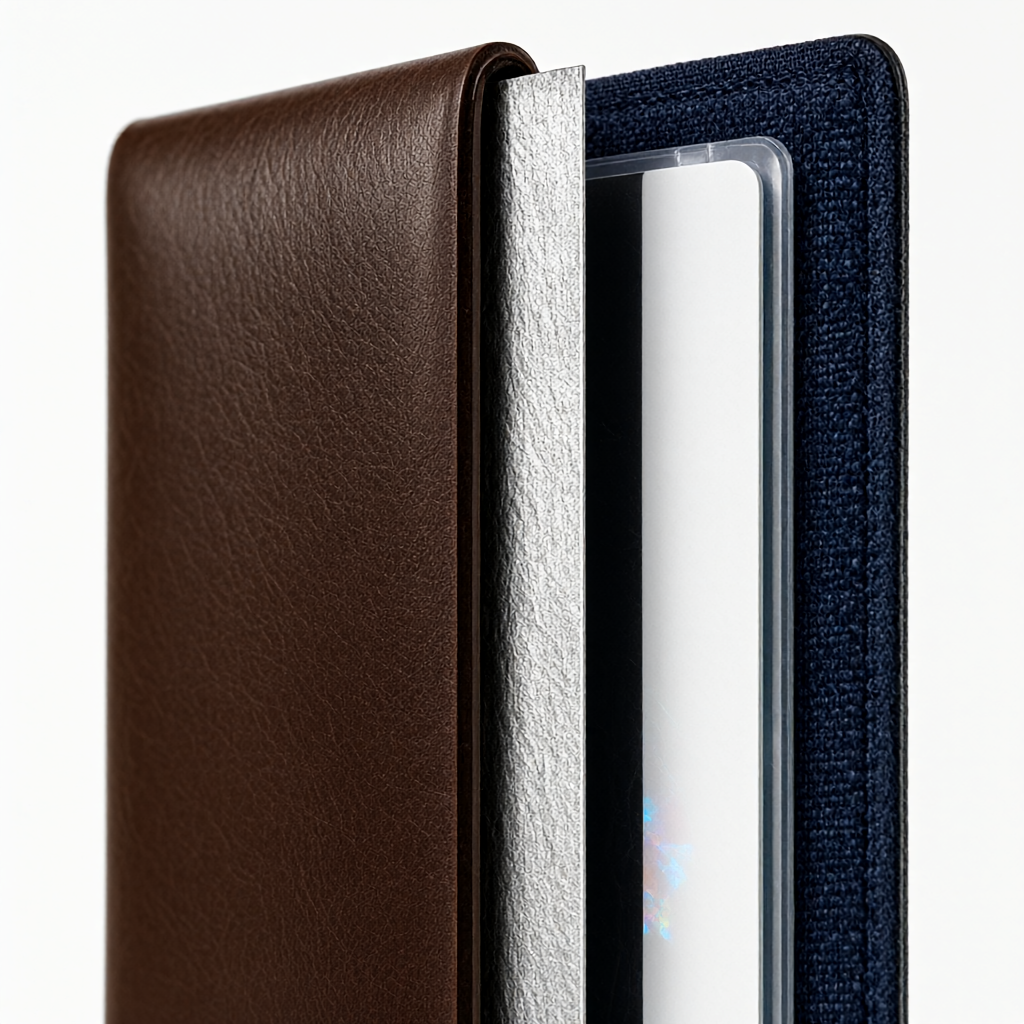
What makes a wallet RFID-blocking?
RFID stands for Radio Frequency Identification, and contactless payment cards, passports, and access credentials all contain tiny chips that communicate via radio waves. When you hold a card near a reader — at a checkout terminal, a transit gate, or, theoretically, a handheld scanner — the reader emits an electromagnetic field that powers the card’s chip and reads its data. An RFID-blocking wallet prevents this by placing a conductive barrier between the card and the outside world. That barrier creates what is essentially a Faraday cage: it reflects incoming radio waves and absorbs residual energy so the card chip never receives a strong enough signal to activate.
The shielding must be continuous around each card slot. Gaps, seams, or non-conductive dividers create weak points where scanning can still occur. This is why solid-core metal wallets — those machined from a single piece of aluminum or titanium with internal card channels cut into the body — are considered more reliable than wallets that simply line the inside with a thin RFID-blocking fabric. A complete metal enclosure provides broad-spectrum protection with no reliance on adhesive liners that may degrade over time.
Which materials offer the best RFID protection for men?
Different materials achieve shielding through different mechanisms, and each has distinct performance characteristics for end users and buyers to evaluate.
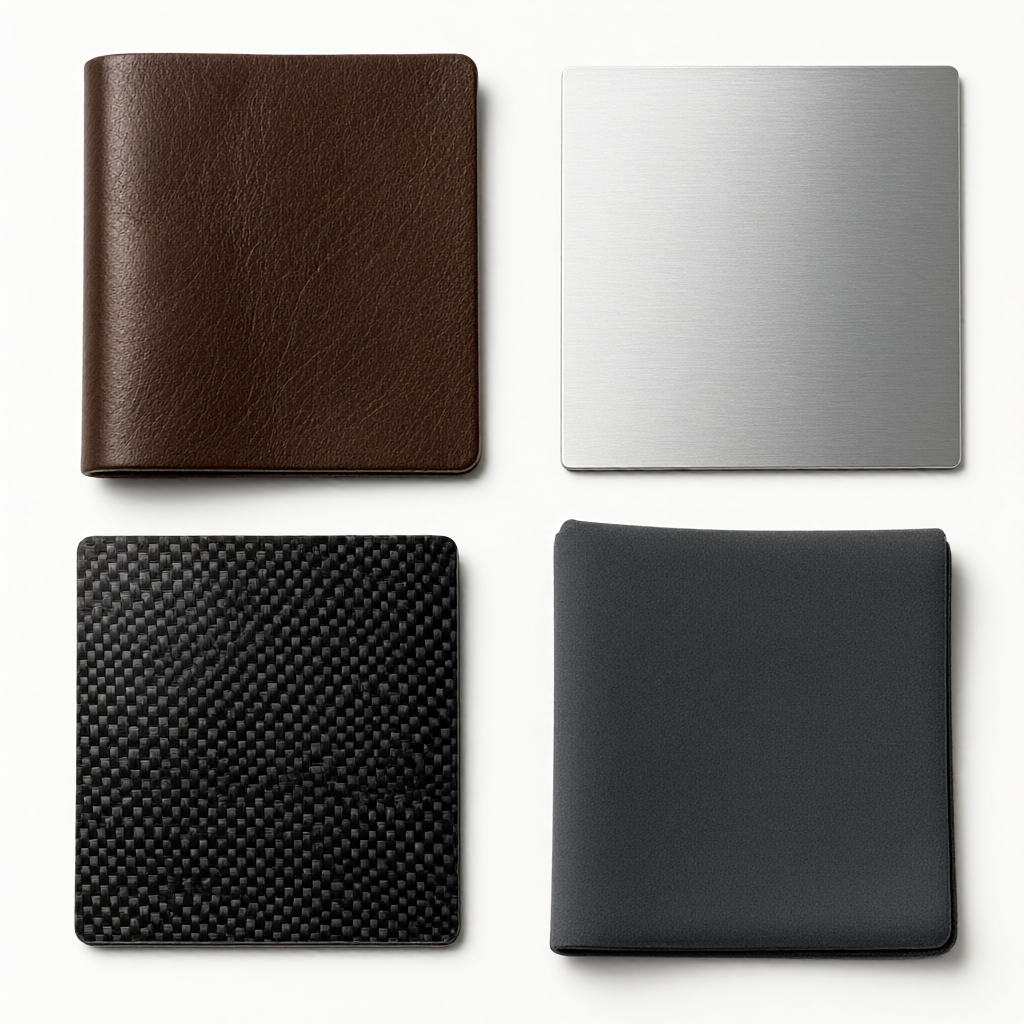
Aluminum is the most common material for RFID-blocking metal wallets. It is lightweight, corrosion-resistant (especially when anodized), and can be CNC-machined into slim, precise enclosures. Aluminum wallets typically block frequencies across the NFC and RFID spectrum, including 125 kHz (older access control cards), 13.56 MHz (credit cards, passports, transit cards), and up to 15.6 GHz (UHF RFID). The thickness of the aluminum — usually between 2 mm and 4 mm — directly affects shielding effectiveness. Thinner gauges may leave small gaps in coverage, while thicker bodies provide more robust protection at the cost of pocket profile.
Titanium offers similar shielding properties to aluminum with greater strength and a higher-end feel. Titanium wallets are denser and heavier than aluminum at equivalent thickness, but they resist scratching and corrosion better over time. For buyers sourcing premium product lines, titanium represents a material upgrade that commands higher retail pricing.
Carbon fiber has become a popular choice for slim card holders and minimalist wallets. Raw carbon fiber itself is not conductive, so effective carbon fiber RFID-blocking wallets embed a conductive layer — typically a thin copper or aluminum foil — between the carbon fiber face sheets. The result is a wallet that looks and feels like premium woven composite while delivering the same RFID shielding as a solid metal wallet. Carbon fiber wallets tend to be thinner than their aluminum counterparts and are favored by buyers targeting design-forward or outdoor-oriented audiences.
RFID-blocking fabric and polymer layers are used in textile wallets and some hybrid designs. These materials contain conductive fibers (stainless steel microfibers, copper-nickel alloys, or silver-coated threads) woven into the fabric or laminated as a film. They are lighter and more flexible than metal options, making them suitable for traditional bifold shapes or slim card sleeves. However, fabric-based shielding coverage depends heavily on how completely the material wraps the card slots. A fabric RFID-blocking wallet that only lines the front flap may leave the rear of the cards exposed. Buyers should verify that the shielding material fully encircles each card position.
What is the difference between a metal RFID wallet and a fabric RFID wallet?
The core difference lies in how the shielding is integrated and how consistently it performs. A metal RFID wallet — whether aluminum, titanium, or stainless steel — achieves blocking through the material’s inherent conductivity. The entire wallet body acts as the shield, which means protection is structural rather than additive. These wallets also tend to be more durable because the shielding cannot separate from the body or peel at the edges.
A fabric RFID wallet relies on an embedded conductive liner. This liner can be sewn into the material or adhered with adhesive. Over time, repeated flexing, moisture exposure, or poor adhesive quality can compromise the liner’s integrity, reducing shielding performance at the seams or fold lines. That said, fabric wallets offer advantages in flexibility, weight, and design variety. They can accommodate traditional bifold or trifold formats that some buyers prefer, and they do not trigger metal detectors — an important consideration for frequent travelers.
For end users, the practical difference is straightforward: a well-made metal wallet provides consistent, long-lasting shielding with zero maintenance, while a quality fabric RFID wallet offers comparable protection at the cost of potential long-term degradation. Both can meet the same frequency-blocking standards when designed and tested correctly.
Do RFID wallets interfere with phone or card functionality?
A common concern among buyers and end users is whether RFID-blocking wallets interfere with contactless payment or smartphone features. They do not. RFID shielding works by blocking unauthorized external readers — it does not prevent the card from communicating when the user intentionally holds it near a payment terminal. In practice, the thin metal or conductive layer in an RFID wallet can actually help direct the signal toward the reader when the wallet is placed directly on the terminal, because the shielding concentrates the field rather than dispersing it.
Smartphones are unaffected. NFC-enabled phones communicate through their own dedicated antenna, and a RFID-blocking wallet sitting in the same pocket does not interfere. MagSafe accessories and wireless charging also operate on different principles and frequencies that are not impacted by RFID shielding materials.
Can RFID wallets be used with airport scanners safely?
Yes. Airport security scanners — specifically the walk-through metal detectors — detect ferromagnetic materials, not RFID shielding. An aluminum or titanium RFID-blocking wallet contains very little ferrous metal and typically passes through metal detectors without setting off alarms. Some airports use advanced imaging technology that may flag dense metal objects, in which case a security officer will perform a secondary screening. This is a routine procedure and not unique to RFID wallets.
RFID-blocking wallets do not interfere with airport X-ray baggage scanners, passport control readers, or any other airport equipment. Travelers should simply remove the wallet from their pocket and place it in the bin during standard security screening, as they would with any other item.
Key Specifications — What to Look for in an RFID Wallet
What are the key specs for best RFID wallets for men?
When evaluating or specifying RFID-blocking wallets for a product line, the following specifications define whether a product meets buyer expectations for protection, usability, and quality.
| Specification | Typical Range | Why It Matters |
|---|---|---|
| RFID frequency coverage | 125 kHz – 15.6 GHz | Must cover EMV payment cards (13.56 MHz), Mifare access cards (13.56 MHz), and UHF tags (860–960 MHz) for full protection |
| Wallet thickness | 6 mm – 18 mm | Determines pocket profile; metal wallets tend toward 8–14 mm, fabric options can be under 6 mm |
| Card capacity | 4 – 12 cards | Affects daily utility; slim card holders hold 4–6 cards, bifold designs hold 6–12 |
| Weight | 30 g – 120 g | Impacts comfort; aluminum wallets typically 40–80 g, titanium 60–100 g, carbon fiber 30–60 g |
| Material | Aluminum, titanium, carbon fiber, fabric with RFID liner | Determines shielding method, aesthetics, and price tier |
| Cash retention | Elastic loop, strap, or slip compartment | Secures bills without adding bulk; elastic loops are common in minimalist designs |
| Shielding type | Solid-core metal, laminated conductive layer, or fabric insert | Affects durability of protection over the product lifecycle |
How much does an RFID-blocking wallet cost at bulk?
Bulk pricing for RFID-blocking wallets varies significantly based on material, complexity, and order volume. As a reference point for B2B buyers evaluating cost structure:
- Aluminum RFID wallets at 500–1,000 pieces typically fall in the $3.50–$8.00 per unit FOB range, depending on machining complexity and finish.
- Carbon fiber RFID card holders at the same volume generally range from $4.00–$9.00 per unit, reflecting the additional lamination step.
- Fabric RFID-blocking wallets with sewn-in conductive liners tend to be the most cost-effective, often $2.50–$5.50 per unit at comparable volumes.
Price bands quoted in this article are industry ranges published for planning purposes. Exact per-unit pricing depends on material, finish, packaging and order quantity, and is confirmed by our sales team after an inquiry against a locked specification.
These ranges assume standard OEM specifications — custom anodizing colors, laser engraving, private label packaging, and specialized forms factor adjustments will increase unit cost. Buyers should expect a 15–30% price premium for fully custom designs versus catalog-based OEM options.
At lower volumes (300–500 pieces), unit costs rise by approximately 20–40% due to setup and tooling amortization over fewer units. For Amazon FBA sellers and smaller distributors, manufacturers with low MOQ programs starting at 300 pieces can reduce upfront inventory risk while still achieving cost-competitive per-unit pricing.
For a detailed breakdown of material selection and sourcing considerations beyond RFID-specific features, see our best minimalist wallets for B2B sourcing and private label guide.
If you have specific volume targets or design requirements, we recommend requesting a bulk FOB quotation to get accurate pricing for your project parameters.
Standards & Requirements — Certifications and Material Safety
What certifications should buyers verify when sourcing RFID wallets?
RFID-blocking wallets are not regulated products in the way medical devices or children’s goods are, but several certifications and compliance standards signal manufacturing quality and material safety. Buyers should request documentation for the following:
ISO 9001 — This is the baseline quality management standard for manufacturing operations. An ISO 9001 certification indicates the factory has documented processes for production consistency, incoming material inspection, and defect tracking. For RFID wallets specifically, this matters because shielding performance must be consistent batch-to-batch — a wallet that passes testing in lot one should perform identically in lot fifty.
BSCI (Business Social Compliance Initiative) — BSCI audits cover labor practices, workplace safety, and ethical manufacturing standards. For brands selling in European markets, BSCI compliance is increasingly expected by retail buyers and distributors as a condition of partnership.
REACH and RoHS compliance — These are EU regulatory frameworks governing chemical substance use (REACH) and restriction of hazardous substances in electronics and metal components (RoHS). Since RFID wallets involve metal machining, anodizing, and adhesive-laminated components, compliance with these standards ensures that materials such as lead, cadmium, and certain dyes are controlled. Buyers should request a test report from an accredited lab such as SGS.
How is RFID-blocking performance verified?
There is no universal certification body that certifies individual wallets as “RFID-blocking.” Performance claims should be backed by test data rather than marketing language. Reputable manufacturers test shielding effectiveness using an RFID reader and a proximity card, measuring signal attenuation at key frequencies:
- 13.56 MHz — The critical frequency for EMV payment cards, passports, and most access credentials. Effective shielding should reduce signal strength by at least 20 dB at this frequency.
- 125 kHz — Used by older proximity access cards. Shielding effectiveness at this lower frequency is generally easier to achieve with conductive materials.
- 860–960 MHz (UHF) — Relevant for supply chain tags and some specialty credentials. Metal wallets inherently block this range; fabric-based shields require careful design to maintain coverage.
Buyers should ask manufacturers for their test methodology and results rather than accepting a blanket “blocks all RFID” claim. Test reports from independent labs carry more weight than in-house assertions. For context on how EMV and contactless card security standards operate at the payment level, the FTC provides consumer guidance on contactless payment security that distinguishes card-level protections from wallet-level shielding.
For deeper guidance on evaluating wallet quality across material and construction dimensions, our best wallet for B2B buyers: EDC wallet procurement guide covers specification evaluation frameworks applicable to RFID and non-RFID products.
Related Considerations — Customization, Sourcing, and Brand Evaluation
What should you consider when customizing RFID wallets?
Customization is where most B2B buyers differentiate their product line. The key variables to define early in the sourcing process include:
Material and finish — Aluminum can be anodized in any RAL color, brushed or polished, or left in a natural state. Titanium is typically offered in natural, black, or gold PVD finishes. Carbon fiber comes in standard weave patterns (plain, twill, hex) with clear or matte top coats. Each finish option affects lead time and unit cost differently — custom anodizing colors require separate dye baths and quality checks.
Laser engraving and UV printing — Logo application is a standard customization. Laser engraving works on metal and carbon fiber surfaces, producing permanent, high-contrast marks. UV printing is suitable for fabric and coated surfaces, allowing full-color logos and artwork. Engraving depth and resolution vary by material; aluminum accepts fine-detail engraving at 0.1 mm resolution, while carbon fiber requires slightly larger feature sizes to maintain visual clarity.
Card retention system — The method used to hold cards in place distinguishes product experiences. Elastic loops are common in minimalist designs and stretch to accommodate thick card stacks. Metal friction retention — where cards are held between precisely spaced metal plates — eliminates elastic degradation over time and is preferred for long-life product lines. Strap-based retention adds a traditional bifold closure and is more common in fabric or hybrid wallets.
Packaging — Retail-ready packaging impacts shelf appeal and unboxing experience. Options include rigid gift boxes, magnetic closure boxes, blister packs, and poly mailers. Custom box design with printed branding typically requires a minimum order of 500–1,000 units for the packaging itself, separate from the wallet order.
Private label and co-branding — Full private label programs involve custom packaging, product labeling, and sometimes exclusive material or design specifications. Buyers should confirm whether the manufacturer supports Amazon FBA prep services — label application, poly bagging, and carton allocation — as this reduces fulfillment complexity for online sellers.
How do MOQ, sample lead time, and production capacity affect buying decisions?
These three factors form the operational foundation of any sourcing decision:
- MOQ (Minimum Order Quantity) — Lower MOQs (300–500 pieces) reduce inventory risk and enable market testing before scaling. Higher MOQs (1,000+ pieces) unlock better per-unit pricing and may include waived setup fees for custom tooling. Buyers launching a new product line should start with the lowest viable MOQ to validate market demand.
- Sample lead time — Sample turnaround indicates manufacturing responsiveness. A 7-day sample lead time is considered fast in the EDC wallet category and allows rapid iteration on design and material choices. Longer sample times (15–30 days) may signal smaller operations or limited CNC capacity.
- Production capacity — Monthly output capacity determines whether a manufacturer can fulfill large orders without compromising quality or lead times. Manufacturers with 500,000+ monthly capacity can handle scale-up orders from growing brands without risking supply delays.
For buyers evaluating the full range of options available in the market, our good wallets for guys: B2B EDC wallet buying guide provides a broader framework for assessing build quality, material performance, and design value across wallet categories.
Who are the recommended manufacturers and how should you evaluate them?
When sourcing RFID-blocking wallets for your brand, evaluate manufacturers against these criteria:
- Technical capability — Does the factory have in-house CNC machining for metal wallets, or do they outsource this critical step? In-house machining ensures tighter tolerances and faster revision cycles for custom designs.
- Material sourcing transparency — Request material certificates for the aluminum, titanium, or carbon fiber used. Reputable suppliers can trace material origin and provide composition reports.
- RFID test documentation — Ask for specific test results at 13.56 MHz. A manufacturer that can provide measured attenuation data demonstrates confidence in their shielding design.
- Certification status — ISO 9001 and BSCI certification are strong indicators of manufacturing maturity. These certifications are verifiable through the certifying body’s public database.
- Client portfolio — Manufacturers serving 200+ brands across multiple continents have the infrastructure and quality discipline to support diverse client requirements.
- Customization breadth — The ability to handle everything from logo engraving to custom packaging design in a single workflow reduces coordination risk for buyers.
As a manufacturer, our approach to this is straightforward: we evaluate each RFIDs project against the same criteria we apply internally — material traceability, shielding verification, finish consistency, and on-time delivery. With 13+ years of export experience and a 50,000 sq ft in-house factory, we support brands, Amazon FBA sellers, and distributors from concept through production. Our CNC machining capability allows us to produce solid-core aluminum and titanium RFID wallets with precise shielding geometries, and our in-house laser engraving and anodizing lines handle full custom branding without outsourcing. We offer low MOQ starting at 300 pieces with a 7-day sample lead time, and our facility is ISO 9001 certified and BSCI audited with REACH and RoHS compliant materials.
Contact Our Team to discuss your RFID wallet project, review sample options, and receive a custom quotation tailored to your specifications.
Best RFID Wallets For Men: Where Can You Verify the Data and Sources?
- FTC provides consumer guidance on contactless payment security — www.ftc.gov
- best minimalist wallets for B2B sourcing and private label — topedcwallet.com
- requesting a bulk FOB quotation — topedcwallet.com
- best wallet for B2B buyers: EDC wallet procurement guide — topedcwallet.com
- good wallets for guys: B2B EDC wallet buying guide — topedcwallet.com
From article to product
Building an RFID range?
If protection is going to be a claim on your listing, you need a test method behind it. We test every batch with a live 13.56 MHz reader and supply the report.
Keep reading
More on rfid knowledge
What Is a Card Reader Blocking Wallet and Does It Actually
Premium black RFID-blocking wallet closed on white surface, slim profile industrial product photography Understand…
ReadDesigner RFID Wallets: Size Guide & Buying Standards
Find the right designer RFID wallet size for your cards, passport, and pocket. Compare…
ReadRFID Card Blockers: Do They Actually Work? (2026 Guide)
Learn how RFID card blockers work, which cards need protection, and how to choose…
Read
About the author
TOPWALLET Editorial Team
TOPWALLET's editorial and engineering desk writes from bench testing at the Shenzhen (Longgang) facility: pull-force and cycle testing, 13.56 MHz shielding measurements, finish trials and factory audits, rather than supplier spec sheets. Every specification in these guides is one we write on a purchase order.
Written on the floor
This article was written by our production and QC team — the people who spec tolerances, run the finishing line and inspect every batch. Where it states a capacity, a pull force or a lead time, it comes from a measurement we made, not a supplier’s catalogue. If a number here disagrees with what your own supplier told you, tell us; several of these articles started as a correction from a buyer.
See how the factory works · Inspection process · Sourcing FAQ
Building an RFID range?
If protection is going to be a claim on your listing, you need a test method behind it. We test every batch with a live 13.56 MHz reader and supply the report.