

RFID Wallets Travel: What Is the Quick Answer?
The best rfid wallet for travel is a slim, single-plane card holder or minimalist metal wallet built around a true Faraday-cage shield that blocks 13.56 MHz RFID/NFC signals, not just a printed “RFID-safe” label. For international travelers, the ideal choice prioritizes complete signal isolation (no gaps at the edges), durable construction in aluminum, carbon fiber, or titanium, and a form factor small enough to fit comfortably in a front pocket or travel money belt without bulk.
From a B2B procurement perspective, the top-performing travel wallets on the market share common traits: metal-core or full-enclosure shielding, ISO/IEC 14443-level blocking, anodized or coated surfaces that resist wear, and capacity for 6–12 cards plus folded cash — all packaged for retail-ready private labeling.
RFID Wallets Travel: How Does It Work in Detail?
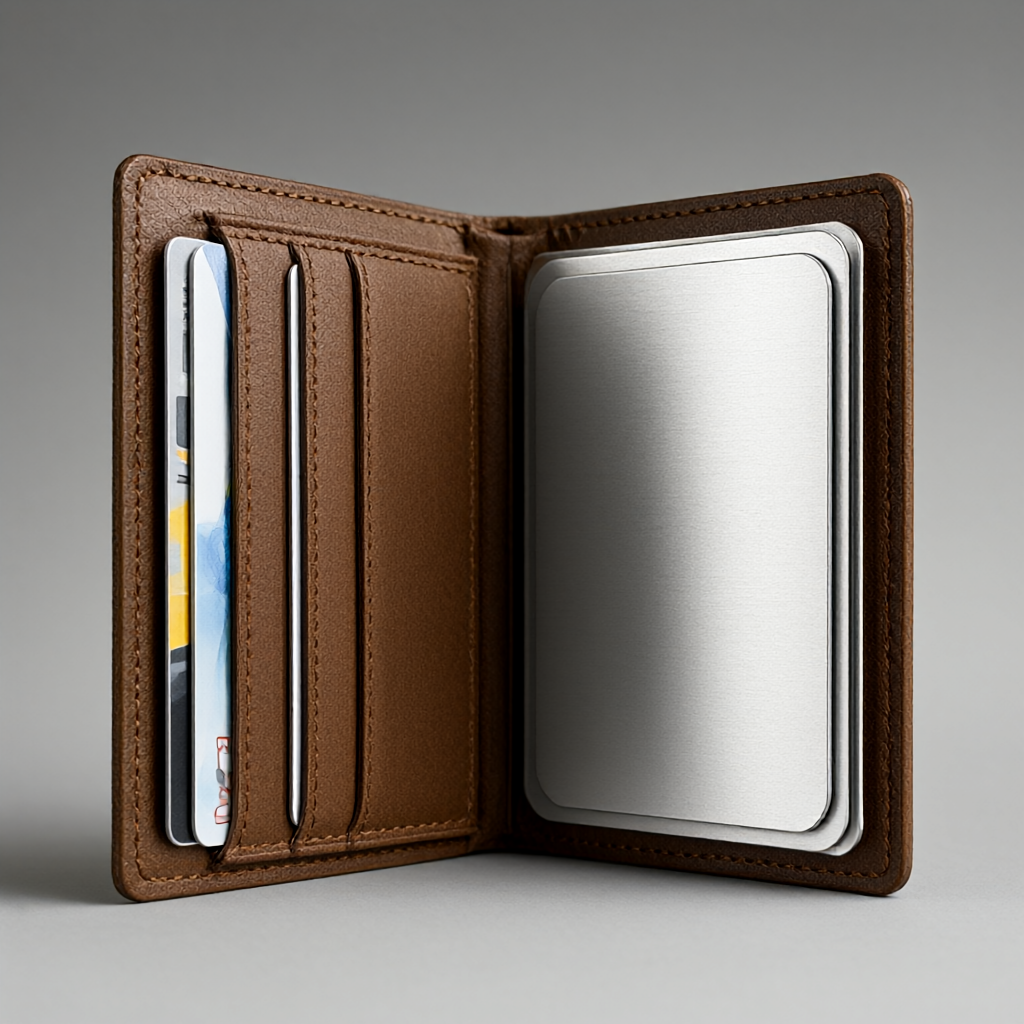
How does RFID blocking work in a wallet?
RFID blocking relies on the Faraday cage principle. A continuous conductive layer — typically aluminum, steel mesh, or a metal-polymer composite — surrounds the card slots, creating an electromagnetic barrier that absorbs or reflects radio-frequency signals before they reach the contactless chip inside a payment card or e-passport.
The relevant frequency for most travel cards, passports, and transit tokens is 13.56 MHz, the same band used by ISO/IEC 14443 NFC and RFID systems. A properly engineered shield attenuates signals at this frequency by 80–100 dB, effectively preventing any reader from communicating with the embedded chip.
What matters most is continuity of the shield. Gaps at the hinge, open sides, or thin coatings that crack under flex will create weak points where scanning becomes possible. That is why full-enclosure metal wallets and carbon fiber builds with integrated shielding layers tend to outperform simple RFID-insert sleeves.
Why is RFID-skimming a real concern for international travelers?
Contactless payment fraud through remote scanning is a documented threat, particularly in high-footfall environments such as airports, train stations, and crowded markets. While not every card in circulation carries an active RFID chip, most newer credit/debit cards, many national ID cards, and all e-passports emit at 13.56 MHz.
The FTC has published guidance on contactless card security, noting that while skimming risk varies by region and card issuer, the combination of universal contactless adoption and portable fraudulent readers makes proactive shielding a rational precaution for frequent travelers. See FTC guidance on contactless payment security.
For B2B buyers sourcing for end consumers, the travel security narrative is a strong product differentiator — but only when the protection claim can be verified through testing, not just stated on packaging.
Metal vs polymer construction trade-offs for travel durability
Aluminum wallets offer the best balance of lightweight durability and inherent signal-blocking capability. CNC-machined aluminum bodies are rigid, resist deformation, and pair naturally with anodized finishes for scratch resistance. They are the dominant material tier for mid-range travel wallets.
Carbon fiber card holders provide high strength-to-weight ratios and a premium tactile feel. The fiber itself is non-conductive, so effective shielding requires an embedded metallic layer — usually a thin copper or aluminum foil laminated between the carbon layers. Quality varies significantly by manufacturer.
Titanium money clips and compact organizers are the premium tier — lighter than steel, stronger than aluminum, and naturally corrosion-resistant. However, titanium is more expensive to machine and often results in higher unit costs, making it better suited for elevated price points.
Polymer and silicone wallets are the budget tier. Most do not provide inherent RFID blocking; they rely on an inserted metal card or a thin foil liner. These are viable for low-cost promotional products but require careful QC to ensure the liner does not shift or degrade over time.
Capacity considerations: card count, cash compartment, passport compatibility
Travel wallets must accommodate a realistic card load — typically 6 to 12 cards — plus folded bills and occasionally a transit pass or hotel key. Beyond individual card capacity, B2B buyers should evaluate:
- Overall dimensions: Must fit in a standard jeans pocket or slim bag compartment without bulging.
- Passport compatibility: Some minimalist organizers include a dedicated passport sleeve or external slot.
- Cash strap vs. zippered compartment: Elastic money clips are faster to access but less secure; zippered compartments protect against accidental loss but add thickness.
- Card retention: High-quality metal wallets use spring steel bands or friction-fit mechanisms that hold cards securely during movement.
See our best card holder selection guide for B2B sourcing for deeper spec analysis.
RFID Wallets Travel: Which Specifications Matter Most?
What are the key specs to look for in a travel RFID wallet?
| Specification | What to Evaluate | Typical Target Range |
|---|---|---|
| Shielding frequency coverage | Must block 13.56 MHz (ISO/IEC 14443 band) | 13.56 MHz ± 5% |
| Blocking efficacy | Measured in dB attenuation | ≥ 80 dB at 13.56 MHz |
| Material | Aluminum, carbon fiber, or titanium preferred | 6061 aluminum or equivalent |
| Thickness | Minimal profile for pocket carry | 6–12 mm closed |
| Card capacity | Practical daily load | 6–12 cards + cash |
| Weight | Lightweight for all-day carry | 40–85 g |
| Surface finish | Anodized, powder-coated, or PVD | Anti-scratch, color-fast |
| Closure mechanism | Spring steel band, snap, or magnetic | Secure under movement |
| Edge sealing | Continuous shield with minimal gaps | No visible openings on shield plane |
These specifications serve as a baseline for evaluating any rfid blocking wallet intended for travel use. When reviewing supplier quotes or product samples, use this table as a checklist — and insist on test reports, not just claims.
RFID Wallets Travel: Which Standards and Certifications Apply?

What standards apply to rfid-blocking wallets?
There is no single mandatory certification for consumer RFID-blocking wallets in most jurisdictions. However, credible products align with the following recognized frameworks:
- ISO/IEC 14443: The international standard governing proximity cards operating at 13.56 MHz. Shielding performance should be validated against this frequency band. Refer to ISO/IEC 14443 specifications for the technical reference.
- FIPS 201: U.S. federal standard for personal identity verification — specifies RFID security requirements for government-issued credentials, including e-passports. Not a product certification, but a useful reference for shielding depth expectations.
- CE marking: Required for products sold in the European Economic Area. While CE does not specifically certify RFID blocking, it confirms the product meets applicable EU safety and electromagnetic compatibility directives.
- ASTM testing methods: Independent laboratories may apply ASTM protocols for material durability, drop resistance, and signal attenuation testing. See ASTM International standards for relevant material and testing references.
Buyers should request third-party test reports from suppliers, ideally from an accredited lab such as SGS or Intertek. A claim of “99.9% RFID blocking” without a supporting test document is not sufficient for serious procurement.
RFID Wallets Travel: What Else Should Buyers Consider?
What should you consider when choosing an rfid wallet for travel?
Several factors go beyond shielding efficacy when selecting a travel-oriented security wallet for travel:
1. Testing methodology transparency. Reputable suppliers can provide test data showing attenuation across the 13.56 MHz band. If a supplier cannot produce a test report, treat the claim as unverified.
2. Real-world card compatibility. Some RFID blockers interfere with wireless charging on smartphones if the phone is placed directly against the wallet. Full-metal enclosures can also block NFC functions on compatible phones. Evaluate whether the design leaves the phone’s charging coil area unobstructed.
3. Durability under travel conditions. Wallets subjected to repeated pocket insertion, baggage compression, and temperature variation must maintain shield continuity. Check for hinge fatigue, coating delamination, and spring tension loss in samples.
4. Brand and retail readiness. For Amazon FBA sellers and retail chain buyers, packaging design, barcoding compliance, and language localization matter as much as the product itself. A minimalist rfid wallet that arrives in plain poly bags may perform well technically but fail to convert at retail.
5. Supplier track record. Prior export experience, quality management certifications, and proven lead-time reliability are indicators of a supplier who can handle repeat orders consistently.
How do I vet a manufacturer for custom RFID wallets?
Vetting a manufacturer for private-label rfid travel wallet production involves evaluating several operational dimensions:
MOQ and tooling. Low MOQ programs (300–500 pcs) are common among factories that have established CNC and laser-engraving lines. Custom tooling for unique enclosures may carry a one-time mold fee, but many standard designs require no additional tooling investment.
Sample lead time. A responsive supplier should deliver functional samples within 5–10 business days. Extended sample cycles often indicate外包 production or limited QC capacity.
Quality control process. In-house QC at multiple stages — incoming material inspection, assembly verification, and final shielding tests — reduces defect rates. Suppliers that outsource QC entirely introduce risk.
Certifications. ISO 9001质量管理体系认证 and BSCI social compliance audits are meaningful signals of operational maturity. REACH and RoHS compliance is essential for European market sales.
Communication and documentation. Clear spec sheets, responsive RFQ handling, and transparent component sourcing are hallmarks of a supplier that can scale with your brand.
Sourcing a Reliable RFID Wallet Manufacturer
For brands, Amazon FBA sellers, and distributors looking to source custom metal wallets, carbon fiber card holders, and money clips with verified RFID protection, working with an experienced OEM/ODM manufacturer is the most efficient path to market.
Here is how the industry works: a competent manufacturer handles everything from initial concept and shielding design through CNC machining, surface finishing, laser engraving, quality testing, and retail packaging — all under one roof. This integration reduces lead times, improves consistency, and allows meaningful cost optimization at volume.
As a manufacturer, our approach centers on three principles. First, shielding is engineered, not added. Every aluminum wallet and carbon fiber card holder we produce uses a continuous conductive barrier designed to block the full 13.56 MHz band — not a surface coating that degrades over time. Second, quality is verified at each stage. Our ISO 9001-certified facility includes incoming material checks, in-process inspection, and final shielding verification before any order ships. Third, customization is accessible at low volume. We support private-label programs starts at 300 pcs per SKU for full OEM customization (100 pcs trial order available for stock finishes) with a 7-day sample lead time, so brands can validate quality before committing to larger runs.
Our facility in China operates a 50,000 sq ft factory with in-house CNC machining, laser engraving, UV printing, aluminum anodizing, and custom packaging lines. We have over 13 years of export experience serving 200+ brands across North America, Europe, Australia, and Southeast Asia. All products comply with REACH and RoHS requirements and are SGS-tested for material safety.
For buyers who want to move from spec to production, the next step is straightforward: share your design requirements, target specifications, and volume expectations, and a sourcing specialist will provide a detailed quotation with lead times and MOQ details.
What to Look For in a Travel RFID Wallet (2025)?
The best RFID wallet for travel blocks 13.56 MHz NFC/RFID signals using a continuous Faraday-cage shield — typically a full-enclosure aluminum body, carbon-fiber laminate with an embedded metallic layer, or a titanium frame — delivering ≥80 dB attenuation per ISO/IEC 14443 test protocols. For international travel, prioritize a slim single-plane card holder (6–12 mm closed) made from 6061 aluminum or equivalent, with a secure spring-steel band closure, no visible shield gaps, and third-party SGS or Intertek test reports. A verified blocking wallet from a reputable OEM manufacturer typically retails between $18–$45 per unit at volume, with customization options including laser engraving, anodized colors, and private-label packaging.
Common Pitfalls: Thin Metal, Cheap Closures, and Poor Edge Sealing
Many travel wallets on the market carry an “RFID-safe” claim but deliver inconsistent real-world protection due to three recurring manufacturing shortcuts. Understanding these pitfalls helps buyers avoid products that look secure on the shelf but fail under actual scanning conditions.
Thin or Incomplete Shielding Layers
The most frequent flaw is a sub-minimum shielding thickness — typically aluminum foil or stamped steel sheets under 0.15 mm. Signal attenuation is logarithmic: halving shield thickness can reduce blocking efficacy from 85 dB to below 50 dB, leaving the 13.56 MHz band partially open. Full-enclosure CNC-machined aluminum bodies (0.5–1.0 mm wall thickness) provide consistent shielding across all surfaces, whereas folded or stamped housings often have seams at corners and edges where signals can penetrate.
A common indicator of insufficient shielding: if a wallet passes an NFC test on one side but fails when rotated 90°, the conductive layer is likely discontinuous or too thin. Reputable manufacturers test samples across the full frequency range (12–15 MHz) and provide attenuation curves, not just a single pass/fail reading.
Cheap Snap and Magnetic Closures That Break Shield Continuity
Metal snap buttons, magnetic clasps, and decorative hardware pieces can compromise the Faraday cage if they create gaps in the conductive path. A snap closure on the front face of a wallet is acceptable only when it is electrically isolated from the shielding layer or when the surrounding enclosure maintains continuous conductive coverage.
Problems to watch for:
- Open-frame designs with no back panel — cards are shielded on one side only
- Snap buttons made of ferrous metal that create a short-circuit path in the shield
- Magnetic closures placed directly over card slots without insulating barriers
- Decorative cutouts or vents that pierce the shielding plane
For travel use, a spring-steel tension band or friction-fit closure is the most reliable option — it adds no conductive breaks and maintains full enclosure continuity.
Poor Edge Sealing and Delamination Over Time
Edge sealing refers to how the shielding layer is terminated at the wallet perimeter. Poorly sealed edges allow signals to enter through the sides — the same way light enters a poorly closed blackout curtain. This issue is especially common in:
- Laminated carbon fiber wallets where the metallic foil layer is not fully encapsulated at the edges
- Stamped metal wallets with unfinished or un-anodized cut edges that oxidize and lose conductivity
- Budget polymer wallets with inserted foil liners that shift, fold, or tear after repeated use
A well-sealed wallet should have the conductive layer fully enclosed within the structural material, with no exposed edges visible to the user. Anodized aluminum surfaces (Type II or Type III hardcoat) and UV-cured resin seals on carbon fiber both provide durable edge protection.
The Pocket-Snap Test: A Simple Field Check
Before committing to a bulk order, perform a basic field test using any smartphone with NFC capability:
- Place an active contactless card inside the wallet
- Attempt to tap the wallet against the phone’s NFC sensor
- Rotate the wallet 360° and repeat
If the phone registers the card at any angle, the shielding is incomplete. A properly blocked wallet should show zero NFC response from every orientation.
How to Vet a Manufacturer for Private-Label RFID Wallets (MOQ, Lead Time, QC)?
Sourcing custom RFID wallets through an OEM manufacturer requires evaluating operational reliability alongside technical capability. Below is a practical framework for assessing potential suppliers.
MOQ and Tooling Requirements
| Factor | What to Ask | Industry Norm |
|---|---|---|
| Minimum order quantity | What is the lowest order size? | 300–500 pcs for standard designs; 1,000+ pcs for custom tooling |
| Custom tooling cost | Is there a one-time mold or fixture fee? | $500–$3,000 for fully custom enclosures; $0 for stock molds |
| Sample cost | Can samples be credited against production orders? | $50–$200 per sample; usually refundable on orders above MOQ |
| Design modification fees | Are design tweaks included after approval? | Typically yes within agreed spec sheet; major changes may incur re-tooling |
Low-MOQ suppliers (300+ pcs) are ideal for brands testing a new product line or Amazon FBA sellers launching a private label. Suppliers requiring 1,000+ pcs for any customization are better suited for large retailers with established SKU depth.
Lead Time Expectations
| Stage | Typical Timeline | Red Flag |
|---|---|---|
| Sample production | 5–10 business days | >15 days indicates limited capacity or outsourcing |
| Mass production | 15–25 business days | >30 days suggests bottlenecked CNC or finishing lines |
| Shipping (air freight) | 5–7 business days | Standard for express; ocean freight adds 25–35 days |
| Total order cycle | 25–45 business days | Longer cycles are acceptable for complex custom projects |
Fast sample turnaround is a strong signal of an in-house manufacturing facility with ready CNC and finishing capacity. Suppliers who subcontract sample production often delay by weeks.
Quality Control and Testing Protocols
A mature OEM manufacturer implements QC at three stages:
1. Incoming Material Inspection
- Verify aluminum alloy grade (6061-T6 or equivalent) via mill certificates
- Confirm RFID-blocking foil/laminate thickness with caliper measurement
- Check anodize layer thickness (10–25 μm for Type II; 25–50 μm for Type III hardcoat)
2. In-Process Assembly Verification
- Shield continuity check on each unit before closure
- Spring tension measurement on card retention bands
- Dimensional inspection against spec sheet tolerances (±0.5 mm)
3. Final Pre-Shipment Testing
- Random-sample RFID attenuation testing (minimum 3% of order or 50 units, whichever is greater)
- Drop test (1 m onto hard surface, minimum 10 cycles)
- Anodize adhesion cross-hatch test per ASTM D3359
- Packaging integrity and labeling verification
Buyers should request a copy of the supplier’s QC inspection checklist and test report format before placing an order. Manufacturers that cannot produce documented test results lack the infrastructure for consistent quality.
Certifications That Matter
| Certification | Significance | Verification Method |
|---|---|---|
| ISO 9001 | Documented quality management system | Valid certificate from accredited body (e.g., SGS, BV) |
| BSCI | Social compliance and labor standards | Audit report available on request |
| REACH / RoHS | Restricted substance compliance | Test report for heavy metals and phthalates |
| SGS / Intertek | Third-party product testing | Lab report with attenuation data at 13.56 MHz |
ISO 9001 certification is the baseline expectation for any manufacturer handling B2B orders above 500 pcs. BSCI becomes important for buyers in European retail markets where social-audit requirements are increasingly enforced.
Product Comparison: Travel RFID Wallet Categories and Price-to-Value Analysis
Choosing the right travel RFID wallet depends on balancing protection level, durability, and unit cost. The table below compares the four primary categories available from OEM manufacturers.
Comparison Matrix
| Category | Shielding Method | Avg. Unit Cost (300 pcs) | Avg. Retail Price | Best For |
|---|---|---|---|---|
| Slim aluminum card holder | Full-enclosure CNC 6061 aluminum | $4–$8 | $18–$32 | Budget-conscious travelers, promotional programs |
| Carbon fiber wallet | Embedded copper/aluminum foil laminate | $6–$12 | $28–$48 | Premium branding, aesthetic differentiation |
| Titanium money clip | CNC titanium frame with integrated shield | $12–$22 | $45–$85 | High-end EDC enthusiasts, luxury gifting |
| Polymer + RFID insert | Silicone body with removable metal card | $2–$4 | $8–$15 | Ultra-low-cost promos, single-use distribution |
Price-to-Value Assessment
Best value for volume orders (500+ pcs): Full-enclosure 6061 aluminum wallets. At $4–$8 per unit, they deliver the highest shielding reliability per dollar. The anodized finish provides scratch resistance and color customization without additional cost. This is the category most B2B buyers choose for Amazon FBA and retail distribution.
Best value for premium positioning: Carbon fiber wallets with embedded shielding laminates. The premium aesthetic commands a higher retail price ($28–$48), and the manufacturing cost premium over aluminum is modest ($2–$4/unit). The perceived value justifies the margin.
Not recommended for serious travel use: Polymer wallets with RFID inserts. While cheapest to produce, the insert can shift, degrade, or be forgotten — leaving the cards unprotected. These are suitable only as loss-leader promotional items where the primary purchase driver is price, not function.
Real-World Case: Aluminum vs. Carbon Fiber for a European Retail Launch
A mid-tier EDC brand in Germany sourced 2,000 aluminum wallets and 1,000 carbon fiber versions for a holiday retail run. Both categories used the same OEM manufacturer with identical shielding thickness (0.6 mm aluminum body; 0.15 mm copper laminate in carbon fiber). Post-launch returns were 0.3% for aluminum and 0.5% for carbon fiber — both well below the industry average of 2–3% for wallet products. The aluminum variant achieved a 38% gross margin at wholesale; the carbon fiber variant achieved 45%. The brand reordered both categories at 4,000 pcs each the following quarter.
RFID Wallets Travel: Where Can You Verify the Data and Sources?
- FTC guidance on contactless payment security — www.ftc.gov
- ISO/IEC 14443 specifications — www.iso.org
- ASTM International standards — www.astm.org
- best card holder selection guide for B2B sourcing — topedcwallet.com
- Get a Free Quote → — topedcwallet.com
From article to product
Turning this into a product?
Most of what is written here is the difference between a sample that works and one that does not. We can build either — the useful one costs the same.
Keep reading
More on buying guides
wallet with trigger
How Does a Trigger Wallet Work? What Is the Pop-Up Mechanism? The core of…
Readbest bifold wallet for women
What Is a Bifold Wallet? The term “bifold” refers to the fold: the wallet…
ReadMen’s trifold wallets with zipper compartments vs. bifold
At a Glance The three dominant men’s wallet formats differ in panel count, depth,…
Read
About the author
TOPWALLET Editorial Team
TOPWALLET's editorial and engineering desk writes from bench testing at the Shenzhen (Longgang) facility: pull-force and cycle testing, 13.56 MHz shielding measurements, finish trials and factory audits, rather than supplier spec sheets. Every specification in these guides is one we write on a purchase order.
Written on the floor
This article was written by our production and QC team — the people who spec tolerances, run the finishing line and inspect every batch. Where it states a capacity, a pull force or a lead time, it comes from a measurement we made, not a supplier’s catalogue. If a number here disagrees with what your own supplier told you, tell us; several of these articles started as a correction from a buyer.
See how the factory works · Inspection process · Sourcing FAQ
Turning this into a product?
Most of what is written here is the difference between a sample that works and one that does not. We can build either — the useful one costs the same.