

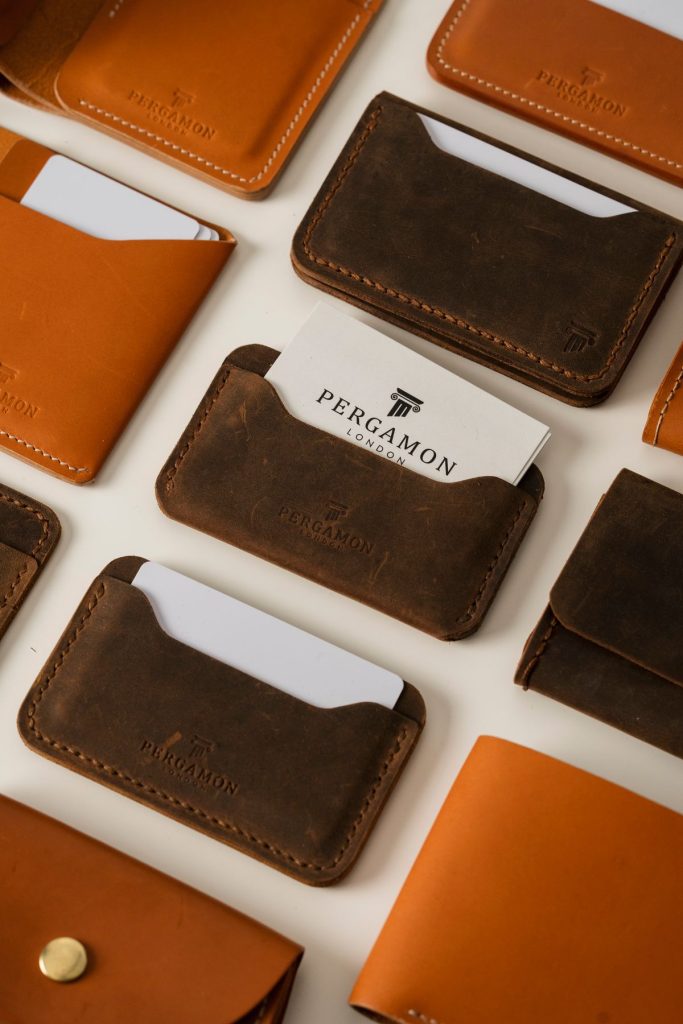
Quick answer: if you never carry a contactless card, a transit pass, or an NFC badge, a regular wallet is entirely adequate and usually slimmer. If you carry any of those, a shielded wallet removes a low-probability but real risk for a modest increase in thickness and cost. The honest framing is insurance, not armour.
What you are actually protecting?
Cut through the marketing and the question narrows to one thing: does anything in your wallet transmit on its own? EMV contactless cards do. Transit passes do. NFC hotel keys and modern building badges do. A magnetic-stripe-only card, a driving licence with no chip, a paper receipt and folded cash do not — they cannot be read at a distance because there is nothing to read.
So the first diagnostic is an inventory, not a purchase. Tip your cards onto a table and look for the contactless symbol — four curved lines radiating from a corner. Count them. Zero means the shielding question is moot. Five means you have a reason to care.
Where skimming genuinely happens?
The threat model is narrower than the advertising suggests. A would-be skimmer needs a reader within a few centimetres, held there long enough to complete a read, in a place where holding a device near a stranger’s pocket does not look strange. In practice that means crowded transit, queues, and busy retail — not a quiet street.
It is also worth understanding what a successful read yields. Modern EMV transactions generate a single-use cryptogram, so the captured data cannot be replayed for a card-not-present purchase the way a stolen magnetic stripe could. What remains valuable is the primary account number and expiry date, which have resale value and can be encoded onto a blank card for in-person use. That is a real loss, but it is a bounded one, and issuers routinely refund it.
None of this means the risk is zero. It means the risk is comparable to wearing a seatbelt: low probability, low cost to mitigate, occasionally decisive.
The tradeoffs, stated honestly
| Regular wallet | Shielded wallet | |
|---|---|---|
| Thickness | Thinner — one less layer | Adds roughly 0.4–0.8 mm depending on stack |
| Weight | Lighter | +5–12 g in a leather bifold; negligible in aluminium |
| Card access | Unchanged | Unchanged — you still remove the card to tap |
| Cost | Lower | +8–15% material cost in leather builds |
| Failure mode | None specific | Liner delamination or edge gaps silently void protection |
| Durability | Standard | Foil laminates can crease over years; mesh lasts longer |
Note the asymmetry in that last row. A regular wallet cannot fail at shielding because it never claimed to. A shielded wallet can — and the failure is invisible. That is the strongest argument for buying from a supplier who will show you a test report rather than a photograph of a liner.
Our take
Three positions, and they are genuinely different situations:
- Carry contactless cards daily, commute on transit: buy shielded. The cost is trivial relative to the exposure and the inconvenience is nil.
- Carry one or two contactless cards, drive everywhere: shielding is optional. Choose on design preference instead.
- Carry no contactless cards: skip it. You would be paying for protection against a scenario that cannot occur.
What tips the decision for most buyers is that the good options no longer compromise on form. A machined aluminium shell is intrinsically a Faraday cage, so you get shielding with no added thickness. A well-built leather bifold with a bonded mesh liner adds under a millimetre. In both cases you are no longer trading design for protection — which is why we treat shielding as a default rather than an upsell.
What to specify if you are sourcing?
For brands and buyers building a range, the decision is commercial as much as technical. Shielded SKUs command a higher retail price and give the product page a concrete, testable claim — but only if the claim survives scrutiny. Before committing to a production run, ask three things: whether the supplier tests to ISO/IEC 10373-6 and can show the report; whether the shield wraps the full pocket or only one face; and how the liner is bonded, since delamination is the failure you will not see until a customer complains. A supplier who answers all three without hesitation is worth more than a cheaper one who cannot.
Related reading: How RFID blocking works · RFID wallet line · Quality control
From article to product
Still deciding between the two?
Send us the use case rather than the product name. Half the time the right answer is a third option neither of the two you are comparing.
Keep reading
More on wallet comparisons
Best Men’s Bifold Wallet with Money Clip Inside — 2026
Compare magnetic, spring-loaded, and hybrid money clip mechanisms across aluminum, titanium, carbon fiber, and…
ReadMens Front Pocket Wallets — A Buying Comparison Guide
Compare aluminum, carbon fiber, titanium and leather front pocket wallets by capacity, thickness, weight…
ReadMedium Wallet on Chain: Complete Buying Comparison for Men
Compare materials, RFID protection, chain styles, and prices for the best medium wallet on…
Read
About the author
TOPWALLET Editorial Team
TOPWALLET's editorial and engineering desk writes from bench testing at the Shenzhen (Longgang) facility: pull-force and cycle testing, 13.56 MHz shielding measurements, finish trials and factory audits, rather than supplier spec sheets. Every specification in these guides is one we write on a purchase order.
Written on the floor
This article was written by our production and QC team — the people who spec tolerances, run the finishing line and inspect every batch. Where it states a capacity, a pull force or a lead time, it comes from a measurement we made, not a supplier’s catalogue. If a number here disagrees with what your own supplier told you, tell us; several of these articles started as a correction from a buyer.
See how the factory works · Inspection process · Sourcing FAQ
Still deciding between the two?
Send us the use case rather than the product name. Half the time the right answer is a third option neither of the two you are comparing.