

What Is an RFID Protection Wallet?
An RFID protection wallet (also called an RFID blocking wallet, skimmer protection wallet, or Faraday wallet) is a security‑focused carrying product designed to block unauthorized radio‑frequency scans of contactless payment cards, passports, and ID cards that contain embedded RFID or NFC chips. It creates an electromagnetic barrier that prevents data theft via electronic pickpocketing, while still allowing the holder to carry cards in a slim, pocket‑friendly form.
How Does RFID Protection Work?
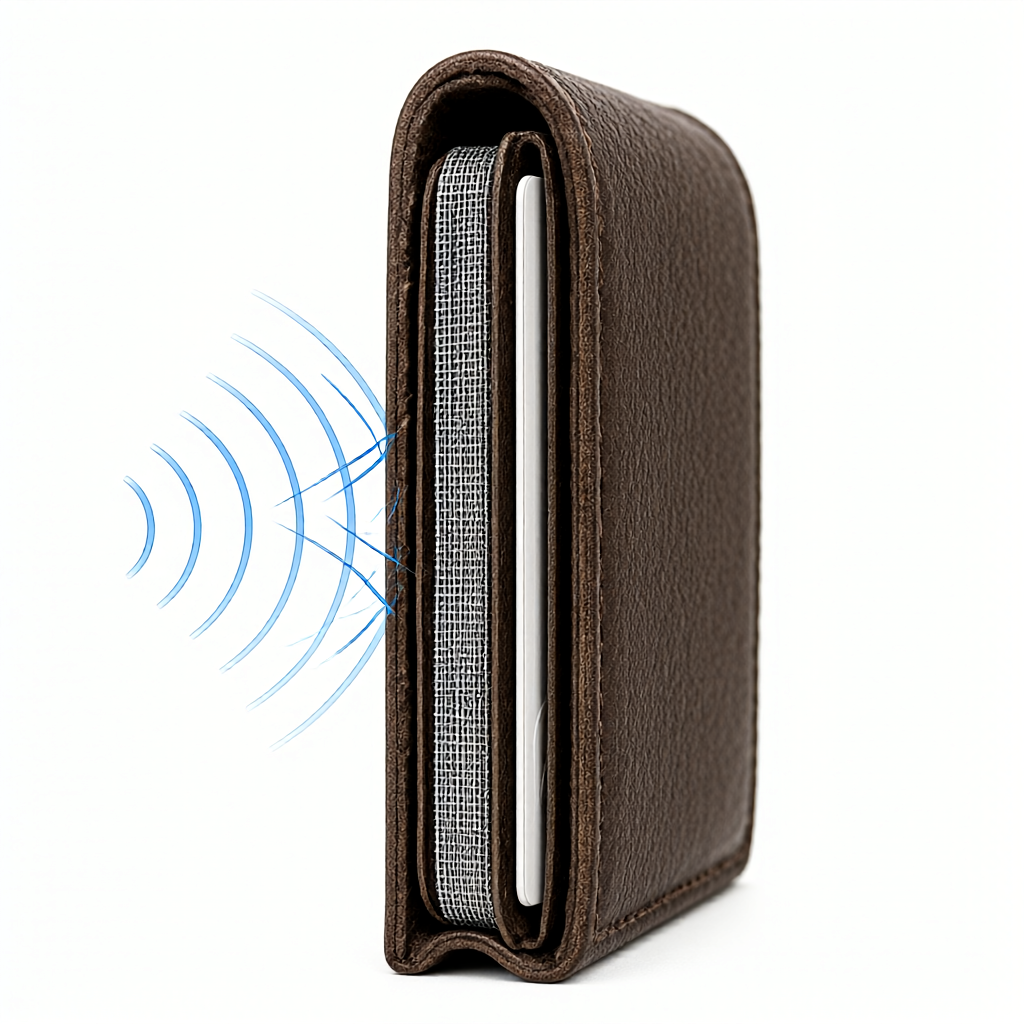
Understanding RFID/NFC in cards. Modern banknotes, passports, and access cards often include a tiny microchip and antenna that communicate via radio waves at 13.56 MHz. When you tap a card at a reader, the field powers the chip and transmits encrypted payment or identity data. The same frequency can be accessed by a rogue reader held within a few inches—this is the basis of “electronic pickpocketing.”
The shielding principle. An RFID‑blocking wallet works on the Faraday cage effect: a continuous conductive layer surrounding the card slots reflects and absorbs the radio waves, preventing them from reaching the chip. The wallet itself becomes a protective shield, not a jammer. Because the barrier is passive, no battery or active circuitry is required.
What actually blocks the signal? The effectiveness depends on the material’s conductivity, thickness, and coverage continuity. Gaps—such as open slots, seams, or thin edges—can allow fringe signals to leak through. High‑quality designs therefore use full‑coverage metal bodies (aluminum, titanium, stainless steel) or carbon‑fiber laminates with an embedded conductive mesh that wraps the entire card stack.
Form‑factor variations. RFID shielding is available across several pocket‑gear styles:
- Metal bifold wallets — solid aluminum or titanium shells with internal card slots; maximum coverage, often used as a contactless card shield.
- Slim card holders — lightweight plates or frames that hold 4–12 cards; suitable for buyers seeking a minimalist chip‑blocking wallet.
- Money clips — combine a card holder with a cash‑retention bar; the clip arm must be continuous to maintain the shield.
- Tactical pocket organizers — multi‑compartment tools that incorporate RFID‑blocking panels alongside knife sheaths or multi‑tools.
The choice of form factor influences both the shielding performance and the target market—for example, Amazon FBA sellers often prioritize slim card holders for impulse‑buy channels, while EDC brand owners may favor rugged organizers.
What Are the Key Specs for RFID Protection Wallets?
Buyers evaluating an RFID‑blocking wallet should assess the following technical parameters:
| Spec | Why It Matters | Typical Range / Guideline |
|---|---|---|
| Material & thickness | Determines attenuation (signal reduction). Metals must be thick enough to prevent permeation; composites need a continuous conductive layer. | Aluminum: 0.5–1.2 mm; Titanium: 0.3–0.8 mm; Carbon‑fiber mesh: ≥2 layers with ≥80% coverage. |
| Coverage area | Gaps allow RF leakage. Full‑wrap designs outperform slot‑only shields. | 100% enclosure around card stack preferred; partial coverage <70% risks skimming. |
| Slot capacity | Impacts both shielding integrity and product utility. Overcrowding can compress the conductive layer. | 4–12 cards typical; more slots require thicker or multi‑layer construction. |
| Weight | Affects pocket comfort and shipping costs. | 30–120 g for metal wallets; 15–40 g for carbon‑fiber/card‑holder styles. |
| Dimensions | Must fit standard credit‑card size (85.6 × 53.98 mm) while allowing card removal. | Outer size ~90 × 60 mm; inner slot clearance ≥1 mm per card. |
| Compliance level | Indicates whether the product has been tested against recognized attenuation standards. | Look for third‑party test reports citing ≥50 dB attenuation at 13.56 MHz. |
Trade‑off to note: Thicker metal provides better shielding but adds weight and can cause card‑ejection mechanisms to feel stiffer. Carbon‑fiber composites offer a lighter alternative, but the conductive mesh must be carefully laminated to avoid delamination over time.
What Standards Apply to RFID‑Blocking Claims?
There is no single mandatory certification for consumer RFID wallets, but several widely referenced standards and guidelines govern performance testing and truthful marketing:
- ISO/IEC 14443 and ISO/IEC 18000‑3 define the air‑interface parameters for 13.56 MHz proximity and proximity cards—the same frequency used by most contactless payment and passport chips. A wallet that blocks signals in this band will generally protect against both payment‑card and passport skimming.
- ASTM E2092 (standard practice for measuring attenuation of radio‑frequency electromagnetic fields) is commonly used by manufacturers and testing labs to quantify shielding effectiveness. Results are expressed in decibels (dB); ≥50 dB attenuation is widely accepted as “effective blocking” for consumer applications.
- Federal Trade Commission (FTC) guidelines require that advertising claims about product security features be truthful and substantiated. Sellers should be able to produce test reports if challenged, and avoid absolute terms like “100% waterproof” or “indestructible” unless rigorously proven.
When sourcing, request a third‑party test certificate that cites the methodology (e.g., ASTM E2092) and the measured attenuation at 13.56 MHz. This documentation is essential for retail compliance and for defending the claim in promotional material.
What Should B2B Buyers Consider When Sourcing RFID Wallets?
Procurement fundamentals. Beyond shielding performance, buyers must align several operational variables:
- MOQ (Minimum Order Quantity) – Low‑MOQ runs (as low as 300 pieces) enable brand testing, while higher volumes secure tighter unit pricing. Clarify whether the MOQ applies per SKU, per color, or per custom artwork setup.
- Lead time – Sample turnaround (often 5–7 days) and mass‑production cycles (typically 15–30 days after artwork approval) directly affect launch timing. Rush fees may apply for expedited runs.
- Certifications & compliance – Verify that the manufacturer holds relevant quality‑management certifications (e.g., ISO 9001) and that materials are REACH/RoHS compliant, especially for markets with strict chemical‑restriction rules.
- Customization scope – Determine whether the supplier offers full OEM/ODM services: logo laser engraving, UV printing, custom packaging, and private‑label barcoding. Check if they support Amazon FBA prep (poly bagging, carton labeling, compliance stickers).
- Quality‑control process – Request a sample lot and perform an in‑house RF attenuation test with a simple NFC reader app. A consistent pass rate (>98%) across a batch indicates reliable production control.
Style‑vs‑shielding trade‑offs. A solid‑metal bifold offers maximum coverage but may feel bulky. A slim card holder with a conductive core preserves minimalism but requires careful slot alignment. Tactical organizers can embed RFID‑blocking panels only in the card compartment, leaving other sections exposed—a compromise that should be disclosed to end users.
Price drivers. Unit cost is influenced by material selection (aluminum vs. titanium), thickness, surface finishing (anodizing, bead‑blasting, PVD coating), order volume, and customization complexity. For a detailed breakdown of how these factors affect cost at 1,000–10,000‑piece runs, refer to our men’s minimalist wallets materials, specs & sourcing guide.
Ready to evaluate FOB pricing for your target volume? Request a bulk quotation with your desired specs and quantity.
Have a custom design or private‑label requirement? Submit your opening sizes and artwork for a tailored development quote.
Manufacturing Insights: How to Source Custom RFID Protection Wallets
From concept to shelf. The development cycle for a custom RFID‑blocking wallet typically follows these stages:
- Requirement definition – Share target card capacity, material preference, shielding level, and any branding elements.
- Prototype & test – The manufacturer produces a functional sample, often with a conductive‑mesh core or solid metal body, and performs initial RF attenuation testing.
- Tooling & setup – For metal wallets, CNC machining or stamping dies are prepared; for composite designs, laminate pressing fixtures are set up.
- Surface finishing – Anodizing (for aluminum), bead‑blasting, polishing, or PVD coating are applied according to the specified aesthetic.
- Assembly & QC – Cards are inserted, mechanisms are tested for smooth ejection, and a statistical sample undergoes final RF verification.
- Packaging & shipment – Retail boxes, poly bags, or blister packs are assembled; FBA‑compliant labeling is applied; pallets are booked for ocean or air freight.
Supplier capabilities to look for. A capable OEM/ODM partner will demonstrate:
- In‑house machining and finishing – Ensures tighter control over tolerances and surface quality.
- Flexible MOQ – Allows brand owners to start with small batches and scale confidently.
- Fast sample turnaround – Reduces time‑to‑market and lets you validate shielding before committing to volume.
- Documentation support – Provides material safety data sheets, test reports, and compliance certificates for import clearance.
How we approach custom RFID wallets. As a manufacturer, our process centers on translating your performance and branding requirements into a reliable, shippable product. We start with a detailed spec review, then produce a working prototype that we test against a 13.56 MHz reference field. Once the shielding attenuation meets your target (typically ≥50 dB), we move to tooling and surface‑finish trials. Our in‑house CNC and anodizing lines allow us to adjust thickness, alloy, and coating without outsourcing, which keeps lead times predictable and quality consistent. For branding, we offer laser engraving, UV printing, and custom packaging design—each step documented so you can verify traceability. If you’d like to see how a project like yours would flow from concept to production, contact our team to discuss your specifications and volume targets.
RFID Protection Wallets: Where Can You Verify the Data and Sources?
- men’s minimalist wallets materials, specs & sourcing guide — topedcwallet.com
- Request a bulk quotation — topedcwallet.com
From article to product
Building an RFID range?
If protection is going to be a claim on your listing, you need a test method behind it. We test every batch with a live 13.56 MHz reader and supply the report.
Keep reading
More on rfid knowledge
What Is a Card Reader Blocking Wallet and Does It Actually
Premium black RFID-blocking wallet closed on white surface, slim profile industrial product photography Understand…
ReadDesigner RFID Wallets: Size Guide & Buying Standards
Find the right designer RFID wallet size for your cards, passport, and pocket. Compare…
ReadRFID Card Blockers: Do They Actually Work? (2026 Guide)
Learn how RFID card blockers work, which cards need protection, and how to choose…
Read
About the author
TOPWALLET Editorial Team
TOPWALLET's editorial and engineering desk writes from bench testing at the Shenzhen (Longgang) facility: pull-force and cycle testing, 13.56 MHz shielding measurements, finish trials and factory audits, rather than supplier spec sheets. Every specification in these guides is one we write on a purchase order.
Written on the floor
This article was written by our production and QC team — the people who spec tolerances, run the finishing line and inspect every batch. Where it states a capacity, a pull force or a lead time, it comes from a measurement we made, not a supplier’s catalogue. If a number here disagrees with what your own supplier told you, tell us; several of these articles started as a correction from a buyer.
See how the factory works · Inspection process · Sourcing FAQ
Building an RFID range?
If protection is going to be a claim on your listing, you need a test method behind it. We test every batch with a live 13.56 MHz reader and supply the report.