

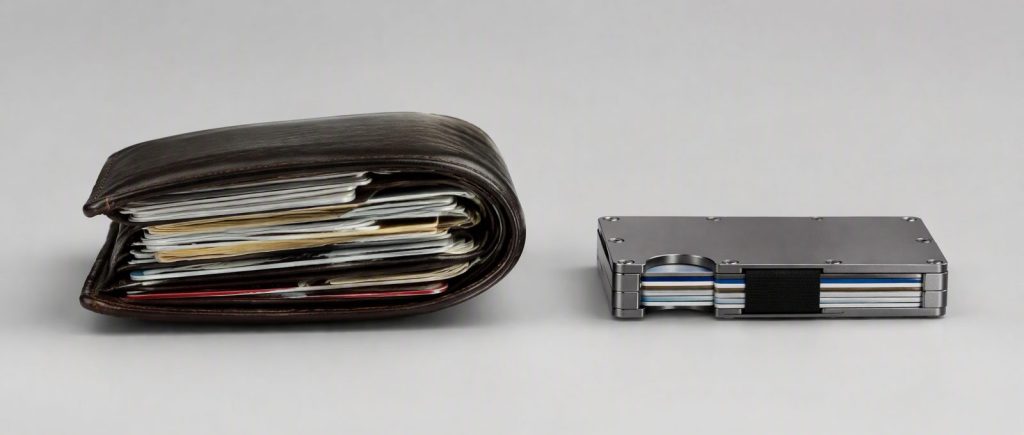
Here’s the short version: empty every card out of your wallet, cut the stack to 6 cards max, pair it with the fewest bills you actually spend in a normal day, and put the rest in a drawer or an app. That’s the whole 15-minute reset. If you want the version with the reasoning, the numbers, and the exact order of operations, keep reading.
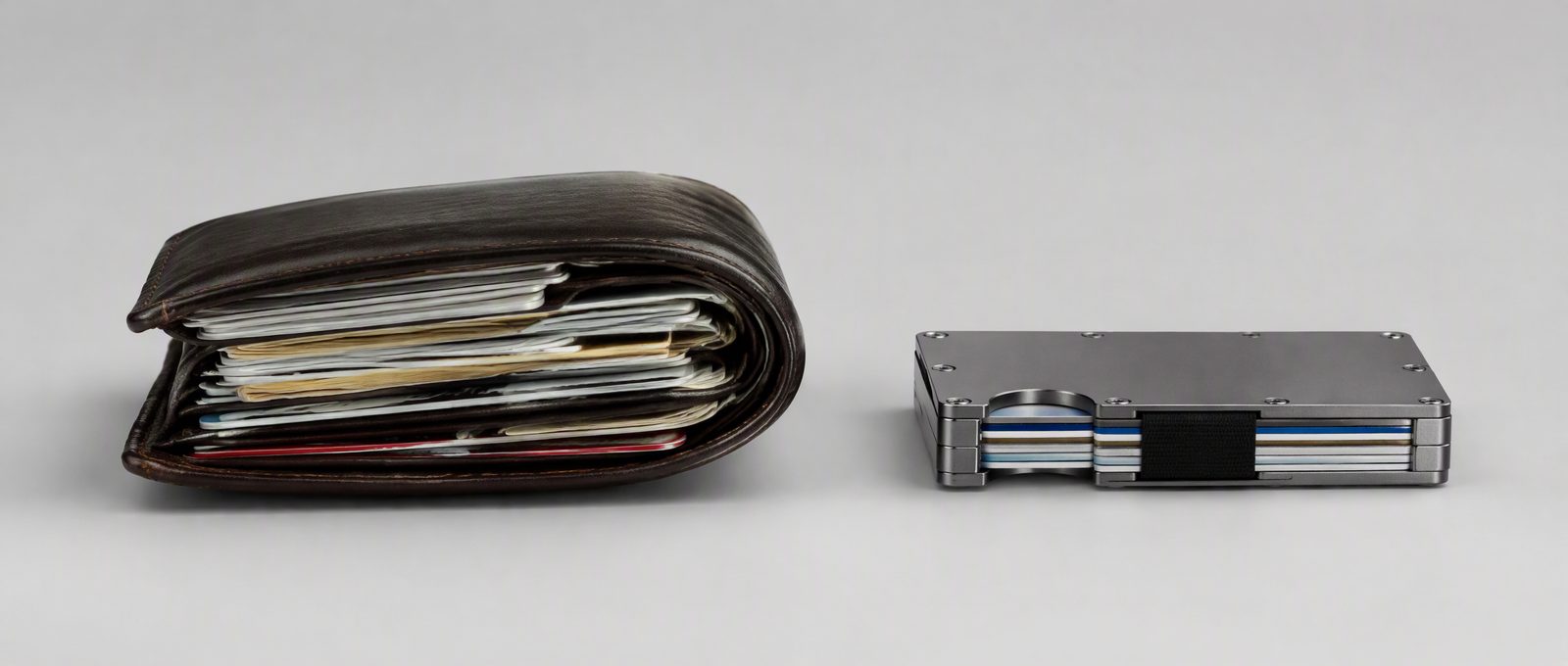
We see this problem from the factory side. When customers send us thick wallets back for trade-in evaluation, the story is almost always the same: 14 to 18 cards, receipts from three months ago, and a stack of bills folded several layers deep. The wallet isn’t the problem. The load is.
Why Your Wallet Is Actually Thick
A standard card is 0.76 mm. Ten cards is 7.6 mm of card before any structure. Fold a few bills and add a leather or metal shell and you cross 15 mm loaded in a hurry — that’s the front-pocket ceiling most people hit without noticing. For the thickness benchmarks behind this, our guide on minimalist wallets explained lays out the numbers.
The usual suspects, in order of how often they add bulk:
- Loyalty cards and gift cards you haven’t used in six months
- Old receipts and business cards
- Debit and credit cards you keep “just in case”
- A reserve of folded cash that never actually gets spent
- Insurance cards and IDs that belong in the car or a drawer
Almost every “fat wallet” fix comes down to those five. Cut them and the pocket profile changes immediately.
Step 1: Empty Everything and Sort (5 minutes)
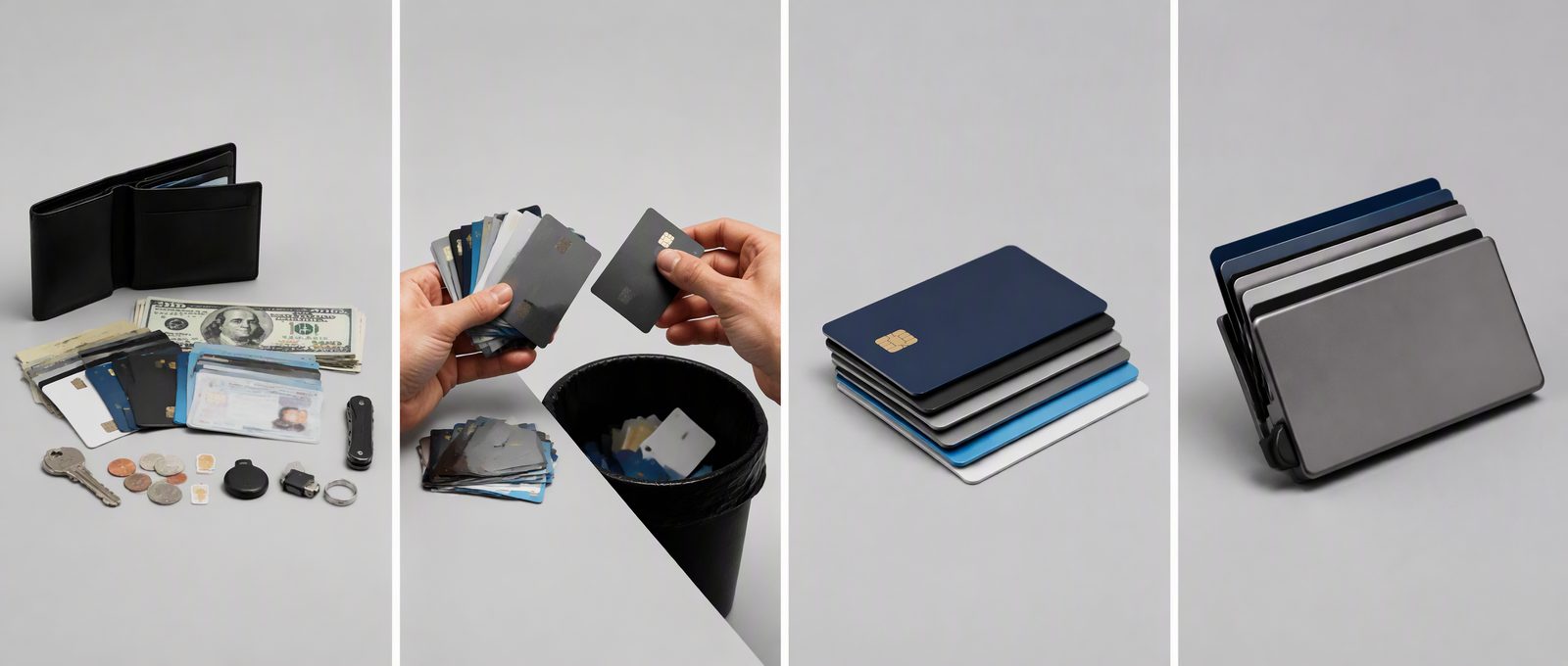
Take every single thing out. No exceptions. Then sort into four piles:
| Pile | What goes in it | What happens next |
|---|---|---|
| Daily carry | Cards you use at least once a week | Goes back in |
| Occasional | Cards you use monthly or less | Phone case, drawer, or wallet sleeve |
| Digital | Loyalty numbers, tickets, membership IDs | Get the app or save a photo |
| Trash | Receipts, expired cards, old business cards | Bin it now |
The rule of thumb: if a card has been in the wallet for a month without being used, it’s not daily carry. That single rule alone removes three to five cards from most wallets.
| Slimming approach | Cards kept | Loaded thickness | Effort | Best for |
|---|---|---|---|---|
| Full reset (this guide) | 5–6 | 9–12 mm | 15 minutes, monthly | Most people |
| Phone-case carry | 3–4 | 8–10 mm | One-time switch | People who never carry cash |
| Dedicated card holder | 4–6 | 8–11 mm | One-time switch | Split-card users |
| Keep as-is | 10+ | 15 mm+ | None | No one with back-pocket pain |
Step 2: Cut to Six (5 minutes)
Six is the sweet spot for a reason. At six cards, a minimal wallet sits around 9–12 mm loaded — comfortable in a front pocket, and still functional for a normal week. Our benchmark guide covers the loaded measurements, but the simple version is: below six you’re trimming for its own sake, above six you’re back to bulk.
The six you keep should be:
- Primary debit/credit card
- Backup card
- Driver’s license or state ID
- Work or building access card (if you need it daily)
- Health insurance card
- One card for the coffee shop / transit / whatever you actually touch daily
If you really need more than six, stop carrying a wallet and think about a phone case or a dedicated card holder. If your wallet itself is designed for more, our guide on how many cards fit in a wallet shows what different designs actually hold — a lot of “12 card” claims only work when the frame stays loose.
Step 3: Fix the Cash Layer (3 minutes)
Cash is the sneaky bulk. Three folded bills in a fat wallet stack to nearly the same thickness as a card. The fix isn’t to stop carrying cash — it’s to carry the cash you’ll actually spend today.
- One or two folded bills for daily stops
- The rest goes in a separate place (car, drawer, home stash)
- If you carry more than two bills, use a clip or keep them flat, not folded
If cash is a daily part of your system, a dedicated money clip wallets guide design holds bills flat without adding a card-layer on top. That’s materially slimmer than folding cash into a card slot.
Step 4: Rebuild in the Right Order (2 minutes)
Order matters more than people think. Rebuild the wallet so the cards you remove least sit in the middle, and the two you use daily sit on the outside. That saves you from digging through everything every time, which is usually why people over-stuff in the first place — they can’t find what they need, so they keep more.
Two practical tips:
- Keep your transit/coffee card in the touch slot or an outer pocket
- Don’t store receipts, ever. Photo them if you need the record
What Happens After the Reset
The uncomfortable truth: most people re-stuff the wallet within two weeks. The reset isn’t a one-time fix, it’s a habit. Here’s what makes it stick:
- Once a month, do the four-pile sort again. Ten minutes, done.
- When you buy a new wallet, treat capacity as a limit, not a promise. A 12-card wallet will collect 12 cards. A 6-card wallet forces the decision early.
- If you carry a phone with a wallet case, move the occasional cards there. That’s not cheating, that’s what the pocket is for.
If the problem is genuinely the wallet design and not the habit — a bifold with a zipper pocket you never use, or a leather shell that adds 5 mm for no reason — then it’s worth switching formats. Our guides on how to choose wallet size and best minimalist wallets cover the options by actual loaded thickness.
The Factory View: What a Slim Wallet Should Be
From our production line: a properly designed minimalist wallet is 8–12 mm loaded at six cards. That’s not an aspiration, it’s what we measure on finished units — every batch through our Dongguan factory goes four-stage inspection under ISO 9001:2015, with AQL 2.5 sampling and a monthly capacity of roughly 50,000 units across 200+ partner brands. Those are the numbers behind the claims any wallet factory makes; we publish ours because loaded thickness is a measured spec, not a marketing line. Materials change it slightly — titanium and aluminum frames hold the profile better than most leathers, which is why they dominate the slim category. If you’re considering a material change to solve bulk, our metal vs leather vs carbon fiber wallet comparison covers the thickness and weight trade-offs side by side.
And when we engineer a custom wallet for a brand, thickness is the first number we lock at the design stage and verify against production units under a 4-stage inspection process — samples reach you in about 7 days, full production in about 30 days. It’s cheaper to design the target profile in from the start than to rediscover it in the third prototype. If you’re building a wallet brand and want a proper slim profile from the first sample, that’s a spec we set before we cut steel — Ask Our Factory Team for the loaded-thickness spec sheet.
FAQ
How do I make my wallet thinner quickly?
Empty it completely, keep only what you use at least weekly — usually 5–6 cards — and carry only the cash you’ll spend today. That’s 15 minutes and it cuts most wallets by half.
How many cards should I carry in my wallet?
Six is the practical maximum if you want a slim wallet. Beyond that you’re choosing bulk over preparedness. See how many cards should you carry for the breakdown by situation.
Why is my wallet so thick even with few cards?
The design itself may add bulk: thick leather, folding layers, or a rigid frame. Card count isn’t the only variable. If you’re under six cards and still thick, it’s the construction, not the load.
Does a bulky wallet cause back pain?
Yes, when carried in the back pocket. Thick wallets tilt the pelvis when you sit. It’s a common cause of hip and lower-back discomfort that people blame on everything else. Details in wallet back pain.
What’s the slimmest wallet that holds 6 cards?
Metal and carbon-fiber frames hold six cards at roughly 9–12 mm loaded. Leather runs a few millimeters more. The exact number depends on the shell design — best slim wallets lists measured options.
Should I keep receipts in my wallet?
No. Receipts are the fastest way to add bulk and they’re usually worthless in a week. Photograph them if you need a record, then bin them.
Is it better to carry cash or cards for a slim wallet?
Cards are thinner stacked. But if you use cash daily, a dedicated money clip keeps bills flat without adding a full card layer — see money clip wallets guide.
Why do wallets get bulky so fast?
Because empty wallets collect stuff. A 12-card wallet will fill to 12 cards; the design invites the load. Swapping to a smaller capacity format forces you to keep the carry honest.
Bottom Line
Bulky wallet, 15 minutes, four steps: empty it, cut to six, fix the cash, rebuild in order. The wallet was never the problem — the load was. Fix the habit, and if the design fights you, fix the design. Request a Quote for a custom slim profile, or Get OEM Pricing if you’re building a wallet brand that starts thin and stays thin.
From article to product
Sourcing minimalist-wallets?
Tell us the format, the quantity and the date you need stock. You get material options, MOQ and a landed-cost range back within one business day.
Keep reading
More on wallet care
How to Carry Cash in a Minimalist Wallet: 7 Folding Methods (2026)
Here’s the short version: the trick to carrying cash in a minimalist wallet is…
ReadHow to Remove Scratches From a Metal Wallet (2026)
Here’s the short version: scratches are removable only when they sit in the finish…
ReadHow to Organize Your Wallet Cards in 2026: a Three-Tier Carry System That Stays Thin
Thick wallets are a stacking problem, not a storage problem: most people carry eight…
Read
About the author
Wu, Leon
Leon Wu is the senior product engineer and EDC testing lead at TOPWALLET. He has spent more than a decade on wallet design-for-manufacture, materials and quality control at the company's Dongguan facility, and writes from bench testing, pull-force and 13.56 MHz shielding measurements rather than supplier spec sheets.
Written on the floor
This article was written by our production and QC team — the people who spec tolerances, run the finishing line and inspect every batch. Where it states a capacity, a pull force or a lead time, it comes from a measurement we made, not a supplier’s catalogue. If a number here disagrees with what your own supplier told you, tell us; several of these articles started as a correction from a buyer.
See how the factory works · Inspection process · Sourcing FAQ
Sourcing minimalist-wallets?
Tell us the format, the quantity and the date you need stock. You get material options, MOQ and a landed-cost range back within one business day.