

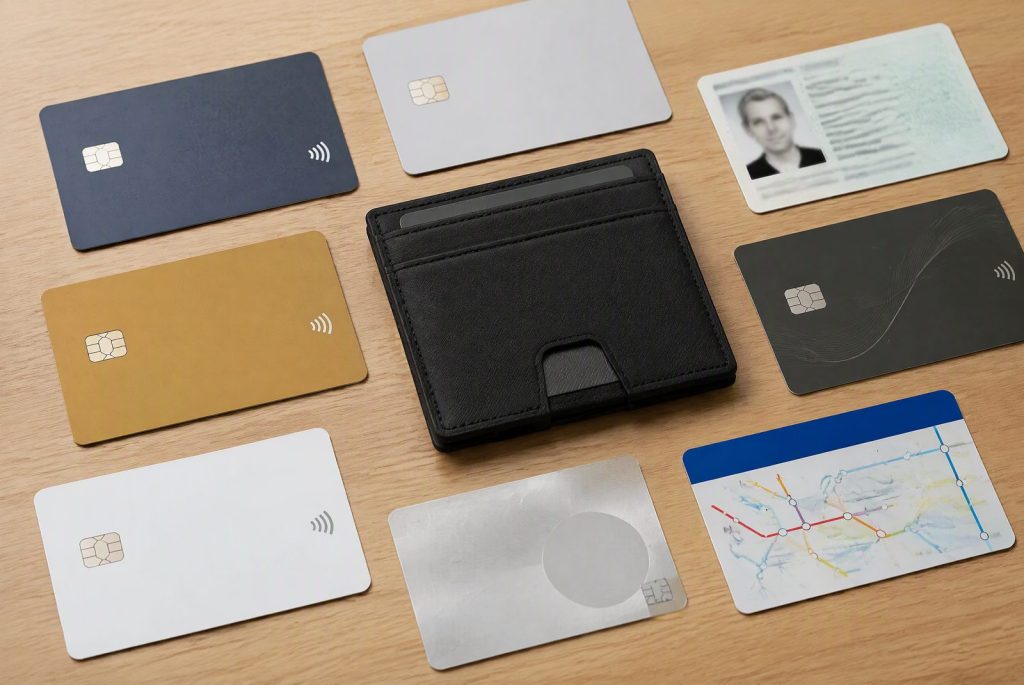
There's a number hiding in every minimalist wallet debate, and it's smaller than you think. Carry 5–8 cards is the practical sweet spot for most people: your ID, a primary payment card, a backup card, a transit card, and 1–3 essentials (health, access, loyalty). Fewer than 5 and you're creating daily friction; more than 8 and you're paying for it with back pain, worn cards, and a wallet that decides its own shape in your pocket. This guide shows you how to count what actually earns a slot — and what that math does to your wallet choice [1] [2].
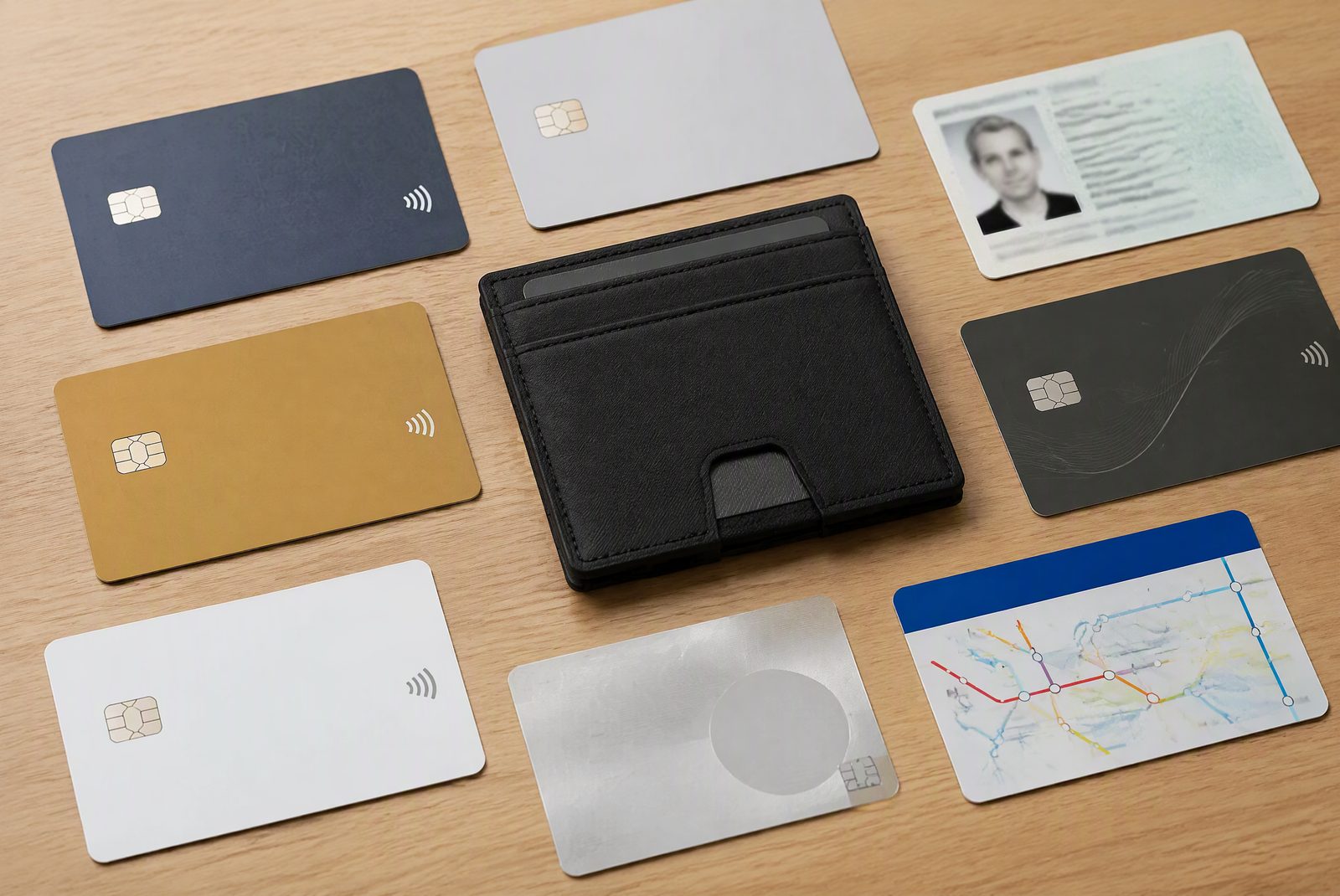
Quick Card Budget: What Actually Belongs
| # | Card Type | Keep? | Why |
|---|---|---|---|
| 1 | Government ID / driver's license | Yes | Non-negotiable legal requirement |
| 2 | Primary debit/credit | Yes | Your daily payment engine |
| 3 | Backup payment card | Probably | Emergency only if networks split |
| 4 | Transit card | Maybe | Only if you ride transit weekly |
| 5 | Health/insurance card | Maybe | Carry the digital copy; card for legacy systems |
| 6 | Access/work badge | Maybe | Works if it's not a separate fob ecosystem |
| 7 | Loyalty cards | No | App them — they're killing your spine |
| 8 | Membership/fitness cards | No | Photos or apps, not plastic |
| 9 | Old expired cards | No | They're literally dead weight |
| 10 | Spare/cash deposit cards | No | Vault them at home |
Why 5–8 is the number (and who should carry more)
The 5–8 range isn't arbitrary — it's the interaction of three limits:
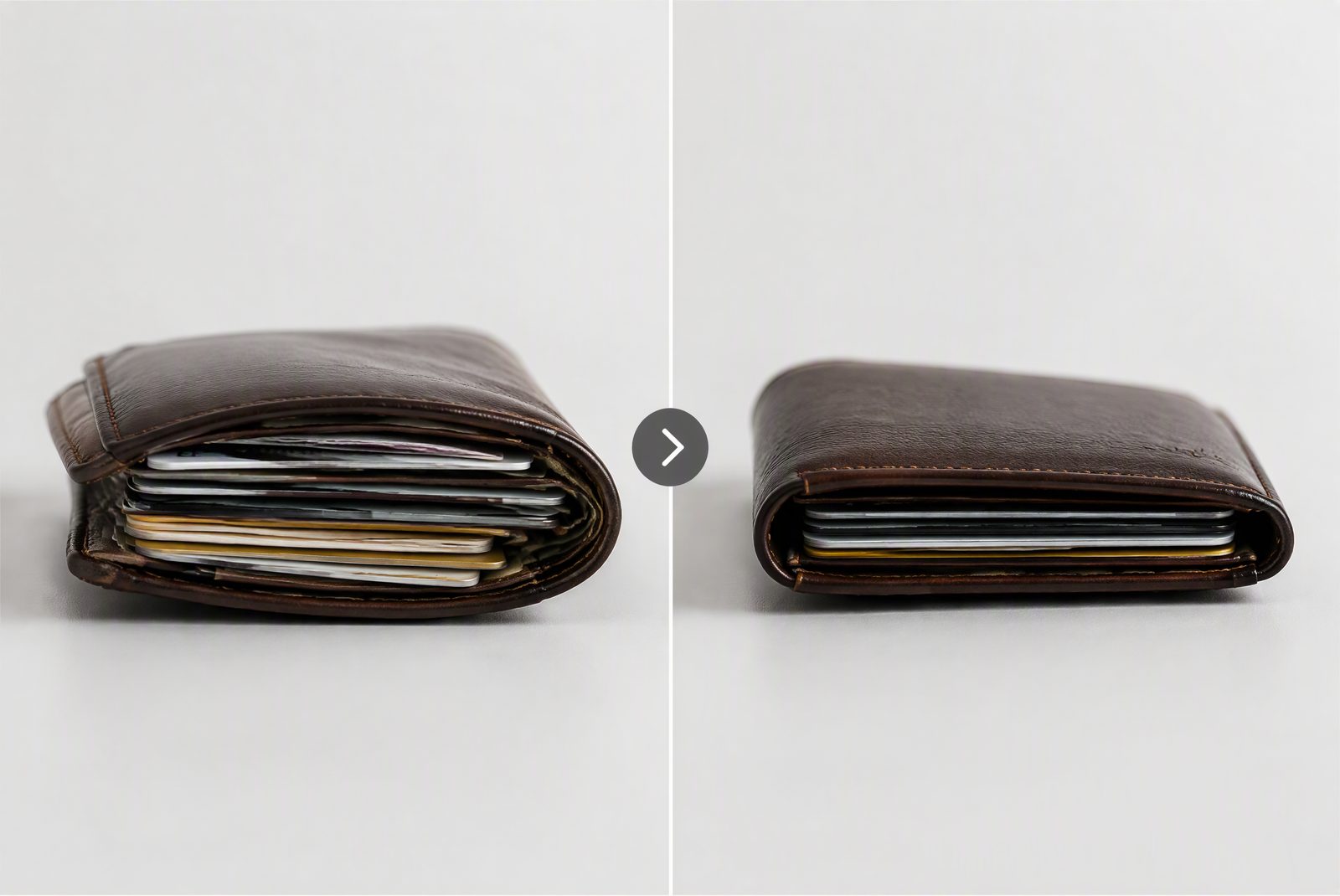
1. Health. Physiotherapists and chiropractic literature consistently flag wallet-in-back-pocket carry as a factor in lower-back and sciatic complaints; the relevant variable is thickness and hours carried, not card count per se [1]. At 5–8 standard cards a slim wallet stays under ~15mm [1]; past 10+ cards you're into "hip wallet" territory that no discreet pocket fixes.
2. Card wear. RFID chips and magnetic strips crack under repeated flexing and pressure. Every extra card multiplies tension inside the wallet; 5–8 keeps the stack loose enough that edge chamfers and dividers actually work (the reason rigid metal wallets — TOPWALLET and G star wallet's aluminum lines — radius their interior edges [1] [2]).
3. Practical limits. Transit, health, and loyalty apps have eliminated the plastic needs these cards used to justify. The phone-first carry (see our MagSafe piece) proves you can run on 2–3 physical cards plus a phone; 5–8 is the conservative version that doesn't depend on battery life.
Who should carry more: travelers (passport substitutes, second currency, travel cards — see Best Travel Wallets and our travel-setup guide), parents (family insurance + access), and anyone with legacy medical/access systems. Who should carry fewer: urban minimalists, commuters with strong transit apps, and anyone whose wallet exceeds 12mm when sitting [1].

The 5-slot audit: a 10-minute card-counting reset
Do this once a year — it's the highest-impact wallet move available:
- Dump everything. Spread all cards, notes, receipts, and "just in case" items on a table.
- Group by function. ID / payment / transit / health / access / loyalty / junk. The junk pile is usually bigger than you think.
- Apply the three-question test to each card: (a) Have I used this in the last quarter? (b) Does an app or digital copy do the same job? (c) Is a replacement genuinely hard to produce on demand? Keep only cards with at least two "yes" answers.
- Digitize the rest. Loyalty cards → apps; insurance/health → digital copies or photos; duplicate payment cards → remove one.
- Re-count and note the number. Your target is 5–8. If the audit lands at 12+, the wallet itself — thick bifold, coin pocket, receipt stash — is the second problem (see below).
What the count does to your wallet choice
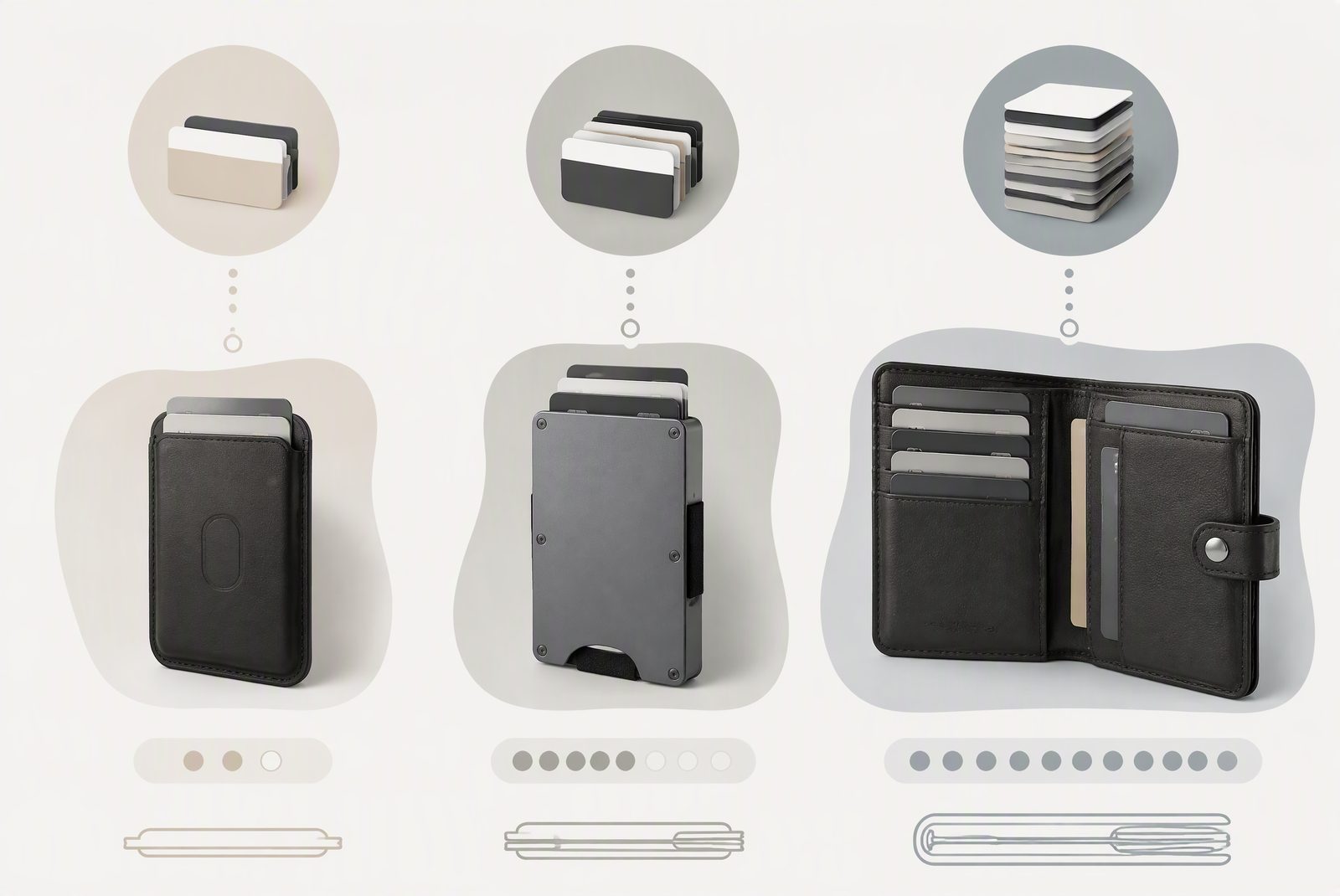
The number you land on should decide the wallet, not the other way around:
- 0–3 cards: phone-first carry — MagSafe wallet attached to the phone (2–3 capacity), or a card-sleeve that lives in a bag (see our MagSafe article). Buy for magnet strength and cavity fit, not capacity [1].
- 4–8 cards: the slim-wallet sweet spot — rigid metal wallets (aluminum 6061-T6/7075-T6, titanium) with an elastic band or clip, or a minimalist leather bifold. This is exactly the load TOPWALLET and G star wallet's metal wallets are engineered around (band-scaling capacity, RFID layers, chamfered edges) [1] [2].
- 9–12 cards: you need a structured organizer with pockets, not a minimalist wallet — and you should run the audit again this quarter.
- 13+ cards: split it. Every wallet at this load is a back problem in progress; split work/access from personal and keep the carried stack ≤8 [1].
Note for travelers and dual-wallet people: the count is per carried wallet. A travel organizer plus a daily slim wallet is fine — the issue is one bloated hip wallet.
The manufacturer's perspective: why "how many cards" is a design spec
For anyone sourcing wallets, card count is the first dimension on the drawing, not a marketing claim [1] [2]:
- Rigid wallets (TOPWALLET aluminum 6061-T6/7075-T6 lines, G star wallet metal range) spec capacity by band length and interior geometry — 4–8 cards is the engineered sweet spot; band-scaling handles ±2 [1] [2].
- Leather bifolds spec by stitch pattern and stitch-line density — the "slots" are decorative if the width math doesn't fit the card; that's an AQL-checkable dimension (TOPWALLET: AQL 2.5, ISO 9001:2015) [1].
- The QC point: card-cavity fit — cards sliding freely without rattling, chamfered edges that don't wear strips — is exactly the four-stage QC check you should see on a factory's sheet (TOPWALLET's four-stage QC; G star wallet's SGS + TUV certified programs) [1] [2].
Brand takeaway: when a factory quotes your wallet, ask for the card-count spec in writing — inner width, band length, ID cutouts. A "fits 10 cards" claim that fails at 6 is a drawing error, and the fix is on the page, not in the pocket [1] [2].
Final Verdict
Carry 5–8 cards: ID, primary payment, backup card, transit (if used weekly), and 1–3 essentials — everything else goes digital or home. Run the 5-slot audit once a year; if the audit lands above 8, fix the count before you buy another wallet [1]. Match the wallet to the count: phone-first 2–3 card carry gets a MagSafe wallet; 4–8 gets a slim rigid metal or minimalist leather wallet (the engineered sweet spot of TOPWALLET and G star wallet's aluminum lines — band-scaling, RFID layers, chamfered edges); 9+ gets a structured organizer and a re-audit [1] [2]. Your wallet is a pocket, a posture, and a product spec — and the card count is the number that ties all three together [1] [2].
FAQ
What is the ideal number of cards to carry in a wallet?
5–8 for most people: ID, primary payment, a backup card, transit if you ride weekly, plus 1–3 essentials. Fewer than 5 creates friction; more than 8 costs you health, card wear, and pocket comfort [1].
How many cards can a minimalist wallet hold?
Metal minimalist wallets (TOPWALLET's aluminum range, G star wallet's metal line) are engineered for 4–8 with band-scaling; MagSafe wallets hold 2–3; leather slimmers often claim 8–12 but bulge past 8 [1] [2].
Does carrying many cards damage them?
Yes — pressure and repeated flexing crack chips and delaminate strips. 5–8 cards keeps tension low enough that dividers and chamfered edges actually work; 13+ multiplies wear [1] [2].
Should I carry my social security card?
No — keep government documents out of daily carry; use them only when legally required. The audit rule applies: replaceable-in-a-day items don't earn a slot [1].
What cards should every man carry?
Minimum set: government ID, one primary payment card, one backup card. Add transit and a health card if you use them weekly. Everything else is app-able [1].
Can a wallet with 10+ cards cause back pain?
The research-linked issue is thickness and hours carried in a back pocket — and 10+ cards reliably produces a thick wallet. 5–8 and a front-pocket or slim carry is the evidence-aligned answer [1].
How do I know if my wallet is too full?
Signals: the wallet bulges visibly, cards leave impressions in the fabric, it's uncomfortable sitting, or the band/clip stretches past spec. Run the 5-slot audit and re-count [1].
Build the right wallet instead: minimalist wallets for the slim carry, and RFID wallets if card security changes your count. Subscribe to the TOPWALLET brief for the next carry-system guide.
For wholesale, OEM, or private-label quantities: REQUEST A QUOTE
Sources
- TOPWALLET — Official site, materials/QC pages (aluminum 6061-T6/7075-T6, band capacity, chamfered edges, RFID layers, AQL 2.5, four-stage QC, ISO 9001:2015, 15-year factory, 200+ brands). https://topedcwallet.com/
- [2] G star wallet — Official site, company and capability (metal lines, titanium TC21/Gr5, 8-dimension customization, logo MOQ 100, SGS + TUV, founded 2012, 13+ years, 300,000+/month). https://gstartec.com/
From article to product
Sourcing minimalist-wallets?
Tell us the format, the quantity and the date you need stock. You get material options, MOQ and a landed-cost range back within one business day.
Keep reading
More on wallet care
How to Carry Cash in a Minimalist Wallet: 7 Folding Methods (2026)
Here’s the short version: the trick to carrying cash in a minimalist wallet is…
ReadHow to Remove Scratches From a Metal Wallet (2026)
Here’s the short version: scratches are removable only when they sit in the finish…
ReadHow to Slim Down a Bulky Wallet: 15-Minute Reset (2026)
Here’s the short version: empty every card out of your wallet, cut the stack…
Read
About the author
Wu, Leon
Leon Wu is the senior product engineer and EDC testing lead at TOPWALLET. He has spent more than a decade on wallet design-for-manufacture, materials and quality control at the company's Dongguan facility, and writes from bench testing, pull-force and 13.56 MHz shielding measurements rather than supplier spec sheets.
Written on the floor
This article was written by our production and QC team — the people who spec tolerances, run the finishing line and inspect every batch. Where it states a capacity, a pull force or a lead time, it comes from a measurement we made, not a supplier’s catalogue. If a number here disagrees with what your own supplier told you, tell us; several of these articles started as a correction from a buyer.
See how the factory works · Inspection process · Sourcing FAQ
Sourcing minimalist-wallets?
Tell us the format, the quantity and the date you need stock. You get material options, MOQ and a landed-cost range back within one business day.