

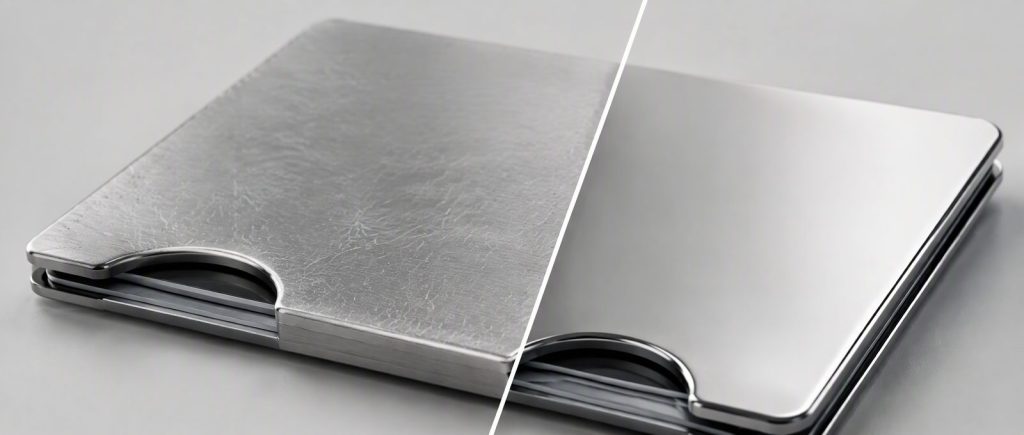
Here’s the short version: scratches are removable only when they sit in the finish layer, not in the metal itself. On an anodized aluminum wallet, light scratches polish out with a mild abrasive pad; deep ones that cut through the anodized layer can’t be “removed” at home — they can only be refinished or accepted as patina. On raw metal and titanium, most surface scratches blend out with progressively finer abrasives. Everything starts with checking what finish your wallet actually has.
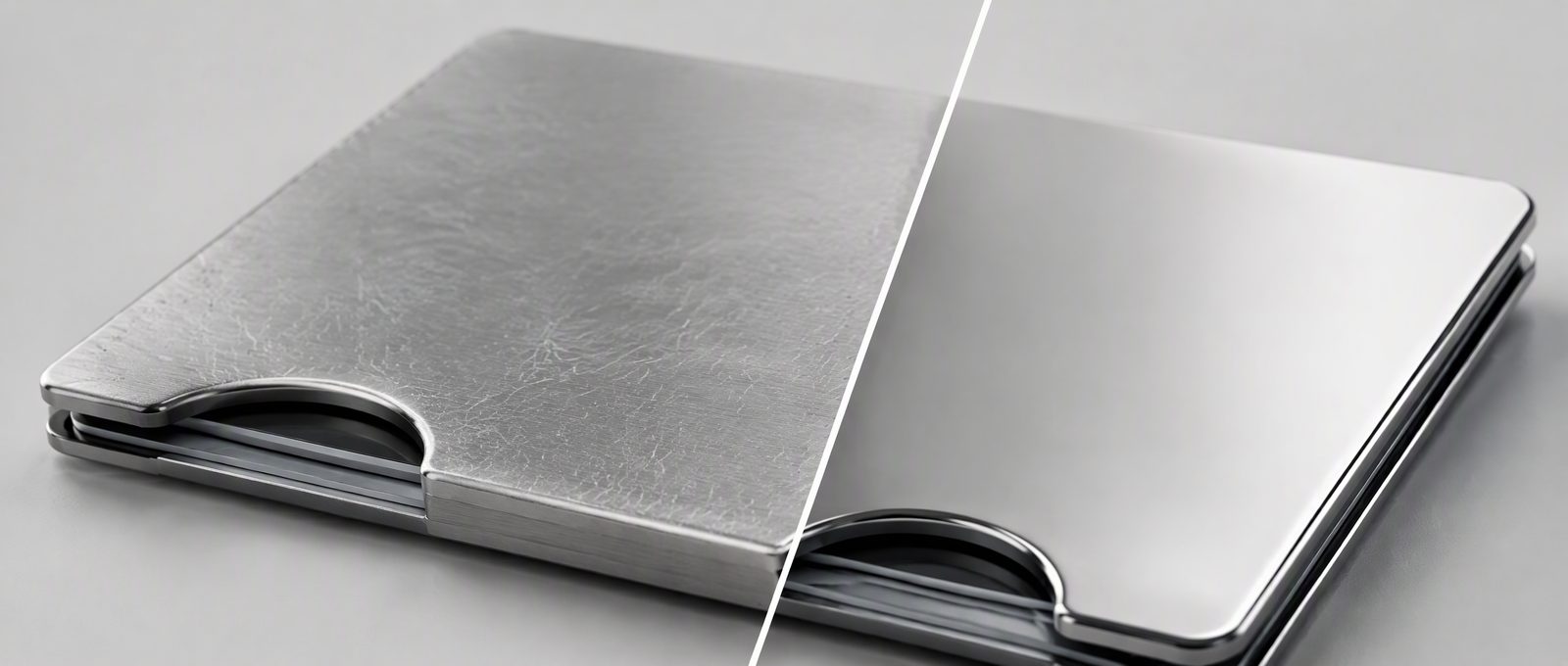
We handle this from the factory side. Every metal wallet we produce goes through surface finishing before assembly, and the same question keeps returning from customers: “the finish is scratched, can it be fixed?” The answer depends on which layer the scratch reached. This guide covers what works at home, what needs a shop, and when the right move is to stop fixing and start preventing.
What Kind of Scratch Is It?
The scratch either lives in the surface treatment or in the metal:
- Scratches in the finish layer (light scuffs on anodizing or PVD) — removable by hand with mild abrasives or polish.
- Scratches through the finish into bare metal — not removable without refinishing the whole surface. You can lighten them, but the line stays visible.
- Scratches on raw metal (raw aluminum, titanium, steel) — mostly blendable by sanding up through finer grits, because you’re working in the metal itself.
The distinguishing test is simple: run a clean fingernail across the scratch. If your nail catches, the scratch is deep — expect refinishing. If the nail slides over it, it’s a surface scratch and usually fixable.
Anodized vs Raw Metal: Which Can Be Repaired
The finish decides the repair path. Here’s the comparison that matters before you touch anything:
| Surface | Scratch location | At-home fix | Realistic result |
|---|---|---|---|
| Anodized aluminum | In the anodized layer (light) | Mild abrasive pad, light pressure | Fades visibly, finish intact |
| Anodized aluminum | Through the layer into metal (deep) | None at home | Can’t restore; refinish or embrace it |
| Raw (bare) aluminum | Surface scratches | Sand up through 400–2000 grit, then polish | Blend to near-invisible |
| Titanium | Light surface scratches | Fine abrasive, light strokes | Fades; titanium is hard but scratchable |
| PVD/coated finishes | In the coating | None safe at home | Coating can’t be spot-restored |
If your wallet is anodized, the worst thing you can do is aggressively sand the visible scratch — you’ll remove the anodized layer around it and leave a larger dull patch. Anodizing isn’t paint; it’s a hardened oxide layer grown into the aluminum. Our explainer on anodizing explained covers why that layer behaves the way it does.
Scratch Severity Check
Before choosing a method, grade the damage. This table is the same logic we use when a customer sends a worn unit back for evaluation:
| Severity | What it looks like | Fingernail test | Repair route |
|---|---|---|---|
| Level 1 | Haze, scuffs, micro-marks | Nail never catches | Microfiber + mild polish only |
| Level 2 | Visible lines you can feel slightly | Nail catches faintly | Fine abrasive pad or high-grit sanding |
| Level 3 | Deep grooves down to bare metal | Nail catches clearly | Refinish, or live with it |
| Level 4 | Scratches with raised burrs | Edges feel sharp | Deburr lightly, then treat as Level 3 |
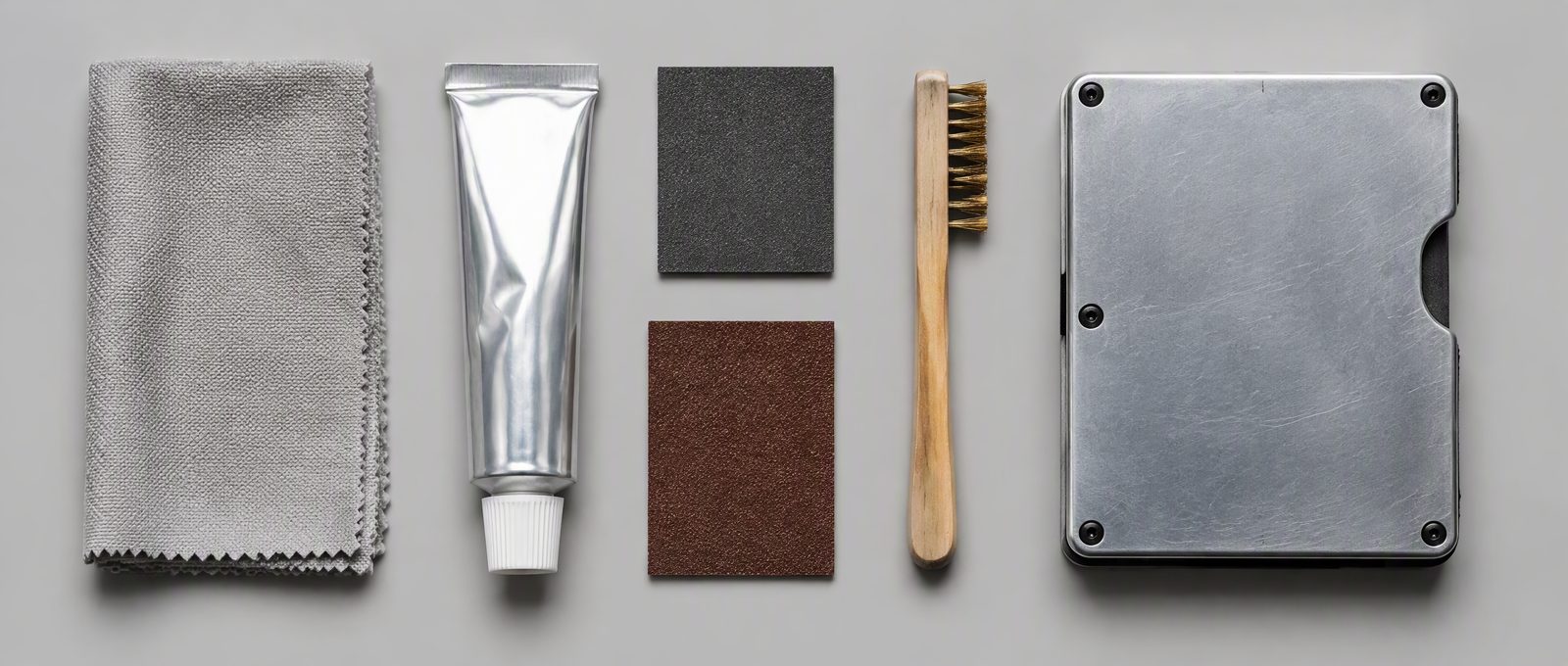
Levels 1 and 2 are your realistic at-home territory. Levels 3 and 4 are “refinishing,” which is a shop process, not a kitchen-table one.
Method 1: Surface Scuffs (Level 1) — Polish, Don’t Sand
For haze and light scuffs, you don’t need abrasives at all:
- Wipe the wallet clean with mild soap and water, then dry it fully (see our how to clean metal wallet guide for the cleaning side — this page is strictly scratch repair).
- Use a clean microfiber cloth with a metal polish made for aluminum (not a general household cleaner).
- Move in straight, overlapping strokes, never circles.
- Wipe off the residue with a second dry cloth.
Expect the haze to lift and light lines to fade; deep lines won’t. If the scratch is still there after this, move to Method 2.
Method 2: Visible Lines on Raw Metal or Finish (Level 2)
Only for raw metal finishes, or very light marks on anodizing. Work gently:
- Start with a 1000-grit wet sanding pad, wet, with light pressure.
- Step up through 1500, 2000, then 3000 grit.
- Finish with metal polish and a microfiber cloth.
- Keep the surface wet while sanding; dry sanding creates new scratches.
On raw aluminum and titanium this blends marks into the surrounding surface. On anodized aluminum, stop after the 1000-grit pad: the goal is to break the scratch’s sharp edge, not to sand it flat. Materials behave differently under abrasives — see metal wallet materials compared before you commit.
Method 3: Deep Scratches (Level 3–4) — Refinishing
Once the scratch goes through the finish into metal, three honest options remain:
- Refinish at a shop — re-sand, re-polish, and re-anodize. This is the only true removal, but it costs nearly as much as a mid-range wallet, and not every workshop handles small volumes.
- Accept it as patina — on anodized wallets, deep scratches don’t rust or weaken the shell. The wallet is still structurally fine.
- Replace — if the wallet is an entry-level unit, a new one is often cheaper than refinishing.
There’s no home workaround for a deep anodized scratch — anyone claiming otherwise is selling a sanding accident. That’s why the finish is specced as part of the design for custom builds; see our how custom wallets are manufactured walkthrough for where finishing sits in the process.
What Not to Do
The most common damage happens during “repair,” not use.
- Never use coarse sandpaper (60–200 grit) on an anodized wallet. It removes the oxide layer and leaves a permanent dull patch.
- Never use steel wool. Steel fibers embed in soft aluminum and cause rust-colored specks later.
- Never use a rotary tool on a thin-wall metal wallet. It heats the metal and burns through thin anodizing in seconds.
Prevention: Why Scratches Happen and How to Slow Them
Most metal-wallet scratches come from three sources: keys in the same pocket, setting the wallet down on concrete or metal surfaces, and sharing a pocket with coins. Prevention is free:
- Keep keys and coins in a separate pocket.
- Don’t set the wallet on rough surfaces — use a desk or a tray.
- In a bag, give it its own pocket or a soft pouch.
It’s the same advice we give brands who want demo units to stay presentable at trade shows. Surface finish is also a design decision — our metal vs leather vs carbon fiber wallet comparison shows how finish durability varies by material before you choose.
The Factory View: What We Actually Do About Scratches
From our factory floor: a visible scratch is almost always a finish-layer event, and finish-layer defects are the most common quality issue we catch in QC — which is why surface inspection runs on every unit, under a 4-stage inspection process certified to ISO 9001:2015, with AQL 2.5 sampling. We run roughly 50,000 units a month across 200+ partner brands; samples reach you in about 7 days, full production in about 30 days, and the finish is checked at every stage in between.
If you’re building a private-label metal wallet brand, treat the finish spec as a product decision, not a checkbox — the wrong anodizing spec means warranty headaches six months in. Our wallet quality control checklist and anodising metal wallet finish pages cover what to specify. If you need a finish that survives real-world carry, or you want surface options for a custom run — Ask Our Factory Team for the finish spec sheet we publish to OEM customers.
FAQ
Can scratches be removed from an anodized metal wallet?
Light scratches in the anodized layer can be faded with a mild abrasive pad. Scratches that cut through into the aluminum can’t be removed at home — they need refinishing or acceptance as patina. Anodizing is a hardened oxide layer, not paint; see anodizing explained for the mechanics.
Does toothpaste actually remove scratches from metal wallets?
Toothpaste is a mild abrasive and will slightly smooth level-1 marks on raw metal, but it’s slower and messier than a proper metal polish. It won’t touch a deep scratch, and it can haze anodized finishes if you scrub.
How can I tell if a scratch is too deep to fix?
Run a clean fingernail across it. If the nail catches, the scratch is through the finish — treat it as a refinishing case. If the nail slides smoothly, it’s a surface scratch, and a level-1 or level-2 method should handle it.
Does sanding a metal wallet make scratches worse?
Yes, if you start too coarse or sand dry. Anything under 1000 grit on thin-wall metal wallets, or dry sanding at all, creates scratches worse than the original. Work wet, work fine, stop early.
Will scratches make my metal wallet rust?
Only if the scratch reaches an alloy that corrodes — bare steel can rust; aluminum and titanium form their own protective oxide and don’t. Raw aluminum and titanium details are in metal wallet materials compared.
Is it worth refinishing a scratched metal wallet?
Financially, rarely. Refinishing costs close to the retail price of a mid-range wallet, and the result is factory-fresh but identical to what you already had. It makes sense for high-end units or demo pieces, not for daily-carry budgets.
Should I just buy a new metal wallet instead of fixing mine?
Usually yes, once you’re past level-2 scratches — but only if you change the finish spec. Buying the same anodized finish means the same scratches in the same timeframe. best metal wallets lists measured options; a finish-level upgrade is the cheaper long-term fix.
Do metal wallet manufacturers test scratch resistance?
Reputable ones do. Our QC includes surface inspection on every unit, and finish robustness is part of the spec we lock before production — four-stage inspection, ISO 9001:2015, AQL 2.5 sampling. If a supplier can’t show you their surface-check step, that’s a red flag.
Bottom Line
Scratches in the finish blend out; scratches through the finish stay. Grade the damage with the fingernail test, use level-1 polish or level-2 wet sanding on the right surface, and treat deep scratches as refinishing cases, not repair jobs. If your wallet is past saving, pick a more scratch-tolerant finish this time — and if you’re a brand planning a metal-wallet line, specify the finish like a product spec. Request a Quote for custom finish options, or Get OEM Pricing for a production run with a surface spec you won’t have to apologize for.
From article to product
Sourcing minimalist-wallets?
Tell us the format, the quantity and the date you need stock. You get material options, MOQ and a landed-cost range back within one business day.
Keep reading
More on wallet care
How to Carry Cash in a Minimalist Wallet: 7 Folding Methods (2026)
Here’s the short version: the trick to carrying cash in a minimalist wallet is…
ReadHow to Slim Down a Bulky Wallet: 15-Minute Reset (2026)
Here’s the short version: empty every card out of your wallet, cut the stack…
ReadHow to Organize Your Wallet Cards in 2026: a Three-Tier Carry System That Stays Thin
Thick wallets are a stacking problem, not a storage problem: most people carry eight…
Read
About the author
Wu, Leon
Leon Wu is the senior product engineer and EDC testing lead at TOPWALLET. He has spent more than a decade on wallet design-for-manufacture, materials and quality control at the company's Dongguan facility, and writes from bench testing, pull-force and 13.56 MHz shielding measurements rather than supplier spec sheets.
Written on the floor
This article was written by our production and QC team — the people who spec tolerances, run the finishing line and inspect every batch. Where it states a capacity, a pull force or a lead time, it comes from a measurement we made, not a supplier’s catalogue. If a number here disagrees with what your own supplier told you, tell us; several of these articles started as a correction from a buyer.
See how the factory works · Inspection process · Sourcing FAQ
Sourcing minimalist-wallets?
Tell us the format, the quantity and the date you need stock. You get material options, MOQ and a landed-cost range back within one business day.