

Aluminum and stainless steel dominate the metal wallet category for one reason: both hold up to everyday abuse while staying thin enough for a pocket. The differences between them are not cosmetic. Density, hardness, and machining behavior decide how the wallet feels in a front pocket, how its finish survives a year of keys and drops, and what it costs to produce. This guide compares the two metals head-to-head, including the manufacturing realities of CNC cutting and finishing that most buyers never see.
The Two Contenders at a Glance
Weight is the first signal most people notice, but it is only one axis. This table maps the properties that matter across daily carry, longevity, and finish.
| Property | Aluminum | Stainless Steel |
|---|---|---|
| Weight feel | Lightest of the two | Heavier, dense in hand |
| Surface hardness | Softer; dents on hard impacts | Harder; resists scratches |
| Corrosion | Needs anodized coating | Naturally corrosion-resistant |
| Finish range | Anodizing: colors, matte, textures | Brushed, bead-blast, mirror |
| Relative cost | Lower | Higher |
Corrosion matters mostly in humid or coastal environments, while finish matters for anyone who inspects their wallet as part of their look. No material wins every row; the right choice depends on which rows you care about.
Aluminum: Light and Fast
Aluminum is the starting point for most slim metal wallets. At roughly one-third the density of stainless steel, it lets designers build enough thickness for rigidity without punishing the pocket. It is also machining-friendly: fast cutting, low tool wear, and inexpensive feed stock, which is why aluminum wallets dominate entry and mid pricing.
The trade-off is surface softness. Keys and drops dent aluminum, and raw aluminum tarnishes, which is why most pieces are anodized. Type II anodizing adds a hard oxide layer and color; hard-coat variants go further for daily abuse. An anodized finish is not armor, but for most carry it holds up well enough.
Stainless Steel: Premium and Durable
Stainless steel brings the weight back, and some buyers want exactly that. The density gives a solid, premium heft that reads as durability the moment you hold it. It also shrugs off the everyday scratches that would mark aluminum, and rust concerns are minimal in standard 304 or 316 grades. Brushing creates a directional grain, while bead-blasting produces a softer satin.
The weaknesses are practical rather than material. A heavy wallet is easier to leave behind and presses harder against a thigh in slim trousers. Stainless is also slower to cut: harder steel means more tool wear, slower feeds, and higher machining cost, which is why stainless steel wallets normally sit above aluminum in price even with the same silhouette.
Manufacturing Considerations: CNC and Finishing
The same design in both metals has two different cost structures, and the difference lives in the machine shop. Aluminum cuts quickly, so shops run high feeds and short cycles; stainless needs slower cuts and more tool changes. Stainless alloy stock also costs more than aluminum at the same volume.
Finish is where identity is decided. Aluminum gets anodizing, an electrochemical oxide layer that adds color and hardness in one pass. Stainless is brushed, bead-blasted, or mirror-polished, and because the finish is part of the metal rather than a coating, it cannot peel.
These realities shape production at TOPWALLET: more than 120 CNC stations run the metal lines inside a 10-plus-line floor in Dongguan, and all 12 to 14 process steps, including stamping, anodizing, and assembly, stay in-house. Every RFID-shielded metal wallet is confirmed on a 13.56 MHz test bench before packing, and finished goods pass a four-stage inspection with 100 percent checking at an AQL of 0.65 in an ISO 9001-certified system.
Titanium: The Premium Middle
Titanium sits between aluminum and stainless steel on nearly every axis: lighter than steel, harder than aluminum, and priced above both. Grade 5 (Ti-6Al-4V) is the wallet-grade standard, offering roughly half the density of stainless steel at a hardness that shrugs off the dents aluminum would take. The finish that ages titanium best is bead-blasting, which hides the micro-scratches that show on mirror-polished titanium.
The cost story is what keeps titanium in the premium tier. Titanium stock is more expensive than either aluminum or steel, and it cuts slowly, wearing tools more aggressively than steel. A titanium wallet normally sits at the top of any lineup, and for most buyers the marginal gain over aluminum or stainless is not worth the jump. Titanium earns its place for users who want maximum strength at minimum weight, such as backcountry carry or users who carry a full deck of cards without sacrificing thinness.
Carbon Fiber: Light and Stiff
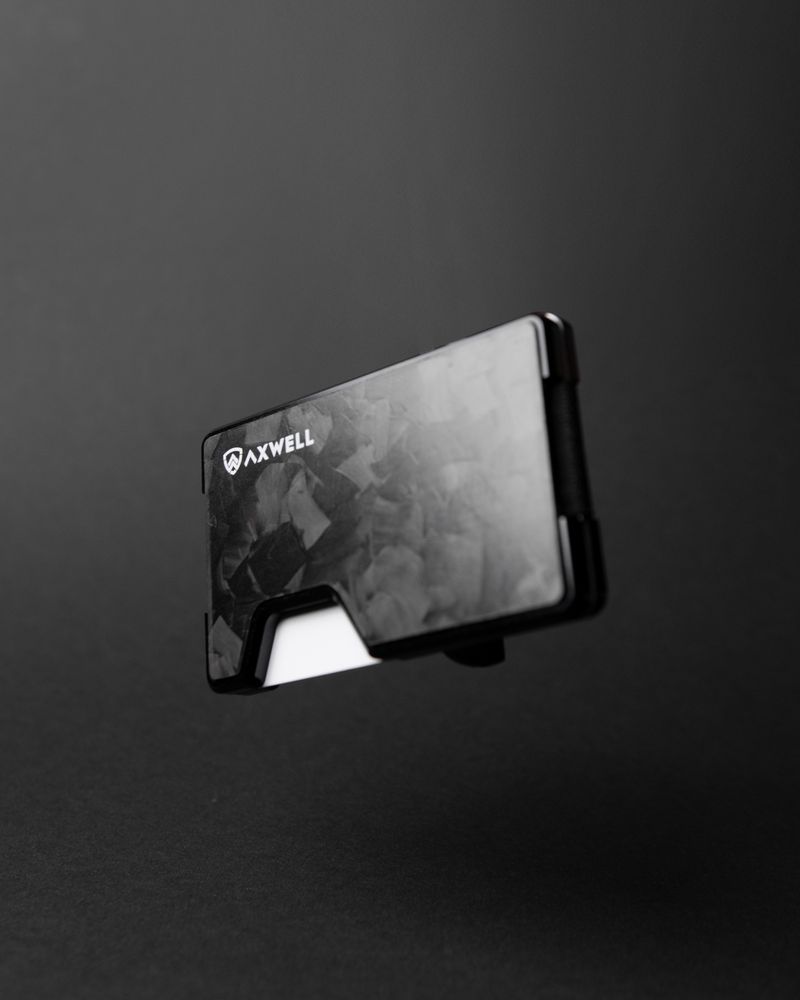
Carbon fiber is not a metal, but it is the third material buyers compare against aluminum and stainless. A carbon fiber wallet weighs roughly half what an aluminum wallet weighs, with stiffness that aluminum cannot match at the same thickness. The look is unmistakable: woven black twill with a matte finish, often paired with anodized aluminum or stainless steel rails to form the rigid edge.
Carbon fiber’s weakness is cosmetic rather than structural. It scratches, and scratches show as light streaks in the weave. It also cannot be anodized or brushed, so finish options are limited to weave pattern, resin tint, and edge treatment. Carbon fiber wallets tend to sit between aluminum and titanium in price, with a technical aesthetic that appeals more to EDC users than to traditional wallet buyers.
How to Choose Based on Your Carry
Start with weight tolerance. If the wallet rides in a front pocket all day, aluminum wins; if it lives in a bag or briefcase, stainless steel’s heft becomes a feature. Next, look at your environment: coastal humidity and frequent sweat push stainless ahead of raw aluminum.
Then weigh finish against maintenance. Anodized aluminum offers the widest color range, while brushed stainless reads as the most traditional premium. The stainless steel RFID wallet and the aluminum money clip wallet show two ends of this balance, while the wallet collection lets you compare silhouettes across materials.
FAQ
Which metal blocks RFID best for a wallet?
Aluminum and stainless steel both attenuate radio waves well at 13.56 MHz when the wallet forms a closed or nearly closed structure, which is why most shielded metal wallets use them. In all cases, shielding should be verified at the operating frequency rather than assumed from the metal name.
Do metal wallets scratch bank cards?
Cards are softer than either of these metals, so normal sliding does not scratch chips or stripes. The risk comes from edges: a poorly deburred pocket or a sharp money-clip seam can press into a card. Reputable manufacturers deburr and polish internal edges, which is one detail worth checking in reviews and product photos before buying.
Will an aluminum wallet dent?
Yes, aluminum is the softer of the two metals and will dent on hard impacts such as dropping onto concrete. Anodizing hardens only the surface layer. If you drop your wallet often or keep it in the same environment as heavy tools, stainless steel will hold its shape longer.
How different is the actual weight in a finished wallet?
Stainless steel is roughly three times as dense as aluminum. In a finished wallet those ratios narrow because walls, fasteners, and card springs add weight too, but the ordering never changes: aluminum lighter, stainless steel heavier.
Can a metal wallet scratch other items in my pocket?
Only if the finish or edges are rough. Brushed and bead-blasted surfaces feel smooth, but a sharp corner or an aggressive money-clip edge can damage a phone screen or a key fob that shares the pocket. Carrying the wallet alone in one pocket avoids that entire class of problems, and a well-finished metal wallet should feel smooth along every edge.
Related reading
- Metal vs leather vs carbon fiber
- Carbon fiber buying guide
- Anodising metal finishes
- Stainless steel RFID wallet
- RFID wallet range
Choosing a supplier: our aluminum wallet manufacturing hub covers CNC, anodising and wholesale MOQs.
From article to product
Choosing a material for a range?
Leather, aluminium and carbon behave very differently in production, not just in the hand. Send us the spec and we will tell you what it costs to make at your volume.
Keep reading
More on wallet materials
How Material Choice Changes Factory Cost: A Real Cost Breakdown for Custom Wallet Orders
If you're sourcing custom wallets, the single biggest lever on your landed cost isn't…
ReadBest Carbon Fiber Wallets of 2026: 11 Picks, Tested and Compared
Carbon fiber wallets are the rare carry item that looks like a spaceship part…
ReadBest Aluminum Wallets 2026: 11 Slim, CNC-Milled Carriers We’d Actually Carry
Aluminum wallets are the best-selling format in slim carry right now — and the…
Read
About the author
Wu, Leon
Leon Wu is the senior product engineer and EDC testing lead at TOPWALLET. He has spent more than a decade on wallet design-for-manufacture, materials and quality control at the company's Dongguan facility, and writes from bench testing, pull-force and 13.56 MHz shielding measurements rather than supplier spec sheets.
Written on the floor
This article was written by our production and QC team — the people who spec tolerances, run the finishing line and inspect every batch. Where it states a capacity, a pull force or a lead time, it comes from a measurement we made, not a supplier’s catalogue. If a number here disagrees with what your own supplier told you, tell us; several of these articles started as a correction from a buyer.
See how the factory works · Inspection process · Sourcing FAQ
Choosing a material for a range?
Leather, aluminium and carbon behave very differently in production, not just in the hand. Send us the spec and we will tell you what it costs to make at your volume.