

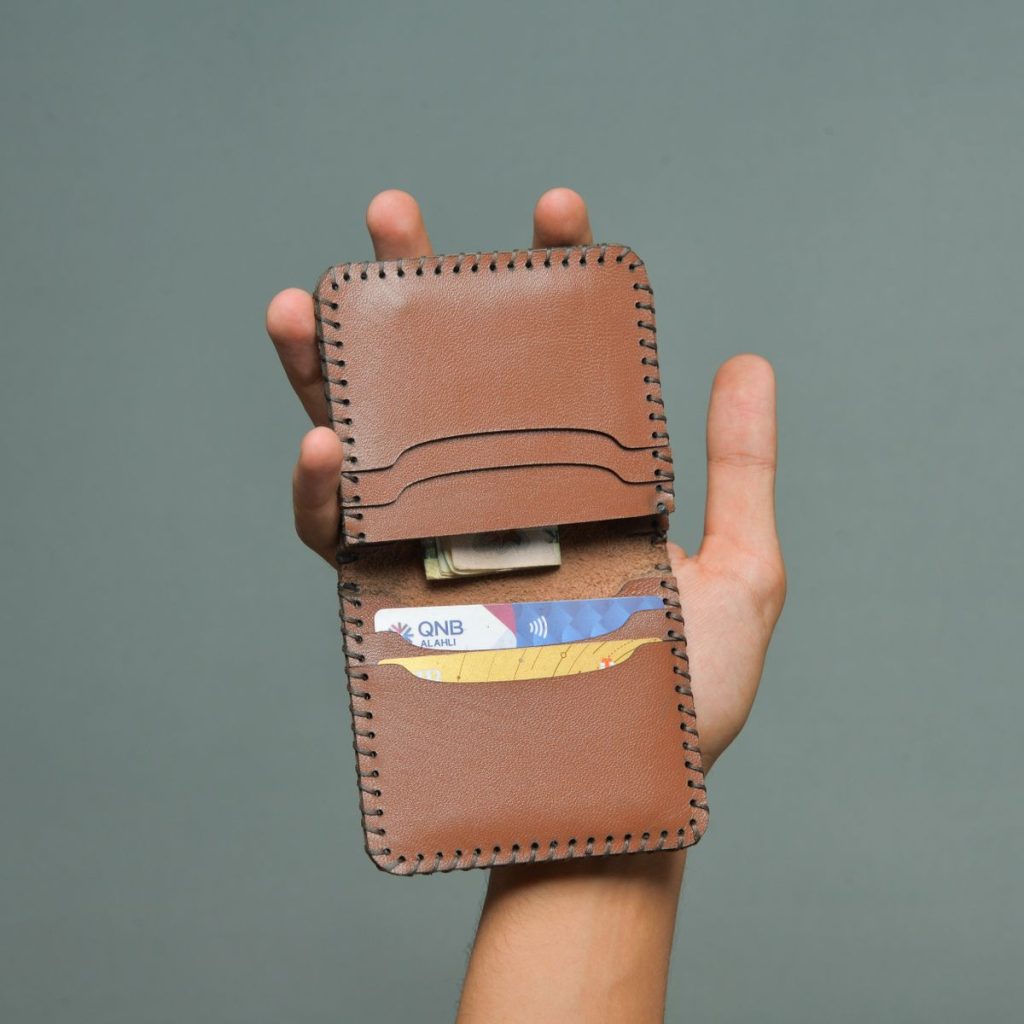
Quick answer: a card holder holds 4–6, a slim bifold 6–8, a standard bifold 8–12 and a trifold 12–16 — comfortably. Those numbers are roughly 20% below what most products advertise, and that gap is deliberate: a wallet rated for ten cards will hold ten cards, but it will not close flat, and it will not still be closing flat in a year.
Quick answer: a slim metal or minimalist wallet genuinely holds 4–8 cards, a standard bifold 6–10, and a trifold or long wallet 10–16. The number that matters is loaded capacity — how many cards fit while the wallet still closes and stays comfortable — not the marketing count.
Capacity by wallet type
| Wallet type | Comfortable capacity | Absolute maximum | Closed thickness at comfort |
|---|---|---|---|
| Card holder / minimalist sleeve | 4–6 cards | 8 | 8–10 mm |
| Slim bifold | 6–8 cards + folded notes | 10 | 12–14 mm |
| Standard bifold | 8–12 cards + notes | 14 | 16–19 mm |
| Trifold | 12–16 cards | 20 | 20–24 mm |
| Long / clutch wallet | 10–14 cards + notes flat | 16 | 14–18 mm |
| Metal card case | 4–8 cards (fixed) | 8 | 10–12 mm |
| Travel / passport wallet | 6–10 cards + documents | 12 | 18–22 mm |
Read the middle column as the number you can carry every day without the wallet becoming the thing you notice when you sit down. The right-hand column is a packing exercise, not a daily habit.
Why overstuffing is what actually breaks wallets
Almost every wallet failure a repair bench sees traces back to one cause, and it is not poor materials — it is sustained overload. Three mechanisms do the damage:
- Seam tension. Every card adds thickness, and thickness translates directly into outward force on the stitch line. Thread rated for a 15 mm stack parts when it is asked to hold 22 mm, and it always fails at the same place: the bottom corner of a card pocket, where the fold concentrates stress.
- Permanent set. Leather is viscoelastic. Hold it stretched long enough and it stops returning. An overfilled bifold develops a permanent bow that no amount of emptying will reverse.
- Spine fatigue. The fold is worked well beyond its designed angle thousands of times. On a trifold the two hinges see the worst of it, which is why trifolds fail at the crease rather than the seams.
There is a second cost that has nothing to do with the wallet. A 24 mm wallet carried in a back pocket tilts the pelvis when you sit, and doing that for eight hours a day for years is a well-documented contributor to lower-back and sciatic discomfort. The ergonomic advice is not about tidiness — it is the reason front-pocket carry and slim profiles became a category at all.
How to measure real capacity rather than marketing capacity
Two tests settle it:
- The flat-close test. Load the number of cards you actually carry, add the notes you actually carry, and close it. If the wallet does not lie flat on a table without being pressed, it is overloaded regardless of what the tag says.
- The one-finger test. Slide a card in and out with one finger. If you need to pinch and lever, the pocket is over-tensioned — and the stress that makes it hard to remove is the same stress that is pulling at the stitching.
Do both tests with the cards you carry, not a stack of blanks. Embossed cards, hotel key cards and loyalty cards have different thicknesses, and a wallet that swallows six flat cards may refuse five embossed ones.
A practical rule that survives contact with real life
Carry the cards you use in a normal week and nothing else. For most people that is four: payment, ID, transit, insurance. Everything else is a once-a-month card, and those belong in a drawer or a phone wallet rather than in your pocket permanently.
If you genuinely need more than ten, split the load instead of buying a bigger wallet — a slim card holder for the daily four plus a money clip or a second sleeve for the rest. Two thin items distributed across two pockets are far more comfortable than one thick block, and each item lasts longer because neither is stressed.
Capacity at a Glance
| Wallet type | Real loaded capacity | Comfort limit |
|---|---|---|
| MagSafe / phone wallet | 2–3 cards | Anything more bulges the phone |
| Card holder | 2–8 cards | 4–6 is the daily sweet spot |
| Slim metal / minimalist | 4–8 cards | 8 max before it stops closing flat |
| Standard bifold | 6–10 cards | 10+ gets thick fast |
| Trifold / long wallet | 10–16 cards | 16 is storage, not pocket carry |
FAQ
Q: Why does a wallet that claims “12 cards” only fit 8?
A: The claim usually counts empty slot width, not loaded thickness. Cards, embossing and cash add real height; measure capacity with your actual cards, not the slot count.
Q: Does carrying fewer cards extend wallet life?
A: Yes — overstuffing is what actually breaks wallets. A stack under the wallet’s comfort limit flexes less and wears the stitching, bands and hinges far slower.
Q: How do I measure real capacity?
A: Load your weekly cards plus cash, close the wallet, and check the profile. If it bulges, no longer lies flat, or fights the closure, you are over capacity.
Specifying capacity for a product line
For buyers and brand owners, capacity is the most consequential specification on the sheet and the most frequently guessed at. Three things to settle before sampling:
- Embossed or flat. Decide which the pocket must accept, then specify the gusset accordingly. A pocket cut for flat cards will frustrate anyone with an embossed bank card, and this is the single most common complaint in post-launch reviews.
- Tolerance, not target. Give the factory a card thickness assumption — typically 0.76 mm per card for embossed — and let them size the stack. Guessing the finished millimetre figure is how you end up with a wallet that closes in the sample room and not in the customer’s pocket.
- State the tested number. If the spec says six cards, test at six plus two. Products that survive a 30% overload in the lab are the ones that do not come back.
Related reading: Leather vs metal wallets · Minimalist wallets · Quality control
From article to product
Turning this into a product?
Most of what is written here is the difference between a sample that works and one that does not. We can build either — the useful one costs the same.
Keep reading
More on buying guides
Best Men’s Card Wallet: B2B Buyer’s Selection Guide 2026
Compare materials, RFID specs, and certifications for men's card wallets. Get procurement-ready guidance on…
ReadBest Bifold Wallets for Bulk Orders — B2B Procurement Guide
Compare materials, specs, certifications, and customization options for bulk bifold wallet sourcing. Learn what…
ReadSale Wallets Women — Bulk Sourcing Guide for Buyers
Find what women's wallets are selling well in bulk — materials, RFID specs, certifications,…
Read
About the author
Wu, Leon
Leon Wu is the senior product engineer and EDC testing lead at TOPWALLET. He has spent more than a decade on wallet design-for-manufacture, materials and quality control at the company's Dongguan facility, and writes from bench testing, pull-force and 13.56 MHz shielding measurements rather than supplier spec sheets.
Written on the floor
This article was written by our production and QC team — the people who spec tolerances, run the finishing line and inspect every batch. Where it states a capacity, a pull force or a lead time, it comes from a measurement we made, not a supplier’s catalogue. If a number here disagrees with what your own supplier told you, tell us; several of these articles started as a correction from a buyer.
See how the factory works · Inspection process · Sourcing FAQ
Turning this into a product?
Most of what is written here is the difference between a sample that works and one that does not. We can build either — the useful one costs the same.