

A small wallet is a compact, minimalist pocket carrier designed for low-profile everyday carry of cards and folded cash. Available in aluminum, carbon fiber, titanium, or leather, these wallets are sourced through OEM/ODM programs that support private labeling, custom finishes, and bulk distribution for EDC brands, Amazon FBA sellers, corporate gift buyers, and retail chains. Successful procurement requires understanding material trade-offs, RFID standards, certification requirements, and manufacturer evaluation criteria.
What is a Small Wallet in B2B Sourcing?
A small wallet is a card-first carrier sized for front-pocket use, typically under 10 mm thick when loaded.
A small wallet is a compact, minimalist pocket carrier—typically aluminum, carbon fiber, titanium, or leather—that holds a handful of cards and folded cash in a low-profile form factor. In the B2B context, “small wallet” refers to the product category that brands source through OEM or ODM manufacturing for private-label distribution across EDC brands, Amazon FBA lines, corporate gift programs, and retail chains. The term covers card holders, money clip wallets, blade wallets, and front-pocket wallets, all distinguished from traditional bifold or trifold designs by their reduced dimensions and simplified carry mode.
How Do Small Wallets Function and Who Uses Them?
They hold four to eight cards plus folded cash; commuters and front-pocket carriers are the core users.
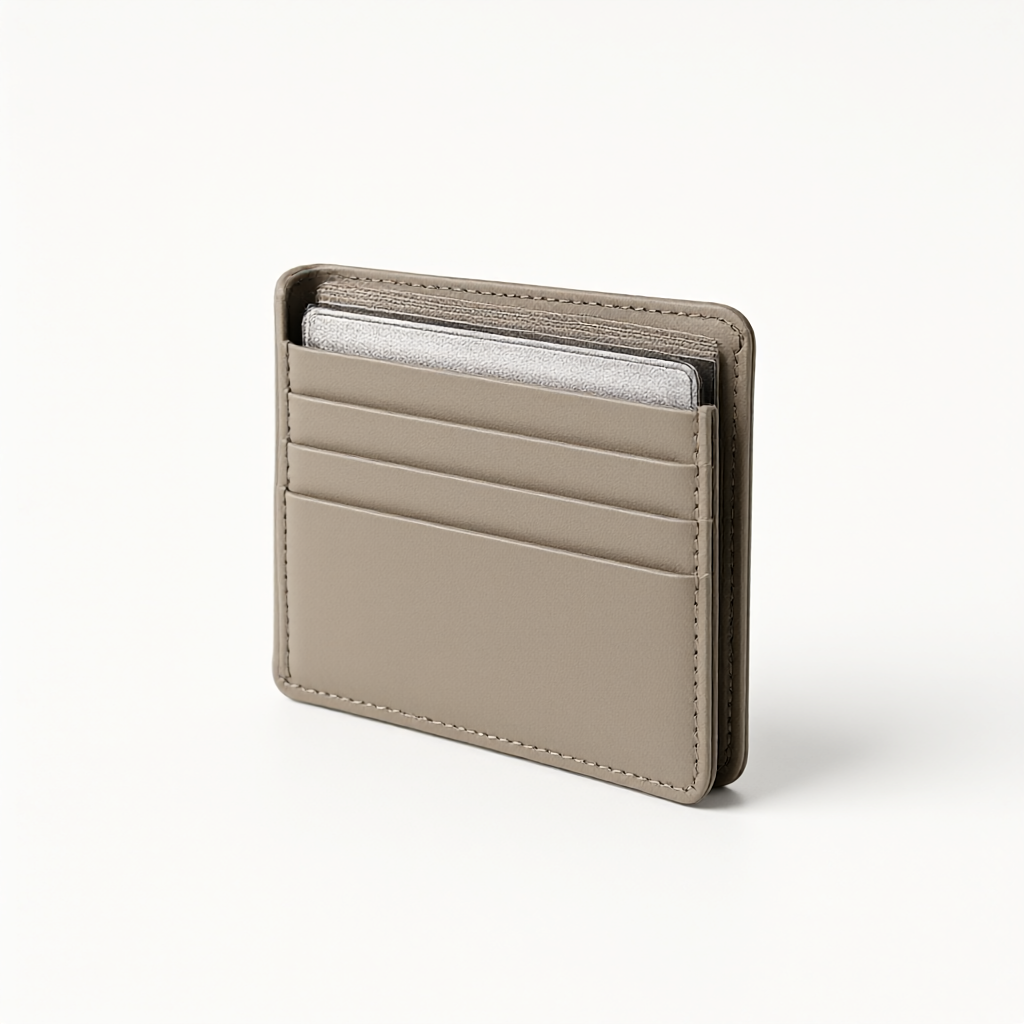
What is a small wallet and who uses it?
At its core, a small wallet replaces the bulky bi-fold with a single-plane or tension-spring architecture. Cards slide into a slot or clamp and are ejected one at a time with a thumb push. Cash sits behind the cards, either loose or in a dedicated strip. The design trades capacity for profile: where a traditional wallet holds 10–15 cards plus receipts, a small wallet typically carries 4–12 cards and a modest bill fold.
The primary user segments in B2B are not end consumers but the brands and distributors that sell to them. Amazon FBA sellers build private-label lines around trending EDC formats. Promotional product distributors source branded metal wallets as corporate gifts. Retail chains stock minimalist wallets in the accessories aisle. And startup EDC brands use custom small wallets as entry-point products to establish market presence. Each segment has different priorities: Amazon sellers compete on price and review velocity, corporate gift buyers prioritize branding options and compliance documentation, and EDC brands emphasize material quality and design differentiation.
Understanding these buyer contexts shapes every specification decision—from RFID-blocking requirements to packaging complexity.
What materials are commonly used for small wallets?
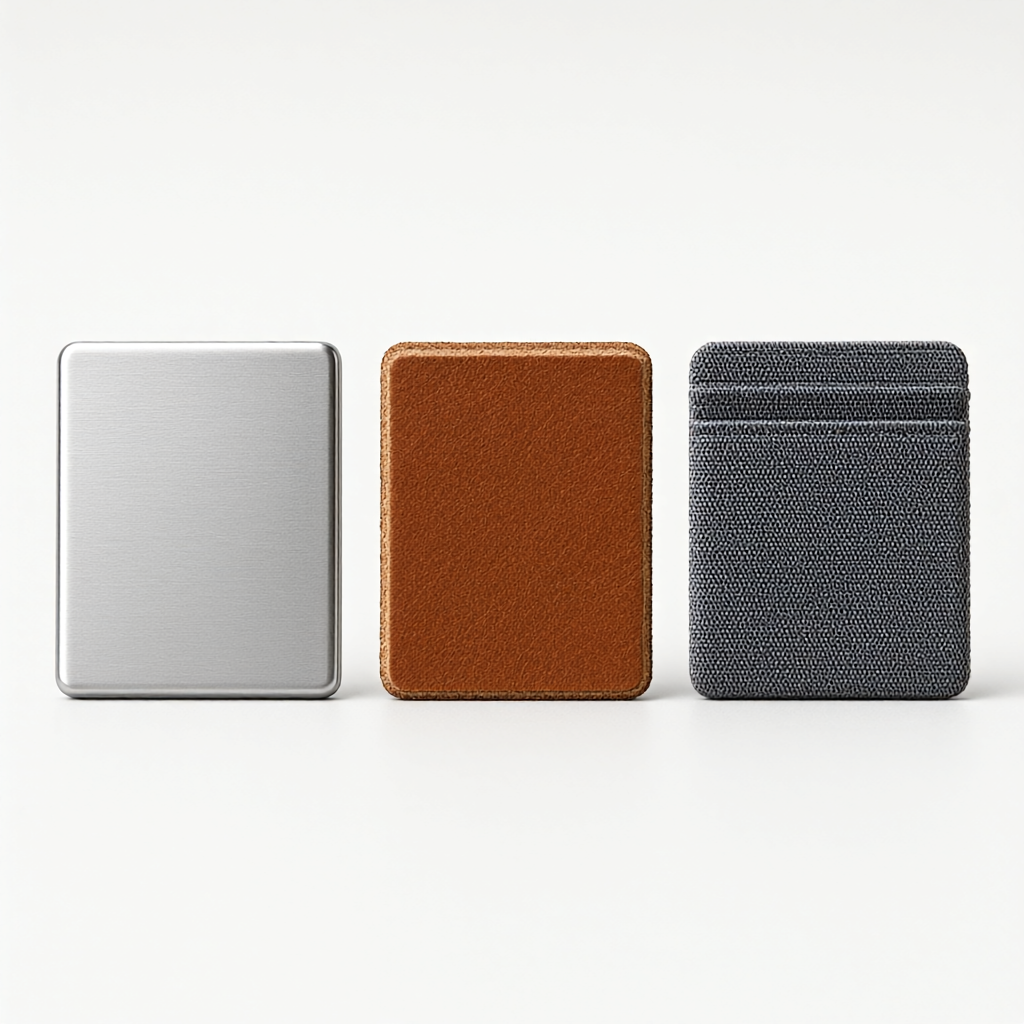
Material selection is the single biggest differentiator in small wallet sourcing. Each material carries distinct trade-offs in cost, weight, durability, and brand perception.
Aluminum (typically 6061-T6) is the most popular B2B choice. It offers a strong price-to-durability ratio, accepts anodized color finishes, and machines cleanly on CNC equipment. Anodized aluminum wallets typically weigh 30–60 grams and resist daily scratches better than raw metal. The trade-off is that aluminum can feel cold to the touch and may dent under impact. For men’s minimalist wallets, aluminum remains the dominant material tier in the mid-price range.
Carbon fiber provides the lightest structural option at roughly 20–40 grams with a distinctive woven texture. It is scratch-resistant and does not conduct electricity, which matters for buyers concerned about electronic interference. The downside is higher material cost and the challenge of achieving consistent weave alignment during production. Carbon fiber also limits color options to the natural black-gray weave unless paired with a metal frame.
Titanium sits at the premium end of the small wallet spectrum. It is stronger than aluminum at lower weights, corrosion-resistant, and carries a premium finish that signals quality to end users. The cost premium is significant—titanium raw material and CNC tooling wear are substantially higher than aluminum. Titanium small wallets typically position at $25–$60+ retail, targeting buyers who view the wallet as a longevity investment. For an overview of how EDC wallets fit into broader product categories, see our guide on EDC wallets and minimalist wallet manufacturing for B2B buyers.
Leather remains relevant for small wallets, particularly full-grain and top-grain variants. Leather offers a warm tactile feel and develops a patina over time, which appeals to certain buyer demographics. However, leather requires more care, can absorb moisture, and generally cannot achieve the sub-6mm thickness that metal and carbon fiber wallets deliver. For detailed leather specifications, refer to our leather wallet guide.
Some manufacturers combine materials—carbon fiber faces with aluminum frames, or titanium clips with leather inserts—to balance aesthetics, cost, and performance.
Which Specs Matter in Small Wallet Procurement?
Dimensions, weight, card capacity, shielding, and closure define the spec sheet for small wallets.
What are the key specs for a small wallet?
When evaluating a small wallet for B2B sourcing, the following specification categories matter most.
Dimensions. A typical slim wallet measures between 75–90 mm in width, 105–120 mm in height, and 6–16 mm in thickness when loaded. The thickness range is especially variable and depends on card count and spring mechanism. Ultra-slim variants target 6–8 mm for travelers and front-pocket carriers, while higher-capacity versions reach 14–16 mm. These measurements should always be verified against actual card stock, as card thickness varies by issuer and region.
Weight. Metal wallets typically range from 30 to 80 grams depending on material and size. Carbon fiber variants lean toward the lighter end (20–40 g), while solid titanium models approach 50–70 g. Weight directly influences whether the wallet fits comfortably in a front or back pocket.
Card capacity. Most minimalist wallets accommodate 4–12 standard credit cards. The actual number depends on card thickness (ISO/IEC 7810 ID-1 standard is 0.76 mm per card) and the stiffness of the retention mechanism. A wallet rated for 8 cards may hold 10 if using thinner gift cards or ID cards. When sourcing, request actual stuffing test results, not just listed capacities.
RFID protection. RFID-blocking capability is increasingly a standard feature rather than an optional upgrade. It works by embedding a conductive metal layer orRFID-blocking fabric that creates a Faraday cage effect around the card slots, preventing unauthorized wireless scanning of contactless payment and identification chips.
Is RFID protection a standard feature in small wallets?
RFID blocking has moved from niche feature to baseline expectation in the mid-range and premium small wallet segments. Most OEM manufacturers offer RFID-blocking as a standard option, typically achieved through an integrated aluminum or stainless steel liner behind the card slots. The effectiveness depends on complete signal coverage—if there are gaps in the shielding material, scanning may still occur at certain angles.
Buyers should verify RFID-blocking claims rather than accepting them at face value. Reputable suppliers can provide test reports or demonstrate blocking with a UHF RFID scanner. According to industry testing frameworks referenced by ASTM International, material shielding effectiveness is measured by signal attenuation in decibels, with practical consumer-grade RFID wallets typically achieving 20–40 dB of attenuation across the 13.56 MHz NFC frequency band.
Note that RFID protection is frequency-specific. A wallet tested against 13.56 MHz payment cards may not block 860–960 MHz UHF tags used in some security applications. For buyers sourcing wallets as promotional gifts or corporate merchandise, confirming the relevant frequency range is important for compliance with organizational security policies. For more on how card holder designs integrate these features, see our card holder sourcing guide.
Which Standards and Compliance Rules Apply to Small Wallets?
Material compliance plus attenuation testing cover most requirements; no small-wallet standard exists.
What standards apply to B2B small wallets?
Small wallet procurement involves two categories of standards: product quality standards and materials compliance standards.
ISO 9001 is the foundational quality management certification that most serious B2B wallet manufacturers hold. It verifies that the supplier has documented processes for design control, incoming material inspection, in-process quality checks, and finished goods verification. When evaluating an OEM wallet manufacturer, ISO 9001 certification should be treated as a minimum requirement rather than a differentiator.
BSCI (Business Social Compliance Initiative) auditing confirms that the manufacturing facility meets recognized labor and ethical standards. For buyers in European and North American markets, BSCI compliance reduces supply chain risk and may be required by corporate procurement policies or retail channel requirements.
REACH and RoHS compliance govern the materials used in the wallet, particularly metals and surface treatments. REACH (EU Regulation 1907/2006) restricts hazardous substances such as nickel release and certain heavy metals. RoHS (Restriction of Hazardous Substances) limits lead, cadmium, and other toxic materials in electronics-adjacent products. For metal wallets, nickel compliance is especially important—skin contact with high-nickel alloys can cause allergic reactions, and REACH limits nickel release to 0.5 µg/cm²/week.
SGS testing of raw materials provides third-party verification that metal alloys, anodizing layers, and adhesive components meet stated specifications. Buyers should request SGS test reports for materials, particularly when specifying custom colors or surface treatments.
For guidance on certification requirements across different product categories, review our minimalist wallet buyer’s guide which outlines the compliance landscape.
What Sourcing Considerations Apply to Small Wallets?
Tooling cost, MOQ, reorder consistency, and packaging decide whether a small wallet program scales.
What should you consider when evaluating a small wallet manufacturer?
The decision between manufacturers comes down to five evaluation criteria.
Manufacturing capability depth. In-house CNC machining is the single most important capability for metal wallets. It enables tight tolerances, consistent anodizing prep, and the ability to iterate designs without outsourcing critical steps. Manufacturers that outsource machining introduce quality variability and longer feedback loops. Similarly, in-house laser engraving and UV printing allow on-site branding proofing rather than sending artwork to a third party and waiting for returns. For women’s wallet options and sizing considerations, our wallets for women sourcing guide provides relevant framework.
MOQ flexibility. Minimum order quantities vary significantly across manufacturers. Some require 500–1000 pieces for custom metal wallets, while others accept 100–300 pieces for standard configurations. Lower MOQs are essential for startup brands and Amazon FBA sellers testing new designs before committing to large production runs. When evaluating MOQs, confirm whether the quoted quantity applies to stock configurations, custom colors, or fully custom designs—each tier typically has a different minimum.
Sample lead time. Fast sampling accelerates the entire sourcing cycle. A 7–14 day sample lead time is industry-standard for experienced manufacturers; longer timelines often indicate that sampling is queued behind production orders or requires external tooling. Verify whether samples include functional prototypes (with working card ejection mechanisms) or simply decorative mockups.
Customization depth. True customization extends beyond logo placement. It includes material selection, finish type, internal layout configuration, spring tension adjustment, and packaging design. Manufacturers that only offer laser engraving on a fixed template are providing branding, not true OEM customization. For specialized products like money bags or wristlets, similar customization principles apply—evaluate the depth of engineering support, not just surface branding options.
Logistics readiness. For Amazon FBA sellers, the ability to prep units to FBA requirements—individual poly bagging, barcode application, bundle configuration, and carton labeling—is critical. Manufacturers experienced in FBA logistics reduce the risk of receiving complaints and storage delays. Drop-shipping support is another capability that separates full-service manufacturers from basic producers.
What customization options are available for private-label small wallets?
Private-label small wallets support customization across four dimensions: product, branding, packaging, and fulfillment.
Product customization includes material choice (aluminum alloy grade, carbon fiber weave pattern, titanium grade), finish (anodized color, bead-blasted, polished, brushed), internal layout (card slot count and arrangement, cash strap vs. no strap, coin pocket integration), and mechanism type (spring-loaded ejector, magnetic closure, friction fit). Some buyers also specify dimensions within reasonable manufacturing bounds—adjusting width by 5 mm or thickness by 2 mm is often feasible without retooling.
Branding customization covers laser engraving (most common for metal wallets, producing permanent marks in 0.05–0.2 mm line width), UV printing (suitable for full-color logos on flat surfaces), pad printing (for curved or irregular surfaces), and embossing (for leather variants). Engraving depth and detail resolution vary by material—aluminum accepts the finest detail, while titanium requires slightly wider engraving lines for comparable visual impact.
Packaging customization ranges from simple poly bags and mailer boxes to full retail cartons with die-cut inserts, window displays, and hang tags. Sustainable packaging options—recycled cardboard, soy-based inks, biodegradable wraps—are increasingly requested by retail chains and environmentally conscious brands. Packaging design can be handled in-house by the manufacturer or submitted by the buyer as pre-printed artwork.
Fulfillment customization includes kitting (combining wallets with other EDC products), labeling (FNSKU barcodes for Amazon, GS1 barcodes for retail), and direct-to-consumer shipping for drop-ship arrangements.
What are typical MOQs and lead times for custom small wallets?
MOQ and lead time expectations depend on the level of customization required.
For stock or near-stock configurations—existing designs with minor color or logo changes—MOQs typically range from 100 to 300 pieces per SKU. Sample lead time is 5–10 business days, with production running 20–35 days depending on order volume and finish complexity.
For partially custom configurations—modified internal layouts, custom anodized colors, or unique branding on an existing platform—MOQs usually sit at 300 to 500 pieces. Samples take 10–15 business days, and production runs 30–45 days.
For fully custom designs—new tooling, proprietary mechanisms, or entirely novel form factors—MOQs can range from 500 to 1,000+ pieces. Tooling and prototyping may require 15–25 business days, with production following at 35–50 days.
These timelines are industry references; actual figures vary by manufacturer capacity, material availability, and seasonal demand fluctuations. The relationship between MOQ and unit cost is inverse—higher volumes reduce per-unit cost through amortized setup and optimized machine scheduling. For cost planning, buyers should request FOB quotations that break out unit price, tooling fees, sample costs, and packaging expenses separately.
Request a bulk FOB quotation for your specific configuration.
How do you evaluate a small wallet manufacturer for an OEM partnership?
A structured evaluation approach reduces sourcing risk. Start by verifying certifications—ISO 9001 and BSCI documentation should be current and verifiable. Request factory photos or virtual tours to confirm that CNC machining, anodizing, and assembly occur on-site rather than being subcontracted.
Review the manufacturer’s product portfolio for depth and consistency. A supplier that produces only one or two wallet styles may lack the engineering breadth to handle custom requirements. Look for evidence of material diversity—aluminum, carbon fiber, and titanium capabilities signal mature manufacturing processes.
Assess communication responsiveness during the inquiry phase. Manufacturers that provide detailed specifications, ask clarifying questions about your market and volume, and share relevant test reports are typically more reliable partners than those who respond with generic catalogs.
Request references from existing B2B clients, particularly those in similar markets or selling through similar channels. A manufacturer serving multiple Amazon FBA sellers or European retail buyers has proven experience with the compliance and logistics requirements those channels demand.
Finally, evaluate the sample quality against your own specifications. Check edge finishing, spring mechanism smoothness, engravement precision, and packaging presentation. A well-produced sample indicates the manufacturer’s attention to detail; a rushed sample may predict production inconsistencies at scale.
How Do We Manufacture Small Wallets?
We machine or cut, finish, assemble, and test shielding in one facility, keeping revisions inside one team.
When sourcing small wallets for private-label programs, the difference between a good result and a great one comes down to how thoroughly the manufacturer understands the specifications you need and whether their capabilities align with your market requirements.
As a manufacturer, our approach centers on treating each specification—not just the exterior finish, but the internal card retention mechanism, the anodizing thickness, and the packaging presentation—as a system that must work together. Our in-house CNC machining handles the precision cuts that define a wallet’s profile and edge quality, while our laser engraving and UV printing capabilities allow branding to be applied with consistent registration across production runs. We work with aluminum, carbon fiber, and titanium substrates, and we structure our MOQs and sample timelines to accommodate brands at different stages—from startup EDC lines testing a first design to established Amazon FBA sellers scaling proven SKUs.
Our quality system is built on ISO 9001 processes and BSCI-compliant facility operations, with REACH and RoHS material compliance verified through SGS testing. This framework supports the sort of specification documentation and compliance reporting that corporate gift buyers and retail chains require during vendor qualification. Whether you are developing a minimalist aluminum card holder, a titanium money clip wallet, or a full line of RFID-blocking small wallets with custom packaging, the same standards apply.
Send us your project requirements or opening sizes for a custom quote.
Which Questions Do Small Wallet Buyers Ask Most?
Buyers ask about sizing, shielding proof, MOQ, and whether the frame survives daily pocket wear.
What is the minimum order quantity for custom small wallets?
MOQs typically starts at 300 pcs per SKU for full OEM customization (100 pcs trial order available for stock finishes) for established configurations with minor customization. Fully custom designs with new tooling generally require 500+ pieces. Actual minimums depend on the manufacturer’s production capacity and the complexity of the requested modifications.
Are metal wallets heavier than leather wallets?
Aluminum wallets typically weigh 30–60 grams, carbon fiber wallets 20–40 grams, and titanium wallets 50–70 grams. Full-grain leather wallets of comparable size usually range from 50–90 grams. Metal wallets offer lower profiles and greater durability but carry a premium price compared to entry-level leather alternatives.
How effective is RFID blocking in small wallets?
Effective RFID-blocking wallets attenuate the 13.56 MHz NFC frequency band—the same frequency used by contactless payment cards and electronic passports—by 20–40 dB in laboratory testing. Performance depends on complete signal coverage around the card slot area; gaps in the shielding material reduce effectiveness. Reputable suppliers should provide test data or demonstration results rather than relying on unverified claims.
Can I get samples before placing a bulk order?
Yes. Most OEM manufacturers provide functional samples before production commitment. Standard samples take 5–14 business days depending on complexity, and many suppliers credit the sample cost against the production order. Request samples that match your intended production specifications, not just decorative prototypes.
What certifications should a B2B small wallet supplier have?
Essential certifications include ISO 9001 for quality management and BSCI for social compliance. REACH and RoHS material compliance documentation is required for EU and US market sales. SGS test reports for raw materials provide additional assurance. Verify that certifications are current and directly applicable to the product category you are sourcing.
How Do Stock and Custom Pathways Differ?
Stock ships fast with limited branding; custom adds tooling cost but controls material and layout.
For stock configurations (standard materials, finishes, and layouts), MOQs typically start at 100–300 pieces with lead times of 15–25 days. These programs are ideal for brands launching a new line or testing market demand before committing to full customization.
Custom manufacturing requires design specification, prototyping, and tooling adjustment. For fully custom metal wallets with unique dimensions, finishes, and internal layouts, MOQs generally range from 300–1,000 pieces with production lead times of 25–45 days after sample approval. The variation depends on whether existing tooling can be modified or whether new CNC programs must be written from scratch.
| Production Tier | Typical MOQ | Lead Time | Best For |
|---|---|---|---|
| Stock / semi-custom | 100–300 pcs | 15–25 days | Market testing, small brands |
| Custom design | 300–1,000 pcs | 25–45 days | Established brands, private label |
| High-volume OEM | 1,000+ pcs | 30–60 days | Retail chains, large distributors |
How Are Small Wallets Built?
Cutting, forming, finishing, and assembly run in sequence, with shielding fitted before closing.
The quality and consistency of a small wallet depend heavily on the manufacturer’s in-house process control. Key processes include:
CNC machining. Aluminum and titanium wallet bodies are precision-cut on multi-axis CNC mills to tolerances of ±0.05 mm. In-house CNC capability ensures that card slot geometry, spring channel depth, and overall dimensions remain consistent across production runs. Manufacturers without in-house machining often outsource this step, introducing variability and longer communication cycles.
Laser engraving and UV printing. Branding is applied via fiber laser engraving for permanent marks on metal surfaces (0.05–0.2 mm line resolution) or UV flatbed printing for full-color graphics on flat panels. In-house marking equipment allows rapid proofing and revision without external vendor delays.
Aluminum anodizing and surface finishing. Anodizing provides color, hardness, and corrosion resistance. Standard finishes include bead-blasted (matte), brushed (directional grain), and polished (mirror). Anodized color options typically span 15–30 standard colors, with custom PMS-matched colors available for larger runs. Surface treatment directly affects scratch resistance and user perception.
Assembly and mechanism tuning. The card ejection spring, cash strap, and closure mechanism are assembled and function-tested individually. Spring tension is adjusted per design specification—too stiff and cards eject forcefully; too loose and cards fall out during pocket transfer. This tuning step is where experienced manufacturers separate themselves from assembly-only operations.
How Do Budget, Mid-Range, and Premium Tiers Differ?
Budget uses stamped aluminum, mid-range anodized alloy, premium titanium or carbon with tighter tolerance.
Understanding price tiers helps buyers align product specifications with their target market positioning.
Budget tier ($3–$8 wholesale / $8–$15 retail). Typically constructed from 6061 aluminum with basic anodized finishes, simple spring mechanisms, and limited customization. RFID blocking may use thin foil liners rather than full-coverage shielding. MOQs are lower but per-unit margins are thin. Commonly sold on Amazon as no-brand or white-label products.
Mid-range tier ($8–$18 wholesale / $18–$35 retail). The dominant B2B segment. Features thicker aluminum (1.5–2 mm), consistent anodized colors, reliable spring mechanisms tested for 5,000+ cycles, and proper RFID shielding with verified attenuation. Custom packaging and branding are standard offerings. This tier balances cost competitiveness with perceived quality.
Premium tier ($18–$40+ wholesale / $35–$70+ retail). Titanium construction, carbon fiber inlays, precision-machined details, and high-end packaging. Materials and processes drive cost upward—titanium CNC tooling wear alone can be 3–5× that of aluminum. These wallets target buyers who prioritize longevity, material authenticity, and distinctive design over price sensitivity.
Which Carry Position Suits a Small Wallet?
Front pocket reduces back pain risk and theft exposure; back pocket still suits bifold habits.
Small wallet design varies depending on intended carry position, which affects ergonomics, profile, and security.
Front pocket carry is preferred by most EDC enthusiasts for comfort and accessibility. Front-pocket wallets prioritize ultra-slim profiles (6–10 mm loaded), rounded edges to prevent seat-bulge, and quick one-handed retrieval. Card ejection mechanisms are essential—front pockets don’t accommodate fumbling through multiple layers. Weight matters less here since the wallet doesn’t sit against the spine.
Back pocket carry allows for slightly thicker profiles (10–16 mm) and higher card capacity but introduces comfort trade-offs. A thick back-pocket wallet creates a noticeable lump and can cause posture issues during extended sitting. Buyers sourcing for back-pocket users should consider tapered edge designs and flexible materials that conform to the body. Some markets, particularly Europe, show stronger preference for back-pocket carry due to jacket and trousers design.
Which Material Costs Apply?
Alloy sheet, finishing, elastic or hinge parts, and packaging make up most unit cost.
Cost structure varies significantly by material and processing requirements:
- 6061 aluminum (anodized): $1.50–$4.00/unit at volume, offering the best value for mid-range products
- Carbon fiber (epoxy-infused, CNC-machined): $3.00–$7.00/unit, with weave consistency being the primary quality variable
- Titanium (Grade 2, CNC-machined): $8.00–$18.00/unit, reflecting raw material cost and tooling wear
- Full-grain leather: $2.00–$6.00/unit depending on grade and finishing complexity
- RFID-blocking liner integration: adds $0.15–$0.50/unit depending on coverage method
These figures represent typical OEM wholesale ranges at 500+ unit quantities. Exact pricing depends on order volume, customization depth, and packaging complexity. Buyers should request itemized quotes that separate material, processing, branding, and packaging costs for transparent comparison.
What Does the Amazon FBA Case Show?
A private-label aluminum run cut reorder defects by freezing the spec sheet and testing each batch.
A US-based Amazon FBA seller approached a manufacturer to develop a mid-range aluminum wallet targeting the $19.99–$24.99 retail price point. The project required:
- 6061-T6 aluminum body, 85 × 108 × 9 mm (loaded), bead-blasted with black anodized finish
- Spring-loaded card ejection with 8-card capacity
- Full RFID-blocking liner with 28 dB attenuation at 13.56 MHz (verified via SGS test report)
- Custom laser-engraved logo on front face, 12 mm height
- Retail-ready packaging: 120 gsm cardboard box with magnet closure, insert tray, and included carry guide
The manufacturer produced a functional prototype within 7 days, refined spring tension based on the buyer’s feedback across two revision rounds, and completed a 500-piece production run in 28 days. The product launched on Amazon with professional listing photography using the custom packaging. Repeat orders totaling 2,400 units followed within six months, demonstrating the importance of supplier responsiveness and quality consistency for FBA sellers.
Which Checklist and Red Flags Apply?
Check test data, sample match, capacity claims, and factory access; skip suppliers who dodge audits.
Before committing to an OEM or ODM partnership, evaluate manufacturers against this checklist:
Green flags:
- In-house CNC machining with documented tolerance capabilities
- ISO 9001 certification with current audit reports
- Ability to provide SGS or third-party test reports for RFID-blocking and material compliance
- Sample lead time of 7–14 days for functional prototypes
- MOQ flexibility with clear tiered pricing
- Experience preparing products for Amazon FBA or retail channel requirements
- Responsive communication with technical rather than purely sales-oriented responses
Red flags:
- No verifiable quality certifications or refusal to share audit reports
- Samples take 30+ days—indicates poor workflow or outsourcing dependencies
- Only offers logo engraving with no engineering support for design changes
- Vague or inconsistent MOQ statements across communications
- No experience with the target market’s regulatory requirements (REACH for EU, Prop 65 for California)
- Pressure to commit to large orders before sample approval
- Unwillingness to provide material test reports or reference cases
How Do You Evaluate an OEM Partner?
Compare in-house capability, tooling ownership, lead-time history, and revision discipline.
Evaluating a potential manufacturing partner requires assessing both technical capability and commercial reliability. Start by requesting a facility overview—including photos or video walkthrough of the production floor, quality control stations, and testing equipment. Manufacturers confident in their operations welcome this transparency.
Review their product portfolio for depth beyond a single price tier. A manufacturer that only produces budget-tier wallets may lack the precision tooling and process control needed for mid-range or premium products. Conversely, a manufacturer serving all three tiers demonstrates versatility and mature process management.
Request references from existing B2B clients, particularly those in your target market or distribution channel. Long-standing client relationships—especially repeat orders—signal reliability and quality consistency. Ask specifically about sample-to-production turnaround, defect rates, and communication responsiveness during production.
Finally, assess their documentation practices. Professional manufacturers maintain organized records of material certifications, test reports, production specs, and quality inspection results. Disorganized or unavailable documentation suggests weak process control that will surface as quality issues during production.
Who uses small wallets in B2B?
The primary B2B customers fall into four segments:
- EDC brand owners build product lines around trending formats and differentiate through material choice, finish, and mechanism design.
- Amazon FBA sellers source private-label wallets that compete on price, review velocity, and listing optimization.
- Promotional product distributors order branded metal wallets as corporate gifts, trade show giveaways, or client appreciation items.
- Retail chain buyers stock minimalist wallets in the accessories aisle, prioritizing shelf-ready packaging and consistent supply.
Each segment has distinct sourcing priorities. Amazon sellers need low MOQs and fast turnaround. Corporate gift buyers require compliance documentation and branding depth. Retail buyers prioritize packaging quality and supply consistency. Understanding these priorities shapes specification decisions from RFID requirements to unboxing experience.
Which Materials Suit Small Wallets?
Aluminum suits volume, titanium suits premium, carbon suits style, and leather suits soft carry.
Material selection is the single most impactful decision in small wallet procurement. Each material carries distinct trade-offs in cost, weight, durability, and brand perception.
| Material | Typical Weight (g) | Cost Tier | Durability | Best For |
|---|---|---|---|---|
| Aluminum 6061-T6 | 30–60 | Mid | High (scratch-resistant with anodizing) | Volume production, mid-price retail |
| Carbon Fiber | 20–40 | Mid-High | Very High (scratch-resistant, non-conductive) | Premium EDC, lightweight-focused buyers |
| Titanium (Grade 2) | 50–70 | Premium | Very High (corrosion-resistant, strong) | Luxury positioning, longevity messaging |
| Leather (Full-grain) | 40–70 | Mid | Moderate (develops patina, requires care) | Traditional aesthetics, warmer tactile feel |
Aluminum (6061-T6) remains the dominant B2B material. It machines cleanly on CNC equipment, accepts anodized color finishes across the full spectrum, and delivers strong durability at accessible cost. Anodized aluminum wallets resist daily scratches far better than raw or polished metal. The primary trade-off is thermal conductivity—aluminum feels cold to the touch—and potential denting under sharp impact. ForMen’s minimalist wallets, aluminum occupies the dominant position in the mid-price tier.
Carbon fiber delivers the lightest structural option with a distinctive woven texture that signals premium quality. It is scratch-resistant, non-conductive, and does not corrode. The drawbacks are higher material cost and the challenge of achieving consistent weave alignment during production. Color options are limited to the natural black-gray weave unless paired with a metal frame.
Titanium (Grade 2 or 5) sits at the premium end. It is stronger than aluminum at comparable or lower weights, inherently corrosion-resistant, and carries a finish that communicates longevity to end users. The cost premium is significant—titanium raw material costs 3–5× aluminum, and CNC tooling wear is substantially higher. Titanium small wallets typically position at $25–$60+ retail.
Leather remains relevant for buyers seeking warm tactile feel and patina development. Full-grain and top-grain leathers are preferred for durability. However, leather cannot achieve sub-6mm thickness, absorbs moisture, and requires care instructions—factors that limit its appeal for ultra-minimalist positioning.
Some manufacturers combine materials—carbon fiber faces with aluminum frames, titanium clips with leather inserts—to balance aesthetics, cost, and performance across different buyer segments.
How Are Small Wallets Manufactured?
Sheet is cut or machined, finished, engraved, then assembled with elastic or hinge mechanisms.
Understanding manufacturing processes is essential for evaluating supplier capability and setting realistic expectations for quality, lead time, and cost.
How Does CNC Machining Work?
A block or sheet is milled to tolerance, then deburred before finishing.
In-house CNC machining is the foundational capability for metal wallets. It enables tight tolerances (±0.05 mm typical), consistent part geometry, and rapid iteration without external tooling dependencies. CNC-milled aluminum wallets start from solid billets that are milled to final dimensions, then drilled for card slots and cutouts. The quality of CNC execution directly affects fitment, ejector mechanism smoothness, and edge consistency.
Manufacturers that outsource CNC machining introduce quality variability, longer feedback loops, and reduced ability to respond to design changes. In-house machining also enables quicker sample turnaround since parts can be produced on demand rather than queued with external orders.
How Is Laser Engraving Applied?
Laser marks the plate or leather surface without a die, so each artwork needs only a file.
Laser engraving is the standard branding method for metal wallets. Fiber laser engravers produce permanent marks with line widths as fine as 0.05 mm. Engraving depth typically ranges from 0.02–0.15 mm depending on material and power settings. Aluminum accepts the finest detail; titanium requires slightly wider lines for comparable visual impact due to its hardness. UV laser engraving on carbon fiber produces high-contrast marks without charring the resin matrix.
What Does Anodizing Add?
Anodizing hardens the surface and adds color, though tone drifts between baths.
Anodizing is an electrochemical process that thickens the natural oxide layer on aluminum, dramatically improving surface hardness and corrosion resistance. Hard coat anodizing can achieve surface hardness of 400–600 HV (Vickers), compared to ~150 HV for raw 6061-T6 aluminum. Anodizing also enables color through dye infusion—standard colors include black, silver, gold, blue, red, and custom PMS-matched shades.
Post-anodizing, parts may undergo bead blasting for a uniform matte finish, polishing for a mirror appearance, or brushing for a directional grain. Surface finish selection affects both aesthetics and tactile feel—brushed finishes hide micro-scratches better than polished surfaces.
How Is RFID Shielding Integrated?
The shield sits between card pocket and shell, then flex-tests at the seam.
RFID-blocking wallets incorporate a conductive layer—typically aluminum foil, stainless steel mesh, or conductive fabric—positioned between card slots to create a Faraday cage. The shielding must achieve complete signal coverage; gaps in the conductive layer at card slot openings or edges can allow scanning at specific angles. Reputable suppliers test shielding effectiveness with UHF RFID scanners across multiple frequencies.
Which Dimensions and Specs Define a Small Wallet?
Target roughly 95 x 65 mm closed, under 60 grams, four to six cards, and 20 dB shielding.
When evaluating a small wallet for B2B sourcing, the following specification categories determine fit for purpose.
Dimensions. Standard slim wallet dimensions fall within 75–90 mm width × 105–120 mm height × 6–16 mm thickness (loaded). Ultra-slim variants target 6–8 mm for travel and front-pocket use. Higher-capacity versions reach 14–16 mm. These measurements must be verified against actual card stock, as card thickness varies by issuer and region per ISO/IEC 7810 ID-1 standard (0.76 mm per card).
Weight. Metal wallets range from 30–80 g depending on material and size. Carbon fiber variants lean toward 20–40 g. Solid titanium models approach 50–70 g. Weight directly influences pocket comfort and whether the wallet fits in jacket vs. pants pockets.
Card Capacity. Most minimalist wallets accommodate 4–12 standard credit cards. Actual capacity depends on card thickness and retention mechanism stiffness. A wallet rated for 8 cards may hold 10 with thinner gift cards. Request actual stuffing test results rather than relying on listed capacities.
RFID Protection. Modern small wallets increasingly feature integrated RFID blocking. Effective shielding creates a Faraday cage that attenuates radio frequency signals across the NFC band (13.56 MHz) and proximity card band (125 kHz). Practical consumer-grade RFID wallets typically achieve 20–40 dB signal attenuation, effectively preventing unauthorized scanning at standard reading distances. Buyers should request test documentation verifying blocking performance at relevant frequencies—13.56 MHz for contactless payment cards and 125 kHz for proximity access cards. Note that some wallets block only specific frequency bands; confirm coverage matches your security requirements.
Which Quality Standards Apply to Small Wallets?
Apply AQL 0.65 inspection, hinge or elastic cycle tests, and attenuation reports per batch.
Small wallet procurement involves two categories of standards: product quality management and materials compliance.
ISO 9001:2015 is the foundational quality management certification. It verifies that the supplier maintains documented processes for design control, incoming material inspection, in-process quality checks, and finished goods verification. When evaluating an OEM wallet manufacturer, ISO 9001:2015 certification should be treated as a minimum requirement.
BSCI (Business Social Compliance Initiative) auditing confirms the facility meets recognized labor and ethical standards. For buyers in European and North American markets, BSCI compliance reduces supply chain risk and may be required by corporate procurement policies.
REACH (EU Regulation 1907/2006) restricts hazardous substances including nickel release. REACH limits nickel release from products intended for skin contact to 0.5 µg/cm²/week. This is especially critical for metal wallets that rest against the skin in pockets.
RoHS (Directive 2011/65/EU) limits lead, cadmium, mercury, and other toxic materials in electronics-adjacent products. For metal wallets, RoHS compliance ensures solder joints, plating layers, and adhesive components meet restricted substance thresholds.
SGS testing of raw materials provides third-party verification that metal alloys, anodizing layers, and adhesive components meet stated specifications. Buyers should request SGS test reports, particularly when specifying custom colors or surface treatments.
CE marking may be required for wallets incorporating electronic components (e.g., integrated trackers or smart features), confirming compliance with EU safety, health, and environmental requirements.
Which Framework Evaluates Small Wallet Vendors?
Score attenuation proof, tooling cost, lead time, QC records, and communication on one scale.
Selecting the right small wallet manufacturer requires systematic evaluation across multiple criteria. The following decision matrix helps buyers compare suppliers objectively.
Which Checklist Evaluates Suppliers?
Verify capability, certifications, sample quality, capacity, and payment terms.
| Criteria | Weight | Supplier A | Supplier B | Supplier C |
|---|---|---|---|---|
| ISO 9001:2015 certified | High | ✓ | ✓ | ✗ |
| In-house CNC machining | High | ✓ | ✗ | ✓ |
| In-house laser engraving | Medium | ✓ | ✓ | ✓ |
| BSCI audited | Medium | ✓ | ✓ | ✗ |
| REACH/RoHS compliance | High | ✓ | ✓ | ✓ |
| MOQ ≤ 300 pcs | Medium | ✓ | ✓ | ✗ |
| Sample lead time ≤ 7 days | Medium | ✓ | ✗ | ✓ |
| RFID test documentation | High | ✓ | Partial | ✓ |
| FBA prep capability | Medium | ✓ | ✓ | ✗ |
| Custom packaging design | Low | ✓ | ✗ | ✓ |
Which Material Wins for Small Wallets?
Aluminum wins on cost and weight; titanium on durability; carbon on look, not strength.
| Factor | Aluminum 6061-T6 | Titanium Grade 2 | Carbon Fiber |
|---|---|---|---|
| Unit cost (per 1000 pcs) | $3–$8 | $12–$25 | $6–$15 |
| Weight (empty) | 35–55 g | 50–70 g | 20–35 g |
| Scratch resistance | Good (anodized) | Excellent | Excellent |
| Corrosion resistance | Good (anodized) | Excellent | Excellent |
| Maximum capacity | 10–12 cards | 8–10 cards | 6–10 cards |
| Brand perception | Mid-tier | Premium | Premium/technical |
| Lead time (sample) | 5–7 days | 7–14 days | 7–10 days |
| Customization depth | High | Moderate | Moderate |
| Best use case | Volume retail, Amazon FBA | Luxury EDC, longevity positioning | Lightweight performance, technical aesthetic |
How Do You Build an RFQ Comparison?
Quote the same spec to every supplier, then compare landed cost and test evidence.
When requesting quotes from multiple suppliers, standardize the RFQ to enable direct comparison. Include these fields:
- Material specification (alloy grade, carbon fiber weave type, titanium grade)
- Target dimensions and loaded thickness
- Card capacity target
- RFID-blocking requirement (frequency range specified)
- Finish type and color (PMS if applicable)
- Branding method and logo file format
- Packaging requirement (poly bag, retail box, sustainable option)
- Order quantity tiers (100 / 500 / 1000 / 5000 pcs)
- Sample lead time and cost
- Production lead time per 1000 pcs
- Certification documents requested (ISO, BSCI, SGS, REACH test report)
- FBA prep requirements
What MOQs and Lead Times Apply to Small Wallets?
Stock frames start near 200 units in 15–20 days; custom tooling needs 500 units and 30–40 days.
What MOQ Ranges Are Typical?
Stock runs start at 300–200 units; custom tooling usually requires 500 or more.
Minimum order quantities vary by manufacturer and configuration complexity:
- Stock configuration (existing design, any color): 100–300 pcs
- Custom color (anodized): 300–500 pcs
- Fully custom design (new tooling): 500–1000 pcs
- Custom packaging: Often 500+ pcs, though some suppliers accept lower quantities for simple poly bag customization
Lower MOQs are essential for startup brands and Amazon FBA sellers testing new designs before committing to large production runs. When evaluating MOQs, confirm whether the quoted quantity applies to stock configurations, custom colors, or fully custom designs—each tier typically has a different minimum.
What Lead Times Should You Expect?
Sampling takes 7–10 days, production 15–25, and freight adds 5–15 depending on mode.
| Stage | Typical Lead Time |
|---|---|
| Sample creation | 5–14 days |
| Sample shipping | 3–7 days (express) |
| Mass production (300–500 pcs) | 15–25 days |
| Mass production (500–2000 pcs) | 20–35 days |
| Mass production (2000+ pcs) | 30–45 days |
Fast sampling—7-day sample lead time—indicates an experienced manufacturer with dedicated sample workflows. Longer timelines often indicate that sampling is queued behind production orders or requires external tooling. Verify whether samples include functional prototypes with working card ejection mechanisms or merely decorative mockups.
How Deep Can Customization Go?
Branding, color, layout, packaging, and mechanism can all change, each with its own cost.
True OEM customization extends beyond logo placement across four dimensions:
- Product: Material selection, finish type, internal layout, spring tension, mechanism type, dimensions within manufacturing bounds
- Branding: Laser engraving (0.05–0.2 mm line width), UV printing, pad printing, embossing
- Packaging: Poly bags, mailer boxes, retail cartons with die-cut inserts, window displays, hang tags, sustainable options
- Fulfillment: Individual poly bagging, FBA barcode application, bundle configuration, carton labeling, drop shipping
Manufacturers that only offer laser engraving on a fixed template are providing branding, not true OEM customization. Evaluate the depth of engineering support, not just surface branding options.
Which Criteria Qualify a Small Wallet Supplier?
Require in-house finishing, documented test data, export experience, and an auditable QC process.
Which Questions Should a Factory Audit Ask?
Ask about machine count, QC stations, test records, and last shipment destinations.
Before committing to a production order, buyers should verify supplier capabilities through targeted audit questions:
- What is your monthly production capacity for metal wallets?
- Do you perform all CNC machining, laser engraving, and anodizing in-house?
- What is your defect rate (PPM) for finished goods?
- Do you hold ISO 9001:2015 and BSCI certifications? Can you provide current certificates?
- What AQL level do you use for incoming inspection and final inspection?
- Can you provide SGS test reports for materials and RFID-blocking performance?
- What is your process for handling production defects or quality disputes?
- Do you offer FBA prep services including labeling and carton compliance?
- What is your sample-to-production consistency rate?
- Can you reference existing clients in our market segment?
How Should You Request Samples?
Request two units per variant plus test reports, and confirm they come from the production line.
- Request functional prototypes, not display models—verify card ejection mechanism works smoothly
- Confirm sample includes your target material, finish, and branding
- Test RFID-blocking with a smartphone NFC app or dedicated scanner
- Measure actual dimensions and weight against specifications
- Evaluate edge finishing, surface quality, and engraving clarity
- Assess packaging quality if applicable
- Document all findings and share feedback before approving mass production
Which AQL Criteria Apply?
AQL 0.65 for major defects and 4.0 for minor ones is the common retail standard.
Most manufacturers use AQL (Acceptable Quality Level) standards for inspection:
- Critical defects: AQL 0 (zero tolerance)—any defect that poses safety risk or renders the product unusable
- Major defects: AQL 0.65—defects that affect functionality, appearance, or customer satisfaction
- Minor defects: AQL 4.0—minor deviations from specification that do not affect function
Third-party inspection services (e.g., SGS, Bureau Veritas, Intertek) can perform pre-shipment inspections at your facility or overseas, providing objective quality verification before goods ship.
Small Wallets For B2B: Where Can You Verify the Data and Sources?
- ASTM International — www.astm.org
- men’s minimalist wallets — topedcwallet.com
- EDC wallets and minimalist wallet manufacturing for B2B buyers — topedcwallet.com
- leather wallet guide — topedcwallet.com
- card holder sourcing guide — topedcwallet.com
- minimalist wallet buyer’s guide — topedcwallet.com
- wallets for women sourcing guide — topedcwallet.com
- money bags — topedcwallet.com
- wristlets — topedcwallet.com
- Request a bulk FOB quotation for your specific configuration. — topedcwallet.com
Small Wallet FAQ: Minimum Size, Jeans Fit, Coins, Promo Use — Which Questions Do Buyers Ask Most?
What is the smallest practical wallet size for six cards?
About 95 x 65 mm closed with a 6 mm stack. Narrower frames force cards to overlap and jam.
Do small wallets fit in jeans front pockets after washing?
Yes if closed width stays under 100 mm. Stretch denim tightens pockets, so test with a sample in real jeans.
Can a small wallet hold coins without a separate pouch?
Rarely. Coin compartments add bulk and complicate assembly, which defeats the size advantage.
Is a small wallet worth it for promotional giveaways?
Only with stock frames. Custom tooling at giveaway volumes will exceed the per-unit budget.
From article to product
Turning this into a product?
Most of what is written here is the difference between a sample that works and one that does not. We can build either — the useful one costs the same.
Keep reading
More on buying guides
wallet with trigger
How Does a Trigger Wallet Work? What Is the Pop-Up Mechanism? The core of…
Readbest bifold wallet for women
What Is a Bifold Wallet? The term “bifold” refers to the fold: the wallet…
ReadMen’s trifold wallets with zipper compartments vs. bifold
At a Glance The three dominant men’s wallet formats differ in panel count, depth,…
Read
About the author
TOPWALLET Editorial Team
TOPWALLET's editorial and engineering desk writes from bench testing at the Shenzhen (Longgang) facility: pull-force and cycle testing, 13.56 MHz shielding measurements, finish trials and factory audits, rather than supplier spec sheets. Every specification in these guides is one we write on a purchase order.
Written on the floor
This article was written by our production and QC team — the people who spec tolerances, run the finishing line and inspect every batch. Where it states a capacity, a pull force or a lead time, it comes from a measurement we made, not a supplier’s catalogue. If a number here disagrees with what your own supplier told you, tell us; several of these articles started as a correction from a buyer.
See how the factory works · Inspection process · Sourcing FAQ
Turning this into a product?
Most of what is written here is the difference between a sample that works and one that does not. We can build either — the useful one costs the same.