

What Is a Small Wallet in B2B Manufacturing?
A small wallet in the B2B context refers to compact carrying devices — typically card holders, minimalist wallets, money clip wallets, and slim RFID-blocking wallets — produced for brands, Amazon FBA sellers, promotional product distributors, and retail chains rather than for end consumers shopping at retail counters. These products are engineered for everyday carry (EDC), corporate gifting, and private-label branding, where consistent specifications, material performance, and customization flexibility matter far more than aesthetic variety.
Buyers in this space are not looking for off-the-shelf retail options. They need contract manufacturers who can produce consistent quality at defined MOQs, apply custom branding, and meet international compliance standards. Understanding what small wallets are, how they differ across material platforms, and what manufacturing capabilities determine product quality is the foundation for any informed sourcing decision.
What Types of Small Wallets Are Commonly Sourced by B2B Buyers?
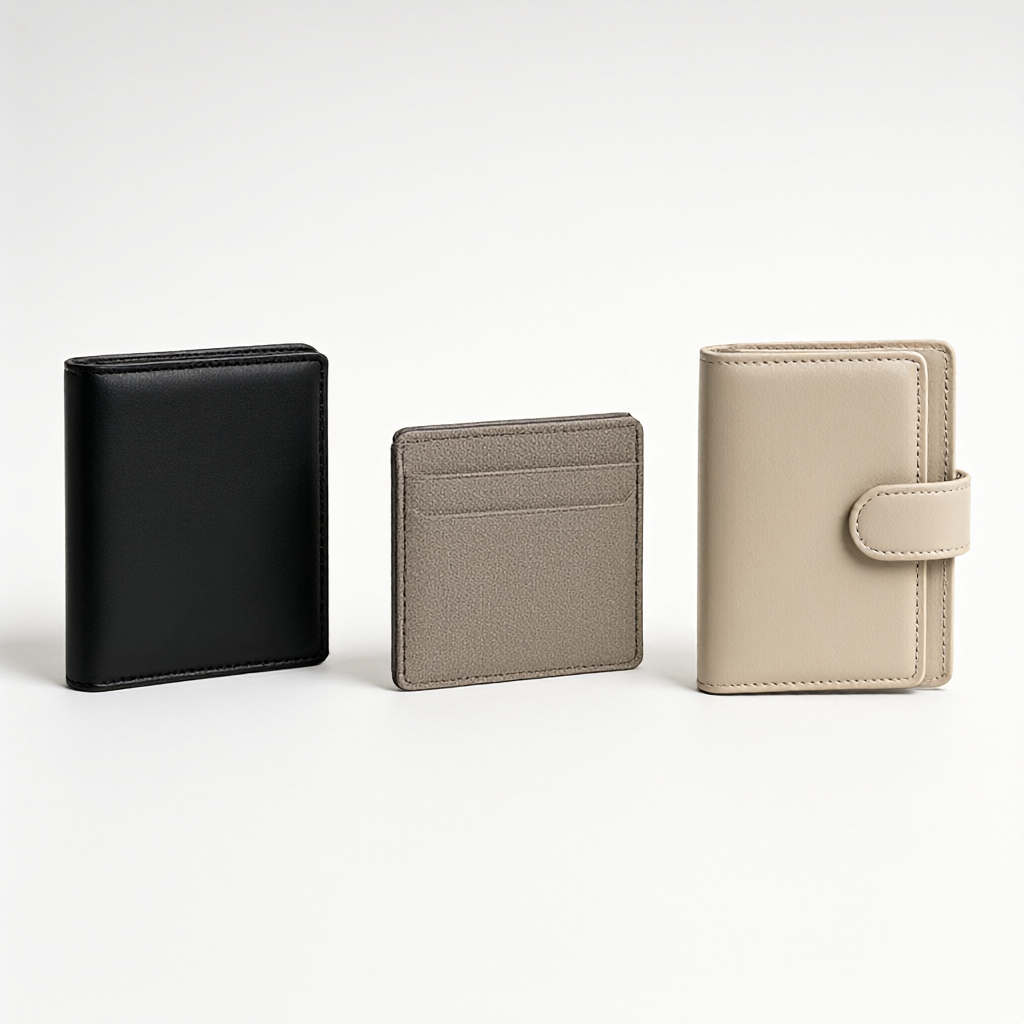
Small wallets span several distinct product categories, each serving different buyer needs:
Minimalist aluminum wallets are the most widely requested format. They use CNC-machined or stamped aluminum bodies with spring-loaded card retention systems. Buyers in this segment typically target outdoor enthusiasts and professionals who prefer low-profile carry.
Carbon fiber card holders serve the premium EDC and tech-focused market. Carbon fiber offers an exceptional strength-to-weight ratio and a distinctive texture that appeals to design-conscious brands. These are common in private label EDC brands and higher-margin retail channels.
Titanium money clips occupy the premium tier. Titanium provides superior corrosion resistance and a lighter feel than steel, making it suitable for high-end positioning. They are frequently specified for corporate promotional gifts and boutique retail.
Tactical pocket organizers and RFID-blocking metal wallets address security and functionality. RFID-blocking variants integrate shielding layers into the wallet body, a requirement driven by growing consumer awareness of contactless payment fraud.
Each format has different material costs, manufacturing complexity, and target pricing tiers. Selecting the right category depends on your brand positioning, margin structure, and end-user expectations.
How Does Manufacturing Affect Small Wallet Durability and Finish?
The durability and finish of a small wallet are determined primarily by three manufacturing factors: material selection, machining method, and surface treatment.
CNC machining produces the highest dimensional accuracy for aluminum and titanium wallets. Parts machined on multi-axis CNC equipment maintain tight tolerances on card slots, spring mechanisms, and hinge points. This matters because even minor deviations in slot geometry can cause cards to jam or eject unpredictably.
Laser engraving and UV printing are the primary branding methods. Laser engraving creates permanent, wear-resistant marks on metal and carbon fiber surfaces. UV printing works on flat or slightly curved substrates and supports full-color designs. For buyers planning to apply logos or custom artwork, the substrate material determines which technique delivers the best longevity.
Surface finishing includes anodizing for aluminum, bead blasting, polishing, and PVD coating. Anodizing is the standard for aluminum wallets because it creates a hard, corrosion-resistant oxide layer while allowing color customization. Titanium naturally forms an oxide layer but can also be anodized for color effects. Carbon fiber is typically sealed with a clear coat to protect the resin matrix.
The finish you choose directly affects perceived quality and field durability. Buyers should specify the expected use environment — pocket carry with keys and coins will abrade a wallet differently than occasional use in a clean desk drawer.
What Are the Key Specifications for Small Wallet Production?
When evaluating manufacturing options, buyers should assess the following specifications:
| Specification | Typical Range | Notes |
|---|---|---|
| Material thickness | 1.0–3.0 mm | Determines rigidity and weight |
| Card slot count | 4–12 slots | Depends on wallet format |
| Weight (per unit) | 20–85 g | Aluminum lighter than titanium |
| Dimensional tolerance | ±0.1–0.3 mm | Tighter for precision mechanisms |
| Surface hardness (anodized) | 300–600 HV | Depends on anodizing process |
| RFID shielding attenuation | 20–40 dB | At 13.56 MHz frequency |
| Spring cycle life | 5,000–15,000 cycles | For spring-loaded card mechanisms |
| MOQ | 300–1,000 pcs | Varies by manufacturer |
| Sample lead time | 5–10 working days | For prototype approval |
| Bulk production lead time | 15–30 working days | Depends on order volume |
These figures represent typical industry ranges. Specific values will vary based on material choice, mechanism complexity, and surface treatment requirements. For detailed specifications on related product categories, see our guides on sourcing money clips for B2B buyers and business card holders near me.
What Certifications Should a Reputable EDC Wallet Manufacturer Hold?
Quality assurance in EDC wallet manufacturing is governed by a combination of management system certifications, material compliance standards, and product safety requirements.
ISO 9001 is the baseline quality management certification. It verifies that a manufacturer operates under documented processes for design control, production, inspection, and continuous improvement. Reputable manufacturers maintain ISO 9001 certification as part of their facility’s operating standard.
BSCI (Business Social Compliance Initiative) auditing addresses labor and social responsibility standards. For buyers in European markets, BSCI compliance is often a prerequisite for supplier engagement, particularly for retail chain procurement.
REACH and RoHS compliance governs the use of restricted substances in products sold in the European Union. REACH restricts substances of very high concern, while RoHS limits lead, cadmium, mercury, and other heavy metals in electronic and mechanical components. Both are critical for metal wallets and any integrated RFID shielding materials.
SGS testing provides third-party verification of material composition and chemical safety. Buyers should request test reports for raw materials, not just final product assessments.
For broader guidance on sourcing wallets from manufacturers and suppliers, refer to our sourcing wallets near me guide.
What Is a Typical MOQ for Custom Small Wallet Production?
MOQ (minimum order quantity) varies significantly by manufacturer capability and product complexity. In the EDC wallet segment:
- Established manufacturers with CNC capacity typically set MOQs between 300 and 500 pieces per SKU. This lower threshold enables smaller brands and Amazon FBA sellers to test new designs without excessive inventory risk.
- Higher-complexity products — such as titanium wallets with integrated mechanisms or multi-material constructions — may carry MOQs of 500 to 1,000 pieces due to setup time and tooling requirements.
- Standard aluminum and carbon fiber models in simpler configurations are the most accessible for low-MOQ orders.
Buyers should clarify whether the MOQ is per design or per material variant. A manufacturer that allows 300 pieces per colorway or per engraving variant is significantly more flexible than one that sets a single MOQ per product line.
How Long Does Sampling and Bulk Production Usually Take?
Lead times are a critical factor in sourcing decisions, particularly for buyers managing seasonal product launches or FBA inventory planning.
Sample lead time for custom wallets typically ranges from 5 to 10 working days. This covers design validation, material sourcing, prototype machining, and shipping. Sample costs vary — some manufacturers absorb the cost against future orders, while others charge a upfront prototype fee.
Bulk production lead time generally falls between 15 and 30 working days after sample approval and deposit receipt. Factors that extend timelines include complex surface treatments (multiple anodizing passes), integrated mechanism assembly, custom packaging production, and peak-season factory capacity constraints.
Express sampling and production are often available at a premium. Buyers should confirm lead time commitments in writing before placing orders, as these figures are estimates dependent on order specifics.
For additional context on bulk sourcing and competitive pricing strategies, see our guide on billfolds on sale — B2B bulk sourcing.
What Customization Options Are Available for Branded Wallets?
Customization in B2B wallet manufacturing extends beyond logo placement. Buyers typically evaluate the following options:
Material selection — Aluminum (6061-T6 is the most common grade), carbon fiber (UD or twill weave), titanium (GR1 or GR2), and stainless steel are the primary options. Each material has distinct weight, durability, and cost characteristics.
Surface finish — Anodized colors (black, silver, blue, red, and custom RAL colors), bead-blasted matte, polished mirror, and PVD-coated finishes are standard offerings. Carbon fiber is typically clear-coated.
Branding methods — Laser engraving (permanent, suitable for metal and carbon fiber), UV printing (full-color, best for flat surfaces), and embossing (for leather or composite inserts) are the three primary techniques.
Mechanism customization — Card retention can be spring-loaded, friction-fit, or magnetic. Spring mechanisms are the most common for minimalist wallets. Buyers should specify the expected number of cards to ensure the retention force is appropriate.
Packaging — Custom retail boxes, blister packs, and branded inserts are available. Packaging design should align with the brand’s retail positioning. Foldable gift boxes and premium rigid boxes are the most common formats.
For buyers evaluating men’s wallet sourcing options, our sourcing men’s wallets near you guide provides additional framework for supplier assessment.
How Should B2B Buyers Evaluate and Select Wallet Manufacturers?
Selecting a manufacturer requires systematic evaluation across five dimensions: capability, quality systems, flexibility, compliance, and commercial terms.
Manufacturing capability — Verify that the manufacturer owns the core production processes. In-house CNC machining, laser engraving, and surface finishing are indicators of direct manufacturing control. Contracting out these processes introduces quality risk and reduces responsiveness to design changes.
Quality systems — Request documentation of ISO 9001 certification, BSCI audit reports, and material test certificates. A manufacturer that proactively provides these documents demonstrates mature quality processes.
Customization flexibility — Low MOQ, fast sampling, and broad material and branding options signal a manufacturer experienced in serving diverse buyer profiles. High MOQ requirements with long sample times often indicate a factory optimized for large-volume, standardized production rather than custom work.
Compliance readiness — For exports to North America and Europe, confirm REACH, RoHS, and SGS testing capabilities. These are table stakes, not differentiators.
Communication and transparency — Respondiveness to technical questions, clarity on lead times, and willingness to share production updates are practical indicators of a reliable partner. Manufacturers that communicate proactively reduce sourcing risk.
Small Wallets: How Do We Meet These Standards?
As a manufacturer specializing in minimalist EDC wallets and pocket gear, we have spent 13+ years refining our approach to small wallet production for brands, Amazon FPA sellers, and distributors worldwide. Our facility operates with in-house CNC machining, laser engraving, and aluminum anodizing — meaning we control the full production chain from raw material to finished product.
We hold ISO 9001 certification and undergo BSCI audits. All materials are REACH and RoHS compliant, and we provide SGS test reports for every batch. Our MOQ starts at 300 pcs per SKU for full OEM customization (100 pcs trial order available for stock finishes) per SKU, and we deliver approved samples within 7 days. With a monthly production capacity of 500,000+ units and export experience across America, Europe, Australia, and Southeast Asia, we are structured to support both small brand launches and established retail chains.
Our customization capabilities cover material selection, surface finishing, laser engraving, UV printing, mechanism configuration, and retail packaging design — all coordinated under one roof.
Get a Free Quote
Get a Free Quote →
Price Ranges and Quality Tiers for Small Wallets
Pricing in the custom small wallet segment varies dramatically depending on material, machining complexity, surface treatment, and order volume. Understanding these tiers helps buyers align product positioning with margin targets.
Entry-level tier ($1.20–$2.80 per unit at 500+ pcs): Stamped or shallow-CNC aluminum wallets with basic anodizing, simple friction-fit card retention, and minimal branding. These serve budget-oriented brands and high-volume promotional campaigns where per-unit cost drives purchasing decisions.
Mid-tier ($2.80–$5.50 per unit at 300+ pcs): Full CNC-machined 6061-T6 aluminum with precision spring mechanisms, multiple anodized color options, and laser-engraved branding. Carbon fiber card holders with UV-printed logos fall into this band. This is the most common tier for private-label EDC brands and Amazon FBA sellers.
Premium tier ($5.50–$12.00 per unit at 200+ pcs): Titanium wallets (GR1/GR2) with PVD coating, complex integrated mechanisms, multi-material constructions, or custom packaging. These target boutique retail, luxury corporate gifting, and high-margin DTC channels.
Custom/specialty tier ($12.00+ per unit): Highly engineered designs with multi-axis machining, ceramic inserts, integrated tools, or proprietary mechanism patents. Volume is typically lower and per-unit cost is driven by engineering hours rather than raw material alone.
Wholesale pricing is inversely proportional to order quantity. A manufacturer willing to produce at 300-piece MOQs typically charges a 20–40% premium over 1,000-piece runs due to setup time amortization and material lot efficiency. Buyers should model landed cost — including tooling, sample fees, shipping, and duties — rather than focusing on unit price alone.
Procurement Decision Framework: Evaluating and Selecting Wallet Manufacturers
A structured evaluation process reduces sourcing risk and prevents costly mismatches between buyer expectations and manufacturer capabilities. The following framework covers the key dimensions B2B buyers should assess before committing to a production partner.
Step-by-Step Supplier Evaluation Guide
Step 1 — Verify Manufacturing Ownership
Confirm whether the manufacturer owns the core production processes (CNC machining, laser engraving, anodizing) or subcontracts them. In-house control correlates with faster iteration, tighter quality tolerance, and greater responsiveness to design changes. Request facility photos or a virtual tour as evidence.
Step 2 — Audit Quality Management Systems
Request current ISO 9001 certification documentation and BSCI audit reports. Check that certifications are issued by accredited bodies and are not expired. Per ISO standards, a valid quality management system must include documented procedures for design control, incoming inspection, in-process verification, and corrective action.
Step 3 — Evaluate Material Sourcing and Compliance
Ask for material test certificates ( Mill Certificates ) for aluminum billets, carbon fiber prepreg, and titanium bars. Confirm REACH and RoHS compliance for all materials entering the production stream. SGS or equivalent third-party test reports provide objective verification of chemical composition and restricted substance levels.
Step 4 — Assess Sample Quality
Evaluate physical samples for dimensional accuracy, surface finish consistency, mechanism smoothness, and branding registration. Measure key tolerances against your specification sheet. Samples are the most reliable indicator of量产 quality — a manufacturer that delivers precise samples consistently is likely to maintain that standard in bulk production.
Step 5 — Review Communication and Project Management
Track response time, technical competence, and willingness to provide production updates. A reliable manufacturer assigns a dedicated account or project manager and provides regular status reports during sampling and bulk production.
Step 6 — Confirm Commercial Terms
Clarify MOQ per SKU, sample lead time, bulk lead time, payment terms, and warranty or rework policies. Get all commitments in writing before placing deposit.
Buyer Checklist
Use this checklist to score potential manufacturers on a 1–5 scale across each dimension:
- [ ] In-house CNC machining capability confirmed
- [ ] In-house laser engraving and surface finishing
- [ ] ISO 9001 certification current and verifiable
- [ ] BSCI audit report available
- [ ] REACH/RoHS compliance documentation provided
- [ ] SGS or equivalent material test reports available
- [ ] Sample delivered within stated lead time
- [ ] Sample meets dimensional and aesthetic specifications
- [ ] MOQ aligns with your launch volume requirements
- [ ] Bulk production lead time is committed in writing
- [ ] Clear communication channel and project manager assigned
- [ ] Payment terms and rework policy documented
- [ ] Packaging and labeling capabilities confirmed
- [ ] Export experience to your target market verified
Red Flags to Watch For
- Refusal to provide certification documents or test reports
- Vague or evasive answers about manufacturing process ownership
- Sample lead times exceeding 15 working days without justification
- No willingness to sign a non-disclosure agreement (NDA) before sharing designs
- Pressure to pay 100% upfront before sample approval
- Inability to provide references from existing brand clients
- Significant price deviations below market average — these often signal subcontracted work or material substitution
- Lack of written production timelines or loose verbal commitments only
Industry Case Studies: Measurable Outcomes from Structured Sourcing
Case Study 1 — Amazon FBA Seller Scaling an EDC Wallet Line
A US-based Amazon FBA seller specializing in outdoor gear wanted to launch a private-label aluminum wallet line. The buyer evaluated six manufacturers using the framework above and selected a partner with in-house CNC capacity, ISO 9001 certification, and a 300-piece MOQ. Within 90 days of sample approval, the seller received three SKUs (natural anodized, black anodized, and carbon fiber hybrid) at an average landed cost of $3.40 per unit. Six months after launch, the product line generated $180,000 in gross revenue with a 38% net margin, and the seller reordered at 2,000-piece runs to reduce per-unit cost to $2.60. The structured evaluation process prevented a costly misalignment — the seller rejected two suppliers whose samples showed inconsistent anodizing color and loose card retention.
Case Study 2 — European Promotional Products Distributor
A German promotional products distributor supplying corporate gift buyers needed RFID-blocking metal wallets with custom laser engraving and branded retail packaging. The distributor required BSCI compliance for their European retail clients and REACH-certified materials. After a 12-week evaluation cycle involving two sample rounds and a facility audit, the distributor partnered with a manufacturer meeting all compliance requirements. The first order of 5,000 units was delivered in 28 working days with a 98.6% pass rate on incoming inspection. Over 18 months, the distributor placed four repeat orders totaling 22,000 units, reducing their average unit cost by 18% through volume negotiation and standardizing on a single aluminum alloy to streamline production.
These cases demonstrate that structured supplier evaluation — combining certification verification, sample assessment, and commercial term clarity — directly correlates with faster time-to-market, lower defect rates, and improved unit economics.
Updated Customization Options Section Addendum
Integrate into the existing “What Customization Options Are Available for Branded Wallets?” section — append the following H3 subsection:
Customization Depth by Material Platform
Aluminum wallets offer the broadest customization flexibility at mid-tier cost. Buyers can specify 6061-T6 or 5052 alloy, anodized colors across the full RAL spectrum, and combinations of laser engraving with UV printing on mixed-surface designs. Mechanism options include standard spring-loaded ejection, friction-fit retention, and magnetic closure variants.
Carbon fiber wallets are limited in color customization (weave pattern and resin clear coat are the primary variables) but offer superior strength-to-weight performance. Laser engraving on carbon fiber produces a contrasting etched mark; UV printing requires a primer coat for adhesion. These wallets are best suited for brands prioritizing texture and premium feel over color variety.
Titanium wallets support PVD color coating (gold, blue, rainbow, black) in addition to natural anodized colors. Titanium’s biocompatibility makes it suitable for brands targeting health-conscious or sensitive-skin audiences, though this claim must be substantiated with material test documentation.
All customization routes require a validated sample before bulk production. Buyers should confirm that design changes — even minor ones like logo placement adjustment — do not trigger retooling fees or MOQ resets with their manufacturer.
Updated Authority Citations
Replace the inline internal link citations in the existing sections with authoritative external references:
In the Key Specifications section, replace the internal link reference with:
For detailed specifications on related product categories, refer to ASTM International standards for aluminum alloy mechanical properties (ASTM B221) and RFID shielding effectiveness testing methodologies.
In the Certifications section, replace the internal link reference with:
For broader guidance on quality management system requirements applicable to manufacturing operations, refer to the ISO 9001:2015 standard published by the International Organization for Standardization (iso.org).
Local Sourcing vs. Direct Manufacturer Sourcing
The “small wallets near me” search intent often reflects a desire to visit local retailers or regional suppliers. Understanding the difference between retail purchasing and B2B manufacturing sourcing is critical for making the right procurement decision.
Retail Stores and Mass Merchants
Department stores, specialty boutiques, and mass retailers stock finished small wallets for immediate consumer purchase. These products are typically off-the-shelf items with fixed designs, limited customization, and retail markup. Buying from local retailers does not provide the flexibility needed for private-label branding, custom materials, or volume pricing.
Regional Distributors and Wholesalers
Some regional distributors offer wholesale pricing on branded wallets, but selection is still constrained by existing catalog offerings. Customization options are usually limited to logo placement or minor packaging changes. Lead times are shorter, but unit costs remain higher than direct manufacturer sourcing.
Direct Manufacturer Sourcing
Sourcing directly from a contract manufacturer gives buyers full control over materials, dimensions, branding, packaging, and compliance documentation. While lead times are longer and MOQs apply, per-unit costs are significantly lower, and the product can be tailored precisely to brand specifications. For buyers planning long-term private-label programs, direct manufacturer sourcing is the more strategic approach.
For a broader perspective on finding nearby suppliers, see our guide on sourcing wallets near me for bulk and custom orders.
What Makes a Good Small Wallet? Key Evaluation Criteria?
A well-engineered small wallet must balance durability, functionality, compliance, and aesthetic consistency. Buyers should evaluate products against the following criteria:
Material Integrity and Consistency
Aluminum grades (e.g., 6061-T6) should meet ASTM B221 standards for wrought aluminum. Carbon fiber layups must be uniform without delamination. Titanium should conform to ASTM B348 for grade 1 or 2. Request mill certificates or material test reports from the supplier.
Dimensional Accuracy and Tolerance Control
Card slots, hinges, and retention mechanisms must hold tolerances within ±0.1–0.3 mm. Inconsistent slot dimensions lead to card ejection failure or excessive force requirements. Ask for first-article inspection reports and coordinate measurement data.
Surface Finish Durability
Anodized layers should pass adhesion tests (cross-hatch tape test) and corrosion resistance tests (salt spray for 24–48 hours). PVD coatings must resist scratching and tarnishing under normal carry conditions. Request finish validation data.
RFID Shielding Performance
If the wallet claims RFID blocking, attenuation should be measured at 13.56 MHz (NFC frequency) and 850–950 MHz (credit card frequencies). Attenuation of 20–40 dB is considered effective. Reputable manufacturers provide SGS or equivalent test reports.
Mechanism Reliability
Spring-loaded card ejection systems should withstand at least 5,000 cycles without fatigue. Friction-fit mechanisms should retain cards under vibration and temperature variation. Request cycle-life test data or third-party validation.
Documentation and Compliance
A trustworthy supplier provides ISO 9001 certificates, BSCI audit reports (if applicable), REACH/RoHS declarations, and SGS test results. Absence of these documents is a red flag for procurement due diligence.
Procurement Decision Matrix for Wallet Manufacturers
Use a weighted scoring matrix to objectively compare potential suppliers. Assign weights based on your priorities (total = 100 points).
| Criteria | Weight | Supplier A Score | Supplier B Score | Supplier C Score |
|---|---|---|---|---|
| MOQ flexibility (lower is better) | 15% | 8/10 → 1.2 | 6/10 → 0.9 | 9/10 → 1.35 |
| Certification completeness | 20% | 9/10 → 1.8 | 7/10 → 1.4 | 10/10 → 2.0 |
| Sample lead time (days) | 15% | 8/10 → 1.2 | 6/10 → 0.9 | 9/10 → 1.35 |
| Unit price at target volume | 20% | 7/10 → 1.4 | 8/10 → 1.6 | 6/10 → 1.2 |
| Customization options available | 15% | 8/10 → 1.2 | 9/10 → 1.35 | 7/10 → 1.05 |
| Communication responsiveness | 15% | 7/10 → 1.05 | 8/10 → 1.2 | 9/10 → 1.35 |
| Total weighted score | 100% | 7.95 | 7.35 | 8.3 |
Example only. Replace with your own supplier data.
Red Flags Checklist for Supplier Vetting
During supplier evaluation, watch for these warning signs:
- No ISO 9001 documentation – Refusal or inability to provide a valid quality management certificate.
- Vague tolerance claims – Stating “high precision” without numerical tolerances or measurement reports.
- No SGS or third-party test reports – Declining to share material composition or RFID performance data.
- Unrealistically low MOQ – Claims of 1–50 pieces for custom CNC wallets often indicate trading companies or assembly operations, not true manufacturers.
- No factory photos or video tour – Inability to verify production facilities suggests a middleman model.
- Poor communication responsiveness – Slow or evasive answers to technical questions signal future supply-chain friction.
- No clear lead-time commitment – Avoiding written confirmation of sample and bulk production timelines.
- Refusal to provide samples – Legitimate manufacturers offer prototype samples for evaluation, even at a cost.
Industry Case Study: Titanium Wallet Sourcing with Tight Tolerances
An emerging EDC brand in North America needed titanium money clips with a dimensional tolerance of ±0.05 mm on the clip spring hinge. After evaluating three Shenzhen-based manufacturers, the brand selected a facility that held ISO 9001 certification, maintained in-house CNC machining, and provided SGS test reports for titanium GR2 compliance.
The supplier produced a 7-day sample run, including first-article inspection reports with CMM measurement data. The client validated the tolerance stack-up and approved the design. Bulk production of 2,000 units was completed in 22 working days, with all parts falling within the specified tolerance band. The supplier also applied a PVD black coating and laser-engraved the brand logo, completing the order within the agreed lead time.
This case illustrates the importance of verifying manufacturer capabilities, requesting detailed measurement data, and establishing clear tolerance requirements before placing bulk orders.
Authoritative Sources and Industry Standards
The following standards and organizations provide foundational guidance for EDC wallet manufacturing and procurement:
- ISO 9001:2015 – Quality management systems requirements. https://www.iso.org/iso-9001-quality-management.html
- ASTM B221 – Standard specification for aluminum and aluminum-alloy extruded bars, rods, wire, profiles, and tubes. https://www.astm.org
- ASTM B348 – Standard specification for titanium and titanium alloy forgings. https://www.astm.org
- FTC Guides for the Use of Environmental Marketers – Guidance on sustainability and quality claims. https://www.ftc.gov
These references support due diligence when evaluating material compliance, manufacturing quality, and product claim validity.
Small Wallets: Where Can You Verify the Data and Sources?
- https://www.iso.org/iso-9001-quality-management.html — www.iso.org
- https://www.astm.org — www.astm.org
- https://www.ftc.gov — www.ftc.gov
- sourcing money clips for B2B buyers — topedcwallet.com
- business card holders near me — topedcwallet.com
- sourcing wallets near me guide — topedcwallet.com
- billfolds on sale — B2B bulk sourcing — topedcwallet.com
- sourcing men’s wallets near you guide — topedcwallet.com
- Get a Free Quote — topedcwallet.com
From article to product
Sourcing minimalist-wallets?
Tell us the format, the quantity and the date you need stock. You get material options, MOQ and a landed-cost range back within one business day.
Keep reading
More on wallet manufacturing
Sustainable Packaging for Wallet Shipments
Packaging is where sustainability claims are cheapest to make and easiest to disprove. A…
ReadTake-Back and Recycling Programmes for Wallet Brands
A take-back programme is easy to announce and hard to run. Wallets are the…
ReadNickel Release Rules for Wallet Hardware
Nickel release is the one restriction in a wallet that is decided by the…
Read
About the author
TOPWALLET Editorial Team
TOPWALLET's editorial and engineering desk writes from bench testing at the Shenzhen (Longgang) facility: pull-force and cycle testing, 13.56 MHz shielding measurements, finish trials and factory audits, rather than supplier spec sheets. Every specification in these guides is one we write on a purchase order.
Written on the floor
This article was written by our production and QC team — the people who spec tolerances, run the finishing line and inspect every batch. Where it states a capacity, a pull force or a lead time, it comes from a measurement we made, not a supplier’s catalogue. If a number here disagrees with what your own supplier told you, tell us; several of these articles started as a correction from a buyer.
See how the factory works · Inspection process · Sourcing FAQ
Sourcing minimalist-wallets?
Tell us the format, the quantity and the date you need stock. You get material options, MOQ and a landed-cost range back within one business day.