

Designer wallets for women in the B2B context are precision-engineered carry accessories made from materials like anodized aluminum, titanium, and carbon fiber — offering RFID-blocking, custom branding, and private-label packaging for brands, Amazon FBA sellers, and distributors. Unlike fashion luxury wallets, B2B designer wallets for women prioritize functional minimalism: slim profiles (90–110 mm wide, 30–75 g), durable non-leather materials, and manufacturing quality backed by ISO 9001 and REACH/RoHS compliance. Buyers should evaluate suppliers on material certification, in-house CNC and anodizing capability, MOQ flexibility (starts at 300 pcs per SKU for full OEM customization (100 pcs trial order available for stock finishes)), and sample lead time (5–10 business days).
Designer Wallets For Women: What Is the Quick Answer?
What are designer wallets for women? In the B2B procurement context, designer wallets for women are slim, design-forward carry accessories engineered from premium materials such as aluminum, titanium, and carbon fiber — often featuring RFID-blocking, custom branding, and private-label packaging. They sit at the intersection of fashion and function, targeting women who carry fewer cards and cash but want a wallet that looks intentional and lasts. For buyers sourcing wholesale or private label, the key differentiators are material choice, card capacity, finish quality, and how well the product aligns with a brand’s aesthetic positioning.
Designer Wallets For Women: How Does It Work in Detail?
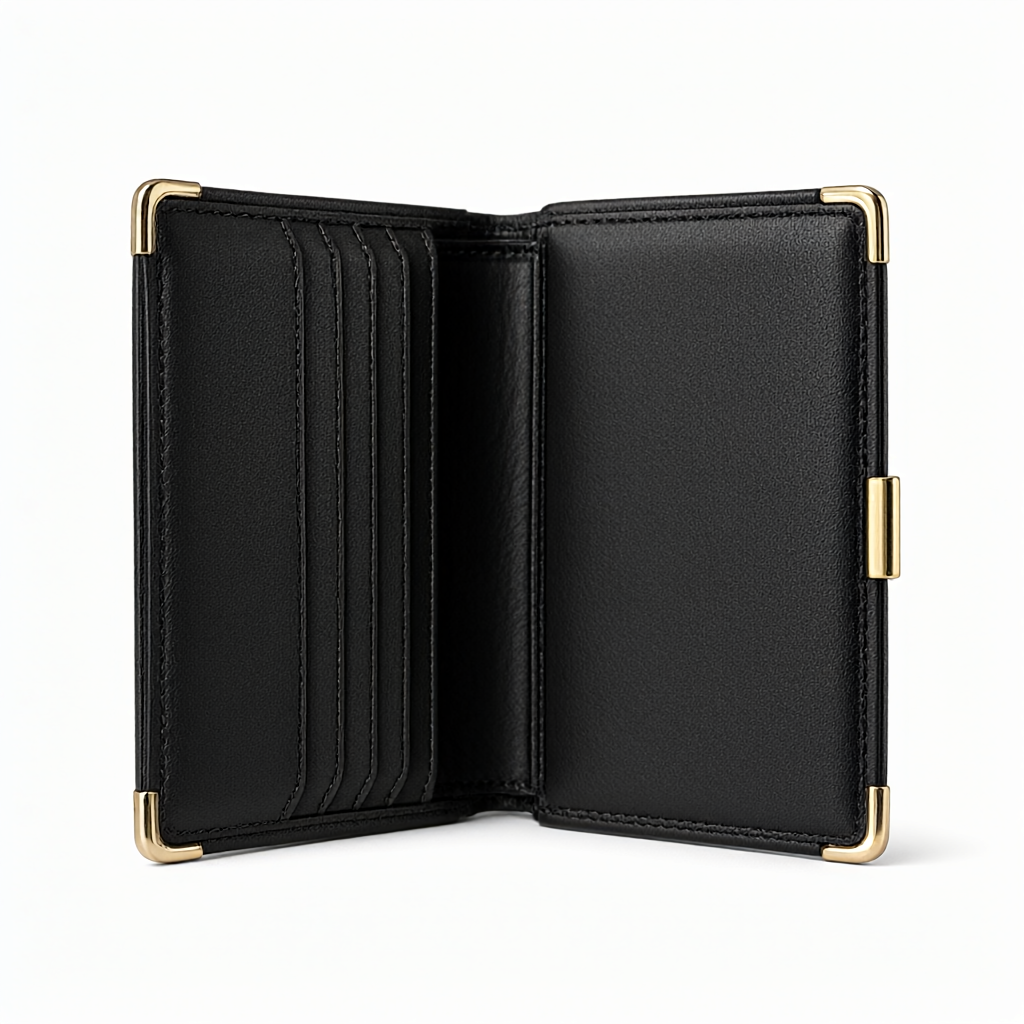
What exactly are designer wallets for women in a B2B sourcing context?
The term “designer wallet for women” has evolved beyond traditional leather goods. Today it describes minimalist card wallets, slim bifold formats, money clips, and compact organizers produced from metals and engineered composites. From a procurement standpoint, these products share several characteristics: they emphasize a low-profile silhouette, use durable non-leather or premium leather materials, offer RFID protection as a standard feature, and are frequently customized with laser engraving, anodized finishes, and branded packaging for retail or private-label programs.
When buyers in the women’s EDC and lifestyle accessories market source these products, they are typically looking for something more refined than a generic bulk item — a wallet that reflects design intentionality while maintaining the functional reliability expected of metal or carbon fiber gear. For background on how minimalist wallets are defined and sourced more broadly, see our men’s minimalist wallets materials and specs guide and our EDC wallets sourcing guide for B2B buyers.
How does RFID-blocking work and is it necessary?
RFID-blocking technology uses a thin layer of conductive metal or ferrite material embedded within the wallet structure to create a signal-dampening barrier. When a contactless card is placed inside, the barrier prevents radio-frequency identification scanners from reading the card’s data, reducing the risk of electronic pickpocketing and unauthorized scanning.
For women’s designer wallets, RFID protection is increasingly considered a baseline feature rather than a premium add-on. Women tend to carry wallet formats with cards arranged in close proximity to the outer surface — whether in a slim card holder or a compact bifold — which makes the blocking layer’s placement a meaningful factor in effectiveness. Buyers should request test reports from suppliers confirming the RFID-blocking performance meets recognized standards such as those referenced by the American Society for Testing and Materials (ASTM).
Is it necessary? For brands selling into North American and European markets, yes — it is now an expected feature. For promotional or budget-tier programs, it may be optional, but its absence can become a competitive disadvantage as consumer awareness grows.
What are the typical dimensions and weight specs for women’s minimalist wallets?
Women’s wallets run smaller than unisex or men’s formats. The typical profile fits inside a woman’s clutch, crossbody bag, or even a large handbag without adding bulk. Standard industry dimensions fall in the range of 90–110 mm in width and 60–80 mm in height, with a thickness between 8 mm and 18 mm depending on card capacity. Weight commonly ranges from 30 g to 75 g for metal and carbon fiber constructions.
Card capacity is another critical specification. A standard slim women’s card wallet holds 4–8 cards plus folded bills; a slightly larger bifold or organizational format may accommodate 8–12 cards and include a dedicated coin compartment or cash pocket. Buyers should validate the internal layout against the target demographic — a wallet designed for someone carrying 3–5 essentials will feel too sparse to one carrying 8+, and vice versa.
For detailed capacity benchmarks and sizing reference, consult the card holder sourcing guide and the wallets for women sourcing guide.
What materials are most commonly used in women’s designer wallets?
The dominant materials fall into three categories, each with distinct trade-offs:
Aluminum — The most widely used metal in women’s minimalist wallets. It offers a strong strength-to-weight ratio, accepts anodized coloring beautifully, and machines cleanly with CNC precision. Anodized aluminum wallets come in a broad color spectrum — rose gold, matte black, navy, mint, and blush are popular choices for the women’s market. The trade-off is that aluminum is softer than titanium and can show micro-scratches over time, though anodizing adds a hard surface layer that mitigates this.
Titanium — A premium option that commands higher pricing but delivers superior scratch resistance, a naturally hypoallergenic surface, and a distinctive matte-gray aesthetic. Titanium wallets are heavier than aluminum but still lightweight compared to steel. For brands positioning at the luxury end of the minimalist segment, titanium is a strong differentiator. See also the minimalist wallet buyer’s guide for deeper specification comparison.
Carbon fiber — A composite material made from woven carbon threads bonded with resin. It offers exceptional rigidity, a high-contrast textured appearance, and natural scratch resistance. Carbon fiber wallets tend to sit between aluminum and titanium in price. A common construction approach combines a carbon fiber exterior shell with an aluminum interior plate for structural reinforcement and RFID functionality.
Hybrid constructions — combining two or more of these materials — are common in the women’s segment, where aesthetic contrast (e.g., a rose gold anodized frame with a carbon fiber front panel) drives visual appeal.
What customization options are available?
Customization is where a generic manufacturer becomes a true OEM partner. Key options include:
- Laser engraving — Used for logos, monograms, or decorative patterns on metal surfaces. Engraving depth and precision vary by equipment; fiber laser systems produce sharper detail on dark-anodized or bare metal surfaces.
- Anodizing — An electrochemical process that colors and hardens aluminum. Colors are matched to brand guidelines; consistency across production runs depends on batch control.
- Private-label packaging — Retail boxes, tissue wraps, and presentation sleeves printed with brand identity. Packaging design capability varies by supplier — some offer full in-house design, while others require external artwork submission.
- Surface finishing — Options include brushed, polished, bead-blasted, or powder-coated textures. Finish selection affects both aesthetics and perceived quality.
- Hardware and mechanisms — Spring-loaded card ejection, magnetic closures, and money clip attachments are available as functional differentiators.
Designer Wallets For Women: Which Specifications Matter Most?
What are the key specs for designer wallets for women?
| Specification | Typical Range | Notes |
|---|---|---|
| Width | 90–110 mm | Fits most women’s bags; check clutch compatibility |
| Height | 60–80 mm | Compact enough for small evening clutches |
| Thickness | 8–18 mm | Depends on card capacity and mechanism |
| Weight | 30–75 g | Carbon fiber and titanium run on the lighter end |
| Card capacity | 4–12 slots | Varies by format; measure insert depth |
| RFID-blocking | Yes / No | Request test documentation |
| Material options | Aluminum, titanium, carbon fiber, leather hybrids | Surface finish affects durability perception |
| Customization | Laser engraving, anodizing, UV printing, packaging | Minimum order applies per customization level |
When evaluating a spec sheet, pay attention to tolerance ranges. A wallet advertised at “90 mm wide” could realistically measure between 88 mm and 92 mm depending on the manufacturer’s quality control. Consistent tolerances signal a capable production floor.
Designer Wallets For Women: Which Standards and Certifications Apply?
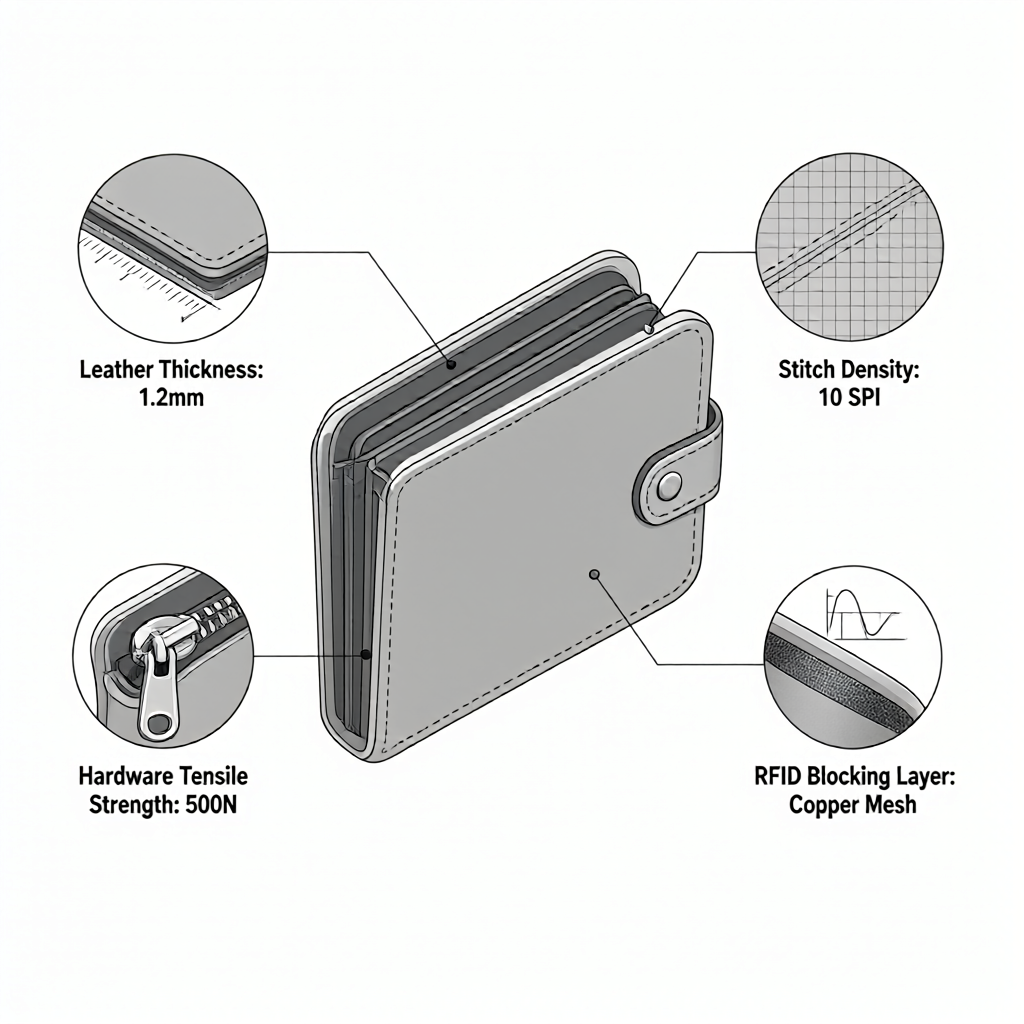
What certifications and standards apply when sourcing these wallets internationally?
Quality and compliance credentials matter differently depending on your target market:
- ISO 9001 — The baseline quality management standard for manufacturing operations. It confirms the supplier has documented processes for production control, defect tracking, and continuous improvement.
- BSCI (Business Social Compliance Initiative) — A social accountability audit covering labor practices, working conditions, and ethical sourcing. Increasingly required by European retail buyers.
- REACH and RoHS compliance — Required for products sold in the European Union. REACH restricts certain hazardous substances in materials; RoHS limits lead, cadmium, and other heavy metals in electronic components (relevant if RFID shielding incorporates metallic layers).
- SGS testing — Third-party material and product testing that verifies claims about composition, finish durability, and blocking performance.
Buyers should request copies of active certification documents and verify their validity with the issuing body. Certification is not a one-time event — expired or unverified credentials are a red flag. For additional context on leather wallet grades and material sourcing standards, review the leather wallet guide.
Designer Wallets For Women: What Else Should Buyers Consider?
What should you consider when evaluating a manufacturer for custom women’s wallets?
Supplier evaluation goes beyond price per unit. Here are the factors that differentiate a reliable manufacturing partner from an unreliable one:
- In-house capability vs. trading company — A factory that owns its CNC machining, anodizing, and assembly lines has tighter control over quality, lead time, and cost. Trading companies add markup and distance you from the production floor. Ask where each step of the process happens.
- Sample lead time — Fast sampling (5–10 business days) indicates an efficient prototype pipeline. Long sample turns (3–4 weeks) suggest a bottlenecked operation that will also slow full production.
- MOQ flexibility — Minimum order quantities signal the supplier’s business model. A supplier requiring 1,000+ units per SKU is geared toward large distributors; one accepting 100 units accommodates emerging brands and Amazon FBA sellers testing new formats.
- Design and engineering support — Can the supplier help refine your concept, suggest material and finish combinations, or produce a CAD model before tooling begins? Strong engineering support reduces iteration cycles.
- Packaging capability — Private-label buyers need more than a blank box. Evaluate whether the supplier can handle die-cut design, print layout, and fulfillment prep (FBA labeling, poly bagging, etc.).
- References and past work — Ask to see product photos from previous orders similar to yours. Real-world finish quality in photos is a better indicator than a spec sheet.
What are typical MOQ and sample lead-time expectations?
MOQs for custom women’s wallets vary by manufacturer and customization level. Basic configurations (stock design, no engraving) may start at 100–300 units per SKU. Fully customized designs with unique engraving patterns, special anodized colors, or proprietary mechanisms typically require 300–500 units minimum.
Sample lead times range from 5 to 15 business days for standard samples and 15–30 days for custom-prototype samples that require new tooling or finish development. Rush sampling is sometimes available at a premium.
For Amazon FBA private-label sourcing, corporate promotional gift programs, and retail chain procurement, MOQ flexibility and FBA-ready fulfillment are particularly important — confirm these capabilities before placing a trial order. See also our money bag sourcing guide and wristlet sourcing guide for related product categories.
If you’re comparing specifications or preparing a request for quotation, request a bulk FOB quotation to get targeted pricing for your opening sizes and customization needs.
Manufacturer Approach
How does a capable manufacturer meet the standards described above?
As a manufacturer, our approach to women’s designer wallets centers on three principles: material integrity, design flexibility, and production efficiency. We operate a 50,000 sq ft facility with in-house CNC machining, laser engraving, and anodizing lines — meaning every step from raw stock to finished product stays under one roof. We hold ISO 9001 certification and maintain BSCI audit compliance, and all materials are REACH and RoHS compliant with SGS testing on file.
Our product range covers minimalist aluminum wallets, carbon fiber card holders, titanium money clips, and RFID-blocking metal wallet formats — all of which can be customized for private-label brands, Amazon FBA sellers, and corporate gift buyers. We support design from concept through retail-ready packaging, with low MOQs starts at 300 pcs per SKU and a 7-day sample turnaround on standard configurations.
For buyers evaluating whether a supplier can deliver on the specifications outlined in this guide, send us your opening sizes for a custom quote.
Wallet Styles by Use Case
What wallet style suits your target customer’s lifestyle?
Women’s wallet formats are segmented by carrying situation — each demands different dimensions, capacity, and design language:
- Cardholder — Ultra-slim (4–8 card slots, no cash pocket). Ideal for women who carry a purse separately and only need instant-access cards and ID. Typical thickness: 8–12 mm. Price tier: $3.50–$8.00 FOB. Most popular format for Amazon FBA private label due to low weight and shipping cost.
- Bifold — Classic folded design with 6–12 card slots and a central bill compartment. The versatile middle ground; fits most women’s handbags and crossbody bags. Typical thickness: 14–18 mm. Price tier: $5.00–$12.00 FOB. Best for customers transitioning from traditional leather wallets to minimalist alternatives.
- Money Clip — Combines a metal clip for folded cash with 2–6 card slots on the reverse. Compact and tactical aesthetic. Typical thickness: 10–14 mm. Price tier: $4.50–$10.00 FOB. Strong performer in the EDC and outdoor-lifestyle women’s segment.
- Zip-Around — Full-circumference zipper enclosure with 8–14 card slots and dedicated coin/cash compartments. Sits closer to a traditional purse wallet. Typical thickness: 18–25 mm. Price tier: $6.00–$15.00 FOB. Appeals to customers who prioritize security and maximum capacity while still wanting a slim profile.
- Clutch-Insert / Wristlet Wallet — Designed to fit inside a clutch bag or double as a wristlet with an attached strap. Larger format (110–130 mm width). Typical thickness: 15–22 mm. Price tier: $7.00–$18.00 FOB. Niche but high-margin category, especially for fashion-forward retail buyers.
Selecting the right format by channel:
| Channel | Recommended Primary Style | Why |
|---|---|---|
| Amazon FBA | Cardholder & Bifold | Low return rate, lightweight shipping, broad appeal |
| Retail Boutique | Zip-Around & Money Clip | Higher price tolerance, visual merchandising appeal |
| Corporate Gifts | Cardholder | Low MOQ feasibility, clean branding surface |
| Outdoor / EDC Brands | Money Clip & Tactical Bifold | Rugged positioning, titanium/aluminum material match |
| Luxury Private Label | Zip-Around with premium finish | Commands higher retail price points ($40–$80+) |
For an expanded comparison of minimalist wallet formats, see the wallets for women sourcing guide.
Trend Forecasts: Colors and Hardware for Women’s Wallets (2025–2026)
What colors and hardware finishes are trending in the women’s minimalist wallet market?
Current market data from trade shows and B2B buyer surveys point to the following trends shaping 2025–2026 orders:
Color Trends:
- Rose Gold & Pink Gold Anodizing — Remains the dominant finish for the women’s market, accounting for an estimated 35–40% of all orders in North America and Europe. Often paired with black carbon fiber front panels for contrast.
- Matte Black & Space Gray — The second-largest segment (~25%), favored by EDC and outdoor lifestyle brands. Titanium natural finish is growing within this category.
- Midnight Blue & Burgundy — Emerging as seasonal premium colors, particularly for holiday gift campaigns and retail exclusives.
- Mint Green & Lavender — Niche pastel colors gaining traction among Gen-Z-targeted DTC brands; typically ordered in smaller batches (100–300 pcs).
- Two-Tone & Gradient Anodizing — A differentiating trend where wallets feature gradient color transitions or contrasting frame/panel combinations. Commands a 15–25% price premium.
Hardware & Mechanism Trends:
- Spring-Loaded Card Ejection — Now standard on mid-tier and premium products. Buyers expect 3–5 card ejection with smooth actuation. Failure rate below 2% is the industry benchmark.
- Magnetic Closure — Growing in popularity for bifold and zip-around formats. Neodymium magnets (N52 grade) are the spec to request; weaker grades cause premature opening.
- Knife-Edge Bevels — Sharp, milled edges are a signature aesthetic of premium minimalist wallets. Adds visual refinement but requires tighter CNC tolerances (±0.05 mm).
- Integrated Key Rings & Lanyard Loops — Functional add-ons that increase perceived value, especially for the EDC segment.
Material Combination Trends:
- Carbon Fiber + Anodized Aluminum Frames — The most popular hybrid construction. Offers visual contrast and structural rigidity.
- Titanium Front Plate + Aluminum Body — Premium tier combination that reduces weight while maintaining scratch resistance on the visible surface.
- Leather Accent Straps on Metal Wallets — A fashion-forward hybrid emerging in 2025, combining minimalist metal construction with a leather cash strap or wrist loop.
Price Tiers and Brand Positioning in the Women’s Designer Wallet Market
How do price tiers map to material, customization, and brand positioning?
| Tier | FOB Price Range | Materials | Target Buyer | Typical MOQ |
|---|---|---|---|---|
| Entry / Promotional | $2.50–$4.50 | Anodized aluminum, basic RFID | Corporate gifts, trade show giveaways | 500–1,000 pcs |
| Mainstream Consumer | $4.50–$8.00 | Aluminum or carbon fiber, laser engraving | Amazon FBA, DTC brands, retail chains | 100–500 pcs per SKU |
| Premium EDC | $8.00–$15.00 | Titanium, hybrid carbon fiber, spring mechanisms | EDC enthusiasts, outdoor brands, boutique retail | 100–300 pcs per SKU |
| Luxury Private Label | $15.00–$30.00+ | Titanium, premium finishes, custom packaging, unique mechanisms | High-end fashion brands, department store exclusives | 300–1,000 pcs per SKU |
Brand positioning benchmarks (retail price):
- Entry-tier wallets typically retail at $15–$25 USD.
- Mainstream consumer wallets retail at $25–$45 USD.
- Premium EDC wallets retail at $45–$80 USD.
- Luxury private label wallets retail at $80–$150+ USD.
Buyers should calculate their target retail price first, then work backward to determine the maximum FOB cost that allows for healthy margins at their channel’s typical markup structure (typically 2.5–3× FOB for DTC, 2–2.5× FOB for wholesale).
Supplier Evaluation Checklist for Women’s Wallet Manufacturing
What should buyers consider when evaluating a manufacturer for custom women’s wallets?
Evaluating a women’s wallet manufacturer requires a structured assessment across six dimensions. Use the weighted scoring framework below during supplier selection to ensure objective comparison:
Weighted Scoring Criteria (Total: 100 points)
| Criterion | Weight | What to Evaluate | Scoring (1–10) |
|---|---|---|---|
| Material Quality & Certifications | 20 pts | ISO 9001:2015 certification, REACH/RoHS compliance, SGS test reports for materials, alloy grade (e.g., 6061-T6 aluminum, Ti-6Al-4V titanium) | /20 |
| In-House Manufacturing Capability | 15 pts | Ownership of CNC machining, anodizing lines, laser engraving, and assembly. Verify each process step is performed in-house, not outsourced. | /15 |
| MOQ Flexibility | 15 pts | Ability to accept low MOQs (100–300 pcs) for trial orders without excessive per-unit cost escalation. Critical for emerging brands and Amazon FBA sellers. | /15 |
| Sample Lead Time & Quality | 15 pts | Standard sample turnaround (5–10 business days), sample quality matching production standards, willingness to revise samples without extra charge. | /15 |
| Customization Range | 10 pts | Breadth of material options (aluminum, titanium, carbon fiber), finish variety, mechanism options, and packaging design capability. | /10 |
| Communication & Responsiveness | 10 pts | Response time to RFQs, clarity of technical communication, English proficiency of sales/engineering team, use of project management tools. | /10 |
| Logistics & FBA Readiness | 5 pts | Experience with Amazon FBA prep (FNSKU labeling, poly bagging, carton compliance), drop-shipping capability, export documentation accuracy. | /5 |
Scoring Interpretation:
- 85–100: Excellent fit — proceed to sample order
- 70–84: Good fit — negotiate terms before sampling
- Below 70: High risk — request corrective action plan or evaluate alternatives
Red Flags to Avoid
- No active ISO 9001 certificate — Request the certificate number and verify at iso.org.
- Samples that look nothing like production quality — This indicates poor QC between prototype and mass production.
- Inability to provide SGS or third-party test reports — Especially for RFID-blocking performance claims.
- MOQ of 1,000+ pcs for custom designs — Unsuitable for emerging brands; signals a large-distributor-only business model.
- No in-house anodizing or CNC — Means the supplier is a trading company with limited control over quality and lead time.
Verification Steps
- Request and independently verify ISO 9001 and BSCI certificates.
- Order samples from at least 3 shortlisted suppliers before making a production decision.
- Ask for a factory video tour or audit report.
- Confirm RFID-blocking test reports reference recognized standards.
- Check if the supplier has experience shipping to your target market (America, Europe, Australia, Southeast Asia).
Procurement Decision Framework
How should B2B buyers systematically evaluate and select a women’s wallet manufacturer?
Use this four-phase framework to move from initial supplier research to production order with confidence:
Phase 1: Pre-Qualification (Week 1)
- Define your target format (cardholder, bifold, money clip, zip-around), material preference, and volume requirements.
- Search for manufacturers with demonstrated experience in your target format and material.
- Request a capability statement including certifications, factory photos, and product catalog.
- Screen against the weighted scoring checklist above; eliminate any supplier scoring below 70.
Phase 2: Sample Evaluation (Weeks 2–3)
- Order samples from 2–3 qualified suppliers with your specifications.
- Evaluate samples against these criteria:
– Dimensional accuracy — Measure against spec sheet; tolerance within ±0.5 mm is acceptable.
– Finish quality — No anodizing defects (fingers, streaks, uneven color), no burrs on edges.
– RFID-blocking performance — Test with a contactless payment card; scanner should not read through the wallet.
– Mechanism function — Spring ejection should operate smoothly 50+ cycles without degradation.
– Weight — Must match spec; significant deviation indicates material density or wall thickness issues.
- Score each sample using the same weighted criteria.
Phase 3: Commercial Negotiation (Week 3–4)
- Negotiate unit pricing based on volume tiers (e.g., 300 pcs, 500 pcs, 1,000 pcs, 5,000 pcs).
- Confirm tooling costs (if any) for custom engraving patterns or proprietary mechanisms.
- Lock in sample lead time, production lead time, and payment terms.
- Clarify packaging requirements: retail box design, FBA prep, shipping carton specifications.
Phase 4: Production & QC (Weeks 5–10)
- Place trial order (minimum 100–300 pcs) before committing to full production run.
- Request pre-shipment inspection or third-party QC report.
- Verify packaging and labeling compliance before shipping.
- Place repeat order once trial order quality is confirmed.
Decision Matrix Summary
| Decision Point | Go / No-Go Criterion |
|---|---|
| Supplier scoring | ≥70/100 on weighted checklist |
| Sample dimensional accuracy | Within ±0.5 mm of spec |
| RFID-blocking test | Pass (card unreadable through wallet) |
| Finish quality | No visible anodizing defects or burrs |
| Mechanism durability | 50+ cycle test without failure |
| Unit price within target | Within 10% of target FOB cost |
| Lead time acceptance | Sample ≤10 days; production ≤30 days |
OPENING: Designer wallets for women in the B2B context are precision-engineered carry accessories made from materials like anodized aluminum, titanium, and carbon fiber — offering RFID-blocking, custom branding, and private-label packaging for brands, Amazon FBA sellers, and distributors. Unlike fashion luxury wallets, B2B designer wallets for women prioritize functional minimalism: slim profiles (90–110 mm wide, 30–75 g), durable non-leather materials, and manufacturing quality backed by ISO 9001 and REACH/RoHS compliance. Buyers should evaluate suppliers on material certification, in-house CNC and anodizing capability, MOQ flexibility (starts at 300 pcs per SKU), and sample lead time (5–10 business days).
Designer Wallets For Women: Where Can You Verify the Data and Sources?
- American Society for Testing and Materials (ASTM) — www.astm.org
- iso.org — www.iso.org
- men’s minimalist wallets materials and specs guide — topedcwallet.com
- EDC wallets sourcing guide for B2B buyers — topedcwallet.com
- card holder sourcing guide — topedcwallet.com
- wallets for women sourcing guide — topedcwallet.com
- minimalist wallet buyer’s guide — topedcwallet.com
- leather wallet guide — topedcwallet.com
- money bag sourcing guide — topedcwallet.com
- wristlet sourcing guide — topedcwallet.com
From article to product
Turning this into a product?
Most of what is written here is the difference between a sample that works and one that does not. We can build either — the useful one costs the same.
Keep reading
More on buying guides
wallet with trigger
How Does a Trigger Wallet Work? What Is the Pop-Up Mechanism? The core of…
Readbest bifold wallet for women
What Is a Bifold Wallet? The term “bifold” refers to the fold: the wallet…
ReadMen’s trifold wallets with zipper compartments vs. bifold
At a Glance The three dominant men’s wallet formats differ in panel count, depth,…
Read
About the author
TOPWALLET Editorial Team
TOPWALLET's editorial and engineering desk writes from bench testing at the Shenzhen (Longgang) facility: pull-force and cycle testing, 13.56 MHz shielding measurements, finish trials and factory audits, rather than supplier spec sheets. Every specification in these guides is one we write on a purchase order.
Written on the floor
This article was written by our production and QC team — the people who spec tolerances, run the finishing line and inspect every batch. Where it states a capacity, a pull force or a lead time, it comes from a measurement we made, not a supplier’s catalogue. If a number here disagrees with what your own supplier told you, tell us; several of these articles started as a correction from a buyer.
See how the factory works · Inspection process · Sourcing FAQ
Turning this into a product?
Most of what is written here is the difference between a sample that works and one that does not. We can build either — the useful one costs the same.