

What Makes a Wallet a ‘Designer’ Wallet?
The term “designer wallet” in B2B procurement does not simply describe a wallet with a recognizable logo. It refers to a product that has been intentionally engineered through material selection, manufacturing precision, and aesthetic refinement to occupy a price tier above mass-market alternatives. For buyers evaluating wholesale sources, understanding this definition is critical because it determines which quality benchmarks, certification requirements, and cost structures apply to a given product.
A designer wallet is defined by three interdependent attributes: material quality, manufacturing execution, and design coherence. Material quality means the raw inputs—whether aluminum, titanium, carbon fiber, or leather—meet defined specifications for hardness, finish, weight, and durability. Manufacturing execution refers to whether the wallet is produced through controlled processes such as CNC machining, anodizing, laser engraving, or precision stitching, rather than through generic stamping or adhesive assembly. Design coherence means every visual and functional element—from edge radius to hardware engraving—serves a purpose rather than being decorative afterthought.
When these three attributes are present together, the wallet commands a higher price point in retail and justifies its positioning in competitive markets. For B2B buyers, this distinction matters because it directly affects what you should demand from your manufacturer, which certifications to verify, and how to price the product for your end market.
Materials, Craftsmanship, and Design Categories
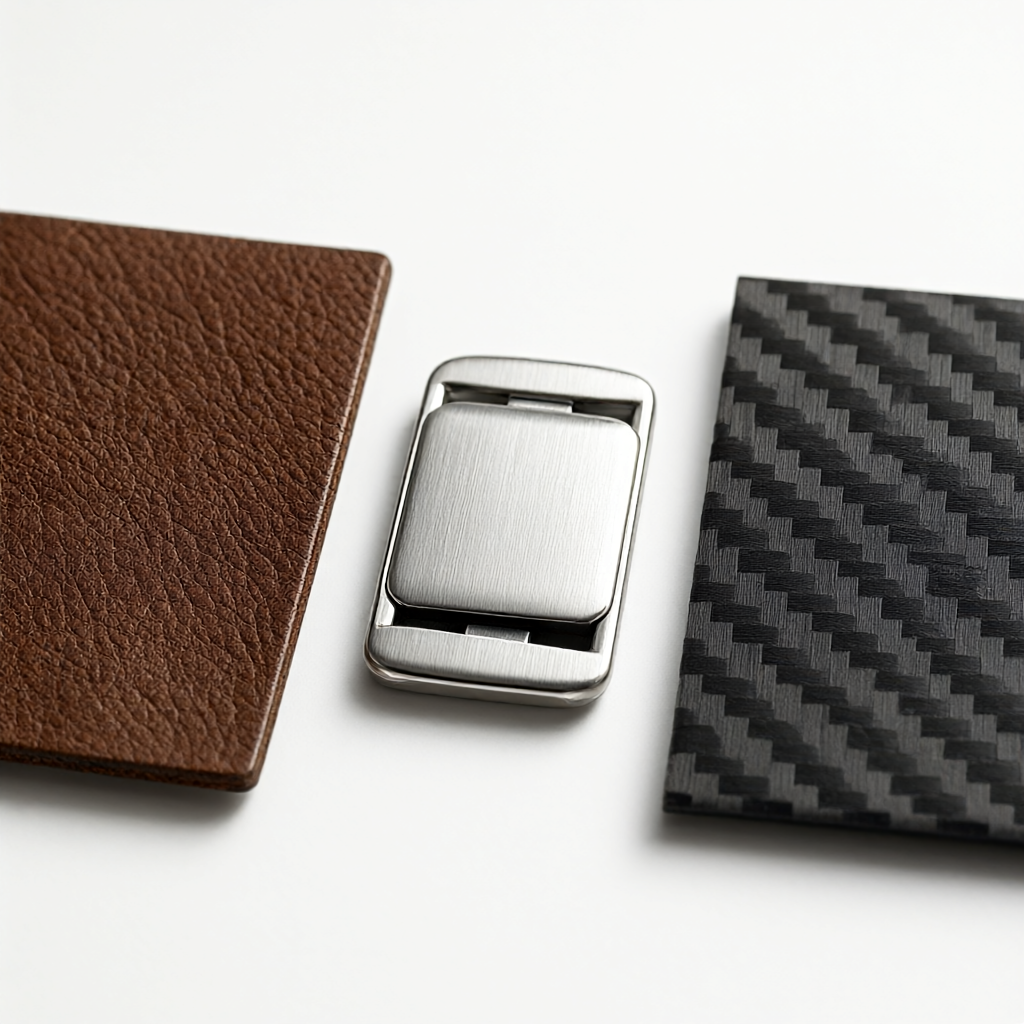
What materials distinguish premium designer wallets from standard ones?
The materials used in a designer wallet determine its performance characteristics, aesthetic appeal, and production cost. Four primary material categories dominate the premium men’s wallet market, each with distinct procurement considerations.
Aluminum wallets are the most common entry point into the designer category. Aerospace-grade aluminum alloys, typically 6000-series, offer an excellent strength-to-weight ratio at an accessible price. The metal is lightweight, corrosion-resistant, and accepts surface treatments including anodizing, bead blasting, and micro-arc oxidation. Aluminum wallets usually weigh between 30 and 60 grams, making them comfortable for pocket carry. The primary limitation is that aluminum can dent under sharp impact, though this rarely affects function. Buyers sourcing aluminum wallets should specify alloy grade, thickness tolerance (typically 1.2 to 2.0 mm), and anodized color consistency across production runs.
Titanium wallets represent the upper tier of metal wallet materials. Grade 5 titanium (Ti-6Al-4V) provides superior strength, scratch resistance, and biocompatibility compared to aluminum. Titanium wallets are lighter than steel equivalents and do not degrade over time with exposure to sweat or moisture. The material is significantly more expensive to source and machine, which raises unit cost but also justifies a higher retail price point. Titanium’s natural brushed appearance is often preferred without additional coating, though PVD color finishes are available. For buyers, titanium requires manufacturers with CNC capabilities and knowledge of titanium-specific tooling, as the material wears cutting tools faster than aluminum.
Carbon fiber wallets occupy a different design philosophy. Carbon fiber is a composite material formed from woven fibers and resin, producing a distinctive textured surface that signals technical sophistication. The material is extremely rigid and lightweight, typically weighing under 20 grams for a card holder format. Carbon fiber does not conduct electricity and is inherently RFID-protective when fully enclosed, though this depends on construction. The main trade-off is that carbon fiber can delaminate or chip if subjected to sharp impact, and the material is more expensive than aluminum. Buyers should verify that the manufacturer uses pre-preg carbon fiber and vacuum bag curing rather than cheap resin-infused alternatives, as the difference in appearance and durability is significant.
Leather wallets remain essential in the designer category, particularly for buyers targeting traditional aesthetics. Full-grain and top-grain leathers are the standards for premium products. Genuine leather—the lowest commercial grade—should not appear on any specification sheet for a designer wallet. Full-grain leather retains the natural grain surface and develops a patina over time. Vegetable-tanned leather is preferred for its environmental profile and firm structure, while chrome-tanned leather offers greater water resistance. Leather wallet buyers should evaluate tanning method, leather thickness (typically 1.2 to 2.0 mm for structured wallets), edge paint quality, and stitching density (minimum 8 stitches per inch for durability).
For a deeper analysis of how these materials perform in real-world EDC use, see our best minimalist wallets for B2B sourcing and private label guide.
How does manufacturing process affect wallet quality and cost?
The manufacturing process is where material specifications translate into finished product. A designer wallet requires processes that maintain tight tolerances and consistent surface quality across production batches.
CNC machining is the primary process for metal wallets. Computer numerical control milling removes material from solid billets to create wallet bodies, frames, and card slides. CNC machining achieves tolerances within ±0.05 mm, which is critical for ensuring that cards insert and eject smoothly without excessive friction or play. The process also allows for complex geometries such as integrated card gates, magnetic closures, and textured surfaces. Buyers should ask manufacturers whether they operate in-house CNC equipment or outsource machining, as in-house control directly impacts revision speed and quality consistency.
Anodizing is an electrochemical surface treatment applied primarily to aluminum wallets. The process creates a hardened oxide layer on the metal surface that increases scratch resistance and provides a base for color. Anodized finishes come in standard colors such as black, silver, gold, and blue, with custom colors available at additional cost. A properly anodized finish should be uniform in color and thickness across the entire surface. Buyers should verify that the manufacturer follows ASTM standards for anodic coatings and can provide color matching documentation for large orders.
Laser engraving applies branding, logos, and decorative patterns to wallet surfaces using fiber or CO₂ lasers. The process is precise, permanent, and compatible with metal, carbon fiber, and coated surfaces. For B2B buyers, laser engraving enables low-cost personalization at the unit level, which is essential for private label programs. The engraving depth and contrast vary by material—fiber lasers produce darker, higher-contrast marks on metal than CO₂ lasers. Buyers should request engraved samples before approving production to verify mark quality and positioning.
Surface finishing encompasses secondary operations such as polishing, bead blasting, brushing, and edge rounding. These processes determine the tactile and visual character of the wallet. A well-finished wallet has smooth edges that do not catch on fabric, a consistent surface texture, and no visible machining marks. Buyers should evaluate finish quality through physical samples rather than photographs, as lighting and image processing can obscure surface defects.
What form factors define designer wallets in the current market?
Wallet form factors determine how the product fits the buyer’s target consumer. Four categories dominate the designer wallet market.
Minimalist card holders are the fastest-growing segment. These wallets hold 4 to 12 cards without a billfold compartment, relying on elastic bands, spring mechanisms, or rigid frames to retain contents. The form factor appeals to consumers who carry minimal items and prioritize pocket slimness. Card holder thickness typically ranges from 6 to 15 mm, with weight under 40 grams. This format is particularly suitable for Amazon FBA sourcing due to its compact packaging and low shipping cost.
Money clip wallets combine a card retention system with an integrated metal clip for cash. The design appeals to consumers who occasionally carry bills and prefer a single-unit solution. Money clip wallets are slightly thicker than card holders and require careful spring mechanism engineering to maintain consistent clamping force. The clip mechanism is a critical quality point—buyers should test clip retention with varying bill stacks and after repeated cycles.
Bifold wallets in the designer category use premium materials and precision construction rather than traditional layered leather assembly. Designer bifold wallets may incorporate metal frames, RFID-blocking linings, and slim-profile card organization. They are thicker and heavier than minimalist formats but offer greater capacity for consumers who prefer traditional wallet functionality. Buyers targeting professional or corporate gift markets often find bifold designs more appropriate for their customer base.
Pocket organizers represent the most complex form factor, combining wallet functionality with storage for keys, coins, and multi-tools. These products target the EDC enthusiast segment and command higher price points. The internal mechanism must balance capacity with reliability, as additional moving parts introduce more failure points. Buyers entering this category should evaluate mechanism durability through cycle testing before committing to large orders.
For a detailed evaluation of card holder selection criteria for B2B procurement, refer to our best card holder buying guide for B2B sourcing.
Key Specifications — Materials, Form Factors, and Features Buyers Compare
What are the key specifications that determine wallet quality?
Buyers evaluating designer wallets should assess specifications across five dimensions: material grade, dimensional tolerance, weight, surface treatment, and functional performance. Each dimension has measurable thresholds that separate premium products from commodity alternatives.
Material grade specification should be documented on the purchase order. For aluminum wallets, this means specifying 6061-T6 or 6063-T5 alloy with a minimum tensile strength of 240 MPa. For titanium, Grade 5 Ti-6Al-4V with a tensile strength exceeding 900 MPa. For carbon fiber, specification should include weave pattern (plain or twill), resin system, and curing method. For leather, specification must define grain type, tanning method, and thickness tolerance. Vague material descriptions on purchase orders are the most common source of quality disputes between buyers and manufacturers.
Dimensional tolerance determines fit and function. Card slot width should measure within ±0.3 mm of specification to ensure cards pass through smoothly. Overall wallet thickness variation between units in the same batch should not exceed ±0.5 mm. Edge radius on metal wallets should be specified (typically R0.3 to R0.5 mm) to prevent sharp edges without compromising structural integrity. Buyers should request tolerance documentation from manufacturers and include acceptance criteria in quality agreements.
Weight specification varies by material and form factor. A typical aluminum card holder weighs 35 to 55 grams. A titanium equivalent weighs 45 to 70 grams. Carbon fiber card holders are the lightest at 15 to 30 grams. Leather bifold wallets range from 60 to 120 grams depending on construction. Weight consistency between units should be within ±3 grams for metal wallets and ±5 grams for leather products. Unusual weight variation between units often indicates inconsistent material density or incomplete machining.
Surface treatment specification defines finish quality. Anodized aluminum should meet ASTM B582 for coating thickness, typically 15 to 25 micrometers for consumer products. Color consistency should be evaluated against a standard color chart and approved sample. Laser engraving depth on metal should be 5 to 15 micrometers for visible but non-protruding marks. Leather edge paint should be smooth, evenly applied, and free of cracking after flex testing.
Functional performance specification covers the criteria that determine whether the wallet performs as intended. Card retention force should allow single-card extraction with 2 to 5 newtons of force. Money clip clamping force should maintain grip across 10 to 40 bills without slipping. Spring mechanism cycle life should exceed 5,000 open-close cycles without degradation. RFID-blocking effectiveness should be verified through testing at 13.56 MHz with a signal attenuation of at least 20 dB.
For guidance on evaluating slim wallet specifications for everyday carry applications, see our good wallets for guys procurement guide.
What features differentiate designer wallets in competitive markets?
Several features have become table stakes in the designer wallet category, while others provide meaningful differentiation for brands seeking to stand out.
RFID-blocking technology has moved from niche feature to expected standard. Modern wallets incorporate either conductive metal framing that creates a Faraday cage effect, or embedded RFID-blocking fabric layers. The technology works by attenuating radio frequency signals at 13.56 MHz, the frequency used by contactless payment cards. Buyers should verify RFID performance through independent testing rather than relying on manufacturer claims. Products that make RFID-blocking claims without test documentation carry reputational risk if end consumers experience unauthorized scans.
Modular card systems represent a design trend that increases perceived value. These systems allow users to expand or reduce card capacity by adding or removing card sleeves or frames. The mechanism requires precise engineering to maintain structural integrity when reconfigured. Modular designs appeal to consumers who anticipate changing carrying habits and provide brands with upsell opportunities through accessory sales.
Integrated tracking capabilities are emerging in the premium segment. Some designer wallets incorporate thin Bluetooth tracker modules that can be paired with smartphone apps for location finding. This feature adds cost and complexity but addresses a genuine consumer pain point. Buyers evaluating this feature should consider battery replacement logistics and regulatory compliance for wireless devices in target markets.
Sustainable materials are increasingly important for brand positioning. Recycled aluminum, bio-based resins for carbon fiber components, and vegetable-tanned leather from responsible tanneries are specifications that resonate with environmentally conscious consumers. Sustainability claims must be verifiable—buyers should request material certificates and supply chain documentation rather than accepting marketing language at face value.
Standards & Requirements — Certifications, Compliance, and Quality Benchmarks

What certifications and standards apply to wallet manufacturing?
Quality certifications and regulatory compliance are non-negotiable requirements for B2B wallet sourcing. These standards protect buyers from product liability issues, customs delays, and brand reputation damage. Understanding what each certification means and what it requires is essential for supplier evaluation.
ISO 9001 certification is the baseline quality management standard for manufacturing. ISO 9001 demonstrates that a manufacturer has documented procedures for production control, defect prevention, and continuous improvement. The certification requires regular internal audits, corrective action processes, and management review. For wallet buyers, ISO 9001 certification is a strong indicator that the manufacturer maintains consistent quality across production batches. Buyers should verify certification status through the issuing body’s public registry rather than accepting certificates at face value. Information on ISO standards and their application can be found through ISO’s official resources.
BSCI certification (Business Social Compliance Initiative) addresses labor practices in the supply chain. BSCI audits evaluate working conditions, wages, working hours, and worker rights. For buyers in European and North American markets, BSCI compliance is often a procurement requirement, particularly for corporate gift programs and retail chain buyers who face scrutiny over supply chain ethics. BSCI audit reports are typically valid for one year and require annual renewal. Buyers should request current BSCI audit reports from manufacturers and review findings for any major non-conformities.
REACH compliance is a European Union regulation governing the use of chemicals in manufactured products. REACH requires that substances of very high concern (SVHC) not exceed prescribed thresholds in finished products. For wallets, REACH compliance primarily affects leather tanning chemicals, adhesive formulations, anodizing solutions, and coating materials. Manufacturers should provide REACH compliance declarations and, for large orders, third-party testing reports from accredited laboratories. Non-compliance with REACH can result in product seizure at EU customs and regulatory action against the importer.
RoHS compliance restricts hazardous substances in electronics and metal components. While RoHS primarily targets electronic devices, it is relevant for wallets incorporating RFID modules, tracking devices, or electronic components. Buyers should verify RoHS compliance when sourcing wallets with integrated technology.
SGS testing represents independent third-party verification of material composition, mechanical performance, and chemical safety. SGS and similar testing organizations (Intertek, TÜV) provide objective validation that products meet specified requirements. Buyers should include SGS or equivalent testing in their quality agreements for new product development and periodic retesting for ongoing production.
For a comprehensive evaluation of RFID-blocking products and their procurement criteria, review our best RFID blocking cards selection guide.
What quality benchmarks should buyers establish before placing orders?
Quality benchmarks should be defined before production begins and documented in a quality agreement with the manufacturer. Benchmarks that are too vague produce inconsistent results; benchmarks that are too strict increase cost without proportional value.
Incoming material inspection should verify that raw materials meet specification before production begins. Buyers should require material test certificates from suppliers and reserve the right to conduct random sampling of incoming batches. For metal wallets, this includes verifying alloy composition and hardness. For leather, this includes checking tanning method and thickness uniformity.
In-process quality control covers inspections conducted during manufacturing. Critical control points for metal wallets include CNC machining dimensions, anodizing coating thickness, and laser engraving position. For leather wallets, critical control points include cutting accuracy, stitching density, and edge paint application. In-process inspections catch defects before they become embedded in finished products, reducing waste and rework costs.
Pre-shipment inspection is the final quality gate before products leave the factory. A standard pre-shipment inspection covers 100% visual inspection, dimensional sampling (typically AQL 0.65 for major defects), functional testing of mechanisms, and packaging verification. Buyers should define acceptance quality levels (AQL) for major and minor defects and communicate these requirements to the manufacturer before production starts.
Packaging and labeling compliance is often overlooked but critically important. Retail packaging must comply with labeling requirements in target markets, including country of origin marking, material composition disclosure, and safety warnings. For Amazon FBA sellers, packaging must meet Amazon’s fragility and suffocation warning requirements. Buyers should review packaging specifications with their manufacturer and verify compliance before approving production samples.
Related Considerations — Customization, Sourcing, and Manufacturer Evaluation
How do customization and private labeling work for designer wallet manufacturers?
Customization is the primary value proposition for B2B wallet buyers. Most designer wallet procurement involves some degree of customization, ranging from logo application to full product redesign. Understanding the customization landscape helps buyers plan projects efficiently and avoid costly misunderstandings with manufacturers.
Logo application methods vary by material and budget. Laser engraving is the most common method for metal wallets, producing permanent, precise marks at low per-unit cost. Screen printing is suitable for flat surfaces on leather and metal. Embossing creates raised or recessed logos on leather without ink. UV printing allows full-color graphics on metal and carbon fiber surfaces. Each method has different setup costs, per-unit costs, and minimum order requirements. Buyers should evaluate logo method based on brand requirements and order volume.
Custom packaging is a significant differentiation opportunity for private label brands. Packaging options include retail boxes with custom printing, magnetic closure boxes, polybags with branded inserts, and eco-friendly recycled paper packaging. Packaging design affects both shelf appeal and shipping efficiency. Buyers should work with manufacturers who offer in-house packaging design and production capabilities, as this reduces lead time and improves quality control.
Product customization ranges from minor modifications to full OEM development. Minor modifications include color changes, logo placement adjustments, and packaging swaps. These changes typically require no tooling investment and can be implemented within existing production runs. Full OEM development involves creating new product designs from concept, including CAD modeling, prototyping, tooling, and production trial. OEM development requires longer lead times and higher initial investment but produces exclusively branded products that cannot be replicated by competitors.
For a detailed look at private label wallet options, see our best minimal wallets for B2B sourcing and private label guide.
What MOQ and lead time ranges are typical in the wallet manufacturing industry?
Procurement planning depends on understanding typical MOQ and lead time parameters. These figures vary by product complexity, material, and customization level.
MOQ ranges for designer wallets typically fall into three tiers. Standard products with minimal customization—such as existing designs with logo laser engraving—often have MOQs of 300 to 500 pieces. Semi-custom products requiring color changes or packaging modifications typically require 500 to 1,000 pieces. Fully custom OEM products requiring new tooling or mold development typically require 1,000 to 3,000 pieces minimum. Buyers with smaller order volumes should focus on semi-custom configurations of existing designs rather than pursuing full OEM development.
Sample lead times vary by complexity. Standard samples with existing materials and simple logo application typically require 5 to 7 days. Custom samples requiring new tooling or material sourcing typically require 10 to 15 days. Buyers should plan sample requests early in the procurement process and budget time for sample revision cycles before committing to production.
Production lead times depend on order volume and product complexity. Standard production runs of 500 to 2,000 pieces typically require 15 to 25 days from deposit receipt. Larger orders of 2,000 to 10,000 pieces typically require 25 to 40 days. OEM development projects with tooling requirements typically require 45 to 60 days from design approval to first shipment. Buyers should negotiate lead time commitments in purchase agreements and include penalty clauses for unacceptable delays.
How should B2B buyers evaluate and choose a wallet manufacturer?
Manufacturer evaluation is the most critical decision in the sourcing process. A poor manufacturer choice leads to quality inconsistencies, delayed shipments, and damaged brand reputation. A sound evaluation framework covers capability, compliance, communication, and commercial terms.
Manufacturing capability assessment should verify that the manufacturer can produce the required products with the specified quality level. Buyers should evaluate facility size, equipment inventory, and production capacity. In-house CNC machining is essential for metal wallet production. In-house anodizing and laser engraving capabilities indicate vertical integration and reduce coordination risk. Manufacturers that outsource critical processes lose control over quality timelines and cost. Buyers should request facility photos, equipment lists, and production flow documentation during supplier evaluation.
Quality system assessment should verify that the manufacturer operates under documented quality management procedures. ISO 9001 certification is the baseline requirement. Buyers should also evaluate the manufacturer’s internal quality control processes, including incoming inspection, in-process control, and final inspection procedures. Requesting quality manuals and inspection checklists during supplier evaluation provides insight into the manufacturer’s commitment to quality consistency.
Communication and responsiveness are practical indicators of manufacturing reliability. Manufacturers who respond to inquiries promptly, provide detailed quotations, and communicate proactively about production status are typically better partners than those who are slow or vague. Buyers should test communication quality during the quotation and sample phase, as this behavior typically continues throughout the production relationship.
Commercial terms evaluation should compare not only unit price but also payment terms, shipping arrangements, and after-sales support. Manufacturers offering flexible payment terms such as 30% deposit with 70% against copy of bill of lading reduce buyer risk. Clear warranty and defect resolution policies protect buyers against production quality issues. Buyers should negotiate terms that align with their cash flow and risk tolerance.
Where can buyers source reliable designer wallet manufacturers?
The global wallet manufacturing landscape centers primarily on specialized production regions with established supply chains for metalworking, leathercraft, and composite materials. China remains the dominant sourcing destination for metal and carbon fiber wallets, with concentrated manufacturing capability in Guangdong and Zhejiang provinces. Europe maintains leather wallet production, particularly in Italy and Spain, though metal wallet manufacturing is limited. Other sourcing regions include Taiwan for precision metal components and Vietnam for emerging leather and textile wallet production.
Buyers should evaluate sourcing regions based on product type, quality requirements, and order volume. Metal wallets with CNC machining requirements are best sourced from manufacturers with established metalworking infrastructure. Leather wallets benefit from regions with long leatherworking traditions and mature supply chains for raw materials. Carbon fiber wallets require manufacturers with composite material expertise and vacuum bag curing capabilities.
For additional guidance on wallet sourcing strategies for different buyer profiles, see our best wallet for B2B buyers procurement guide and our best slim wallets for men sourcing guide.
How do brands position designer wallets in competitive markets?
Brand positioning determines whether a designer wallet succeeds or fails in market, regardless of product quality. Successful positioning requires alignment between product specifications, target consumer profile, and pricing strategy.
Positioning by material is the most common strategy. Aluminum wallet brands compete on value and accessibility, targeting consumers who want premium materials without luxury pricing. Titanium wallet brands position on performance and durability, targeting technical consumers who prioritize function over fashion. Carbon fiber brands position on exclusivity and modern design, targeting style-conscious consumers who want visually distinctive products. Leather brands position on tradition and craftsmanship, targeting consumers who prefer classic aesthetics.
Positioning by use case appeals to specific consumer segments. EDC-focused wallets target enthusiasts who carry multiple daily tools and value modularity. Professional wallets target business consumers who prioritize slim profile and card organization. Travel wallets target consumers who need secure storage for passports and cards. Positioning by use case requires clear product differentiation and targeted marketing.
Positioning by price tier determines competitive positioning. Budget designer wallets compete on volume and accessibility, targeting price-sensitive consumers. Mid-tier designer wallets compete on quality-to-price ratio, targeting consumers who want premium materials at reasonable prices. Premium designer wallets compete on brand prestige and exclusivity, targeting consumers who view wallets as status accessories. Each tier requires different sourcing strategies, quality standards, and marketing approaches.
Choosing Your Manufacturer
Selecting the right manufacturing partner is the final step in translating your wallet concept into a product ready for market. The evaluation criteria outlined above—capability, compliance, communication, and commercial terms—should guide your decision. When you identify a manufacturer that meets your standards, the next step is to share your project requirements for a detailed quotation.
As a manufacturer with 13+ years of export experience, we approach designer wallet production through the same standards and processes described throughout this guide. Our in-house CNC machining, laser engraving, and anodizing capabilities allow us to maintain quality control across all production stages. We hold ISO 9001 and BSCI certifications, and all products comply with REACH and RoHS requirements. With an MOQ starting at 300 pieces and a 7-day sample lead time, we work with EDC brand owners, Amazon FBA sellers, and promotional product distributors to move products from concept to shelf. Contact Our Team to discuss your project specifications.
Designer Wallets For Men: Where Can You Verify the Data and Sources?
- ISO’s official resources — www.iso.org
- best minimalist wallets for B2B sourcing and private label — topedcwallet.com
- best card holder buying guide for B2B sourcing — topedcwallet.com
- good wallets for guys procurement guide — topedcwallet.com
- best RFID blocking cards selection guide — topedcwallet.com
- best wallet for B2B buyers procurement guide — topedcwallet.com
- best slim wallets for men sourcing guide — topedcwallet.com
- Contact Our Team — topedcwallet.com
From article to product
Sourcing minimalist-wallets?
Tell us the format, the quantity and the date you need stock. You get material options, MOQ and a landed-cost range back within one business day.
Keep reading
More on wallet types
Thin Male Wallets: Buying Guide for Slim Minimalist Picks
How to choose a slim wallet for men — thickness thresholds, material trade-offs, capacity…
ReadStashed Wallet: A Minimalist Everyday-Carry Solution
Understand what a stashed wallet is, how minimalist slim wallets work, and what to…
ReadFolding Wallets: Types, Materials & Buying Guide
Learn what makes a folding wallet worth buying, from materials and card capacity to…
Read
About the author
TOPWALLET Editorial Team
TOPWALLET's editorial and engineering desk writes from bench testing at the Shenzhen (Longgang) facility: pull-force and cycle testing, 13.56 MHz shielding measurements, finish trials and factory audits, rather than supplier spec sheets. Every specification in these guides is one we write on a purchase order.
Written on the floor
This article was written by our production and QC team — the people who spec tolerances, run the finishing line and inspect every batch. Where it states a capacity, a pull force or a lead time, it comes from a measurement we made, not a supplier’s catalogue. If a number here disagrees with what your own supplier told you, tell us; several of these articles started as a correction from a buyer.
See how the factory works · Inspection process · Sourcing FAQ
Sourcing minimalist-wallets?
Tell us the format, the quantity and the date you need stock. You get material options, MOQ and a landed-cost range back within one business day.