

A standard cardholder wallet measures approximately 3.5 inches wide × 4.25 inches tall (89 mm × 108 mm) and holds 6–12 cards in a 0.4–0.8 inch thick profile. Choose your exact size based on daily card count, pocket type, and whether you need RFID shielding, NFC transparency, or travel-grade durability — detailed measurement methods and industry standards below.
Quick Answer
A standard men’s cardholder wallet measures approximately 3.5 inches wide by 4.25 inches tall (about 89 mm × 108 mm) when closed, with a thickness ranging from 0.4 to 0.8 inches (10–20 mm) depending on capacity. If you carry 6–8 cards regularly, look for a wallet rated for 8–12 card slots plus a cash compartment. The right size depends on how many cards you use daily, whether you fold cash or prefer receipts flat, and how slim your front pockets can tolerate.
Size System
What are the standard sizes for a cardholder wallet?
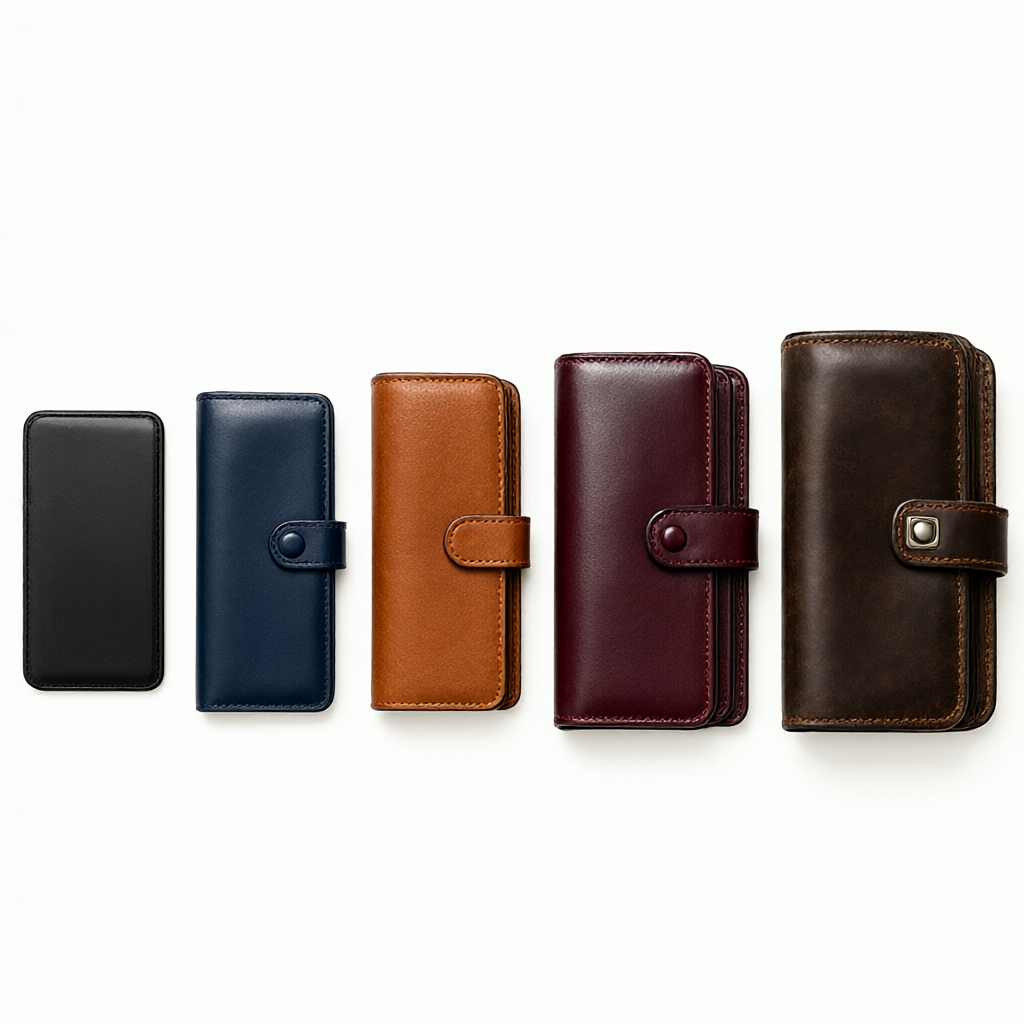
Most minimalist cardholders follow one of three common dimension families:
| Category | Width (in/mm) | Height (in/mm) | Thickness (closed) | Typical Capacity |
|---|---|---|---|---|
| Ultra-slim / ID case | 2.5–3.0 / 64–76 | 3.75–4.0 / 95–102 | 0.3–0.4 in / 8–10 mm | 1–4 cards + paper cash |
| Standard men’s | 3.5–3.75 / 89–95 | 4.25–4.5 / 108–114 | 0.5–0.7 in / 13–18 mm | 4–8 cards + folded bills |
| Big / maximum capacity | 3.75–4.0 / 95–102 | 4.5–5.0 / 114–127 | 0.7–1.0+ in / 18–25 mm | 8–12 cards + accessories |
These measurements describe the closed wallet. A few models add a removable money clip or expandable elastic band that changes effective thickness once loaded. Manufacturers sometimes list only height and width; thickness is where the real capacity story lives.
What size cardholder wallet do I need for 6–8 cards?
For a comfortable daily carry of 6–8 cards with room for folded bills, aim for a standard men’s size wallet (3.5″ × 4.25″) rated for 8–12 cards. That rating leaves breathing room so cards don’t bind or pop out unexpectedly. If you prefer receipt-style cash storage rather than folding, a thinner model may suffice because flat paper takes less vertical space than a billfold.
If you carry transit passes, gym keys, or loyalty cards beyond your everyday set, bump up to the larger category (up to 4.0″ × 5.0″) and expect 0.8–1.0 inch thickness once loaded.
How to Measure
How do I measure a cardholder wallet accurately?
Use a soft measuring tape or a rigid ruler calibrated in both inches and millimeters. Follow these steps for consistent results:
- Width — Measure across the shortest side of the closed wallet, parallel to the bottom edge. Record to the nearest 1/16 inch or 1 mm. Ignore embossed logos; measure the outermost edge.
- Height — Measure from the bottom seam to the top edge, again along the long axis. This is usually the taller dimension.
- Thickness (closed) — Place the wallet on a flat surface, compress it gently until it stops shrinking under normal pressure, then measure. Don’t crush it with vice grips; hand pressure is the realistic carrying condition.
- Thickness (loaded) — Load the wallet with your actual daily cards and folded bills, close it, and remeasure. This number matters more for pocket comfort than the unloaded spec.
- Weight — Weigh the empty wallet, then weigh it loaded. Note the gram difference to understand how much your cash and cards add.
When comparing products across sellers, insist that all listings use the same measurement convention (metric or imperial). Mixed units are a common source of surprise when a “slim” wallet turns out to be nearly an inch thick once loaded.
Standards & Codes
What standards apply to RFID-blocking cardholder wallets?
RFID-blocking claims sit under material performance standards rather than product certifications. Most manufacturers reference the following benchmarks when evaluating shielding materials:
- ASTM F3696 (material test methods for radio-frequency identification shielding performance) provides guidance on how to verify Faraday-cage properties in blocking fabrics and laminates. This comes from ASTM International, which develops the consensus technical standards used across material testing.
- Consumer-facing claims about RFID protection should align with FTC guidance against deceptive security marketing — if a seller says “military-grade” or “100% blocked,” request documentation rather than accepting the label alone.
- Material compliance commonly referenced includes RoHS (restrictions on hazardous substances in electronics-adjacent goods) and REACH (EU chemical regulation). These govern what metals, dyes, and adhesives enter the wallet, not the blocking performance itself.
A practical way to audit blocking effectiveness at home: place your credit/debit card with NFC enabled inside the wallet, stand a reader device about two inches away, and confirm the transaction cannot initiate. Legitimate products will block or severely attenuate the field at typical scanning distances. Overclaiming shows up as inconsistent results near edges or seams.
Fit & Compatibility
Will a cardholder wallet fit in a jeans pocket comfortably?
Front jeans pockets typically accept wallets up to about 4.0″ wide × 4.5″ tall × 0.75″ thick before bulk becomes noticeable. Once thickness exceeds roughly 0.8 inches, you’ll feel a permanent ridge when sitting and notice the wallet riding up during movement.
To test fit before buying, hold your current wallet against your palm or slide it into a similar pocket; compare the height-to-width ratio. A 3.5″ × 4.25″ wallet tends to nestle flush in most men’s front pockets. Anything approaching 4.0″ × 5.0″ works better in back pockets or loose trousers.
Women’s pockets run narrower and shallower on average. Slim profiles around 2.5″ × 3.75″ with under-0.5-inch thickness pair better with women’s apparel. For a deeper dive into women-specific choices, see our lightweight wallet guide for women and the companion women’s wallet size and style buying guide.
What is the difference between a big skinny wallet and a regular cardholder?
“Big skinny wallet” is a colloquial term for high-capacity minimalist designs — typically 8–12 cards plus multiple compartments while still claiming to stay thin. A regular cardholder usually targets 4–8 cards with simpler construction. The trade-off is mechanical:
- Capacity vs. pull-out effort. More cards mean tighter friction. A well-designed holder uses elastic bands or tapered sleeves so the first card slides out smoothly even when the stack is heavy. Poorly designed ones jam the entire stack.
- Thickness growth. Extra cards inevitably push closed thickness toward 0.8–1.0 inch unless the design relies on a removable money clip to offload bills.
- Edge wear. High-capacity holders see faster sleeve abrasion at the card ejection points, especially with stiff polymer-coated cards.
In short, choose capacity based on your actual daily load, not the maximum listed on the product page. The “big” options are worth it only if you consistently use 8+ cards; otherwise a standard holder ages more gracefully.
Hard-shell vs. flexible cardholder wallet materials and thickness impact
Material choice drives both feel and dimensions:
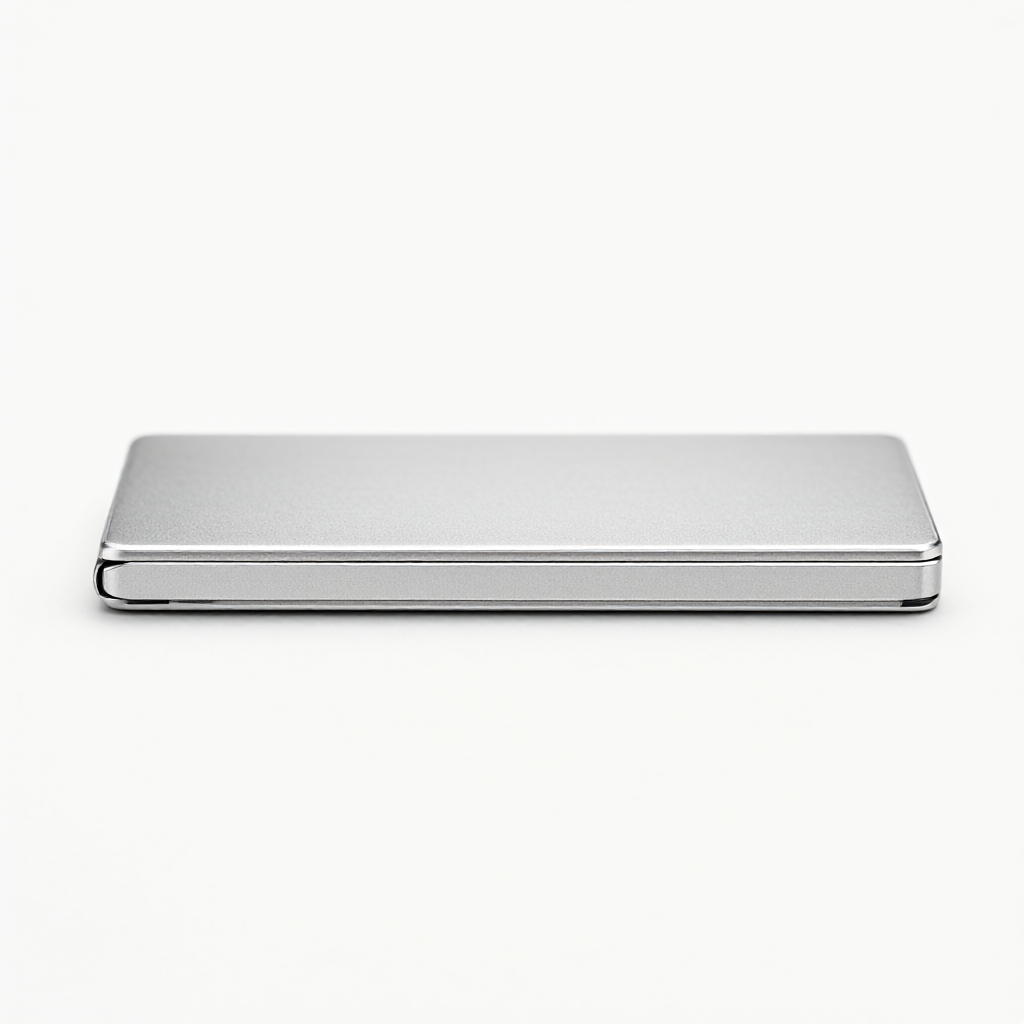
- Aluminum and titanium frames add structural rigidity but increase weight (often 40–80 g empty) and contribute roughly 0.3–0.5 inch of baseline thickness. They protect cards from bending and work well for travelers who drop their wallet occasionally.
- Carbon fiber panels offer stiffness接近 aluminum at lower weight (~30–50 g) with a thinner profile option since the material performs well at reduced gauge. Expect a clean ~0.4–0.6 inch closed thickness.
- Leather inserts (full-grain or corrected) flex over time, settling closer to your cards rather than maintaining a rigid envelope. They read softer but gain slight thickness as fibers compress.
- Hybrid constructions — aluminum frame with leather or silicone interior — attempt to balance protection and comfort. They often land around 0.5–0.7 inch once loaded.
If you prioritize ultrathin carry, carbon fiber or spring-steel mechanisms beat thick aluminum plates. If you want a wallet that survives drops, hard-frame designs earn the sacrifice in weight.
Do women’s cardholder wallets come in different sizes than men’s?
Yes. Women’s cardholders generally target a smaller footprint — widths under 3.0 inches and heights under 4.0 inches — because wallets travel in smaller pockets, clutches, and crossbody bags. They also tend to favor lighter construction (carbon fiber, thin leather, silicone) over chunky metal frames. Men’s wallets more commonly use 3.5″ × 4.25″ as a baseline, with heavier metals and snap closures.
Beyond dimensions, women often prioritize: fewer card slots (3–6), coin zippers or hidden compartments, and exterior textures that show less wear from handbag friction. Men typically prioritize speed of access and bulk tolerance in front pockets. For brand-specific evaluations, compare our guides on good money clip wallets for men and the best cheap money clip alongside physical versus digital wallet selection considerations in our how to choose and buy a wallet series.
Can an electronic wallet (NFC/Google Wallet) work inside a hard metal cardholder?
Partially, but with caveats. NFC operates at 13.56 MHz, and solid metal housings create a Faraday effect that blocks or weakens the signal. Some modern cardholders address this through:
- Strategic cutouts — a small non-metallic window aligned with the card chip area so the reader contacts the antenna directly.
- Partial shielding layers — blocking only the payment antenna zone while leaving sensor areas exposed, reducing false positives at readers without killing connectivity entirely.
- Material selection — carbon fiber and certain polymers are RF-transparent enough for intermittent NFC taps, unlike full aluminum enclosures.
Test before committing: insert your most-used contactless card into the empty holder, lock it closed, and try paying at a terminal. If the transaction fails at normal holding distance (~1–2 inches), the wallet is too屏蔽 for NFC-dependent use. A biker wallet chain or rugged outdoor setup benefits from full blocking; a commuter relying on Google Wallet APK scenarios or Apple Pay tap-to-pay needs transparent construction.
See our guide on wallets that protect cards and our RFID protected wallets guide for men and women for deeper comparison of shielding strategies.
Size Chart
| Card count range | Recommended width | Recommended height | Loaded thickness expectation | Pocket recommendation |
|---|---|---|---|---|
| 1–4 cards | 2.5–3.0 in / 64–76 mm | 3.75–4.0 in / 95–102 mm | 0.3–0.5 in / 8–13 mm | Any pocket; ultra-slim bag insert |
| 5–8 cards | 3.5–3.75 in / 89–95 mm | 4.25–4.5 in / 108–114 mm | 0.5–0.7 in / 13–18 mm | Front jeans or chinos |
| 9–12 cards | 3.75–4.0 in / 95–102 mm | 4.5–5.0 in / 114–127 mm | 0.7–1.0+ in / 18–25 mm | Back pocket or loose trouser |
| Family/shared (multiple people’s cards) | 4.0–4.5 in / 102–114 mm | 5.0–5.5 in / 127–140 mm | 1.0–1.5 in / 25–38 mm | Dedicated bag compartment |
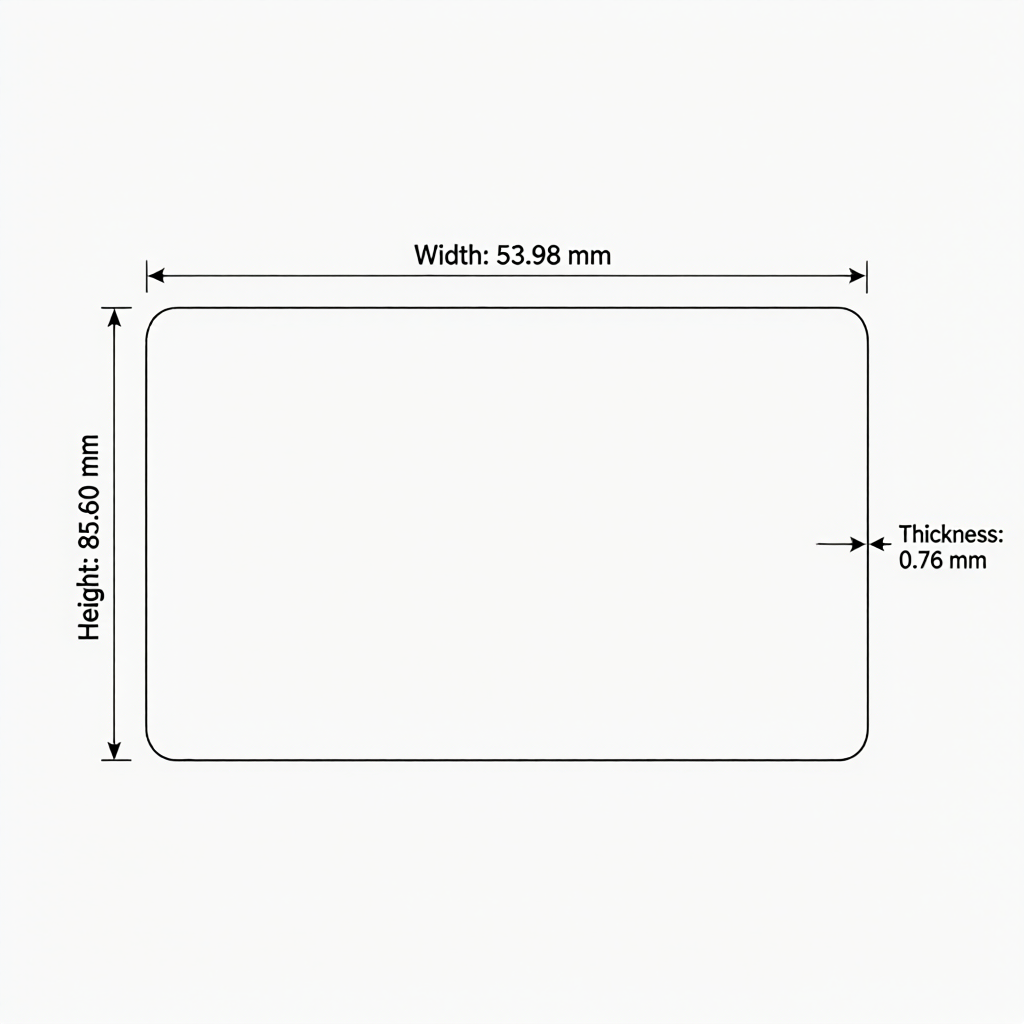
All measurements assume standard ISO/IEC 7810 ID-1 credit-card dimensions (85.60 mm × 53.98 mm) with a slight margin for card-stack compression. Transit cards and loyalty cards with rounded corners fit snugly; thicker business cards may add 1–2 mm of spread per extra card.
Related Considerations
Beyond raw dimensions, several usage patterns shift which size feels optimal in practice:
Travel compact carry favors sub-0.6-inch thickness and a secure closure so the wallet survives airport scanner belts and hotel-room nightstands without popping open. Magnetic snap or elastic-band designs keep flat profiles intact.
Professional/business daily users often carry 6–8 cards plus expense receipts. A medium-thickness holder with separate bill and card zones reduces digging time during meetings. Look for a wallet with a smooth card-eject mechanism and a textured grip panel for quick retrieval.
Outdoor/adventure carry introduces moisture and impact risks. Aluminum and titanium frames shed water faster than leather, and rubberized edges resist dropping. Pairing a hard cardholder with a money clip wallet adds modularity: swap clips between home and trail kits.
Vintage leather cardholders break in gradually. New leather runs stiffer and thicker; after weeks of use, it conforms to your card stack and can actually reduce overall thickness compared to a rigid plastic or metal counterpart. Factor a 1–2 week adjustment period into your sizing choice.
Brand wallets for him span a wide range of price tiers and tolerances. Premium labels may charge for craftsmanship, but sizing standards remain consistent across the market because they share the same card-format geometry. Compare build details and load ratings rather than assuming bigger brands automatically produce proportionally larger wallets.
Hard wallet designs excel at protection but penalize portability; they’re best reserved for riders, mechanics, or anyone whose environment threatens bent cards. For street-level daily carry, a hybrid with minimal hard framing keeps flexibility.
Choosing With Confidence
The right cardholder wallet starts with an honest inventory of your daily cards, not the maximum the product claims. Measure your existing load once, note the closed thickness and weight, then match those numbers to the tables above. Small deviations matter more than big leaps — moving from 6 to 8 cards usually requires just a half-inch increase in thickness, not a whole new category.
When evaluating options, prioritize consistent measurement reporting from manufacturers, visible material certifications for RFID layers, and real-world loaded厚度 data rather than empty-state specs. If you need help narrowing down a custom build or private-label order that matches your exact card-count and pocket constraints, reach out to discuss your configuration.
Bifold vs Trifold vs Mono Design Comparison
| Design Type | Closed Dimensions (typical) | Card Access Style | Best Use Case | Thickness Range |
|---|---|---|---|---|
| Mono / card sleeve | 3.5″ × 4.25″ / 89×108 mm | Single-slot pull | Everyday minimal carry | 0.3–0.6 in / 8–15 mm |
| Bifold | 4.0″ × 4.5″ / 102×114 mm | Folded access, dual compartments | Business/travel balance | 0.6–1.0 in / 15–25 mm |
| Trifold / compact bi-fold | 3.75″ × 4.5″ / 95×114 mm | Triple-layer layout | Maximum organization | 0.8–1.2 in / 20–30 mm |
Mono cardholders dominate the minimalist market because they eliminate fold lines that create bulk pockets and reduce structural integrity over time. ASTM F3696 testing frameworks emphasize consistent edge tolerance across single-sheet constructions, which is why precision-cut metal frames often list dimensional accuracy within ±0.5 mm.
Bifolds retain relevance for users who need dedicated ID windows, coin compartments, or receipt storage alongside card slots. The fold mechanism adds roughly 0.2–0.3 inch of baseline thickness even when empty, and repeated folding can weaken stitching or adhesive bonds after 10,000+ cycles — a threshold covered under general product durability expectations though not always certified per specific ASTM household goods protocols.
Trifold configurations target organizational needs at the cost of pocket comfort. They typically measure closer to 4.0″ × 4.5″ when closed and expand noticeably when loaded. For most front-pocket scenarios, a well-designed bifold outperforms a trifold in comfort-to-capacity ratio.
Price-to-Value Framework by Use Case
| Use Case | Recommended Design | Target Price Range (USD) | Key Value Indicators | Budget Risk if Underpriced |
|---|---|---|---|---|
| Daily commuter (NFC/RFID needed) | Mono with partial shielding | $25–$60 | Card-eject mechanism smoothness, material compliance docs | Weak RFID layer; inconsistent blocking |
| Travel/airport frequent flyer | Rigid bifold with secure closure | $40–$100 | Strap/snap reliability, drop-resistance claims | Loose closures, poor scratch resistance |
| Minimalist everyday carry | Ultra-slim mono / metal frame | $15–$45 | Weight under 60 g, anodized finish quality | Thin plating wear, sharp edges |
| Business/formal environments | Leather bifold with stitching | $30–$80 | Full-grain leather sourcing, edge painting consistency | Corrected leather marketed as full-grain |
| Outdoor/adventure duty | Hard-case metal wallet | $50–$120 | Impact rating, water resistance testing records | Inadequate sealing, dent-prone alloys |
Value scales with construction transparency — brands that publish material grades (e.g., 6061-T6 aluminum versus 7075-T6), hinge cycle ratings, and coating hardness values tend to hold up better across three-to-five-year ownership spans. Generic listings rarely disclose these specs, making independent reviews and supplier audit reports critical for informed purchasing.
Electronic/Digital Wallet Integration Guide
Electronic wallet integration depends on both the payment technology used and the physical barriers introduced by wallet construction. Understanding these interactions helps buyers avoid frustrating checkout failures.
NFC frequency fundamentals. Contactless payments operate at 13.56 MHz under the ISO/IEC 14443 standard. At this frequency, conductive materials like aluminum and stainless steel reflect the electromagnetic field rather than absorbing it, creating shielding zones where transactions fail. Non-conductive materials such as carbon fiber, certain polymers, and textiles allow signal passage with minimal attenuation.
Compatibility matrix by wallet type:
| Wallet Construction | NFC Pass-Through Score | Google Wallet Compatible? | Apple Pay Compatible? | Practical Notes |
|---|---|---|---|---|
| Full aluminum frame | Low (0–30% signal) | Unreliable at distance | Unreliable at distance | Requires chip-out window or removal of phone/card |
| Partial-aluminum hybrid | Medium (40–70%) | Works with alignment trick | Works with alignment trick | User must position card antenna against open zone |
| Carbon fiber composite | High (80–100%) | Fully compatible | Fully compatible | Best choice for digital-wallet-dependent users |
| Leather/fabric sleeve | Very high (90–100%) | Fully compatible | Fully compatible | Traditional option with no signal interference |
| Mixed-metal+plastic hybrid | Variable (depends on layout) | Often requires precise alignment | Often requires precise alignment | Test before committing; geometry matters more than material alone |
Testing protocol buyers should follow before purchase:
- Insert your primary contactless card into the empty holder.
- Close the wallet completely.
- Attempt payment at a terminal from 1–2 inches away.
- If transaction succeeds instantly, the design is NFC-friendly.
- If it fails or requires tapping directly against a specific spot, note that spot’s location for future reference.
Manufacturing solutions that improve electronic wallet compatibility:
- Laser-cut apertures aligned to common card antenna positions
- Embedded ferrite sheets that redirect field lines around shielding zones
- Multi-material layups that isolate blocking layers away from payment chip areas
For comprehensive discussions on protecting cards while managing electronic wallet trade-offs, review our guides on wallets that protect cards and RFID protection strategies for men and women.
Vintage Leather Cardholder Sizing Notes
Vintage-style leather cardholders require special attention during size selection because material behavior changes significantly from production to break-in. New full-grain leather runs stiffer and thicker than aged pairs, often measuring 0.1–0.2 inch heavier in closed thickness until fibers compress around your card stack.
Break-in timeline and dimension shifts:
| Stage | Typical Thickness Change | Fit Characteristics |
|---|---|---|
| Factory new (days 1–7) | Baseline spec +0.1 to +0.2 in | Stiff card insertion, snug fit on larger palms |
| Initial break-in (weeks 1–3) | Settles toward nominal | Moderate friction reduction |
| Mature condition (months 2–4) | Approaches spec or slightly under | Smooth card slide, conforms to individual card count |
Full-grain leather sourced from reputable tanneries maintains dimensional stability better than corrected leather, which relies on surface coatings that crack or peel when flexed repeatedly. Buyers seeking long-term accuracy should verify that sellers specify leather grade and tanning method (vegetable-tanned versus chrome-tanned) in product descriptions.
Sizing recommendation: if your measured daily card stack fills a 3.5″ × 4.25″ holder snugly when new, expect a comfortable fit after two weeks of regular use. Order based on post-break-in expectation, not factory measurements, to avoid purchasing an oversized replacement later.
For additional perspective on leather maintenance and sizing adjustments, explore our resource on good money clip wallets for men, which covers material selection across multiple constructions.
Manufacturing Technical Parameters & Industry Standards
Understanding how wallets are built reveals why certain dimensions matter beyond marketing copy. Production tolerances, material selection, and finishing processes directly influence real-world fit and longevity.
Aluminum alloy choices for metal cardholders:
| Alloy Grade | Tensile Strength (MPa) | Hardness (HV) | Typical Thickness Application | Cost Tier |
|---|---|---|---|---|
| 6061-T6 | 310 | 95 | 0.8–1.2 mm panels | Mid-range |
| 6063-T5 | 260 | 80 | 0.6–1.0 mm panels | Budget-friendly |
| 7075-T6 | 570 | 150 | 0.5–0.8 mm precision panels | Premium tier |
| Titanium (GR2) | 345 | 120 | 0.6–0.9 mm panels | Luxury segment |
Higher-strength alloys permit thinner cross-sections without sacrificing rigidity. A 7075-T6 wallet can achieve equivalent structural performance at 0.5 mm thickness versus 0.9 mm required for 6061-T6, translating directly into slimmer closed profiles and lighter overall weight.
Tooling tolerances common in CNC-machined wallets:
- Dimensional accuracy: ±0.1 mm on height and width
- Edge radius consistency: ±0.05 mm variation between units
- Surface finish Ra value: 0.8–1.6 μm for bead-blasted/anodized parts
- Hole/punch alignment: within ±0.2 mm for card ejection slots
These tight tolerances prevent card binding and ensure smooth extraction even after thousands of insertions. Cheap laser-cut alternatives often exceed ±0.5 mm tolerance, producing wallets where cards slide inconsistently or jam at particular extraction angles.
Leather processing impact on dimensions:
- Full-grain vegetable-tanned leather: initial thickness 1.2–1.5 mm, compresses 10–15% over six months
- Chrome-tanned leather: more uniform thickness control but lower abrasion resistance
- Bonded/reconstituted leather: variable composition leads to unpredictable shrinkage patterns
Buyers comparing options should request thickness measurements taken at production and after simulated break-in periods when evaluating long-term sizing claims.
Quality documentation standards referenced by reputable manufacturers:
- ISO 9001:2015 Clause 8.5.1 controls production process specification and monitoring
- REACH SVHC compliance ensures restricted substances remain below threshold limits
- BSCI social audit certifications verify ethical manufacturing conditions
- SGS material testing reports provide independent verification of chemical and mechanical properties
When vetting suppliers, ask for these documents directly. Claims without supporting documentation represent higher procurement risk and make post-purchase dispute resolution difficult.
How We Approach Sizing at TOP EDC Wallet
As a manufacturer specializing in minimalist EDC wallets and pocket gear, we see sizing decisions shape every production choice from material cutting to packaging dimensions. Our approach starts with understanding how many cards customers actually carry daily rather than maximizing slot counts for marketing appeal.
We begin each custom project by reviewing the client’s target card volume, preferred closure system, and anticipated pocket environment. From there, we select appropriate material grades — typically 6061-T6 aluminum for balanced cost-performance or 7075-T6 when ultra-thin profiles demand maximum strength. Carbon fiber laminates remain popular for customers prioritizing lightweight carry without sacrificing structural integrity.
Dimensional validation happens through prototype testing using actual credit cards, transit passes, and folded currency. We measure closed thickness at both unloaded and fully loaded states because those numbers dictate pocket comfort far more than height and width specifications alone. Tolerance checks follow ISO 9001:2015 Clause 8.6 release criteria, ensuring dimensional consistency across production batches.
Our CNC machining centers maintain ±0.1 mm accuracy on critical card-slot boundaries. Laser engraving and UV printing positions align within ±0.5 mm so logos and personalization appear consistently regardless of order size. Surface treatments including anodizing, bead blasting, and polishing receive visual inspection against defined samples before shipment approval.
Lead times reflect our operational scale: seven-day sample turnaround supports rapid design iteration, while full production runs starting at MOQ starts at 300 pcs per SKU for full OEM customization (100 pcs trial order available for stock finishes) enable small-brand flexibility without compromising margin. Bulk orders benefit from our 500K+ monthly output capacity distributed across a 50,000 sq ft facility serving clients across America, Europe, Australia, and Southeast Asia.
Every project follows documented quality checkpoints spanning incoming material verification, in-process dimensional inspection, and final functional testing. Documentation packages include test reports where applicable and compliance statements addressing REACH and RoHS requirements for international shipments.
A cardholder wallet measures approximately 3.5 inches wide × 4.25 inches tall (89 mm × 108 mm) when closed, with a profile thickness of 0.4–0.8 inches (10–20 mm) depending on material and capacity. For 6–8 cards, look for a standard-sized holder rated for 8–12 cards with room for folded bills. Choosing the right size involves understanding industry dimension standards, material thickness impacts, pocket compatibility, RFID shielding requirements, and how minimalist designs trade capacity for slimness — all detailed below.
# Industry Sizing Standards and Common Size Codes
Manufacturers worldwide reference ISO/IEC 7810 ID-1 dimensions (85.60 mm × 53.98 mm) as the baseline credit-card standard. This drives the width and height margins you see across cardholders, because every wallet must accommodate at least one card with a small clearance margin — typically 1–3 mm per side.
Common size codes you’ll encounter in B2B catalogs and wholesale listings include:
| Code | Typical Width | Typical Height | Use Case |
|---|---|---|---|
| Mini / ID-only | 2.5–3.0 in (64–76 mm) | 3.75 in (95 mm) | License, badge, transit pass |
| Standard Men’s | 3.5–3.75 in (89–95 mm) | 4.25 in (108 mm) | Everyday carry, 4–8 cards |
| Compact Women’s | 2.75–3.0 in (70–76 mm) | 3.5–4.0 in (89–102 mm) | Small pockets, clutches |
| Full Capacity | 3.75–4.0 in (95–102 mm) | 4.5–5.0 in (114–127 mm) | 8–12 cards + accessories |
When ordering wholesale, suppliers will often quote sizes in millimeters using the ISO convention. Always confirm that stated dimensions account for both the rigid frame and any flexible interior sleeves, since a 3.5-inch nominal width may measure closer to 3.75 inches once the elastic card band is loaded.
Material Costs and Manufacturing Process Benchmarks
Understanding production economics helps buyers evaluate whether a quoted unit price reflects reasonable margins or inflated markup. Below are typical B2B benchmark ranges for common cardholder wallet materials and processes, drawn from industry quoting practices.
Estimated Unit Material Costs (Ex-Factory)
| Material Grade / Type | Approx. Raw Cost per Unit | Typical MOQ Tier (pcs) | Lead Time (Sample → Bulk) |
|---|---|---|---|
| 304 Stainless Steel (machined) | $3.50 – $6.00 | 500+ | 14–21 days |
| 316L Surgical-Grade Stainless | $5.00 – $9.00 | 300+ | 18–25 days |
| 6061-T6 Aluminum (CNC machined) | $2.00 – $4.50 | 500+ | 10–14 days |
| Carbon Fiber (prepreg layup) | $4.00 – $7.00 | 200+ | 14–20 days |
| Genuine Full-Grain Leather | $3.00 – $5.50 | 300+ | 12–18 days |
| Hybrid Alu + Carbon Fiber | $4.50 – $8.00 | 200+ | 14–21 days |
Prices decrease significantly at higher volumes. A 1,000-unit order typically lands in the lower half of each range; a 5,000-unit run pushes toward the bottom. These figures are ex-works and exclude tooling, packaging, and shipping.
Key Manufacturing Processes with Quantitative Parameters
Buyers should request process specifications during RFQs to avoid quality disputes later:
- CNC Milling Tolerances (Aluminum & Steel Wallet Bodies)
– Standard tolerance: ±0.1 mm across mated surfaces
– Tight tolerance (precision-fit card slots): ±0.05 mm
– Per ISO 2768-mK medium tolerance class for general machining — suppliers adhering to this standard provide more predictable part-to-part consistency. Verify mill certificates accompany raw stock batches.
- Laser Welding Specifications (Metal Frame Assembly)
– Fiber laser weld depth: 0.8–1.2 mm penetration for structural seams
– Spot welding tolerance: ±0.2 mm positioning accuracy
– Post-weld grind flushness: ≤0.15 mm step height above parent metal surface
– Ask suppliers for welding process certificates when evaluating titanium or 316L builds.
- Edge Finishing Methods
– Deburring: Mechanical tumbling (glass-media) achieves a 120-grit equivalent finish; manual buffing reaches 400-grit satin. Both remove sharp edges safely.
– Bevel radius: Common specification of 0.3–0.5 mm on exposed card-edge zones to prevent card coating abrasion. Request this be measured with a fillet gauge.
– Anodizing thickness (aluminum models): Class II anodize typically delivers 0.0002–0.0005 in (5–13 µm) coating — sufficient for colorfastness and mild scratch resistance without affecting dimensional tolerances.
- Metal Stamping Tolerances (Budget-tier Steel Holders)
– Blanking tolerance: ±0.15 mm
– Bending angle tolerance: ±1°
– Suitable for high-volume promotional runs where cosmetic perfection matters less than consistency.
Concrete B2B Use Cases: Who Buys Cardholder Wallets and Why
Beyond individual consumers, cardholder wallets serve distinct commercial channels. Understanding these applications helps both buyers and brands target the right specification for each segment.
Corporate Gift Programs
A mid-size tech company distributing 500 units annually typically specifies:
- Anodized aluminum wallet in brand colors (Pantone-matched)
- Laser-engraved logo on front face
- 10-card capacity with cash sleeve
- Retail-ready box with foam insert
- Target landed cost: $6–$9 per unit (excluding shipping)
Customization drives perceived value far more than raw material upgrades. A well-executed laser engrave on a 6061 aluminum base satisfies most corporate gifting budgets while projecting a premium image.
Uniform Outfitting and Field Operations
Outdoor-service companies (landscaping, facility maintenance) equip field crews with rugged slim wallets that survive daily impacts, moisture exposure, and tool-pocket friction. Specifications commonly include:
- Titanium or hardened 316L steel frame
- Rubberized corner bumpers
- Minimalist closure (no snap buttons that catch)
- Target landed cost: $9–$14 per unit
Durability here outweighs aesthetics; field crews replace lost gear quickly, so upfront toughness reduces replacement churn.
Distribution Channel Requirements
Amazon FBA sellers require barcoded retail boxes compliant with Amazon’s packaging guidelines, plus poly-bagged inner wrapping to prevent scratching during fulfillment. Distributors across Europe often request REACH-compliant documentation and CE marking declarations for metal wallets entering EU retail shelves.
When sourcing for resale, clarify upfront which compliance package the supplier can deliver — this affects both landing cost and customs clearance timeline.
RFQ Preparation and Supplier Qualification Checklist
Before issuing a purchase order, running through this qualification matrix reduces risk:
| Check Item | Pass Criteria | Red Flag |
|---|---|---|
| Dimensional spec sheet provided | Measurements within ISO 2768-mK tolerances | No written tolerance statement |
| Material test report available | Mill certificate matching batch number | “Commercial grade steel” with no grade specified |
| Coating/plating spec documented | Anodize thickness ≤13 µm stated | Unknown coating; potential heavy-metal presence |
| Sample lead time confirmed | ≤7 business days for prototype | Exceeds 14 days without justification |
| Production lead time defined | 14–21 days standard for 500-unit orders | Vague timelines (“a few weeks”) |
| Certifications provided | ISO 9001, BSCI audit summary, RoHS/REACH declaration | No certification history |
| Packaging options shown | Retail box, blind pack, and custom design available | Single option only |
Ask suppliers for a completed quotation table listing unit price breaks at 100 / 300 / 500 / 1,000 pcs, sample cost policy, mold/tooling fees (if any), and defect-rate guarantee. Repeat-quote transparency correlates strongly with reliable fulfillment.
Procurement Decision Guide: Total Cost of Ownership
Total cost extends well beyond the sticker price per unit. Factor these elements into your budget model:
- Material Costs Per Unit — Stainless steel commands a 40–80% premium over aluminum. If weight isn’t critical, aluminum offers the strongest value proposition for volume distribution.
- MOQ Pricing Tiers — Order quantities below 300 pieces typically trigger setup surcharges of $150–$400 for custom engraving tooling. At 500+ units, tooling is frequently absorbed. Confirm tier breakpoints explicitly.
- Lead Time Benchmarks — Sample turnaround averages 5–7 days; bulk production adds 14–21 days depending on complexity. Expedited runs (7-day bulk delivery) incur a 25–40% rush premium.
- Packaging Cost Per Unit — Custom retail boxes add $0.35–$0.75 per piece. Choose pre-printed stock boxes to eliminate setup fees on smaller orders.
- Shipping Weight Impact — Aluminum wallets ship lighter (~40 g) versus titanium (~75 g). Freight differentials scale dramatically at 10,000+ unit shipments.
- Defect Allowance — Reputable suppliers quote 1–2% defect allowance; anything higher signals quality-process risk. Negotiate credit-replacement terms before signing.
When calculating total landed cost, apply the formula: (Unit Price × Qty) + Tooling + Packaging + Shipping + Duty Rate + Defect Buffer to compare apples-to-apples across vendors.
Buyer’s Material and Compliance Comparison Table
This table summarizes the core material choices and compliance expectations for bulk cardholder wallet orders.
| Material | Grades Available | Weight Range | Durability | NFC Transparency | Typical MOQ | Best For |
|---|---|---|---|---|---|---|
| 304 Stainless Steel | 304, 316 upgrade option | 45–65 g | High (scratch-resistant) | Blocks NFC unless cutout present | 300 pcs | Premium branding, corporate gifts |
| 6061 Aluminum | 6061-T6, 7075 hardening option | 30–50 g | Moderate (anodized surface) | Blocks unless window present | 500 pcs | Cost-efficient volume, custom engraving |
| Titanium (Grade 2) | Gr1, Gr2, Gr5 (Ti-6Al-4V) | 55–80 g | Very high (corrosion-resistant) | Blocks unless cutout present | 200 pcs | Premium EDC, outdoor market |
| Carbon Fiber | Epoxy prepreg, thermoplastic blend | 25–45 g | High (impact-resistant shell) | Transparent to NFC | 200 pcs | Ultralight carry, women’s market |
| Full-Grain Leather | Vegetable-tanned, chrome-tanned option | 35–55 g | Good (improves with age) | Fully transparent | 300 pcs | Heritage aesthetic, gift market |
| Hybrid (Alu + CF) | Aluminum frame, CF front panel | 38–58 g | High | Blocked unless strategic window | 200 pcs | Balanced performance |
Certification and Compliance Requirements for Bulk Orders
| Market | Required Certifications | Key Compliance Notes |
|---|---|---|
| United States | FTC-deceptive-claim substantiation; Prop 65 disclosure if applicable | Avoid “military-grade” or “100% RFID-proof” language |
| European Union | REACH SVHC compliance, RoHS directive conformity | Submit Declaration of Conformity; maintain chemical inventory records |
| Australia | AS/NZS compliance markers on metal goods (if structural claim made) | Generally minimal import restriction on finished wallets |
| General Export | ISO 9001 quality management documentation | Suppliers audited under ISO 9001:2015 Clause 8.5.1 (control of production) offer stronger traceability |
Request mill test certificates (MTC) for all stainless-steel and titanium orders — this confirms actual alloy grade rather than unverified “stainless steel” labels. Reputable factories provide these within 48 hours of sample approval.
Top-Rated Cardholder Wallet Manufacturers for B2B Buyers
Selecting the right manufacturing partner determines whether your project ships on time, within spec, and at the intended margin. When evaluating suppliers, weigh process transparency, certification readiness, sample speed, and proven export experience against quoted unit prices.
Here is how the industry works, and how we meet these standards as a manufacturer. TOP EDC Wallet operates a 50,000 sq ft facility equipped with in-house CNC machining, laser engraving, UV printing, and aluminum anodizing lines — all verified under an ISO 9001-certified quality management system and BSCI-audited for social compliance. Our production capability supports 500,000+ units monthly with a standard 7-day sample lead time and MOQ flexibility starts at 300 pcs per SKU for most customization projects.
We’ve supported over 200 brands across America, Europe, Australia, and Southeast Asia — ranging from Amazon FBA sellers launching private-label collections to corporate procurement teams building branded gift programs. Our approach covers the full chain: concept sketch and material selection, CNC machined prototypes, dimensional verification against ISO 2768 tolerances, pilot run validation, and scaled production with documented QC checkpoints at every stage.
Get a Free Quote to discuss your material choice, target quantity, and compliance requirements with our team.
Sources & References
- ASTM International — www.astm.org
- FTC guidance — www.ftc.gov
- ISO 2768-mK — www.iso.org
- lightweight wallet guide for women — topedcwallet.com
- women’s wallet size and style buying guide — topedcwallet.com
- good money clip wallets for men — topedcwallet.com
- the best cheap money clip — topedcwallet.com
- how to choose and buy a wallet — topedcwallet.com
- wallets that protect cards — topedcwallet.com
- RFID protected wallets guide for men and women — topedcwallet.com
From article to product
Sourcing minimalist-wallets?
Tell us the format, the quantity and the date you need stock. You get material options, MOQ and a landed-cost range back within one business day.
Keep reading
More on wallet types
Thin Male Wallets: Buying Guide for Slim Minimalist Picks
How to choose a slim wallet for men — thickness thresholds, material trade-offs, capacity…
ReadStashed Wallet: A Minimalist Everyday-Carry Solution
Understand what a stashed wallet is, how minimalist slim wallets work, and what to…
ReadFolding Wallets: Types, Materials & Buying Guide
Learn what makes a folding wallet worth buying, from materials and card capacity to…
Read
About the author
TOPWALLET Editorial Team
TOPWALLET's editorial and engineering desk writes from bench testing at the Shenzhen (Longgang) facility: pull-force and cycle testing, 13.56 MHz shielding measurements, finish trials and factory audits, rather than supplier spec sheets. Every specification in these guides is one we write on a purchase order.
Written on the floor
This article was written by our production and QC team — the people who spec tolerances, run the finishing line and inspect every batch. Where it states a capacity, a pull force or a lead time, it comes from a measurement we made, not a supplier’s catalogue. If a number here disagrees with what your own supplier told you, tell us; several of these articles started as a correction from a buyer.
See how the factory works · Inspection process · Sourcing FAQ
Sourcing minimalist-wallets?
Tell us the format, the quantity and the date you need stock. You get material options, MOQ and a landed-cost range back within one business day.