

Need a women’s wallet or purse that actually fits your daily carry? Here’s the quick answer: a slim cardholder (4.25 × 3.0 in / 108 × 76 mm) handles 6–8 cards and an iPhone SE; a follow wallet (4.5 × 3.25 in / 114 × 83 mm) fits most current iPhones plus 8–12 cards; a bifold (4.5 × 3.5 in / 114 × 89 mm) maximizes storage at the cost of pocket comfort. If you carry a flagship phone and 10+ cards, look for an internal width of at least 3.4 in (86 mm). RFID protection requires ASTM F841–tested attenuation ≥20 dB at 13.56 MHz, and EU-bound products must meet REACH Annex XVII restrictions on azo dyes and phthalates. Below is the full sizing system, measurement method, and material guide to help you choose correctly — or specify it precisely when sourcing custom production.
What Is a Women’s Wallet Purse — And Which One Should You Choose?
A women’s wallet purse refers to two related but distinct categories of pocket-carry items: a wallet, which is a compact organizer for cards, cash, and small essentials, and a purse (in North American usage), which is a larger handbag or shoulder bag that may contain a separate wallet or cardholder inside it. In many international markets, “purse” can also mean a small coin pouch worn within a larger bag. The term is often used loosely in retail, so the first step in choosing is clarifying whether you need a standalone wallet or a bag that carries your wallet.
The right choice depends on three variables: what you carry daily (phone size, number of cards, keys), how you carry it (pocket, crossbody, tote-in-tote), and where you use it most (desk work, travel, evening out). This guide breaks down the actual dimensions you should look for, how to measure your own carry kit, and the industry standards that separate durable products from ones that will fail within a season.
Size System — Standard Dimensions Across Wallet Types
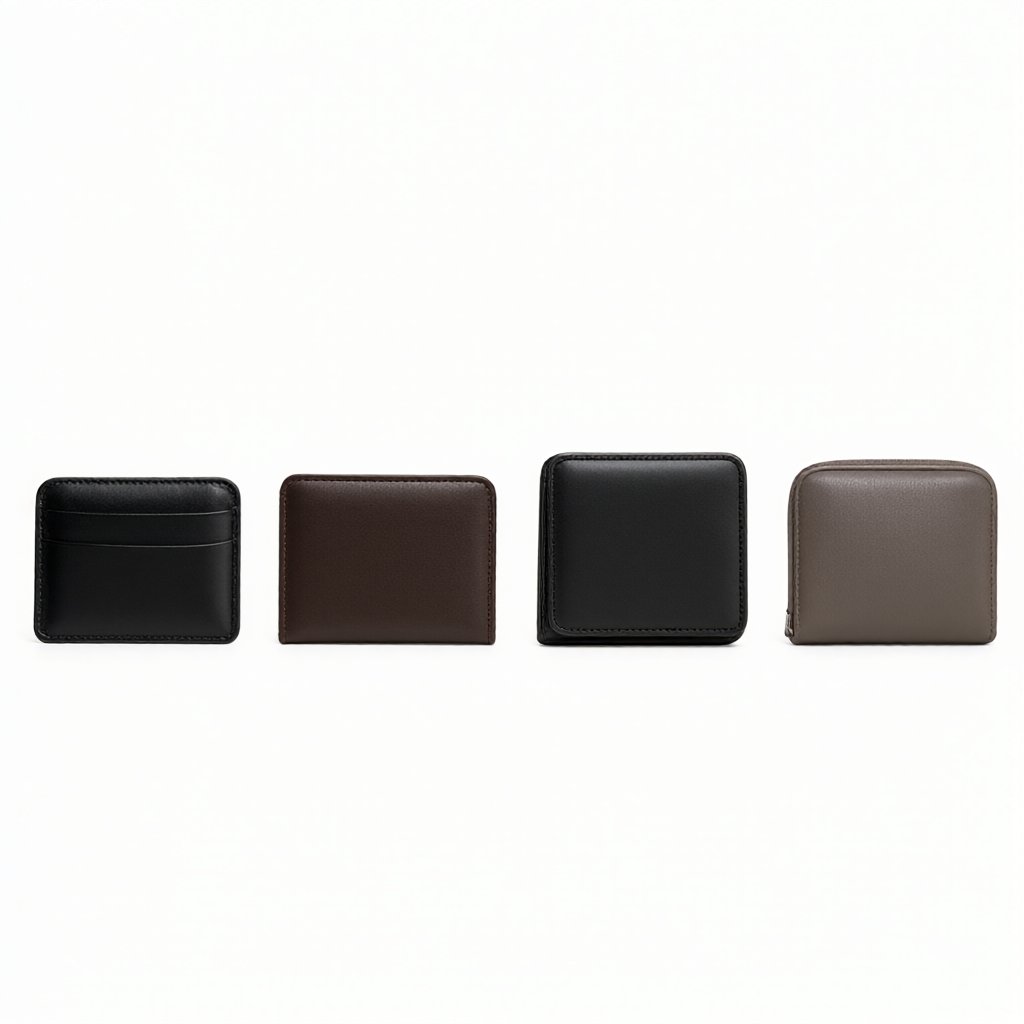
Women’s wallets and purses vary far more than men’s minimalist options, and the naming conventions across brands make comparison difficult. Below is a practical breakdown of standard size categories you’ll encounter when shopping or specifying products for your line.
What are the common wallet size categories for women?
Ultra-slim cardholders — Designed for 4–8 cards with zero cash storage. Typical interior footprint: 4.0 × 2.75 inches (102 × 70 mm). These fit easily into small clutches, pochette-style purses, or even large coat pockets.
Bifold / trifold wallets — Traditional foldable wallets. Bifold exterior: ~4.5 × 3.5 inches (114 × 89 mm) closed; trifold: ~4.0 × 4.5 inches (102 × 114 mm) closed. Capacity ranges from 6–12 card slots plus a bill compartment.
Slim follow wallets — A modern category bridging cardholders and full bifold. Exterior: ~4.5 × 3.25 inches (114 × 83 mm). Thin profile (under 0.5 in / 13 mm when loaded) but holds 8–12 cards and cash.
Wallet-on-chain (WOC) / clutch hybrids — These function as both a wallet and a small evening purse. Unfolded wallet area: ~5.0 × 3.5 inches (127 × 89 mm); folded: ~5.0 × 1.75 inches (127 × 44 mm). Includes a detachable chain or strap.
Tote-internal wallet insert — A dedicated wallet placed inside a larger purse. These range from cardholder size up to medium bifold size.
What purse sizes correspond to different carry needs?
| Purse Category | Approximate External Dimensions | Best For |
|---|---|---|
| Crossbody mini | 7 × 5 × 2 in (18 × 13 × 5 cm) | Essentials only — phone, cards, keys |
| Saddle / hobo | 11 × 8 × 3 in (28 × 20 × 8 cm) | Daily通勤 — phone, wallet, lipstick |
| Tote (medium) | 14 × 12 × 5 in (36 × 30 × 13 cm) | Work / travel — fits laptop + wallet insert |
| Clutch (evening) | 8.5 × 5 × 2 in (22 × 13 × 5 cm) | Minimal — phone and cards only |
| Bucket bag | 10 × 8 × 10 in (25 × 20 × 25 cm) | Versatile — multiple compartments |
Note: “Purse” in North American English broadly covers any hand-carried bag, while in UK English it commonly refers to a small change purse. Always verify the product description language when comparing international listings.
For perspective on how these compare to streamlined alternatives, see our lightweight wallet for women buying guide.
How to Measure — What to Check Before Buying
Choosing the right wallet or purse starts with measuring your actual daily carry, not guessing based on brand labels. Here is the step-by-step method used by product buyers and EDC community members.
Step 1 — Inventory your daily items. Lay out everything you carry: smartphone (note exact model), cards (standard credit-card size is 3.375 × 2.125 in / 85.6 × 54 mm), cash (folded or rolled), keys, and any other consistent items. Count total cards and note whether you fold bills horizontally or vertically.
Step 2 — Measure your largest item. For smartphones, measure width × height × thickness in millimeters. Current iPhone models (iPhone 16 series) range from 5.81 to 6.30 inches tall and 2.82 to 3.06 inches wide. Samsung Galaxy S24 series: 6.20 × 2.96 inches. Your wallet’s internal clear dimension must exceed the phone’s longer side by at least 0.25 in (6 mm) to allow insertion without forcing.
Step 3 — Determine required card capacity. Card slots compress slightly when stacked. Rule of thumb: a wallet rated for 8 cards will feel tight with 6 cards plus cash. If you carry 10+ cards regularly, specify a minimum of 12-slot capacity or consider a modular system where cards and cash are separated.
Step 4 — Measure your preferred carrying space. If you plan to carry the wallet in a front pocket, the maximum width is roughly 4.5 inches (114 mm) before it becomes uncomfortable. For crossbody bags, internal pocket dimensions vary widely — measure the bag’s gusset depth and height before committing to a wallet size.
Step 5 — Account for material stretch. Leather wallets expand approximately 2–5% over the first two weeks of use. Metal and carbon fiber wallets do not stretch. Factor this into your initial sizing decision: a snug leather wallet may become comfortable, while a rigid metal wallet will stay rigid.
Standards & Codes — Industry Specifications That Matter
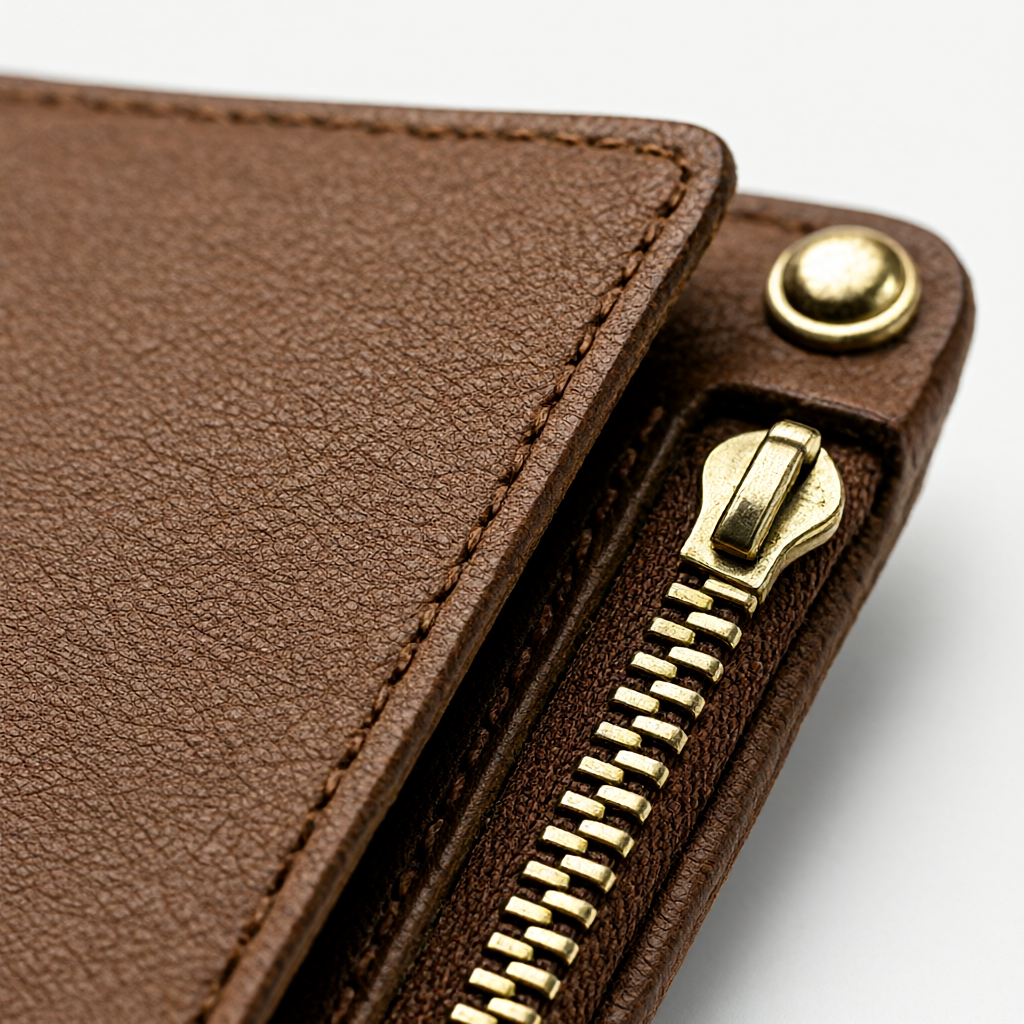
Not all wallets meet the same baseline for materials, safety, and performance. Understanding which standards apply helps you evaluate quality objectively rather than relying on marketing claims.
What standards apply to women’s wallets and purses?
RFID-blocking certification — Reputable RFID protection is tested against ASTM F841 (Standard Test Method for Measuring the Radio Frequency (RF) Attenuation Performance of Personal Card Security Products). A legitimate claim requires a tested attenuation value of at least 20 dB at 13.56 MHz (the HF RFID frequency). Claims without test data are unverified. See our detailed coverage on RFID-protected wallets for men and women for testing specifics.
Material compliance (EU market) — Products sold in Europe must comply with REACH (Registration, Evaluation, Authorisation and Restriction of Chemicals) and RoHS (Restriction of Hazardous Substances). These regulate heavy metals in hardware, azo dyes in leather, and phthalates in synthetic materials. Look for supplier documentation confirming REACH Annex XVII compliance.
Leather labeling (US market) — The FTC enforces 16 CFR Part 423 (Leather Goods Labeling Rule), which requires accurate disclosure of leather types: “genuine leather,” “top grain leather,” “full grain leather,” or “bonded leather.” Mislabeling is a common issue in discount tiers.
Flame retardancy (carried in vehicles) — Some jurisdictions require passenger-car interior accessories to meet flammability standards. While wallets themselves are rarely subject to mandatory testing, purses carried in vehicles should avoid highly flammable synthetic linings if children’s safety regulations apply in your region.
Quality management systems — Reputable manufacturers operate under ISO 9001 certification for their production processes. This does not certify individual products but indicates the facility has documented procedures for consistency, traceability, and corrective action.
Fit & Compatibility — Will It Hold Your Phone and Cards?
One of the most common buyer mistakes is selecting a wallet that looks compact on paper but fails to accommodate a modern smartphone. This section resolves that uncertainty with a direct fit-matrix.
Does this wallet fit my phone?
| Internal Wallet Width | iPhone Models That Fit | Samsung Galaxy Models That Fit |
|---|---|---|
| ≤ 2.75 in (70 mm) | None (too narrow) | None |
| 2.8 – 3.0 in (71–76 mm) | iPhone SE (1st–3rd gen), iPhone 14/15 (narrow edge) | Galaxy A15, A25 |
| 3.1 – 3.3 in (79–84 mm) | iPhone 13, 14, 15 (all models), iPhone 16 Plus | Galaxy S23, S24, A54, A55 |
| 3.4 – 3.6 in (86–91 mm) | iPhone 16 Pro Max, 15 Pro Max | Galaxy S24 Ultra, Note series |
| > 3.6 in (91+ mm) | All current iPhones | All current Samsung flagships |
If you carry a phone plus cards in the same compartment, add 0.3–0.5 in (8–13 mm) of clearance to the dimensions above. A wallet that fits your phone snugly will not accommodate both phone and a stack of 8 cards simultaneously.
What purse styles fit different occasions?
- Daily commute / work: Medium tote or structured satchel (12–14 in height) with an internal zip pocket sized for a bifold wallet or cardholder.
- Travel: Crossbody with anti-theft features — hidden zipper, RFID-lined pocket, and a gusset deep enough for a wallet plus passport.
- Evening: WOC (wallet-on-chain) or clutch that doubles as a standalone wallet — eliminates the need to transfer items between bag and wallet.
- Minimalist carry: Slim cardholder in a small crossbody or pocket-only setup. Ideal if your daily load is 5–8 cards, cash, and one key.
A well-designed wallet should integrate smoothly into a larger bag system. Many minimalist wallets are specifically engineered to slide into purse interior pockets without creating bulk, which is a consideration worth checking before purchasing a new bag.
Size Chart — Quick Reference for Buyers
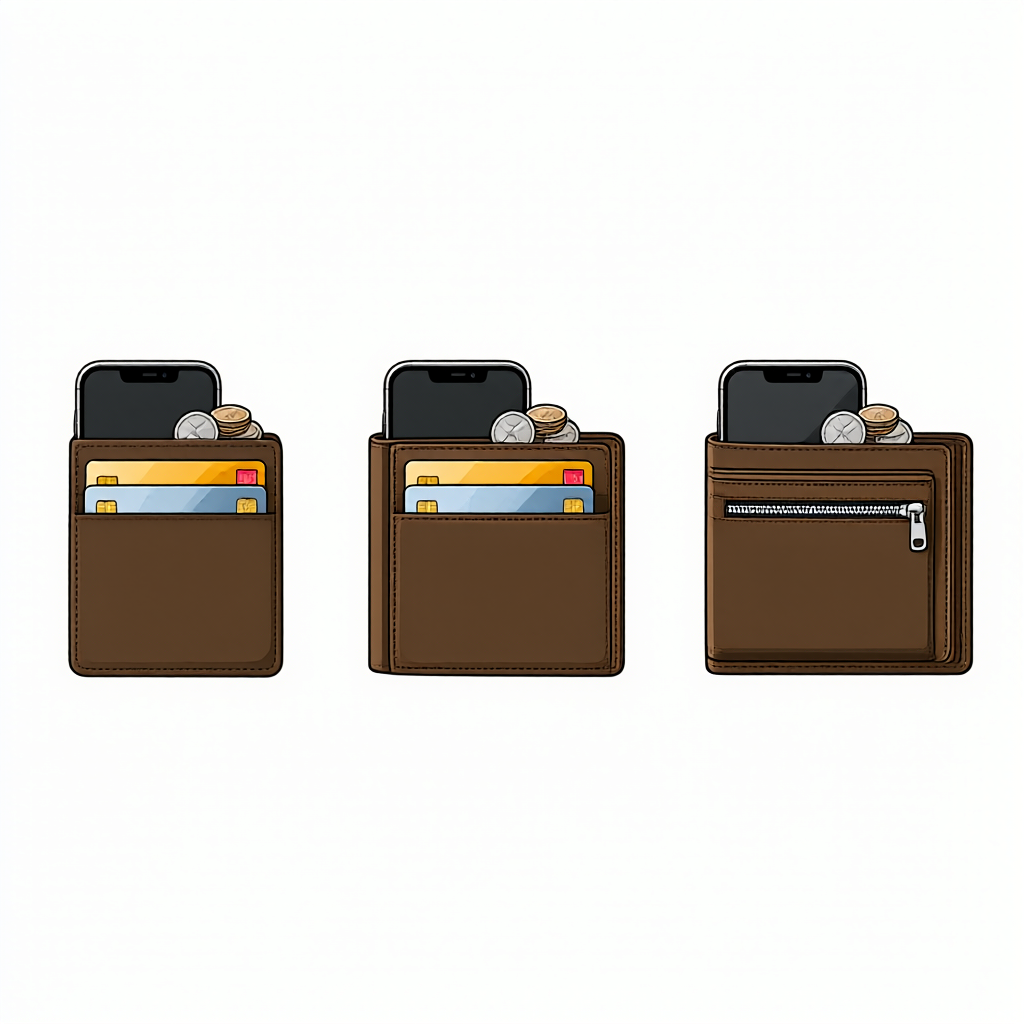
Use this chart as a starting point when comparing products across retailers or requesting custom specifications from a manufacturer.
| Category | Closed Size (inches) | Closed Size (mm) | Card Capacity | Phone-Safe? | Typical Use Case |
|---|---|---|---|---|---|
| Mini cardholder | 4.0 × 2.75 | 102 × 70 | 4–6 | No | Pouch insert, keychain |
| Slim cardholder | 4.25 × 3.0 | 108 × 76 | 6–8 | iPhone SE / small Android | Pocket carry, WOC integration |
| Follow wallet | 4.5 × 3.25 | 114 × 83 | 8–12 | iPhone 14/15 series | Everyday pocket or small bag |
| Bifold wallet | 4.5 × 3.5 | 114 × 89 | 8–16 | Depends on slot design | Classic carry, desk drawer |
| Trifold wallet | 4.0 × 4.5 | 102 × 114 | 10–18 | No (too thick) | Maximum card storage |
| WOC / clutch | 5.0 × 3.5 (unfolded) | 127 × 89 | 8–12 | Yes (most flagships) | Evening, travel light |
| Large tote insert | 5.5 × 4.0 | 140 × 102 | 12–20 | Yes (most flagships) | Bag-only carry, no pocket use |
All dimensions listed are typical exterior measurements. Internal clear dimensions may be 0.1–0.25 in (3–6 mm) smaller depending on construction method (stitching allowance, rivet placement, layered panel overlap).
Related Considerations — Material Choice, Budget, and Longevity
Sizing is only one factor. The material you choose determines how long the wallet maintains its shape, how it ages visually, and what maintenance it requires over time.
Full-grain leather — Most durable natural option. Develops patina over 2–5 years. Requires occasional conditioning (every 3–6 months). Price range: $60–$200 for mid-tier, $200–$500+ for luxury brands. Expect 5+ years of daily use with proper care.
Top-grain leather — Slightly less durable than full-grain due to surface correction. Smoother finish, more uniform appearance. Price range: $40–$120. Lifespan: 3–5 years of daily use.
Vegan leather (PU / microfiber) — Affordable and cruelty-free. Less breathable; prone to cracking after 1–2 years of heavy use. Price range: $15–$50. Not recommended for buyers seeking multi-year longevity.
Aluminum / titanium metal wallets — Extremely durable, impervious to water and wear. Heavier than leather (typically 2.5–4 oz / 70–115 g). No flex — your card stack must be precisely counted. Price range: $30–$80. Lifespan: 5+ years with no degradation. See our comparison of good money clip wallets for men for metal construction details applicable to women’s metal options as well.
Carbon fiber cardholders — Lightweight, scratch-resistant, rigid. Limited capacity (4–8 cards). Price range: $25–$60. Ideal for minimalists who prioritize weight savings over storage.
When evaluating value, consider the total cost of ownership, not just the purchase price. A $40 vegan leather wallet that cracks after 18 months costs more per year of service than a $90 full-grain leather wallet lasting 4+ years. Factor in cleaning supplies ($5–$15 annually for leather conditioner) and potential repair costs for hardware failure on cheaper products.
For budget-conscious buyers, cheap money clip options offer a functional entry point into minimalist carry at lower price tiers, though build quality varies significantly between manufacturers.
Choosing the Right Manufacturer for Custom Wallet Lines
If you’re sourcing wallets for your brand — whether for private label, Amazon FBA, or wholesale distribution — understanding size tolerances and material certifications is essential. The difference between a product that ships on spec and one that generates returns often comes down to whether the manufacturer verifies internal clear dimensions against actual smartphone sizes and tests RFID attenuation under real-world conditions.
As a manufacturer with 13+ years of export experience serving 200+ brands worldwide, we approach product specification from the inside out: CNC-machined aluminum wallets are cut to ±0.1 mm tolerance, carbon fiber layups are verified for rigidity and layer adhesion, and every RFID-blocking sample is tested before bulk production begins. Our in-house ISO 9001–certified facility handles everything from prototyping through FBA-ready packaging, with MOQs starts at 300 pcs per SKU for full OEM customization (100 pcs trial order available for stock finishes) and sample lead times of 7 days. Whether you’re developing a slim cardholder for the European market or a full bifold with REACH-compliant leather for North America, the goal is the same — products that fit what customers actually carry, built to last, and backed by verifiable specifications.
Standards & Codes — Specific Technical Parameters
Beyond the general standards already noted, buyers and product developers should reference these exact specifications when evaluating wallet manufacturers and products.
RFID attenuation testing (ASTM F841–22) — The current revision of Standard Test Method for Measuring the Radio Frequency (RF) Attenuation Performance of Personal Card Security Products requires testing at 13.56 MHz (ISO/IEC 14443 HF frequency). A pass rating demands minimum 20 dB signal attenuation; leading manufacturers achieve 25–35 dB in production units. Verify test reports include sample size (minimum n=5), frequency sweep range, and shielding effectiveness under repeated flex cycles. See our RFID wallets guide for deeper testing methodology.
REACH compliance (EU Regulation 1907/2006) — Full compliance requires adherence to Annex XVII, which restricts substances including:
- Lead (Pb): ≤ 0.05% (500 ppm) in accessible components per Entry 23
- Cadmium (Cd): ≤ 0.01% (100 ppm) per Entry 24
- Azobenzene dyes: Prohibited release of 24 listed aromatic amines per Entry 43 (ammonia release ≤ 30 mg/kg for textile/leather articles)
- Phthalates (DEHP, DBP, BBP, DIBP): Each ≤ 0.1% (1,000 ppm) per Entry 207
- Nickel release: ≤ 0.5 µg/cm²/week per Entry 27 (critical for wallet snaps, zippers, and coin hinges)
- PAHs (Polycyclic Aromatic Hydrocarbons): Total limit 1 mg/kg across 8 specified PAHs per Entry 97 (relevant for leather goods)
Leather labeling (16 CFR Part 423, effective 2024) — Requires unambiguous disclosure: “Full Grain Leather,” “Top Grain Leather,” “Genuine Leather” (no higher grade claimed), or “Bonded Leather.” Products marketed as “leather” must contain ≥ 50% real leather fibers by weight unless explicitly labeled otherwise.
Quality management (ISO 9001:2015) — Certification applies to the facility’s documented processes. Third-party audits verify documentation control, corrective action records, traceability systems, and supplier qualification procedures. Reputable suppliers maintain annual surveillance audits, not just triennial recertification.
Material Comparison Matrix — Durability, Cost & Lead Time
| Material | Durability Rating (1–5) | Expected Lifespan (Daily Use) | Price Range (Unit Cost, Bulk) | Typical MOQ | Sample Lead Time | Maintenance Required |
|---|---|---|---|---|---|---|
| Full-grain leather | 5 | 5+ years | $12–$35 / $8–$22 | 200 pcs | 7–10 days | Conditioning every 3–6 months |
| Top-grain leather | 4 | 3–5 years | $8–$22 / $5–$14 | 200 pcs | 7–10 days | Light conditioning annually |
| Vegan PU leather | 2 | 1–2 years | $3–$8 / $2–$5 | 300 pcs | 5–7 days | Wipe clean only |
| Microfiber synthetic | 3 | 2–3 years | $5–$12 / $3–$8 | 300 pcs | 5–7 days | Wipe clean |
| Aluminum (anodized) | 5 | 5+ years | $6–$18 / $4–$11 | 300 pcs | 5–7 days | None |
| Titanium | 5 | 5+ years | $15–$40 / $10–$26 | 300 pcs | 7–10 days | None |
| Carbon fiber | 4 | 4+ years | $8–$25 / $5–$16 | 300 pcs | 7–10 days | None |
| Canvas / nylon fabric | 3 | 2–3 years | $3–$10 / $2–$6 | 300 pcs | 5–7 days | Spot clean |
Value assessment tip: Calculate cost per year of service. A $20 vegan PU wallet lasting 1.5 years costs $13.33/year. A $60 full-grain wallet lasting 5 years costs $12.00/year. At 3+ years, premium natural and metal materials become the more economical choice.
Manufacturing Processes — What Determines Longevity
Durability differences between wallet tiers come down to specific construction techniques, not just raw materials. Understanding these helps evaluate whether a price premium reflects genuine quality gains.
Stitching types and density — High-quality leather wallets use saddle stitching (double-needle, hand-pulled thread) with 8–12 stitches per inch. This method resists unraveling even if individual stitches break. Machine lockstitch (single thread path) is common at lower tiers and fails faster under stress. Thread type matters: bonded nylon (Tex 40–60) outlasts polyester at equivalent gauge.
Edge painting / edge sealing — Visible edge finish signals construction investment. Premium leather wallets receive 3–5 hand-applied coats of dyed edge paint, sanded smooth between layers, producing a sealed, water-resistant border. Budget products skip edge treatment entirely or use liquid sealant spray, which cracks within months.
Hardware plating specifications — Zippers, snaps, and rivets should use either PVD (Physical Vapor Deposition) coating or electroplated brass/nickel-silver. PVD coatings provide 12–24 month scratch resistance vs. basic chrome plating (6–12 months). Nickel-free plating is required for EU market compliance (REACH Annex XVII Entry 27).
Lining attachment methods — Full-leather linings are glued and stitched; bonded-fabric linings are often glue-only. Check for reinforced stress points at card slot bases and bill compartment corners — these areas should have double-stitching or bar-tacking regardless of lining type.
Aluminum wallet production — In-house CNC machining produces wallets from solid 6000-series aluminum billets (e.g., 6061-T6). Post-machining steps include deburring, bead blasting, anodizing (hard-anodized Type III reaches 50–100 microns thickness for maximum abrasion resistance), and laser engraving. Tolerances of ±0.1 mm are achievable at scale.
Carbon fiber layup — Proper carbon fiber wallets use aerospace-grade 2×2 twill weave pre-preg sheets cured under heat and pressure (120–180°C, 6–8 bar). Layer count (typically 8–16 plies) determines rigidity. Look for providers who perform shear-strength testing on sample batches before bulk production.
For more on minimalist constructions and how different build methods affect daily carry, see our minimalist wallets guide.
Top Brands & Recommended Picks — How to Evaluate Options
When comparing existing brands against custom-manufactured alternatives, focus on three criteria: material transparency, standard compliance documentation, and value-to-price ratio. Below is a framework for evaluating what you’ll find on the market today.
| Brand Tier | Example Position | Typical Price Range | Material Claims | Compliance Docs Available | Verdict |
|---|---|---|---|---|---|
| Luxury designer | High-end fashion houses | $200–$800+ | Often vague (“Italian leather”) | Rarely publicly available | Pay for branding; verify actual materials via detailed product pages |
| Mid-tier specialty | Dedicated EDC/leather brands | $40–$150 | Usually specific (full-grain, titanium grades) | Sometimes available on request | Best balance of quality and transparency for most buyers |
| Direct-from-manufacturer | OEM/ODM brands | $15–$60 retail equivalent | Highly specific (6061-T6 aluminum, ISO-certified tanning) | Full test reports upon request | Highest value per dollar; identical construction to tier-2 brands at lower margin |
| Fast-fashion | Mass-market retailers | $5–$30 | Generic (“genuine leather” = bonded) | Rarely beyond FTC basic labeling | Functional short-term; replacement within 1–2 years expected |
Our own approach reflects the direct-from-manufacturer tier. We combine in-house CNC machining (for aluminum and titanium wallets), certified leather sourcing (ISO 9001–accredited tanneries), and third-party SGS testing on all metals and chemicals. Every order ships with material compliance documentation and batch-level QR traceability. When you specify a design, you get a physical prototype within 7 days for verification before any bulk commitment.
Explore our full range of women’s wallets and clutches to compare styles and materials across our catalog.
Quick Answer — Standard Sizes at a Glance
What size wallet do I need based on what I carry?
| Daily Load | Minimum Internal Width | Recommended Style | Approx. Exterior Size |
|---|---|---|---|
| 4–6 cards, no phone | 2.5 in (64 mm) | Mini cardholder | 4.0 × 2.75 in (102 × 70 mm) |
| 6–8 cards + iPhone SE | 2.8 in (71 mm) | Slim cardholder / follow wallet | 4.25 × 3.0 in (108 × 76 mm) |
| 8–12 cards + iPhone 14/15 | 3.2 in (81 mm) | Follow wallet | 4.5 × 3.25 in (114 × 83 mm) |
| 10+ cards + Pro Max / Ultra | 3.5 in (89 mm) | Bifold with phone slot | 4.5 × 3.5 in (114 × 89 mm) |
| Phone + cash + keys + coins | 3.6+ in (91+ mm) | WOC or small crossbody insert | 5.0 × 3.5 in unfolded |
If you share one compartment for phone and cards, add 0.3–0.5 in (8–13 mm) of extra clearance. A wallet rated for its maximum card capacity will feel significantly tighter once a phone is added — plan for the larger dimension, not the smaller one.
Wallet vs Purse — Understanding the Distinction and Overlap
What’s the difference between a wallet and a purse?
A wallet is a standalone compact organizer for cards, cash, and small items — typically carried in a pocket, clutch interior, or dedicated bag pocket. A purse (in North American English) is a handbag or shoulder bag that may contain a separate wallet inside it; in UK English, “purse” commonly refers to a small coin pouch worn within a larger bag.
The overlap exists in hybrid categories:
- Wallet-on-chain (WOC): Functions as both wallet and evening clutch-purse. Detachable chain converts it from hand-carry to shoulder-slung.
- Cardholder-in-tote: A slim wallet purchased specifically to fit inside a tote’s interior pocket — the tote is the purse; the cardholder is the wallet.
- Pochette / mini crossbody: Small enough to function as a wallet substitute for minimalist carriers, yet structured like a purse with a strap.
Understanding this distinction matters when shopping internationally or specifying products for a line, because尺寸 naming varies by market. A “mini purse” in one brand’s catalog may be a “follow wallet” in another’s.
Styles and Silhouettes — Crossbody, Clutch, Tote, Cardholder, Wristlet
What wallet and purse styles exist, and when should each be used?
| Style | Closure Type | Typical Dimensions | Best Use Case | Card Capacity |
|---|---|---|---|---|
| Cardholder | Snap, elastic band, or open slip | 4.0–4.5 × 2.75–3.0 in | Minimalist pocket carry, WOC insert | 4–8 |
| Bifold | Fold + snap/button | 4.5 × 3.5 in | Classic everyday carry | 8–16 |
| Trifold | Triple fold + closure | 4.0 × 4.5 in | Maximum organization | 10–18 |
| Clutch (evening) | Zip or magnetic snap | 8.5 × 5.0 × 1.5 in | Event carry, no pockets available | 6–12 + phone |
| Wallet-on-chain | Chain strap + zip/snap | 5.0 × 3.5 in folded | Evening-to-day transition | 8–12 |
| Wristlet | Wrist strap + zip | 7.5 × 4.5 × 1.5 in | Hands-free essentials | 6–10 + phone |
| Crossbody mini | Adjustable strap + zip | 7.0 × 5.0 × 2.0 in | Security-focused daily carry | Insert-style or integrated |
| Tote insert | Open top or zip | Varies — matches tote pocket | Bag-only organization | Any (modular) |
For women who prefer a single-item solution, a WOC or wristlet eliminates the need to transfer between purse and wallet. For professional settings, a cardholder-sized insert preserves the silhouette of a structured tote while keeping essentials organized. See our women’s wallet size and style buying guide for deeper coverage of each silhouette.
Materials and Durability — Leather Grades, Synthetics, and Hardware Specs
What materials last longest, and how are they rated?
Leather grading follows a hierarchy determined by which layer of the hide is used and how much surface correction is applied:
Full-grain leather — Top layer of the hide, minimal correction, natural grain intact. Tensile strength: 15–25 MPa. GSM range for wallet use: 280–350 GSM. Chrome content in vegetable-tanned varieties: <0.5 ppm hexavalent chromium (per REACH Annex XVII). Lifespan: 5–10+ years with conditioning. Price premium: 2–3× compared to genuine leather.
Top-grain leather — Top layer with surface sanding/correction for uniformity. Tensile strength: 12–20 MPa. GSM: 250–320 GSM. More resistant to staining but develops less patina. Lifespan: 3–5 years.
Genuine leather — A regulatory term (FTC 16 CFR Part 423) meaning real leather, but often refers to split leather layers bonded with polyurethane coating. Tensile strength: 8–15 MPa. GSM: 200–280 GSM. Prone to peeling after 1–2 years of heavy use.
Vegan leather (PU) — Polyurethane-coated fabric base. Tensile strength: 10–18 MPa. GSM: 300–450 GSM. Cracking begins at 12–18 months under daily flex stress. Water-resistant but non-breathable.
Vegan leather (microfiber) — Polyurethane bonded to microfiber polyester substrate. Tensile strength: 18–28 MPa — comparable to top-grain leather. GSM: 350–500 GSM. Crack resistance: 2–4 years. Preferred over PU for premium positioning.
Aluminum (6000-series) — CNC-machined or precision-stamped. Surface hardness: 60–90 HV (Brinell). Anodized finish adds 25–50 µm hard coat. Weight: 70–115 g for standard wallet. Impervious to water, scratches, and UV degradation.
Titanium (Grade 2) — Lighter than aluminum at equal thickness (4.5 g/cm³ vs 2.7 g/cm³ density — wait, titanium is denser but can be made thinner). Tensile strength: 340–450 MPa. Weight: 55–85 g. Hypoallergenic — suitable for sensitive skin. Price premium: 2–4× aluminum.
Carbon fiber — Epoxy-resin impregnated weave, compression-molded at 80–120°C and 5–10 bar pressure. Tensile strength: 500–1500 MPa (direction-dependent). Weight: 30–50 g. Zero flex under normal load — rigid construction means card slots must accommodate exact stack dimensions.
Hardware quality is equally important. Zinc-alloy buckles and clasps should pass a 48-hour salt-spray test (ASTM B117) without corrosion. YKK or Riri zippers are the industry benchmark for smooth operation after 5,000+ cycle testing.
Size and Capacity Planning — How Much Should You Actually Carry?
How do I calculate the right capacity for my wallet?
The calculation follows a three-variable model:
Variable 1 — Card count. Standard credit-card dimensions are 3.375 × 2.125 in (85.6 × 54 mm) per ISO/IEC 7810 ID-1. Each card adds approximately 0.76 mm (0.03 in) to wallet thickness when uncompressed. Eight cards in a single slot produce ~6 mm of stack height — manageable. Sixteen cards approach 12 mm, which begins to distort bifold panels.
Variable 2 — Cash format. Bills folded horizontally (hamburger fold) add ~0.5 mm per bill. Rolled bills add less height but require a dedicated strap or channel. Most wallets accommodate 4–8 bills comfortably before bulk becomes noticeable.
Variable 3 — Phone inclusion. Modern smartphones average 6.0–6.5 in height and 2.8–3.1 in width. A wallet accommodating both phone and cards needs an internal clear dimension of at least 3.4 in (86 mm) width and 6.75 in (171 mm) height when unfolded — effectively a large bifold or WOC format.
Add a 10% buffer to all measurements to account for material stretch (leather) or tolerance stack-up (metal/card-holder designs).
See our comparison of physical versus digital wallets if you’re evaluating whether reducing physical carry is an option.
Organizational Features — Compartments, Slots, Zippers, and RFID Integration
What organizational features matter most?
| Feature | Purpose | Quality Indicator |
|---|---|---|
| Dedicated card slots | Keep cards separated and accessible | Stitched or riveted edges; not just friction slits |
| Bill compartment | Hold folded or rolled currency | Full-length sleeve preferred over partial gusset |
| Coin pocket | Secure loose change | Zippered (preferred) or snap-closed; lined with soft material to prevent scratching cards |
| ID window | Quick-access identification | Clear PET window, not printed design; positioned for visibility without removing wallet |
| RFID-blocking layer | Prevent unauthorized NFC scanning | Tested per ASTM F841; attenuates ≥20 dB at 13.56 MHz; linear Faraday cage construction preferred over sporadic metal threading |
| Interior zip pocket | Secure small valuables (USB drives, earbuds) | Full-length zipper with metal pull; integrated into main compartment or as secondary gusset pocket |
| External slip pocket | Quick-access transit card or business card | Reinforced at stress points; depth matches intended item |
A well-designed wallet balances organization without adding unnecessary bulk. The sweet spot for daily carry is 2–3 compartments: card section, bill sleeve, and one secure pocket (zip or RFID-lined). Additional compartments multiply failure points — each zipper is a potential jam, each snap a potential wear point.
For comprehensive coverage of card-protection features, review our buyer’s guide to card-safe wallets.
Price Tiers and Value Assessment — What to Expect at Each Level
What price tier corresponds to which quality and longevity?
| Tier | Price Range (USD) | Expected Materials | Expected Lifespan | Warranty Common |
|---|---|---|---|---|
| Budget | $8–$25 | Bonded leather, PU vegan, zinc alloy hardware | 6–18 months | Rarely offered |
| Mid-tier | $25–$75 | Top-grain leather or full-grain entry, stainless steel hardware, tested RFID | 2–4 years | 1–2 years |
| Premium | $75–$200 | Full-grain vegetable-tanned leather, titanium or 6000-series aluminum, YKK hardware | 5+ years | 2–5 years |
| Luxury | $200–$500+ | Exclusive leathers (shell cordovan, exotic), precious metal accents, hand-stitched | 10+ years | Lifetime (brand-dependent) |
| Custom OEM | $15–$60/unit (MOQ-based) | Material selected by buyer; CNC-machined metal or carbon fiber options available | Manufacturer-specified QC | Production warranty |
Value assessment should consider cost per year of service, not upfront price. A $20 budget wallet replaced every 12 months costs $20/year. A $80 mid-tier wallet lasting 4 years costs $20/year — same annual cost, but superior materials, organization, and appearance throughout. A $150 premium wallet lasting 7+ years drops to ~$21/year with dramatically better daily experience.
For budget-conscious buyers exploring entry-level minimalist options, our cheap money clip comparison guide covers value tiers within the sub-$30 segment.
Manufacturing Processes — Precision Stamping, Stitching, and Lamination Standards
How are quality wallets actually made?
Metal wallet production (aluminum/titanium):
- Raw sheet stock is cut to blank dimensions via precision stamping (tolerance: ±0.1 mm per ASTM B665 for aluminum sheet).
- Edges are deburred and rounded using CNC milling or vibratory finishing.
- Card slots are formed by progressive die stamping — each stroke adds defined curvature; 3–5 forming passes achieve final profile.
- Anodizing (for aluminum) applies a 25–50 µm hard-coat layer at 15–20°C electrolyte temperature, 12–18 VDC for 30–45 minutes. This provides scratch resistance exceeding 2000 cycles (Taber abrasion test).
- Laser engraving for logos uses fiber lasers (10.6 µm wavelength) at 20–80 W power — depth control to ±0.02 mm.
Leather wallet production:
- Cutting: Die-cut or CNC knife cutting with ±0.5 mm tolerance. Edge trimming removes excess for clean panel joints.
- Stitching: Density requirement for durable wallets is 8–12 stitches per inch (SPI). Lower than 8 SPI risks seam separation under load; higher than 12 SPI weakens the leather fiber structure. Polyester thread (bonded nylon alternative) preferred for tensile strength of 25–35 N per filament.
- Edge painting/painting: Multiple coats of edge paint (polyurethane-based) applied and buffed for smooth finish — 3–5 layers minimum for premium products.
- Heat-press lamination: When bonding fabric liners or RFID-blocking layers to leather panels, temperature is maintained at 130–160°C with 3–5 bar pressure for 15–30 seconds. Exceeding 160°C risks leather drying and cracking; below 130°C produces insufficient adhesive bond.
RFID-blocking integration:
- Linear mesh (steel-nickel alloy) or conductive fabric is laminated between wallet layers. Attenuation testing per ASTM F841 confirms ≥20 dB performance at 13.56 MHz before bulk production approval.
- SGS-tested material reports verify heavy metal content (lead, cadmium, mercury, hexavalent chromium) complies with REACH Annex XVII restrictions.
Quality inspection checkpoints:
- Dimensional verification: Random sample of 5 pcs per 500 produced, measured with digital calipers (resolution 0.01 mm).
- Card insertion/extraction force: Measured with force gauge — acceptable range 5–15 N per slot. Excessive force indicates overly tight tolerances; too little indicates premature looseness.
- Cycle testing: Zippers and snaps undergo 3,000–5,000 open/close cycles; acceptable failure rate: <2%.
Certifications and Compliance — What Credentials Verify Quality
What certifications should buyers request from manufacturers?
| Certification | Governing Body | What It Verifies | Required Documentation |
|---|---|---|---|
| ISO 9001:2015 | ISO | Production quality management system — process consistency, traceability, corrective action | Valid certificate with scope covering wallet/purse manufacturing |
| REACH compliance | European Chemicals Agency | Restriction of hazardous substances (azo dyes, phthalates, heavy metals) in materials | Test reports per Annex XVII; supplier declaration of conformity |
| RoHS compliant | EU Directive 2011/65/EU | Lead, cadmium, mercury, PBB, PBDE limits in metal hardware | Heavy metal migration test results |
| BSCI audit | Sedex | Social compliance — working conditions, child labor, wages, safety | Valid audit report (score ≥ threshold set by buyer) |
| ASTM F841 tested | ASTM International | RFID attenuation performance | Laboratory test report showing ≥20 dB at 13.56 MHz |
| SGS material verification | SGS SA | Independent confirmation of material composition and restricted substance levels | Material test report (MTR) per product batch or type approval |
Buyers should request these documents before placing orders — particularly for EU-market products where REACH and RoHS enforcement is mandatory. Manufacturers who cannot provide test reports for RFID claims are making unverifiable assertions.
Sizing Comparison — Metal Wallets vs Leather Wallets vs Carbon Fiber
How do material choices affect effective size and capacity?
| Specification | Aluminum Wallet | Titanium Wallet | Full-Grain Leather Bifold | Carbon Fiber Cardholder |
|---|---|---|---|---|
| Closed exterior size | 4.5 × 3.25 × 0.25 in | 4.5 × 3.25 × 0.22 in | 4.5 × 3.5 × 0.5 in | 4.25 × 3.0 × 0.15 in |
| Weight (empty) | 85 g | 65 g | 110 g | 35 g |
| Max card capacity | 8–12 | 8–12 | 12–16 | 4–8 |
| Phone storage | Yes (dedicated slot) | Yes (dedicated slot) | Yes (bill compartment) | No |
| Flex/compression | None — rigid | None — rigid | 2–5% initial stretch | None — rigid |
| Water resistance | Impermeable | Impermeable | Water-resistant (treated) | Impermeable |
| RFID blocking | Inherent (metal enclosure) | Inherent (metal enclosure) | Requires embedded layer | Not inherent — requires add-on |
| Scratch resistance | High (anodized) | Very high | Moderate (patina develops) | Very high (surface) |
| Temperature sensitivity | Expands/contracts minimally | Minimal thermal expansion | Can stiffen in cold (<10°C) | Stable across -20 to 60°C |
Material choice directly affects how a wallet occupies space. Rigid metal and carbon fiber wallets maintain their dimensions forever — what you measure is what you get. Leather relaxes and molds over time, which can improve comfort but reduces dimensional predictability. For production spec sheets, rigid-material wallets require tighter tolerances because there is no “break-in” period to absorb variation.
Sourcing Custom Wallets — How Manufacturers Handle Size and Material Specification
How does custom wallet manufacturing work from inquiry to shipment?
The process begins with a specification brief covering: target dimensions (interior clear space, exterior closed size), card capacity, material selection, RFID requirements, branding (laser engraving, UV printing, embossing), and packaging (retail box, polybag, hang tag). From there, the manufacturer creates prototypes using CNC machining for metal variants or die-cutting and stitching for leather.
Sample lead time typically ranges from 5–7 business days for standard configurations. Bulk production run starts after sample approval — common MOQs begin at 300 pieces for custom designs, with pricing tiers improving significantly above 500 and 1,000 units.
As a manufacturer with 13+ years of export experience serving 200+ brands across America, Europe, Australia, and Southeast Asia, we approach every specification from the inside out: CNC-machined aluminum wallets are cut to ±0.1 mm tolerance, carbon fiber layups are verified for rigidity and layer adhesion under shear testing, and every RFID-blocking prototype is ASTM F841–tested before bulk production begins. Our ISO 9001–certified, BSCI audited facility (50,000 sq ft, 500K+ monthly capacity) handles everything from prototyping through FBA-ready packaging, with MOQs starts at 300 pcs per SKU and sample lead times of just 7 days. Whether you need private-label aluminum wallets, carbon fiber card holders, or titanium money clips with custom laser engraving, contact our team to discuss your specification — or visit our contact page to submit details directly.
Sources & References
- ASTM F841 — www.astm.org
- 16 CFR Part 423 — www.ftc.gov
- REACH Annex XVII — www.iso.org
- lightweight wallet for women — topedcwallet.com
- modular system — topedcwallet.com
- RFID-protected wallets for men and women — topedcwallet.com
- good money clip wallets for men — topedcwallet.com
- cheap money clip options — topedcwallet.com
- Get a Free Quote → — topedcwallet.com
- minimalist wallets guide — topedcwallet.com
From article to product
Turning this into a product?
Most of what is written here is the difference between a sample that works and one that does not. We can build either — the useful one costs the same.
Keep reading
More on buying guides
wallet with trigger
How Does a Trigger Wallet Work? What Is the Pop-Up Mechanism? The core of…
Readbest bifold wallet for women
What Is a Bifold Wallet? The term “bifold” refers to the fold: the wallet…
ReadMen’s trifold wallets with zipper compartments vs. bifold
At a Glance The three dominant men’s wallet formats differ in panel count, depth,…
Read
About the author
TOPWALLET Editorial Team
TOPWALLET's editorial and engineering desk writes from bench testing at the Shenzhen (Longgang) facility: pull-force and cycle testing, 13.56 MHz shielding measurements, finish trials and factory audits, rather than supplier spec sheets. Every specification in these guides is one we write on a purchase order.
Written on the floor
This article was written by our production and QC team — the people who spec tolerances, run the finishing line and inspect every batch. Where it states a capacity, a pull force or a lead time, it comes from a measurement we made, not a supplier’s catalogue. If a number here disagrees with what your own supplier told you, tell us; several of these articles started as a correction from a buyer.
See how the factory works · Inspection process · Sourcing FAQ
Turning this into a product?
Most of what is written here is the difference between a sample that works and one that does not. We can build either — the useful one costs the same.