

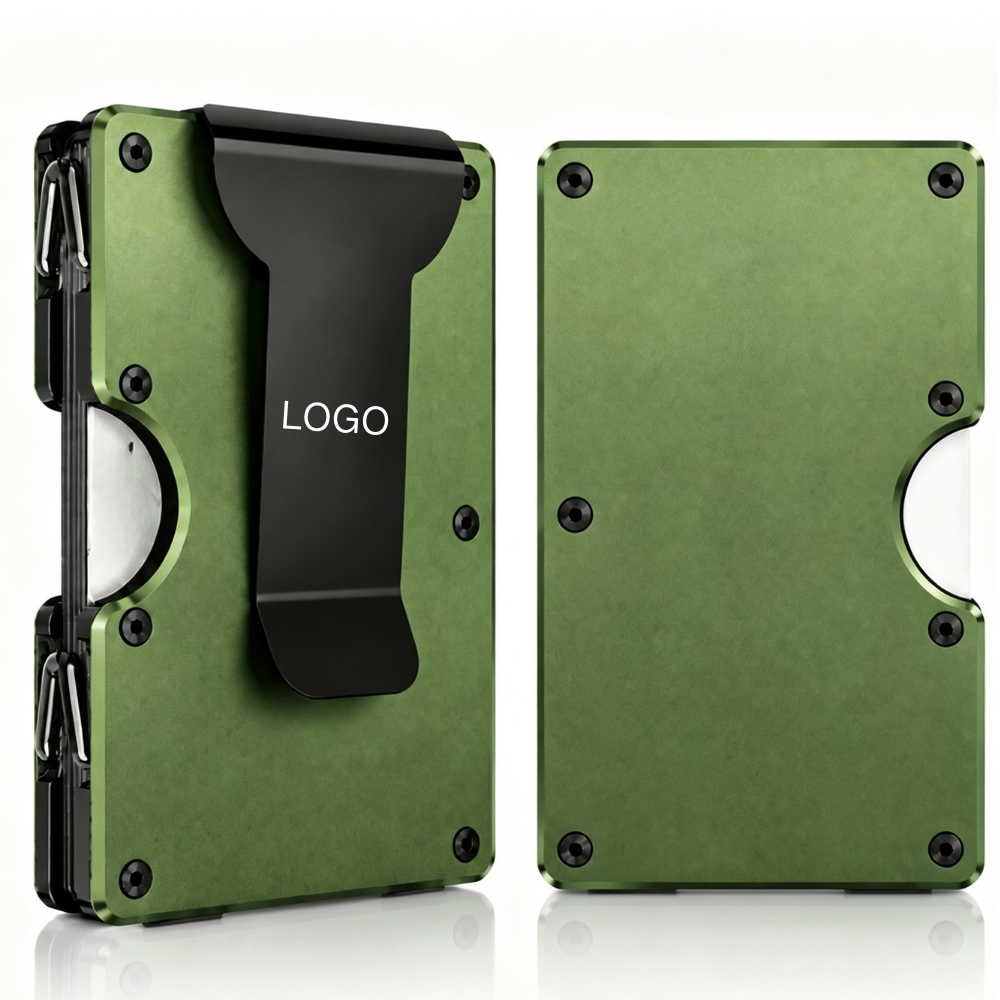
Quick answer: source front pocket and minimalist wallets by defining how the product must carry — loaded dimensions, edge comfort, retention and access — then write one specification that every supplier quotes against. “Slim” is a marketing word; a loaded thickness, a defined card-and-cash load and a sample test you can repeat are specifications.
Sourcing front pocket wallets starts with the carrying job, not with a logo. For retailers, private-label brands and promotional buyers, this wholesale and OEM sourcing guide covers how to compare formats, write a specification, test samples and control a first order — so the wallet matches your customer’s routine and your commercial requirements rather than an attractive supplier photograph.
What Makes a Front Pocket Wallet Suitable for Daily Carry?
Define a front-pocket wallet by its loaded dimensions, edge comfort, secure retention and accessible layout. Define a minimalist wallet by the essentials it must hold. Judge both against an agreed carrying load instead of treating “slim” as a complete specification. The category boundaries matter: front pocket wallets are a geometry decision, while card holders are a capacity decision.
Start from one customer scenario. A card-first commuter prioritises quick access; a gift buyer may want folded-cash storage and polished presentation. Trying to serve every scenario in one design makes sample evaluation unfocused and approvals slower.
Which Front Pocket Wallet Formats Fit Your Carrying Priorities?
- Card sleeves: check access to the deepest slot and retention when only partially filled.
- Compact bifolds: test the intended cash arrangement alongside cards, then measure the closed wallet.
- Rigid holders: examine edge comfort, card release, hardware and contact with pocket fabric.
- Hybrid designs: assess whether straps, clips and pull tabs improve access without awkward bulk.
Adjacent formats carry their own trade-offs. If your range also includes thinner constructions, the comparison in thin wallets and minimalist card holders gives a second reference point for loaded thickness.
Which Sourcing Route Suits Your Front Pocket Wallet Order?
Specify whether you want an unchanged stock product, branding on an existing design, or manufacturing to your own specification. Ask each supplier to describe exactly what its wholesale, private-label, OEM or ODM offer includes, then compare the work being quoted rather than the label. The route definitions and buyer-side implications are set out in wholesale men’s wallets: OEM and private label.
| Sourcing route | What to request | What to clarify |
|---|---|---|
| Existing stock | Current design and packaging | Available quantities, repeat availability, branding restrictions |
| Branded existing design | Approved base wallet with your artwork | Logo method, placement, packaging, setup charges |
| Custom manufacturing | Product built to your drawings or specification | Development stages, tooling, ownership, testing, change control |
For an untested range, ask for both an existing-design option and a custom proposal. That gives you a practical comparison without committing to development. For custom work, document who owns drawings, dies, molds and production files, and have any exclusivity or IP clause reviewed before you rely on it.
How Do You Write a Front Pocket Wallet Spec Suppliers Can Quote?
Send every shortlisted supplier the same request for quotation. Include drawings or annotated reference images, but identify the details that matter instead of asking for something “similar”, and version the document so revisions stay traceable.
What Must a Front Pocket Wallet RFQ Define?
A usable RFQ fixes loaded thickness, card count, currency slots, material grade, finish, logo placement, target FOB, and inspection standard. Vague language invites quotes that cannot be compared.
- Dimensions: closed length and width, empty thickness, and loaded thickness under a defined card-and-cash arrangement.
- Capacity: intended everyday load, slot allocation, access expectations at minimum and maximum loads.
- Construction: outer material, backing, lining, thread, edge finish, adhesive, hardware and shielding where applicable.
- Appearance: colour reference, surface finish, logo artwork, placement, acceptable variation.
- Packaging: individual protection, retail presentation, barcode location, carton quantities, shipping marks.
- Acceptance: measurable tolerances, functional checks, inspection arrangements, remedies for nonconforming goods.
Do not choose arbitrary tolerances just to make the document look technical. Ask suppliers what they can hold consistently, then decide whether that meets your product promise. Require approval before any material substitution or construction change — an apparently minor swap still deserves review if it alters the sample you accepted. Custom formats such as custom leather card holders show how far this detail has to go when branding and material both change.
How Do You Specify Front Pocket Wallet Materials Without Vague Labels?
Ask for a component-level description instead of accepting “premium leather” or “vegan material” as an answer. For a leather-look wallet, separate exterior, internal pockets, lining, backing and coatings. In the United States, the FTC Leather Guides address misleading composition descriptions and require disclosure where material looks like leather but is not.
Turn the description into checks: request material swatches alongside finished samples, compare colour and texture, and examine folded edges and high-contact areas. Ask the supplier to identify any difference between sample materials and what is proposed for production. For coated fabrics, request the substrate and coating; for rigid designs, specify body material, finish, fasteners and replaceable components. The cost consequence of these choices is covered in how material choice changes factory cost.
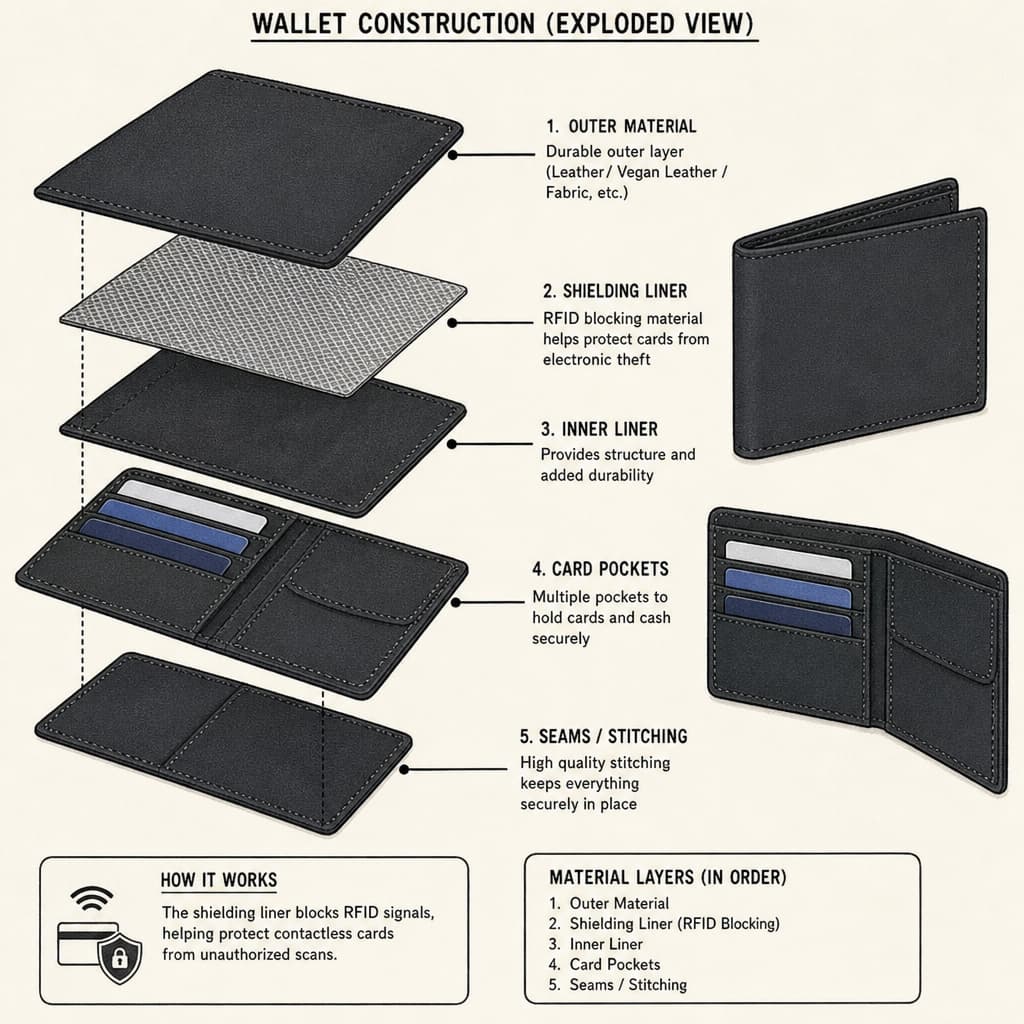
Minimalist constructions in leather are a common starting point for private-label ranges; the material and specification side is covered in minimalist leather wallets for B2B sourcing, and process-side detail in leather wallet manufacturing for men.
How Should You Test Front Pocket Wallet Samples Before Bulk?
Test samples against a written checklist using the intended carrying load, and keep an approved reference sample for production comparison. Separate appearance, usability and durability observations so a good first impression cannot hide a functional problem. Record conditions and results instead of relying on memory.
What Makes a Repeatable Front Pocket Wallet Sample Review?
Score every sample on the same card, at the same load, with the same tools. Photograph each angle and record the numbers, so a second reviewer reaches the same conclusion.
- Load and measure: record dimensions empty and loaded, and photograph the arrangement so another reviewer can reproduce it.
- Retrieve essentials: remove the most-used card, the deepest card and the cash; note snagging, excessive force or accidental release.
- Check retention: assess agreed minimum and maximum loads with controlled movement over a safe surface.
- Review construction: inspect stitching, seams, corners, edge coating, exposed adhesive and hardware alignment.
- Simulate ordinary handling: repeat agreed insertion, removal, opening and closing checks, documenting visible changes.
- Inspect presentation: verify artwork, labels, barcodes, packaging protection and consistency with the specification.
Treat these as screening checks, not laboratory evidence for advertised performance. For an RFID-blocking claim, request a report that names the tested model, frequency, method and conditions. NFC communication uses 13.56 MHz — the band and coupling differences are described in this TI RFID technology overview — so specify that frequency when it matches your claim instead of accepting an undefined “RFID tested” statement. Production-lot inspection is separate: the sequence in the wallet quality control checklist is where consistency is actually enforced.
How Do You Compare Total Cost and Accountability on Front Pocket Wallet Orders?
Build the comparison around the full order budget rather than the quoted unit price. Request separate figures for samples, development, tooling, branding, packaging, inspection, freight and any service bundled into delivery, and have a customs broker or qualified adviser confirm import costs before you finalise margin.
Clarify minimum order quantities at every level — total order, design, material, colour, logo treatment, packaging format — and ask whether mixed colours count toward the same minimum and whether reorder conditions differ. Record quote validity and payment milestones at the same time.
Check the supplier’s legal identity, production location, subcontracting arrangements and ability to reproduce the approved construction. Request evidence relevant to your order rather than treating a catalogue or a badge as a complete assessment. On Alibaba, the platform’s Trade Assurance guidance recommends putting quantity, product specifications and shipping information into the contract — which only works if your approved requirements live in the order documents, not in chat messages.
How Do You Keep Front Pocket Wallet Claims and Import Details Evidence-Led?
Review packaging and product-page copy before production. The FTC’s leather guidance also covers unsupported descriptors such as “scratchproof” and “waterproof” for covered products, so do not turn a supplier’s casual assurance into an unqualified retail claim. Ask what evidence supports each proposed statement and narrow the wording where it does not hold.
For US imports, country-of-origin marking generally must identify the origin to the ultimate purchaser, subject to applicable exceptions — see 19 CFR Part 134. Confirm the marking approach for the wallet and its packaging rather than assuming a shipping-carton label is sufficient. Keep reports, material declarations, artwork approvals and order records together, and let a qualified compliance adviser tell you what else applies to your materials, markets and users. The site’s wallet compliance checklist is a starting frame, not a certification.
How Do You Turn an Approved Front Pocket Wallet Sample Into a First Order?
Translate sample approval into documented production requirements, then verify the finished order against them before shipment. Agree inspection timing, sampling, defect categories, acceptance criteria and corrective action — including what happens if the order fails inspection and who pays for rework and reinspection.
Build the schedule backwards from the required arrival date, with explicit stages for revisions, artwork approval, material procurement, production, inspection, corrective work, transit and receiving. Confirm when each supplier’s lead-time estimate actually starts, because a quote that begins at “order confirmation” and a factory that begins at “material arrival” describe different dates.
Keep the first assortment small enough to evaluate. After delivery, log defects and customer feedback by design and batch, then revise the specification before expanding colours or quantities.
What Is the Front Pocket Wallet Sourcing Takeaway?
Choose the wallet around a clear carrying scenario, then make that scenario measurable. Compare suppliers against one specification, approve samples deliberately, and document what production must match. A disciplined first order gives your next buying decision a stronger foundation than either a low headline price or an impressive sample on its own.
Front Pocket Wallet FAQ: Thickness, Fit, and Clip Options — Which Questions Do Buyers Ask Most?
What loaded thickness keeps a front pocket wallet from bulging?
Stay at or under 16 mm loaded. Above that the wallet reads as a visible rectangle through trousers, which defeats the reason buyers moved it forward; the working target for a metal cardholder is 8–12 mm with six cards and two notes inside.
Will a front pocket wallet fit a jeans coin pocket?
No for almost all models. A coin pocket is about 60–70 mm wide, while a front pocket wallet runs 70–105 mm, so only the smallest card sleeves come close and they will not close with cash. Treat the coin pocket as a card-only slot, not a wallet location.
Should the design use a money clip or a strap and slot?
Choose by use: a clip suits two to six notes and one-hand access, while a strap and slot hold a thicker note stack without pinching. Clips add a spring or magnetic part to inspect, so specify clip force and cycle life when the brief calls for one.
From article to product
Turning this into a product?
Most of what is written here is the difference between a sample that works and one that does not. We can build either — the useful one costs the same.
Keep reading
More on buying guides
wallet with trigger
How Does a Trigger Wallet Work? What Is the Pop-Up Mechanism? The core of…
Readbest bifold wallet for women
What Is a Bifold Wallet? The term “bifold” refers to the fold: the wallet…
ReadMen’s trifold wallets with zipper compartments vs. bifold
At a Glance The three dominant men’s wallet formats differ in panel count, depth,…
Read
About the author
TOPWALLET Editorial Team
TOPWALLET's editorial and engineering desk writes from bench testing at the Shenzhen (Longgang) facility: pull-force and cycle testing, 13.56 MHz shielding measurements, finish trials and factory audits, rather than supplier spec sheets. Every specification in these guides is one we write on a purchase order.
Written on the floor
This article was written by our production and QC team — the people who spec tolerances, run the finishing line and inspect every batch. Where it states a capacity, a pull force or a lead time, it comes from a measurement we made, not a supplier’s catalogue. If a number here disagrees with what your own supplier told you, tell us; several of these articles started as a correction from a buyer.
See how the factory works · Inspection process · Sourcing FAQ
Turning this into a product?
Most of what is written here is the difference between a sample that works and one that does not. We can build either — the useful one costs the same.