

A minimalist leather wallet is a slim, low-profile carry item built from full-grain, top-grain, or bonded leather that holds 3–8 cards and cash while eliminating the bulk of traditional bi-folds — making it one of the fastest-growing B2B accessory categories for private-label brands, Amazon FBA sellers, and corporate gifting programs.
What Is a Minimalist Leather Wallet?
A minimalist leather wallet is a slim, low-profile carry item constructed primarily from leather — full-grain, top-grain, or bonded — engineered to hold only the essentials: typically 3 to 8 card slots and a dedicated cash compartment. The design philosophy prioritizes reducing pocket bulk while maintaining enough capacity for everyday transactions. Unlike traditional bi-fold wallets that carry 12-plus cards, receipts, and coins, a minimalist leather wallet strips away redundancy and fits comfortably in a front or back pocket without distorting clothing fit.
For B2B buyers, these wallets appear across multiple channels: private label brands looking for a differentiator in the EDC (everyday carry) segment, Amazon FBA sellers seeking a high-margin accessory, corporate gift programs needing branded merchandise, and retail chains stocking lifestyle accessories. The category sits at the intersection of function and form, which is why material selection, construction integrity, and compliance documentation matter more than aesthetic alone.
How Does a Minimalist Leather Wallet Differ From a Traditional Bi-Fold?
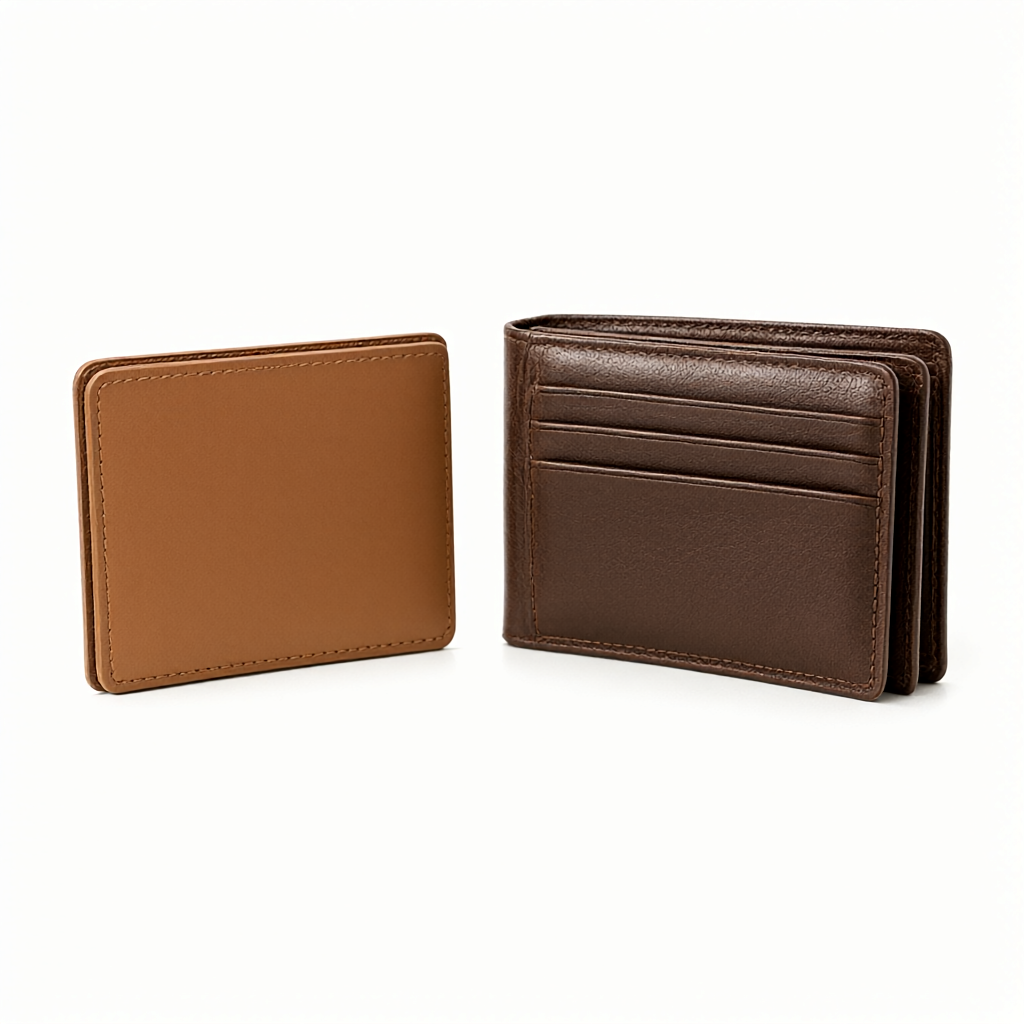
The structural difference is fundamental. A traditional bi-fold wallet relies on a folded sheet of material with multiple card slots on each side and an internal billfold compartment. It typically measures 4.5 × 3.5 inches when closed and can add 1.5 to 2 ounces of bulk to a pocket. A minimalist leather wallet eliminates the fold — it is a single-panel construction, often reinforced with metal springs, elastic straps, or rigid frames to maintain shape. Dimensions usually fall between 3.5 × 2.5 and 4 × 3 inches, with a profile of 0.4 to 0.8 inches depending on capacity.
Weight comparison illustrates the shift clearly:
| Wallet Type | Typical Weight | Typical Profile |
|---|---|---|
| Traditional bi-fold leather wallet | 3.0–4.5 oz | 1.5–2.0 in |
| Minimalist leather wallet (5–8 card capacity) | 1.5–2.5 oz | 0.4–0.8 in |
| Minimalist leather wallet (RFID-blocking, metal frame) | 2.0–3.0 oz | 0.5–1.0 in |
The practical result is a 40–60% reduction in pocket load for the average buyer. That weight saving becomes a meaningful selling point in product listings and marketing copy for retail partners.
What Types of Leather Are Used and Which Is Best for Bulk Procurement?
Leather grading determines durability, appearance, and unit cost. For B2B buyers, understanding the hierarchy matters because supplier quotes often conflate terms.
Full-Grain Leather
Full-grain leather retains the complete original grain layer, including natural markings. It is the most durable grade, develops a patina over time, and commands the highest wholesale price. For a slim leather wallet intended for long-term use, full-grain is the preferred choice. Expect lead times to be slightly longer due to material sourcing, but the end product justifies it for premium private-label lines.
Top-Grain Leather
Top-grain leather has been sanded or buffed to remove imperfections from the grain surface, then typically receives a finish coat. It is more uniform in appearance than full-grain and slightly more water-resistant due to the treatment. This is the most common choice for mid-tier B2B orders — it balances cost, consistency, and durability. For buyers referencing our leather wallet guide, top-grain consistently appears as the recommended grade for volume production where appearance uniformity matters.
Genuine Leather
“Genuine leather” is a legitimate industry term but is frequently misunderstood. In grading hierarchies, it refers to split leather — the lower layers of the hide that remain after the grain layer is separated. These splits are often coated with polyurethane or pigment to mimic the look of higher-grade leather. The result is functional but less breathable and less durable over repeated flex cycles. Buyers should verify whether a supplier uses genuine leather as a mid-tier option or as a misleading substitute for top-grain.
Bonded Leather
Bonded leather is a composite made from leather scraps bonded with adhesive and pressed into sheets. It is the least expensive option and suitable only for promotional or low-cost product lines. It lacks the fiber structure of real hides, so it cracks and delaminates faster under regular use. Avoid bonded leather for any brand positioning that depends on perceived quality.
What Are the Key Specifications for a Quality Minimalist Leather Wallet?
When evaluating a bulk minimalist leather wallet order, the following specifications determine whether the product will perform reliably in the hands of end consumers:
- Card capacity: 4 to 12 slots depending on form factor. A 6- to 8-card configuration is the industry sweet spot for the average user.
- Cash compartment: Integrated slip pocket or elastic band. Bifold-style cash slots defeat the minimalist purpose unless the design is specifically hybrid.
- Material thickness: 1.0 to 1.4 mm for top-grain; 1.2 to 1.6 mm for full-grain. Thinner leather may not survive repeated opening without reinforcement.
- Hardware grade: Stainless steel or zinc alloy frames and springs. Brass hardware tarnishes and may cause leather discoloration over time.
- Stitching density: Minimum 8 stitches per inch for edge reinforcement. Loose stitching is the most common field failure in budget production.
- Water resistance: Top-grain and full-grain leather resist light moisture naturally; bonded and coated genuine leather require additional treatment for wet conditions.
- RFID-blocking integration: See the standards section below for test methods.
What Standards and Certifications Should B2B Buyers Require?
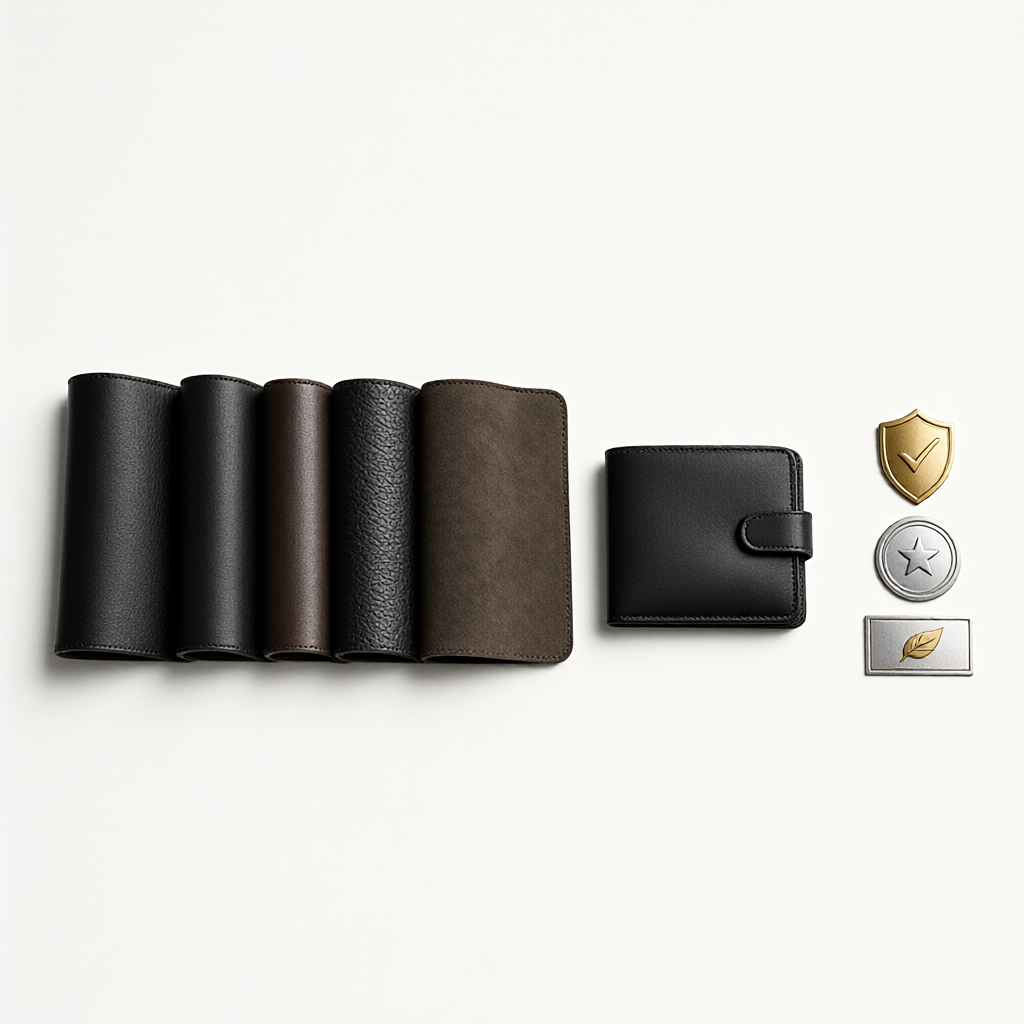
Compliance and quality systems are non-negotiable for serious procurement. Buyers should expect the following from qualified suppliers:
ISO 9001
This quality management standard verifies that the manufacturer has documented processes for design control, incoming material inspection, in-process quality checks, and final verification. It does not certify the leather itself — it certifies the consistency of production. A facility operating without ISO 9001 carries higher risk of batch-to-batch variation.
REACH and RoHS Compliance
These European regulations restrict hazardous substances in consumer goods. REACH covers chemical safety, and RoHS restricts heavy metals in components. Leather processing chemicals — particularly chromium VI in tanning — must fall within regulated limits. Reputable suppliers provide test reports from accredited laboratories such as SGS. Buyers should request these reports before placing a production order.
These European regulations restrict hazardous substances in consumer goods. REACH covers chemical safety, and RoHS restricts heavy metals in components. Leather processing chemicals — particularly chromium VI in tanning — must fall within regulated limits.
Specific thresholds buyers should require:
- Chromium VI: < 3 ppm per EN 15987 (EU leather safety standard)
- Pentachlorophenol (PCP): < 1 ppm per EN 71-9
- ALAR (1,2-cyclohexanedione): < 0.02 ppm per EU Regulation 1005/2011
- Zinc pyrithione: Not detected above 0.1 ppm
- Heavy metals (lead, cadmium, mercury, hexavalent chromium): Compliant with RoHS Directive 2011/65/EU limits
Reputable suppliers provide test reports from accredited laboratories such as SGS, Intertek, or TÜV. Buyers should request these reports — specifically the EN 15987 chromium VI test results — before placing a production order. Test reports should be no older than 12 months for current production batches.
BSCI Audit
The Business Social Compliance Initiative audit verifies ethical manufacturing practices. While not a product quality standard, it matters significantly for buyers in Western markets where retail partners and marketplaces increasingly require social compliance documentation. An audited facility reduces supply chain risk.
RFID-Blocking Standards
RFID-blocking technology is often marketed without technical backing. Legitimate claims should reference specific standards such as ISO/IEC 14443, which defines the operating parameters for proximity smart cards, or FIPS 201 for identification security. Blocking effectiveness depends on the conductive material used — typically a thin stainless steel mesh or ferrite layer embedded between leather layers. Buyers should verify the frequency range covered (13.56 MHz for most payment cards) and request shielding effectiveness data measured in decibels.
RFID-blocking technology is often marketed without technical backing. Legitimate claims should reference specific standards and test data.
Standards to reference:
- ISO/IEC 14443: Defines operating parameters for proximity smart cards (13.56 MHz)
- ASTM F2890-15: Standard Test Method for Measuring the Electromagnetic Shielding Effectiveness of Materials
- FIPS 201: Personal Identity Verification (PIV) for federal employees — specifies RFID shielding requirements for government-issued ID
Specific test values buyers should require:
- Shielding effectiveness: ≥ 30 dB attenuation at 13.56 MHz (reduces signal strength to < 0.03% of original)
- Frequency range covered: 125 kHz (low-frequency access cards) through 13.56 MHz (NFC/payment cards)
- Material composition: Typically 304 or 316L stainless steel mesh (200–400 mesh count) or ferrite sheet laminated between leather layers
- Test documentation: Third-party lab report from SGS, Intertek, or TÜV measuring dB attenuation across the target frequency band
Buyers should reject suppliers who cannot provide shielding effectiveness data measured in decibels at 13.56 MHz. Marketing claims of “RFID protection” without test reports are unreliable.
How Do MOQ, Lead Time, and Customization Options Affect Sourcing?
Several variables determine what a supplier can deliver and when:
- MOQ (Minimum Order Quantity): Industry-standard MOQ for custom minimalist leather wallets ranges from 300 to 500 pieces per design. Lower quantities are possible with standard stock designs, but customization — logo stamping, edge painting, packaging — typically requires a minimum run to justify tooling and setup costs.
- Sample lead time: A well-organized manufacturer can produce and ship samples within 5 to 7 business days after artwork and specification approval. This includes physical sampling, not just digital proofing.
- Production lead time: After sample approval, bulk production typically runs 20 to 35 days depending on order volume, leather sourcing availability, and finishing complexity. Custom packaging adds 5 to 7 days.
- Customization scope: Common options include laser engraving or hot stamping logos, embossing brand marks on leather, custom edge painting, personalized packaging, and insert cards or hang tags. UV printing on metal plates is also available for detailed branding.
- Private label readiness: For Amazon FBA product sourcing, suppliers should offer FNSKU labeling, poly bagging, bubble wrap insertion, and carton packing per Amazon’s requirements. This capability should be confirmed before contracting.
What Should You Consider When Evaluating a Manufacturer?
Evaluating a OEM leather wallet supplier requires assessing four dimensions:
Technical capability: Does the factory own its machining and finishing equipment, or does it outsource critical steps? In-house CNC machining, laser engraving, and leather treatment ensure tighter quality control and shorter iteration cycles between samples and production runs.
Material traceability: Can the supplier provide documentation for leather origin, tanning method (vegetable vs. chromium), and chemical compliance? A manufacturer that cannot answer these questions poses a compliance risk, especially for export to the EU and North America.
Quality control process: A reliable facility inspects incoming hides, checks stitch density and edge finishing during production, and performs random sampling before shipment. Request their QC checklist and defect tolerance thresholds — typical acceptable defect rates fall below 2% for premium orders.
Communication and responsiveness: Lead time commitments, sample iteration speed, and clarity on trade terms (FOB, CIF, EXW) reflect organizational maturity. Suppliers who provide detailed quotations with clear spec breakdowns are easier to manage at scale.
What Are Common Procurement Pitfalls to Avoid?
Several specification mismatches routinely cause problems in B2B leather wallet sourcing:
Confusing leather grades in quotations. A supplier may quote “genuine leather” at a price that assumes bonded leather. Always specify full-grain, top-grain, or split leather explicitly in your purchase order and contract.
Underestimating RFID testing requirements. A wallet marketed as RFID-blocking without verifiable test data exposes the buyer to regulatory risk and customer complaints. Require shielding effectiveness documentation in the 13.56 MHz range.
Overlooking packaging specifications. Retail-ready packaging adds cost and lead time. If you assume packaging is included in the unit price and it is not, the landed cost can increase by 15 to 25%.
Ignoring break-in expectations. Full-grain leather is firm when new and softens over 30 to 60 days of regular use. Top-grain with finish coating breaks in faster but shows wear patterns differently. Communicate this timeline to end consumers to prevent returns based on initial rigidity.
Missing certification timelines. Some certifications require annual renewal or renewal audits. If your retail partner requires an up-to-date BSCI report, confirm the facility’s audit date before signing.
How Does TOP EDC Wallet Approach Minimalist Leather Wallet Manufacturing?
The standards outlined above define what qualified manufacturing looks like, and here is how a production facility aligned to those standards operates.
Our approach to custom minimalist leather wallets begins with material selection — we source top-grain and full-grain hides with documented tanning processes and REACH compliance certificates. Each batch is inspected for grain consistency, thickness uniformity, and color match before cutting. Our in-house CNC machining handles metal frame fabrication, while laser engraving and edge painting are performed on-site, ensuring quality control at every stage rather than outsourcing to third parties.
For buyers working through private label leather wallet manufacturer programs, we offer design consultation from the initial sketch through sample approval. Our 7-day sample lead time allows rapid iteration, and our MOQ starts at 300 pcs per SKU for full OEM customization (100 pcs trial order available for stock finishes), which accommodates emerging brands and Amazon FBA sellers who need flexibility during product validation. Full-grain and top-grain options are available with RFID-blocking inserts tested against standard protocols, and we provide SGS-certified material reports alongside BSCI audit documentation for retail partners that require it.
Customization extends to logo application — laser engraving for precision, hot stamping for metallic finishes, and UV printing for full-color graphics on metal accent plates. Packaging is designed per your specifications, including retail boxes, hang tags, and FBA-compliant cartoning. We have built this capability over 13+ years of export experience, serving brands across North America, Europe, Australia, and Southeast Asia with a facility that produces 500,000+ units monthly while maintaining the inspection rigor that ISO 9001 certification requires.
How Leather Type Affects Durability and Break-In Period?
The durability and break-in behavior of a minimalist leather wallet depend heavily on the leather grade and tanning method used.
Full-grain leather is the most durable option and typically requires a break-in period of 30 to 60 days of regular use before it softens and conforms to the user’s pocket. During this period, the leather may feel stiff and the card slot tension can be tighter than expected. End consumers should be informed of this timeline to reduce returns based on initial rigidity. Full-grain leather develops a patina over time, which many buyers consider a premium quality signal.
Top-grain leather breaks in faster — usually within 14 to 30 days — because the surface has been sanded and finished, reducing initial stiffness. It offers consistent appearance across batches, which is critical for private label leather wallet production where uniformity matters. However, the finish coat can show wear patterns (scuffing, color variation) earlier than full-grain under heavy use.
Bonded and coated genuine leather do not meaningfully break in. They tend to crack, peel, or delaminate within 6 to 12 months of regular use, making them unsuitable for any brand positioning that depends on longevity or perceived quality.
When specifying leather for bulk orders, buyers should request:
- Tanning method documentation (vegetable-tanned vs. chromium-tanned)
- Expected break-in timeline from the supplier
- Flex-cycle test data (minimum 5,000 cycles without cracking for premium grades)
- Patina development samples for full-grain options
Leather Wallet Guide: Types, Grades & Procurement Specs provides a detailed breakdown of these leather categories.
Price Tiers and Value Comparison for Minimalist Leather Wallets
Understanding price tiers helps B2B buyers set realistic margins and communicate value to retail partners. The following ranges reflect typical FOB pricing for custom minimalist leather wallets based on material grade, customization depth, and order volume.
| Tier | Material | Typical MOQ | Unit Price Range (USD) | Best For |
|---|---|---|---|---|
| Budget | Bonded / coated genuine leather | 500+ pcs | $1.50 – $3.50 | Promotional products, low-cost retail |
| Mid-tier | Top-grain leather, standard hardware | 200–500 pcs | $3.50 – $7.00 | Amazon FBA sellers, private label brands |
| Premium | Full-grain leather, CNC-machined frames, RFID-blocking | 100–300 pcs | $7.00 – $14.00 | Premium EDC brands, corporate gifting |
| Ultra-premium | Full-grain vegetable-tanned, titanium hardware, custom engraving | 100+ pcs | $14.00 – $25.00 | Luxury EDC lines, limited editions |
Key value drivers:
- Material grade accounts for 40–60% of unit cost variance between tiers.
- RFID-blocking inserts add $0.50–$1.50 per unit depending on shielding effectiveness.
- Custom packaging (retail boxes, hang tags, FBA cartoning) adds $0.30–$1.20 per unit.
- Logo application method (laser engraving vs. hot stamping vs. UV printing) varies by $0.10–$0.50 per unit.
- Order volume typically yields 10–25% unit cost reduction at 1,000+ pieces versus 300-piece minimums.
Cost-per-use analysis is a useful framing tool for retail buyers. A $8 mid-tier wallet used daily over 3 years (1,095 days) costs approximately $0.007 per day, while a $14 premium wallet lasts 5+ years with proper care, reducing cost-per-use to $0.008. Both are competitive against traditional bi-fold wallets priced at $15–$40 retail that may need replacement after 1–2 years.
Updated ISO 9001 Section with Specific Compliance Details
OEKO-TEX Standard 100
OEKO-TEX Standard 100 certifies that leather components have been tested for harmful substances and are safe for human use. This certification is increasingly required by European and North American retail partners.
Class I requirements (closest skin contact — wallets qualify):
- Formaldehyde: < 30 ppm
- pH value: 5.0 – 7.5
- Nickel release: < 0.5 µg/cm²/week
- Azo dyes: Not detected above 30 mg/kg
- Pest控制 residues: Compliant with EU pesticide regulations
Procurement Decision Framework — Weighted Scoring Matrix
B2B buyers should evaluate suppliers using a weighted scoring matrix that balances material quality, compliance documentation, and cost. The following framework assigns weights based on typical priority for minimalist leather wallet procurement:
| Evaluation Criteria | Weight | Scoring (1–10) | Weighted Score |
|---|---|---|---|
| Leather grade and material traceability | 25% | ||
| Compliance certifications (ISO 9001, REACH, OEKO-TEX) | 20% | ||
| Stitch quality and construction durability | 15% | ||
| RFID-blocking test data (ASTM F2890-15) | 10% | ||
| MOQ flexibility and sample lead time | 10% | ||
| Unit pricing and volume discounts | 10% | ||
| Customization capabilities (engraving, packaging) | 5% | ||
| Communication responsiveness and trade terms clarity | 5% | ||
| Total | 100% | / 100 |
Interpretation guidelines:
- 80–100: Qualified supplier — proceed to sample request
- 60–79: Conditional qualification — request additional documentation or clarifications
- Below 60: Do not proceed — address gaps before engagement
Buyer Checklist and Red Flags
Pre-Sourcing Checklist
Before engaging a manufacturer, verify the following:
- [ ] ISO 9001 certificate issued within last 12 months
- [ ] REACH compliance test reports (EN 15987 chromium VI < 3 ppm)
- [ ] OEKO-TEX Standard 100 Class I certification (if required by market)
- [ ] RFID-blocking shielding effectiveness data ≥ 30 dB at 13.56 MHz (ASTM F2890-15)
- [ ] Material mill certificates for leather (tanning method, hide origin, thickness tolerance ±0.1 mm)
- [ ] Stitch density specification (minimum 8 stitches per inch)
- [ ] BSCI audit report dated within 24 months
- [ ] Sample lead time commitment (7 days or less)
- [ ] Production lead time commitment (20–35 days standard)
- [ ] MOQ flexibility documentation
- [ ] Customization capability examples (logo methods, packaging options)
- [ ] FOB/CIF/EXW trade term clarity in quotation
- [ ] Defect tolerance threshold (acceptable rate < 2% for premium orders)
- [ ] Reference from at least one existing brand customer in your target market
Red Flags — Suppliers to Avoid
| Red Flag | Why It Matters |
|---|---|
| Cannot provide stitch density specifications | Loose stitching is the #1 field failure in budget production; unknown stitch count indicates lack of QC process |
| Cannot provide material mill certificates | No traceability = compliance risk; unable to verify tanning method or hide origin |
| RFID claims without ASTM F2890-15 test data | Unverifiable shielding effectiveness; regulatory and customer complaint risk |
| No ISO 9001 certification | Higher batch-to-batch variation risk; inconsistent quality across production runs |
| Unit pricing significantly below market average (< $1.50 for top-grain) | Likely using bonded leather or skipping compliance testing; quality compromise |
| Cannot provide REACH/EN 15987 chromium VI test results | Non-compliance with EU chemical regulations; shipment rejection risk |
| No sample lead time commitment or > 14-day sampling | Indicates disorganized production planning; delays cascade into bulk production |
| Refuses to share BSCI audit report | Social compliance risk for Western retail partners; potential supply chain disruption |
| No defect tolerance threshold defined | Unclear quality expectations; disputes over acceptable quality levels at shipment |
| Vague or incomplete quotation (no spec breakdown) | Hidden costs likely; unclear scope leads to change orders and budget overruns |
Sources & References
- ISO/IEC 14443 — www.iso.org
- leather wallet guide — topedcwallet.com
- Get a Free Quote → — topedcwallet.com
From article to product
Choosing a material for a range?
Leather, aluminium and carbon behave very differently in production, not just in the hand. Send us the spec and we will tell you what it costs to make at your volume.
Keep reading
More on wallet materials
Vegetable Tanned Leather for Wallet Programmes
“Vegetable tanned” is a marketing phrase with a technical meaning, and the two do…
ReadRecycled Aluminium in Wallet Shells: Verifiable Claims
“Recycled aluminium” is a claim about provenance, and the wallet shell in your hand…
ReadFashion Zipper Men’s Wallets Leather Short Design Guide
Learn how to choose a short zipper leather wallet for men — full grain…
Read
About the author
TOPWALLET Editorial Team
TOPWALLET's editorial and engineering desk writes from bench testing at the Shenzhen (Longgang) facility: pull-force and cycle testing, 13.56 MHz shielding measurements, finish trials and factory audits, rather than supplier spec sheets. Every specification in these guides is one we write on a purchase order.
Written on the floor
This article was written by our production and QC team — the people who spec tolerances, run the finishing line and inspect every batch. Where it states a capacity, a pull force or a lead time, it comes from a measurement we made, not a supplier’s catalogue. If a number here disagrees with what your own supplier told you, tell us; several of these articles started as a correction from a buyer.
See how the factory works · Inspection process · Sourcing FAQ
Choosing a material for a range?
Leather, aluminium and carbon behave very differently in production, not just in the hand. Send us the spec and we will tell you what it costs to make at your volume.