

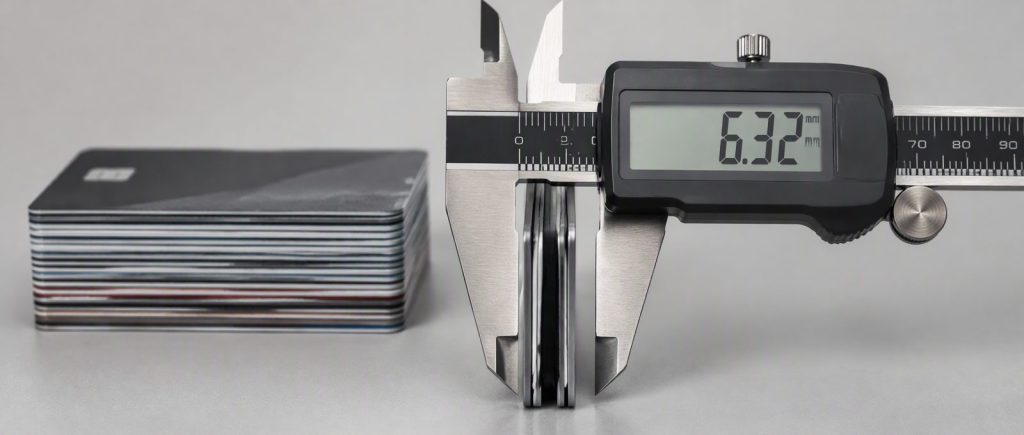
A slim wallet measures 8–15 mm when loaded with 4–8 cards, depending on card thickness and frame design. Most people don’t need a wallet thinner than that — they need the right card count. Below 8 mm loaded, you start trading away capacity; above 15 mm loaded, a front pocket starts to feel like a brick. The useful target is 10–13 mm loaded with your daily carry.
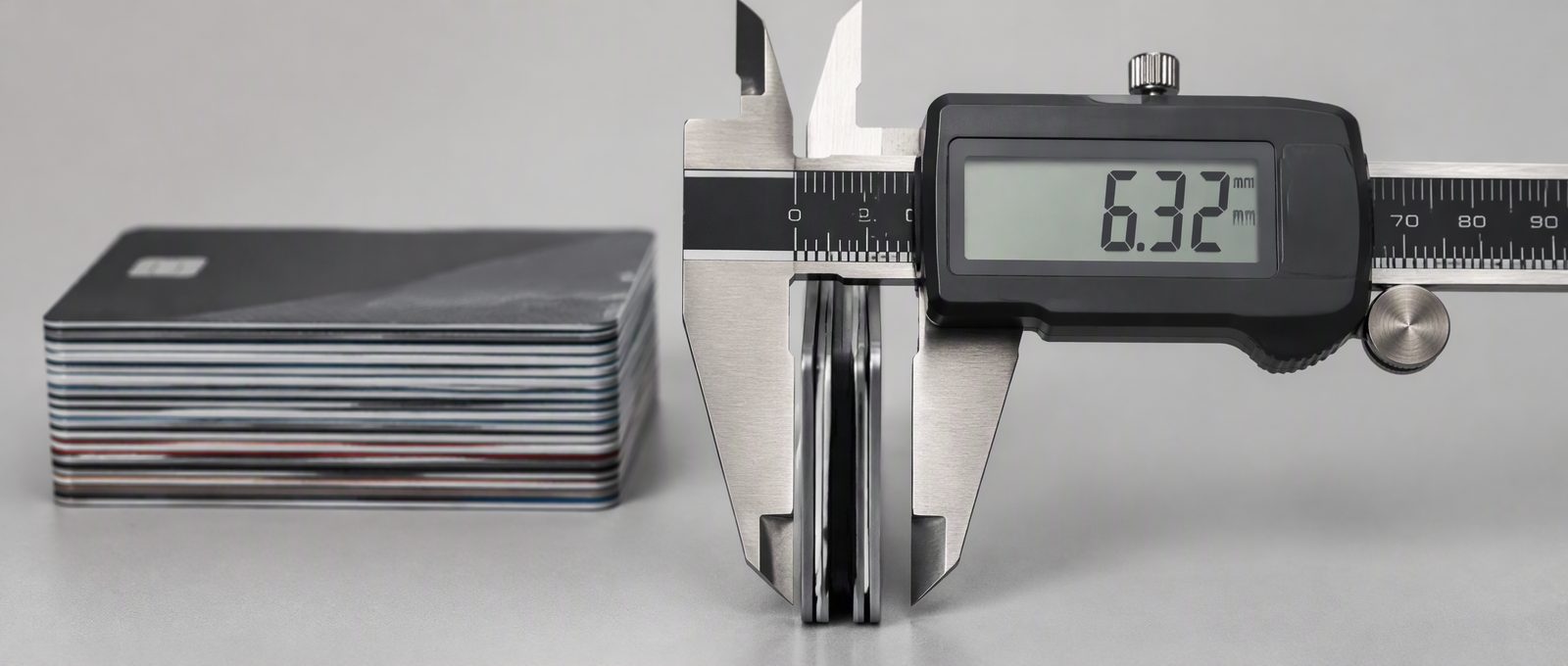
We manufacture metal wallets in our Dongguan factory, which means we measure thickness on finished units daily, not just in CAD. This guide uses those measurements plus the published card standard (ISO/IEC 7810 ID-1: 0.76 mm per card) to give you a benchmark you can check at home with a caliper or a ruler.
Why Thickness Is the Metric That Matters
Width and height are decided for you by your pockets and card slots. Thickness is the only dimension you control, and it’s the one that decides whether a wallet rides comfortably or leaves a welt in your thigh after a day sitting.
The math is simple but most buyers skip it:
Total thickness ≈ frame/shell + (number of cards × card thickness) + folding/stacking overhead
A standard credit card is 0.76 mm. Six cards is 4.6 mm of pure card. Add a metal shell at 4–6 mm and you’re at 9–11 mm before you carry a single bill. That’s why thin claims on product pages almost never survive contact with a real stack of cards.
Thickness Benchmarks by Wallet Type
Here’s how wallet categories actually measure up, loaded with 6 cards plus 3 folded bills — the way most people actually carry.
| Wallet type | Empty | Loaded (6 cards + cash) | Typical materials |
|---|---|---|---|
| Trifold leather | 12–18 mm | 18–28 mm | Leather, stitching, 2+ card layers |
| Bifold leather | 10–14 mm | 14–22 mm | Leather, stitching |
| Slim leather/card holder | 6–9 mm | 10–15 mm | Thin leather, 1–2 layers |
| Metal minimalist | 4–8 mm | 9–13 mm | Aluminum/titanium shell |
| Metal + mechanism (pop-up/ejector) | 6–10 mm | 11–15 mm | Aluminum + internal mechanism |
| Carbon fiber | 4–7 mm | 9–12 mm | Carbon plate + frame |
| Money clip wallet | 5–8 mm | 9–13 mm | Metal + clip or strap |
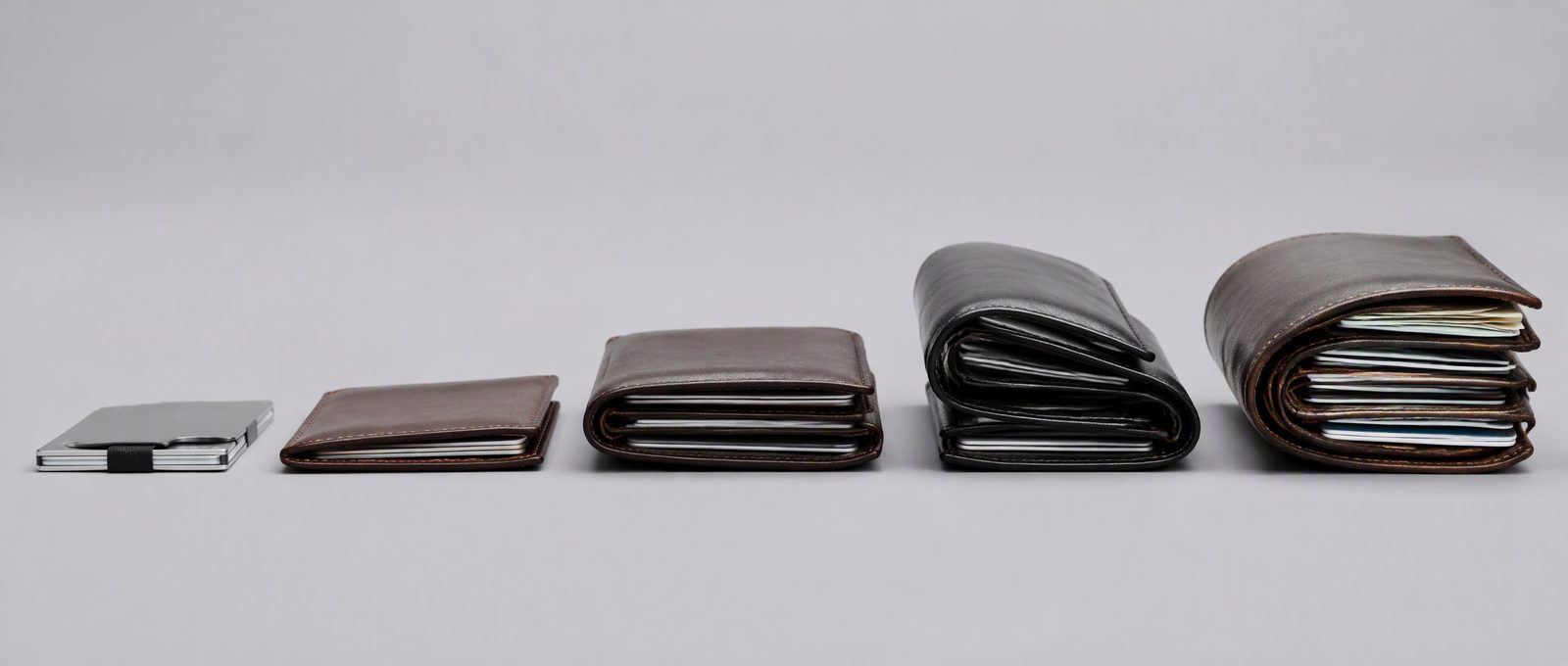
Ranges come from measuring production units across these categories in our factory. The headline finding: the category doesn’t decide the thickness — the card count does. A leather bifold with 4 cards is thinner than a minimalist metal wallet with 12.
The Loaded Benchmark Table: What “Slim” Actually Means
Use this as your decision table. Find the card count you carry, then check the target.
| Cards carried | Target loaded thickness | Feels like | Category that fits |
|---|---|---|---|
| 2–4 | 7–9 mm | Disappears in pocket | Card holder, titanium minimalist |
| 5–7 | 9–12 mm | Comfortable, noticeable | Metal minimalist, slim leather |
| 8–10 | 12–15 mm | Fills the pocket, still fine | Bifold, larger metal frame |
| 11–14 | 15–20 mm | Bulky front pocket | Trifold, travel organizer |
| 15+ | 20 mm+ | Back-pocket wallet | Trifold, anything — you’re carrying a wallet pouch |
If you’re at 10+ cards, stop buying “slim” wallets and fix the card problem first. Our guide on how many cards should you carry walks through what actually needs to live in your wallet versus what should live in a drawer.
Front Pocket vs. Back Pocket: The 15 mm Line
The practical ceiling for front-pocket carry is about 15 mm loaded. Above that, sitting down with the wallet in your front pocket gets uncomfortable, and it starts pressing on the hip joint rather than riding flat.
Back-pocket carry tolerates more (up to 20–22 mm) because the hip distributes the load — but back-pocket wallets also cause the posture issues most people never connect to their EDC. If you carry in the back pocket, see the posture notes in wallet back pain before assuming thickness is the only variable.
For most men’s pants, a loaded wallet over 15 mm also starts to deform the pocket seam over months of daily use. That’s a wear pattern we see on returned trade-in units constantly.
Metal Wallet Thickness: Where the Marketing Runs Ahead of Reality
Metal wallets earn their “slim” label honestly at 4–8 mm empty — then buyers load them and wonder what happened. Because a rigid shell can’t flex, metal wallets show thickness more harshly than leather. Leather compresses and drapes; aluminum doesn’t.
Two rules from our production floor:
- Card capacity claims are measured empty. A “12-card” metal frame at 12 cards measures 14–16 mm loaded. That’s no longer a slim wallet. See how many cards fit in a wallet for the real per-frame numbers.
- Mechanisms add 2–3 mm. Pop-up and ejector wallets carry an internal mechanism, and that sandwich shows up in the loaded number. pop up card mechanism explained covers what the mechanism costs in pocket profile.
If a metal wallet is your goal, the honest draw is 4–8 cards. At that count, aluminum and titanium frames hit 9–11 mm loaded and genuinely disappear in a front pocket. Compare the real geometries in best titanium wallets and best aluminum wallets before you buy on an empty spec sheet.
How to Measure Your Own Wallet Right Now
You don’t need a caliper to benchmark your wallet — a ruler works within a millimeter. Do this:
- Load the wallet exactly as you carry it (this is not a jewelry measurement).
- Place it flat on a table, ruler standing on its edge beside it.
- Read the highest point. That’s your real thickness.
Then ask three questions:
- Is it under 15 mm loaded? Front-pocket comfort zone. Done.
- Between 15–20 mm? Fine in a back pocket, marginal in front.
- Over 20 mm? You’ve got a card-count issue, not a wallet issue. Cut cards to 6–8 first — how to organize your wallet cards is the fastest fix.
If you’re shopping for a replacement instead, review best slim wallets with the loaded benchmark from this guide in hand — the two together are the whole buying process: know your number, then pick the wallet that hits it.
What the Factory Measures That Reviews Don’t
Product pages publish empty thickness because it’s the flattering number. We publish the loaded number for our own cost-down and QC work, because loaded thickness is what customers actually feel. That’s also why our packaging spec caps foam padding at 3 mm — padding doesn’t help the pocket, it helps the box photo.
One more factory detail: anodized and coated layers add 0.02–0.05 mm per side, which is nothing. The real variance in thickness comes from card stacking tolerances, not finishes. Two units from the same batch measure within 0.5 mm of each other after assembly — that’s the precision our 4-stage inspection process holds, run under ISO 9001:2015 with AQL 2.5 sampling in our Dongguan facility. We’ve applied the same measurement discipline across 200+ private-label brands and about 50,000 units of monthly production, so a loaded-thickness spec sheet is a standard deliverable, not a favor. If you’re buying OEM, ask any factory for one — a factory that can measure it can control it. Samples ship in about 7 days; production runs in about 30 days. If you’re planning a branded run, wallet quality control checklist lists exactly what to verify before production.
FAQ
What is a good wallet thickness?
10–13 mm loaded with your daily card count is the comfortable target. Under 8 mm loaded means you’ve cut capacity or use ultralight materials.
How thick is a normal wallet?
A typical bifold runs 14–22 mm loaded with 6+ cards. Trifolds run thicker, 18–28 mm. “Normal” is thicker than most people want — which is why the slim category exists.
How many mm is a card?
A standard ISO/IEC 7810 ID-1 card (credit, debit, ID) is 0.76 mm. Folded bills add roughly 1 mm per 3 bills folded once into a typical money slot.
Is 15 mm wallet thick?
15 mm loaded is about the ceiling for front-pocket comfort. Below 15 feels fine for most men; above it, you notice the wallet when sitting.
Are metal wallets thinner than leather?
Empty, yes: 4–8 mm vs 10–14 mm. Loaded with the same cards, the gap narrows to 2–4 mm because metal shells can’t flex and leather drapes.
Does wallet thickness matter for back pain?
It’s one input. Thick back-pocket wallets alter sitting posture and contribute to hip and lower-back strain over time. wallet back pain covers the mechanics.
What’s the thinnest wallet that still holds 6 cards?
About 8–10 mm loaded with a metal or carbon-fiber frame. Below that, you’re at 4 cards or fewer.
Can a factory make a custom-waist wallet to my thickness spec?
Yes. Loaded thickness is a design parameter we engineer to, not a side effect. Get OEM Pricing for your target dimensions and card count.
The Bottom Line
Slim isn’t a number on a spec sheet — it’s your wallet, loaded, in your pocket. Benchmark at 10–13 mm loaded for everyday comfort, treat 15 mm as the front-pocket ceiling, and fix your card count before you blame the wallet. Thickness is engineering; capacity is a habit. Ask Our Factory Team about your target spec, or Request a Quote for a production run built to it.
From article to product
Sourcing minimalist-wallets?
Tell us the format, the quantity and the date you need stock. You get material options, MOQ and a landed-cost range back within one business day.
Keep reading
More on wallet types
Front Pocket Wallets: The Complete Guide to Slim Front Carry
A front pocket wallet is a slim, low-profile wallet designed to ride in the…
ReadMinimalist Wallets Explained: What “Minimalist” Really Means
A minimalist wallet is not simply a small wallet. It is a carry system…
ReadMoney Clip Wallets: Design, Pros and Cons
A money clip wallet is a cash-first carry that pairs a metal clip, spring…
Read
About the author
Wu, Leon
Leon Wu is the senior product engineer and EDC testing lead at TOPWALLET. He has spent more than a decade on wallet design-for-manufacture, materials and quality control at the company's Dongguan facility, and writes from bench testing, pull-force and 13.56 MHz shielding measurements rather than supplier spec sheets.
Written on the floor
This article was written by our production and QC team — the people who spec tolerances, run the finishing line and inspect every batch. Where it states a capacity, a pull force or a lead time, it comes from a measurement we made, not a supplier’s catalogue. If a number here disagrees with what your own supplier told you, tell us; several of these articles started as a correction from a buyer.
See how the factory works · Inspection process · Sourcing FAQ
Sourcing minimalist-wallets?
Tell us the format, the quantity and the date you need stock. You get material options, MOQ and a landed-cost range back within one business day.