

Mens Billfold Wallets: What Is the Quick Answer?
What is a men’s billfold wallet? A men’s billfold wallet is a compact folding wallet — traditionally bifold or trifold — designed for everyday carry. Modern versions increasingly shift from leather to slim metal and carbon fiber constructions, often integrating RFID blocking, minimalist card slots, and custom branding options. For B2B buyers, the core evaluation centers on material selection, RFID standard compliance, card capacity, and customization capability before any sourcing decision is made.
The shift toward minimalist wallets and metal billfolds reflects changing consumer expectations: buyers want durable, professional-looking pocket gear that holds fewer cards more securely, while Amazon FBA sellers and private-label brands want products that differentiate on shelf and convert through clear spec sheets.
Mens Billfold Wallets: How Does It Work in Detail?
How does RFID blocking work in modern billfolds?
RFID blocking in billfold wallets operates on the same principle as a Faraday cage: a continuous conductive layer inside the wallet intercepts radio-frequency signals before they reach the card chip. Most modern implementations use a thin metal mesh or foil laminate positioned between the outer shell and the inner card sleeves. When a contactless payment card, passport, or ID enters the wallet, the blocking layer disrupts the electromagnetic field that an unauthorized reader would need to communicate with the card’s antenna.
Not all blocking products perform equally. The critical distinction for B2B buyers is which standard the product has been tested against. Major reference frameworks include:
- ISO/IEC 14443 (proximity card communication standard) — defines how close a reader must be and at what frequency (typically 13.56 MHz) to attempt communication.
- FIPS 201 (U.S. federal standard for personal identity verification) — specifies test methods for RFID security, including signal attenuation thresholds.
- EMF Shielding effectiveness ratings — measured in decibels (dB); a well-designed blocking wallet typically achieves 20 dB or greater attenuation at 13.56 MHz.
A buyer should ask suppliers for test reports referencing these standards, not just a claim of “RFID protection.” Products tested to FIPS 201 or similar frameworks provide verifiable assurance, which matters especially for corporate gift programs and government-adjacent procurement.
What materials are most common for men’s minimalist wallets?
The material you choose determines the wallet’s durability profile, weight, perceived value, and price point. The four dominant materials in contemporary billfold production are:
| Material | Durability | Weight | Cost Position | Best For |
|---|---|---|---|---|
| Aluminum (6061-T6) | High — scratch resistant, anodized surface | Light (~40–60 g) | Low–Mid | Everyday carry, budget-conscious private label |
| Titanium (Grades 1–5) | Very high — corrosion resistant, premium feel | Light (~60–80 g) | High | Premium EDC, luxury corporate gifts |
| Carbon Fiber | High — lightweight and rigid | Very light (~30–50 g) | Mid–High | Minimalist EDC, outdoor-oriented buyers |
| Genuine Leather | Moderate — develops patina, requires care | Medium (~50–90 g) | Low–High (grade-dependent) | Traditional aesthetics, formal carry |
Aluminum is the volume leader in the minimalist wallet space. Anodized 6061-T6 aluminum offers a hard, wear-resistant surface that accepts color through the anodizing process, enabling brand-consistent finishes without paint. It is the go-to material for high-volume Amazon FBA and retail chain procurement where consistent color and acceptable durability are required at competitive cost.
Titanium sits at the premium end. Grade 5 titanium (Ti-6Al-4V) is significantly harder than aluminum and far more resistant to scratching and corrosion, making it suitable for outdoor and tactical use cases. The material command a a higher unit cost, but the perceived value justifies it for limited-edition runs and高端 brand positioning.
Carbon fiber combines exceptional stiffness with minimal weight. The material is layered and cured under heat and pressure, then finished with a resin coating. It resists impact better than aluminum but can chip at the edges if subjected to severe abrasion. For buyers evaluating carbon fiber versus metal billfolds men, the trade-off is weight savings versus long-term edge durability.
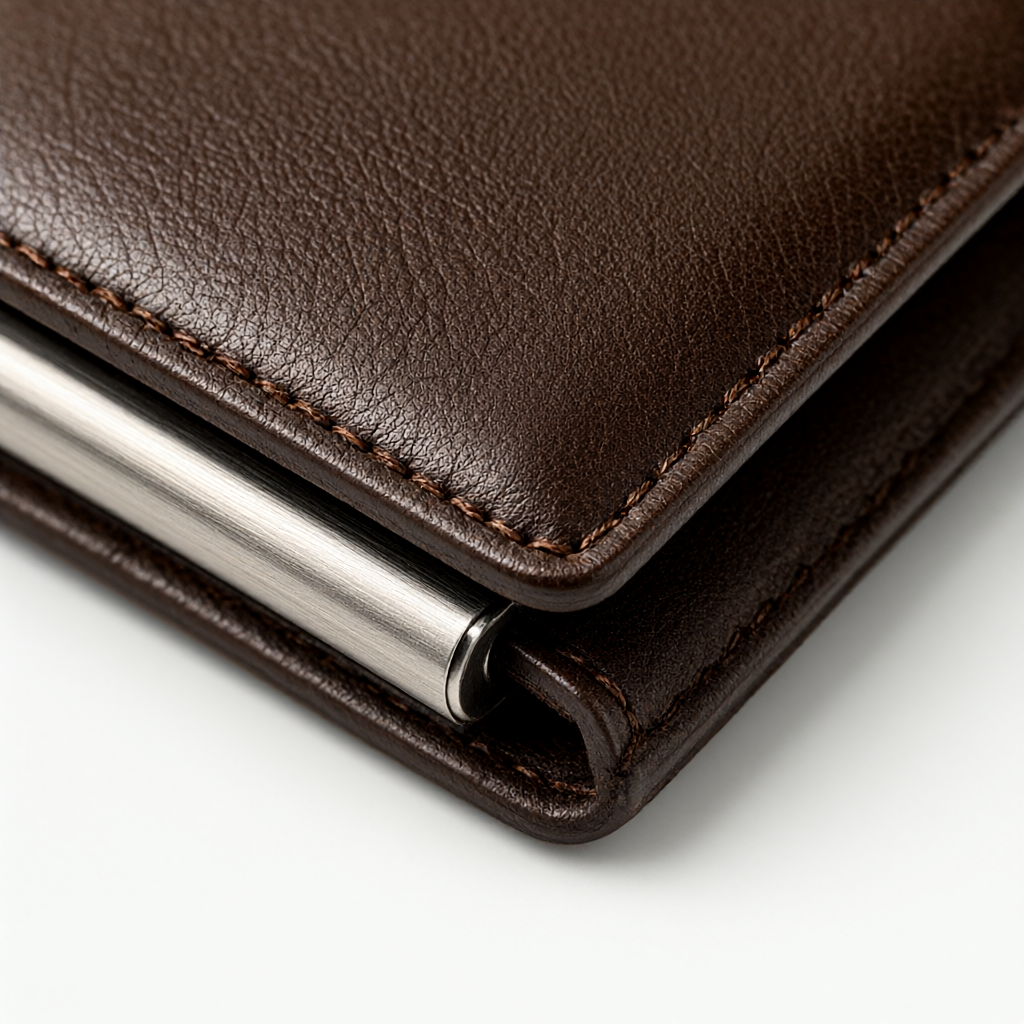
Leather remains relevant but requires careful sourcing. Full-grain leather is the highest quality tier — it retains the natural grain and develops a patina over time. “Genuine leather” is a lower-grade term that may include bonded or split leather. Buyers should specify the leather grade in their purchase agreement to avoid misrepresentation. See our guide on leather wallet sourcing specifications for deeper detail on grading and procurement traps.
The choice among these materials also interacts with the target market. European buyers often favor aluminum and carbon fiber for their sustainability narrative and low maintenance. Southeast Asian and North American buyers show strong demand for both metal and leather options depending on whether the end user is an outdoor enthusiast or a corporate professional.
Why do men’s billfold wallets matter for B2B sourcing?
The global EDC market has pushed billfold wallets away from bulky traditional designs toward slim, functional forms. This shift creates specific sourcing implications:
- Lower unit weight reduces shipping costs — important for Amazon FBA sellers operating under weight-based fulfillment fees.
- Material consistency is easier to verify — metal and carbon fiber wallets have fewer variability issues than leather, which can wrinkle, stretch, or discolor.
- Customization complexity is higher with metals — laser engraving and anodizing require tooling setup, but the result is a permanent, high-quality brand application that outlasts printed labels.
Understanding these dynamics helps buyers make informed sourcing decisions rather than defaulting to familiar leather suppliers when the market has moved toward metal and composite constructions.
Mens Billfold Wallets: Which Specifications Matter Most?
What are the key specs for billfolds men?
When evaluating men’s wallets, buyers should define specifications around four dimensions: capacity, physical dimensions, weight, and construction type.
Card capacity typically ranges from 4 to 16 slots depending on design. A standard bifold billfold holds 6–10 cards plus folded cash. Slim metal wallets commonly hold 6–12 cards in a single-stack or expandable configuration. Card slot tension is a critical specification — slots that are too tight make cards difficult to remove; slots that are too loose cause cards to fall out. Reputable manufacturers test slot retention under repeated insertion and removal cycles.
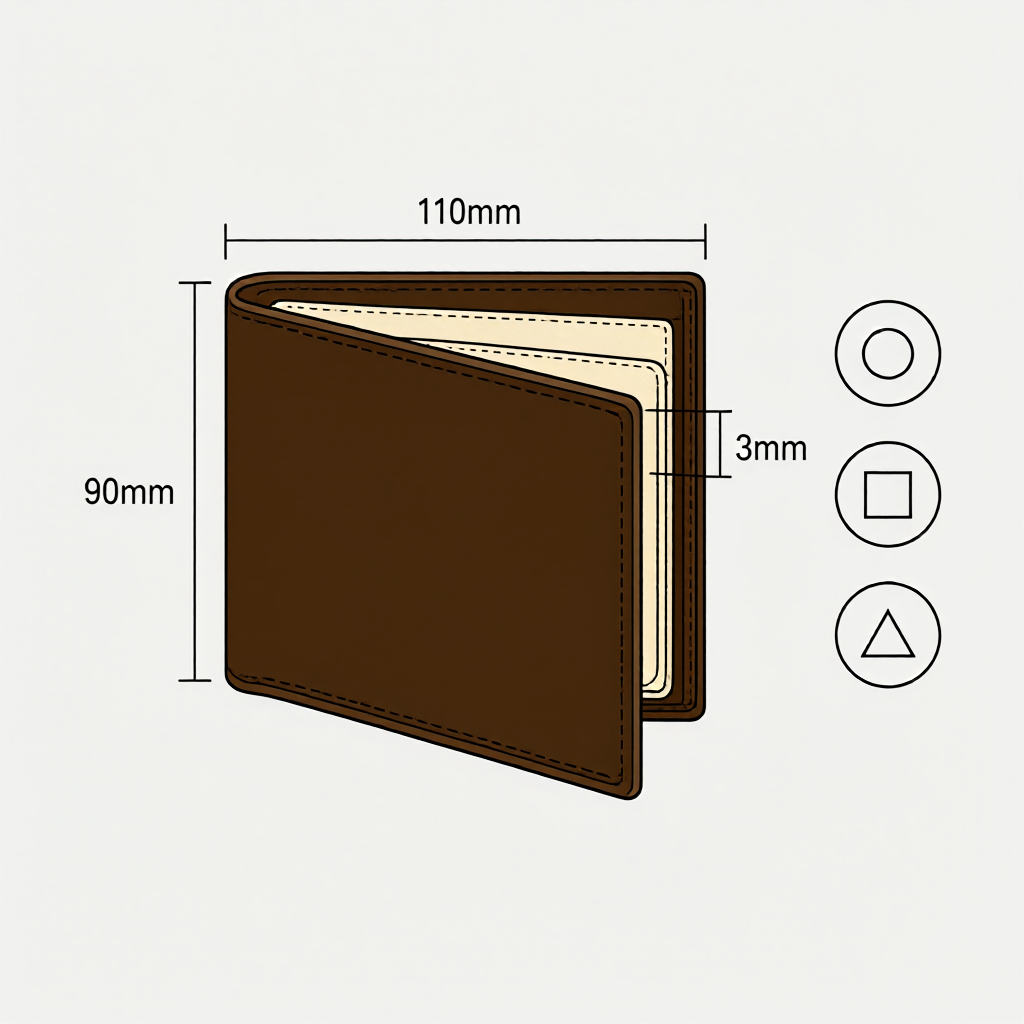
Physical dimensions for a standard men’s bifold wallet approximate 115 × 90 mm (folded). Slim metal variants compress this to roughly 85 × 60 mm or 90 × 65 mm. Thickness is the differentiator: traditional leather bi-folds measure 12–18 mm when loaded; metal and carbon fiber versions range from 3 to 8 mm. This slim profile is what distinguishes a minimalist wallet men choices from conventional designs.
Weight varies by material and card load. An unloaded aluminum wallet typically weighs 40–60 g; a titanium model 60–90 g. A loaded carbon fiber holder sits in the 50–70 g range. Weight directly influences pocket comfort and is a frequent comparison point for buyers evaluating metal billfolds men against leather alternatives.
Construction types include:
- Bifold — traditional fold-over design, usually 2–4 card slots per side
- Trifold — three-panel fold, historically common but declining in popularity due to bulk
- Money clip wallet — combines a card sleeve with a metal clip for cash
- Card holder — a slim, single-plane organizer without cash storage; see our card holder sourcing guide for specifications
- Tactical wallet — rugged construction, often with added tools or MOLLE-compatible features
For Amazon FBA and private-label buyers, the bifold and money clip wallet formats dominate volume. The card holder format appeals to ultra-minimalist buyers who carry only a few essential cards. Understanding which format your target market prefers should drive your initial material and specification choices.
Mens Billfold Wallets: Which Standards and Certifications Apply?
What standards apply to men’s billfold wallets?
B2B buyers should verify three categories of standards before placing an order: quality management, material compliance, and RFID performance.
Quality management standards ensure the manufacturer has a documented production system:
- ISO 9001 — certifies that the facility follows a quality management system covering process control, document control, and corrective action. For wallet manufacturing, this translates to consistent material incoming inspection, in-process checks, and final product testing.
- BSCI (Business Social Compliance Initiative) — audited facility standard addressing labor practices, health and safety, and ethical sourcing. Relevant for retailers and corporate buyers with supplier responsibility policies.
Material compliance standards govern restricted substances:
- REACH (EU Regulation 1907/2006) — restricts certain chemicals in products sold in the European Economic Area, including heavy metals and certain dyes used in leather treatments and anodizing processes.
- RoHS (Restriction of Hazardous Substances) — limits lead, mercury, cadmium, and other substances in electronic-adjacent products. While primarily targeting electronics, some buyers extend RoHS expectations to RFID-blocking wallets due to the integrated conductive layers.
Buyers should request a material test report or declaration of conformity for REACH and RoHS compliance, particularly when sourcing from new suppliers. SGS and other accredited labs can provide third-party verification.
RFID performance standards define measurable blocking effectiveness:
- FIPS 201 — U.S. federal standard specifying test procedures for RFID personal identity verification cards. Products claiming FIPS compliance should have test reports demonstrating signal attenuation at specified frequencies.
- ISO/IEC 14443 — international standard for proximity smart cards operating at 13.56 MHz. Blocking effectiveness is measured by the ability to prevent card reader communication at specified distances.
A supplier that can provide test data — not just a marketing claim — gives the buyer confidence that the product will perform as specified in real-world conditions.
Mens Billfold Wallets: What Else Should Buyers Consider?
What should you consider when sourcing men’s billfold wallets?
Several practical factors determine whether a sourcing relationship succeeds. These span customization, production logistics, and quality assurance.
Customization options fall into three tiers:
- Logo application — laser engraving on metal and carbon fiber surfaces is the most permanent and professional method. UV printing works on flat surfaces but may wear over time with pocket friction.
- Packaging — retail boxes, blind shipping, and branded inserts all affect shelf appeal and unboxing experience. Amazon FBA sellers require prep that meets Amazon’s packaging guidelines; corporate gift buyers need presentation boxes.
- Design modification — changing card slot count, adding a money clip, or altering dimensions requires design iteration and often new tooling. Lead time increases proportionally with customization depth.
See our EDC wallets and manufacturing guide for deeper coverage on how customization scales from concept to production.
MOQ and lead time are the two commercial factors buyers negotiate most often. Industry-typical ranges for metal and carbon fiber wallets:
- MOQ: 300–500 pcs for custom designs; 500–1,000 pcs for private-label runs with significant packaging changes
- Sample lead time: 5–10 business days for existing design samples; 10–15 days for custom prototypes
- Production lead time: 15–30 business days depending on order volume and customization complexity
Lower MOQs are common in the minimalist wallet men segment because many buyers start with small test orders before committing to larger runs. Suppliers who offer low MOQ without sacrificing quality control are relatively rare and represent a sourcing advantage.
Quality control during production should include:
- Incoming material inspection (alloy grade verification, carbon fiber layup quality)
- In-process dimensional checks (slot spacing, fold alignment, clip tension)
- Final inspection sampling (AQL-based, typically 2.5% for major defects)
- Function testing (RFID blocking verification on random samples, card insertion/removal cycles)
Ask your supplier about their QC checkpoints and whether they provide inspection reports with each shipment.
Sourcing scenarios also shape your evaluation criteria:
- Amazon FBA — prioritize fast sample turnaround, FBA-compliant packaging prep, and reliable on-time delivery
- Private label branding — prioritize logo quality, color matching, and packaging design support
- Corporate gift programs — prioritize branding consistency, gift-ready packaging, and bulk pricing tiers
- Retail chain procurement — prioritize certification documentation, consistent quality across shipments, and volume capacity
Each scenario weights the same factors differently, so clarify your buying context early in the supplier conversation.
How Manufacturers Approach These Standards?
For buyers evaluating whether a supplier can deliver on these specifications, the practical question is: does the manufacturer have the infrastructure and experience to produce consistent, compliant products at scale?
As a manufacturer, our approach to sourcing-ready billfold production is built around vertical integration and documented quality systems. Our 50,000 sq ft facility houses in-house CNC machining, laser engraving, and aluminum anodizing lines, which means we control the critical surface-finishing and precision-machining steps rather than outsourcing them. This control directly impacts consistency — the same alloy batch, the same anodizing cycle, and the same engraving parameters can be reproduced across production runs.
Our quality management framework is ISO 9001 certified, and our facility has passed BSCI social compliance audits. These certifications are not decorative: they require documented procedures for material incoming inspection, in-process quality checks, and corrective action when deviations occur. For buyers who need audit documentation for their own compliance requirements, these certifications provide verifiable evidence rather than verbal assurance.
On the materials side, we source aluminum alloys that meet standard mechanical property specifications, carbon fiber prepregs that meet tensile strength requirements, and titanium stocks appropriate for grade-specific applications. We also ensure all materials are REACH and RoHS compliant, with test reports available for customer review. For RFID-blocking products, we reference ISO/IEC 14443 and FIPS 201 test methodologies during our own quality checks.
Our typical sourcing parameters reflect the expectations of the B2B buyer:
- MOQ: starts at 300 pcs per SKU for full OEM customization (100 pcs trial order available for stock finishes) for custom designs, allowing brands to test markets with manageable inventory commitment
- Sample lead time: 7 days for existing design adaptations; longer for fully custom engineering
- Production lead time: 15–30 days depending on order size and customization depth
- Monthly capacity: 500,000+ units across all product lines
We have supported procurement for EDC brand owners, Amazon FBA sellers, promotional product distributors, and retail chains across North America, Europe, Australia, and Southeast Asia. For buyers at any stage of the awareness journey, the next step is a specification discussion — sharing your target material, card capacity, branding requirements, and volume expectations so we can provide an accurate quote and lead time estimate.
How customization options affect production time and cost?
Customization is not a single linear variable; it is a set of decisions that compound across the production timeline. Buyers should understand how each option shifts both cost and lead time before specifying requirements.
| Customization Tier | Typical Impact on Lead Time | Typical Cost Impact | Example |
|---|---|---|---|
| Logo only (laser engraved) | +3–5 days | +$0.50–$2.00 per unit | Existing wallet design, buyer-supplied vector file |
| Logo + custom packaging | +5–8 days | +$0.80–$3.00 per unit | Branded retail box with insert |
| Full design modification | +10–20 days | +$500–$3,000 tooling | New card slot layout, altered dimensions |
| Material change (e.g., aluminum → titanium) | +2–4 days | +$5–$15 per unit | Different raw material procurement |
| Multi-color anodizing | +3–7 days | +$1–$4 per unit | Additional masking and bath cycles |
The largest time and cost deltas come from design modifications, not branding. Changing the internal card slot configuration, for instance, requires CAD revision, prototype sampling, and often new jigs or fixtures. A buyer who specifies logo-only customization on an existing platform can typically move from inquiry to shipment in under 25 business days. A buyer requesting a fully custom design should plan for 35–50 business days from initial contact to first shipment.
Style and use-case guidance for men’s billfold wallets
Selecting the right wallet style depends heavily on how and where the end user carries it. Matching style to use case improves both customer satisfaction and return rates.
Everyday carry (EDC) — The most common use case. Buyers in this segment prioritize slim profile, RFID protection, and durable materials. Aluminum and carbon fiber wallets dominate here. Card capacity of 6–10 slots with a cash pocket is the sweet spot.
Formal / professional carry — Corporate professionals and business buyers often prefer leather or minimalist metal wallets in black, gunmetal, or navy finishes. Leather billfolds in full-grain or top-grain hide project tradition and professionalism. A slim metal wallet in brushed black anodized aluminum is also acceptable in modern corporate environments.
Travel and outdoor carry — Tactical-style wallets and money clip designs appeal to travelers and outdoor enthusiasts. Features like MOLLE compatibility, enhanced grip textures, and high-visibility color options matter in this segment. Titanium and ruggedized aluminum perform best under abrasive conditions.
Minimalist carry — Buyers who carry only 2–4 cards and minimal cash gravitate toward card holder formats. These prioritize slimness (under 6 mm) and light weight (under 50 g) over cash storage capacity.
| Use Case | Recommended Material | Recommended Format | Typical Card Capacity |
|---|---|---|---|
| Everyday carry | Anodized 6061-T6 aluminum | Bifold or money clip | 6–10 |
| Formal / professional | Full-grain leather or brushed titanium | Bifold or card holder | 4–8 |
| Travel / outdoor | Titanium or ruggedized aluminum | Tactical wallet or money clip | 4–6 |
| Minimalist | Carbon fiber | Card holder | 2–4 |
For more context on how format and material interact with buyer profiles, see our minimalist wallet buyer’s guide.
Care and maintenance for leather billfolds
Leather wallets require more maintenance than metal or carbon fiber alternatives, but proper care extends their lifespan significantly and preserves the aesthetic that many buyers expect.
Cleaning — Use a soft, dry microfiber cloth to remove surface dust and debris after each use. For deeper cleaning, apply a leather-specific cleaner sparingly with a damp cloth, then allow the wallet to air dry completely before reuse. Never soak leather or use household cleaners.
Conditioning — Apply a quality leather conditioner every 2–3 months for frequently used wallets, or every 6 months for occasional use. Conditioning prevents the leather from drying out, cracking, or losing flexibility. Over-conditioning should be avoided, as excess oil can attract dirt and darken the leather unevenly.
Storage — When not in use, store leather wallets in a cool, dry place away from direct sunlight. Prolonged UV exposure fades leather color and accelerates drying. Include a silica gel packet in storage to control moisture in humid climates.
Water exposure — Leather is hygroscopic and will absorb moisture. If a leather wallet gets wet, blot gently with a dry cloth and let it air dry at room temperature — never apply direct heat such as a hair dryer or radiator. Water stains can often be minimized by conditioning the leather once it is fully dry.
Buyers specifying leather wallets should communicate care instructions to end users through included documentation or packaging inserts. This reduces complaints about discoloration and cracking, which are the most common return reasons for leather products.
Procurement buyer checklist
Before engaging a supplier, B2B buyers should complete the following qualification protocol. This checklist reduces risk and ensures that both parties share the same expectations.
Supplier qualification questions:
- [ ] Is the facility ISO 9001 certified? Request a copy of the current certificate.
- [ ] Has the facility undergone BSCI or equivalent social compliance audit? Request the audit summary.
- [ ] What is the monthly production capacity? Verify with recent shipment records if possible.
- [ ] Can you provide REACH and RoHS test reports for materials used in current production?
- [ ] What RFID blocking test standards have your products been evaluated against? Request test data.
- [ ] What is your standard AQL inspection threshold, and do you provide inspection reports per shipment?
- [ ] Do you hold patents or design registrations for any wallet configurations?
Sample request protocol:
- [ ] Request a physical sample before placing any production order — never approve based on photos alone.
- [ ] Specify the exact material grade, finish color (Pantone if applicable), and logo placement on the sample request.
- [ ] Test the sample for: card slot tension, RFID blocking effectiveness, logo permanence, and dimensional accuracy.
- [ ] Submit the sample for third-party lab testing if the order value justifies it (recommended for orders above 1,000 units).
- [ ] Document any defects or deviations and communicate them to the supplier before authorizing production.
Quality acceptance criteria:
- [ ] Dimensional tolerance: ±0.5 mm on critical features (slot spacing, overall length/width)
- [ ] Surface finish: no visible scratches, chips, or discoloration exceeding 2 mm in any dimension
- [ ] Logo registration: position偏差 within ±1 mm of approved artwork proof
- [ ] RFID blocking: verified attenuation of ≥20 dB at 13.56 MHz on random sample basis
- [ ] Card retention: cards remain secure after 50 insertion/removal cycles with no loosening
- [ ] Packaging: compliant with Amazon FBA requirements if applicable; correct labeling and polybagging
Industry case studies
Real-world sourcing decisions often hinge on material specifications that appear minor on paper but have significant performance implications.
Case study 1 — Defect reduction through material specification: A North American private-label brand sourcing aluminum wallets for Amazon FBA reported a 40% reduction in customer complaints about scratching and fading after switching from unanodized 6061 aluminum to anodized 6061-T6. The unit cost increased by approximately $1.20 per wallet, but return rates dropped from 3.8% to 2.3%, resulting in a net profit improvement despite the higher material cost. The key lesson: specifying anodized alloy upfront avoids post-production quality failures that are far more expensive to remediate.
Case study 2 — Packaging-driven margin improvement: A European promotional product distributor replaced generic brown boxes with custom-printed retail packaging co-designed with their manufacturer. The packaging upgrade added $0.90 per unit but enabled a $4.50 increase in wholesale price, as retail buyers perceived the product as premium. The distributor moved from a mid-tier to a premium positioning in their catalog, and repeat order volume increased by 28% over six months.
Case study 3 — MOQ optimization for market testing: An Amazon FBA seller in Southeast Asia placed a 200-unit test order of carbon fiber card holders with custom laser engraving before committing to a 2,000-unit production run. The supplier’s low-MOQ policy (starts at 300 pcs per SKU) allowed the seller to validate market demand with minimal capital risk. After confirming sales velocity, the seller scaled to the larger order at a 15% volume discount, achieving a healthier per-unit margin on the second run.
Red flags: supplier deception tactics to watch for
The EDC wallet sourcing space contains several common misrepresentations that buyers should be able to detect before committing capital.
- “Titanium” when the product is aluminum with titanium PVD coating. Physical Properties Comparison: genuine titanium has a density of ~4.5 g/cm³ and a Brinell hardness of ~270 HB; PVD-coated aluminum has a density of ~2.7 g/cm³ and a base hardness of ~95 HB. A simple weight comparison or magnet test (titanium is non-magnetic; some aluminum alloys show slight magnetic response due to trace elements) can reveal the discrepancy. Always request material certification from an accredited lab.
- Claims of “military-grade” without referenced standards. The term is unregulated and meaningless in sourcing contexts. Ask which specific military standard (e.g., MIL-SPEC, NATO standard) the product complies with and request documentation.
- RFID-blocking claims without test reports. Any supplier stating their product blocks RFID should provide a test report from an accredited laboratory (SGS, TÜV, Intertek, or equivalent). A claim of “blocks all RFID” without data is unverifiable.
- Leather described as “genuine leather” without grade specification. As noted, “genuine leather” is a lowest-grade classification. Buyers should require the supplier to specify whether the material is full-grain, top-grain, split, or bonded leather, and include this specification in the purchase agreement.
- MOQ claims that seem too low for the level of customization requested. A supplier advertising 50-unit MOQs for fully custom-designed titanium wallets with multi-color anodizing should be treated with skepticism. Legitimate low-MOQ suppliers typically offer customization within defined parameters (existing designs with logo addition), not open-ended design-from-scratch work at small quantities.
Decision guide: matching buyer profiles to materials and MOQs
Different buyer types have fundamentally different priorities. Use this matrix to align your sourcing strategy with your business model.
| Buyer Profile | Primary Priority | Recommended Material | Recommended MOQ | Key Supplier Question |
|---|---|---|---|---|
| Amazon FBA seller | Fast turnaround, low defect rate, FBA-compliant packaging | Anodized 6061-T6 aluminum | 300–500 pcs | Can you meet FBA prep and labeling requirements? |
| Corporate gift buyer | Brand consistency, presentation quality, bulk pricing | Titanium or premium aluminum | 300–1,000 pcs | Can you provide gift-ready packaging and logo proofs? |
| Luxury/private-label brand | Material premium, unique design, exclusivity | Grade 5 titanium or carbon fiber | 500–2,000 pcs | Do you support full design customization and trademark protection? |
| Promotional product distributor | Cost competitiveness, speed, volume capacity | Aluminum or carbon fiber | 500–5,000 pcs | What volume discounts are available at 1K, 5K, and 10K units? |
| Retail chain buyer | Certification compliance, consistency, long-term supply reliability | Specified per category (metal or leather) | 1,000+ pcs | Can you provide ongoing ISO 9001 and BSCI audit access? |
No single supplier excels across all profiles. The most effective sourcing strategy matches the buyer’s profile to a supplier whose capabilities and minimums align with the required commitment level.
Mens Billfold Wallets: Where Can You Verify the Data and Sources?
- leather wallet sourcing specifications — topedcwallet.com
- card holder sourcing guide — topedcwallet.com
- EDC wallets and manufacturing guide — topedcwallet.com
- Get a Free Quote → — topedcwallet.com
- minimalist wallet buyer’s guide — topedcwallet.com
From article to product
Sourcing minimalist-wallets?
Tell us the format, the quantity and the date you need stock. You get material options, MOQ and a landed-cost range back within one business day.
Keep reading
More on wallet types
Thin Male Wallets: Buying Guide for Slim Minimalist Picks
How to choose a slim wallet for men — thickness thresholds, material trade-offs, capacity…
ReadStashed Wallet: A Minimalist Everyday-Carry Solution
Understand what a stashed wallet is, how minimalist slim wallets work, and what to…
ReadFolding Wallets: Types, Materials & Buying Guide
Learn what makes a folding wallet worth buying, from materials and card capacity to…
Read
About the author
TOPWALLET Editorial Team
TOPWALLET's editorial and engineering desk writes from bench testing at the Shenzhen (Longgang) facility: pull-force and cycle testing, 13.56 MHz shielding measurements, finish trials and factory audits, rather than supplier spec sheets. Every specification in these guides is one we write on a purchase order.
Written on the floor
This article was written by our production and QC team — the people who spec tolerances, run the finishing line and inspect every batch. Where it states a capacity, a pull force or a lead time, it comes from a measurement we made, not a supplier’s catalogue. If a number here disagrees with what your own supplier told you, tell us; several of these articles started as a correction from a buyer.
See how the factory works · Inspection process · Sourcing FAQ
Sourcing minimalist-wallets?
Tell us the format, the quantity and the date you need stock. You get material options, MOQ and a landed-cost range back within one business day.