

The best billfold wallet is determined by three measurable factors: material performance under daily carry conditions, card-carry capacity relative to pocket profile, and manufacturing quality verified through industry certifications. For everyday carry, anodized aluminum and titanium billfolds deliver the strongest durability-to-weight ratio, while carbon fiber wallets serve premium private-label positioning. For B2B buyers sourcing in bulk, the “best” billfold is the one that meets your target material specification, certification requirements, and MOQ threshold — not the one with the most marketing claims.
Quick Answer — What Is the Best Billfold Wallet for Everyday Carry and Business Use?
The best billfold wallet depends on the use case. For everyday carry, a slim metal billfold in aluminum or titanium offers the best balance of durability, card capacity, and profile. For corporate gifting and private-label programs, a carbon fiber wallet or RFID-blocking aluminum wallet typically delivers the strongest perceived value and margin potential. The decisive factors are material choice, card capacity, cash-carry method, and whether the supplier can handle OEM branding at your required MOQ.
There is no single winner across all scenarios. A titanium money clip excels for users who carry few cards but value lightweight performance. An aluminum billfold suits buyers who need to hold ten or more cards while keeping the pocket profile minimal. The “best” billfold is the one that matches the target user’s carry volume, budget tier, and branding requirements — which is why B2B buyers should evaluate specifications before brand names.
Detailed Explanation
How Does RFID Blocking Work in Metal Wallets?
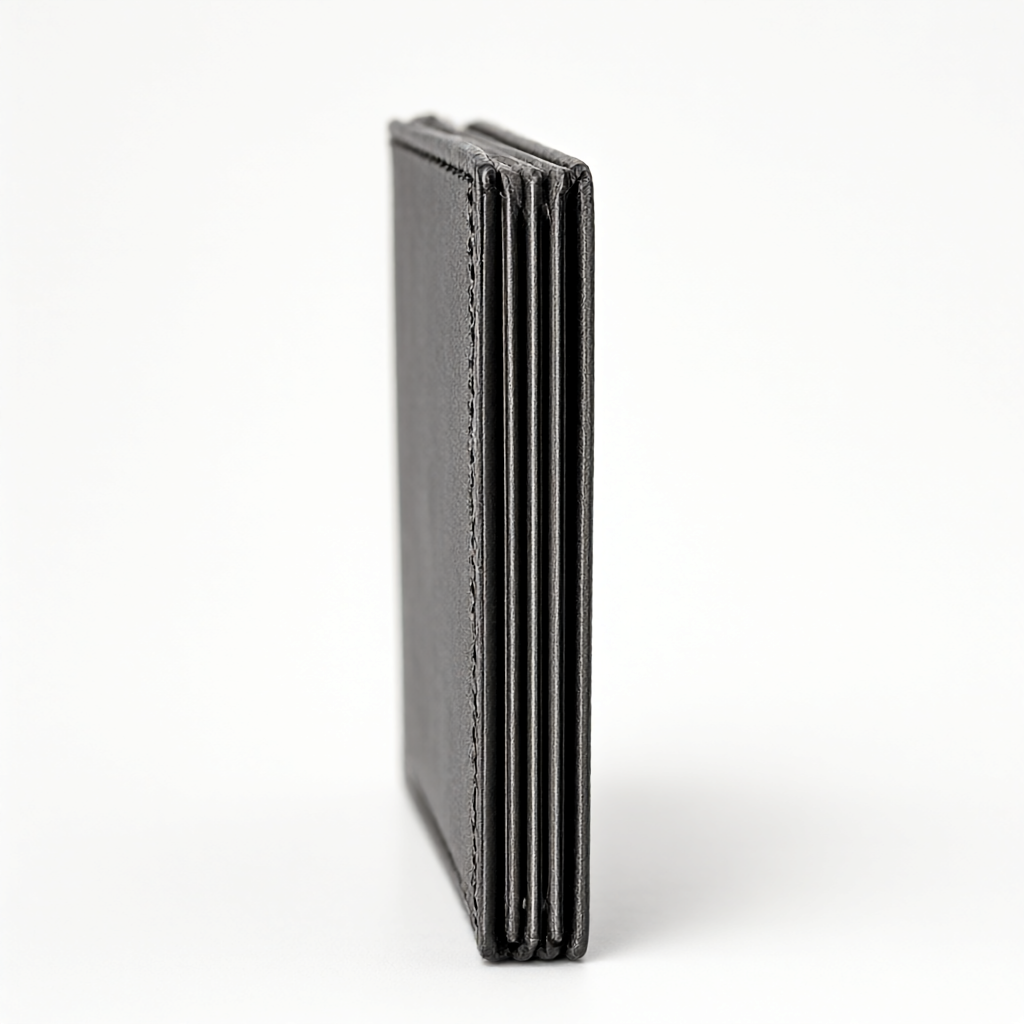
RFID blocking in wallets relies on conductive materials that create a Faraday cage around embedded contactless cards. Metals like aluminum and titanium naturally attenuate radio-frequency signals, meaning a metal wallet without any added lining often provides partial RFID protection simply by virtue of its construction. Carbon fiber, by contrast, is not inherently conductive, so true RFID blocking in carbon fiber wallets requires an integrated metallic mesh or laminate layer.
It is important to understand the scope of protection. Most modern payment cards use EMV chips that store static data rather than continuously broadcasting, making them relatively resistant to remote skimming. The real risk involves older magnetic-stripe cards and some government-issued IDs that may transmit data more readily. A well-designed RFID-blocking wallet typically uses multiple shielding layers to cover the frequency bands used by NFC and HF RFID (13.56 MHz). However, not all advertised shielding performs equally — thin foil linings can leave gaps, and metal frames alone may not fully enclose the card stack. Buyers should request test reports or material specifications rather than relying on marketing labels.
For a deeper look at RFID protection mechanisms and what to verify when sourcing, see our best RFID blocking cards selection guide.
What Materials Are Best for a Minimalist Billfold?
Each material offers distinct trade-offs for EDC and commercial use.
Aluminum is the most common choice for entry-to-mid-tier minimalist wallets. It is lightweight, corrosion-resistant after anodizing, and cost-effective to CNC machine. Anodized aluminum accepts laser engraving and UV printing well, making it ideal for branded corporate gifts and private-label runs. The main limitation is that aluminum can scratch and dent under heavy daily abuse, though this is often accepted as part of the worn-in aesthetic.
Titanium sits at the premium end of the material spectrum. It is significantly stronger than aluminum, highly corrosion-resistant, and noticeably lighter than steel. Titanium billfolds command higher retail prices, which benefits private-label buyers targeting the upper market segment. The material is more difficult to machine, which raises production costs and can extend lead times. Laser marking on titanium produces a contrasting dark mark without needing additional dye, which many brands find attractive for logo applications.
Carbon fiber delivers a distinctive visual identity and excellent rigidity. It is lighter than aluminum and does not conduct electricity, which some users prefer. The surface is prone to visible micro-abrasions over time, and the aesthetic consistency depends heavily on the quality of the resin and weaving process. Low-cost carbon fiber wallets often use printed vinyl that mimics the weave pattern rather than genuine layered composite — a distinction that matters for long-term durability and perceived quality.
Leather remains relevant for certain segments, particularly corporate gifting where a traditional aesthetic is expected. Full-grain leather develops a patina over years of use, which many buyers associate with quality. However, leather expands and contracts with humidity, requiring careful dimensioning during design. For a detailed comparison of leather grades and sourcing considerations, review our best leather wallets for men procurement guide.
The decision between these materials should be driven by the end-user profile and price point rather than personal preference alone.
What Is the Difference Between a Billfold and a Regular Wallet?
The term billfold originally described a folding wallet designed specifically to hold paper currency. In contemporary usage, especially in EDC and B2B contexts, “billfold” has evolved to refer primarily to slim, card-centric carrying solutions — often without a traditional fold. A slim wallet or compact wallet in the modern sense typically holds cards in a vertical or horizontal stack, with cash carried via a money clip, elastic band, or slip pocket. Traditional bi-fold wallets remain larger and heavier, designed for bulk storage rather than minimal carry.
Understanding this distinction matters for sourcing because supplier catalogs sometimes use the terms interchangeably. When placing a bulk order, specifying the exact card capacity, cash-carry method, and overall dimensions prevents mismatches between expectation and product.
Should You Carry Your Billfold in the Front or Back Pocket?
Carrying a wallet in the back pocket is associated with postural strain and nerve compression issues, particularly for individuals who sit for extended periods. A slim front-pocket billfold eliminates this risk while also reducing the likelihood of the wallet being targeted in pickpocket situations. For EDC users and professionals who commute or work in urban environments, front-pocket carry has become the dominant preference.
From a design perspective, this trend pushes manufacturers toward lower-profile wallets with rounded edges and minimal bulk. A wallet that fits comfortably in a front pocket typically measures under 110 mm in length and 75 mm in width, with a thickness not exceeding 18 mm when fully loaded. Anything larger tends to dig into the thigh or create an awkward bulge.
Key Specifications
What Are the Key Specs to Evaluate When Sourcing Billfolds in Bulk?
B2B buyers should evaluate the following specifications during the sourcing and quotation phase.
| Specification | Typical Range | Why It Matters |
|---|---|---|
| Card capacity | 4–16 cards | Determines target user segment and market positioning |
| Overall dimensions | 105–115 mm L × 70–80 mm W | Must fit front pockets comfortably |
| Thickness (loaded) | 12–20 mm | Directly affects carry comfort and pocket profile |
| Weight | 30–85 g | Lightweight models favor titanium and aluminum |
| MOQ | 50–500 pcs | Lower MOQ allows testing demand before committing |
| Sample lead time | 5–14 days | Shorter turnaround accelerates product launch |
| Production lead time | 20–40 days | Depends on order size and customization complexity |
| Customization options | Logo, packaging, material | Enables private-label differentiation |
For a detailed breakdown of specification evaluation criteria, refer to our best wallet for B2B buyers procurement guide.
How Many Cards Can a Billfold Realistically Hold?
Capacity claims on product pages are often inflated. A realistic assessment requires understanding how card thickness and wallet mechanism interact. Standard credit cards measure approximately 0.76 mm thick. A wallet advertised as holding “12 cards” may achieve that number only if the cards are loosely stacked with minimal friction, which increases the risk of cards sliding out.
In practice:
- A 4-card capacity billfold typically measures around 12 mm thick when loaded
- A 10-card capacity model usually reaches 15–18 mm thick
- Models claiming 16+ cards often require aggressive spring tension that makes card insertion and removal difficult
The best approach is to request a physical sample and load it with actual cards from your target market. Different card types — including government IDs with embedded chips — vary slightly in thickness, and cumulative variation affects the fit.
Can a Slim Billfold Still Hold Cash Comfortably?
Yes, but the method matters. Modern minimalist billfolds accommodate cash through three common mechanisms: a money clip (typically integrated on the exterior), a cash strap (elastic band that wraps the billfold), or a slip pocket (a small compartment between card slots). Each method has trade-offs.
Money clips provide the thinnest profile and the quickest cash access but only hold a few bills securely. Cash straps accommodate more bills but add a visual and tactile element that not all users prefer. Slip pockets are the most discrete but can make the wallet bulkier when cash is included. For buyers evaluating options across these methods, our best slim wallets for men guide covers practical carry considerations in detail.
Standards & Requirements
What Certifications Should a Billfold Supplier Hold?
Certifications signal that a manufacturer operates within recognized quality and compliance frameworks. The following are relevant to billfold and EDC wallet sourcing:
ISO 9001 is the baseline quality management standard. It confirms that the manufacturer has documented processes for production, inspection, and continuous improvement. It does not certify the product itself but indicates that the facility maintains consistent operational standards.
BSCI (Business Social Compliance Initiative) audits address labor practices, working conditions, and ethical sourcing. For buyers in European markets, BSCI certification is increasingly required by distributors and retailers as part of their own supply-chain due diligence.
REACH and RoHS compliance are critical for products sold in the European Economic Area. REACH regulates chemical substances in manufactured goods, while RoHS restricts hazardous materials such as lead and cadmium. Non-compliance can result in customs holds or product recalls.
SGS testing provides third-party verification of material composition and safety. While not a certification itself, test reports from recognized laboratories like SGS give buyers confidence that material claims — particularly regarding titanium grade or aluminum alloy — are accurate.
Additional certifications may apply depending on the target market and product features. For instance, buyers seeking products for regulated industries should verify whether the supplier can provide additional material safety data sheets.
To compare material options and certification relevance across wallet categories, consult our minimalist wallets materials and features buying guide.
Related Considerations
What Makes a Billfold the ‘Best’ for a Given Use Case?
The best billfold for one buyer is the wrong choice for another. The determining factors fall into three categories: user behavior, market positioning, and commercial requirements.
User behavior dictates the functional spec. A contractor who carries tools and cash needs a different wallet than a financial professional who carries only ID and a single card. Understanding the end user prevents over-engineering or under-specifying the product.
Market positioning determines the material and price tier. A private-label brand targeting Amazon FBA sellers at the $25–$40 price point will typically choose anodized aluminum with basic RFID blocking. A premium brand positioned at $60–$120 will favor titanium or genuine carbon fiber with more refined finishing. The best billfold aligns with the brand’s positioning rather than chasing feature density.
Commercial requirements include MOQ flexibility, customization scope, and logistics capability. A buyer testing a new product line may need 300 pieces with custom packaging. A established distributor may place recurring orders of 5,000+ units. The right supplier accommodates both scenarios without compromising quality or delivery.
What Should You Consider When Choosing an OEM Billfold Manufacturer?
Selecting an OEM partner involves evaluating manufacturing capability, quality control, and communication responsiveness. Start by confirming that the supplier has in-house CNC machining rather than outsourcing the core production step. In-house machining ensures tighter tolerances, faster iteration on design changes, and better control over surface finishing.
Next, assess the supplier’s customization range. A capable OEM should support modifications to opening size, card-slot configuration, material selection, logo application method (laser engraving, UV printing, or embossing), and packaging design. Limited customization forces buyers into generic configurations that blend into commodity markets.
Lead time and MOQ are practical constraints. Suppliers with low MOQ thresholds (100–300 pieces) are better suited for startups and test orders. Higher minimums may offer better per-unit pricing but require greater upfront commitment. Sample turnaround time of one to two weeks is typical for standard designs; more complex customizations may require additional time.
Finally, verify that the supplier has export experience to your target market. Familiarity with shipping documentation, import compliance, and packaging requirements for specific regions reduces friction during production and fulfillment. For a broader overview of OEM sourcing decisions, see our B2B card holder selection guide.
Common Pitfalls When Selecting a Billfold Supplier
Several mistakes recur in B2B billfold sourcing that buyers should proactively avoid.
Accepting product photos without requesting a sample. Factory photography is professionally lit and often staged. The actual product may differ in finish quality, material texture, and functional feel. Always order a sample before committing to production.
Overlooking packaging requirements. Private-label buyers often forget that retail packaging is part of the cost structure. A wallet with excellent build quality but poor unboxing experience will underperform on e-commerce platforms. Confirm that the supplier can produce custom boxes, inserts, and hang tags that meet your branding standards.
Assuming all RFID claims are equivalent. As noted earlier, shielding effectiveness varies widely. Some suppliers use a single thin metallic lining that leaves card edges exposed. Request documentation or test data to verify the coverage area and frequency range of the blocking layer.
Neglecting tooling costs for custom designs. If your design requires a new opening mechanism or a unique card-slot layout, the supplier may charge for custom jigs or fixtures. These costs are typically one-time but can add hundreds to the initial order. Clarify tooling fees before approval.
Choosing a supplier based solely on unit price. The cheapest per-unit quote often reflects thinner materials, looser tolerances, or outsourced finishing steps that compromise consistency. Evaluate total landed cost, including shipping, tariffs, and any rework required to meet quality standards.
How We Approach Billfold Manufacturing for B2B Buyers?
For over a decade, we have worked with EDC brands, Amazon FBA sellers, and promotional product distributors to develop minimalist wallets and pocket gear that meet specific commercial requirements. As a manufacturer, our approach to this is grounded in practical sourcing experience: we evaluate material, specification, and branding needs together rather than treating them as separate decisions.
Our in-house CNC machining capability allows us to produce aluminum and titanium wallets with tight tolerances and consistent surface finishing. We support full customization from logo engraving to retail packaging design, with low MOQ starts at 300 pcs per SKU for trial orders. Our facility holds ISO 9001 certification and BSCI audit compliance, and our products meet REACH and RoHS requirements for international markets.
We currently serve buyers across North America, Europe, Australia, and Southeast Asia, and we provide Amazon FBA prep and drop-shipping logistics for eligible orders. If you are evaluating billfold sourcing for corporate gifting, private-label retail, or promotional distribution, Contact Our Team to discuss your requirements and receive a tailored quotation.
The best billfold wallet for everyday carry prioritizes slim profile, durable material, and reliable card retention over gimmicks. For B2B buyers sourcing private-label or corporate-gift billfolds, the decision hinges on material specs, certification compliance, customization flexibility, and supplier capability — not marketing claims. Aluminum, titanium, and carbon fiber each serve distinct market tiers, and understanding their technical differences prevents costly sourcing mistakes.
Procurement Decision Framework and Buyer Checklist
Use this structured evaluation to compare potential billfold suppliers objectively.
| Evaluation Criterion | What to Verify | Red Flag |
|---|---|---|
| Manufacturing capability | In-house CNC machining, laser engraving, anodizing | All steps outsourced; no facility tour available |
| Quality certifications | ISO 9001:2015, BSCI audit report, REACH/RoHS compliance statements | Certifications cited but documents not provided |
| Material verification | SGS test reports for aluminum alloy grade (e.g., 6061-T6), titanium grade (e.g., Gr2), carbon fiber layer count | Material claims without documentation |
| Sample quality | Physical sample from production batch, not prototype | Only CAD renders or pre-production photos |
| Customization range | Material, dimensions, logo method, packaging, closure type | Logo-only customization on fixed molds |
| MOQ and pricing | Tiered pricing at 100 / 500 / 1,000 / 5,000 pcs | Single price point regardless of volume |
| Lead times | Sample: 5–14 days, Production: 20–40 days depending on complexity | Unrealistically short promises (<5 days sample, <10 days production) |
| Export experience | Shipments to your target region, documentation handling | No prior exports to your market |
| Communication responsiveness | Response time under 24 hours, clear technical answers | Vague replies, deflects specification questions |
| After-sale support | Rework policy, replacement terms for defective batches | No formal quality assurance policy |
Technical benchmarks to reference during evaluation:
- Standard credit card thickness: 0.76 mm (ISO/IEC 7810 ID-1)
- Typical anodized aluminum hardness: 200–300 HV (Vickers)
- Titanium Gr2 tensile strength: ≥345 MPa
- Carbon fiber laminate density: 1.5–1.6 g/cm³ (authentic woven, not printed vinyl)
- RFID blocking efficacy target: ≥80 dB attenuation at 13.56 MHz (HF/NFC band)
For additional reference on material selection and feature trade-offs across billfold categories, see our best minimalist wallets for B2B sourcing guide and our EDC wallet buying guide for men.
How We Approach Billfold Manufacturing and Sourcing Support?
As a manufacturer, our approach to this is straightforward: we align our capabilities with the standards and specifications that serious buyers expect. Established in 2014, we operate a 50,000 sq ft facility with in-house CNC machining, laser engraving, UV printing, and aluminum anodizing — all under one roof. This integration means tighter tolerances, faster iteration, and fewer hand-offs that can compromise quality.
We hold ISO 9001 certification and have undergone BSCI audits. Our materials comply with REACH and RoHS requirements, and we provide SGS test reports on request. Every claim about titanium grade, aluminum alloy, or RFID performance is backed by documented verification rather than marketing language.
Our typical engagement looks like this: you share your target specs — material, card capacity, dimensions, branding, and volume — and we respond with a feasible configuration, sample timeline, and tiered pricing. Samples ship within 7 days for standard designs. MOQ starts at 300 pcs per SKU for full OEM customization (100 pcs trial order available for stock finishes), and production lead time typically runs 20–30 days depending on complexity. We’ve supported 200+ brands across America, Europe, Australia, and Southeast Asia, and our monthly output capacity exceeds 500,000 units.
If you’re evaluating suppliers or need a second opinion on a billfold specification, contact our team — we’re happy to walk through what’s realistic for your target market and price point.
What Technical Standards Govern Billfold Performance and Safety?
Beyond broad certifications, specific technical standards quantify billfold performance and compliance:
- ISO 9001:2015 defines quality management system requirements including documented procedures for incoming material inspection, in-process quality checks, and corrective action tracking. Manufacturers operating under this standard maintain traceable records from raw alloy receipt through final packaging, enabling consistent batch-to-batch quality.
- ASTM F2923 provides the standard test method for measuring RF attenuation of shielding materials. Effective RFID-blocking billfolds should achieve at least 20 dB of attenuation at 13.56 MHz (HF/NFC band), which reduces incident signal power by 99% or more. Shielding effectiveness is measured across both the 13.56 MHz and 850–960 MHz UHF bands to ensure broad-spectrum protection.
- MIL-STD-810H covers environmental engineering laboratory tests relevant to EDC durability. Method 516.G (Drop) validates survival of impacts from 0.6–1.2 m heights onto hard surfaces. Method 501.7 (High Temperature) and Method 507.7 (Humidity) confirm material stability under thermal and moisture stress. While not all manufacturers advertise MIL-STD compliance, third-party drop-test reports provide objective evidence of structural integrity.
- REACH (EC 1907/2006) restricts over 160 substances of very high concern, including specific heavy metals and azo dyes used in leather treatments and adhesives. RoHS (2011/65/EU) limits lead, cadmium, mercury, and six phthalate flame retardants in manufactured goods. Together, these regulations are mandatory for EU market access and should be verified through supplier declarations or SGS test reports.
For detailed guidance on RFID shielding performance and card selection, refer to our best RFID blocking cards B2B procurement guide.
B2B Procurement Decision Framework: Material Comparison by Sourcing Criteria
Evaluating billfold materials for bulk sourcing requires a structured comparison across cost, minimum order quantity, lead time, and customization scope.
| Material | Unit Cost (300 pcs) | Unit Cost (1,000 pcs) | Typical MOQ | Production Lead Time | Key Customization Options | Ideal Market Position |
|---|---|---|---|---|---|---|
| Anodized Aluminum | $3.50–$6.00 | $2.00–$3.50 | 300 pcs | 15–25 days | Laser engraving, UV printing, anodized color selection | Entry-to-mid private label; Amazon FBA |
| Titanium (Grade 2) | $12.00–$25.00 | $8.00–$15.00 | 200 pcs | 25–35 days | Laser marking (etch contrast), bead blast, mirror polish | Premium EDC; $60–$120 retail tier |
| Carbon Fiber (Genuine) | $5.00–$10.00 | $3.00–$6.00 | 300 pcs | 15–25 days | Resin finish variants, partial metal frame integration | Design-forward brands; mid-premium tier |
| Leather + Metal Hybrid | $4.00–$8.00 | $2.50–$5.00 | 300 pcs | 20–30 days | Stamp engraving, edge paint, hardware finish | Corporate gifting; traditional aesthetic |
Procurement decision checklist:
- Define target retail price point first — this determines feasible material and margin structure. Aluminum at $25–$40 retail, titanium at $60–$120 retail, carbon fiber at $35–$70 retail.
- Verify MOQ flexibility — buyers testing a new product line should prioritize suppliers offering 300-piece MOQs to limit initial capital exposure. Our best minimal wallets for B2B sourcing guide details how MOQ tiers affect per-unit pricing.
- Confirm sample lead time — standard samples ship within 7 days; fully custom designs with new tooling require 14–21 days. Never place a bulk order without physically evaluating a sample loaded with actual cards from your market.
- Audit certification documentation — request current ISO 9001 certificates, BSCI audit reports, and REACH/RoHS material declarations before signing contracts. Expired or generic certificates should prompt additional verification.
- Assess customization depth — true OEM partners support changes to card-slot layout, opening dimensions, clip mechanism, and retail packaging. Suppliers offering only logo application on stock designs limit product differentiation.
For a broader evaluation of men’s minimalist EDC wallets from a procurement perspective, review our good wallets for guys B2B guide.
How Manufacturers Translate Specifications Into Production Reality?
The difference between a specification sheet and a ship-ready product comes down to manufacturing capability, quality-control discipline, and supply-chain maturity. Buyers who request quotes from multiple suppliers quickly discover that identical-looking billfolds can differ significantly in material grade, dimensional tolerance, and finish consistency.
As a manufacturer, our approach begins with material verification. Incoming aluminum billets are confirmed against ASTM B221 for 6061-T6 alloy composition. Titanium components meet ASTM B348 Grade 2 commercial-purity specifications. Carbon fiber laminates are inspected for weave density consistency and resin-to-fiber ratio. This incoming-material QC prevents grade substitutions that compromise durability or appearance.
In-house CNC machining maintains dimensional tolerances within ±0.05 mm for critical features including card-slot engagement force, cash-clip tension, and overall stack thickness. For RFID-blocking models, we validate shield continuity through conductive resistance measurements and verify attenuation performance against ASTM F2923 test protocols. Finished parts undergo visual inspection for anodize color consistency, laser-engraved mark clarity, and surface defect elimination.
Our OEM and ODM process covers the full development cycle — from concept sketch and 3D modeling to prototype sampling, tooling, and mass production. Standard samples are ready within seven days, and production runs begin at 300 pieces. Private-label buyers receive complete branding support: laser engraving, UV printing, custom anodized colors, and retail packaging designed to brand specifications.
We hold ISO 9001 certification since 2014, operate from a BSCI-audited 50,000 sq ft facility, and maintain REACH and RoHS compliance across all materials. With 13+ years of export experience serving 200+ brands across North America, Europe, Australia, and Southeast Asia, we provide end-to-end manufacturing from raw material to FBA-prepped inventory.
Sources & References
- best RFID blocking cards selection guide — topedcwallet.com
- best leather wallets for men procurement guide — topedcwallet.com
- best wallet for B2B buyers procurement guide — topedcwallet.com
- best slim wallets for men guide — topedcwallet.com
- minimalist wallets materials and features buying guide — topedcwallet.com
- B2B card holder selection guide — topedcwallet.com
- Contact Our Team — topedcwallet.com
- best minimalist wallets for B2B sourcing guide — topedcwallet.com
- EDC wallet buying guide for men — topedcwallet.com
Frequently Asked Questions
How Does RFID Blocking Work in Metal Wallets?
RFID blocking in wallets relies on conductive materials that create a Faraday cage around embedded contactless cards. Metals like aluminum and titanium naturally attenuate radio-frequency signals, meaning a metal wallet without any added lining often provides partial RFID protection simply by virtue of its construction. Carbon fiber, by contrast, is not inherently conductive, so true RFID blocking in carbon fiber wallets requires an integrated metallic mesh or laminate layer.It is important to understand the scope of protection. Most modern payment cards use EMV chips that store static data rather than continuously broadcasting, making them relatively resistant to remote skimming. The real risk involves older magnetic-stripe cards and some government-issued IDs that may transmit data more readily. A well-designed RFID-blocking wallet typically uses multiple shielding layers to cover the
What Is the Difference Between a Billfold and a Regular Wallet?
The term billfold originally described a folding wallet designed specifically to hold paper currency. In contemporary usage, especially in EDC and B2B contexts, "billfold" has evolved to refer primarily to slim, card-centric carrying solutions — often without a traditional fold. A slim wallet or compact wallet in the modern sense typically holds cards in a vertical or horizontal stack, with cash carried via a money clip, elastic band, or slip pocket. Traditional bi-fold wallets remain larger and heavier, designed for bulk storage rather than minimal carry.Understanding this distinction matters for sourcing because supplier catalogs sometimes use the terms interchangeably. When placing a bulk order, specifying the exact card capacity, cash-carry method, and overall dimensions prevents mismatches between expectation and product.
Should You Carry Your Billfold in the Front or Back Pocket?
Carrying a wallet in the back pocket is associated with postural strain and nerve compression issues, particularly for individuals who sit for extended periods. A slim front-pocket billfold eliminates this risk while also reducing the likelihood of the wallet being targeted in pickpocket situations. For EDC users and professionals who commute or work in urban environments, front-pocket carry has become the dominant preference.From a design perspective, this trend pushes manufacturers toward lower-profile wallets with rounded edges and minimal bulk. A wallet that fits comfortably in a front pocket typically measures under 110 mm in length and 75 mm in width, with a thickness not exceeding 18 mm when fully loaded. Anything larger tends to dig into the thigh or create an awkward bulge.
What Are the Key Specs to Evaluate When Sourcing Billfolds in Bulk?
B2B buyers should evaluate the following specifications during the sourcing and quotation phase. SpecificationTypical RangeWhy It Matters Card capacity4–16 cardsDetermines target user segment and market positioning Overall dimensions105–115 mm L × 70–80 mm WMust fit front pockets comfortably Thickness (loaded)12–20 mmDirectly affects carry comfort and pocket profile Weight30–85 gLightweight models favor titanium and aluminum MOQ50–500 pcsLower MOQ allows testing demand before committing Sample lead time5–14 daysShorter turnaround accelerates product launch Production lead time20–40 daysDepends on order size and customization complexity Customization optionsLogo, packaging, materialEnables private-label differentiation For a detailed breakdown of specification evaluation criteria, refer to our best wallet for B2B buyers procurement guide.
From article to product
Still deciding between the two?
Send us the use case rather than the product name. Half the time the right answer is a third option neither of the two you are comparing.
Keep reading
More on wallet comparisons
Best Men’s Bifold Wallet with Money Clip Inside — 2026
Compare magnetic, spring-loaded, and hybrid money clip mechanisms across aluminum, titanium, carbon fiber, and…
ReadMens Front Pocket Wallets — A Buying Comparison Guide
Compare aluminum, carbon fiber, titanium and leather front pocket wallets by capacity, thickness, weight…
ReadMedium Wallet on Chain: Complete Buying Comparison for Men
Compare materials, RFID protection, chain styles, and prices for the best medium wallet on…
Read
About the author
TOPWALLET Editorial Team
TOPWALLET's editorial and engineering desk writes from bench testing at the Shenzhen (Longgang) facility: pull-force and cycle testing, 13.56 MHz shielding measurements, finish trials and factory audits, rather than supplier spec sheets. Every specification in these guides is one we write on a purchase order.
Written on the floor
This article was written by our production and QC team — the people who spec tolerances, run the finishing line and inspect every batch. Where it states a capacity, a pull force or a lead time, it comes from a measurement we made, not a supplier’s catalogue. If a number here disagrees with what your own supplier told you, tell us; several of these articles started as a correction from a buyer.
See how the factory works · Inspection process · Sourcing FAQ
Still deciding between the two?
Send us the use case rather than the product name. Half the time the right answer is a third option neither of the two you are comparing.