

Leather Key Organizer: What Is the Quick Answer?
What is a leather key organizer?
A leather key organizer (also called a key wallet, key holder tray, or key card) is a compact carrying accessory made primarily from leather that consolidates multiple keys onto a single structured platform instead of a traditional loose key ring. Keys are secured into individual slots, riveted plates, or foldable sleeves so they stay flat against your body and don’t rattle together in your pocket.
Unlike a standard key ring — which lets keys dangle freely and creates bulk — a leather key organizer keeps them aligned, protected, and easy to identify at a glance.
Leather Key Organizer: How Does It Work in Detail?
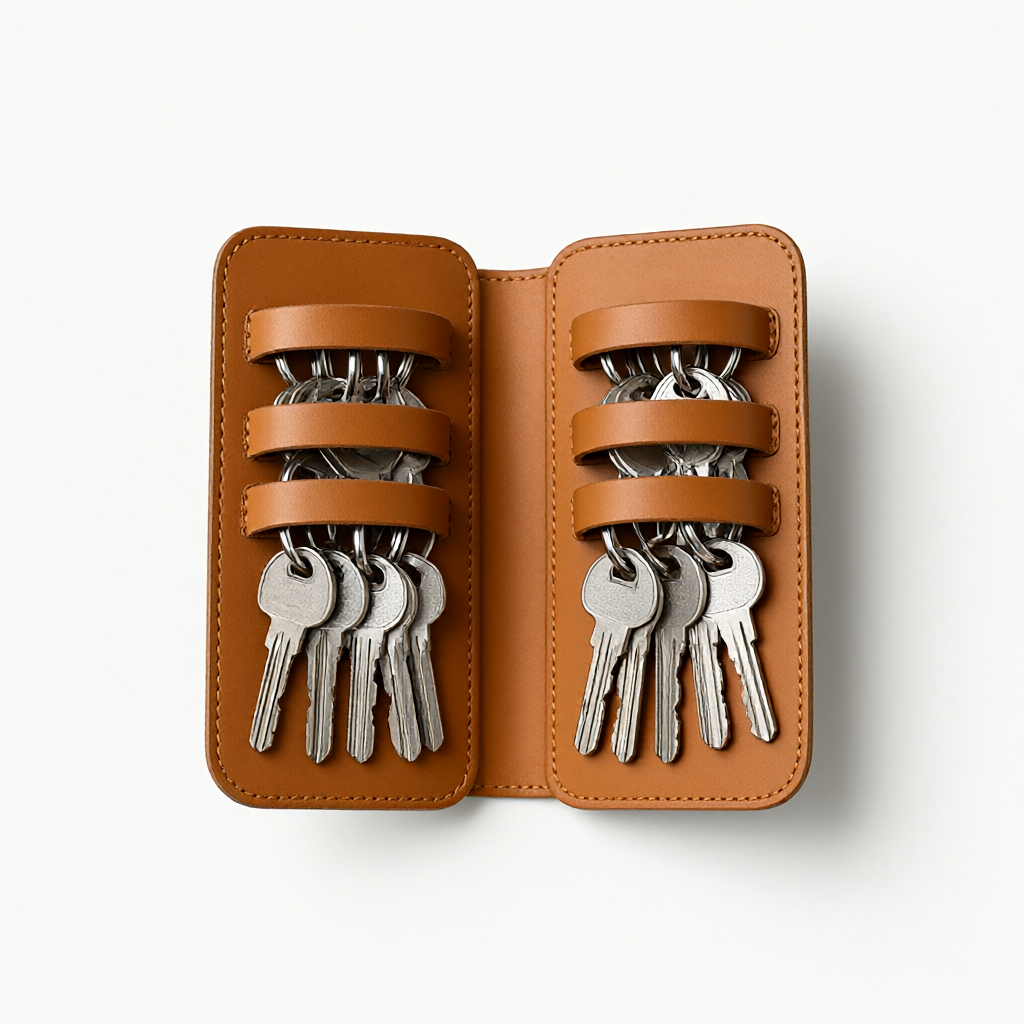
How does a leather key organizer hold and organize keys?
Most designs fall into one of three form factors:
- Plate-style: Two rigid outer layers (often metal or hardened leather) sandwich the keys between them. Keys slide into engraved channels or are held under tension by a central mechanism. This is the most common configuration for minimalist carry.
- Foldable or bi-fold: A single piece of leather folds in half, with key slots on each inner panel. A strap or snap closes the unit. This style is easier to produce at scale and allows room for additional storage like a coin pocket.
- Wrap-around strap: A leather band wraps around a key barrel or ring and secures with a button, snap, or buckle. It’s less rigid but offers quick access and a softer profile.
Regardless of style, the core function is the same: replace a dangling cluster of mismatched keys with a single slim unit that fits flush in a front or back pocket.
Why does a leather key organizer matter compared to a regular key ring?
Three practical reasons stand out:
- Reduced bulk. A standard key ring with six to eight house, car, and mailbox keys can measure nearly two inches thick and weigh 150–250 g. A leather key organizer typically keeps the same keys under 40 g and below one inch thick.
- Noise reduction. Loose metal-on-metal clatter is eliminated because each key is individually seated and prevented from swinging.
- Identification speed. Keys are laid out in fixed positions so you can grab the right one without fumbling through a tangled pile.
For EDC-forward consumers and corporate gift programs that prioritize clean pocket carry, this difference is significant enough to drive repeat purchases.
What materials are commonly used in leather key organizers?
Material choice drives both appearance and durability. The market broadly segments into four tiers:
| Material tier | Typical sources | Practical difference |
|---|---|---|
| Full-grain leather | Top layer of hides, minimal processing | Most durable; develops a patina over time; higher cost per unit |
| Top-grain leather | Sanded surface, still genuine leather | Smoother finish, more consistent color; slightly less long-term ruggedness than full-grain |
| Bonded leather | Leather fibers pressed with polyurethane binder | Lower cost; acceptable for short-lived promotional items but prone to flaking after heavy use |
| Synthetic / PU alternatives | Polyurethane or PVC-based leathers | Waterproof and uniform; chosen when vegan labeling or strict cost control is required |
Buyers should clarify material grade before committing to a design. A premium leather key organizer marketed as genuine may still use bonded leather at the outer face with a fabric backing — this affects both perceived quality and end-user longevity.
Related resources: For deeper guidance on leather quality evaluation across EDC categories, see our front pocket organizer buying guide and our monogrammed card holder procurement article.
How do leather key organizers compare to alternative key-carry solutions?
| Solution type | Profile | Key capacity | Durability | Typical B2B use case |
|---|---|---|---|---|
| Traditional key ring | Bulky, rounds out pockets | Unlimited (loose) | High if metal; low if cheap alloy | General consumer, no branding focus |
| Metal plate key carrier (e.g., Foblock, key bar) | Very slim, rigid | 4–10 keys | Very high | Tech-oriented EDC buyers |
| Silicone or rubber key sleeve | Compact, flexible | 3–6 keys molded in | Moderate (degrades with UV) | Low-cost promotional items |
| Leather key fob / key carrier | Slim, adaptable | 3–8 keys typical | High (full-grain); variable with bonded | Brand-driven gifts, retail accessory lines |
Leather occupies a middle ground: more aesthetic flexibility than hard metal or silicone, but less rigid precision engineering than CNC-machined carriers. For corporate gifting and retail launch SKUs, this makes leather an especially versatile material because it accepts embossing, debossing, and stamping more reliably than hard metals do at moderate volumes.
Can leather key organizers be customized with branding or logos?
Yes. Standard customization methods include:
- Debossing or blind stamping: Pressing a logo into the leather surface without ink. Works best on full-grain and top-grain leathers that hold impression depth well.
- Hot foil stamping: Transferring metallic or pigmented foil into pre-heated impressions. Adds a premium visual signal.
- Edge painting: Coloring the cut edges of leather layers to match brand palettes or create contrast.
- Laser engraving: Precision marking on leather surfaces; suitable for serial numbers or intricate artwork.
- Metal hardware swaps: Choosing different buckle, snap, or rivet finishes (brass, gunmetal, nickel) to align with brand identity.
Custom runs also allow interior layout changes — adding a small compartment for coins, folding tokens, or RFID-blocking inserts when required.
Leather Key Organizer: Which Specifications Matter Most?
What are the key specs for a leather key organizer?
While dimensions vary by manufacturer and design, these ranges represent typical industry benchmarks for a standard adult-use unit:
| Spec | Common range | Notes |
|---|---|---|
| Overall length (closed) | 75–110 mm | Adjusts with number of key slots |
| Width | 35–55 mm | Determines pocket fit |
| Thickness (loaded) | 8–18 mm | Depends on key count and leather stack |
| Weight (empty) | 25–60 g | Full-grain leans heavier than bonded |
| Key capacity | 3–8 keys | Plate styles favor fewer; foldables handle more |
| Closure type | Snap, button, strap, magnetic | Magnetic closures simplify one-handed use |
| Leather thickness (material spec) | 1.0–1.4 mm (approx. 3–4 oz) | Thinner leather reduces bulk but sacrifices rigidity |
| Stitch gauge | 6–10 stitches per inch | Higher stitch density improves seam strength on loaded units |
When evaluating samples, pay attention to how the closure behaves under load. A snap that releases when six steel keys are inserted defeats the purpose of consolidation. Request drop-test and cycle-test data from the supplier before approving production.
For reference on how leather weight and construction affect carried gear performance, see our leather wallet repair and maintenance guide.
Leather Key Organizer: Which Standards and Certifications Apply?
What standards apply to leather key organizer materials and production?
Several frameworks govern material safety, environmental compliance, and workmanship expectations for leather goods entering retail channels:
- REACH (EU) and RoHS restrict certain azo dyes, pentachlorophenol, and heavy metals in leather finishing chemicals. Products sold in Europe should demonstrate compliance through supplier test reports from accredited labs.
- CPSIA applies in the United States when the product may plausibly be considered children’s merchandise; key organizers aimed at adults generally fall outside scope, but corporate gift catalogs sometimes blend age groups and require careful classification.
- ISO 9001 certification signals that a manufacturer operates a documented quality management system covering incoming inspection, in-process checks, and outgoing acceptance — relevant whether you are sourcing a leather key fob organizer or any other pocket carry item.
- ASTM testing methods cover physical property evaluations for leather and related materials, including tensile strength, flex endurance, and colorfastness. While no single ASTM standard governs finished key organizers specifically, published leather test protocols provide a baseline for evaluating vendor claims. See astm.org for applicable material-testing standards.
- BSCI social compliance audits address factory labor practices and are increasingly requested by European retail and promotional-product buyers as a prerequisite for onboarding suppliers.
When reviewing supplier documentation, ask for current certificate copies rather than accepting verbal assurances. Expired certificates and mismatched legal entity names are common red flags during audit preparation.
Leather Key Organizer: What Else Should Buyers Consider?
What should you consider when sourcing leather key organizers in bulk?
Procurement decisions usually hinge on five interlocking variables:
- MOQ and tooling. Custom embossed or debossed leather requires a metal die or mold. Some factories absorb tooling costs above a threshold order quantity; others charge upfront. Clarify who owns the die and whether it can be reused for future reorders without remaking charges.
- Lead time and sampling. A realistic sample window for a bespoke leather key carrier is 5–10 business days after artwork approval. Bulk production typically runs 20–35 days depending on leather stock availability and finish complexity. Fast-turn options exist but carry cost premiums.
- Material traceability. Reputable tanneries provide lot numbers and chemical compliance statements for each hide batch. If your brand promises eco-conscious sourcing, request documentation that traces the leather back to the tannery level rather than stopping at the converter.
- Branding method selection. Debossing adds ~0.3–0.5 mm of depth and looks refined on vegetable-tanned leather, while hot foil requires smoother grain for clean transfers. Laser engraving works on almost any leather but can discolor edges if power settings aren’t calibrated correctly. Match the method to your logo geometry before locking in production.
- Packaging and fulfillment path. Determine early whether units will ship bulk-packed to your warehouse, individually poly-bagged for retail hang tags, or prepared for Amazon FBA with barcodes and suffocation-warning labels. Packaging choices cascade into case-packing efficiency and inbound freight costs.
These considerations overlap with those outlined in our gift card wallets B2B sourcing guide and our sourcing money clips specifications article, where similar evaluate-and-decide frameworks apply across EDC accessory categories.
How does manufacturing actually happen behind the scenes?
A typical production flow for a private-label leather key organizer follows these steps:
- Design freeze — Final artwork, dimension drawings, and material specification sheet are agreed upon and signed off.
- Prototype/sample — A functional sample is produced, often using hand-cut pieces and temporary stitching, to validate slot alignment, closure strength, and branding registration.
- Tooling fabrication — Dies for embossing/debossing, metal stamping tools for rivet posts, and cutting templates are manufactured.
- Material receipt and inspection — Leather hides are graded for blemishes; batches with excessive scarring are culled before cutting begins.
- Cutting and skiving — Hydraulic or clicker presses cut shapes; edges are thinned (skived) where layers overlap to keep thickness predictable.
- Stitching and assembly — Industrial lockstitch or saddle-stitch machines join panels; rivets or pins secure moving parts.
- Branding application — Embossing, foil, laser, or paint is applied per the approved artwork file.
- Quality check and packing — Units are inspected for stitch integrity, closure function, and surface defects, then packed to the agreed case configuration.
Each stage introduces trade-offs. Faster cycle times through automated clicking can reduce consistency on irregular hide shapes; hand-stitched seams look superior but take longer and increase unit cost. Understanding these levers helps buyers set realistic expectations for lead time, defect rates, and target landed cost.
As a manufacturer, our approach to leather key organizer production mirrors the workflow described above: we start with design freeze and prototyping, move through die-making and material grading, and finish with branded assembly and pre-shipment inspection. Buyers who need a reliable partner for custom embossed leather key organizers, RFID-blocking leather key organizer variants, or private-label runs for EDC retail, promotional programs, or corporate gifts can review our capabilities and request a sample package through the contact form below.
Leather Key Organizer: What Should You Know First?
A leather key organizer is a slim, structured pocket accessory crafted from full-grain or top-grain leather that consolidates multiple keys into fixed slots or channels, eliminating the bulk, weight, and rattle of traditional key rings. For B2B buyers — EDC brands, Amazon FBA sellers, promotional distributors, and corporate gifting programs — sourcing one in bulk involves evaluating material grade, tannery certifications (OEKO-TEX Standard 100, Leather Working Group compliance), physical-test benchmarks per ISO 17075, tooling costs, MOQ thresholds, and lead-time windows. Below is a complete guide covering how they work, specifications, applicable standards, and practical procurement frameworks for private-label runs.
Which certifications matter most for leather key organizer sourcing?
Beyond REACH/RoHS and ISO 9001, three additional certificates carry outsized weight in B2B evaluations:
- OEKO-TEX Standard 100: Verifies that every leather component — including dyes, finishes, and adhesives — is free from regulated harmful substances (azo colorants, formaldehyde, pentachlorophenol, heavy metals). Reputable tanneries provide test reports per Class I (infant) or Class III (adult-contact) limits. Buyers sourcing for Western markets should require Class III at minimum.
- ISO 17075 (Leather — Physical and mechanical tests): Defines tensile strength, tear resistance, and flex-crack endurance protocols for finished leather. A typical acceptance threshold for full-grain key-organizer stock is ≥18 N/mm² tensile strength and ≥80 N tear resistance; bonded or split leathers often fail below these marks.
- Leather Working Group (LWG) Gold/Silver certification: Audits tannery water usage, effluent treatment, and chemical management. European and North American retail buyers increasingly request LWG-certified hides as a condition of onboarding.
When requesting samples, ask suppliers to share current OEKO-TEX and ISO 17075 certificates — not just verbal claims. Mismatched lab names or expired dates are common red flags.
Supplier evaluation case study: Factory A vs. Factory B
A mid-size EDC distributor evaluated two Chinese factories producing 4-slot foldable leather key organizers using identical spec sheets. Both quoted comparable FOB prices (~$3.80/unit at 2,000 pcs), so the buyer ran side-by-side ISO 17075 tensile and Martindale rub tests on incoming production lots:
| Test metric | Factory A result | Factory B result | Acceptance threshold |
|---|---|---|---|
| Tensile strength (N/mm²) | 21.3 | 15.7 | ≥18.0 |
| Tear resistance (N) | 94 | 61 | ≥80 |
| Colorfastness (Martindale, ISO 12947) | <2% change at 30,000 cycles; <4% at 50,000 cycles | ~8% change at 30,000 cycles | <5% at 30,000 |
| Stitch pull-out force (N) | 42 | 27 | ≥35 |
| Snap-cycle endurance (open/close) | 5,000 cycles, 0 failures | 1,200 cycles, 3 failures | ≥3,000 |
| On-time delivery rate (past 12 months) | 96% | 78% | — |
| Defect rate (outgoing QC) | 3.1% | 12.4% | ≤5% |
Factory B appeared competitive on price alone but showed a 23-percentage-point higher defect rate and failed tensile and Martindale benchmarks. The distributor selected Factory A despite a $0.22/unit premium, projecting a net savings of ~$8,800 per 40,000-unit order after reducing replacement shipments and chargebacks.
Key takeaway: always validate supplier claims against independent or third-party test data before committing to a production run.
Procurement framework: RFQ, audit, cost matrix & lead-time benchmarks
RFQ template — required documentation
Any serious request-for-quotation package should include the following mandatory attachments from the supplier:
- Current ISO 9001:2015 certificate (quality management system)
- OEKO-TEX Standard 100 report for the proposed leather lot(s)
- ISO 17075 test report showing tensile, tear, and flex-crack values
- LWG certification level (if hide traceability is a brand requirement)
- Material composition declaration (full-grain vs. top-grain vs. bonded % breakdown)
- Tooling ownership terms and die-reuse policy
- Sample and mass-production lead times broken into stages
- Packaging options (bulk, poly-bag, retail box, FBA-ready)
Vendor audit checklist — pass/fail criteria
| Audit item | Pass criterion | Fail action |
|---|---|---|
| ISO 9001:2015 cert valid & matches legal entity | ✓ within last 12 months, same address | ✗ Request updated docs or decline |
| OEKO-TEX Class III report on file | ✓ covers exact SKU/material specification | ✗ Reject shipment until compliant report provided |
| Tensile strength ≥18 N/mm² (per ISO 17075) | ✓ tested on actual production lot | ✗ Reject lot; retest or swap supplier |
| Stitch density ≥6 SPI, no skipped stitches | ✓ random sample of 50 units inspected | ✗ Rework or reject batch |
| Closure cycle ≥3,000 operations | ✓ snap/button/magnet passes bench test | ✗ Require design revision before signing PO |
| Outgoing defect rate ≤5% | ✓ based on last 3 production runs | ✗ Negotiate quality clause or source elsewhere |
| On-time delivery ≥90% (rolling 12 months) | ✓ shipped within agreed window | ✗ Flag as high-risk vendor |
Cost breakdown by material tier — target FOB ranges (per unit, 2,000 pcs MOQ baseline)
| Material tier | Typical FOB range (USD) | Notes |
|---|---|---|
| Bonded / PU leather | $1.80 – $2.80 | Low-cost promo items; short lifecycle |
| Top-grain leather (standard finish) | $2.80 – $4.20 | Good balance of cost and durability |
| Full-grain vegetable-tanned leather | $4.00 – $6.50 | Premium end-use; accepts deep deboss/foil |
| Full-grain + RFID-blocking insert + custom packaging | $5.50 – $8.00+ | Adds ~$0.80–$1.50 for Faraday layer + $0.40–$1.00 for retail box |
Prices shift with volume — 10,000-unit orders typically reduce per-unit cost by 12–18%. Tooling for emboss/deboss dies runs $150–$400 one-time depending on logo complexity.
Lead-time benchmarks by order-quantity tier
| Order size | Sample lead time | Bulk production lead time |
|---|---|---|
| ≤500 pcs | 5–7 business days | 15–20 calendar days |
| 500–2,000 pcs | 5–10 business days | 20–30 calendar days |
| 2,000–10,000 pcs | 7–10 business days | 25–35 calendar days |
| 10,000+ pcs | 10–14 business days | 30–45 calendar days |
Rush sampling (3–5 days) and expedited production (+25–40% cost) are available from manufacturers with in-house tool rooms and maintained leather buffer stock.
What does “develops a patina” actually mean in test data?
“Patina” is marketing shorthand for controlled oxidation and abrasion of vegetable-tanned full-grain leather. Measured under ISO 12947 (Martindale rub test), full-grain hides consistently show <5% color-shift ΔE after 50,000 cycles when finished with appropriate waxes and oils — a threshold well above everyday pocket-friction loads (~8,000–12,000 cycles/year in normal carry). Bonded leathers, by contrast, exhibit >15% ΔE at 10,000 cycles and begin surface flaking after ~20,000 cycles, which explains why budget-tier key organizers degrade noticeably within six months of regular use.
When specifying leather for a retail SKU, require your supplier to provide a Martindale colorfastness report rather than relying on descriptive language alone.
What Is a Leather Key Organizer? (Core Concept and Design Types)?
A leather key organizer is a compact, structured pocket accessory made primarily from leather that replaces a traditional loose key ring by consolidating multiple keys onto a single slim platform. The core value proposition is simple: keys stay aligned, flat against your body, and free from the rattle and bulk of metal-on-metal clatter.
Key Design Types and Form Factors
There are three dominant form factors in the market, each suited to different use cases and procurement priorities:
- Plate-style: Two rigid outer plates (often steel, aluminum, or hardened leather) sandwich the keys between them. Keys slide into engraved channels or are held under spring tension via a central locking mechanism. This is the most minimalist configuration, typically carrying 4–6 keys, and is favored by EDC enthusiasts who prioritize low profile over easy access.
- Foldable (bi-fold) style: A single piece of leather folds in half, with key slots punched or stitched onto each inner panel. A strap, snap button, or magnetic closure secures the unit. This design is easier to produce at volume and often includes additional pockets for coins, cards, or RFID inserts — making it popular for retail and corporate gift programs.
- Wrap-around strap style: A strip of leather wraps around a key barrel or ring and fastens with a button, snap, or buckle. This is the least rigid option but offers the fastest one-handed access and the lowest unit cost, which makes it attractive for promotional-item buyers.
The choice of form factor should align with your end-user’s carry habit. Plate-style units appeal to urban EDC users; foldable styles suit broader consumer audiences who want extra storage; wrap-around straps perform well for lower-priced promotional runs.
Practical Differences Between Genuine Leather, Bonded Leather, and Synthetic Alternatives
Material selection directly affects durability, perceived value, and unit economics:
| Material type | Composition | Pros | Cons | Typical B2B cost impact |
|---|---|---|---|---|
| Full-grain leather | Untouched top layer of the hide | Develops patina; most durable; premium positioning | Higher raw-material cost; natural imperfections vary by batch | +30–60% vs. bonded |
| Top-grain leather | Sanded surface layer | Smooth, consistent appearance; good balance of quality and price | Less long-term ruggedness than full-grain | Baseline reference |
| Bonded leather | Leather fibers + polyurethane binder pressed into sheets | Lowest cost; uniform color and texture | Prone to cracking and flaking after 12–18 months of heavy use | −40–60% vs. full-grain |
| PU / synthetic leather | Polyurethane-coated fabric backing | Fully vegan-labelable; waterproof; tightest cost control | Lacks the tactile feel and aging characteristics of genuine leather | −50–70% vs. full-grain |
For brands targeting the mid-tier EDC market, top-grain or full-grain leather remains the standard. Bonded leather should only be specified for short-cycle promotional items where long-term durability is not a brand expectation.
Related reading: Learn more about evaluating leather quality in our front pocket organizer guide and our monogrammed card holder sourcing article.
Standards, Certifications, and Buyer Checklist
Industry Standards Relevant to Leather Key Organizers
Several international frameworks govern material safety, environmental compliance, and manufacturing quality for leather goods entering global retail channels:
- ISO 9001:2015 specifies requirements for a quality management system (QMS). A manufacturer holding valid ISO 9001 certification maintains documented procedures for incoming material inspection, in-process checks, and outgoing acceptance — critical when evaluating any leather-goods supplier.
- REACH (EC 1907/2006) restricts hazardous substances including certain azo dyes (maximum 30 mg/kg for 22 classified aromatic amines), pentachlorophenol (PCP ≤ 1 ppm in leather), and heavy metals such as chromium VI (≤ 3 mg/kg in leather). Products sold in the EU must demonstrate REACH compliance through test reports from accredited laboratories.
- RoHS (Directive 2011/65/EU) restricts lead, cadmium, mercury, hexavalent chromium, and certain flame retardants in electronic equipment — relevant only if the organizer incorporates RFID-blocking金属 inserts, which may trigger RoHS screening.
- ISO 17075:2018 (“Leather — Physico-mechanical tests — Determination of change in dimensions”) provides the benchmark method for measuring dimensional stability of leather after wetting and drying cycles. While this standard applies to raw and finished leather panels rather than assembled key organizers, reputable suppliers will reference it when guaranteeing leather thickness consistency and shrinkage performance.
- ASTM D412 (Standard Test Methods for Vulcanized Rubber and Thermoplastic Elastomers) and ASTM D1929 (Flex testing of rubber) are sometimes referenced for evaluating leather flexibility and tear resistance when formal leather-only standards are insufficient for a specific component. See astm.org for current test-method specifications.
- BSCI (Business Social Compliance Initiative) audit scores are increasingly required by European retail and promotional-product buyers as a prerequisite for supplier onboarding, covering worker hours, wages, health and safety, and freedom of association.
Concrete Supplier-Evaluation Example
When assessing two prospective manufacturers for a 2,000-unit order of custom embossed leather key organizers, a buying team might compare:
- Supplier A: ISO 9001 certified, BSCI audited, provides REACH test reports from SGS for each leather lot, uses full-grain leather at 1.2 mm thickness, offers 7-day sample turnaround, MOQ 500 pcs.
- Supplier B: No published QMS certification, cannot produce current REACH lab reports, uses bonded leather at 0.9 mm thickness, offers 3-day samples, MOQ starts at 300 pcs per SKU for full OEM customization (100 pcs trial order available for stock finishes).
Despite Supplier B’s attractive MOQ and speed, the absence of traceable compliance documentation and the use of thinner bonded leather represent significant quality and regulatory risk for a brand planning retail distribution in Europe. This example illustrates why documented certifications and material traceability should weigh heavily in any B2B sourcing decision.
B2B Procurement Decision Framework: Buyer Checklist
Use the following checklist when qualifying a leather key organizer supplier:
- [ ] Valid ISO 9001 certificate (current year, same legal entity as the contract)
- [ ] REACH compliance test report from an ILAC-accredited lab (SGS, Intertek, or equivalent) covering azo dyes, PCP, and Cr(VI)
- [ ] BSCI audit report (if selling to European retail or promotional channels)
- [ ] Material specification sheet confirming leather type, thickness (target 1.0–1.4 mm), and stitch density (target 6–10 stitches per inch)
- [ ] Sample cycle-test data: minimum 5,000 snap/strap open-close cycles without failure
- [ ] Drop-test protocol: units survive 1 m drop onto hard surface with no structural failure
- [ ] Clear tooling ownership terms (embossing dies belong to the buyer after payment)
- [ ] Defined defect-rate threshold (industry norm: ≤ 2% AQL for visual defects, ≤ 0.5% for functional failures)
- [ ] Packaging specification aligned with your fulfillment channel (bulk, polybag with hang tag, or Amazon FBA-ready)
Red Flags to Watch For
- Supplier cannot produce a current ISO 9001 certificate or provides a certificate for a different legal entity
- REACH test reports are older than 12 months or issued by a non-accredited laboratory
- No sample available before bulk commitment, or sample takes longer than 15 business days
- Unusually low pricing that implies bonded leather being sold as “genuine leather”
- Vague or evasive answers about stitching method (machine lockstitch vs. hand saddle-stitch) and thread type (waxed polyester vs. standard nylon)
- No defined AQL inspection protocol or rejection criteria
How the Industry Works — and How We Meet These Standards?
As a manufacturer, our approach to leather key organizer production mirrors the workflow described above: we begin with design freeze and prototyping, move through die-making and material grading, and finish with branded assembly and pre-shipment inspection. Our facility has operated under ISO 9001 certification since 2014, and all leather materials we source carry REACH compliance documentation from accredited labs. We conduct incoming hide inspections for blemishes, validate stitch density and closure cycle performance during sampling, and provide full traceability from tannery lot number to finished shipment.
For buyers who need reliable partners for custom embossed leather key organizers, RFID-blocking leather key organizer variants, or private-label runs tailored to EDC retail, promotional programs, or corporate gifting, we invite you to review our capabilities and request a sample package.
Leather Key Organizer: Where Can You Verify the Data and Sources?
- astm.org — www.astm.org
- front pocket organizer buying guide — topedcwallet.com
- monogrammed card holder procurement article — topedcwallet.com
- leather wallet repair and maintenance guide — topedcwallet.com
- gift card wallets B2B sourcing guide — topedcwallet.com
- sourcing money clips specifications article — topedcwallet.com
- Get a Free Quote → — topedcwallet.com
From article to product
Sourcing minimalist-wallets?
Tell us the format, the quantity and the date you need stock. You get material options, MOQ and a landed-cost range back within one business day.
Keep reading
More on wallet types
Thin Male Wallets: Buying Guide for Slim Minimalist Picks
How to choose a slim wallet for men — thickness thresholds, material trade-offs, capacity…
ReadStashed Wallet: A Minimalist Everyday-Carry Solution
Understand what a stashed wallet is, how minimalist slim wallets work, and what to…
ReadFolding Wallets: Types, Materials & Buying Guide
Learn what makes a folding wallet worth buying, from materials and card capacity to…
Read
About the author
TOPWALLET Editorial Team
TOPWALLET's editorial and engineering desk writes from bench testing at the Shenzhen (Longgang) facility: pull-force and cycle testing, 13.56 MHz shielding measurements, finish trials and factory audits, rather than supplier spec sheets. Every specification in these guides is one we write on a purchase order.
Written on the floor
This article was written by our production and QC team — the people who spec tolerances, run the finishing line and inspect every batch. Where it states a capacity, a pull force or a lead time, it comes from a measurement we made, not a supplier’s catalogue. If a number here disagrees with what your own supplier told you, tell us; several of these articles started as a correction from a buyer.
See how the factory works · Inspection process · Sourcing FAQ
Sourcing minimalist-wallets?
Tell us the format, the quantity and the date you need stock. You get material options, MOQ and a landed-cost range back within one business day.