

What Is a Women’s Trifold Wallet?
A women’s trifold wallet is a three-panel folding carry device designed for everyday organization of cards, cash, and occasionally coins. Unlike a traditional bifold that folds once, a trifold uses two hinge points to create three panels that fold inward, producing a compact rectangular form factor that fits comfortably in a woman’s palm or a smaller handbag.
The modern trifold wallet for women has evolved beyond purely aesthetic roles. Today’s buyers — private label brands, Amazon FBA sellers, and corporate gift procurement teams — increasingly specify metal wallets, carbon fiber card holders, or premium leather constructions with RFID-blocking technology. The format delivers higher card capacity than a slim cardholder while maintaining pocketability.
For a deeper look at how this category fits into broader minimalist wallet trends, see our wallets for women guide.
How Does a Trifold Wallet Work?
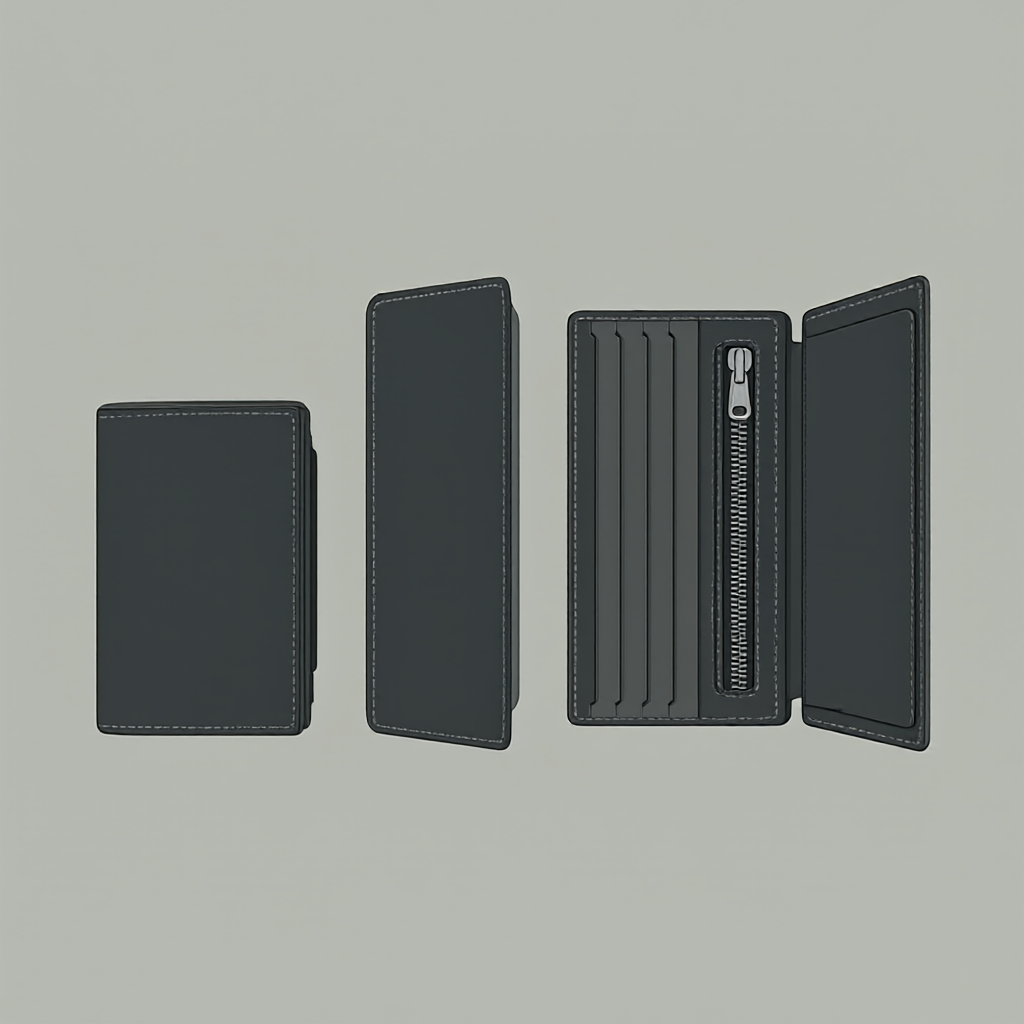
How does the trifold folding mechanism work?
The trifold mechanism relies on two precision-engineered hinge points that divide the wallet into three functional panels. Panel one holds the primary card slots, panel two serves as the central fold spine — often incorporating an RFID-blocking layer or a coin pouch — and panel three contains additional card storage or a bill compartment. When closed, the three panels stack into a single compact block.
The hinge design determines long-term reliability. Cheap trifold wallets fail at the bend points where the material fatigues after repeated opening and closing. Quality manufacturers reinforce these stress zones with metal pins, reinforced stitching (for leather), or monocoque CNC-machined frames (for metal wallets). This is why an EDC wallet built around a rigid metal frame often outlasts a folded leather alternative by years of daily use.
Why does a trifold design matter for women?
The trifold format offers specific advantages for female users that distinguish it from bifold or money clip options. Card capacity typically ranges from 6 to 12 cards, which accommodates the higher volume most women carry — driver’s license, credit cards, debit cards, ID, transit card, and photo ID simultaneously. The folded rectangular profile also slides more easily into smaller clutches and crossbody bags compared to bulkier bi-fold designs.
However, the trifold does introduce trade-offs. A three-panel metal wallet is thicker than a slim cardholder when fully loaded, and coin pouch integration adds bulk. Buyers must evaluate whether their target customer prioritizes capacity or minimal profile. This is a critical specification decision during the OEM prototyping phase.
What Are the Key Specifications for a Women’s Trifold Wallet?
What materials are commonly used?
Material selection directly affects weight, durability, cost, and end-user perception. Three dominant materials define the current women’s trifold market:
Anodized aluminum offers the best value proposition — lightweight at approximately 35 to 50 grams, corrosion-resistant through hardcoat anodizing, and available in a wide color spectrum. Aluminum trifold wallets represent the most cost-effective entry point for private label programs. See our minimalist wallet guide for detailed material comparisons across the full category.
Titanium provides superior strength-to-weight ratio and scratch resistance. A titanium trifold wallet typically weighs 40 to 55 grams — slightly heavier than aluminum but significantly more durable. Titanium’s natural biocompatibility and premium finish make it a strong choice for luxury-tier products.
Carbon fiber delivers a distinctive woven texture with high rigidity and low weight. Carbon fiber trifold wallets usually fall in the 30 to 45 gram range. The material requires a resin bonding process during manufacturing, which affects cost and lead time compared to machined metal alternatives.
| Material | Weight Range | Card Capacity | Estimated Cost Tier | Best For |
|---|---|---|---|---|
| Anodized aluminum | 35–50 g | 6–12 cards | Mid-range | High-volume private label |
| Titanium | 40–55 g | 6–10 cards | Premium | Luxury retail and corporate gifts |
| Carbon fiber | 30–45 g | 6–10 cards | Mid-to-premium | Design-focused EDC brands |
What are the typical dimensions and specifications?
Standard women’s trifold wallet dimensions range from 110 mm to 115 mm in width, 75 mm to 85 mm in height, and 12 mm to 20 mm in thickness when closed. Thickness varies depending on material choice, card capacity, and whether a coin pouch is integrated.
Card slot configuration typically accommodates 6 to 12 cards across the three panels, with a central cash slot or bill compartment. RFID-blocking models add a metallic laminate or woven mesh layer between the inner panels — this layer adds approximately 0.5 mm to overall thickness without significantly affecting fold functionality.
Weight distribution matters for palm comfort. Wallets exceeding 60 grams become noticeably heavy in a pocket or small bag over extended carry. The optimal range for a women-specific trifold sits between 35 and 50 grams for aluminum constructions, balancing substance and portability.
What Standards and Certifications Apply to Trifold Wallet Manufacturing?
What certifications should buyers verify?
Quality verification begins with facility and product certifications rather than marketing claims. Three certification categories are relevant for trifold wallet procurement:
Quality management systems. ISO 9001 certification confirms the manufacturer operates under a documented quality management framework covering design control, incoming material inspection, in-process quality checks, and final product testing. Buyers should request the ISO certificate number and verify it against ISO’s official directory before placing an order.
Social compliance. BSCI (Business Social Compliance Initiative) audit reports verify that the manufacturing facility meets labor, health, and safety standards. This matters particularly for brands selling in European and North American markets where supply chain transparency is increasingly demanded by retailers and consumers.
Material safety compliance. REACH and RoHS compliance ensure that the metals, adhesives, coatings, and RFID-blocking laminates used in the wallet do not contain restricted substances such as lead, cadmium, or certain phthalates. SGS testing reports provide third-party verification of material safety for each production batch.
For wallets targeting the U.S. market, the FTC enforces labeling requirements around material composition — genuine leather must be accurately described, and “metal” claims must reflect actual alloy content rather than thin plating over base metals.
What about RFID-blocking verification?
RFID-blocking performance depends on the frequency range targeted. Most consumer RFID wallets protect against 13.56 MHz frequencies used by credit cards and passports. However, performance varies widely between products. Reputable manufacturers will provide test data or certify to standards published by ASTM International for radio-frequency identification shielding effectiveness. Buyers should request a shield attenuation specification — anything below 20 dB at 13.56 MHz provides insufficient protection for practical use.
What Should B2B Buyers Consider When Sourcing Trifold Wallets?
What customization options are available for OEM production?
OEM trifold wallet production offers multiple customization layers that affect both product differentiation and unit cost:
Logo application. Laser engraving is the most common method for metal wallets, producing permanent marks that resist wear. UV printing allows full-color graphics on flat surfaces but may degrade over time with frequent handling. Both methods work on aluminum and titanium; carbon fiber surfaces accept laser engraving but limit UV print adhesion.
Finish and color. Aluminum wallets accept anodizing in virtually any Pantone-matched color, with hardcoat anodizing providing the highest scratch resistance. Titanium wallets can be anodized for color effects or left in a brushed or bead-blasted natural finish. Carbon fiber is typically paired with colored aluminum or titanium frames for accent options.
Packaging. Private label buyers require retail-ready packaging. Custom boxes with product imagery, spec labels, and barcodes can be designed in-house by the manufacturer or supplied by the buyer. Minimalist packaging reduces shipping weight and cost per unit while maintaining brand presence.
What is the typical MOQ and lead time?
Minimum order quantities for custom trifold wallets vary by material and complexity. Aluminum models commonly starts at 300 pcs per SKU for full OEM customization (100 pcs trial order available for stock finishes) per design, while titanium and carbon fiber constructions may require 200 to 500 piece minimums due to higher material costs and longer machining cycles.
Sample production timelines typically range from 5 to 7 business days for standard designs. Production lead time after sample approval generally falls between 15 and 25 business days depending on order volume, finishing complexity, and packaging requirements. Expedited production is often available for repeat orders with established tooling.
What trade-offs should buyers evaluate?
The most common sourcing trade-off centers on thickness versus capacity. A wallet designed to hold 12 cards plus cash will necessarily be thicker than one holding 6 cards. For women-specific products, this is especially important — excessive thickness reduces palm fit and increases bag bulk. Buyers should specify an exact card-and-cash loadout during the prototyping phase rather than relying on generic “high capacity” claims.
Another frequent consideration is RFID integration versus slimness. Adding an RFID-blocking layer increases thickness by approximately half a millimeter per side. For ultra-slim designs targeting minimalist users, some buyers opt to skip RFID blocking entirely and rely on physical card positioning within the wallet’s interior as a natural signal barrier.
How Do Reputable Manufacturers Approach Custom Trifold Wallet Production?
As a manufacturer, our approach to custom trifold wallet production follows a structured workflow that addresses the technical and commercial variables buyers encounter. With 13+ years of export experience serving EDC brands, Amazon FBA sellers, and promotional product distributors across 30+ countries, we have developed processes that balance design flexibility with manufacturing efficiency.
Our in-house CNC machining capability allows us to produce aluminum and titanium trifold wallet bodies with tight tolerances, ensuring consistent fold alignment and hinge durability across production runs. Laser engraving and UV printing are handled internally, which eliminates the coordination delays that occur when buyers outsource finishing to third parties. Anodizing is performed on-site for aluminum components, providing full color control and eliminating the wait times associated with external coating vendors.
Quality verification follows a documented process. All raw materials are tested against REACH and RoHS requirements before production begins. Final products undergo dimensional inspection and functional testing to confirm fold mechanism integrity and RFID shielding performance where specified. This systematic approach is consistent with the ISO 9001 quality management standards our facility maintains.
The combination of low MOQ flexibility starts at 300 pcs per SKU, 7-day sample turnaround, and complete in-house customization from logo application to retail packaging design allows buyers to validate market response before committing to large production runs. This is particularly valuable for private label buyers and Amazon sellers who need to test multiple designs and colorways without significant upfront investment.
For buyers evaluating the full range of EDC wallet formats beyond trifold designs, our men’s minimalist wallets guide covers material specifications and sourcing considerations that apply across the broader product category.
Trifold Wallet: Where Can You Verify the Data and Sources?
- ISO’s official directory — www.iso.org
- ASTM International — www.astm.org
- wallets for women — topedcwallet.com
- EDC wallet — topedcwallet.com
- minimalist wallet — topedcwallet.com
- men’s minimalist wallets — topedcwallet.com
- Get a Free Quote → — topedcwallet.com
From article to product
Sourcing minimalist-wallets?
Tell us the format, the quantity and the date you need stock. You get material options, MOQ and a landed-cost range back within one business day.
Keep reading
More on wallet types
Thin Male Wallets: Buying Guide for Slim Minimalist Picks
How to choose a slim wallet for men — thickness thresholds, material trade-offs, capacity…
ReadStashed Wallet: A Minimalist Everyday-Carry Solution
Understand what a stashed wallet is, how minimalist slim wallets work, and what to…
ReadFolding Wallets: Types, Materials & Buying Guide
Learn what makes a folding wallet worth buying, from materials and card capacity to…
Read
About the author
TOPWALLET Editorial Team
TOPWALLET's editorial and engineering desk writes from bench testing at the Shenzhen (Longgang) facility: pull-force and cycle testing, 13.56 MHz shielding measurements, finish trials and factory audits, rather than supplier spec sheets. Every specification in these guides is one we write on a purchase order.
Written on the floor
This article was written by our production and QC team — the people who spec tolerances, run the finishing line and inspect every batch. Where it states a capacity, a pull force or a lead time, it comes from a measurement we made, not a supplier’s catalogue. If a number here disagrees with what your own supplier told you, tell us; several of these articles started as a correction from a buyer.
See how the factory works · Inspection process · Sourcing FAQ
Sourcing minimalist-wallets?
Tell us the format, the quantity and the date you need stock. You get material options, MOQ and a landed-cost range back within one business day.