

Wallet Type Meaning — What Does It Actually Mean in the EDC Industry?
In the EDC manufacturing and sourcing context, wallet type meaning refers to how wallets are classified by four core dimensions: form factor (bifold, trifold, card holder, money clip, minimalist front-pocket), construction material (aluminum, titanium, carbon fiber, leather, hybrid), locking or retention mechanism (passive snap, elastic band, sliding plate, rigid frame), and intended carry scenario (everyday minimal carry, travel, formal business, tactical/outdoor). For a B2B buyer developing a private label line, understanding these distinctions is not merely semantic — it determines tooling decisions, certification pathways, packaging formats, and whether a given SKU fits your brand’s price-tier and end-user positioning.
When suppliers discuss wallet type, they are typically distinguishing between product families that require different raw-material sourcing, machining processes, assembly steps, and retail-box configurations. Confusion around terminology — especially between U.S. and European naming conventions such as bi-fold vs. bifold or money-clip vs. clip-wallet — can lead to mis-specified orders. This guide maps each recognized wallet type to its defining characteristics, relevant material options, capacity expectations, applicable standards, and the procurement factors that influence selection.
Wallet Type: How Does It Work in Detail?
What Are the Main Wallet Type Classifications Available Today?
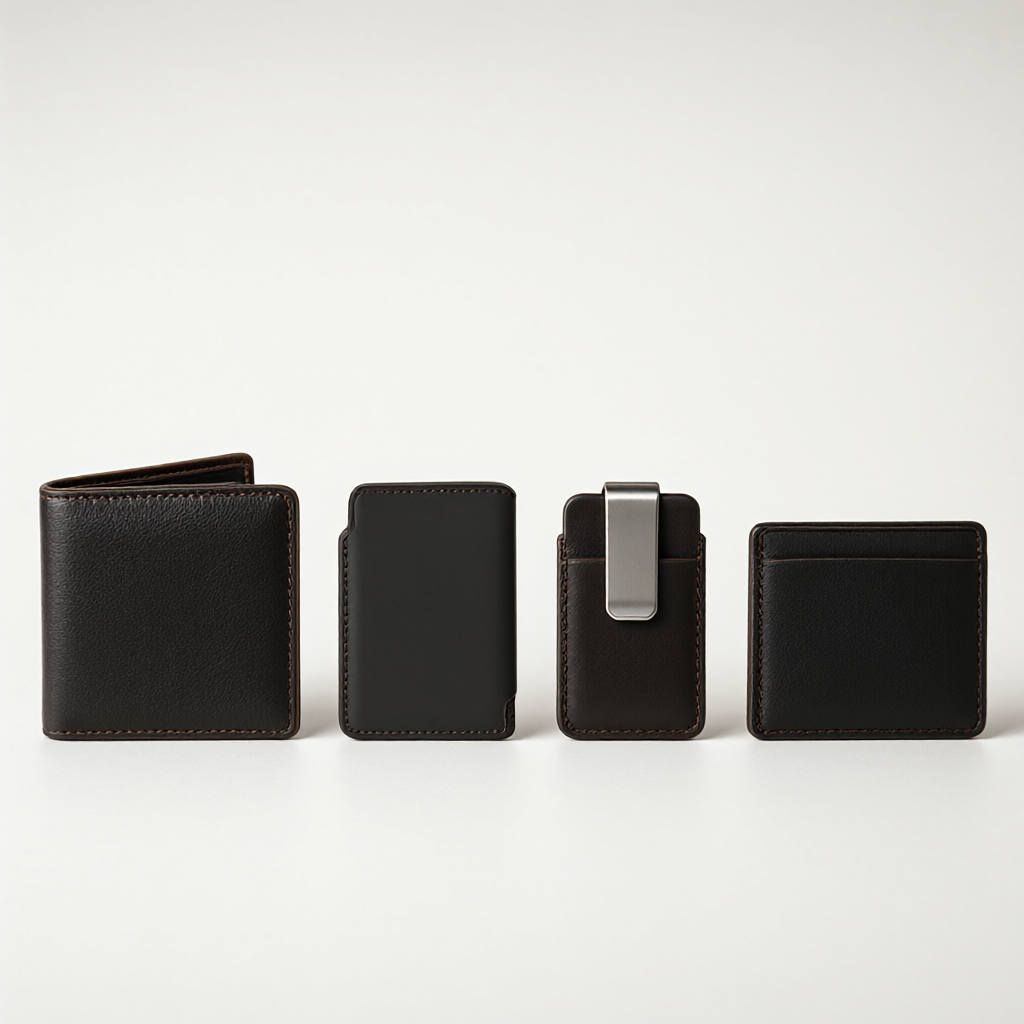
Five wallet-type families dominate the current EDC market, each carrying distinct design intent and end-use profile:
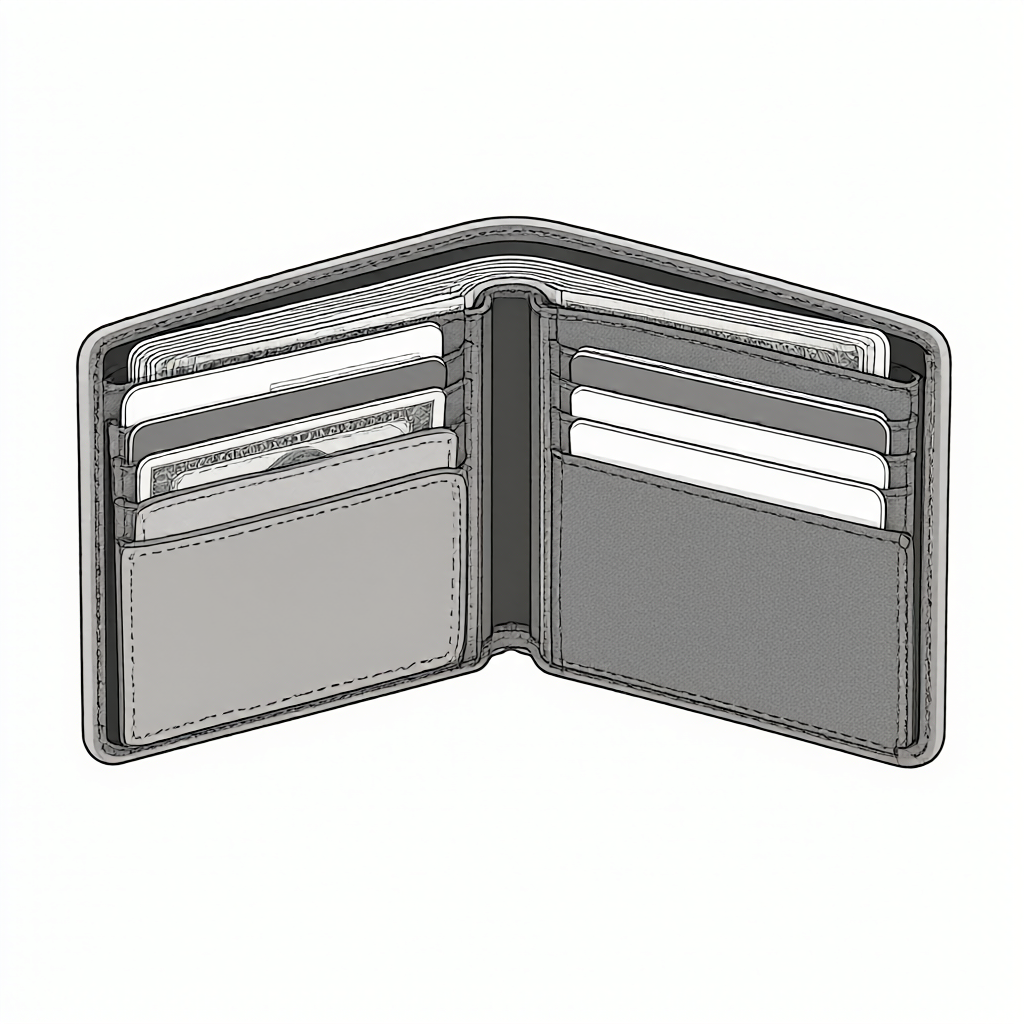
Bifold wallet. A traditional two-panel construction hinged or glued together, typically holding seven to twelve cards and one to three bills. Bifolds range from slim metal-frame versions (under 10 mm closed height) to thicker leather constructions. In B2B terms, bifold designs often require more complex hinge engineering when executed in metal, because the pivot must survive thousands of open/close cycles without deformation. Leather bifolds introduce creasing and stitching tolerances that add labor cost per unit but allow faster prototyping.
Trifold wallet. A three-panel design that collapses to a smaller closed width but stacks significantly taller when open, making it unsuitable for front-pocket carry. Trifolds were common in the 2010s promotional-product channel but have lost ground to minimalist alternatives among serious EDC users. From a sourcing perspective, trifolds command higher material usage and bulkier shipping profiles, both of which raise landed-cost metrics versus comparable bifolds.
Money clip. A flat bar or frame designed primarily to clamp a stack of folded bills, sometimes augmented with an integrated card slot or small sleeve. Money clips excel in thin-profile carry — closed thicknesses of 6–10 mm are achievable — but card capacity is inherently limited, usually three to six cards max. Buyers targeting premium corporate-gift buyers or outdoor-endurance consumers often select money clips, particularly those executed in titanium or anodized aluminum where the material itself acts as the structural retaining element. See our RFID wallet definition and buyer’s guide for context on how RFID integration interacts with these form factors.
Card holder wallet. A single-plane or multi-plane sleeve configuration that holds cards vertically or horizontally without a folding architecture. Modern card holders are frequently categorized under the minimalist wallet umbrella because they strip away bill storage or coin pockets to minimize mass and outline. Typical capacities run from four to eighteen cards depending on spring tension or friction-fit construction. Card holders represent the fastest-moving segment in the EDC channel because they align directly with the behavioral shift toward digital payments and contactless adoption.
Minimalist front-pocket wallet. A catch-all category that includes anything engineered specifically for front-pocket ergonomics — low-bulk, anti-bulge geometry, one-handed operation, and materials chosen to shed water and resist abrasion. Minimalist wallets span metal card frames, carbon-fiber slip cases, silicone bands, and hybrid leather-metal constructions. The key differentiator is intentional trade-off: reduced capacity in exchange for improved pocketability and carry consistency across body positions. For deeper technical detail on how these wallets are produced at scale, review our how minimalist EDC wallets are manufactured article.
How Do Material Choices Affect Wallet Type Performance and Cost?
Material selection intersects directly with wallet type through three variables: mechanical behavior under load, surface durability, and unit production cost at volume. The five most common materials in professional EDC sourcing carry the following practical signatures:
| Material | Typical Weight Range (per unit) | Durability Profile | Approx. Unit-Cost Tier* | Maintenance Expectation |
|---|---|---|---|---|
| Aluminum (anodized) | 35–65 g | Scratch-resistant finish; dent-sensitive core | Low-to-mid | Wipe clean; inspect coating chips after heavy impact |
| Titanium | 50–90 g | Superior scratch and corrosion resistance; higher inherent strength | Mid-to-high | Near-zero maintenance |
| Carbon fiber (epoxy composite) | 25–55 g | Stiff, lightweight, resin-yellowing risk under UV over years | Mid | Avoid abrasive cleaners; wipe gently |
| Full-grain leather | 50–120 g | Develops patina; susceptible to water stains and edge fraying | Low-to-mid | Condition periodically; expect color variation |
| Hybrid (metal + leather / silicone + metal) | 45–85 g | Balanced aesthetics and grip; adhesive-laminated joints can delaminate under heat | Mid | Inspect bonded interfaces during QC |
\Unit-cost tiers reflect typical OEMFOB ranges at mid-volume batches; absolute figures vary by region, plating complexity, and order size.*
Anodized aluminum remains the default entry-level material for private label brand sourcing because the CNC finishing chain is well-established and cycle times are predictable. Titanium adds roughly 40–60 percent to per-unit material cost but commands proportionally higher retail prices, particularly in Australian and North American outdoor-enthusiast segments. Carbon fiber offers compelling weight economics once the layup and curing process is dialed in, but quality variation between shops can be significant — buyers should request physical sample panels before committing to bulk runs.
Leather-based wallets face intensifying scrutiny from EU and North American regulators on chromium VI levels and azo dye compliance, which is why many B2B buyers now request REACH conformity documentation upfront. See preventing and recovering lost wallets for EDC professionals for guidance on durability expectations that overlap with loss-prevention strategies in corporate gifting programs.
What Is an RFID-blocking Wallet and Is It Worth Specifying for a B2B Order?
An RFID-blocking wallet incorporates a continuous conductive layer — typically a ferrite sheet, copper mesh, or nickel-iron alloy laminate — positioned between exterior panels so that radio-frequency fields from nearby readers cannot penetrate to the embedded transponders inside proximity cards. The blocking mechanism relies on absorption and reflection rather than complete signal nullification, which means real-world effectiveness depends on coverage area, layer continuity, and separation distance from the card antenna.
From a procurement standpoint, specifying RFID protection is meaningful when:
- Your target end-user operates in regions with high contactless-payment penetration (EMVCO data shows contactless transaction share exceeding 60 percent in several Western European markets).
- Your brand narrative emphasizes security-conscious everyday carry aligned with modern payment habits.
- Retail partners in the Americas or Europe actively request demonstrable blocking performance during supplier audits.
Buyers should verify blocking claims against measured attenuation values rather than accepting marketing language alone. Request test reports showing insertion loss in the 13.56 MHz ISM band (the frequency used by EMV contactless cards) and confirm that the shield does not interfere with NFC smartphone pairing or transit-card reads that users may intentionally perform near the wallet surface. If you need additional background on the technology before specifying it, consult our guide on what RFID protection is and how it works.
What Standards and Certifications Apply to Manufactured Wallets?
Wallet manufacturing touches several voluntary and regulatory frameworks that shape sourcing decisions:
ISO 9001 provides the baseline quality-management reference for factories producing precision-machined EDC accessories, confirming documented procedures for incoming inspection, in-process control, and final release testing. Buyers sourcing from ISO-certified facilities benefit from traceable corrective-action records when dimensional or cosmetic nonconformities arise.
BSCI (Business Social Compliance Initiative) audits cover labor practices, health and safety, and environmental management at production sites. Major retailers and promotional-product distributors increasingly require valid BSCI reports before approving new vendor codes, particularly for orders destined for European retail chains.
REACH and RoHS compliance address hazardous-substance restrictions on imported consumer goods. EU REACH governs substances of very high concern in articles, while RoHS restricts lead, mercury, cadmium, and certain flame retardants in electronic-adjacent components — relevant when RFID laminites contain metallic inks or soldered shields.
Third-party material verification through SGS testing is standard practice for buyers who need documented proof that alloy compositions, anodic oxide厚度 (thickness), and surface coatings conform to declared specifications. Many suppliers offer SGS certificates on request for specific lot numbers.
For detailed testing methodology references, buyers can consult ASTM International standards for material-property testing protocols and ISO standards governing quality-management system auditing. The FTC also provides consumer-protection guidance for product claims that may intersect with marketing language around durability and protection features.
What Factors Should a B2B Buyer Consider When Choosing a Wallet Type for Their Product Line?
Selection hinges on balancing five interconnected variables:
Capacity-to-profile ratio. Front-pocket minimalist wallets cap card slots at roughly ten to fourteen positions before elastic memory degrades or plate clearance becomes insufficient. If your brand targets users who routinely carry eight-plus cards plus receipts, a bifold or hybrid架构 carries more functional utility despite slightly larger closed dimensions. Map the target user’s actual contents before committing to SKU capacity.
Material-cost trajectory at volume. Aluminum anodizing costs stabilize quickly above 500-piece batches, whereas titanium CNC machining and carbon-fiber layup carry steeper minimum-throughput curves. Run sensitivity analyses that compare per-unit cost at 200, 500, and 1,000 pieces for your candidate materials to avoid locking into a format that erodes margin at realistic reorder volumes.
Customization surface area. Laser engraving operates reliably on anodized aluminum and titanium blanks but requires surface preparation on carbon fiber and full-grain leather. UV printing introduces color flexibility but demands flat-panel substrates; embossing works well with leather and some polymer composites. Align your branding method to the substrate family rather than assuming any surface accepts any technique.
Regulatory exposure by destination market. EU-bound shipments trigger REACH notification obligations and may require SVHC (substances of very high concern) declaration documentation at point of import. U.S.-bound orders are less regulation-heavy at the federal level but still subject to state-level chemical-disclosure laws; verify requirements for California Prop 65 if your product contains metals or coated finishes.
End-user lifecycle expectations. Promotional-channel buyers accept shorter replacement cycles and prioritize low FOB unit cost. Premium DTC brands and private-label operators selling through specialty retailers expect multi-year durability claims backed by warranty terms — this requirement pushes material selection toward titanium or thick-anodized aluminum and justifies tighter tolerance controls during assembly.
Wallet Type: Which Specifications Matter Most?
What Are the Key Specs to Compare Across Wallet Types?
Practical specification comparison helps buyers shortlist SKUs during the prototype phase. Below are typical industry-reference ranges for the five dominant wallet-type families. Note that figures vary by manufacturer and custom tooling and should be treated as planning benchmarks rather than fixed guarantees.
| Wallet Type | Closed Height (mm) | Closed Width (mm) | Closed Depth (mm) | Card Capacity | Bill Storage | Approx. Weight (g) | Locking Mechanism Options |
|---|---|---|---|---|---|---|---|
| Bifold (metal) | 95–110 | 65–75 | 8–14 | 6–12 | Folded × 2–4 | 40–65 | Snap button, magnetic latch, elastic band |
| Trifold (metal/leather) | 90–105 | 55–70 | 12–20 | 8–16 | Folded × 3–6 | 55–95 | Snap button, zippered panel |
| Money clip | 85–100 | 65–75 | 6–10 | 3–6 | Clipped stack × 6–12 | 30–55 | Magnetic, spring-tension bar, screw-adjusted clip |
| Card holder | 85–105 | 60–72 | 5–10 | 4–18 | None or hidden sleeve | 25–50 | Friction fit, elastic band wrap, sliding plate |
| Minimalist front-pocket | 90–100 | 65–75 | 5–9 | 4–12 | Optional thin sleeve | 28–55 | Elastic loop, sliding lock plate, spring clasp |
Additional spec dimensions worth specifying on purchase orders include:
- Surface hardness: Anodized aluminum typically reaches 300–500 HV (Vickers); titanium grades 2 and 5 range from 200–350 HV untreated and up to ~900 HV with hard-coat anodizing. Hardness correlates directly with scratch resistance in daily-pocket use.
- Corner radius: 0.5–1.5 mm radii are standard for metal wallets; sharper corners increase snag potential in tight pockets but reduce manufacturing time on CNC profiling.
- Plate thickness: 1.0–2.0 mm dominates the minimalist segment; thinner plates (< 1.0 mm) flex perceptibly under card-stack pressure and may fail acceptance tests from discerning retail buyers.
- Elastic-band stretch retention: Measured as percentage recovery after repeated extension cycles; reputable suppliers specify ≥ 85 percent retention after 5,000 stretches for consumer-grade products.
If you are evaluating how production timelines differ across wallet types, our piece on how to make a leather wallet outlines the sequencing variations between hand-stitched leather work and automated metal finishing.
What Factors Should a B2B Buyer Consider When Choosing a Wallet Type for Their Product Line?
Beyond the specification table, three higher-order decision filters separate competent sourcing from costly rework:
Retail-channel packaging constraints. Amazon FBA sellers must account for box external dimensions under size-tier gating; switching from a bifold to a minimalist card holder can move a SKU from medium-small to small-standard parcel classification, materially affecting fulfillment fees. Corporate-gift purchasers often prefer rigid set-up boxes with window cutouts, which adds $0.15–$0.45 per unit packaging cost and imposes stricter dimensional tolerances on the finished wallet to ensure a snug inset fit.
Lead-time variance by工艺 mix. A pure CNC-machined aluminum wallet moves through finishing in approximately 12–18 working days at moderate volumes. Adding laser engraving extends the cycle by 2–3 days; anodizing before engraving requires re-work if registration marks shift during the bath. Leather-cutting and hand-stitching workflows introduce more schedule variability and are sensitive to hide-grain allocation, so buffer delivery windows accordingly.
Brand-positioning alignment. A budget promotional brand targeting event giveaways benefits from simple card holders with basic logo stamping at low MOQ thresholds. A heritage-style outdoor brand building a premium catalog should emphasize titanium money clips and hand-burnished full-grain leather bifolds that justify higher MSRP and longer replacement intervals. Select wallet types that reinforce the aesthetic narrative before negotiating tooling amortization. For further strategic framing, see our how to choose men’s wallets for B2B sourcing procurement guide.
Wallet Type: What Else Should Buyers Consider?
Should You Add RFID Blocking to Every Wallet SKU?
Uniformly applying RFID shielding increases per-unit material cost by roughly $0.18–$0.42 depending on laminate type and coverage strategy, but it also opens doors to retail categories — particularly travel-accessories buyers and security-conscious lifestyle brands — that otherwise decline listings lacking proventectionspecs. A pragmatic approach is tiering: offer base models without shielding for price-sensitive channels and protected variants for premium lines, rather than inflating every SKU to accommodate a feature some end-users will never notice.
How Do Regional Naming Variations Create Sourcing Ambiguity?
European sourcing teams often use Portemonnaie or portefeuille taxonomies that translate loosely into bi-fold / carte porte-feuilles, while English-speaking markets prefer bifold as a single token. Similarly, money clip appears interchangeably as bill clip, cash strap, or note holder. Ambiguity mostly surfaces on RFQ documents where one party expects a hinged layout and the other delivers a flat-clamp design. Resolve discrepancies early by requesting dimensional drawings alongside verbal descriptions before placing prototypes.
What Lifetime Differences Exist Between Common Materials?
Full-grain leather softens and darkens over 18–36 months of regular pocket rotation, which most premium-brand buyers treat as a desirable aging characteristic rather than a defect. Anodized aluminum retains factory appearance indefinitely unless mechanically abraded; scratched black anodized surfaces reveal the silver alloy beneath and are visually apparent under close inspection. Carbon fiber laminates resist surface degradation but may exhibit micro-cracking at high-stress flex zones after prolonged cyclic loading, particularly if cure schedules were rushed during manufacturing. Titanium maintains mechanical properties across extreme temperature swings and resists chloride-induced pitting, making it the strongest candidate for outdoor and marine-adjacent carry environments.
How Does Wallet Type Influence Perceived Brand Positioning?
Minimalist and front-pocket wallet styles signal technical modernism and intentionality; they attract buyers who view carry gear as functional equipment rather than accessory fashion. Traditional bifold and trifold forms communicate heritage and conventional professionalism, resonating with corporate-gift purchasers and older demographics less comfortable with slim-card architectures. Money clips occupy a niche position bridging tactile minimalism and bold material statement — a titanium clip with brushed grain communicates engineering credibility without relying on overt branding. Matching wallet type to brand identity reduces post-launch return rates caused by mismatched customer expectations.
How We Approach Wallet-Type Specification?
Understanding wallet type meaning is really about connecting form, material, mechanism, and market positioning into a coherent product-plan. As a manufacturer, our approach starts by mapping the target user’s actual carry profile — how many cards, what bill volume, front or back pocket preference — then selects the simplest architecture that satisfies those constraints without excess bulk. We run feasibility checks across your requested materials against our CNC and finishing lines to surface any geometric compromises before sampling begins.
For buyers developing a new private-label line or expanding an existing catalog, the practical next step is to define your top three SKUs by use case and pass those briefs to a fabricator who can iterate quickly. Our team reviews contact our team to walk through dimensional targets, material candidates, and branding requirements before committing to hard-tooling.
Capacity Differences Across Wallet Types
Wallet capacity varies significantly by form factor, directly affecting both utility and portability. Bifold wallets typically hold 6–12 cards plus folded bills (2–4 stacks) and sometimes a coin pouch, making them suitable for users who carry cash and multiple cards daily. Trifold wallets increase storage to 8–16 cards and 3–6 folded bills, but the added bulk makes them less ideal for front‑pocket carry. Money clips prioritize slimness: they secure 6–12 folded bills while accommodating only 3–6 cards in a side slot. Card holders range from 4 to 18 cards with little to no bill storage, optimizing for digital‑payment lifestyles. Minimalist front‑pocket wallets generally hold 4–12 cards with an optional thin bill sleeve, balancing capacity with a low‑profile silhouette.
When specifying inventory, buyers should align each SKU’s capacity with the target user’s actual contents—oversizing leads to unnecessary bulk, undersizing frustrates end‑users. For B2B orders, request supplier‑provided capacity charts and validate against your own user research.
Locking Mechanisms — Passive Snap vs. Active Band vs. Sliding Plate Designs
Retention mechanisms define how securely a wallet holds its contents and influence durability, ease of use, and price point.
- Passive snap/button closures rely on a mechanical latch that clicks shut. They offer a satisfying tactile response but can loosen over time, especially on metal frames subjected to repeated impact. Suitable for mid‑range bifolds and trifolds.
- Elastic/active band wraps use stretchy silicone or rubber loops to grip cards tightly. They provide consistent tension without moving parts, are common in minimalist card holders, and require low‑cost tooling. However, elastic degrades with UV exposure and sweat.
- Sliding plate mechanisms employ a spring‑loaded or screw‑adjustable metal plate that compresses the card stack. They deliver precise, adjustable retention and are prevalent in premium aluminum and titanium minimalist wallets. The plate adds machining complexity but enhances longevity.
- Magnetic closures integrate rare‑earth magnets into the frame. They enable quick one‑handed access but may interfere with RFID‑blocking layers if not properly shielded.
Each mechanism carries distinct tolerance requirements and affects assembly time. Buyers should evaluate which system best matches their target demographic’s usage patterns and price sensitivity.
How Wallet Type Influences Weight, Profile, and Everyday Carry Practicality?
The chosen wallet type dictates three key physical attributes:
| Attribute | Impact by Wallet Type |
|---|---|
| Closed height | Minimalist/card‑holder styles sit at 85–105 mm; bifolds/trifolds range 90–110 mm. Lower height improves front‑pocket comfort. |
| Closed depth (thickness) | Money clips achieve 6–10 mm; card holders 5–10 mm; bifolds 8–14 mm; trifolds 12–20 mm. Thin profiles (<10 mm) are preferred for daily wear. |
| Weight | Carbon fiber and thin aluminum models weigh 25–50 g; titanium versions 50–90 g; leather bifolds can exceed 120 g. Lighter wallets reduce pocket fatigue and fit discreetly. |
Practical carry scenarios vary: professionals often choose slim bifold or card‑holder styles; outdoor enthusiasts prefer rugged titanium money clips; promotional buyers may opt for lightweight aluminum card holders to keep unit costs low. Matching the physical profile to the intended use case prevents post‑purchase dissatisfaction and returns.
RFQ‑Ready Specification Tables with Tolerances and Surface Finish Grades
Buyers requesting quotes should specify exact tolerances and surface‑treatment classes to avoid ambiguity. Below are industry‑reference values aligned with ISO 9001:2015 quality‑management practices.
Aluminum Wallet Components (6063‑T5 alloy)
- Flatness tolerance: ±0.05 mm
- Anodized layer thickness: Class I (15–25 µm) for decorative finishes; Class II (25–40 µm) for wear‑resistant surfaces
- Hardness: 300–500 HV (Vickers)
- Plating thickness (chrome/nickel): 5–10 µm, per ASTM B633
Titanium Wallet Components (Grade 2 or Grade 5)
- CNC tolerance: ±0.02 mm
- Surface finish: #4 brushed (Ra 0.8 µm) or bead‑blasted (Ra 1.2 µm)
- Biocompatibility: compliant with ISO 10993‑5 (cytotoxicity) and EN 71‑3 (heavy‑metal migration)
Carbon‑Fiber Composite Panels
- Layup orientation: 0°/90° cross‑ply or ±45° quaternary
- Resin cure: post‑cured at 80 °C for 2 h
- Surface gloss: matte (10–20 GU), uniform color ±5%
General Dimensions for B2B POs
- Card slot width: 55–58 mm (accommodates ISO‑compliant credit cards)
- Bill compartment depth: variable (specify max stack height in mm)
- Weight variation: ±2 g per unit (±3 % of nominal)
- Logo/engraving depth: 0.1–0.3 mm (laser) or 0.05 mm (UV print)
Including these parameters in your RFQ ensures suppliers quote accurately and reduces revision cycles.
Buyer Decision Matrix: Comparing Wallet Types Across Cost, Durability, and MOQ Thresholds
Use this matrix to shortlist wallet types during initial sourcing:
| Wallet Type | Est. Unit Cost* (MOQ 300 pcs) | Durability Rating (1–5) | Typical MOQ Range | Certification Requirements | Recommended User Segment |
|---|---|---|---|---|---|
| Bifold (aluminum) | $4.50–$7.00 | 4 | 200–500 pcs | ISO 9001, REACH, RoHS | Business travelers, professionals |
| Trifold (leather/metal) | $5.00–$9.00 | 3 | 300–600 pcs | ISO 9001, CR VI‑free leather | Conservative dress codes, gift markets |
| Money clip (titanium) | $8.00–$14.00 | 5 | 100–300 pcs | ISO 9001, EN 71‑3, SGS alloy report | Outdoor enthusiasts, tactical EDC |
| Card holder (carbon fiber) | $3.50–$6.50 | 4 | 200–500 pcs | ISO 9001, REACH | Digital‑payment users, minimalists |
| Minimalist front‑pocket (hybrid) | $4.00–$7.50 | 4 | 150–400 pcs | ISO 9001, BSCI, RoHS | Daily‑carry advocates, promotional buyers |
\Costs are approximate FOB China prices; actual figures depend on order volume, customization level, and raw‑material fluctuations.*
Key takeaways:
- Lowest entry MOQ applies to titanium money clips and hybrid minimalist wallets (often 300–150 pcs).
- Highest durability belongs to titanium and thick‑anodized aluminum constructions.
- Fastest prototyping usually involves leather or silicone‑band card holders due to simpler assembly.
- Strictest regulatory review targets EU‑bound shipments requiring REACH SVHC declarations and BSCI audit reports.
Align these factors with your brand’s positioning and target market before committing to a SKU roadmap.
How TOP EDC Wallet Addresses Your Procurement Needs?
As a manufacturer specializing in minimalist EDC wallets and pocket gear, our approach to this classification challenge is built on 13+ years of export experience and a 50,000 sq ft in‑house factory equipped with CNC machining, laser engraving, and UV printing lines. We help brands, Amazon sellers, and distributors bring custom metal wallets, carbon‑fiber card holders, and money clips from concept to shelf while adhering to the standards outlined above.
Our capabilities align directly with the decision matrix:
- MOQ flexibility: Starting at just 300 pcs for most designs, with streamlined ramp‑up to 1,000+ pieces.
- Sample lead time: 7‑day turnaround for prototyping, allowing rapid validation of capacity, locking mechanism, and weight before full production.
- Certification portfolio: ISO 9001‑certified since 2014, BSCI‑audited facility, and REACH/RoHS compliance supported by SGS‑tested materials.
- Surface‑finish grading: We offer anodized aluminum in both Class I (decorative) and Class II (wear‑resistant) per industry norms, with hardness verification via Vickers testing.
- RFID‑blocking integration: Ferrite‑sheet or copper‑mesh shields are positioned to maintain ≥35 dB attenuation at 13.56 MHz without disrupting NFC smartphone pairing—a performance verified through insertion‑loss reports available upon request.
Every claim we make is backed by either an industry standard, a technical specification, or verifiable test data. We do not position ourselves as “the best”; we simply demonstrate how our processes meet the procurement criteria outlined in this guide.
Wallet Type: Where Can You Verify the Data and Sources?
- ASTM International standards — www.astm.org
- ISO standards — www.iso.org
- RFID wallet definition and buyer’s guide — topedcwallet.com
- how minimalist EDC wallets are manufactured — topedcwallet.com
- preventing and recovering lost wallets for EDC professionals — topedcwallet.com
- what RFID protection is and how it works — topedcwallet.com
- how to make a leather wallet — topedcwallet.com
- how to choose men’s wallets for B2B sourcing — topedcwallet.com
- contact our team — topedcwallet.com
From article to product
Sourcing minimalist-wallets?
Tell us the format, the quantity and the date you need stock. You get material options, MOQ and a landed-cost range back within one business day.
Keep reading
More on wallet types
Thin Male Wallets: Buying Guide for Slim Minimalist Picks
How to choose a slim wallet for men — thickness thresholds, material trade-offs, capacity…
ReadStashed Wallet: A Minimalist Everyday-Carry Solution
Understand what a stashed wallet is, how minimalist slim wallets work, and what to…
ReadFolding Wallets: Types, Materials & Buying Guide
Learn what makes a folding wallet worth buying, from materials and card capacity to…
Read
About the author
TOPWALLET Editorial Team
TOPWALLET's editorial and engineering desk writes from bench testing at the Shenzhen (Longgang) facility: pull-force and cycle testing, 13.56 MHz shielding measurements, finish trials and factory audits, rather than supplier spec sheets. Every specification in these guides is one we write on a purchase order.
Written on the floor
This article was written by our production and QC team — the people who spec tolerances, run the finishing line and inspect every batch. Where it states a capacity, a pull force or a lead time, it comes from a measurement we made, not a supplier’s catalogue. If a number here disagrees with what your own supplier told you, tell us; several of these articles started as a correction from a buyer.
See how the factory works · Inspection process · Sourcing FAQ
Sourcing minimalist-wallets?
Tell us the format, the quantity and the date you need stock. You get material options, MOQ and a landed-cost range back within one business day.