

Quick answer: a custom travel wallet or passport holder is only orderable when the brief names the traveller, the exact contents, the carrying style and the sales context — then converts those into measurable dimensions, materials, branding and acceptance checks. “OEM” does not by itself establish who designs, who owns tooling, or who tests; that has to be written down.
Travel wallets and passport holders let brands turn a routine accessory into a distinctive retail product or corporate gift. For product developers and sourcing teams, this guide walks through the format decision, material specification, branding trials, supplier evaluation and sample approval — so production rests on an approved specification rather than on a supplier’s assurance.
What Should You Define Before Ordering Custom Travel Wallets?
Before requesting quotes, decide who uses the wallet, what it must carry, and how you will sell or distribute it. Those four answers set layout, material, branding, packaging and budget — and they determine whether your supplier’s “OEM” offer actually covers design, tooling, sourcing and testing, or only assembly.
Which Four Decisions Shape a Custom Travel Wallets Brief?
- Audience: individual travellers, families, corporate recipients or another defined group.
- Contents: passports, cards, cash, tickets, receipts and any accessory the product must accommodate.
- Carrying style: pocket, handbag, backpack or carry-on compartment.
- Sales context: retail presentation, gifting, personalisation or replenishable stock.
Rank requirements as essential, desirable or optional instead of asking for every feature. A compact cover for occasional trips needs a different brief from a family organiser holding several documents, and the trade-offs become deliberate rather than accidental when they are ranked in advance. If your range also includes compact carry, the format logic in the front pocket and minimalist wallet sourcing guide is a useful counterpoint.
Which Custom Travel Wallets Format Matches Your Travel Routine?
Choose the format before refining colours and logos. During sample review, judge capacity against the contents in your brief — never against an empty product photograph. Easy access matters, but so does retention: a document that slides out on its own is a defect, not a convenience. For the category definition and specification framework, see what a travel wallet is and how to specify one.
| Format | Consider it for | Check during sampling |
|---|---|---|
| Slim passport cover | A passport-first design with minimal extras | Insertion, removal, pocket fit |
| Bifold travel wallet | A combined passport, card and cash layout | Closure and thickness when loaded |
| Zipped organiser | A brief that requires enclosed storage | Zipper clearance and document access |
| Multi-passport organiser | Several travellers’ documents | Separation and identification of contents |
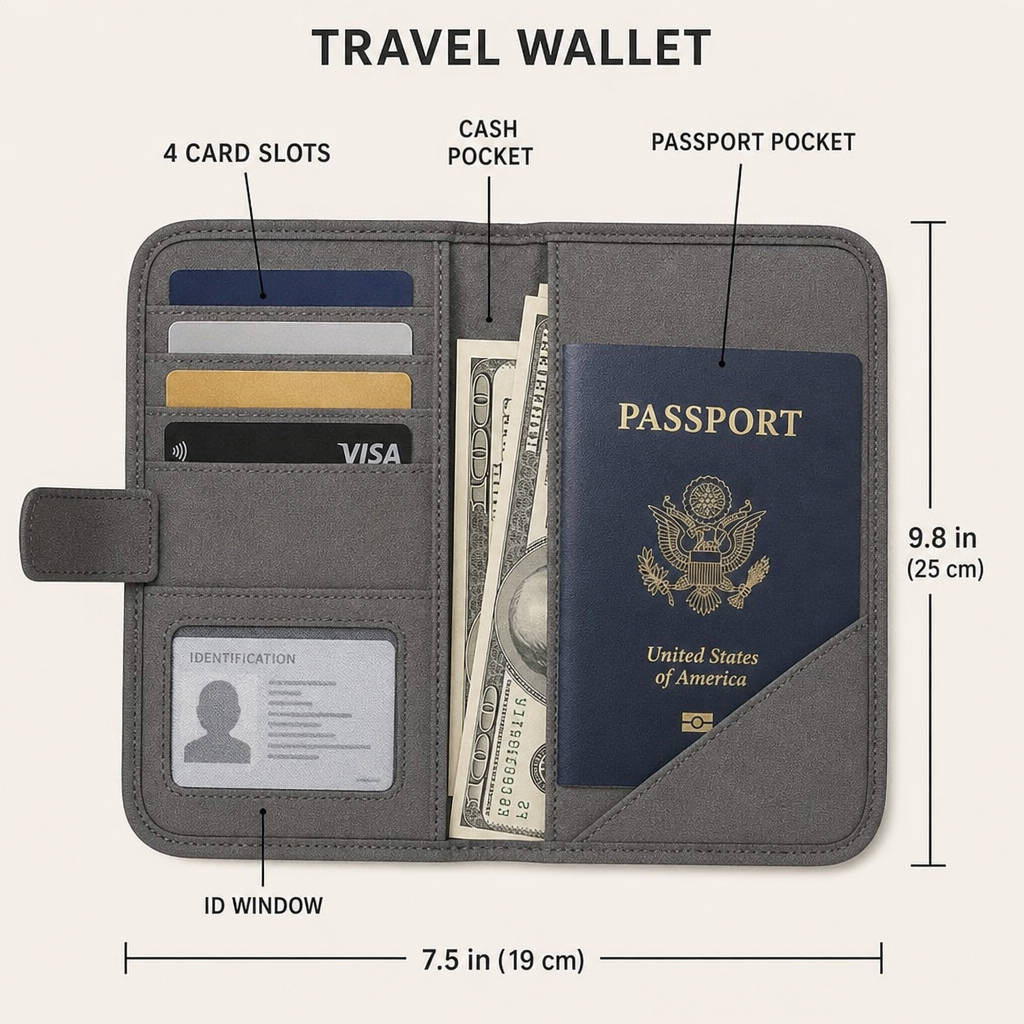
For passport holders, test whether the book slides out without catching at corners or seams. For a passport-and-card combination, load every intended compartment before judging comfort and closure. Reject the sample that only looks tidy when nearly empty — that is the most common failure on this format.
If your brief is to buy finished product rather than to specify production, the best travel wallets of 2026 comparison ranks eleven ready-made options by passport fit, currency handling and theft resistance — a different question from the manufacturing decisions on this page.
How Do You Specify Custom Travel Wallets Materials Beyond Looks?
Ask suppliers to identify the composition of the exterior, lining, pocket backing, reinforcement and trim. For leather options, “premium leather” is not a material description: the FTC Leather Guides address misleading composition claims and require disclosure where a material looks like leather but is not.
What Should You Ask About Each Custom Travel Wallets Material?
- Composition: exact materials, including coatings and backing.
- Reproducibility: can the supplier reproduce this finish on a repeat order?
- Evidence: what supports any durability or performance claim?
- Decoration fit: how will the chosen branding method behave on this surface?
Request physical swatches alongside written specifications, record colour reference, surface finish, thickness and acceptable appearance variation, and keep the approved swatch in the project file. Material choices also move unit cost and process — the arithmetic is in how material choice changes factory cost, and the leather-specific view is in leather travel wallets for B2B buyers.
Treat environmental language with the same care. The FTC Green Guides warn against broad unqualified claims such as “eco-friendly” and expect recycled-content claims to be qualified when only part of the product or packaging uses recycled material. If a supplier cites Leather Working Group certification, verify the facility and the permitted claim: LWG certification applies to the facility where leather was made, not to a finished wallet. A tannery’s status is not a product certificate.
How Do You Turn Branding Into a Custom Travel Wallets Specification?
Build one specification sheet with drawings, dimensions, materials, branding artwork and packaging instructions. Mark the requirements that actually affect function — usable pocket openings, clearance around documents — and add photographs or diagrams wherever words leave room for interpretation.
A workable specification covers dimensions (finished open and closed measurements, pocket openings, tolerances), construction (seam positions, edge treatment, reinforcement, closure), branding (artwork version, placement, size, approved appearance), packaging (inserts, wrapping, labels, carton quantities) and change control (any substitution that needs written approval). The same structure applies to smaller formats such as custom leather card holders.
Run a branding trial on the actual selected material before approving the finished sample, then review clarity, alignment and consistency against the artwork. Keep an attractive alternative finish separate from the approved version until you deliberately authorise the change — artwork approval and production intent should never be the same email.
For an RFID-blocking option, request evidence for the finished construction and the intended use: test method, frequencies evaluated, sample configuration and limitations. A lining description is not a test result. See RFID blocking wallets: OEM testing and compliance for the protocol, and RFID travel formats for the sourcing side.
How Should You Evaluate a Custom Travel Wallets OEM Supplier?
Judge a supplier by whether it can document the proposed materials, explain who performs each production step, and reproduce an approved specification. Use a relevant sample and a written inspection plan as decision points rather than catalogue images.
Ask who performs cutting, stitching, decoration, assembly and packing, request disclosure of subcontracted operations, and identify who remains accountable for corrections. If a supplier proposes a material or construction change, ask for the reason and a supporting sample before accepting it.
Make quotations comparable by issuing the same specification to every candidate and asking each to separate unit pricing, sample charges, tooling, decoration setup, packaging, inspection and shipping assumptions. Record minimum order requirements by design, colour and packaging version instead of assuming one minimum covers everything. Supplier capability, not catalogue breadth, is what the process steps in evaluating travel wallets for B2B resale are designed to surface.
How Do You Approve Custom Travel Wallets Samples Under Real Use?
Plan approval as a sequence rather than one yes-or-no meeting: review layout first, then materials and branding, then a representative pre-production version. Retain matching approved samples with both parties and record exceptions in writing.
What Sequence Should a Custom Travel Wallets Sample Review Follow?
- Check fit: insert the intended documents and confirm pockets do not force them to bend.
- Load the wallet: fill the specified compartments, close it, inspect alignment and bulk.
- Check access: remove and replace documents and cards without disturbing everything else.
- Inspect workmanship: seams, edges, lining, hardware and decoration against the specification.
- Check packaging: confirm the packed product arrives in the presentation customers will receive.
Set acceptance limits and test procedures before production, including how defects are recorded and resolved and whether a failed check requires correction, replacement or another agreed remedy. Introducing a new interpretation of “acceptable” after the goods are complete is how good projects turn into disputes. The defect categories and sampling logic are in the wallet quality control checklist.
Keep protection claims realistic. A damaged passport remains a damaged passport: stains, mould and significant tears are grounds for replacement, and a holder should never be marketed as making a compromised document valid for travel.
How Do You Compare the Complete Custom Travel Wallets Order Cost?
Build the budget around the whole transaction: development, setup, packaging, inspection, freight and any destination charges. Ask each supplier to state exclusions so you can price them before committing rather than after.
Request a schedule with separate milestones for material confirmation, sampling, approval, production, inspection and dispatch, and establish what starts each stage. Leave room in the launch plan to review and correct problems instead of treating sample approval as an administrative step. Documentation requirements for each market are a separate workstream — start from the wallet compliance checklist and confirm scope with a qualified adviser.
For repeat orders, preserve artwork files, material references, approved samples and revision history, and require confirmation of any proposed substitution before replenishment. That is what makes the second order verifiably the same product as the first. Where the line also includes gift and personalisation programs, see monogram customisation on wallets and corporate gift wallets in bulk.
Why Should a Custom Travel Wallets Order Start From a Clear Brief?
A successful custom travel accessory starts with a defined user and ends with an approved, repeatable specification. Choose the format first, verify materials and claims, then assess the fully loaded sample before authorising production.
Before requesting the next quote, assemble the brief, artwork, packaging requirements and inspection checklist into one shared project file — that file is the product, and the sample is only its first proof.
Custom Travel Wallets FAQ: Passport Fit, Logos, and Field Failures — Which Questions Do Buyers Ask Most?
Should a custom travel wallet use an integrated passport page or a separate sleeve?
Integrated page wins for one-document travelers; separate sleeve wins for families and couples. An integrated page keeps the passport fixed and the wallet thinner, while a removable sleeve lets two travelers share one wallet and lets the passport be handed over alone at a counter.
What MOQ applies when a custom travel wallet carries a debossed logo?
Expect about 100 pieces for a deboss or foil logo, because the die is made once and amortized. Below that volume, printed or patch branding is the realistic route; confirm whether the logo MOQ applies per colorway as well as per model.
Which travel wallet feature fails first in real use?
The closure, not the leather. Zip pulls snap off, magnetic flaps lose holding force after repeated opening, and elastic straps relax within months, so the closure should carry the highest cycle-test requirement in the specification.
Can custom travel wallets be made in recycled or vegan material?
Yes, with a performance trade-off buyers should verify. Recycled PET fabric and PU laminate both work, but PU hydrolyzes in humid climates and recycled fabric needs a backing for structure; ask for a humidity aging test before committing a full order to either.
From article to product
Sourcing minimalist-wallets?
Tell us the format, the quantity and the date you need stock. You get material options, MOQ and a landed-cost range back within one business day.
Keep reading
More on wallet manufacturing
Sustainable Packaging for Wallet Shipments
Packaging is where sustainability claims are cheapest to make and easiest to disprove. A…
ReadTake-Back and Recycling Programmes for Wallet Brands
A take-back programme is easy to announce and hard to run. Wallets are the…
ReadNickel Release Rules for Wallet Hardware
Nickel release is the one restriction in a wallet that is decided by the…
Read
About the author
TOPWALLET Editorial Team
TOPWALLET's editorial and engineering desk writes from bench testing at the Shenzhen (Longgang) facility: pull-force and cycle testing, 13.56 MHz shielding measurements, finish trials and factory audits, rather than supplier spec sheets. Every specification in these guides is one we write on a purchase order.
Written on the floor
This article was written by our production and QC team — the people who spec tolerances, run the finishing line and inspect every batch. Where it states a capacity, a pull force or a lead time, it comes from a measurement we made, not a supplier’s catalogue. If a number here disagrees with what your own supplier told you, tell us; several of these articles started as a correction from a buyer.
See how the factory works · Inspection process · Sourcing FAQ
Sourcing minimalist-wallets?
Tell us the format, the quantity and the date you need stock. You get material options, MOQ and a landed-cost range back within one business day.