

What Is a Leather Travel Wallet?
A leather travel wallet is a compact carry accessory designed to consolidate travel essentials—passport, boarding pass, cards, and cash—into a single slim profile that fits comfortably in a pocket or under an airplane tray table. It differs from a standard bifold wallet by incorporating a dedicated document sleeve, often with RFID-blocking material, and a secure closure system such as a drawstring, magnetic snap, or zip compartment. For B2B buyers sourcing wholesale or private-label inventory, the travel wallet occupies a distinct niche between everyday-carry accessories and promotional corporate gifts.
The typical user base includes airline amenity suppliers, boutique hotel chains procuring welcome amenities, corporate gifting buyers seeking executive presentation pieces, and EDC-branded retailers expanding their travel-organizer range. A professional buyer evaluating this category should look past surface aesthetics and examine material construction, closure reliability, interior layout efficiency, and compliance with labeling and safety standards for the target market.
How Does RFID Blocking Work in a Travel Wallet?
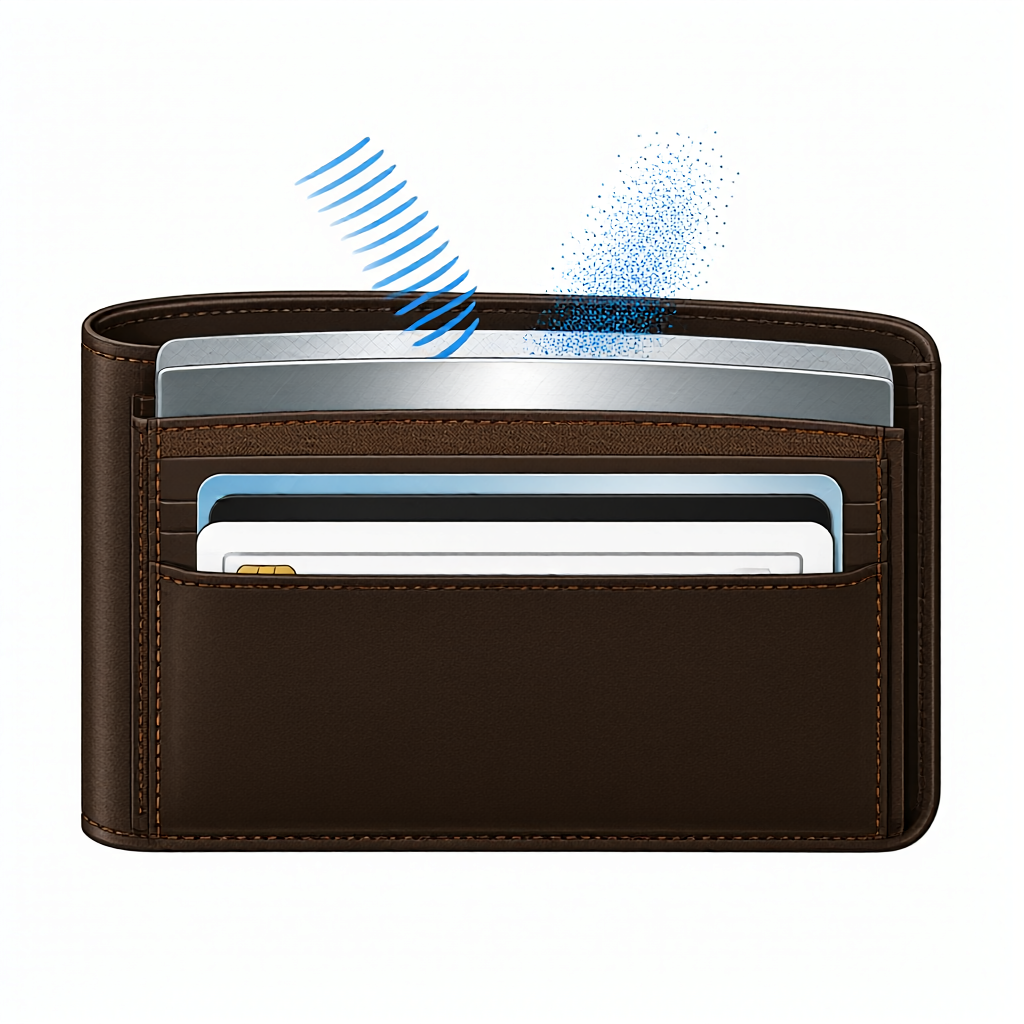
RFID-blocking travel wallets protect cardholder data using either passive metallic mesh laminates or conductive thread weaving integrated into the liner. When a wallet contains this shielding layer, it creates a Faraday cage effect that absorbs or reflects radio-frequency signals in the 13.56 MHz range used by contactless payment cards and e-passports. The barrier prevents unauthorized scanners from reading card information at close range without the cardholder initiating a transaction.
Buyers should verify that the blocking material covers every zone where cards may rest—not just a strip across one slot—and check whether the supplier provides independent test reports from recognized laboratories. Materials used for RFID lining must also meet REACH and RoHS restrictions for restricted substances, which is especially relevant for products sold into European Union markets or American retail channels requiring compliance documentation. More detail on the testing and specification considerations for RFID wallets is available in our RFID-blocking wallet sourcing guide.
What Material Options Are Used?
The two dominant material categories in travel wallet sourcing are genuine leather and synthetic alternatives, each carrying different margin structures and brand positioning implications.
Genuine Leather
Genuine leather—typically cowhide, buffalo, or top-grain variants—offers natural durability, a recognizable texture profile, and higher perceived value at retail. Buyers sourcing genuine leather wallets should clarify the exact grade with the manufacturer, because terms like “genuine leather” can span bonded, split, or full-grain tiers with wide variance in cost and longevity. Full-grain leather carries a price premium but develops patina over time; split or bonded leathers are functional at lower price points and are common in mid-tier promotional runs.
Leather finish type matters as much as grade. Aniline dyes produce a soft, breathable surface but require protective treatment for water resistance. Pigmented or corrected-grain finishes add consistency and scuff tolerance, which is important for products expected to endure repeated transit handling.
Synthetic / PU Leather
Polyurethane leather delivers uniform color, tighter batch-to-batch consistency, and lower unit cost than genuine hides. It is widely used in high-volume corporate gifting programs and fast-moving EDC accessory lines where visual coherence across thousands of units takes priority over natural material variation. Modern PU constructions have improved significantly, with multi-layer laminates offering abrasion resistance and moisture performance that approach genuine leather for light-use scenarios.
When comparing material options, buyers should weigh retail positioning, minimum order quantity thresholds, colorway count per SKU, and post-production finish requirements against gross margin targets. The trade-off between material authenticity and cost predictability determines which category aligns with a given brand strategy. Additional context on material selection across minimalist wallet categories can support broader sourcing decisions—see our EDC wallets manufacturing guide and our men’s minimalist wallets materials overview.
What Design Features Define a Travel Wallet?
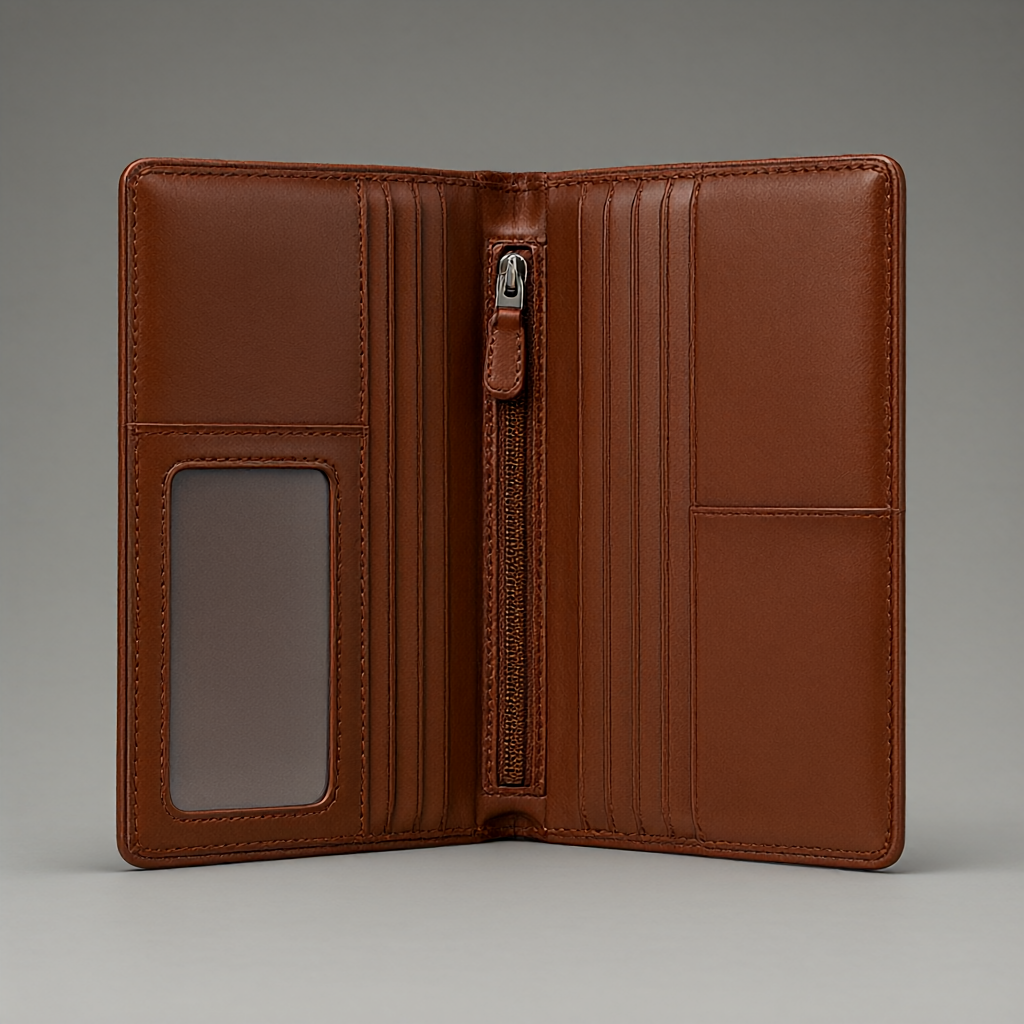
Several construction patterns recur across commercially viable travel wallets. Understanding these patterns helps buyers specify the right configuration before placing a development order.
Slim profile — Most travel wallets measure between 120 mm and 155 mm in height when closed, with thickness ranging from 15 mm to 30 mm depending on card capacity. The form factor prioritizes pocket fit over expansion capacity, making them suitable for front-pocket carry and luggage organizer inserts. Slim configurations also reduce material usage and simplify packaging dimensions for FBA-ready shipments.
Document organization — Interior layouts typically include a passport-size sleeve rated for standard ICAO-compliant passports (approximately 125 mm × 88 mm), a boarding-pass slip pocket, multiple card slots arranged along the sides, and an optional central cash compartment. Layout efficiency depends on slot spacing and pocket depth tolerances; poorly dimensioned sleeves cause passports to slide out during movement or fail to seat fully in jacket pockets.
Closure systems — Drawstring closures remain popular because they provide one-handed operation and prevent accidental opening during transit. Magnetic snaps offer faster access but may fail in environments with strong electromagnetic interference near security readers. Zippered main compartments are increasingly adopted when buyers require sealed storage for loose cash or valuables. Closure choice affects hardware sourcing—buyers should confirm string braid composition, magnet type, and zipper track quality during sample evaluation.
Integrated organizational accessories — Some manufacturers combine the wallet format with modular components such as money clips, coin pouches, or key holders. These hybrid configurations expand retail SKUs but introduce additional tooling requirements and assembly complexity. A streamlined passport folio wallet tends to perform best as a dedicated travel piece, while a combined organizer variant suits buyers targeting utility-oriented travelers.
What Travel-Specific Functions Matter Most?
Functionality distinguishes a true travel organizer from an adapted bifold with a document sleeve appended. Key functions buyers should validate include:
- Passport retention — The sleeve must hold passports securely without excessive friction that risks damaging document corners. Elasticized openings or reinforced edge stitching extend service life.
- Boarding-pass accessibility — A separate, slimmer slip pocket positioned near the closure allows quick retrieval without unfolding the entire wallet during airport checks.
- Zippered internal compartments — Separate secured zones for cash and valuables reduce mixing risk and comply with expectations in higher-tier amenity assortments.
- Luggage tag integration — Some designs incorporate a detachable fabric loop or printed panel for attaching destination information, useful for hotel amenity and corporate gift programs.
These details shape retail perception and return rates. A buyer evaluating wholesale sourcing should review the full layout diagram during the sampling phase, not rely solely on photographs provided in marketing catalogs. If you are exploring broader wallet formats alongside travel-specific models, resources on minimalist wallet sizing and function and card holder configurations can help calibrate your assortment plan.
What Are the Key Specifications for Sourcing?
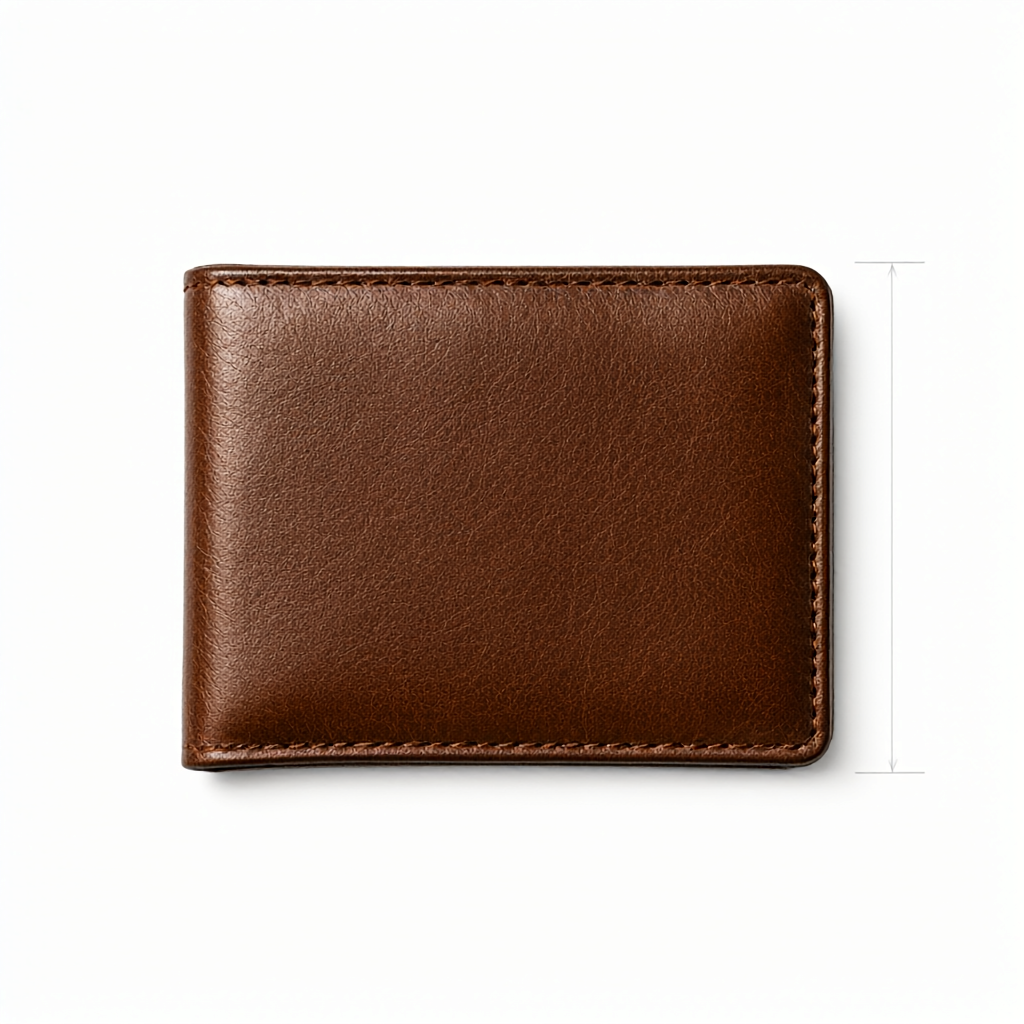
B2B buyers typically negotiate specifications around materials, dimensions, and production parameters before moving to prototyping. Representative industry ranges are outlined below.
| Specification | Typical Range |
|---|---|
| Product height | 120–155 mm |
| Closed width | 90–115 mm |
| Thickness | 15–30 mm |
| Card slot capacity | 4–12 slots |
| Passport sleeve compatibility | ICAO standard (125 × 88 mm) |
| RFID shield frequency range | 13.56 MHz (contactless payment / e-passport band) |
| Leather type | Full-grain, top-grain, split, or PU |
| Closure types | Drawstring, magnetic snap, zippered, combination |
| Packaging | Polybag, retail window box, or custom branded carton |
| MOQ baseline | 300–500 pcs per SKU/colorway |
| Sample lead time | 5–10 working days |
| Bulk production lead time | 15–30 working days after art approval |
Actual figures vary according to material selection, hardware complexity, printing method, and order volume. A simple PU drawstring model with laser-engraved branding will reach completion faster than a full-grain leather version requiring hand-stitched edges, multiple print registrations, and custom retail packaging.
What Standards and Certifications Apply?
Multiple regulatory and quality frameworks influence leather travel wallet sourcing, depending on the destination market and end use.
Material Compliance
Products entering the EU must satisfy REACH restrictions on restricted substances in leather treatments and metal components. US-bound goods should avoid phthalate-heavy synthetic linings and ensure adhesive residues comply with applicable consumer-product guidelines. Third-party testing through accredited laboratories—such as SGS or equivalent—provides documented proof for customs clearance and marketplace listing compliance.
Quality Management Systems
Manufacturers operating under ISO 9001 certification follow structured processes for incoming inspection, in-process QC, and outgoing verification. While the standard does not certify individual products, it signals organized documentation, traceability, and continuous improvement practices that reduce lot-to-lot variability—a critical factor for buyers placing repeat orders across quarters. Additional guidance on wallet manufacturing for B2B buyers explains how quality systems translate into fewer defects and smoother replenishment cycles.
Social Compliance
Buyers sourcing from Southeast Asian or Latin American manufacturing bases often require BSCI or similar social-audit results to satisfy retail-chain or brand-supplier policies. Audits cover labor standards, working hours, health and safety conditions, and anti-discrimination practices. Confirm audit currency—most purchasers accept results no older than two years.
ASTM Testing References
Where material performance claims are evaluated objectively, standardized tests referenced by organizations such as ASTM International provide measurable criteria for tensile strength, abrasion resistance, and colorfastness. Buyers should request lab reports matching relevant test methods when evaluating supplier claims about leather durability or stitching longevity.
What Should B2B Buyers Consider When Sourcing?
Procurement success depends on evaluating several decision factors before approving samples.
Material origin and traceability — Request the tannery name and country of origin for leather substrates. Known sources reduce supply-chain risk and simplify sustainability reporting if your brand requires it.
Hardware spec verification — String diameter, magnet gauss rating, zipper coil material, and snap corrosion rating all affect long-term performance. Ask suppliers to provide hardware datasheets rather than accepting verbal assurances.
Artwork and branding method — Laser engraving produces permanent, premium-quality marks on leather and metals. UV printing offers full-color graphics suitable for complex designs on flat surfaces. Embossing adds tactile depth at low incremental cost. Matching the branding method to material type prevents adhesion failure and ensures legibility after repeated handling.
Packaging and labeling requirements — Private-label buyers often need barcodes, country-of-origin stamps, and care-label text compliant with destination-market regulations. Confirm that the manufacturer can apply these during packing without extending lead times disproportionately.
Lead-time realism — Expect longer timelines during peak sourcing seasons (typically Q2–Q3 for holiday and spring-summer assortments). Place development orders early and lock production schedules with written commitments.
Post-sale defect thresholds — Establish acceptable defect rates in the purchase agreement and agree on rework or credit procedures. Clear terms prevent disputes after bulk delivery.
How Does a Professional Manufacturer Approach Quality and Lead Times?
The leather travel wallet category requires attention to dimensional accuracy, material consistency, and reliable fulfillment—areas where experienced contract manufacturers differentiate themselves. As a practical example, here is how a specialist EDC manufacturer approaches these priorities.
TOP EDC Wallet operates from a 50,000 sq ft facility with 13+ years of export experience serving brands across North America, Europe, Australia, and Southeast Asia. Their production workflow integrates CNC machining for metal hardware components, in-house laser engraving and UV printing for branding, and dedicated leather finishing steps including edge painting, dye application, and protective coating. Products are manufactured to ISO 9001 quality-management standards and undergo BSCI audit compliance, with REACH/RoHS alignment verified through SGS testing on material lots.
Customization scope spans logo placement, interior slot configuration, closure style, color matching, and retail packaging design—including FBA-labeled shipping cartons for Amazon sellers. Low minimum order quantities starts at 300 pcs per SKU allow emerging brands and promotional buyers to test new travel-wallet styles without committing to large inventory runs. Sample turnaround typically occurs within seven working days, giving buyers functional prototypes before scaling to bulk production.
Professional sourcing also involves clear communication about artwork files, material swatches, and compliance documentation before sampling begins. Well-prepared briefs reduce revision cycles and keep development on schedule.
Leather Travel Wallet For B2B Buyers: What Should You Know First?
A leather travel wallet is a compact, document-integrated carry accessory — typically combining a passport sleeve, card slots, and secured cash storage — engineered for frequent travelers and sourced in bulk by B2B buyers through OEM or private-label manufacturing. Professional buyers evaluate these products against material-grade specifications, RFID shielding performance at 13.56 MHz, ICAO-compliant passport dimensions, closure reliability under repeated transit stress, and supplier compliance with REACH, RoHS, ISO 9001, and BSCI standards. This guide covers the technical and procurement factors that determine whether a leather travel wallet meets wholesale-quality expectations.
Manufacturing Considerations for B2B Buyers: MOQ, Customization & Certification Details
How Order Volume Shapes Unit Economics?
Minimum order quantity thresholds directly influence per-unit cost in leather travel wallet production. Suppliers typically tier pricing across three bands: low-volume runs at 100–300 pieces justify higher setup amortization across fewer units; mid-volume runs between 500–2,000 pieces unlock meaningful material-cost reductions; and high-volume runs exceeding 5,000 pieces often trigger raw-hide purchasing leverage and dedicated production-line scheduling. Buyers should model landed cost including freight, duties, and packaging against projected retail velocity before committing to a quantity bracket.
Customization Dimensions That Affect Lead Time
Every customization variable — leather grade selection, hardware type, branding method, interior layout configuration, and packaging format — adds compounding steps to the production pipeline. Laser engraving on full-grain leather requires individual pass registration per unit; UV printing on PU leather involves plate or file setup but enables full-color graphic runs; embossing demands custom die tooling with a one-time $150–$400 investment. Buyers should batch unique customization requests rather than mixing them across SKUs to minimize changeover delays and maintain consistent defect rates.
Certification Requirements by Destination Market
| Target Market | Required Compliance | Typical Test Focus |
|---|---|---|
| European Union | REACH, RoHS | Heavy metals, azo dyes, phthalates in leather treatments and metal hardware |
| United States | FTC labeling, CPSIA-aligned adhesives | Country-of-origin stamps, fiber-content claims, restricted substance screening |
| Global retail chains | BSCI audit | Labor practices, working hours, health and safety documentation |
| Quality-focused brands | ISO 9001 facility certification | Incoming material inspection SOPs, in-process QC checkpoints, outgoing verification logs |
Buyers should request current audit certificates rather than relying on supplier self-declarations. Certificate issue dates older than 24 months are generally rejected by major retail platforms and corporate procurement teams. For detailed guidance on how quality management systems affect defect rates and replenishment consistency, see our EDC wallets manufacturing guide for B2B buyers.
What Can Buyers Expect from a Professional OEM/ODM Partner?
A qualified OEM or ODM manufacturer differentiates itself through four operational pillars: documented specification adherence, transparent communication during development, consistent sample-to-production parity, and responsive post-delivery support. When evaluating potential partners, buyers should assess the following capabilities.
Specification Translation Accuracy
An experienced manufacturer converts buyer requirements into internally readable work orders with measurable tolerances — not generic descriptions. A specification sheet for a leather travel wallet should include exact leather thickness in millimeters, GSM weight for lining materials, stitch count per inch, magnet gauss rating, zipper coil diameter, and colorway references using standardized systems such as Pantone or RAL. Requests for spec sheets during the sampling phase reveal whether a supplier treats engineering documentation as integral to production or as an afterthought.
Sample-to-Production Parity
Sample approval does not guarantee bulk-order equivalence unless the manufacturer controls its own material sourcing and finishing processes. Vertically integrated facilities — those operating in-house CNC machining, laser engraving, and surface-finishing lines — reduce the risk of supplier-layer variance because the same equipment and operators produce both samples and bulk runs. Buyers should ask whether prototype samples are hand-finished by skilled technicians while bulk production uses automated jigs and fixtures, as this discrepancy is a common source of post-order complaints.
Development Timeline Realism
Professional manufacturers publish realistic timeline estimates based on historical throughput data rather than best-case projections. A typical OEM development cycle for a leather travel wallet spans five stages: requirement clarification (1–2 days), material sourcing and incoming inspection (2–3 days), sample fabrication (5–7 days), revision rounds if requested (3–5 days per round), and bulk production scheduling (15–30 days depending on order volume). Buyers who receive timeline promises shorter than this baseline without written justification should treat those commitments as optimistic rather than binding.
Post-Delivery Support Structure
Reliable aftermarket support includes replacement-part fulfillment for defective hardware, color-matching for reorder consistency, and documentation retention for regulatory audits. Buyers should confirm that the manufacturer retains archived work orders, material lot numbers, and test reports for a minimum of two production cycles, since repeat orders frequently require matching existing inventory or replacing damaged goods from prior shipments.
How We Approach Quality and Lead Times as a Manufacturer?
Here is how the industry works and here is how we meet these standards. TOP EDC Wallet operates from a 50,000 sq ft facility with 13+ years of export experience, serving EDC brand owners, Amazon FBA sellers, and promotional-product distributors across North America, Europe, Australia, and Southeast Asia. Our production workflow integrates in-house CNC machining for metal hardware components, laser engraving and UV printing for branding, and aluminum anodizing and leather surface finishing — all under one roof — which means sample and bulk units are produced on identical equipment with consistent tolerances.
We hold ISO 9001 certification since 2014 and operate under a BSCI-audited facility, providing documented proof of organized quality-management processes and social-compliance practices. Our MOQ starts at 300 pcs per SKU for full OEM customization (100 pcs trial order available for stock finishes) per SKU and colorway, enabling emerging brands and Amazon sellers to validate market demand without overcommitting capital. Sample lead time averages seven working days, and bulk production typically ships within 15 to 30 working days after artwork approval, depending on material complexity and order volume. With a monthly production capacity of 500,000 units and active export to 30+ countries, we support both rapid prototyping and sustained replenishment cycles for global buyers. Get a Free Quote
Continue: How Does a Professional Manufacturer Approach Quality and Lead Times?
…ng for branding. Their quality system is anchored in ISO 9001 certification (in place since 2014), with incoming material inspection against AQL benchmarks, inline dimensional checks at every stitching or assembly station, and final shipment audits before packing. The facility produces over 500,000 units monthly across its leather and EDC accessory lines, enabling flexible batch sizing—from prototype runs of 300 pieces up to full-container replenishment orders.
For sourcing travel wallets at scale, this translates into three practical advantages: consistent color and grain matching across reorders, reliable adherence to ICAO passport sleeve dimensions, and documented REACH/RoHS compliance for EU market entry or FTC-aligned labeling for US retail channels. A leading amenity supplier recently placed a 25,000-unit reorder of PU leather travel wallets with integrated RFID liners and custom logo embossing; the manufacturer delivered samples in 7 days, completed bulk production in 22 working days, and shipped FBA-labeled cartons directly to a West Coast fulfillment center—demonstrating the lead-time predictability buyers should expect from an established contract partner.
Industry Case Study: Premium Airline Amenity Reorder
In 2024, a European airline amenity supplier (confidential client) commissioned a second-batch order of 50,000 minimalist leather travel wallets after a successful first run of 12,000 units the prior year. The specification called for top-grain cowhide, magnetic snap closure, a dedicated passport sleeve rated for ICAO-standard documents, and RFID-blocking inserts tested to ANSI/CTA-2045 guidelines for passive shielding effectiveness. The manufacturer produced pre-production samples within 7 calendar days, secured written approval on grain selection and magnet gauss rating, then completed the full order in 28 working days—with an in-process QC pass yield of 98.2% and zero critical defects reported on arrival. This project highlights how experienced manufacturers balance aesthetic specificity (leather tone consistency, stitch color matching) with functional requirements (closure strength, RFID coverage area) without extending timelines beyond committed windows.
Technical Specifications You Should Require From Suppliers
When issuing an RFQ for leather travel wallets, specify measurable tolerances rather than qualitative descriptors. Buyers who request the following technical parameters during sampling typically experience fewer post-production disputes:
| Parameter | Acceptable Tolerance / Requirement |
|---|---|
| Passport sleeve internal dimension | 130 mm × 92 mm ± 2 mm |
| RFID blocking attenuation | ≥ 25 dB at 13.56 MHz (per ISO/IEC 14443 testing protocol) |
| Leather pull-test strength | ≥ 12 N/mm² tear resistance |
| Stitch density | 8–10 stitches per inch minimum |
| Magnet holding force | ≥ 800 g pull force per snap |
| Adhesive VOC content | Compliant with California Proposition 65 limits |
| Colorfastness to rubbing | Grade 4 or higher (ASTM D737) |
| Zipper cycle durability | 3,000 open/close cycles without jamming (ASTM D2061) |
| Packaging drop-test survival | 4-face drop from 76 cm without interior damage |
Requiring these figures upfront separates prepared suppliers from those relying on generic templates. It also establishes objective acceptance criteria for your own QA team when evaluating incoming shipments.
RFQ Evaluation Checklist Template (Weighted Scoring)
Use the following weighted matrix to compare multiple manufacturing candidates side by side. Assign each criterion a score of 1–5 based on your RFQ responses and sample audit, then multiply by the weight to produce a composite ranking.
| Criterion | Weight | Score (1–5) | Weighted Total |
|---|---|---|---|
| Leather grade clarity and traceability (tannery name, country of origin) | 20% | ||
| RFID test report from accredited third-party lab (SGS / Intertek / TÜV) | 20% | ||
| MOQ flexibility and willingness to accommodate low-volume试产 | 15% | ||
| Compliance documentation completeness (REACH, RoHS, BSCI if applicable) | 15% | ||
| Sample lead time (days from art approval to delivery) | 10% | ||
| Bulk production lead time and on-time delivery track record | 10% | ||
| Unit pricing transparency (no hidden setup charges) | 5% | ||
| Communication responsiveness and English proficiency | 5% |
A vendor scoring above 4.0 on this matrix generally meets the threshold for serious consideration. Any single criterion below 2—particularly RFID lab reports or compliance documentation—should trigger further due diligence before committing to a purchase order.
True Cost Comparison: Genuine Leather vs PU Per 1,000 Units
Material choice directly impacts landed cost and long-term margin. The table below reflects typical 2024–2025 B2B pricing for a standard 125 mm × 90 mm drawstring travel wallet with RFID insert and basic laser engraving:
| Cost Component | Full-Grain Leather | Top-Grain Leather | Split / Bonded Leather | PU Leather |
|---|---|---|---|---|
| Raw material (per unit) | $4.80 – $6.50 | $3.20 – $4.60 | $1.40 – $2.20 | $0.90 – $1.50 |
| Cutting & assembly labor | $1.20 – $1.80 | $1.10 – $1.60 | $0.90 – $1.30 | $0.80 – $1.10 |
| RFID liner & hardware | $0.60 – $0.90 | $0.60 – $0.90 | $0.60 – $0.90 | $0.50 – $0.80 |
| Laser engraving (per unit) | $0.35 – $0.55 | $0.30 – $0.50 | $0.25 – $0.45 | $0.25 – $0.40 |
| Packaging (polybag + header card) | $0.40 – $0.60 | $0.40 – $0.60 | $0.35 – $0.55 | $0.30 – $0.50 |
| Estimated unit cost | $7.35 – $10.35 | $5.60 – $8.20 | $3.50 – $5.40 | $2.75 – $4.30 |
| Retail price point (est.) | $35 – $55 | $25 – $40 | $15 – $25 | $12 – $22 |
| Gross margin % (midpoint) | ~65% | ~68% | ~62% | ~60% |
| Projected gross profit (1,000 units) | $6,350 – $8,850 | $4,600 – $6,200 | $2,500 – $3,700 | $1,750 – $2,800 |
Key takeaways: full-grain leather commands the highest absolute profit per unit but carries greater material variability risk and longer lead times; PU leather offers the fastest path to volume and the tightest color consistency, making it ideal for branded promotional programs where uniformity matters more than luxury positioning. At the 1,000-unit mark, the cost gap between PU and split leather is marginal (~$0.50–$1.00/unit), so the decision often hinges on brand perception rather than pure margin math.
What Certifications and Standards Apply to These Products?
Beyond the baseline REACH/RoHS and ISO 9001 frameworks discussed earlier, several additional standards commonly influence procurement decisions for leather travel wallets:
ICAO Doc 9303 — Defines the standardized dimensions and security features of machine-readable travel documents (passports). Any passport sleeve claiming compatibility should accommodate these physical specs without binding or excessive friction.
ANSI/CTA-2045 — Specifies performance requirements for RFID protection materials used in consumer products. Buyers should request test reports that reference this standard (or equivalent ISO/IEC 14443 Type A/B protocols) when validating RFID-blocking claims. Products lacking published attenuation data may not deliver the advertised protection level.
ASTM D737 / D4157 — Covers colorfastness to rubbing and light exposure for leather-treated surfaces. These tests confirm that dyes and pigments will not bleed onto clothing or other contents during normal use—a key quality signal for premium-positioned SKUs.
Proposition 65 (California) — Requires warning labels on products containing certain chemical thresholds. Suppliers should declare whether any adhesive, finishing agent, or lining material triggers Prop 65 listing, and negotiate label placement responsibility accordingly.
More detail on how certifications factor into the broader sourcing process can be found in our RFID-blocking wallet sourcing guide and our EDC wallet manufacturing overview for B2B buyers.
Meet the Manufacturer Behind These Standards
TOP EDC Wallet brings 13+ years of export-focused production to the leather travel wallet category, serving 200+ brands across North America, Europe, Australia, and Southeast Asia. Founded in 2014 and operating from a 50,000 sq ft facility, the company specializes in OEM and ODM contracts for minimalist wallets, carbon fiber card holders, titanium money clips, and RFID-blocking pocket gear.
Their workflow aligns directly with the sourcing standards outlined above: in-house CNC machining for metal components, precision laser engraving and UV printing for branding, controlled-anodizing and surface-finishing lines for consistent color output, and a dedicated QC team auditing against AQL 0.65 for critical defects. Orders starts at 300 pcs per SKU per SKU, with sample turnaround in 7 days and bulk production completing within 15–30 working days depending on complexity. All materials are SGS-tested and manufactured under ISO 9001 and BSCI-audited conditions, with REACH and RoHS compliance documented for EU and US market entries.
As a manufacturer, our approach to leather travel wallets starts with the buyer’s end position—whether that’s premium retail, airline amenity assortments, or corporate gift programs—and works backward through material grade, closure mechanism, RFID specification, and packaging format to arrive at a configuration that balances perceived value with realistic unit economics. We handle everything from initial concept sketches and 3D renderings through sample approval, bulk production, and direct FBA or drop-ship fulfillment. Get a Free Quote to discuss your specification, volume targets, and timeline.
Leather Travel Wallet For B2B Buyers: Where Can You Verify the Data and Sources?
- ASTM International — www.astm.org
- RFID-blocking wallet sourcing guide — topedcwallet.com
- EDC wallets manufacturing guide — topedcwallet.com
- men’s minimalist wallets materials overview — topedcwallet.com
- minimalist wallet sizing and function — topedcwallet.com
- card holder configurations — topedcwallet.com
- Get a Free Quote → — topedcwallet.com
From article to product
Turning this into a product?
Most of what is written here is the difference between a sample that works and one that does not. We can build either — the useful one costs the same.
Keep reading
More on buying guides
wallet with trigger
How Does a Trigger Wallet Work? What Is the Pop-Up Mechanism? The core of…
Readbest bifold wallet for women
What Is a Bifold Wallet? The term “bifold” refers to the fold: the wallet…
ReadMen’s trifold wallets with zipper compartments vs. bifold
At a Glance The three dominant men’s wallet formats differ in panel count, depth,…
Read
About the author
TOPWALLET Editorial Team
TOPWALLET's editorial and engineering desk writes from bench testing at the Shenzhen (Longgang) facility: pull-force and cycle testing, 13.56 MHz shielding measurements, finish trials and factory audits, rather than supplier spec sheets. Every specification in these guides is one we write on a purchase order.
Written on the floor
This article was written by our production and QC team — the people who spec tolerances, run the finishing line and inspect every batch. Where it states a capacity, a pull force or a lead time, it comes from a measurement we made, not a supplier’s catalogue. If a number here disagrees with what your own supplier told you, tell us; several of these articles started as a correction from a buyer.
See how the factory works · Inspection process · Sourcing FAQ
Turning this into a product?
Most of what is written here is the difference between a sample that works and one that does not. We can build either — the useful one costs the same.